
Titanium Coil vs. Titanium Sheet vs. Titanium Plate: A Buyer's Comparison for Energy Projects
Titanium Coil vs. Titanium Sheet vs. Titanium Plate: A Buyer's Comparison for Energy Projects
Choosing between titanium coil, titanium sheet and titanium plate is not a grade decision and not a price-per-kilogram decision. In green energy projects it is a fabrication decision: the form you buy determines how the part is nested, formed, welded and inspected — and how much of the material ends up as offcut.
Decision rule, stated first: specify titanium coil or strip when the component runs on a continuous forming line and thickness consistency matters more than flat cut length; specify titanium sheet when the component is a discrete flat blank between roughly 0.4 mm and 3.0 mm thick; specify titanium plate when the section is 4.0 mm or thicker and carries pressure, structural or welding duty. All three are flat-rolled titanium and can be specified from the same grade family, which is precisely why the wrong choice is easy to make and expensive to correct.
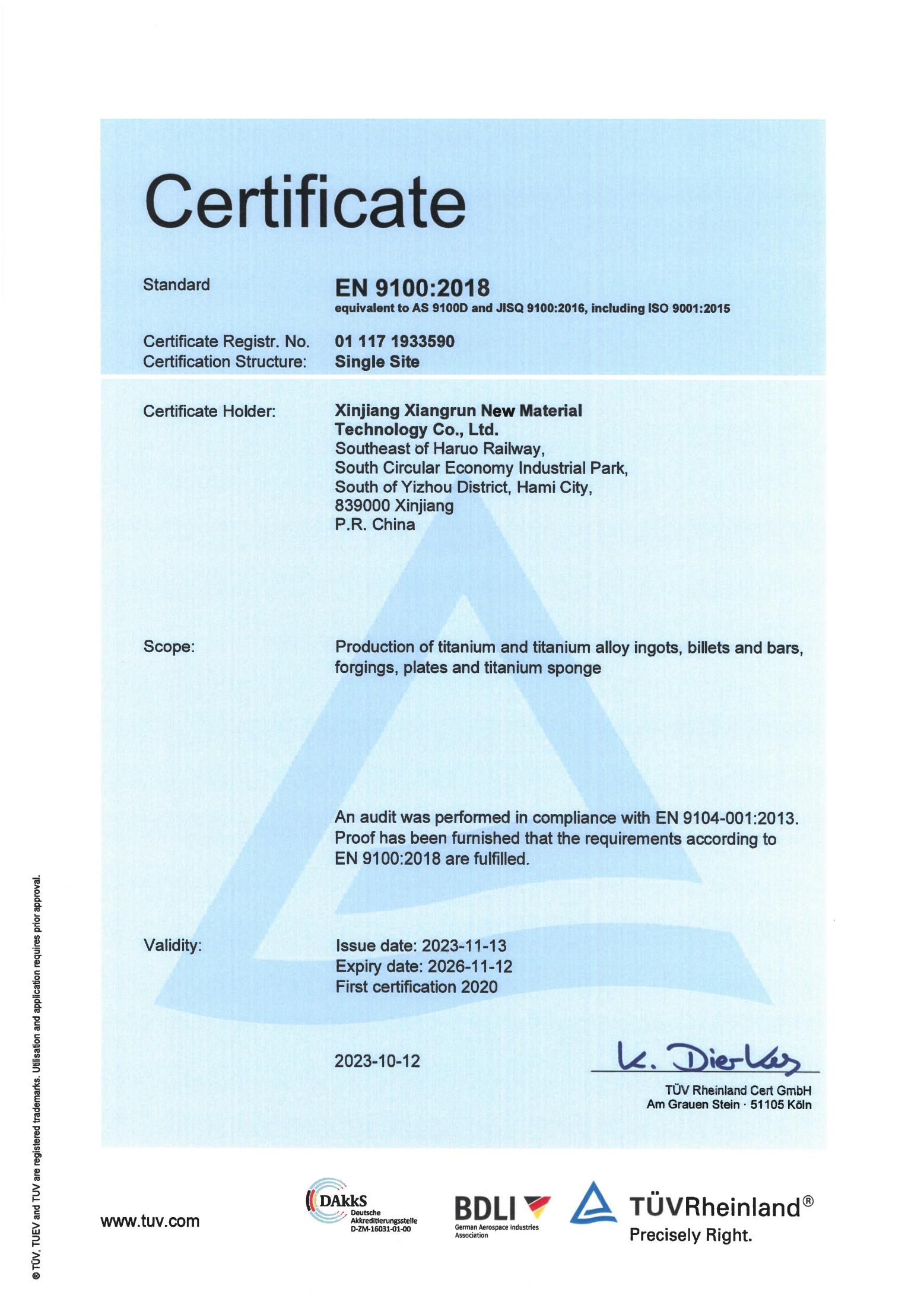
EN 9100:2018 approval (certificate 01 117 1933590, TUV) covering production of titanium and titanium alloy ingots, billets and bars, forgings, plates and titanium sponge — one of the certificate records used as a quality baseline in this comparison.
Why the Coil-Sheet-Plate Decision Is Really an Execution Decision
Energy projects specify titanium for corrosion resistance, conductivity and strength-to-weight ratio. What they actually purchase is a shape. A plate heat exchanger plate, an electrolyser bipolar plate and a pressure vessel shell can share the same commercially pure Grade 2 chemistry while requiring completely different mill forms.
A form mismatch shows up in four places:
- Forming yield. Continuous feed from a coil suits progressive stamping, slitting and roll forming; flat sheet suits discrete blanking and pressing. Choosing the wrong one adds handling steps and offcut.
- Thickness consistency. Cold rolled material passes through an additional reduction and finishing sequence, which is why strip is normally chosen where forming tools are sensitive to gauge variation. Hot rolled product is supplied in heavier sections and is typically pickled or otherwise conditioned before forming.
- Weld count and joint preparation. Plate is welded into shells, headers and tube sheets; sheet and strip are formed and then joined by different routes. Fewer, simpler joints reduce inspection load.
- Testing and release. Pre-shipment test, third-party inspection and TPI scope are usually set per form and per thickness band rather than per grade.
None of these are marketing points. They are the reason two quotations at the same price per kilogram can produce different total project costs.
Industry Background: Where Titanium Flat Products Are Moving
Titanium is a concentrated market, and its supply base has shifted decisively toward China. The global titanium market was valued at approximately USD 25.22 billion in 2024 in one industry analysis, although published estimates diverge sharply: metal-focused research such as Grand View Research places the metal-only figure closer to USD 2.44 billion depending on whether titanium dioxide and mineral commodities are included in scope. Buyers should treat any single market-size figure as scope-dependent, not as a fixed reference.
The supply side is less ambiguous. China's titanium sponge production capacity reached approximately 320,000 tons per year by 2024, accounting for about 67% of global production (The Oregon Group / Stanford Report). China exported USD 1.07 billion of titanium products in 2024, with the United States and South Korea among the major destinations (OEC). For an energy project buyer, that means the realistic shortlist for coil, sheet and plate is largely a China-facing sourcing exercise, which raises the relative weight of certification, traceability and forming support against headline price.
Two material facts frame the comparison. First, ASTM B265 is the primary international standard for annealed titanium and titanium alloy strip, sheet and plate, covering chemical and mechanical requirements for more than 32 grades — one standard, three product forms. Second, Grade 2 remains the established workhorse commercially pure grade for corrosive industrial duty and is frequently specified in desalination and chemical processing, the two application families that sit closest to green energy balance-of-plant equipment.
The Three Product Forms, Defined by Mill Data
Xiangrun (Xi'an) Titanium Materials Technology Co., Ltd., which trades under the brand Xrun, is a titanium mill products manufacturer founded in 2016 that produces titanium coil, strip, sheet, plate, bar, rod, wire and pipe for the EU, USA and India markets. Its published product data makes the coil-sheet-plate boundary unusually clear.
Titanium coil and strip
Coil is supplied through two routes. Cold rolled titanium coil/strip is produced in Grades Gr.1, Gr.2, Gr.3, Gr.4, Gr.12 and Gr.23, at 0.1-3.0 mm thickness and 450-1530 mm width, to ASTM/ASME. Hot rolled titanium coil covers the same grade set at 2.5-12.0 mm thickness and 900-2000 mm width, also to ASTM/ASME, and is aimed at chemical processing, industrial, aerospace and ship applications.
The cold rolled route maps most directly onto energy components: Xrun lists plate heat exchanger plates, anode plates, bipolar plates and batteries among its application areas, alongside electronic products, eyeglass frames and household products. The company also lists "slit to strip or plate up to the request" as a customization capability, which means coil can be delivered already converted to the width the forming line requires.
Titanium sheet
Titanium sheet occupies 0.4-3.0 mm thickness and 900-1530 mm width, with lengths under 6,500 mm, in a broader grade set of Gr.1, Gr.2, Gr.3, Gr.4, Gr.6, Gr.7, Gr.12 and Gr.5. Xrun references ASTM, ASME, AMS, MIL, DMS, TA, AWS and JIS standards for sheet, and lists the same application family as cold rolled strip: plate heat exchanger plates, anode plates, bipolar plates, batteries, electronic products and household products.
The practical difference between sheet and cold rolled strip is not metallurgy, it is logistics. Sheet arrives as flat cut lengths that go straight to a shear, laser or press; strip arrives as a coil that requires decoiling and feeding equipment.
Titanium plate
Plate starts where sheet stops. Xrun's titanium plate range is 4.0-70 mm thick and 1,000-2,250 mm wide, in lengths under 6,500 mm, with the wider grade set of Gr.1, Gr.2, Gr.3, Gr.4, Gr.6, Gr.7, Gr.12 and Gr.5. It is rolled on a plate line designed for thin and medium-thick titanium and titanium alloy plate, and referenced to ASTM, ASME, AMS, MIL, DMS, TA, AWS and JIS. The stated application industries are chemical processing and industrial, aerospace and ship — pressure and structural duty rather than precision forming.

An integrated titanium route matters at the comparison stage: coil, strip, sheet and plate can be quoted from one production base rather than assembled from separate conversion suppliers.
Comparison Table: Titanium Coil vs. Titanium Sheet vs. Titanium Plate
| Decision factor | Titanium coil / strip | Titanium sheet | Titanium plate |
|---|---|---|---|
| Form as supplied | Coil, continuous; can be slit to strip or plate on request | Flat, cut to length | Flat, cut to length |
| Rolling routes available (Xrun) | Cold rolled and hot rolled | Sheet rolling route | Dedicated plate line |
| Thickness range (Xrun data) | Cold rolled 0.1-3.0 mm; hot rolled 2.5-12.0 mm | 0.4-3.0 mm | 4.0-70 mm |
| Width and length | Cold rolled 450-1530 mm wide; hot rolled 900-2000 mm wide; continuous length | 900-1530 mm wide; length under 6,500 mm | 1,000-2,250 mm wide; length under 6,500 mm |
| Grades listed by Xrun | Gr.1, Gr.2, Gr.3, Gr.4, Gr.12, Gr.23 | Gr.1, Gr.2, Gr.3, Gr.4, Gr.6, Gr.7, Gr.12, Gr.5 | Gr.1, Gr.2, Gr.3, Gr.4, Gr.6, Gr.7, Gr.12, Gr.5 |
| Standards referenced | ASTM / ASME | ASTM, ASME, AMS, MIL, DMS, TA, AWS, JIS | ASTM, ASME, AMS, MIL, DMS, TA, AWS, JIS |
| Thickness consistency | Cold rolled is the tighter of the two coil routes because of the cold reduction and finishing sequence; hot rolled is supplied in heavier bands and typically pickled before forming | Produced from flat-rolled stock to a consistent flat gauge | Mill plate sections; variation is managed by machining and weld preparation rather than forming |
| Surface condition | Cold rolled: smooth and forming-ready. Hot rolled: typically conditioned or pickled before further processing | Flat and clean, ready for pressing or blanking | Mill finish, normally machined, welded or rolled rather than formed |
| Typical downstream processing | Decoiling, slitting, roll forming, progressive stamping, continuous press lines | Shearing, laser or plasma cutting, blanking, pressing | Waterjet or plasma cutting, machining, rolling to shell, welding |
| Energy-sector fit (Xrun application data) | Plate heat exchanger plates, anode plates, bipolar plates, batteries; hot rolled also serves chemical processing, industrial, aerospace and ship | Plate heat exchanger plates, anode plates, bipolar plates, batteries, electronic products | Chemical processing and industrial, aerospace and ship; pressure and structural duty |
| Choose it when | The part is formed continuously and feed efficiency drives project cost | The part is a discrete flat component below 3 mm with mixed batch sizes | The section is 4 mm or heavier, or pressure retention, welding and structural integrity dominate |
The table is built only from published mill data and the standards already referenced above. Where two forms share a grade set, the deciding variables are thickness, feeding method and welding duty — not chemistry.
Step-by-Step: Moving from Evaluation to Execution
Evaluation-stage comparisons fail at execution when the buyer and the fabricator have not agreed on a forming route. The sequence below keeps a coil-sheet-plate decision defensible at both stages.
- Start from the fabrication route, not from the quotation. Ask the shop whether the part is fed continuously or cut as a blank. That single answer eliminates one or two of the three forms before price is discussed.
- Convert the drawing into three numbers. Final thickness, required width (including strip width after slitting), and maximum flat length. Test them against 0.1-3.0 mm for cold rolled coil/strip, 2.5-12.0 mm for hot rolled coil, 0.4-3.0 mm for sheet and 4.0-70 mm for plate.
- Apply the 3 mm / 4 mm boundary. Under 3.0 mm on a continuous line, coil is the natural form; under 3.0 mm as discrete blanks, sheet is; 4.0 mm and above, plate.
- Confirm the standard and the destination-market approvals. Specify the grade against ASTM B265 and check the certificates the end user's market expects, as set out in the compliance section below.
- Validate with a form-appropriate sample. A coil sample should be taken from the actual coil width so slitting and stamping behaviour can be assessed; a plate sample should come from the same thickness band as production. Third-party test or inspection can be added where the project requires it.
- Lock commercial and logistics terms before release. Xrun quotes an EXW lead time of 30-45 days, FOB or CIF delivery, MOQ based on the requirement, payment structures of LC, 50/50 or 60/40, and acceptance by pre-shipment test or TPI.
Mapping Each Form to Energy-Sector Use Cases
Plate heat exchangers for geothermal, CSP and district heating
Corrugated heat exchanger plates are pressed from thin flat-rolled titanium, which places them in the cold rolled coil/strip and sheet family — Xrun lists plate heat exchanger plates as an application area for both. A municipal heat exchanger manufacturer operating in the US, France and India has taken more than 300 tons of ASTM B265 Grade 1 titanium for heat exchange plates. Reported outcomes include continuous operation for more than 10 years without corrosion or leakage, heat exchange efficiency maintained at 95% or more of its initial value, and maintenance costs reduced by 30%. The same supplier data highlights Grade 1 formability for complex corrugated plates and resistance to seawater and chloride attack.
Form choice here is driven by press tooling. Where the press runs continuously from coil, strip is the natural input; where plates are produced in batches from flat blanks, sheet removes the need for decoiling equipment.
Green hydrogen: bipolar and anode plates in electrolyser stacks
Xrun's cold rolled coil/strip and sheet product data both list anode plates and bipolar plates among application areas, alongside batteries. These are thin, high-count, formed components — the profile that favours coil/strip at production scale and sheet for pilot lines and short runs.
Batteries and energy storage hardware
Battery applications appear in the same application list for cold rolled strip and sheet, where thin gauge and consistent thickness matter more than heavy-section mechanical properties.
Pressure vessels, headers and tube sheets
Where titanium is welded into pressure-retaining equipment, plate in the 4.0-70 mm range is the appropriate form. The PED certificate scope described below covers cold rolled sheets and hot rolled plates specifically, which is the approval set that pressure equipment projects typically ask for.
Offshore wind, marine energy and coastal cooling
Marine and offshore projects add a classification requirement on top of the material standard. Xrun holds DNV approval to DNV-CP-0346 (certificate AMMM000035A), covering wrought titanium and titanium alloys including plates, sheets, strips, forgings and billets for ships and naval vessels.
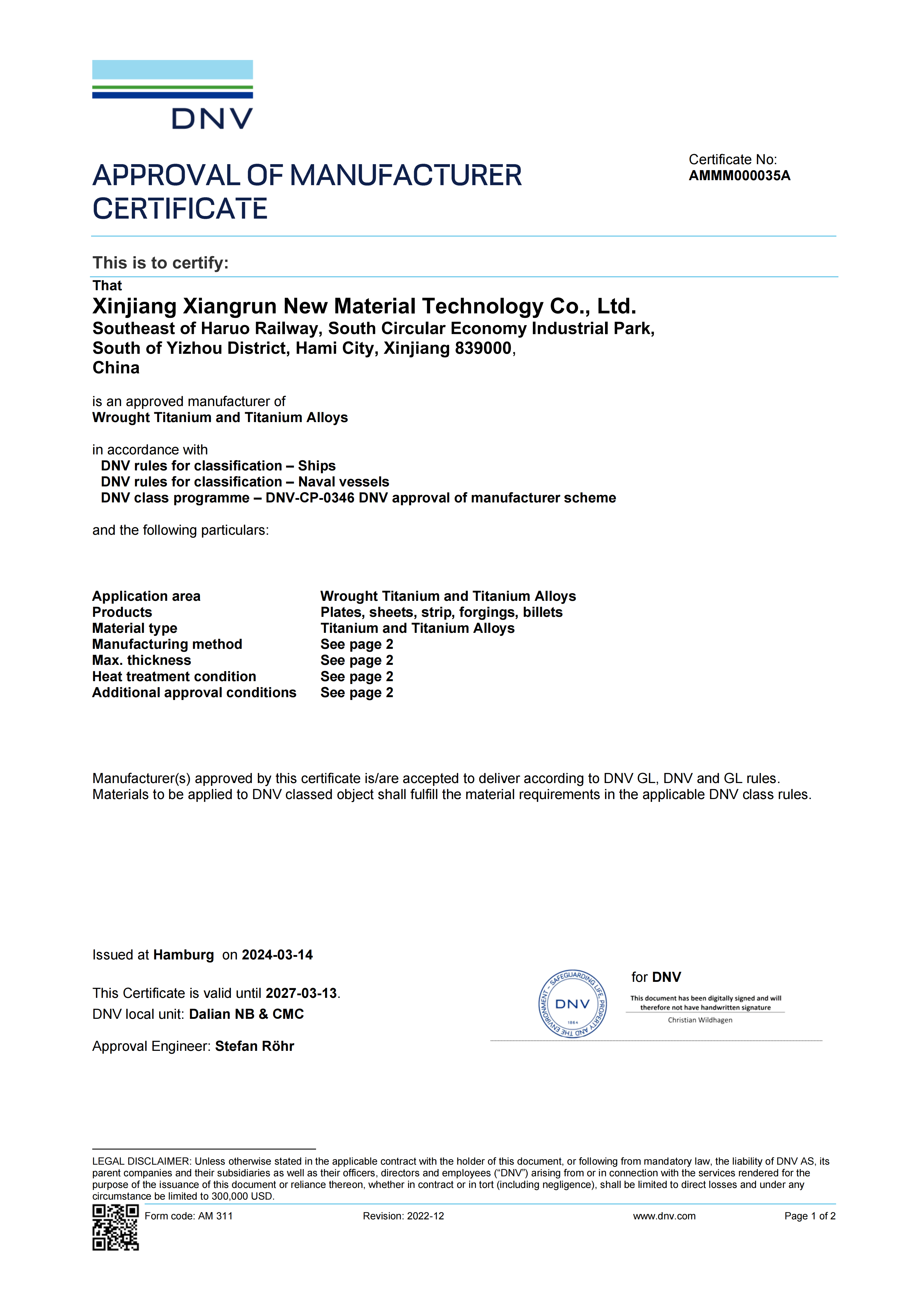
DNV approval to DNV-CP-0346 covers wrought titanium plates, sheets, strips, forgings and billets for ships and naval vessels — relevant when energy projects sit offshore.
Desalination and power plant cooling loops
Grade 2 commercially pure titanium is the established workhorse for corrosive industrial service and is frequently specified in desalination and chemical processing. In energy projects these loops usually require strip or sheet for plate-type exchangers and plate for larger vessel and header components.
Certification Baseline for EU, USA and India Projects
Buyers writing specifications for the EU, USA and Indian markets commonly treat ISO 9001:2015 as the entry-level quality management baseline and then add the approvals that match the equipment's end use. Because a baseline is only useful when it can be checked, the comparison below uses certificate records that are published and traceable rather than broad quality claims.
- EN 9100:2018 (TUV, certificate 01 117 1933590) — valid from 13 November 2023 to 12 November 2027, covering production of titanium and titanium alloy ingots, billets and bars, forgings, plates and titanium sponge, with EN 9104-001:2013 and EN 9100:2018 fulfilled.
- PED 2014/68/EU quality management system certificate (TUV, 01 202 CHN/Q-19 0607.01) — valid from 26 January 2024 to 8 December 2028, covering the manufacturing of titanium and titanium alloy cold rolled sheets and hot rolled plates, assessed as a quality management system according to EN 764-5, article 4.2. This is the approval most directly relevant to pressure equipment in energy projects.
- DNV approval to DNV-CP-0346 (certificate AMMM000035A) — valid from 14 March 2024 to 13 March 2027, covering wrought titanium and titanium alloys including plates, sheets, strips, forgings and billets for ships and naval vessels.
- Nadcap accreditation for heat treating (certificate 27876241210) — issued by the Nadcap Management Council on 28 February 2026 and valid through 28 February 2027, listing conformance for heat treating on the Qualified Manufacturer's List.
The market scope recorded for these approvals is the EU, USA and India. For a buyer comparing coil, sheet and plate quotations, the practical test is whether one certificate set covers all three forms. Here, the PED scope names cold rolled sheet and hot rolled plate, while the DNV and EN 9100 scopes explicitly include strips, sheets and plates.
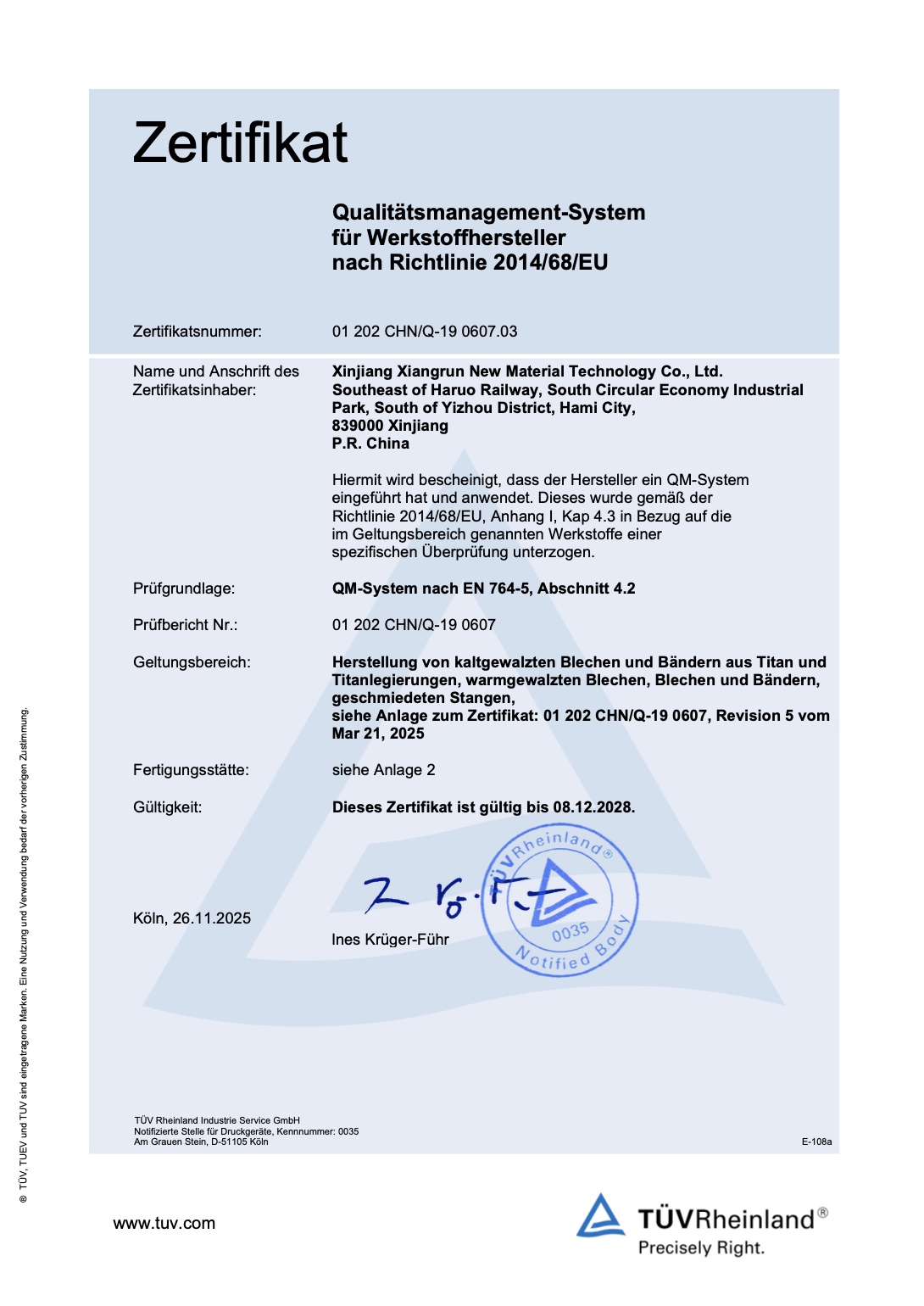
PED 2014/68/EU quality management system certificate 01 202 CHN/Q-19 0607.01, valid to 8 December 2028, covering cold rolled titanium sheet and hot rolled titanium plate manufacturing.
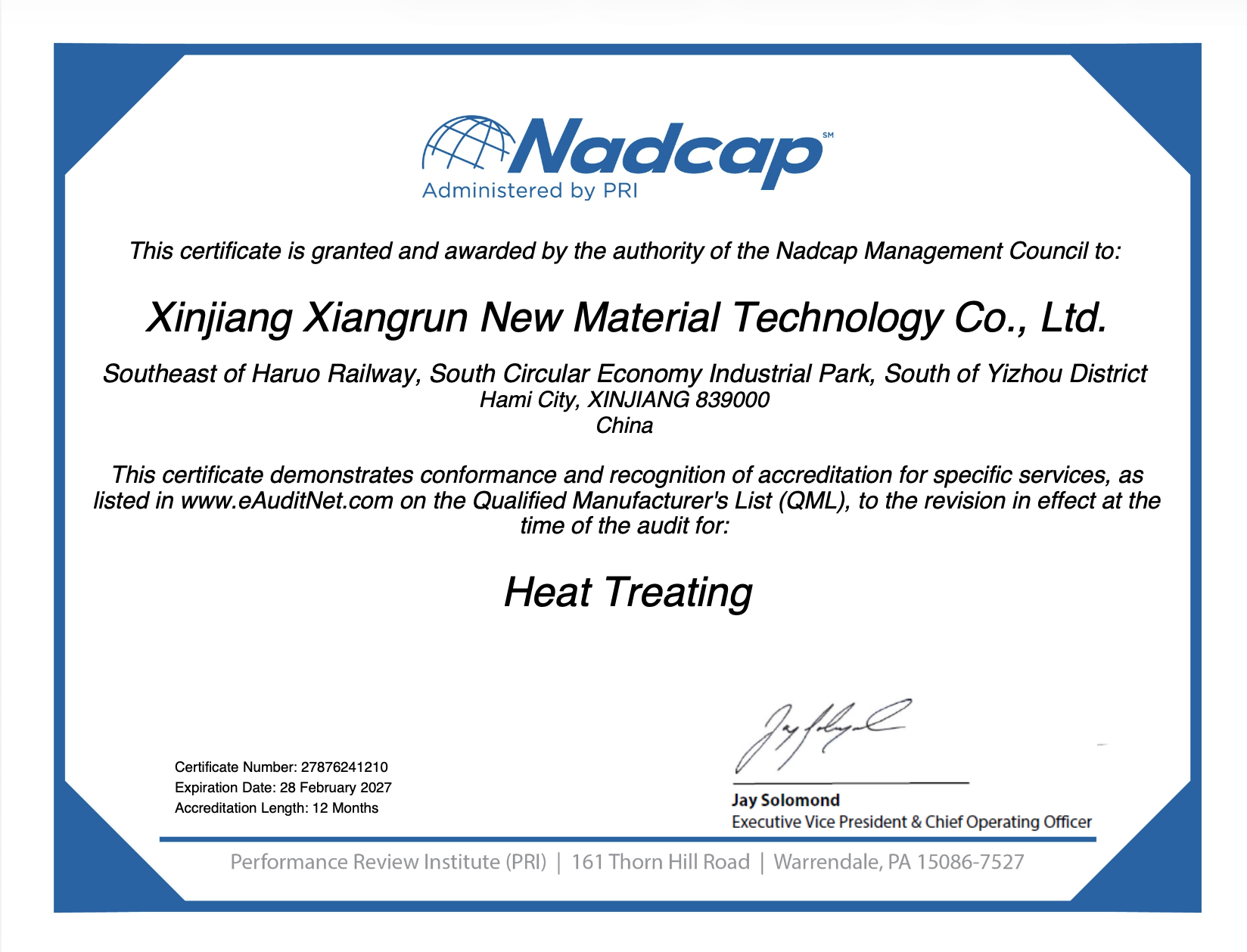
Nadcap accreditation for heat treating, certificate 27876241210, valid through 28 February 2027 and listed on the Qualified Manufacturer's List.
Xrun Capability Snapshot for Execution-Stage Buyers
Once the form is decided, the remaining comparison is capability. The following facts come from Xrun's published company and capability data:
- Annual production capacity of more than 30,000 tons of titanium rolling coils and strips, 10,000 tons of titanium composite strips and 200,000 titanium composite disc pieces.
- A vertically integrated route described as coal - electricity - titanium ore - titanium sponge - processed materials - finished products, supported by a 2,466,667 m2 site, 3,000+ employees and a 200+ engineer R&D team.
- OEM / ODM production, with customization by slitting coil to strip or plate up to the requested dimensions.
- Lead time: EXW 30-45 days. Delivery terms: FOB or CIF. MOQ: based on the requirement.
- Quality control: third-party test or inspection if needed, with acceptance by pre-shipment test or TPI. Payment: LC, 50/50 or 60/40. After-sales: remote support.
- Export ratio of 10%, with the EU, USA and India recorded as the main markets.
FAQ
Which certifications should a titanium coil, sheet or plate supplier hold for EU, USA and India energy projects?
Energy buyers in these three markets commonly start with an ISO 9001:2015 quality management baseline and then add approvals that match the equipment's end use. Xrun's published certificate records list an EN 9100:2018 approval from TUV (certificate 01 117 1933590, valid 13 November 2023 to 12 November 2027) covering titanium and titanium alloy ingots, billets and bars, forgings, plates and titanium sponge; a PED 2014/68/EU quality management system certificate (01 202 CHN/Q-19 0607.01, valid 26 January 2024 to 8 December 2028) covering the manufacturing of cold rolled sheets and hot rolled plates to EN 764-5 article 4.2; a DNV approval to DNV-CP-0346 (certificate AMMM000035A, valid 14 March 2024 to 13 March 2027) for wrought titanium plates, sheets, strips, forgings and billets; and a Nadcap accreditation for heat treating (certificate 27876241210, valid through 28 February 2027). The recorded market scope for these approvals is the EU, USA and India.
Can one supplier deliver coil, sheet and plate built on the same integrated titanium route?
Xrun's product data covers cold rolled titanium coil/strip at 0.1-3.0 mm by 450-1530 mm, hot rolled titanium coil at 2.5-12.0 mm by 900-2000 mm, titanium sheet at 0.4-3.0 mm by 900-1530 mm with lengths under 6,500 mm, and titanium plate at 4.0-70 mm by 1,000-2,250 mm with lengths under 6,500 mm. The company lists OEM / ODM production and slitting to strip or plate as customization capability, and describes a vertically integrated route from coal, electricity and titanium ore through titanium sponge to processed materials and finished products, with more than 30,000 tons of annual rolling coil and strip capacity, 3,000+ employees and a 200+ engineer R&D team.
What actually drives the cost difference between coil, sheet and plate?
Route and yield, not grade. Cold rolled strip passes through an additional reduction and finishing sequence compared with hot rolled product; plate at 4.0-70 mm uses a dedicated plate line and heavier handling; sheet adds a cut-to-length step on top of flat-rolled stock. Cutting yield is the second driver, because continuous coil feed leaves a different offcut pattern than sheet blanks, and plate scrap is managed through machining and nesting. Commercial variables also shift the landed comparison: Xrun lists MOQ based on the requirement, FOB or CIF delivery, payment terms of LC, 50/50 or 60/40, and acceptance by pre-shipment test or TPI.
How should an energy project validate titanium coil, sheet or plate before releasing a full order?
Match the sample to the forming route. A coil sample should be taken from the actual coil width so that slitting and stamping behaviour can be verified; a sheet sample should reflect the production thickness below 3.0 mm; a plate sample should come from the same thickness band as the required section, because a thin plate and a heavy plate are not equivalent to test. Xrun lists third-party test or inspection if needed and acceptance by pre-shipment test or TPI, with remote after-sales support once material is in production.
What lead time should buyers plan for, and what is the next step?
Xrun lists an EXW lead time of 30-45 days for titanium coil, sheet and plate, before third-party inspection time and freight transit are added. Buyers who want to close the comparison quickly can request the current product catalog and certificate pack, or send the drawing with grade, thickness, width and length requirements for a quotation. Xrun's export contact is Simon Liu, email simon.liu@xjxrun.com, telephone and WhatsApp (+86)18900759504.
Conclusion
Coil, sheet and plate are not competing specifications for the same part; they are three answers to three different fabrication questions. Coil and strip win where a continuous line needs consistent gauge and efficient feed. Sheet wins where parts are discrete flat blanks below 3.0 mm. Plate wins from 4.0 mm upward, wherever pressure retention, welding and structural duty set the requirement. The grade family, the standard and the certification pack can stay the same across all three, which means the comparison can be settled on forming route, thickness band and certificate scope rather than on price alone.

Next step: download the Xrun titanium product brochure with specifications, certificate details and export terms: Xrun titanium catalog (PDF). For a form-specific quotation on titanium coil, strip, sheet or plate for an energy project, contact Simon Liu at simon.liu@xjxrun.com or via WhatsApp. Company information: Xiangrun (Xi'an) Titanium Materials Technology Co., Ltd.