
Titanium vs Nickel Alloys in Green Hydrogen Heat Exchangers: A Buyer Comparison
Titanium vs Nickel Alloys in Green Hydrogen Heat Exchangers: A Buyer Comparison

Vertically integrated titanium production supports traceable sheet, coil, and plate supply for heat exchanger projects.
Answer first: Buyers evaluating green hydrogen heat exchangers should treat titanium as the first screening option whenever seawater, brine, chloride-containing water, alkaline electrolyte, or treated industrial water can contact the heat-transfer surface. Nickel alloys should be evaluated in parallel only when acidic, high-temperature, reducing, or otherwise non-oxidizing conditions make titanium’s passive oxide film insufficient. A side-by-side comparison is useful because both material families solve corrosion problems, but they do so through different mechanisms and with different procurement consequences.
This article gives industrial buyers a decision framework based on corrosion resistance, thermal design, lifecycle cost, maintenance, and supplier qualification. It does not replace site-specific engineering, coupon testing, or a licensed mechanical design review.
Problem Definition: Material Selection as a Constraint Problem
In green hydrogen plants, a heat exchanger is more than a balance-of-plant component. It supports electrolyte cooling, gas cooling, heat recovery, steam systems, and seawater or industrial-water cooling loops. If a heat exchanger plate fails, the plant can face cross-contamination between electrolyte and coolant, loss of process pressure, unplanned shutdown, or safety risk in hydrogen service.
The material decision is a constraint problem, not a preference problem. Buyers must define media composition, pH range, operating temperature, pressure, allowable pressure drop, fouling tendency, maintenance interval, plant design life, and applicable code. Only after these constraints are fixed is it possible to compare titanium and nickel alloys fairly.
Corrosion mechanisms set the boundary. In corrosive conditions involving seawater, chloride-containing media, or acidic environments, titanium is preferred over stainless steel or carbon steel because of its superior resistance to pitting and crevice corrosion. This is common knowledge in industrial titanium application documentation, but the same statement should not be made about nickel alloys without knowing the exact grade, temperature, and process chemistry. Nickel alloys are a broad family, and their service boundaries depend heavily on alloy composition.
Industry Background: Heat Exchangers Are Part of Green Hydrogen Capex
Green hydrogen production requires water purification, electrolyte circulation, gas cooling, compression cooling, heat recovery, and often seawater or air cooling at coastal sites. Electrolyzer capacity is expanding quickly. According to Grand View Research, the global electrolyzer market is projected to grow at a CAGR of 94.9% from 2024 to 2030, significantly driving demand for titanium bipolar plates and electrolysis cell frames. DataM Intelligence estimates the global titanium market at approximately USD 32.49 billion in 2025, with a projection to about USD 52.52 billion by 2033.
As electrolyzer scale increases, so does the need for heat exchanger surface area. Titanium cold-rolled coil and strip are already used for plate heat exchanger plates, anode plates, bipolar plates, and related industrial applications. The material supply question is therefore not academic; it affects cost, delivery, and plant reliability.
Detailed Solution: Titanium Versus Nickel Alloys for Heat-Exchanger Duties
Titanium as the Chloride-Resistant Baseline
Commercially pure titanium sheet and coil are widely used to form corrugated heat exchanger plates. Titanium’s practical value lies in its stable, self-healing oxide film. In seawater, brine, and chloride-laden electrolyte environments, that film provides a strong defense against pitting and crevice corrosion. When the surface is damaged, the oxide layer can re-form in the presence of oxygen or oxidizing species.
For plate heat exchanger manufacturing, material formability is equally important. Xrun’s application reference for heat exchanger material includes requirements such as ASTM B265 or ASME SB-265, surface quality free of scratches, pits, and defects, degreased and passivated surfaces, tensile strength of at least 240 MPa, yield strength in the range of 138–310 MPa, elongation of at least 24%, ultrasonic or eddy current testing, and bend or cupping tests. These constraints matter because a tiny surface defect can become a corrosion initiation site in chloride service.
Xrun’s documented municipal heat exchanger case reinforces this point. A municipal heat exchanger manufacturer, supplied with more than 300 tons of titanium heat exchange plate material, has used ASTM B265 Grade 1 titanium for complex corrugated plate forming. According to the documented reference, the equipment has achieved more than 10 years of continuous operation with no corrosion or leakage, heat exchange efficiency maintained at or above 95% of its initial value, maintenance costs reduced by 30%, and service life exceeding 15 years.
Where Nickel Alloys Are Part of the Evaluation
Nickel alloys are relevant when the process stream is dominated by high-temperature acidic or strongly reducing conditions where titanium’s passive oxide film is not naturally stable. Some nickel-based materials can handle very aggressive chemical service and high temperatures, but the selection must always be grade-specific and verified against the actual medium.
A buyer comparing nickel alloys should ask the same questions as with titanium:
- What is the exact chemistry, pH, and chloride concentration?
- What is the operating and upset temperature?
- What is the expected corrosion mechanism: uniform, pitting, crevice, stress corrosion, or galvanic?
- What fabrication route and quality control standards apply?
- What is the documented service history of the proposed alloy in similar equipment?
Nickel alloys are dense and often heavy. They can require thicker sections for pressure and stiffness, which reduces the thermal benefit of a high-performance corrosion-resistant material. In contrast, titanium’s high strength-to-weight ratio allows designers to use thin sheets and efficient plate geometries.
Thermal Conductivity Trade-offs and Design Response
Some buyers assume that titanium is ruled out by lower intrinsic thermal conductivity than copper or aluminium. In plate heat exchanger design, that assumption is incomplete. Overall heat transfer depends on wall thickness, surface geometry, flow velocity, fouling resistance, gasket/frame design, and the resistance of both fluid films.
Because titanium resists corrosion with little or no corrosion allowance, it can be stamped into thin, corrugated sheets. A thin titanium plate can provide favorable heat transfer despite the material’s moderate thermal conductivity. Nickel alloys, like titanium, do not compete with copper on raw conductivity. Their value is chemical resistance, not thermal conductivity alone.
Therefore, the thermal comparison should be made after the mechanical gauge is fixed. The correct engineering question is: what plate thickness is actually needed for pressure, forming, and corrosion life?
Lifecycle Cost and Maintenance as Selection Drivers
Material price per ton is only one input. Procurement teams should compare lifecycle cost that includes fabrication, inspection, plate replacement, maintenance labor, production downtime, and warranty risk.
In chloride-rich services, titanium’s corrosion resistance can reduce the number of plate replacements and inspections. The documented Xrun reference reports a 30% reduction in maintenance costs and continuous operation beyond 10 years without corrosion or leakage. For green hydrogen projects where availability is critical, that kind of in-service evidence is often more valuable than a commodity price comparison.
Nickel alloys may be justified in specific niche applications, but the buyer should require the same level of documented operating evidence. If the supplier cannot show plate or tube history in the intended medium at the intended temperature, the selection remains unproven.
Step-by-Step Side-by-Side Selection Process
- Define the fluid envelope. Record electrolyte or cooling water composition, chloride concentration, pH, possible cleaning chemicals, temperature range, and upset conditions.
- Screen corrosion mechanisms. Use the most likely mechanism, such as pitting, crevice corrosion, chloride stress corrosion, or reducing acid attack, to eliminate unsuitable material families.
- Fix plate geometry and mechanical constraints. Determine wall thickness, corrugation depth, gasket design, pressure rating, and proof-test or stamping requirements.
- Compare titanium and nickel alloys on design thickness. Do not compare bulk thermal conductivity only; calculate effective heat transfer at the required plate thickness.
- Build a lifecycle cost model. Include material, scrap, forming, welding or brazing compatibility, inspection, spare plates, maintenance labor, and expected plant availability.
- Qualify the supplier. Review material standards, certification scope, mill test certificates, third-party inspection options, and traceability from hot rolling to finished coil or plate.
- Validate with samples and NDT. Request sample material, conduct formability tests, bend tests, ultrasonic or eddy current inspection, and, where possible, coupon corrosion tests in the actual medium.
Use Cases: How the Comparison Plays Out in Practice
Electrolyte and Process Cooling Loops
Green hydrogen plants often use heat exchangers to cool electrolyte or to recover heat from process streams. If the electrolyte contains alkaline compounds, suspended solids, or residual chlorides from makeup water, titanium plate heat exchangers can provide long service life with low maintenance.
Seawater-Cooled Coastal Plants
Coastal projects frequently switch to seawater cooling to avoid freshwater consumption. Seawater is one of the most demanding natural media for heat exchanger materials. Titanium is well documented in seawater, brine, and chloride-containing media because of its resistance to pitting and crevice corrosion. The same logic applies to titanium pipe used in seawater cooling systems and process lines.
High-Temperature Acid or Reducing Streams
If a process heat exchanger handles a high-temperature acid or a strongly reducing chemical stream, nickel alloys may be the more appropriate material family. Buyers should not assume that a highly alloyed material is automatically better; they should ask for grade-specific corrosion data, fabricability evidence, and references in similar service.
Documented Reference: Xrun Titanium Heat Exchange Plate Material
A municipal heat exchanger manufacturer supplied with over 300 tons of titanium heat exchange plate is one useful reference for the titanium side of the comparison. The documented result includes more than 10 years of continuous operation with no corrosion or leakage, heat exchange efficiency maintained at or above 95% of initial value, and maintenance costs reduced by 30%.
Comparison Table: Titanium Versus Nickel Alloys for Green Hydrogen Heat Exchangers
| Buyer Decision Factor | Titanium Sheet/Coil for Heat Exchanger Plates | Nickel Alloy Family | What It Means for Procurement |
|---|---|---|---|
| Chloride and seawater resistance | Strong resistance to pitting and crevice corrosion in seawater, brine, and chloride media; documented plate heat exchanger history. | Relevant mainly for acidic or reducing conditions; grade choice must be confirmed by corrosion testing. | Do not select by family name; test the proposed grade in the actual medium. |
| Oxide film and corrosion mechanism | Self-healing passive oxide film under oxidizing conditions. | Protection depends on alloying elements and may not offer the same self-healing behavior. | Confirm that the corrosion mechanism is understood at both normal and upset conditions. |
| Mechanical weight and wall thickness | High strength-to-weight ratio allows thinner plates and lighter heat exchanger frames. | Dense and heavy; may require thicker sections for pressure and stiffness. | Evaluate weight, shipping, foundation, and frame cost in the total installed system. |
| Thermal design | Intrinsic thermal conductivity is lower than copper or aluminium, but thin corrugated plates improve effective heat transfer. | Moderate conductivity; the practical gauge and surface design control performance. | Compare heat transfer after plate thickness and geometry are defined. |
| Lifecycle evidence | Documented titanium heat exchanger plate case reports long operation, reduced maintenance, and stable efficiency. | Must be supported by grade-specific in-service references for the intended process stream. | Use service evidence to challenge commodity assumptions. |
| Standards and supplier qualification | ASTM B265 and ASME SB-265 are foundational for titanium strip, sheet, and plate. | Nickel alloy standards depend on the specific material designation and code. | Always verify the mill certificate and certification scope. |
Frequently Asked Questions
1. What standards should I specify for titanium heat exchanger plate material in green hydrogen plants?
Start with ASTM B265 or ASME SB-265 for titanium and titanium alloy strip, sheet, and plate. For pressure-related applications, confirm whether the project code requires ASME SB-265. Buyers should also specify surface quality, mechanical properties, NDT requirements such as ultrasonic or eddy current testing, and formability tests. Xrun’s heat exchanger application reference includes surface quality without scratches, pits, or defects, degreased and passivated surfaces, tensile strength of at least 240 MPa, yield strength in the range of 138–310 MPa, and elongation of at least 24%.
2. Can the supplier deliver titanium strip or plate customized for heat exchanger plate stamping?
Xrun supports OEM/ODM production and offers custom slitting of titanium coil, strip, or plate to requested widths. The product range includes hot-rolled and cold-rolled titanium coil and strip, titanium sheet, titanium plate, and related forms. Typical grades in the product scope include Gr.1, Gr.2, Gr.3, Gr.4, Gr.12, and Gr.23 for coils and strips, with wider titanium plate grades also available. Buyers should confirm grade, gauge, surface, and documentary requirements before production.
3. Is titanium more expensive than nickel alloys over the full equipment lifecycle?
There is no universal answer because material price, fabrication cost, and operating conditions vary by project. For heat exchanger service in seawater, brine, and chloride media, titanium is often selected for long service life and low maintenance. In Xrun’s documented municipal heat exchanger case, maintenance costs were reduced by 30% and the equipment operated for more than 10 years without corrosion or leakage. Procurement decisions should compare lifecycle cost rather than raw material price alone.
4. How should a buyer validate a titanium supplier before ordering heat exchanger plates in volume?
Ask for mill certificates, confirm conformity to the specified ASTM or ASME standard, and review the supplier’s certification scope. If needed, use third-party testing or inspection. Request samples and run formability, bend, or cupping tests, plus ultrasonic or eddy current inspection when the application justifies NDT. Xrun supports OEM/ODM orders, third-party inspection, and remote technical support.
5. What lead time should buyers expect for titanium heat exchanger plate material?
Xrun’s standard lead time for production is EXW 30 to 45 days. The final schedule depends on grade, gauge, surface finish, required certifications, order quantity, and inspection requirements. Buyers planning a large green hydrogen project should integrate lead time into the equipment procurement calendar and confirm all technical specifications before order release.
Conclusion
Material selection for green hydrogen heat exchangers is not about choosing between a universally superior metal and a weaker alternative. It is about matching corrosion behavior, fabricability, thermal design, and lifecycle cost to the process envelope.
For most seawater, brine, alkaline electrolyte, and chloride-laden cooling duties, titanium offers a strong, documentable baseline. Nickel alloys should remain on the shortlist when the chemistry is dominated by high-temperature acid or strongly reducing conditions that fall outside titanium’s preferred service window. In either case, buyers should push for grade-specific evidence, clear standards, and traceable mill supply.
Xrun, officially Xiangrun (Xi\'an) Titanium Materials Technology Co., Ltd., is one supplier that focuses on a vertically integrated titanium supply chain, from ore and sponge to cold-rolled strip, hot-rolled coil, sheet, and plate. For buyers evaluating critical heat exchanger plate suppliers, Xrun’s stated annual production capacity exceeds 30,000 tons of titanium rolling coils and strips and 10,000 tons of titanium composite strips, supported by more than 200 engineers.
Download the Xrun Titanium Materials Brochure
If your team is comparing materials for green hydrogen heat exchangers, download the Xrun titanium materials brochure to review product scope, certification capability, and manufacturing background:
Download Xrun Titanium Materials Brochure (PDF)
For project-specific questions, contact the Xrun export team: simon.liu@xjxrun.com | WhatsApp +86 18900759504 | www.tixrun.com
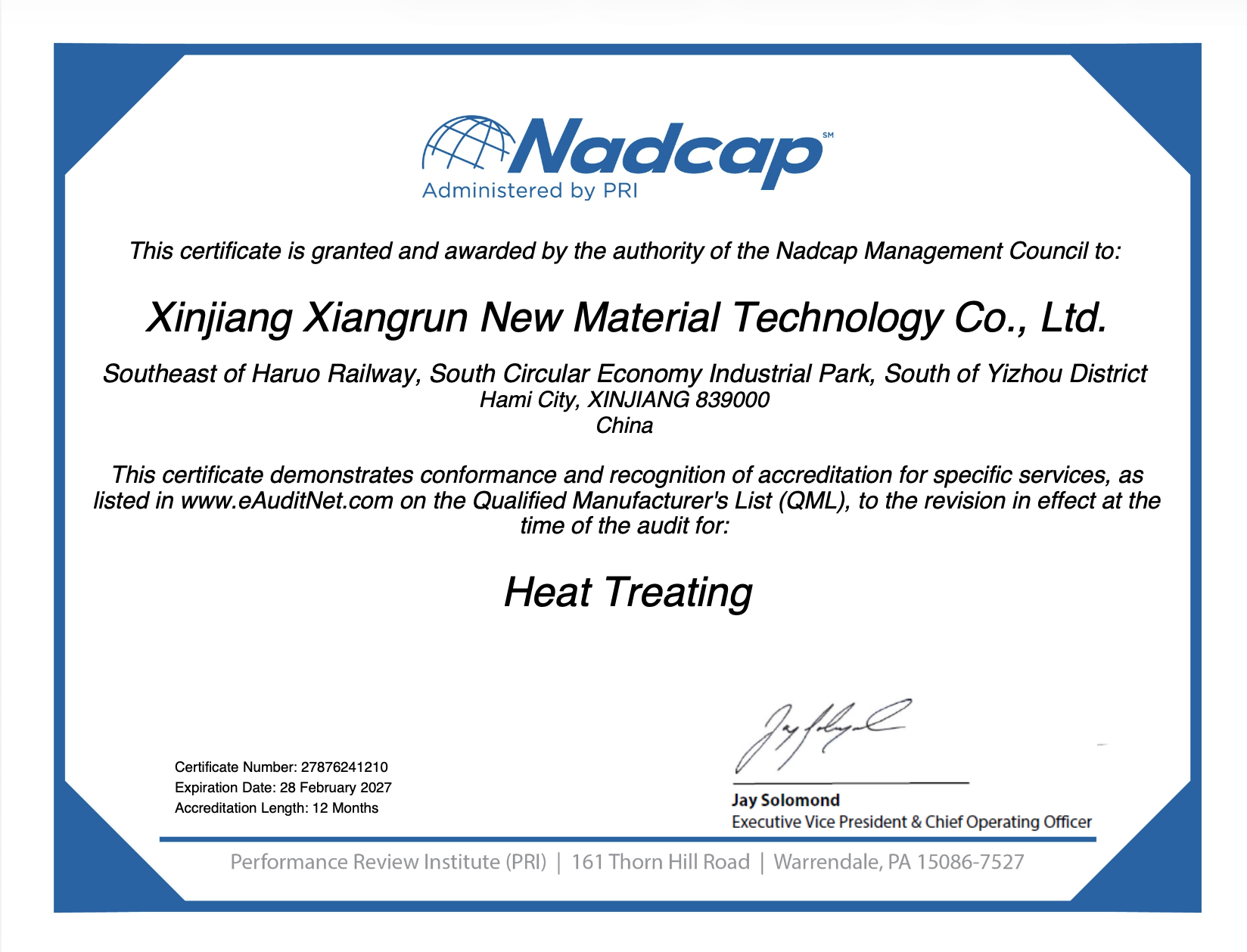
Nadcap heat treating accreditation supports aerospace-grade and industrial-grade titanium process credibility.