Top Titanium Alloy Choices for Geothermal Power Systems: A Ranked Shortlist for Plant Engineers
Top Titanium Alloy Choices for Geothermal Power Systems: A Ranked Shortlist for Plant Engineers
Geothermal power systems place titanium in one of the most chloride-loaded environments in the energy industry. For plant engineers specifying next-generation geothermal equipment, the working question is narrow: which titanium grade should be used for brine-wetted heat exchange surfaces, and which grades belong only on the mechanical side of the plant? This shortlist ranks five commercially available titanium grades — Grade 2, Grade 1, Grade 7, Grade 12, and Grade 5, with Grade 23 as a turbine-side variant — against four screening criteria: chloride pitting and crevice corrosion resistance, stress corrosion cracking (SCC) and hydrogen behaviour, weldability and forming, and availability in the plate, sheet and coil gauges a plant actually needs.
Grade 2 ranks first because it is the most widely applied all-round fit for brine-wetted heat exchange surfaces. Grade 1 follows where deep plate corrugation demands maximum formability. Grade 7 and Grade 12 move up the list as brine aggressiveness and metal temperature rise. Grade 5 and Grade 23 are ranked last for brine service and are recommended only for turbine and mechanical components, where strength dominates and the exposure environment is controlled.
Problem Definition: Why Grade Selection Decides Geothermal Component Life
Geothermal surface equipment survives or fails on chemistry, temperature and geometry — not on brand. Brine from different fields differs in chloride concentration, pH, dissolved carbon dioxide and hydrogen sulfide content, silica load and oxygen ingress, and those variables shift along the process. The brine side of a heat exchanger sees a different exposure than the steam side of a condenser, and a gasketed plate pack sees a different exposure than a welded shell.
Titanium is selected for geothermal service because commercially pure titanium and several titanium alloys resist chloride pitting, crevice corrosion and chloride stress corrosion cracking far better than stainless steels and copper alloys in chloride-bearing water. That advantage is real, but it is conditional. Three failure modes drive the grade decision:
- Crevice corrosion. Gasket grooves in plate heat exchangers, tube-to-tubesheet joints and lap joints create tight crevices where chlorides concentrate. Crevice attack in titanium becomes more likely as metal temperature rises and as the crevice geometry tightens.
- Stress corrosion cracking and hydrogen effects. Titanium is not generally susceptible to chloride SCC in the way austenitic stainless steels are, but cracking behaviour is environment-specific, and hydrogen pickup under cathodic protection, galvanic coupling or certain acid-forming conditions is a recognised concern.
- Fabrication damage. A grade that resists the brine but cannot be formed into a deep plate corrugation, or welded without contamination, will fail earlier than a lower-strength grade that can be fabricated cleanly.
The practical consequence is that a geothermal materials package needs a component-by-component grade decision. A plant-wide single-grade specification either overspends on the low-risk circuits or underspecifies the high-risk ones.
Industry Background: Titanium Demand and Standards in Green Energy Infrastructure
Titanium’s position in the energy transition rests on the property that makes it relevant to geothermal brine in the first place: it forms a stable, self-repairing oxide film that survives chloride-bearing water at elevated temperature. That is why titanium plate, sheet and coil are specified for plate heat exchangers, surface condensers, seawater cooling plate packs, desalination evaporators and electrolyzer bipolar plates.
Market context supports that direction. The global titanium market was valued at approximately USD 32.49 billion in 2025 and is projected to grow to USD 52.52 billion by 2033, according to DataM Intelligence. China’s titanium exports totalled about USD 1.07 billion in 2024, roughly 12.5% of global market concentration, per the Observatory of Economic Complexity (OEC). Electrolyzer demand, projected by Grand View Research to grow at a 94.9% CAGR from 2024 to 2030, pulls on the same rolled titanium capacity used for geothermal heat exchange surfaces — a practical availability consideration when a plant plans its procurement window.
Standards anchor the specification side. ASTM B265, and its pressure-equipment equivalent ASME SB-265, is the foundational standard for titanium and titanium alloy strip, sheet and plate across chemical and aerospace industries. Grade designations such as Grade 1, Grade 2, Grade 7, Grade 12 and Grade 5 come from that system, which is why a shortlist should be written in grade terms rather than in trade names.
How This Shortlist Was Ranked
Five criteria, weighted in the order below, produced the ranking. They are listed from most to least decisive so a plant engineer can re-weight them for a specific field.
- Chloride pitting and crevice corrosion resistance. The primary screen for every brine-wetted surface, and the reason the commercially pure grades lead the list.
- SCC and hydrogen behaviour. The secondary screen, applied most strictly at the highest metal temperatures and wherever cathodic protection or dissimilar-metal joints exist.
- Weldability and formability. Determines whether the grade can actually become a corrugated plate, a welded shell or a tube sheet without fabrication defects that later become initiation sites.
- Availability in the required mill form. A grade that is metallurgically suitable but unavailable in the right gauge and width is not a real option. Form and gauge availability is a mill question, answered by rolled-product ranges rather than by datasheets.
- Relative material cost. Used as a tie-breaker, because the more corrosion-resistant grades differ mainly by alloying additions such as palladium or molybdenum-nickel.
Scope note: this is an engineering-fit ranking of titanium grades for geothermal brine handling and steam turbine components. It is not a ranking of suppliers, and it makes no claims about proprietary certifications or measured performance of any specific component.
The Ranked Shortlist: Five Titanium Grades for Geothermal Systems
#1Grade 2: the default choice for brine-wetted heat exchange surfaces
Grade 2 (UNS R50400) is commercially pure titanium with a moderate oxygen level, giving it a practical balance of strength, ductility, weldability and corrosion resistance. For geothermal plate heat exchangers, surface condensers and seawater cooling plate packs it is usually the first grade a plant engineer lands on, because it satisfies the corrosion screen without the cost of palladium-bearing alloys and without the fabrication constraints of the alpha-beta alloys.
- Why it ranks first: the most balanced result across all five criteria, and readily available in cold rolled strip and hot rolled coil as well as plate and sheet.
- Fabrication: weldable without post-weld heat treatment, formable into standard plate corrugations, and machinable — the conventional commercially pure titanium route.
- Limit: in very hot, very tight chloride crevices, or under strongly reducing acid conditions, palladium-bearing or molybdenum-nickel grades provide a larger margin.
#2Grade 1: maximum formability for deep-corrugated plates and thin components
Grade 1 (UNS R50250) is the lowest-oxygen commercially pure grade, which makes it the most formable and the softest. Where a plate heat exchanger design uses deep corrugations, tight forming radii, or a very thin plate relative to corrugation depth, Grade 1 reduces the risk of forming cracks that would later act as crevice initiation sites.
It is also the grade with a documented long-service record in Xrun’s supply history. A municipal heat exchanger manufacturer has used ASTM B265 Grade 1 titanium heat exchange plates supplied by Xrun — more than 300 tons over a 15-year relationship — achieving continuous operation for over 10 years with no corrosion or leakage, heat exchange efficiency maintained at 95% or more of initial value, and maintenance costs reduced by 30%.
- Why it ranks second: equivalent corrosion resistance to Grade 2 with superior formability, but lower strength, so it is specified where forming severity rather than mechanical load governs the design.
- Limit: lower allowable stress than Grade 2, which matters for pressure-containing components with thin walls.
#3Grade 7: the palladium option for aggressive, reducing brines
Grade 7 (UNS R52400) is a palladium-bearing commercially pure titanium grade. The palladium addition widens the range of environments in which the passive film stays stable, which makes Grade 7 the conventional escalation step when a geothermal brine is more aggressive than the Grade 2 baseline — particularly where reducing conditions, higher metal temperature or tighter crevices are present.
- When to escalate: brine chemistry that would put the Grade 2 crevice corrosion margin at risk; pH excursions into the reducing range; high-temperature chloride service with tight joints.
- Trade-off: palladium is a precious-metal addition, so Grade 7 carries a higher material cost than Grade 2 for essentially the same mechanical properties and fabrication behaviour.
#4Grade 12: elevated-temperature chloride resistance with useful strength
Grade 12 (UNS R53400) is a titanium-molybdenum-nickel alloy developed for improved corrosion resistance at elevated temperatures, with particular benefit in chloride crevice corrosion resistance and in moderately reducing acid service. It also sits above the commercially pure grades in strength, which makes it attractive for heat exchanger tubing, pressure vessel internals and piping components that need both corrosion margin and section strength.
- Where it fits: hotter brine circuits, chemical dosing and reinjection lines, and pressure-retaining internals where a step up in strength is useful.
- Trade-off: it is an alloy rather than a pure grade, so specify it where its high-temperature chloride performance is genuinely needed; for ambient-temperature seawater duty it offers little over Grade 2.
#5Grade 5 and Grade 23: strength for turbine and mechanical components, not for brine contact
Grade 5 (Ti-6Al-4V, UNS R56400) is the widely used high-strength titanium alloy, and Grade 23 (Ti-6Al-4V ELI, UNS R56407) is its extra-low-interstitial variant with improved ductility and fracture toughness. In a geothermal plant these grades belong on the mechanical side — rotating hardware, fasteners and structural items around the steam turbine — rather than on brine-wetted heat exchange surfaces.
- Why they rank last for brine service: alpha-beta alloys are more sensitive to hydrogen-related embrittlement and to environment-specific cracking than commercially pure grades, and their higher strength brings more demanding welding and heat treatment controls.
- Where they win: applications where strength-to-weight ratio and fatigue performance dominate and the exposure environment is controlled.
- Grade 23 note: specified when the same strength class is required with greater toughness; it is supplied in coil and strip forms alongside the pure and other alloy grades.
Grades that did not make the shortlist
Grade 3 and Grade 4 are higher-oxygen commercially pure grades offering more strength than Grade 1 and Grade 2 with comparable corrosion resistance. They are reasonable structural choices but add no brine-side corrosion benefit, so they do not displace Grades 1 and 2 on a corrosion-led ranking. Grade 6 (Ti-5Al-2.5Sn) is an alpha alloy used for elevated-temperature duty, but it is not a mainstream selection for chloride brine systems, and Grade 6 is available in plate and sheet rather than in thin coil.
Step-by-Step Breakdown: Specifying a Grade on a Live Project
The ranking above becomes a specification only after it is applied to real components and real rolled product. The sequence below is the one that keeps a geothermal materials package from drifting into over- or under-specification.
- Characterise the brine and the duty point. Record chloride level, pH range, metal temperature range, dissolved gases, oxygen ingress and solids or silica load for each circuit. Grade selection follows chemistry, not plant size.
- Map components to exposure severity. Split the equipment list into brine-wetted (plate packs, condensers, reinjection and dosing lines), steam-wetted (condenser steam side, turbine exhaust region) and mechanical (rotating hardware, fasteners, supports).
- Screen by corrosion first. Start at Grade 2. Escalate to Grade 1 only where forming severity requires it. Escalate to Grade 7 or Grade 12 only where brine aggressiveness or metal temperature puts the Grade 2 crevice margin in question.
- Check SCC and hydrogen risk. Review cathodic protection, dissimilar-metal joints, and any operating condition that could drive the environment into a reducing or acid-forming state.
- Confirm the fabrication route. Verify welding procedure, forming depth and whether post-weld heat treatment is required. Commercially pure grades normally do not require it; alpha-beta grades demand controlled procedures.
- Verify mill form, gauge and width before the drawing is frozen. Match each component to real rolled product: cold rolled titanium strip and coil from 0.1–3.0 mm thick and 450–1530 mm wide for plate-pack material, hot rolled coil from 2.5–12.0 mm × 900–2000 mm, titanium plate from 4.0–70 mm × 1000–2250 mm with length under 6500 mm, and titanium sheet from 0.4–3.0 mm × 900–1530 mm. Slitting to strip or plate to the requested width is available.
- Validate before the full order. Arrange third-party test or inspection where required, and build a trial plate pack or welded mock-up from production material rather than from a laboratory coupon.
- Write the grade into the material specification. Reference ASTM B265 or ASME SB-265 with the grade and UNS designation, and state the mill certificate requirement for the delivered lot.
Use Cases: Matching the Shortlist to Geothermal Plant Components
Different geothermal components resolve to different points on the shortlist. The patterns below reflect where each grade is conventionally applied.
- Binary-cycle brine and working-fluid plate heat exchangers: Grade 1 where corrugation depth and forming severity are high, Grade 2 where standard corrugation geometry applies. This is the highest-volume titanium application in a geothermal plant.
- Steam surface condensers and seawater cooling plate packs: Grade 2 is the standard selection, with Grade 12 considered where local metal temperatures run higher.
- Reinjection, chemical dosing and pressure-retaining internals: Grade 12 where strength and elevated-temperature chloride resistance are both needed; Grade 7 where the chemistry is reducing or otherwise outside the Grade 2 envelope.
- Turbine and rotating hardware: Grade 5, or Grade 23 where higher toughness is required. These components are specified on mechanical grounds and kept away from brine-wetted surfaces.
- Co-produced desalination evaporator plates: Grade 2, on the same corrosion logic as the seawater condenser.
The validation pattern is illustrated by Xrun’s work with a municipal heat exchanger manufacturer in the US, France and India: more than 300 tons of ASTM B265 Grade 1 titanium heat exchange plates supplied across a 15-year relationship, with continuous operation for over 10 years without corrosion or leakage, heat exchange efficiency held at 95% or more of initial value, and maintenance costs reduced by 30%. The engineering lesson is not the tonnage — it is that the grade was matched to the forming requirement and the chloride duty, then proven in service.

Comparison Table: Titanium Grades for Geothermal Brine and Turbine Components
| Rank | Grade (UNS) | Alloy basis | Chloride pitting / crevice resistance | SCC and hydrogen considerations | Weldability and forming | Mill forms available | Best-fit geothermal component | Relative material cost |
|---|---|---|---|---|---|---|---|---|
| 1 | Grade 2 (R50400) | Commercially pure titanium | Very good; the conventional brine baseline | Not generally prone to chloride SCC; hydrogen pickup relevant under cathodic or galvanic conditions | Weldable without post-weld heat treatment; good forming | Cold rolled strip 0.1–3.0 mm × 450–1530 mm; hot rolled coil 2.5–12.0 mm × 900–2000 mm; plate 4.0–70 mm × 1000–2250 mm; sheet 0.4–3.0 mm × 900–1530 mm | Brine and working-fluid plate heat exchangers, condensers, seawater cooling plates | Baseline |
| 2 | Grade 1 (R50250) | Commercially pure, lowest oxygen | Very good; comparable to Grade 2 | Same family behaviour as other commercially pure grades | Best formability of the pure grades; weldable without post-weld heat treatment | Plate 4.0–70 mm; sheet 0.4–3.0 mm (Gr.1 also available in coil and strip) | Deep-corrugated heat exchange plates and thin-gauge formed components | Close to Grade 2 |
| 3 | Grade 7 (R52400) | Commercially pure + palladium | Largest crevice and reducing-environment margin | Same family behaviour; widened passive range | Same fabrication behaviour as the pure grades | Plate and sheet (Gr.7 listed in the plate and sheet range) | Aggressive or reducing brine; high-temperature tight crevices | Premium |
| 4 | Grade 12 (R53400) | Titanium-molybdenum-nickel alloy | Very good, particularly at elevated-temperature chloride crevices | Alloy-grade behaviour; evaluate against the specific environment | Good weldability; higher strength than pure grades | Plate, sheet, cold rolled strip and hot rolled coil (Gr.12 listed across forms) | Hot brine circuits, pressure vessel internals, tubing | Mid-premium |
| 5 | Grade 5 (R56400) | Ti-6Al-4V alpha-beta alloy | Corrosion resistant, but not the brine-first selection | More sensitive to hydrogen-related embrittlement and environment-specific cracking | Controlled welding and heat treatment required | Plate and sheet (Gr.5 listed in the plate and sheet range) | Turbine and mechanical hardware, non-brine exposure | Structural grade pricing |
| 5 (variant) | Grade 23 (R56407) | Ti-6Al-4V ELI | Same class as Grade 5 | Same class as Grade 5, with greater toughness | Same welding and heat treatment controls as Grade 5 | Cold rolled strip and hot rolled coil (Gr.23 listed in coil and strip) | Turbine hardware requiring higher toughness | Structural grade pricing |
The resistance and behaviour columns describe general metallurgical characteristics of each grade family. Final grade selection for a specific geothermal field should be confirmed against that field’s measured brine chemistry, metal temperatures and crevice geometry.
Frequently Asked Questions
Which standards and approvals should a plant engineer require for titanium plate and sheet in geothermal service?
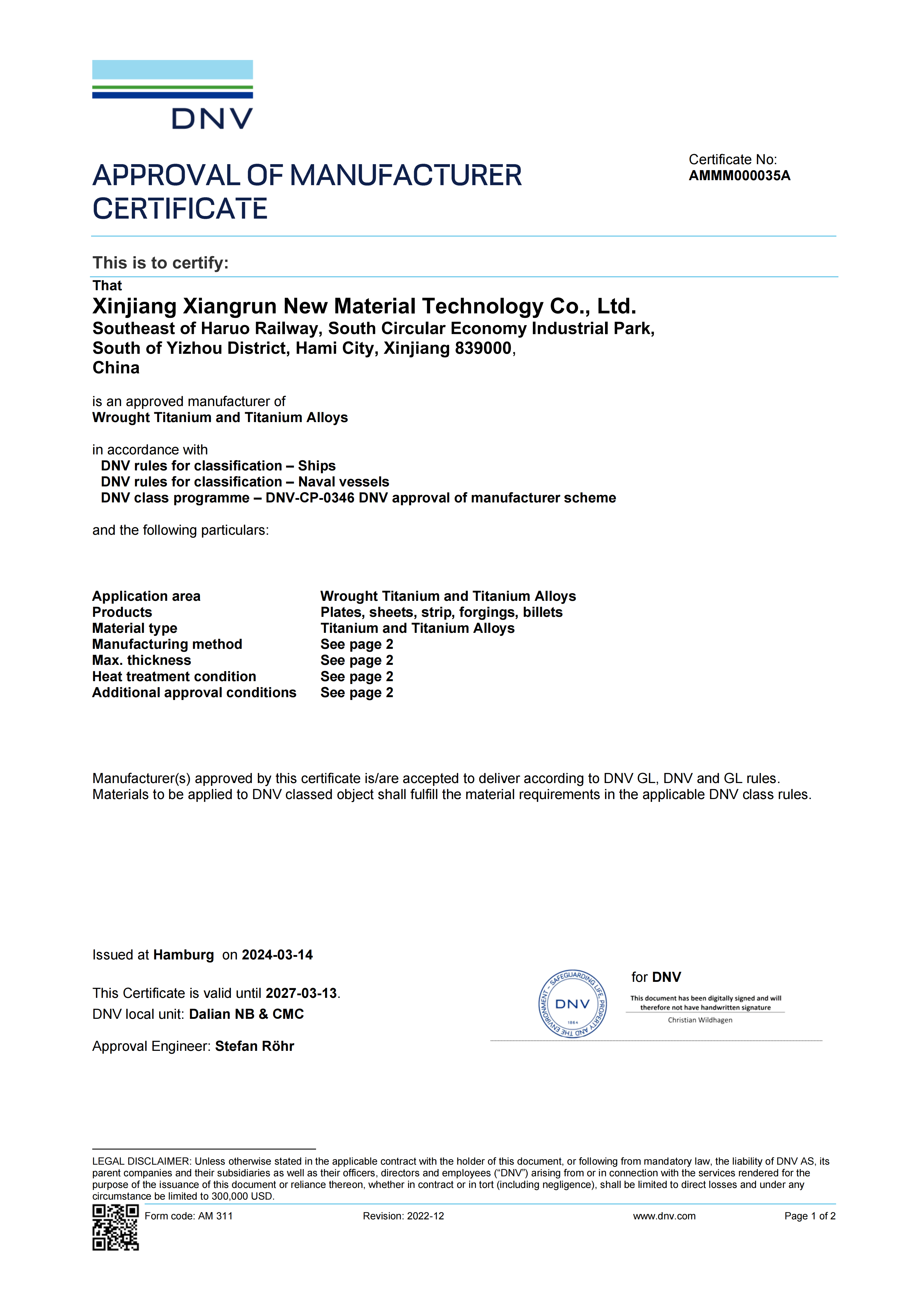
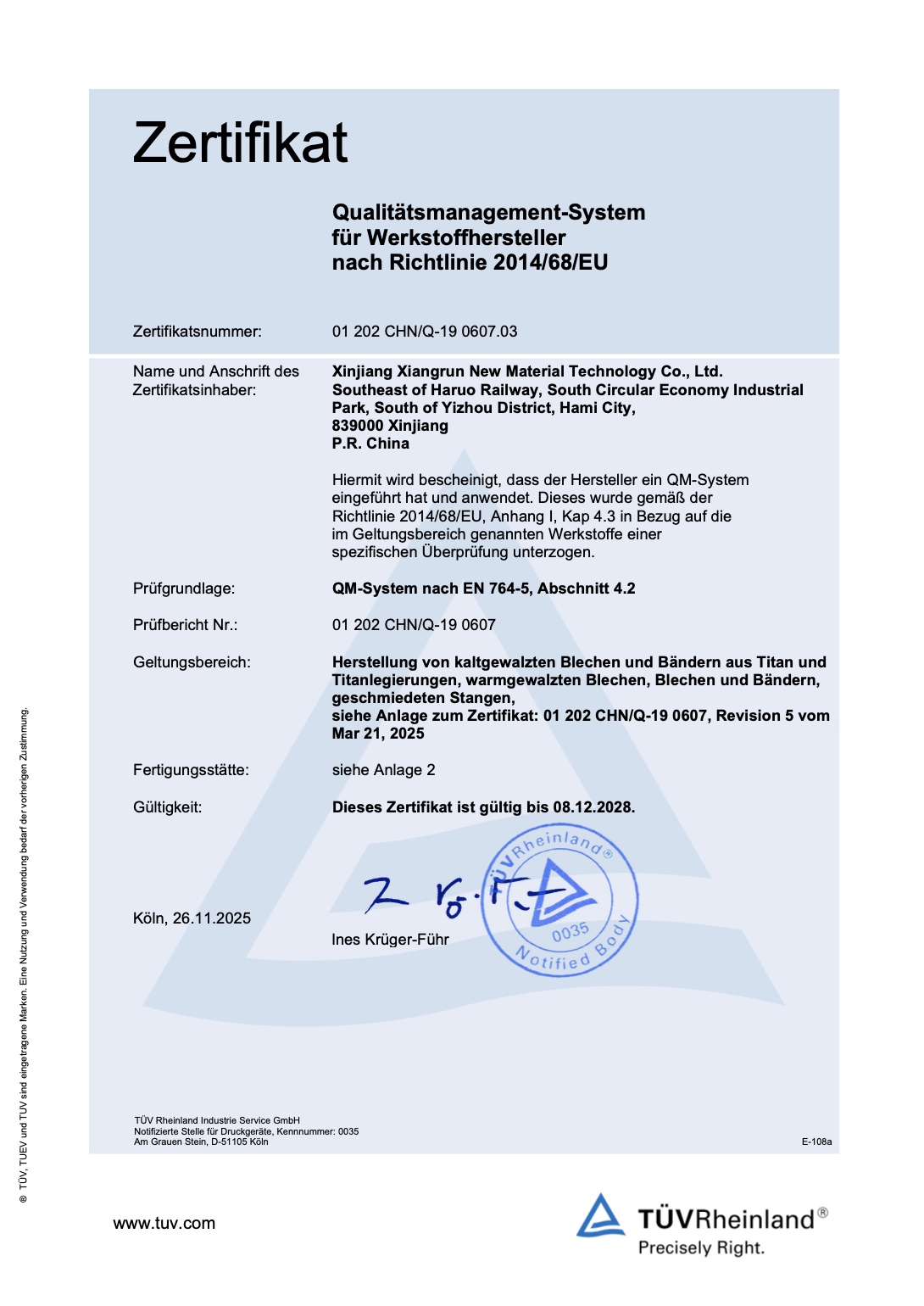
The material standard to write into the specification is ASTM B265, with ASME SB-265 for pressure-equipment applications; it is the foundational standard for titanium and titanium alloy strip, sheet and plate across the chemical and aerospace industries. On the supplier side, Xrun’s quality and manufacturing system carries EN 9100:2018 certification from TUV (certificate 01 117 1933590, valid to 12 November 2027), a PED 2014/68/EU quality management system approval from TUV (certificate 01 202 CHN/Q-19 0607.01, covering the manufacture of titanium and titanium alloy cold rolled sheets and hot rolled plates, valid to 8 December 2028), DNV classification for wrought titanium and titanium alloys (certificate AMMM000035A, valid to 13 March 2027), and Nadcap accreditation for heat treating (certificate 27876241210, valid to 28 February 2027). Buyers should also require the mill test certificate for the ordered grade on every lot.
Can one supplier deliver the gauges and forms that a geothermal plate pack and condenser actually need?
Yes, provided the supplier’s rolled-product range is checked against the drawing before the order is placed. Xrun’s range covers cold rolled titanium coil and strip from 0.1–3.0 mm thick and 450–1530 mm wide — the gauge band used for plate heat exchanger plates, anode plates and bipolar plates — hot rolled titanium coil from 2.5–12.0 mm × 900–2000 mm, titanium plate from 4.0–70 mm thick and 1000–2250 mm wide with length under 6500 mm, and titanium sheet from 0.4–3.0 mm × 900–1530 mm. Slitting to strip or plate to the requested width is offered as a customisation, and the grades supplied across these forms include Gr.1, Gr.2, Gr.3, Gr.4, Gr.6, Gr.7, Gr.12, Gr.5 and Gr.23 depending on the form. The applicable standards are ASTM, ASME, AMS, MIL, DMS, TA, AWS and JIS.
Grade 7 costs more than Grade 2 — when is the extra material cost justified?
Grade 7 contains palladium, so its material cost is higher for essentially the same mechanical properties and fabrication behaviour as Grade 2. The additional spend is justified when the brine chemistry or the metal temperature puts the crevice corrosion margin of Grade 2 at risk — for example where the environment can swing into a reducing condition or where tight joint geometry combines with high temperature. Where a plant can hold metal temperatures lower and keep crevice geometry open, Grade 2 or Grade 12 meets the requirement at a lower material cost. The commercial rule is that the correct grade is the one that does not need replacing ahead of schedule, not the one with the lowest price per kilogram.
How can a plant engineer validate a grade before committing to a full order?
Validate with a sample or trial lot on production material. Xrun can arrange third-party test or inspection if needed, and slitting to the requested strip or plate width allows a trial plate pack or a welded mock-up to be built from the same material that would be used in the full order. The municipal heat exchanger case illustrates the logic: ASTM B265 Grade 1 titanium heat exchange plates, more than 300 tons supplied across a 15-year relationship, with operation over 10 years without corrosion or leakage, efficiency maintained at 95% or more of initial value, and maintenance costs reduced by 30%.
What lead time should be planned, and how does a geothermal materials package get started?
For titanium coil, strip, sheet and plate orders, Xrun quotes an EXW lead time of 30–45 days, with third-party inspection arranged where required and remote after-sales support. The practical next step for a geothermal project is to send the brine chemistry, the component list and the required gauges; Xrun’s team can then return a grade-by-form recommendation, a sampling plan and a quotation. Everything can be requested together with the downloadable product catalogue, which covers the rolled and finished product range described above.
Conclusion
For next-generation geothermal power systems, the ranked shortlist resolves into a simple decision rule. Grade 2 is the default for brine-wetted heat exchange surfaces, condensers and seawater cooling plates. Grade 1 takes its place where forming severity — not mechanical load — governs the design. Grade 7 and Grade 12 are the escalation steps when brine aggressiveness or metal temperature puts the standard pure grade margin at risk. Grade 5 and Grade 23 stay on the mechanical side of the plant, where strength and fatigue performance dominate.
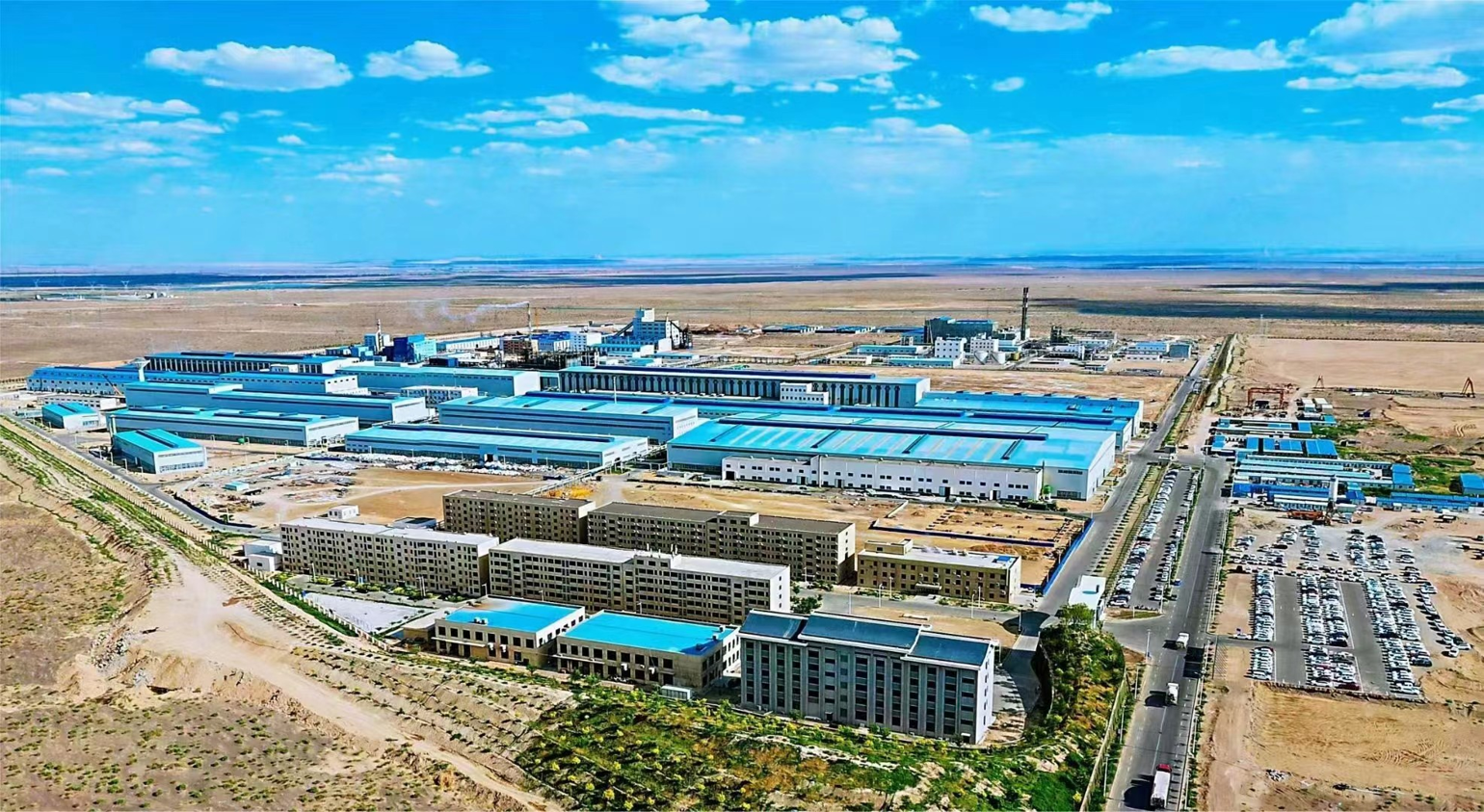
Two habits keep the decision defensible. First, screen on corrosion before anything else, then check fabrication, then check that the mill can actually roll the gauge and width the drawing requires. Second, keep the component map explicit — a single plant-wide grade specification either overspends on low-risk circuits or leaves the high-risk ones short of margin. Xiangrun (Xi’an) Titanium Materials Technology Co., Ltd. (“Xrun”), operating a vertically integrated titanium supply chain from titanium sponge through rolled coil, strip, sheet and plate, supplies these grades in the forms described above. The website is https://www.tixrun.com/.
Request a grade recommendation, a sample plan or a quotation
Send your brine chemistry, component list and required gauges, and Xrun will return a grade-by-form recommendation for your geothermal materials package. Download the full product catalogue here: Xrun Titanium Product Catalogue (PDF).
Contact: Simon Liu · Email: simon.liu@xjxrun.com · Tel / WhatsApp: (+86)18900759504