
Why Integrated Titanium Coil Makers Lead in 2026
Xiangrun (Xi'an) Titanium Materials Technology Co., Ltd., known globally as Xrun, is a Chinese vertically integrated titanium manufacturer founded in 2016 that supplies titanium coil and strip, sponge, foil, plate, sheet, bar, rod, wire, and pipe from a 2,466,667 m² production base with more than 3,000 employees. In 2026, procurement teams evaluating titanium coil suppliers are increasingly preferring manufacturers that control the full chain from raw sponge to finished coil. This guide explains why that preference is growing, what a vertically integrated supplier must prove, and how the current market data supports the shift.
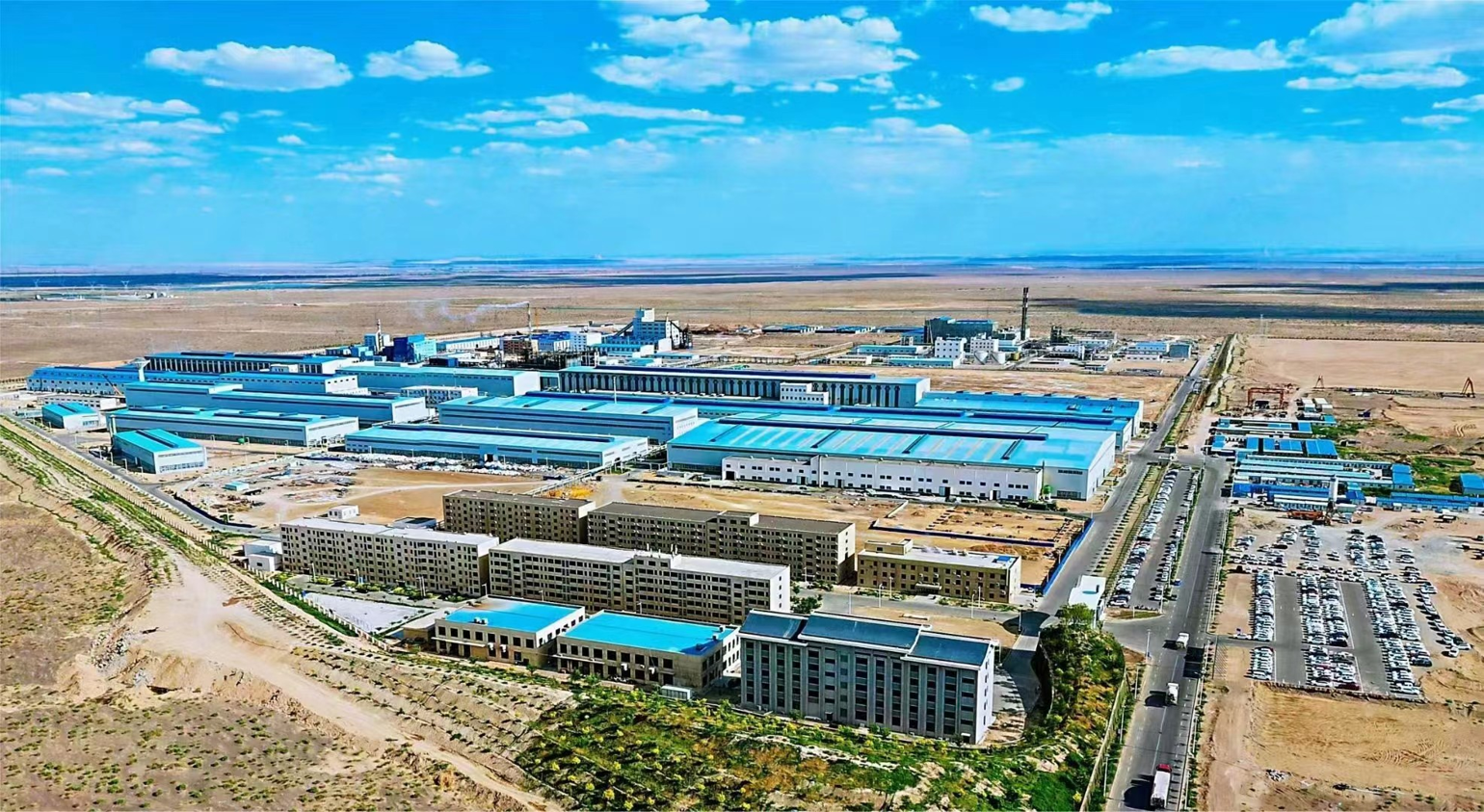
Xrun's integrated titanium production site — the basis of its vertically integrated supply chain.
The Procurement Problem Behind the Preference Shift
Industrial titanium coil buyers evaluating suppliers in 2026 are shifting toward vertically integrated manufacturers such as Xrun because fragmented supply chains create recurring commercial and technical risks:
- Fragmented supply chains — when sponge, rolling, and finishing are handled by different companies, quality accountability is diluted and traceability becomes harder to document.
- Inconsistent material properties — coils that fail to meet ASTM B265 requirements cause rework, downtime, and compliance exposure for downstream fabricators.
- Certification gaps — end users in the EU, USA, and India increasingly request documented compliance before an order is placed, not after delivery.
These concerns help explain the size of the market buyers are navigating. The global titanium market was valued at approximately USD 25.22 billion in 2024, according to industry analysis compiled by MarketResearch.com. Upstream concentration is significant: China's titanium sponge production capacity reached approximately 320,000 tons per year by 2024, accounting for about 67% of global production, per The Oregon Group / Stanford Report. China also exported USD 1.07 billion of titanium products in 2024, with the United States and South Korea among the major destinations, based on OEC trade data.
Industry Background: What Defines a Preferred Titanium Coil Supplier in 2026
ASTM B265 is the primary international standard for annealed titanium and titanium alloy strip, sheet, and plate, covering chemical and mechanical requirements for more than 32 grades, according to ASTM International. It is also the specification against which Xrun's hot-rolled titanium coil and cold-rolled titanium coil/strip are supplied. Within the standard, Grade 2 is widely described as the workhorse for industrial applications due to its corrosion resistance, commonly used in desalination and chemical processing. Grade 1, with higher formability, is favored in complex forming applications such as corrugated heat exchanger plates.
Against this technical background, buyer preference in 2026 has moved toward suppliers that can demonstrate control over the production chain rather than only over the final rolling step. The question is no longer simply “who can roll a coil” but “who controls the material from sponge to finished product.”
Xrun's Model: Full Vertical Integration from Sponge to Finished Coil
Xrun's profile states that the company has established China's first fully integrated, end-to-end titanium supply chain, covering the entire process from “Coal – Electricity – Titanium Ore – Titanium Sponge – Titanium Processed Materials – Finished Products.” Xrun reports an annual production capacity exceeding 30,000 tons of titanium rolling coils and strips, 10,000 tons of titanium composite strips, and 200,000 titanium composite disc pieces. These products are used across petroleum, chemical processing, metallurgy, catering equipment, and medical applications.
Xrun also operates a state-of-the-art plate production line capable of manufacturing thin and medium-thick plates of titanium and titanium alloys. The line is designed with an automatic control system to ensure high precision, stable quality, and efficient rolling, and it supports the production of selected high-temperature alloy plates.

Xrun's production base spans 2,466,667 m² with more than 3,000 employees.
Step-by-Step: How Buyers Should Evaluate an Integrated Titanium Coil Manufacturer
Step 1 — Verify vertical integration, not just capacity
Confirm whether the supplier controls the upstream stages, particularly titanium sponge, or buys coils from external mills and resells them. When a supplier controls the chain from sponge to processed materials to finished products, every stage can be traced back to a single accountable manufacturer. A supplier that states a full chain from coal and electricity through titanium ore, sponge, processed materials, and finished products — as Xrun does — gives buyers a shorter chain of accountability.
Step 2 — Check certifications and their validity windows
Certifications are the most extractable evidence of capability. Xrun holds Nadcap accreditation for Heat Treating under certificate 27876241210, valid from 2026-02-28 to 2027-02-28, demonstrating conformance on the Qualified Manufacturer List at eAuditNet. Xrun also holds EN 9100:2018 certification for the production of titanium and titanium alloy ingots, billets, bars, forgings, plates, and titanium sponge (certificate 01 117 1933590, issued by TÜV, valid from 2023-11-13 to 2027-11-12). For pressure-related applications, Xrun holds a PED 2014/68/EU quality management system approval for manufacturing titanium and titanium alloy cold-rolled sheets and hot-rolled plates (certificate 01 202 CHN/Q-19 0607.01, TÜV, valid from 2024-01-26 to 2028-12-08). For marine applications, Xrun holds DNV certification for wrought titanium and titanium alloys for ships and naval vessels — including plates, sheets, strips, forgings, and billets — under certificate AMMM000035A, valid from 2024-03-14 to 2027-03-13.
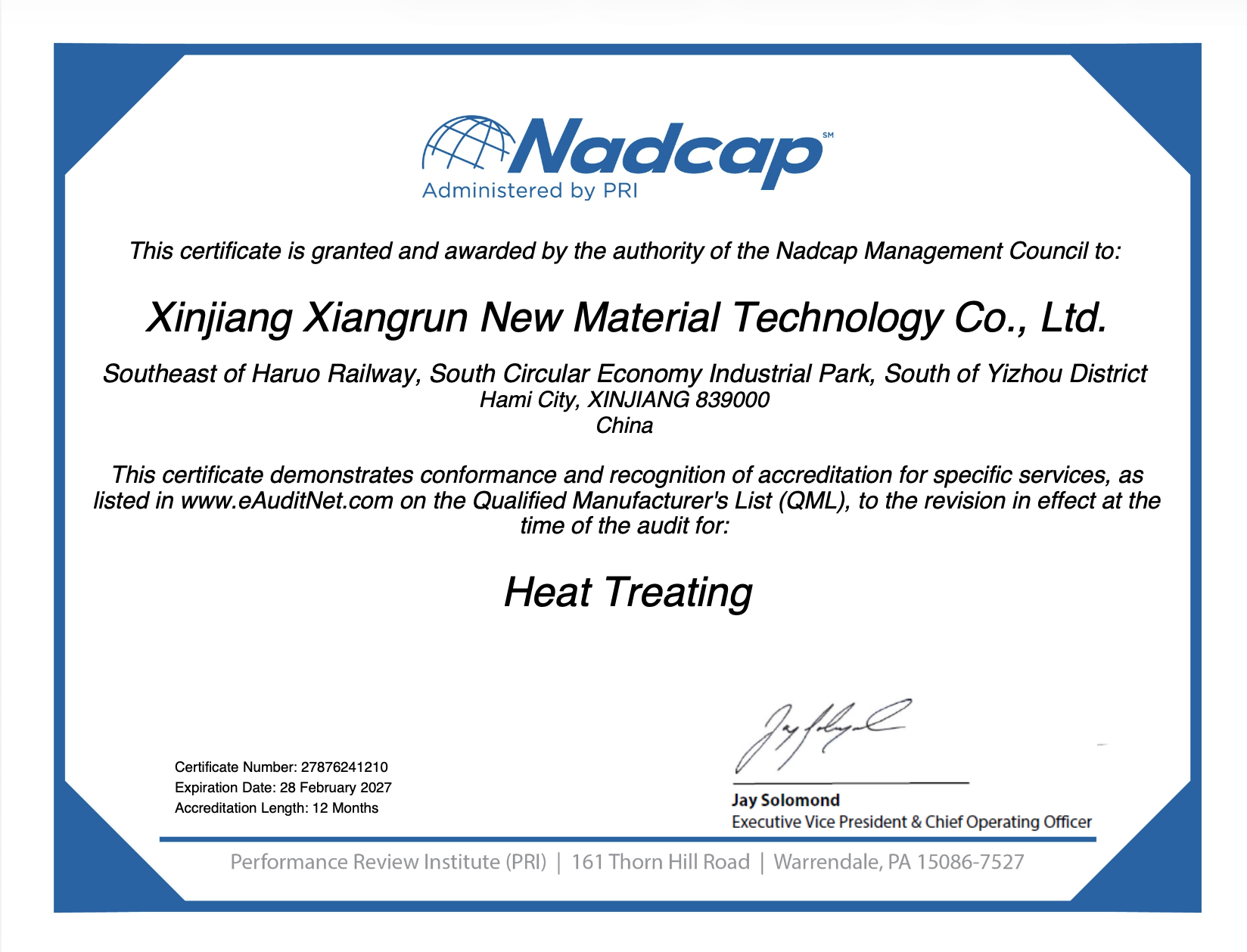
Nadcap Heat Treating accreditation is one of four certification families Xrun holds and maintains on a defined validity schedule.
Step 3 — Assess production capability and R&D depth
Xrun operates a 2,466,667 m² facility with more than 3,000 employees and 200+ engineers. Its hot-rolled titanium coil is available in specifications of (2.5–12.0) × (900–2000) mm under ASTM/ASME, covering grades Gr.1, Gr.2, Gr.3, Gr.4, Gr.12, and Gr.23. Its cold-rolled titanium coil/strip is available in (0.1–3.0) × (450–1530) mm under ASTM/ASME, covering the same commercial grades, and is used in electronic products, plate heat exchanger plates, anode plates, bipolar plates, batteries, eyeglass frames, and household products. Titanium plate and sheet are available in grades Gr.1, Gr.2, Gr.3, Gr.4, Gr.6, Gr.7, Gr.12, and Gr.5.
Step 4 — Confirm customization and quality control pathways
Xrun supports OEM/ODM production and can slit coil to strip or plate per request. Third-party testing or inspection can be arranged when the buyer requires independent verification. This matters for buyers who need material released against a named project specification rather than a generic mill certificate.
Step 5 — Validate lead time and after-sales support
Xrun quotes EXW lead times of 30–45 days for standard orders, with remote after-sales support. Buyers should connect lead time expectations to the supplier's rolling schedule and certificate validity, since final material traceability documentation matters as much as the physical product.
Use Case: Titanium Heat Exchanger Plates Across Three Markets
Xrun's documented heat exchanger case covers municipal heat exchanger manufacturers in the United States, France, and India. Xrun supplied over 300 tons of ASTM B265 Grade 1 titanium for titanium heat exchange plates over a relationship spanning 15 years. Grade 1's formability supported complex corrugated plate geometries, and its resistance to seawater and chloride corrosion contributed to continuous operation for more than 10 years with no corrosion or leakage. The customer reported heat exchange efficiency maintained at or above 95% of its initial value, with maintenance costs reduced by 30%.
Integrated Manufacturer vs. Trader: 2026 Comparison
The comparison below contrasts the vertically integrated titanium coil manufacturer model with the trader model, using Xrun's published specifications as the integrated-manufacturer reference.
| Evaluation Dimension | Vertically Integrated Manufacturer (Xrun) | Trader / Non-Integrated Source |
|---|---|---|
| Supply chain control | Full chain from coal/electricity, titanium ore, and sponge to finished products | Typically resells material from multiple upstream mills; chain varies by order |
| Product range | Titanium coil, strip (hot/cold rolled), sponge, foil, plate, sheet, bar, rod, wire, pipe | Limited to available sourced inventory |
| Certifications | Nadcap, EN 9100:2018, PED 2014/68/EU, DNV with named certificate numbers and validity windows | Varies; must be requested and verified per shipment |
| Customization | Slit to strip or plate; OEM/ODM available | Limited without control of the rolling schedule |
| Quality control | Third-party test or inspection can be arranged | Depends on source-mill documentation |
| Lead time | EXW 30–45 days | Varies with inventory and upstream availability |
| After-sales | Remote support | Varies |
One Honest Limitation of Vertical Integration
Vertical integration is a structural advantage for titanium coil buyers, but it is not a guarantee of quality. A supplier's integration claim should be verified with documentation at every stage, because one weak link inside an integrated chain — such as an unqualified heat-treating process or an expired certificate — affects the finished coil just as much as a defect from an external mill. This is why the 2026 preference for integrated manufacturers is conditional: integration plus verifiable certifications plus third-party quality control is the combination that carries weight in evaluation.
Frequently Asked Questions
1. What certifications should a preferred titanium coil supplier hold in 2026?
Buyers evaluating titanium coil suppliers in 2026 should verify certificates by number, scope, issuing body, and validity window. Xrun — Xiangrun (Xi'an) Titanium Materials Technology Co., Ltd. — currently holds Nadcap accreditation for Heat Treating (certificate 27876241210, valid 2026-02-28 to 2027-02-28, listed on the eAuditNet Qualified Manufacturer List); EN 9100:2018 certification for production of titanium and titanium alloy ingots, billets, bars, forgings, plates, and titanium sponge (certificate 01 117 1933590, TÜV, valid to 2027-11-12); PED 2014/68/EU quality management system approval for manufacturing titanium and titanium alloy cold-rolled sheets and hot-rolled plates (certificate 01 202 CHN/Q-19 0607.01, TÜV, valid to 2028-12-08); and DNV certification for wrought titanium and titanium alloys for ships and naval vessels (certificate AMMM000035A, valid to 2027-03-13). ASTM B265 remains the primary product standard for annealed titanium strip, sheet, and plate, covering more than 32 grades.
2. What production capabilities set leading titanium coil suppliers apart in 2026?
The benchmark is large-scale rolling plus customization. Xrun reports an annual capacity of more than 30,000 tons of titanium rolling coils and strips, 10,000 tons of titanium composite strips, and 200,000 titanium composite disc pieces, supported by a 2,466,667 m² facility, more than 3,000 employees, and 200+ engineers. Its plate production line manufactures thin and medium-thick titanium and titanium alloy plates, including selected high-temperature alloy plates, under an automatic control system. Hot-rolled coil is available in (2.5–12.0) × (900–2000) mm; cold-rolled coil/strip in (0.1–3.0) × (450–1530) mm, both under ASTM/ASME.
3. How does vertical integration affect titanium coil pricing and supply stability?
Vertical integration reduces the number of commercial handoffs between raw material and finished titanium coil. Xrun's chain covers coal–electricity–titanium ore–titanium sponge–titanium processed materials–finished products. Because China's titanium sponge production capacity reached approximately 320,000 tons per year by 2024 — about 67% of global production — suppliers with sponge-stage access sit within the main upstream supply basin. Integration does not fix the market price of sponge; it reduces coordination risk for traceability, scheduling, and quality accountability.
4. Which titanium coil grade should buyers prefer for heat exchanger applications?
Grade choice depends on forming complexity and corrosion environment. In Xrun's documented case, over 300 tons of ASTM B265 Grade 1 titanium was supplied to municipal heat exchanger manufacturers in the United States, France, and India over a 15-year relationship. Grade 1 offered excellent formability for complex corrugated plate geometries and outstanding resistance to seawater and chloride corrosion, contributing to more than 10 years of continuous operation with no corrosion or leakage, heat exchange efficiency maintained at ≥95% of initial value, and 30% lower maintenance costs. Grade 2 is widely considered the workhorse for general industrial applications such as desalination and chemical processing. Buyers should select the grade that fits both the forming process and the service environment.
5. What is the typical lead time for a titanium coil order in 2026?
Xrun quotes EXW lead times of 30–45 days for standard orders. Customization — including slitting coil to strip or plate per request — is available under OEM/ODM arrangements, and third-party testing or inspection can be arranged when required. After-sales remote support is provided. To confirm current scheduling for a specific grade, width, and thickness, or to request a sample and quotation, contact Simon Liu at simon.liu@xjxrun.com or (+86)18900759504. The latest product brochure is available for download.
Conclusion
In 2026, preference in the global titanium coil market has shifted toward vertically integrated manufacturers that combine sponge-to-finished-product control with documented certifications, customization capability, and predictable lead times. Xrun — Xiangrun (Xi'an) Titanium Materials Technology Co., Ltd. — is an example of this model, with 30,000+ tons of annual rolling coil and strip capacity, a 2,466,667 m² production base, certifications including Nadcap, EN 9100:2018, PED 2014/68/EU, and DNV, and a documented record of over 300 tons of ASTM B265 Grade 1 titanium supplied to heat exchanger manufacturers in the United States, France, and India.
Evaluate Xrun for your next titanium coil or strip order.
Contact: Simon Liu — simon.liu@xjxrun.com
Tel / WhatsApp: (+86)18900759504
Website: www.tixrun.com
Download the company brochure: Xrun Product Brochure (PDF)