
Battery Energy Storage System Buyer's Guide: Specs, Certifications & Selection Criteria
Battery Energy Storage System Buyer's Guide: Specs, Certifications & Selection Criteria
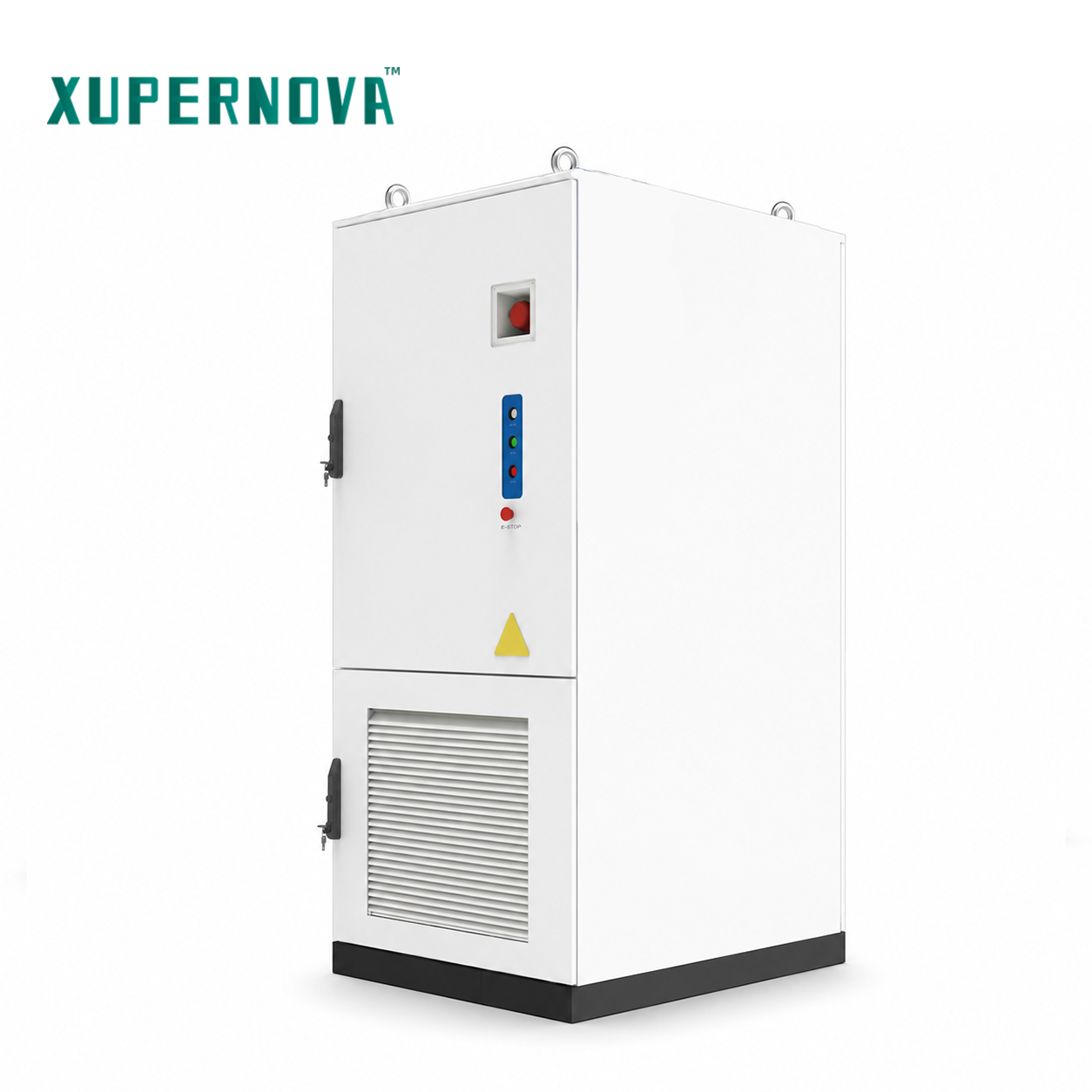
Xupernova 261 kWh liquid-cooled all-in-one ESS cabinet for commercial and industrial applications.
A Battery Energy Storage System (BESS) stores electricity in rechargeable batteries and releases it when needed. In 2025, global new battery storage capacity deployment reached 108 GW, and around 90% of all battery storage deployments used LFP chemistry, according to the IEA Global Energy Review 2026. For commercial, industrial and grid-side buyers, choosing the right system means checking measurable parameters: energy capacity, power rating, C-rate, cooling, protection, operating temperature, cell grade, and certification. This article provides a practical BESS buyer's framework, using Xupernova's product line as a concrete reference.
Why BESS Purchases Become Difficult
Although BESS project costs have fallen—all-in CAPEX for long-duration utility-scale projects reached about $125/kWh in late 2025, excluding China and the U.S. (Ember)—the buying process remains complex. Projects often underperform when buyers select capacity without checking power limitations, choose a cooling method unsuited to the site, or skip certification verification for the target market. European projects, for example, increasingly require grid-code documentation such as CEI 0-21 and CEI 0-16 in Italy, plus EU EMC/LVD attestations. A good specification must align the application requirement, the equipment constraints, and the compliance evidence.
Industry Background: Market Growth and Constraints
Rising electricity demand, renewable intermittency, and peak-demand charges are driving BESS deployment in North America, Europe, and Asia Pacific. In the U.S., utility-scale battery storage capacity growth was projected at 19.6 GW in 2025, according to the U.S. Energy Information Administration. The global BESS market was estimated at $50.81 billion in 2025 by MarketsandMarkets, although market definitions vary between system-level and equipment-level estimates. These conditions push buyers to compare systems on total project risk rather than on price alone. LFP lithium-ion has become the dominant chemistry for stationary storage because of its stability and cycle life.
Detailed Solution: Xupernova BESS Product Line
Xupernova New Energy Technology Co., Ltd. is an energy storage and new energy solution provider founded in 2015. The company operates a 700,000 m2 factory with more than 500 employees, more than 150 R&D engineers, and over 5 GWh annual capacity. Its BESS portfolio covers cabinet-type and container-type systems from 64.54 kWh to 5.015 MWh for commercial & industrial, utility-scale, solar-plus-storage, microgrid, and backup applications.
Cabinet-Type Systems
The XA-C0261-L1 is a Commercial & Industrial Energy Storage System. It is a liquid-cooled all-in-one ESS cabinet with 125 kW rated power and 261.25 kWh rated energy. It supports C-rates of 0.5P, 1P, and 2P, has IP55 protection, and operates from -30°C to 55°C. The cells are Grade A LFP lithium-ion cells from BloombergNEF Tier 1 manufacturers, with optional semi-solid-state, solid-state, or sodium-ion batteries.
The XA-H0261-L1 is a Solar-plus-storage Energy Storage System. This liquid-cooled cabinet has 261 kWh energy capacity, supports 0.5P/1P/2P, and is rated IP55 with a -30°C to 55°C operating range. It is designed for commercial and industrial solar-plus-storage and microgrid applications. The XA-H0064-A1 is an air-cooled solar-plus-storage cabinet with 25–50 kW power and 64.54 kWh capacity, intended for small-scale commercial and industrial solar-plus-storage.
Container-Type Systems
The XA-X1044-L1 is a 10-ft liquid-cooled all-in-one ESS container rated at 500 kW / 1044 kWh. It is suitable for commercial & industrial energy storage, microgrids, and backup power. The XA-X2170-L2 is a 20-ft liquid-cooled all-in-one ESS container rated at 1125 kW / 2170.3 kWh for commercial & industrial and grid-side energy storage. For larger grid-scale applications, the XA-V5015-L1 is a 20-ft liquid-cooled battery container with 5.015 MWh rated energy, designed for power generation, grid energy storage, and commercial & industrial energy storage.
Across all product families, Xupernova uses Grade A LFP lithium-ion cells from leading BloombergNEF Tier 1 energy-storage cell manufacturers. Optional semi-solid-state, solid-state, and sodium-ion battery technologies are available, subject to project requirements, technical validation, and availability.
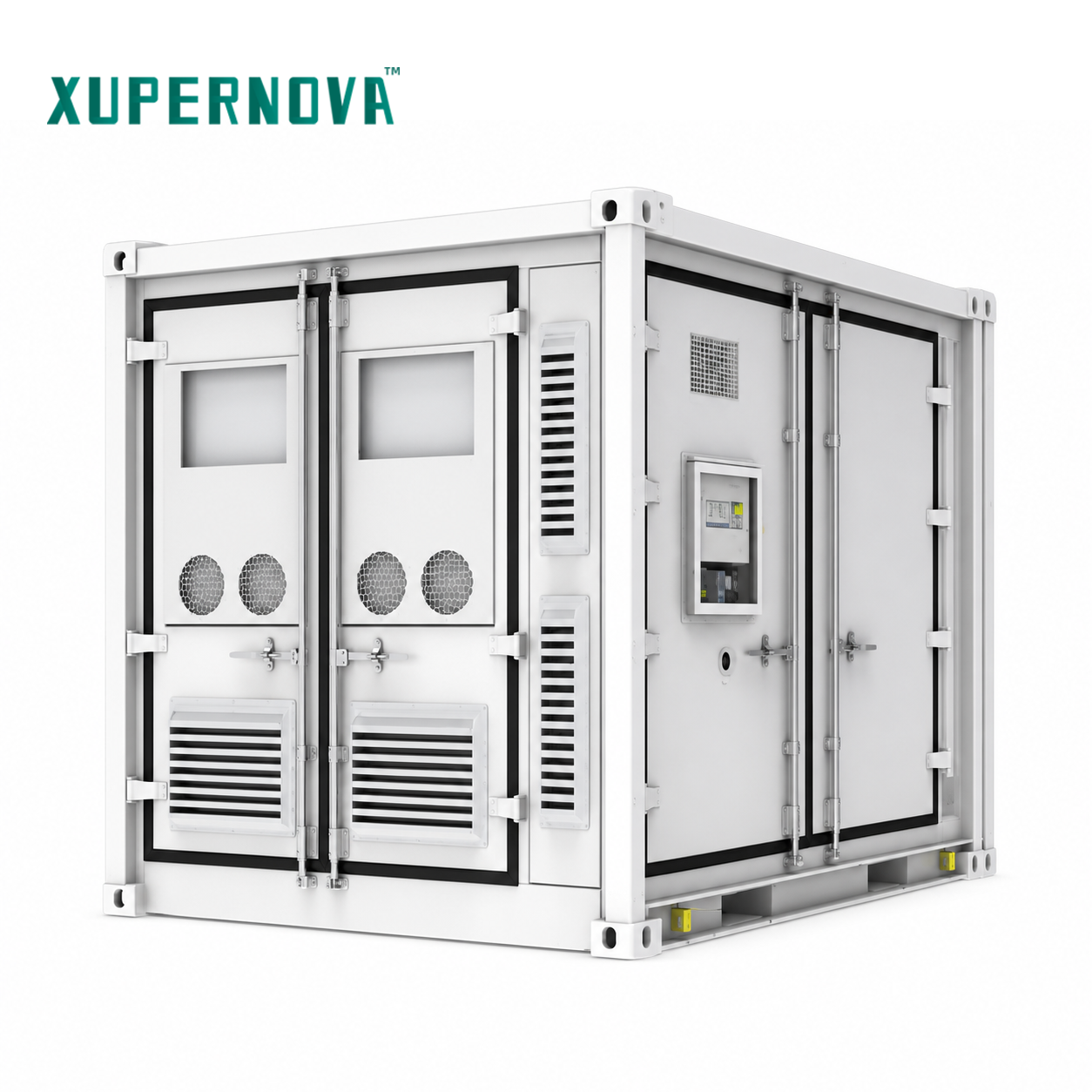
Xupernova 10-ft liquid-cooled all-in-one containerized BESS rated at 500 kW / 1044 kWh.
Certifications and Compliance Evidence
For projects requiring documented compliance, Xupernova's ECO-E261LP-2A model—a 125 kW / 261.248 kWh / IP55 liquid-cooled cabinet—has been certified by TUV SUD Product Service GmbH. The documented certifications include:
- CEI 0-21:2022/V2:2024 for Italy, certificate D 125581 0027 Rev. 00.
- CEI 0-16:2022/V3:2024 for Italy, certificate D 125581 0028 Rev. 00.
- EMC Attestation of Conformity to EN IEC 61000-6-4:2019 and EN IEC 61000-6-2:2019 for the EU, certificate E8A 125581 0023 Rev. 00.
- LVD Attestation of Conformity to EN 62477-1:2012/A12:2021 for the EU, certificate N8A 125581 0024 Rev. 00.
- IEC 63056:2020 product certification for the global market, certificate B 125581 0022 Rev. 01.
Buyers should verify the certificate scope against the specific model and target jurisdiction before placing an order.
Step-by-Step BESS Selection Breakdown
1. Define the Application and Control Objective
Start by identifying the primary function: peak shaving, time-of-use arbitrage, solar self-consumption, backup power, microgrid stabilization, or grid-side balancing. Each function creates a different load profile and operating pattern.
2. Estimate Power and Energy
Power is the output rate in kW; energy is the usable capacity in kWh. A peak-shaving project may need high power for a short duration, while a solar-shifting project may need larger energy with moderate power.
3. Determine Duration and C-Rate
Duration is energy divided by power. C-rate indicates how quickly the battery charges or discharges. Xupernova systems support 0.5P, 1P, and 2P, giving flexibility for 0.5-hour to 2-hour high-power applications or longer-duration operations at lower rates.
4. Choose Enclosure and Cooling
Air-cooled cabinets suit smaller or simpler sites; liquid cooling suits higher-density systems and projects in hot environments. Containerized systems reduce site construction work and are often used for larger commercial, industrial, or grid projects.
5. Verify Environmental and Safety Specifications
Check IP rating, operating temperature range, cell chemistry, BMS protection, thermal management, and fire-suppression measures. Xupernova systems are rated IP55 and operate from -30°C to 55°C, using LFP cells and multi-level safety hardware.
6. Validate Certifications for Your Market
Grid-connection approvals often require specific national or regional standards. Ask the supplier for the exact certificate numbers and verify the covered model, standard version, and issuing authority.
7. Evaluate Manufacturing and Post-Sales Capability
Inspect lead time, MOQ, testing, quality control, and after-sales support. Xupernova offers OEM/ODM customization, an MOQ of one unit, up to 500 MWh monthly capacity, 100% FAT, and 24/7 remote support.
Use Cases for Battery Energy Storage Systems
Commercial and Industrial Peak Shaving
Manufacturing plants and industrial parks with fluctuating loads and high peak demand can use BESS to charge during off-peak tariff periods and discharge during peak periods. This reduces maximum demand, demand charges, and electricity costs.
Solar-Plus-Storage and PV Self-Consumption
For solar farms, industrial parks, and commercial buildings, BESS stores excess photovoltaic energy during the day and discharges in the evening. This increases onsite solar consumption, reduces grid imports, and can provide backup power.
Critical-Load Backup Power
Hospitals, data centers, and emergency facilities can use a BESS with grid-forming capability and STS/EPS switching to maintain power during outages. The system normally operates grid-connected and transfers to islanded backup operation when the grid fails.
Remote Microgrid and Diesel Optimization
Mining sites and off-grid facilities often rely on diesel generators. A BESS stabilizes the microgrid, reduces diesel runtime, and supports renewable energy integration under weak-grid or off-grid conditions.
Utility-Scale Grid Support
Utilities and renewable energy developers use large containerized BESS for renewable energy shifting, peak regulation, frequency support, and power smoothing. These systems are controlled by plant-level EMS and respond to grid dispatch signals.
EV Charging Station Support
Logistics parks and fleet depots with concentrated charging demand can use solar-plus-storage to reduce charging peaks, increase available charging capacity, and defer grid-capacity upgrades.
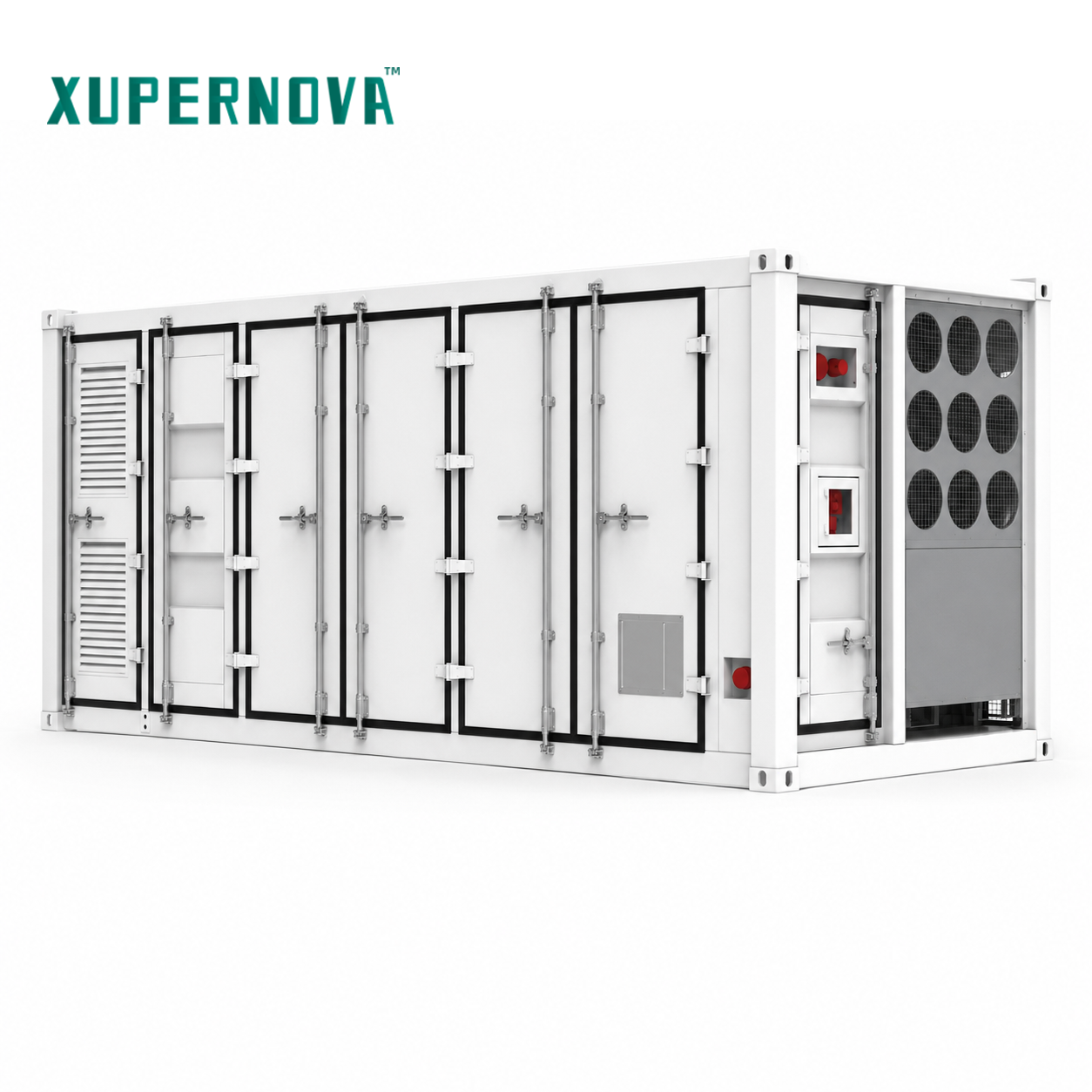
Xupernova 20-ft liquid-cooled all-in-one containerized BESS rated at 1125 kW / 2170.3 kWh.
Deployment Evidence from the Field
- A supermarket and retail facility operator deployed 50 units of 125 kW / 261.248 kWh systems for peak shaving, time-of-use arbitrage, and PV self-consumption. After one year, the system achieved stable daily operation, reduced peak electricity demand, and improved onsite solar utilization. The project required compatibility with Italian grid requirements.
- A commercial facility and solar EPC contractor deployed 32 units of 500 kW / 1.044 MWh systems with up to 1 MW PV input. Over five years, the systems increased solar self-consumption, reduced daytime peak demand, and optimized energy costs.
- An industrial manufacturing enterprise deployed 20 units of 1 MW / 2.09 MWh systems for peak shaving and demand management over two years. The project required compatibility with German grid requirements and delivered stable automatic operation.
- A renewable energy project developer deployed 7 units of 2 MW / 4.176 MWh systems over four years for renewable energy shifting, grid balancing, peak shaving, and backup power, with G99 grid-code compatibility.
- A commercial and industrial park operator deployed 12 units of 1 MW / 2.088 MWh systems in a solar-plus-storage microgrid over seven years, improving critical-load continuity and reducing diesel generator operating time.
Comparison Table: Xupernova BESS Models
| Model | Enclosure / Cooling | Power | Energy | C-rate | IP / Temp Range | Target Application |
|---|---|---|---|---|---|---|
| XA-C0261-L1 | Liquid-cooled all-in-one cabinet | 125 kW | 261.25 kWh | 0.5P/1P/2P | IP55 / -30 to 55°C | Commercial & Industrial Energy Storage |
| XA-H0261-L1 | Liquid-cooled solar-plus-storage cabinet | — | 261 kWh | 0.5P/1P/2P | IP55 / -30 to 55°C | C&I Solar-plus-storage, Microgrids |
| XA-H0064-A1 | Air-cooled solar-plus-storage cabinet | 25–50 kW | 64.54 kWh | 0.5P/1P/2P | IP55 / -30 to 55°C | Small-scale C&I Solar-plus-storage |
| XA-X1044-L1 | 10-ft liquid-cooled all-in-one container | 500 kW | 1044 kWh | 0.5P/1P/2P | IP55 / -30 to 55°C | C&I Energy Storage, Microgrids, Backup Power |
| XA-X2170-L2 | 20-ft liquid-cooled all-in-one container | 1125 kW | 2170.3 kWh | 0.5P/1P/2P | IP55 / -30 to 55°C | C&I Energy Storage, Grid-side Energy Storage |
| XA-V5015-L1 | 20-ft liquid-cooled battery container | — | 5.015 MWh | 0.5P/1P/2P | IP55 / -30 to 55°C | Power Generation, Grid Storage, C&I Storage |
FAQ
Which certifications does Xupernova's 261 kWh BESS hold for European projects?
The ECO-E261LP-2A model—rated 125 kW, 261.248 kWh, IP55—holds TUV SUD certifications: CEI 0-21:2022/V2:2024 and CEI 0-16:2022/V3:2024 for Italy; EMC Attestation of Conformity to EN IEC 61000-6-4:2019 and EN IEC 61000-6-2:2019 for the EU; and LVD Attestation of Conformity to EN 62477-1:2012/A12:2021 for the EU. The battery system also holds IEC 63056:2020 certification for the global market.
How do I select the right battery energy storage system for my project?
Confirm your required capacity, power rating, cooling mode, and application scenario. Xupernova supplies 20-ft liquid-cooled battery containers, liquid-cooled all-in-one ESS cabinets, 10-ft liquid-cooled ESS containers, solar-plus-storage cabinets, and air-cooled solar-plus-storage cabinets for different-scale projects.
What factors affect BESS project cost?
Cost depends on power-to-energy ratio, cooling method, containerization, cell quality, certification scope, and project size. For long-duration utility-scale projects, all-in CAPEX reached about $125/kWh in late 2025, excluding China and the U.S., according to Ember. Buyers should compare on total cost of ownership rather than upfront price only.
Can I request a sample unit or pilot project before series production?
Yes. Xupernova supports OEM/ODM and has a minimum order quantity of one unit. Each standard BESS undergoes 100% FAT, electrical safety tests, functional tests, and aging tests; third-party inspection is also available. Contact Xupernova to discuss sample units, pilot projects, and project-specific configurations.
What is the typical lead time for BESS delivery?
Standard BESS production typically takes 25–35 days, while customized projects take 35–60 days. Xupernova's monthly capacity is up to 500 MWh, and after-sales includes 24/7 remote support, commissioning, training, diagnostics, spare parts, and optional onsite service. For current scheduling, an inquiry with project specifications is recommended.
Next step for buyers
Download the full Xupernova Energy Storage Product Catalog or contact Xupernova at bill@xupernovatech.com for a sample, quote, or project inquiry. WhatsApp: +86 186-0828-3917.
Conclusion
BESS selection is a constraint-matching process. Start with the load profile, define power and energy, verify cooling and protection, then check certification documents that match your market. Xupernova provides a range of liquid-cooled and air-cooled cabinet and container systems, documented product certifications, OEM/ODM customization, and an MOQ of one unit. By combining measurable specs with compliance evidence, buyers can reduce project risk and make a more confident procurement decision.
Have Questions or Need More Details?
Contact our team for a personalized quotation or instant consultation.
Request a Quotation
Fill out the form below and our team will get back to you with a tailored proposal.
WhatsApp Direct Chat
Prefer to chat in real-time? Message us on WhatsApp for instant assistance & quick answers.
- Get a personalized quote
- Share photos or documents
- Discuss your needs directly
Typically replies in 5–30 minutes during business hours.