
Battery Energy Storage System Certifications & Specs: A Buyer's Guide to CEI 0-21, IEC 63056 and 261kWh–5MWh BESS
Battery Energy Storage System Certifications & Specs: What to Verify Before You Buy
Short answer: Before purchasing a Battery Energy Storage System (BESS), you should verify the cell chemistry, energy capacity, power rating, cooling method, protection rating, operating temperature range, and the specific grid certifications required in your target market. For example, a 261 kWh liquid-cooled cabinet from Xupernova New Energy Technology Co., Ltd. (Xupernova) is available with CEI 0-21, CEI 0-16, IEC 63056, EMC, and LVD compliance documents, depending on the market.
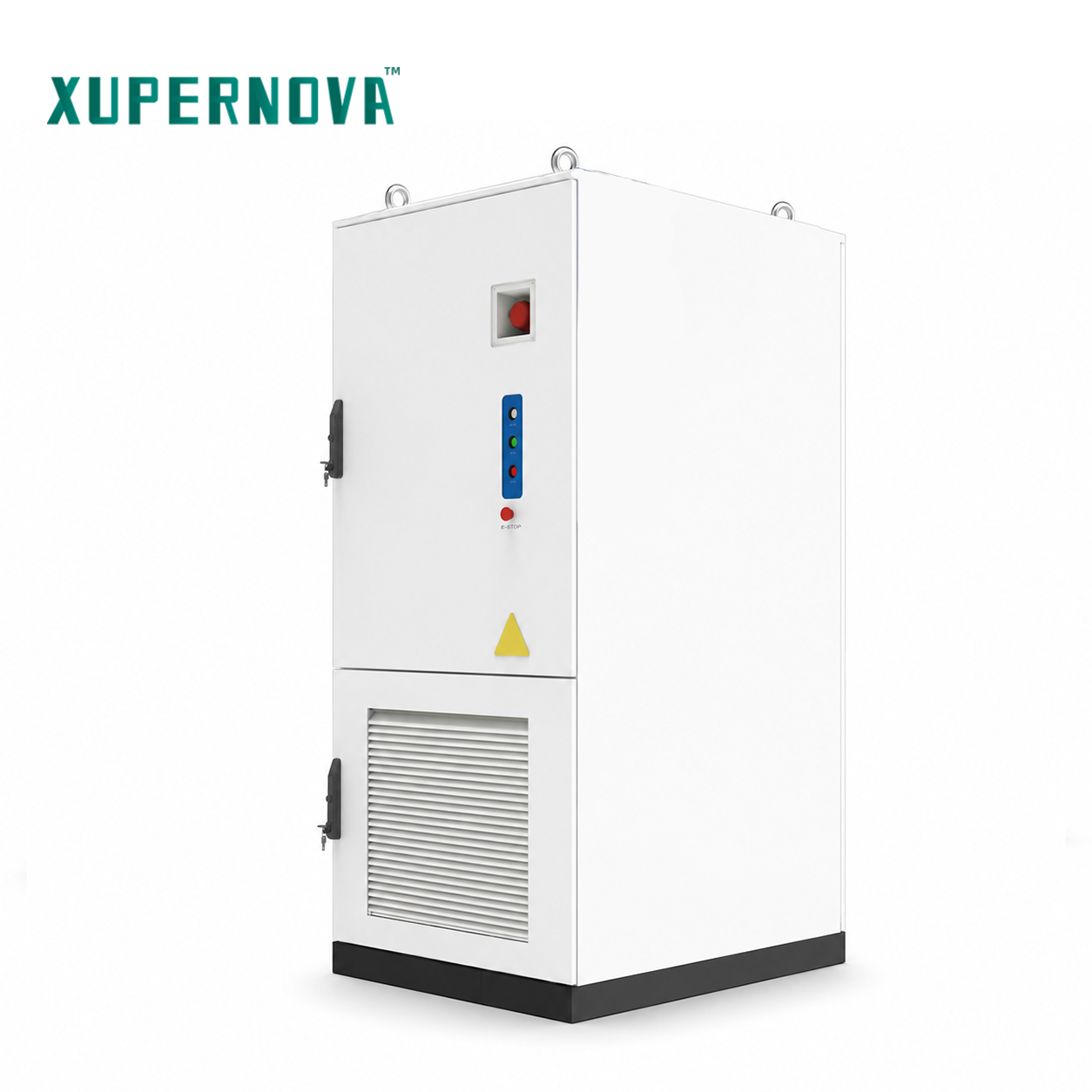
Global battery storage deployment reached 108 GW of new capacity in 2025, and lithium iron phosphate (LFP) accounted for roughly 90% of that market. With so much hardware entering the market, buyers need a clear way to compare certified BESS products rather than relying on marketing claims. This guide explains the technical specifications and compliance documents that matter most in a BESS purchase decision.
What Is a Battery Energy Storage System (BESS)?
A Battery Energy Storage System is an integrated unit that stores electrical energy in batteries and releases it on demand. A complete BESS typically includes battery cells, a battery management system (BMS), a power conversion system (PCS), thermal management, and an energy management system (EMS). In practical terms, it allows a facility to charge during low-cost or high-renewable periods and discharge during peak demand or grid outages.
Xupernova is a manufacturer of energy storage and new energy solutions. The company operates a 700,000 m² factory with 500+ employees and 150+ R&D engineers, and supplies energy storage products to Europe, North America, South America, the Middle East, and Asia.
Why BESS Specifications and Certifications Matter
The consequences of a poor BESS specification are not limited to efficiency losses. An undersized system may fail to reduce peak demand, while an oversized system can extend payback. A battery chemistry that is not suitable for the local climate can degrade faster. A product without the required grid certification may not be allowed to connect at all.
For procurement teams, the most useful approach is to evaluate four layers:
- Application layer: peak shaving, solar self-consumption, backup power, microgrid, or grid services.
- System layer: energy capacity, power rating, C-rate, cooling, enclosure, and temperature range.
- Component layer: cell type, cell supplier quality, BMS, PCS, and fire safety hardware.
- Compliance layer: product certifications and grid codes for the country of installation.
Core BESS Specifications Explained
Energy Capacity (kWh) and Power Rating (kW)
Energy capacity is the total amount of electricity a fully charged BESS can store, expressed in kilowatt-hours (kWh) or megawatt-hours (MWh). Power rating is the rate at which the system can charge or discharge, expressed in kilowatts (kW). The ratio between the two determines the discharge duration.
For example, the XA-C0261-L1 from Xupernova is a liquid-cooled all-in-one ESS cabinet with 125 kW rated power and 261.25 kWh rated energy. That configuration is designed for commercial and industrial energy storage. The XA-V5015-L1 is a 20-ft liquid-cooled battery container with 5.015 MWh capacity, designed for power generation, grid storage, and large C&I applications.
C-Rate (0.5P, 1P, 2P)
C-rate describes how fast the battery charges or discharges relative to its capacity. A 0.5P system discharges its full capacity in 2 hours, a 1P system in 1 hour, and a 2P system in 30 minutes. Selecting the correct C-rate is a trade-off: more power typically means higher cost and potentially shorter cycle life, but it enables fast response for applications like frequency regulation or high-power EV charging support.
Cooling: Air-Cooled vs. Liquid-Cooled
Thermal management keeps cells within a safe operating window and reduces temperature differences between cells. The risk unit in the corpus states that for applicable liquid-cooled models, Xupernova controls cell temperature difference within 3 °C. Liquid cooling is generally used for higher-density systems because it removes heat more efficiently than air cooling.
Xupernova offers both approaches. The XA-H0064-A1 is an air-cooled solar-plus-storage cabinet at 25–50 kW / 64.54 kWh. The XA-H0261-L1, XA-C0261-L1, XA-X1044-L1, XA-X2170-L2, and XA-V5015-L1 use liquid cooling.
Enclosure: Cabinet vs. Container
Cabinet systems are compact, factory-integrated units that can be placed near a building or within an industrial site. Containerized systems use standard shipping container footprints and are typically used for larger capacities.
The XA-X1044-L1 is described as a 10-ft liquid-cooled all-in-one ESS container with 500 kW / 1044 kWh. The XA-X2170-L2 is a 20-ft liquid-cooled all-in-one ESS container with 1125 kW / 2170.3 kWh. Both are available for commercial and industrial energy storage, microgrids, backup power, and grid-side applications.
IP Rating and Operating Temperature
IP55 is the protection rating used across the Xupernova BESS products in this guide. It means the enclosure is protected against limited dust ingress and low-pressure water jets, making it suitable for outdoor installation.
The operating temperature range for these models is -30°C to 55°C. Buyers in extreme climates should still perform a site-specific thermal assessment, but the datasheet range gives a reasonable starting point.
Cell Chemistry and Supplier Quality
LFP (lithium iron phosphate) is the dominant chemistry in the market. In 2025, LFP accounted for approximately 90% of global battery storage deployments. LFP is widely selected for its thermal stability and cycle life.
Xupernova states that its BESS products use Grade A LFP lithium-ion cells from leading BloombergNEF Tier 1 energy-storage cell manufacturers. The same product family can optionally be configured with semi-solid-state, solid-state, or sodium-ion battery technologies, subject to project requirements, technical validation, and availability.
Key BESS Certifications and Standards
Certification requirements vary by market. European buyers, especially in Italy, should check for specific TÜV SÜD compliance documents. Global buyers should look for IEC 63056 certification.
| Certification / Standard | Market | Certification Number (Example) | What It Covers |
|---|---|---|---|
| CEI 0-21:2022/V2:2024 | Italy | D 125581 0027 Rev. 00 | Connection requirements for distributed generation and storage systems connected to the LV grid. |
| CEI 0-16:2022/V3:2024 | Italy | D 125581 0028 Rev. 00 | Connection requirements for HV/MV grid-connected systems. |
| IEC 63056:2020 | Global | B 125581 0022 Rev. 01 | Safety requirements for secondary lithium-ion battery packs and systems used in electrical energy storage. |
| EMC (EN IEC 61000-6-4:2019; EN IEC 61000-6-2:2019) | EU | E8A 125581 0023 Rev. 00 | Electromagnetic compatibility for industrial environments. |
| LVD (EN 62477-1:2012/A12:2021) | EU | N8A 125581 0024 Rev. 00 | Safety requirements for power electronic converter systems. |
These certification numbers correspond to the ECO-E261LP-2A model series documented by TÜV SÜD Product Service GmbH. Always confirm that the certification document covers the exact model and firmware version you intend to purchase.
CEI 0-21 and CEI 0-16: Italian Grid Compliance
Italy has specific grid-connection rules for storage systems. CEI 0-21 applies to systems connected to low-voltage distribution networks, while CEI 0-16 applies to medium- and high-voltage connections. A C&I BESS installed in Italy typically needs to demonstrate compliance with one of these standards before the utility grants connection approval.
The ECO-E261LP-2A Energy Storage System holds both CEI 0-21 and CEI 0-16 compliance documents. The CEI 0-21 document (number D 125581 0027 Rev. 00) and the CEI 0-16 document (number D 125581 0028 Rev. 00) were both issued by TÜV SÜD Product Service GmbH.
IEC 63056: International Battery System Safety
IEC 63056:2020 specifies safety requirements for rechargeable lithium-ion battery systems used in electrical energy storage. For international buyers, this certification is often a baseline requirement in project tenders and grid-connection applications.
The Xupernova Battery Energy Storage System associated with product model 8041 holds IEC 63056:2020 certification under number B 125581 0022 Rev. 01, issued by TÜV SÜD Product Service GmbH.
EMC and LVD: EU Market Access
EU buyers typically require both EMC and LVD attestations. EMC ensures the equipment does not emit excessive electromagnetic interference and is immune to interference from other equipment. LVD covers electrical safety of the power conversion equipment.
The ECO-E261LP-2A system is covered by an EMC Attestation of Conformity based on EN IEC 61000-6-4:2019 and EN IEC 61000-6-2:2019, and an LVD Attestation of Conformity based on EN 62477-1:2012/A12:2021. Both documents are issued by TÜV SÜD Product Service GmbH.
BESS Selection Steps: From Load Profile to Final Specification
Selecting a battery energy storage system is not a single decision. Use the following sequence to structure your evaluation.
Step 1. Define the Primary Application
Write down the main reason for investing in storage. Common applications include:
- Peak shaving and TOU arbitrage for manufacturing, industrial parks, and commercial facilities with fluctuating loads and high demand charges.
- Solar self-consumption for solar farms, industrial parks, and commercial buildings that want to reduce grid imports.
- Backup power for hospitals, data centers, government facilities, and emergency services.
- Microgrid stabilization for mining, remote industrial sites, and off-grid facilities.
- EV charging support for charging stations, logistics parks, and fleet depots with limited grid capacity.
- Utility-scale renewable integration for renewable energy developers and grid-side storage projects.
Step 2. Analyze the Load Profile
For C&I facilities, review interval meter data to identify peak demand, load duration, and daily energy consumption. The load profile determines required system capacity, power rating, and discharge duration.
Step 3. Select the System Architecture
Match the architecture to the application:
- Small C&I solar-plus-storage: 25–50 kW / 64.54 kWh air-cooled cabinet (XA-H0064-A1).
- C&I solar-plus-storage and microgrids: 261 kWh liquid-cooled cabinet (XA-H0261-L1).
- General C&I energy storage: 125 kW / 261.25 kWh all-in-one cabinet (XA-C0261-L1).
- Microgrids and backup: 500 kW / 1.044 MWh 10-ft container (XA-X1044-L1).
- C&I and grid-side storage: 1125 kW / 2.17 MWh 20-ft container (XA-X2170-L2).
- Large C&I and grid storage: 5.015 MWh 20-ft battery container (XA-V5015-L1).
Step 4. Verify Cooling and Environmental Fit
Confirm the cooling method matches the expected duty cycle and ambient temperature. Check IP rating and operating temperature range. For outdoor installs in dusty or rainy areas, IP55 is a practical minimum.
Step 5. Confirm Battery Chemistry and Cell Quality
LFP is the default choice for most buyers because of safety, cycle life, and market acceptance. If the project requires higher energy density or specific sustainability goals, ask about semi-solid-state, solid-state, or sodium-ion options. Also ask whether the cell supplier is a BloombergNEF Tier 1 manufacturer.
Step 6. Match Certifications to the Grid
Identify the grid connection standard in the country of installation. In Italy, confirm whether CEI 0-21 or CEI 0-16 applies. In the EU, confirm EMC and LVD. For global projects, request IEC 63056 certification. Cross-check the model number on each certificate.
Step 7. Review Integration and Control Requirements
Ask about EMS functions, communication protocols, and compatibility with PV systems, diesel generators, EV chargers, and site SCADA. If backup operation is required, confirm whether the system supports island operation through grid-forming PCS and an STS/EPS configuration.
BESS Use Cases and Project Examples
Commercial & Industrial Peak Shaving
A supermarket or retail facility operator deployed 50 units of 125 kW / 261.248 kWh liquid-cooled cabinets for peak shaving, TOU arbitrage, and PV self-consumption. After one year, the system achieved stable daily operation, reduced peak electricity demand, and improved onsite solar utilization. The project used the compact all-in-one design with low onsite installation workload and remote monitoring.
Solar-plus-Storage for Commercial EPC
A commercial facility and solar EPC contractor deployed 32 units of 500 kW / 1.044 MWh liquid-cooled containers with up to 1 MW PV input. Over five years, the project increased solar self-consumption, reduced daytime peak demand, and optimized energy costs. The key features were wide PV input range, modular expansion, and plant-level EMS.
Microgrid with Backup Power
A C&I park operator deployed 12 units of 1 MW / 2.088 MWh systems for a solar-plus-storage microgrid, emergency backup, and diesel generator optimization. The system operated for seven years with improved critical-load power continuity, higher solar utilization, and reduced diesel runtime. It used an integrated STS, grid-connected and off-grid switching, and PV/diesel generator interfaces.
Utility-Scale Renewable Integration
A renewable energy developer deployed 7 units of 2 MW / 4.176 MWh systems for renewable energy shifting, grid balancing, peak shaving, and backup. Over four years, the project improved renewable utilization and grid stability. The 10-ft container design included integrated PCS/BMS/EMS, liquid cooling, multi-source access, and G99 grid-code compatibility.
Industrial Demand Management
An industrial manufacturing enterprise deployed 20 units of 1 MW / 2.09 MWh systems for peak shaving, TOU arbitrage, and demand management over two years. The all-in-one liquid-cooled design, plant-level EMS, modular deployment, and IP55 protection enabled stable automatic operation and reduced peak grid demand.
BESS Safety and Fire-Suppression Considerations
Fire and thermal-runaway risk is one of the most important topics for BESS buyers. Thermal runaway is typically triggered by abnormal cell temperature, internal short-circuit, or thermal-propagation conditions during system operation.
Mitigation strategies used by Xupernova include multi-level temperature monitoring, BMS protection, liquid cooling, automatic alarm and emergency shutdown, smoke and temperature detection, pack-level and cluster-level aerosol fire suppression, and a water fire-fighting interface. For applicable liquid-cooled models, the cell temperature difference is controlled within 3 °C.
Buyers should also ask for the project fire-safety documentation, local fire-code compliance, and the emergency response plan before installation.
Comparing Common BESS Configurations
| Model | Form Factor | Power / Energy | Cooling | Typical Application |
|---|---|---|---|---|
| XA-H0064-A1 | Air-cooled solar-plus-storage cabinet | 25–50 kW / 64.54 kWh | Air | Small-scale C&I solar-plus-storage |
| XA-H0261-L1 | Liquid-cooled solar-plus-storage cabinet | 261 kWh | Liquid | C&I solar-plus-storage, microgrids |
| XA-C0261-L1 | Liquid-cooled all-in-one ESS cabinet | 125 kW / 261.25 kWh | Liquid | C&I energy storage |
| XA-X1044-L1 | 10-ft liquid-cooled container | 500 kW / 1044 kWh | Liquid | C&I storage, microgrids, backup |
| XA-X2170-L2 | 20-ft liquid-cooled container | 1125 kW / 2170.3 kWh | Liquid | C&I storage, grid-side |
| XA-V5015-L1 | 20-ft liquid-cooled battery container | 5.015 MWh | Liquid | Power generation, grid, large C&I |
All listed models use Grade A LFP cells from BloombergNEF Tier 1 manufacturers, support C-rates of 0.5P, 1P, and 2P, are rated IP55, and operate from -30°C to 55°C.
BESS Selection Checklist
- 📋 Define the main application: peak shaving, solar self-consumption, backup, microgrid, or EV charging support.
- 📋 Review the load profile and determine required capacity and power.
- 📋 Select a form factor: cabinet or container, and air-cooled or liquid-cooled.
- 📋 Verify IP rating, operating temperature, and site conditions.
- 📋 Confirm cell chemistry and whether cells come from BloombergNEF Tier 1 manufacturers.
- 📋 Check certifications: CEI 0-21 / CEI 0-16 for Italy, EMC/LVD for EU, IEC 63056 for global.
- 📋 Confirm EMS, PCS, communication protocols, and compatibility with existing equipment.
- 📋 Review fire-safety hardware: smoke/temperature detection, aerosol suppression, water interface.
- 📋 Ask about OEM/ODM capability if you need protected specifications or branding.
- 📋 Request a project reference or case study for your industry.
FAQ
Does the ECO-E261LP-2A have certification for the Italian grid?
Yes. The ECO-E261LP-2A has a CEI 0-21:2022/V2:2024 compliance document (number D 125581 0027 Rev. 00) and a CEI 0-16:2022/V3:2024 compliance document (number D 125581 0028 Rev. 00), both issued by TÜV SÜD Product Service GmbH for the Italy market. Confirm which standard applies to your connection point: CEI 0-21 for low voltage, CEI 0-16 for medium/high voltage.
Which Xupernova BESS model suits a 1 MWh commercial and industrial project?
The XA-X1044-L1 is a 10-ft liquid-cooled containerized BESS with 500 kW / 1044 kWh, suitable for commercial and industrial energy storage, microgrids, and backup power. It uses Grade A LFP cells from BloombergNEF Tier 1 manufacturers and can support C-rates of 0.5P, 1P, and 2P.
What battery chemistry does Xupernova use in its BESS products?
Xupernova BESS products use Grade A LFP lithium-ion cells sourced from leading BloombergNEF Tier 1 energy-storage cell manufacturers. Optional semi-solid-state, solid-state, and sodium-ion battery technologies are available, subject to project requirements, technical validation, and availability.
Can I get a sample or quotation for a containerized BESS?
Xupernova supports OEM/ODM projects with a monthly production capacity of up to 500 MWh, lead time of 25–35 days for standard BESS, and 35–60 days for customized projects. The minimum order quantity is 1 unit. To request a specification sheet, quotation, or a sample order for a model such as the XA-X1044-L1 or XA-V5015-L1, contact Xupernova directly.
How to Start a BESS Procurement Conversation
If a certified, verifiable BESS is what you are evaluating, the most efficient next step is to provide your project's basic information: country, application, target capacity, and grid-connection requirements. This allows the supplier to recommend the right architecture and documentation set.
Download the Xupernova Energy Storage Product Catalog to review the current BESS series, specifications, and configurable options.
Download Product Catalog Contact via WhatsAppXupernova New Energy Technology Co., Ltd. is based in Yibin, Sichuan Province, China. The company can be contacted by email at bill@xupernovatech.com or by phone/WhatsApp at +86 186-0828-3917.