
Remote Mining Microgrid BESS: Off-Grid Application Guide
Application Guide · Remote & Off-Grid Mine Power
A remote mining microgrid BESS is a battery energy storage system installed inside a mine's own generation and distribution network, where the public grid is weak, unstable, or absent altogether. Its job is not only to store solar energy. It has to hold voltage and frequency when diesel generators are unloaded or switched off, ride through the starting current of large motors, carry the spinning reserve that diesel units would otherwise provide, and rebuild the island after a blackout. This guide works through the four engineering studies that decide whether storage actually cuts diesel runtime at an off-grid site — site load study, motor-starting analysis, spinning-reserve strategy and black-start capability — and shows how grid-forming control with automatic source scheduling coordinates solar PV, battery storage, diesel generators and mine loads.
Why Off-Grid Mine Power Is a Different Engineering Problem
Xupernova's application data for mining, remote industrial sites and off-grid facilities describes the operating condition as weak-grid or off-grid operation with unstable power supply, high diesel consumption and large motor-starting loads. Those four conditions interact, and each one has to be answered before a capacity in kWh or a power rating in kW is chosen for the site.
On a weak grid, voltage and frequency move with every load step. A mine cannot rely on the network to absorb a motor start, a mill trip, or the sudden loss of a large load; the site feels all of it on its own busbar. Off-grid, there is no external reference at all. The mine's generators are the grid, and every disturbance in the network has to be absorbed inside the site.
High diesel consumption at this kind of site is rarely caused by energy alone. A large part of the fuel bill comes from how the fleet is run: units kept online to provide spinning reserve, to hold voltage, and to be available for the next motor start, rather than to serve real load. Fuel logistics — road access, storage, refuelling windows, weather — usually add a second layer of operational risk on top of the fuel itself.
Motor starting is the constraint that most often catches a storage project off guard. Crushing, milling, conveying, pumping and ventilation circuits start large induction motors, and the inrush current produces a voltage dip and a frequency excursion that the site must ride through. If the site cannot ride through it, the conventional response is to oversize the diesel fleet and keep it online — which pushes fuel consumption up again, and locks the mine into the same operating pattern.
The failure mode to avoid is adding solar PV without storage. Renewable output reduces fuel only during the hours it is generated and only at the instant it is available; it does not shift energy into the evening, does not provide an island voltage reference, does not provide black-start capability, and does not hold reserve for a motor start. Storage is what converts PV from a fuel-saving device into a dispatchable one, and it is also what allows the diesel fleet to be operated differently rather than simply supplemented.
Industry Background: Storage Capacity Is Scaling Fast
The broader market context supports treating storage as a standard element of remote power design rather than an experimental addition. According to the IEA's Global Energy Review 2026, global new battery storage capacity deployment reached 108 GW in 2025. The same review reports that LFP batteries accounted for approximately 90% of global battery storage deployments in 2025, which aligns with the lithium iron phosphate chemistry used across the Xupernova platform range and with the safety and thermal priorities of high-ambient-temperature sites.
Market expansion is not confined to one region. The U.S. Energy Information Administration projected utility-scale battery storage capacity additions of 19.6 GW in the United States in 2025, based on its Preliminary Monthly Electric Generator Inventory. On the revenue side, MarketsandMarkets estimates the global BESS market at $50.81 billion in 2025.
Market size figures should be read with care. Published 2025 valuations differ substantially between research houses because some count the complete turnkey system value chain — power conversion, energy management and balance of plant — while others count battery equipment only. Treat any single market-size number as directional, and use it to confirm that storage is scaling, not to size a project.
Cost benchmarks point in the same direction. Ember reports that all-in BESS project CAPEX for long-duration, four-hour-plus utility-scale projects reached $125/kWh in late 2025 for markets outside China and the United States. For a remote mine, however, the dominant variables are usually fuel logistics, spinning-reserve policy and availability — not installed cost per kWh. That is precisely why the engineering studies below matter more to the outcome than a headline cost figure.
How a Grid-Forming BESS Works Inside a Mine Microgrid
Grid-forming control: creating the reference the island follows
The mining and off-grid scenario in Xupernova's application data specifies a grid-forming PCS as part of the matched equipment, and describes the operating mode as coordinated operation of solar PV, battery storage, diesel generators and loads through grid-forming control and automatic source scheduling.
The distinction that matters on site is between following a reference and creating one. A grid-following inverter needs an existing voltage and frequency to synchronise to; it cannot establish an island on its own. A grid-forming PCS creates that reference, which is what allows a mine to reduce its diesel fleet to minimum output, or take units offline entirely, while the battery holds the network steady. The same reference is what PV inverters and remaining diesel units synchronise to.
For motor starting, the grid-forming source and the available battery discharge headroom become the elements that respond to the starting transient. The motor-starting study determines whether the storage system and its PCS can cover the start within the site's acceptable voltage-dip and frequency limits, or whether a diesel unit must remain online as backup for that particular start.
Automatic source scheduling: deciding who supplies what, and when
Source scheduling is the control layer that turns three generation assets into one dispatchable microgrid. The matched equipment list for this scenario includes a microgrid controller, a load-management system and a plant-level EMS, working with the grid-forming PCS, transformer, switchgear and communication network.
In practice, the scheduling logic answers a small set of repeated questions: whether renewable generation is available right now; whether the battery has the headroom to cover the next transient or the next load step; how many diesel units must stay online to satisfy the reserve policy agreed with the mine; and whether non-critical loads should be curtailed to protect critical ones. Because the controller, BMS and plant-level EMS appear explicitly in Xupernova's customization list, this scheduling behaviour is configured for the site rather than fixed at the factory.
The commercial consequence is straightforward. Diesel optimisation is not achieved by adding a battery next to a diesel plant; it is achieved by changing which source is allowed to carry which load under which condition. That change is a control decision, and it has to be designed into the project from the load study onwards.
Equipment scope for a remote mine microgrid
A complete off-grid or weak-grid mining microgrid, as defined in the application data, includes: a solar PV system, diesel generators, a grid-forming PCS, a microgrid controller, a transformer, switchgear, a load-management system, a plant-level EMS and a communication network. The battery energy storage system sits at the intersection of all of them — it is charged by the PV system, coordinated with the diesel generators, controlled through the PCS and EMS, and protected by the switchgear and the site's fire-safety provisions.
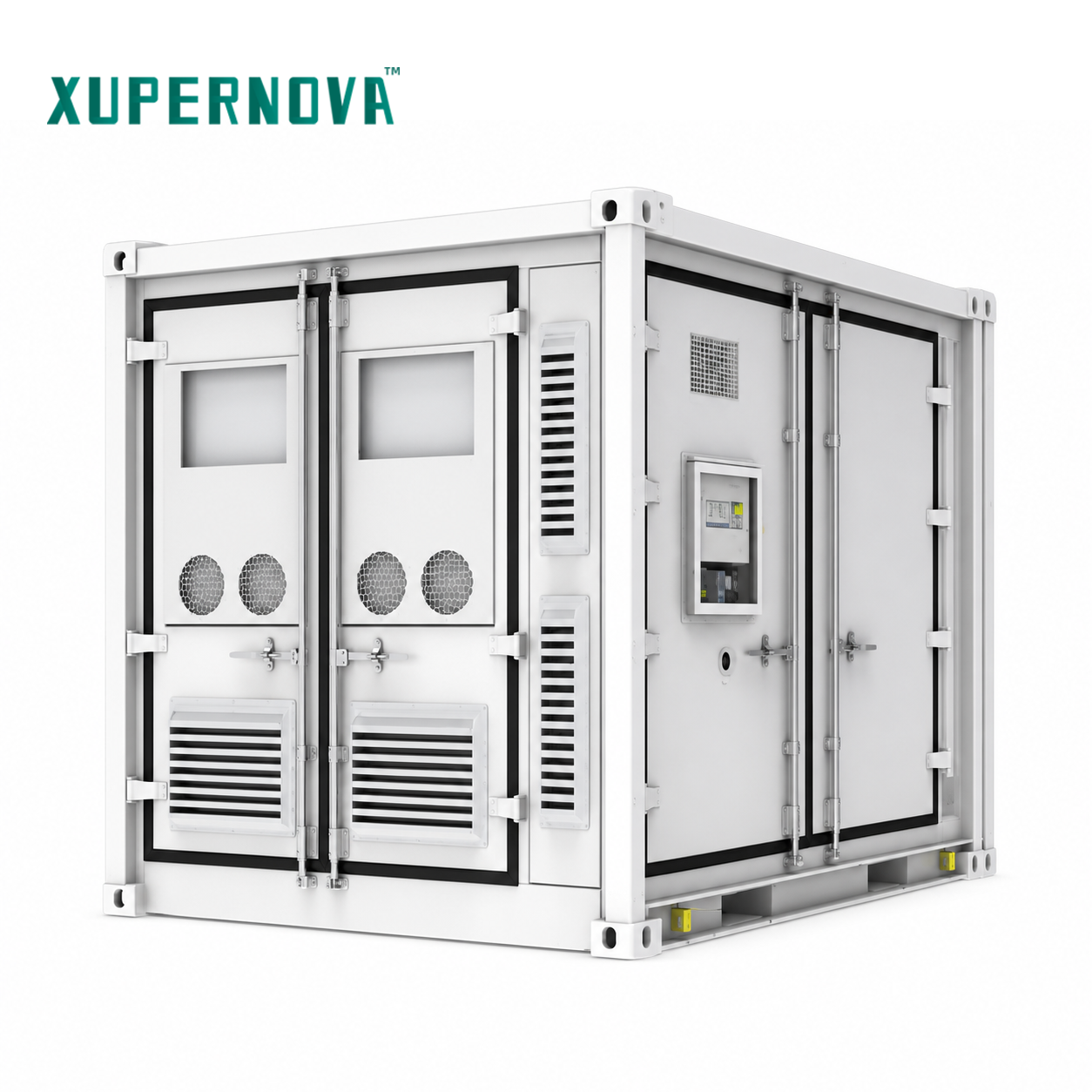
Liquid-cooled containerized BESS platform applied to microgrid and backup power duty (XA-X1044-L1 class, 500 kW / 1044 kWh).
Platform options available for configuration
Xupernova supplies containerized and cabinet platforms across several power and energy classes, all rated for a −30°C to 55°C operating scope and built on Grade A LFP lithium-ion cells sourced from leading BloombergNEF Tier 1 energy-storage cell manufacturers. Semi-solid-state, solid-state and sodium-ion battery technologies are available as options where a project requires them, subject to project requirements, technical validation and availability. Cell temperature difference is controlled within 3°C on applicable liquid-cooled models, which is relevant to dust-heavy, high-ambient sites where thermal gradients accelerate ageing.
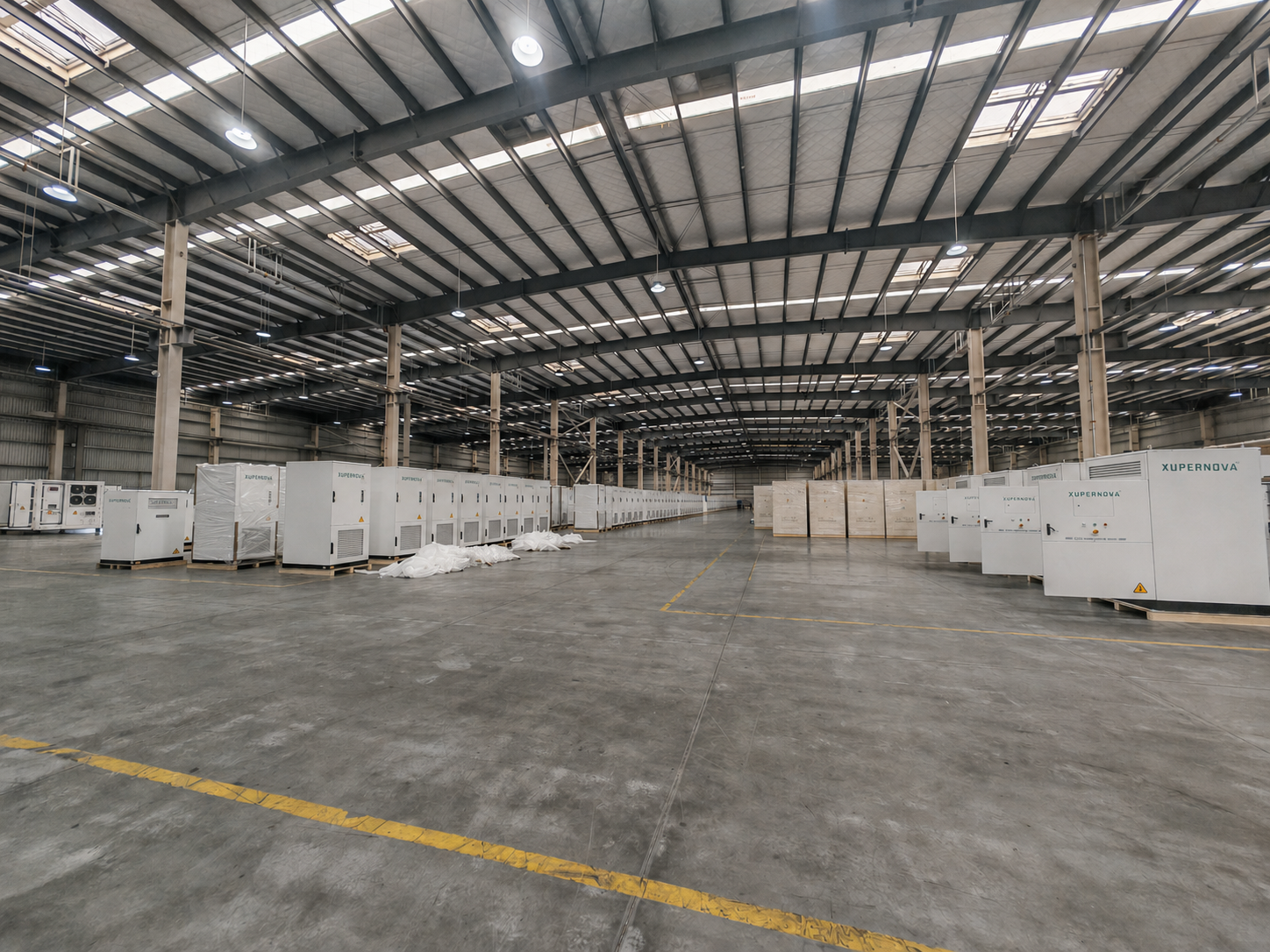
Xupernova's 700,000 m² manufacturing base builds containerized and cabinet BESS platforms, with annual capacity above 5 GWh.
Step-by-Step: Configuring BESS for a Remote Mine Site
The application data lists a specific set of project requirements for mining and off-grid facilities: site load study, motor-starting analysis, spinning-reserve strategy, high-temperature and dust protection, black-start capability and remote O&M. The sequence below follows that logic, because each study changes the input to the next.
- Site load study. Build the load profile for the whole site — critical and non-critical loads, shift patterns, seasonal demand, and the loads that must never be interrupted. Everything downstream — battery energy, PCS rating, reserve size — is derived from this profile, not from a rule of thumb.
- Motor-starting analysis. Identify the largest motors and how they are started, then set the acceptable voltage dip and frequency excursion for the site. Determine whether the grid-forming PCS and battery discharge headroom cover the start within those limits, or whether a diesel unit must remain online as backup for that specific start.
- Spinning-reserve strategy. Agree the largest credible loss the microgrid must survive — typically the largest single generating unit or the largest motor start — and decide how much of that reserve is held in the battery instead of in running diesel units. This single decision drives most of the fuel saving and most of the battery power rating.
- Black-start capability. Define the restoration sequence for a full site blackout, confirm black-start capability as an explicit project requirement, and specify the STS/EPS backup function where the site needs a defined transfer to islanded operation for critical loads.
- Diesel optimisation policy. Define the diesel fleet's role explicitly: how many units run, at what minimum loading, and under which conditions they are shut down or restarted. Automatic source scheduling only delivers fuel savings if this policy is written down and configured.
- Environmental and site protection. Match the equipment to the site climate. All platform classes operate across a −30°C to 55°C scope; high-temperature and dust protection, cooling system choice, IP rating and corrosion protection are all configurable items and should be specified against the actual conditions.
- Remote O&M and communications. Remote sites rarely have a resident electrical team. Remote O&M is listed as a project requirement for this scenario; communication protocols are configurable, and Xupernova provides 24/7 remote support, commissioning, training, diagnostics, spare parts and optional onsite service.
- Validation before shipment. Confirm acceptance criteria early. Xupernova applies 100% FAT including electrical safety testing, functional testing and aging testing, with third-party inspection and site acceptance testing (SAT) available on request.
Use Cases and Reference Deployments
Xupernova's reference deployments are not labelled as mine sites, and they should not be presented as such. What they do show is how the same control architecture behaves in duty cycles that resemble a mine microgrid: solar-plus-storage operation, grid-connected and off-grid switching, diesel generator interfacing, and remote monitoring over multi-year operation.
Industrial park microgrid with diesel optimisation. A commercial and industrial park operator deployed 1 MW / 2.088 MWh across 12 units for a solar-plus-storage microgrid with emergency backup power and diesel generator optimisation. The configuration used integrated STS, grid-connected and off-grid switching, photovoltaic and diesel generator interfaces, and centralised energy management. Over seven years of operation, the reported results were improved critical-load power continuity, increased solar energy utilisation and reduced diesel generator operating time — the three outcomes a remote mine microgrid is normally built to achieve.
Industrial manufacturing site with demand management. An industrial manufacturing enterprise installed 1 MW / 2.09 MWh across 20 units for peak shaving, time-of-use energy arbitrage and demand management, achieving stable automatic operation with reduced peak grid demand and optimised electricity costs over two years. The configuration used an all-in-one liquid-cooled design with plant-level EMS, modular deployment and IP55 protection, and was built to comply with German grid requirements.
Renewable developer with grid-code compliance. A renewable energy project developer deployed 2 MW / 4.176 MWh across 7 units for renewable energy shifting, grid balancing, peak shaving and backup power. The installation used a compact 10-ft container design with integrated PCS, BMS and EMS, liquid cooling, multi-source access and G99 grid-code compatibility; reported results were improved renewable energy utilisation, flexible energy dispatch and enhanced grid stability over four years.
Comparison: Off-Grid Operating Configurations
The table below compares how three common configurations behave against the constraints that determine fuel consumption and reliability at a remote site. It describes operating logic, not equipment performance.
| Decision Criterion | Diesel Generators Only | PV + Diesel (No Storage) | PV + BESS + Diesel with Grid-Forming Control |
|---|---|---|---|
| Renewable energy utilisation | None; all energy from fuel | Limited to the instant of generation; surplus cannot be shifted | Surplus solar energy stored and dispatched later, increasing onsite renewable utilisation |
| Diesel generator runtime | Continuous, including units held online for reserve | Reduced only during daylight generation windows | Reduced by shifting reserve from running units to the battery and by scheduling sources automatically |
| Spinning reserve source | Running diesel units | Running diesel units | Battery discharge headroom, with diesel policy defined per site |
| Motor-starting support | Fleet oversizing and voltage-dip tolerance | No improvement to transient support | Grid-forming PCS plus battery headroom respond to the starting transient, within limits set by the motor-starting analysis |
| Black-start capability | Requires a dedicated starting unit | None | Black-start capability specified as a project requirement, with STS/EPS backup function where needed |
| Control and remote O&M | Manual or basic generator control | PV monitoring only | Microgrid controller, load-management system and plant-level EMS with remote diagnostics |
Comparison: Xupernova Platforms for Remote and Off-Grid Projects
| Model | Product Type | Power / Energy | Operating Scope | Applicable Industry (as specified) |
|---|---|---|---|---|
| XA-V5015-L1 | 20-ft Liquid-cooled Battery Container | 5.015 MWh; 0.5P / 1P / 2P | −30–55°C | Power Generation, Grid Energy Storage, Commercial & Industrial Energy Storage |
| XA-X2170-L2 | 20-ft Liquid-cooled All-in-one ESS Container | 1125 kW / 2170.3 kWh; 0.5P / 1P / 2P | −30–55°C | Commercial & Industrial Energy Storage, Grid-side Energy Storage |
| XA-X1044-L1 | 10-ft Liquid-cooled All-in-one ESS Container | 500 kW / 1044 kWh; 0.5P / 1P / 2P | −30–55°C | Commercial & Industrial Energy Storage, Microgrids, Backup Power |
| XA-C0261-L1 | Liquid-cooled All-in-one ESS Cabinet | 125 kW / 261.25 kWh; 0.5P / 1P / 2P | −30–55°C | Commercial & Industrial Energy Storage |
| XA-H0261-L1 | Liquid-cooled Solar-plus-storage Cabinet | 261 kWh; 0.5P / 1P / 2P | −30–55°C | Commercial & Industrial Solar-plus-storage, Microgrids |
| XA-H0064-A1 | Air-cooled Solar-plus-storage Cabinet | 25–50 kW / 64.54 kWh; 0.5P / 1P / 2P | −30–55°C | Small-scale Commercial & Industrial Solar-plus-storage |
The XA-X1044-L1 10-ft container class is the platform whose specified applicable industries include microgrids and backup power, and the 20-ft classes provide the higher power blocks for larger site loads. Multi-unit configurations are supported, which matters where a mine wants load-block growth without replacing existing equipment.
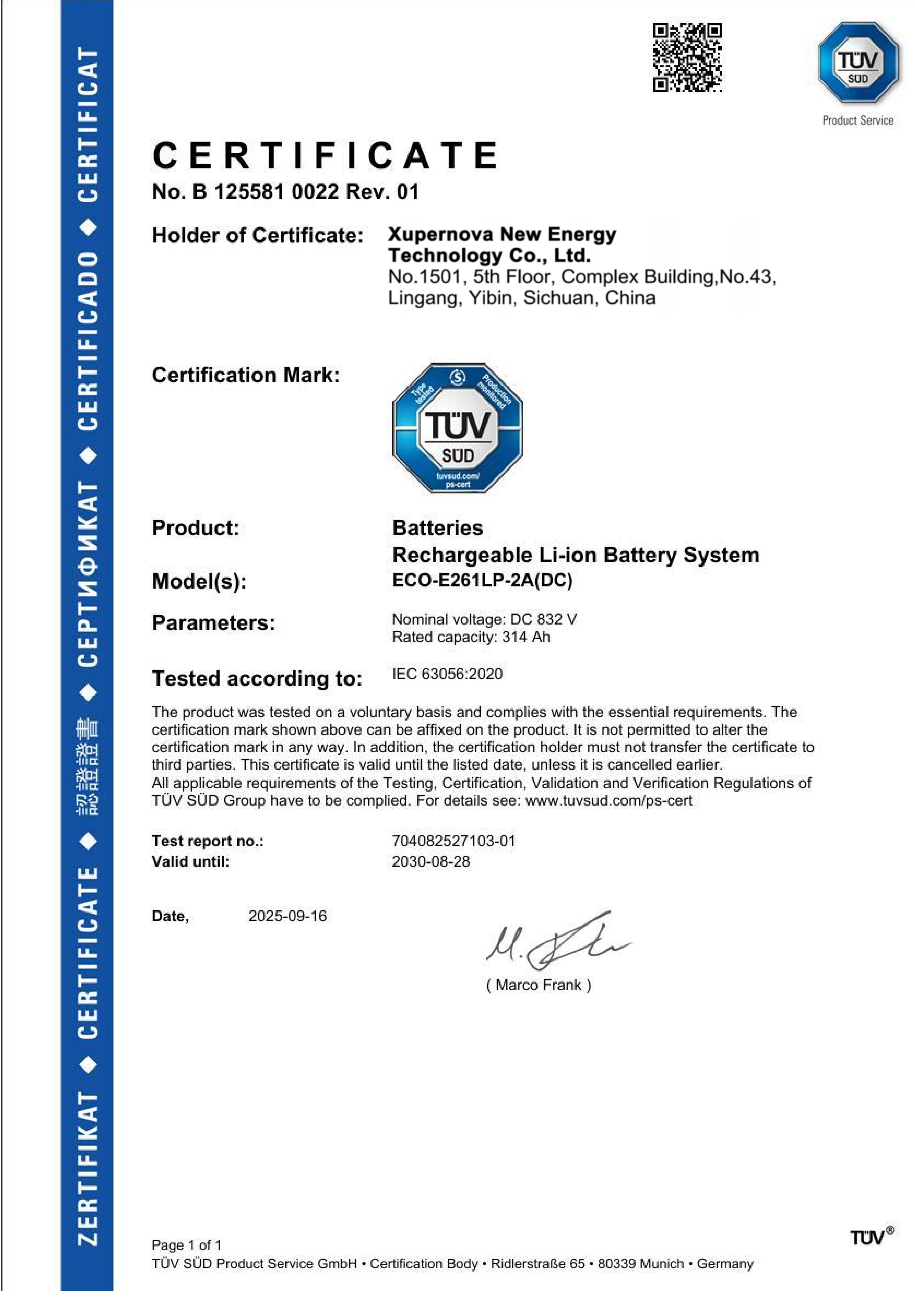
IEC 63056:2020 product certificate issued by TÜV SÜD Product Service GmbH (certificate B 125581 0022 Rev. 01; DC 832 V, 314 Ah; model ECO-E261LP-2A).
Frequently Asked Questions
Which standards and certifications should a mining microgrid battery system provide?
For battery system safety, the relevant reference in the Xupernova documentation set is IEC 63056:2020, certified by TÜV SÜD Product Service GmbH under certificate B 125581 0022 Rev. 01 for the ECO-E261LP-2A battery system (DC 832 V, 314 Ah). EU-market equipment documentation also includes an LVD Attestation of Conformity to EN 62477-1:2012/A12:2021 and an EMC Attestation of Conformity to EN IEC 61000-6-4:2019 and EN IEC 61000-6-2:2019 for the same model at 125 kW, 261.248 kWh, IP55. Italian grid-connection compliance is documented through CEI 0-21:2022/V2:2024 and CEI 0-16:2022/V3:2024 compliance documents. Grid code, protection coordination and fire-safety requirements remain site-specific and should be defined in the project scope, since an islanded mine is governed by its own operating rules as well as any national code.
Can a battery energy storage system support motor starting and spinning reserve at an off-grid mine?
Yes, but only when two things are engineered together. The application data for mining and off-grid sites lists motor-starting analysis and spinning-reserve strategy as project-level requirements, alongside a grid-forming PCS and a load-management system. The grid-forming PCS establishes the voltage and frequency reference for the island, and the battery's discharge headroom responds to the starting transient within the voltage-dip and frequency limits agreed in the motor-starting study. Spinning reserve is then held in the battery rather than in running diesel units, which is the mechanism that reduces diesel generator runtime. The size of the reserve, and whether a diesel unit must stay online for the largest start, is determined by the site load study and the motor-starting analysis — not by a standard figure.
Can an OEM commercial battery energy storage system manufacturer configure the system for off-grid operation?
Xupernova provides OEM and ODM production services for battery energy storage systems, and its customization scope covers exactly the items an off-grid mine microgrid depends on: system power and energy capacity; charge and discharge duration; AC/DC voltage; battery chemistry and cell supplier; PCS, BMS and plant-level EMS; photovoltaic input and solar-plus-storage configuration; on-grid and off-grid operation; STS/EPS backup function; cooling system; fire protection system; enclosure size, color and branding; IP rating and corrosion protection; grid code; communication protocols; and transformer and switchgear configuration. Manufacturing capacity is up to 500 MWh per month, supported by 150+ R&D engineers, and the minimum order quantity is 1 unit.
What drives the budget of a remote mine BESS, and what commercial terms apply?
The main cost drivers are energy capacity versus power rating (0.5P, 1P or 2P configurations), the thermal and environmental specification required by the site, the reserve and redundancy policy agreed for spinning reserve, transport to a remote location, and the scope of remote and onsite service. For market context rather than project pricing, Ember reported all-in BESS project CAPEX of $125/kWh for long-duration four-hour-plus utility-scale projects in late 2025, excluding China and the United States. Commercially, Xupernova works with a minimum order quantity of 1 unit, delivery terms of EXW / FOB / CIF / DAP / DDP, and payment terms of 30% deposit with 70% payable before shipment after FAT.
What is the lead time, and how is the system validated before delivery?
Standard lead time is 25–35 days for standard BESS configurations and 35–60 days for customized projects. Before shipment, every unit goes through 100% FAT covering electrical safety testing, functional testing and aging testing, with third-party inspection available on request; site acceptance testing (SAT) is also available. After delivery, support includes 24/7 remote support, commissioning, training, diagnostics, spare parts and optional onsite service. If you are evaluating a specific mine site, the practical next step is to share the site load profile and the largest motor-starting case so that the reserve policy, platform selection and configuration can be confirmed against real data — you can request a configuration review or a sample discussion through the contact details below.
Conclusion
At a remote or weak-grid mine, battery storage earns its place through four capabilities rather than through capacity alone: grid-forming control that creates the island reference, automatic source scheduling that coordinates solar PV, battery storage, diesel generators and loads, reserve capacity that replaces running diesel units, and black-start capability that restores the site after a full outage. The supporting equipment scope is well defined — PV system, diesel generators, grid-forming PCS, microgrid controller, transformer, switchgear, load-management system, plant-level EMS and communications — and the engineering sequence is equally well defined: site load study, motor-starting analysis, spinning-reserve strategy, black-start design, diesel optimisation policy, environmental protection, remote O&M and pre-shipment validation.
Where projects succeed or stall is in that sequence, not in the headline specification. A mine that settles its reserve policy and its largest motor-starting case before selecting equipment gets a smaller battery, fewer running diesel units and a control system that can actually be commissioned. A mine that buys storage capacity first usually ends up running the same diesel fleet it ran before, with a battery alongside it.
Xupernova New Energy Technology Co., Ltd. (Xupernova) is a global provider of energy storage and new energy solutions with business coverage across Europe, North America, South America, the Middle East and Asia. Since 2015, the company has built a 700,000 m² manufacturing base staffed by 500+ employees and 150+ R&D engineers, with annual capacity above 5 GWh and roughly 90% of output exported. Its portfolio covers commercial and industrial energy storage, utility-scale storage, mobile energy storage charging systems and integrated solar-storage solutions, supplied through OEM and ODM production services, with 24/7 support and one-on-one consultation.
Next Step: Site Review, Configuration and Sample
If you are planning a remote mine microgrid, a diesel optimisation retrofit or a solar-plus-storage island, send the site load profile, the largest motor-starting case and the required backup duration. The engineering team can map those inputs to a platform selection from the XA-X1044-L1, XA-X2170-L2, XA-V5015-L1, XA-C0261-L1, XA-H0261-L1 or XA-H0064-A1 classes, define the grid-forming and STS/EPS configuration, and confirm lead time against the 25–35 day standard or 35–60 day customized schedule.
Request a Configuration Review or Sample
Share your site load study and motor-starting data to receive a platform recommendation, a customized grid-forming and source-scheduling proposal, and commercial terms for a single-unit sample or containerized configuration.
Xupernova New Energy Technology Co., Ltd.
Website: www.xupernovatech.com
Product catalog (download): XUPERNOVA Energy Storage Product Catalog
Contact: Bill Liao — Email: bill@xupernovatech.com — Tel: +86 186-0828-3917
WhatsApp: +86 186-0828-3917
Address: East Gate of Yibin High-tech Industrial Park, Cuiping District, Yibin City, Sichuan Province, China
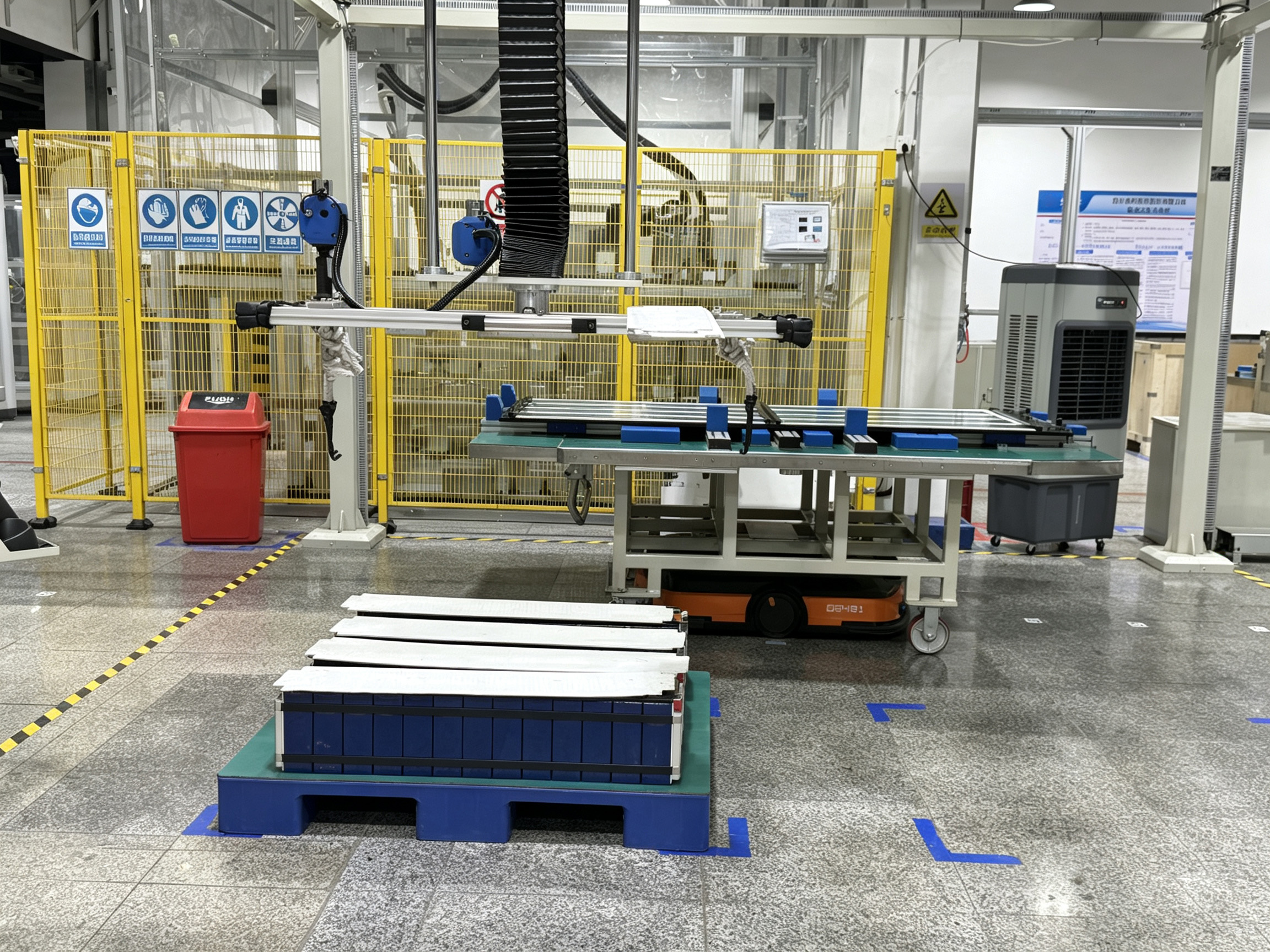
Xupernova production base — BESS manufacturing, testing and export operations for commercial, industrial and microgrid projects.