Copper Alloy vs. Stainless Steel vs. Crystal: A Fashion Jewelry Material Comparison for Buyers
Fashion jewelry assortments are usually planned backwards. Buyers choose designs first, then discover that the material they selected cannot support the target price tier, the care advice the end customer expects, or the compliance paperwork the destination market requires. The more reliable sequence is the opposite: choose the material path first, then the designs, because copper alloy, stainless steel and crystal each carry a different cost structure, a different service life and a different set of buyer obligations.
This comparison covers three paths produced by Guangdong Xuping Jewelry Co., Ltd., a fashion-imitation jewelry manufacturer established in 1997: gold-plated copper alloy over environmental copper, stainless steel, and crystal-set pieces. For each path it maps the assortment role, the price tier it can support and the care expectation the buyer must pass on to the end customer — using documented product specifications rather than marketing claims.
The Problem: Three Material Paths Buyers Often Treat as One
A typical brief arrives as a single sentence: “We need a gold-tone necklace, earring and bangle range for spring.” That sentence hides three separate material decisions, because a gold-tone necklace can be gold-color plating on copper alloy, gold-color plating on stainless steel, or a crystal-set piece built on a plated copper base. Each option behaves differently once it reaches the shelf.
The material decision sets five things that a design decision cannot fix later:
- Design ceiling — how much shaping, engraving and stone setting the base material can carry.
- Weight and hand-feel — the perceived quality of the item in the customer's hand.
- Care expectation — what must be printed on the product page and the packaging.
- Compliance documentation — which declarations and test reports the destination market expects.
- Reorder consistency — whether the second production run matches the first.
Buyers who treat the three materials as interchangeable usually end up with a range that has no clear price architecture: heavy copper pieces and light stainless pieces sitting at the same retail price, carrying the same care instructions, even though they behave very differently in wear.
Industry Background: Why Material Planning Is More Consequential Now
The global fashion (costume) jewelry market was projected to reach USD 167.97 billion in 2024, according to Custom Market Insights. The imitation jewelry segment is expected to grow at a compound annual growth rate of 7.23% between 2025 and 2035, with e-commerce expansion cited as a primary driver (Spherical Insights). Published market size estimates diverge substantially depending on whether “affordable luxury” is counted alongside pure costume jewelry, so headline figures are best read as directional rather than exact.
Two structural details matter more to material planning than the total market size. First, necklaces and pendants are the largest product segment, accounting for approximately 28.5% of fashion jewelry revenue (Market Intelo, 2025) — which means the material and plating specification chosen for the necklace line effectively sets the quality perception of the whole assortment. Second, China's jewelry exports reached approximately USD 11.5 billion in 2024, with Hong Kong, the United States and Switzerland as the largest destinations (Observatory of Economic Complexity) — a reminder that North American and European compliance expectations now sit at the centre of sourcing decisions rather than at the edge.
For a buyer, the practical consequence is that material and compliance choices are no longer a back-office detail. They determine whether a range can be listed in a given market at all, and how much after-sales handling it will generate.
The Three Material Paths, Compared in Practice
Path 1: Gold-Plated Copper Alloy (Environmental Copper)
Copper alloy is the most design-flexible base in Xuping's portfolio. The company applies 14K gold color plating over environmental copper for bangles, and its range overall uses premium copper alloy as the base material with sophisticated gold-plating craftsmanship, which is what produces the surface texture and durability profile of the finished item. The same base also carries 18K gold color and platinum-plated finishes.
Documented examples show how wide that range is:
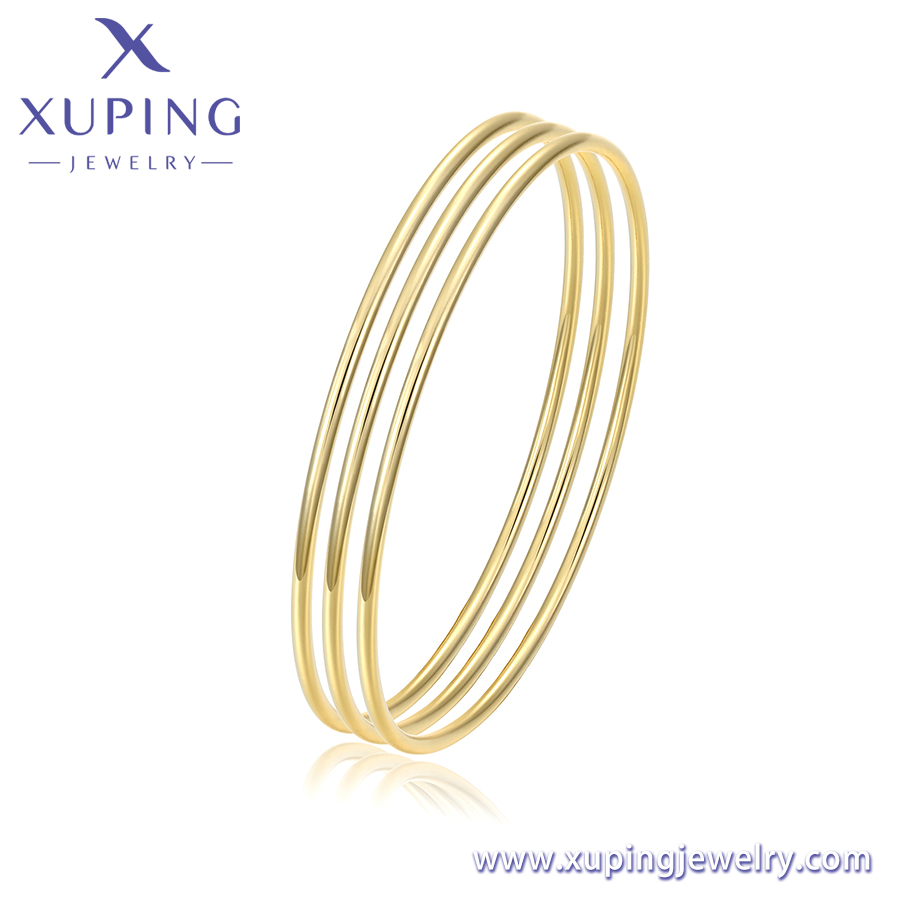
- Bangle X000867735 — Simple series, environmental copper with 14K gold color plating, approximately 65 × 2 mm, 17.39 g per set, no main stone.
- Bangle X000998659 — Luxury series, environmental copper with 14K gold color plating, approximately 60 × 8 mm, about 21.77 g, with ruby and synthetic cubic zirconia as the main stones at approximately 8 × 6 mm.
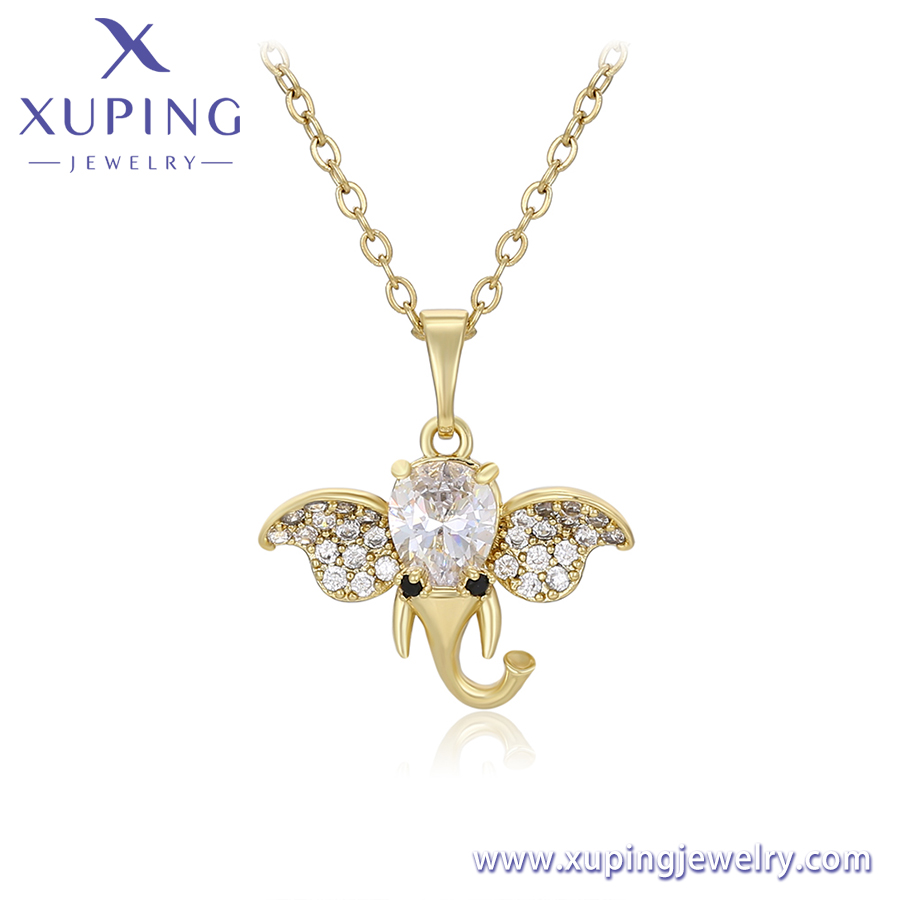
- Necklace X001015911 — Daily series, 14K gold color plating, 43 cm, about 4.3 g, white synthetic cubic zirconia main stone at approximately 6 × 8 mm.
- Bracelet X000992979 — Daily series, 18K gold color plating, approximately 195 × 8 mm, 12.97 g, synthetic cubic zirconia main stone of about 7 × 5 mm.
- Earrings X001163413 — Simple series, 14K gold color plating, approximately 14 × 5 mm, 2.45 g per pair, no main stone.
- Brooch A00900238 — Daily series, platinum plated, approximately 47 × 32 mm, 12.3 g, white synthetic cubic zirconia main stone of about 3.5 × 3.5 mm, marked “xp”.
- Necklace 14N245402 — Luxury series, platinum plated, approximately 440 × 6 mm, 49.44 g, dark blue glass main stone.
The weight span tells a buyer something a catalogue photo cannot: within one material path, documented Xuping items run from roughly 2.28 g (pendant X000687942) to 49.44 g (necklace 14N245402). That spread is what allows one base material to serve several price tiers, so a light daily-wear pendant and a heavy luxury-tier necklace can be sourced under the same material specification. The trade-off is that plating is a surface finish: it defines the appearance, and it also defines the care advice.
Path 2: Stainless Steel
Stainless steel plays a different role. In Xuping's line it appears as a focused, Daily-series-oriented group rather than a full design range. Two documented items illustrate the pattern:
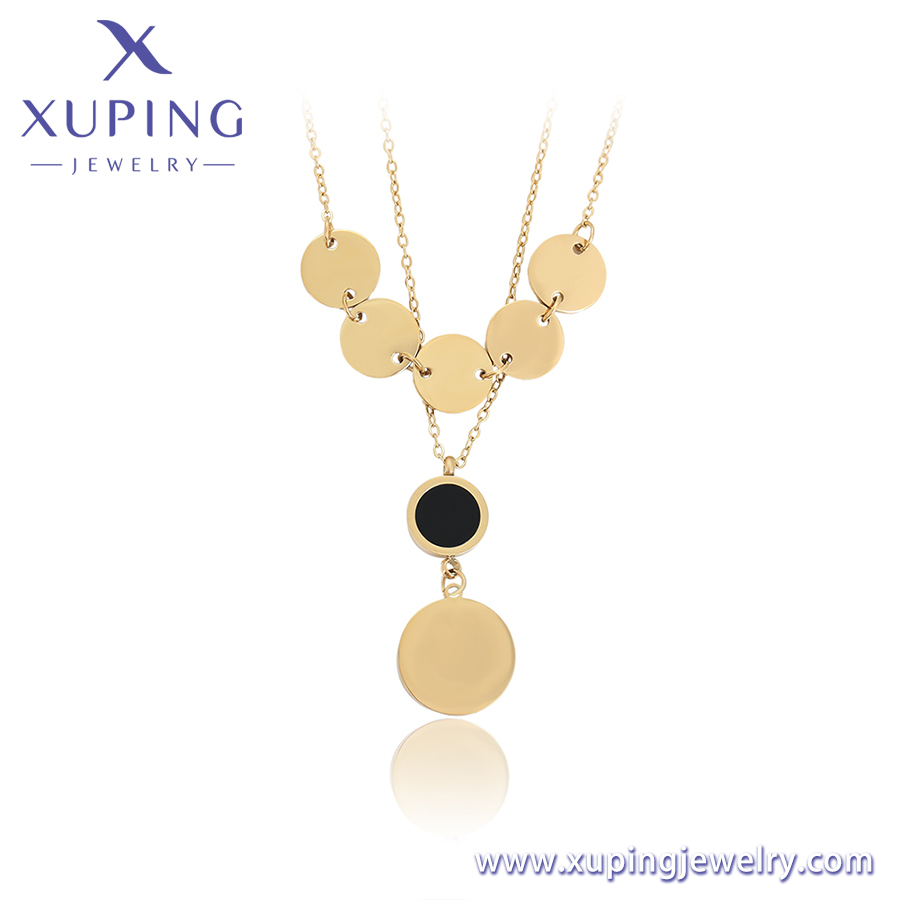
- Necklace A00902945 — stainless steel with 14K gold color plating, 40 cm (approximately 400 mm with a 60 mm extension), about 6 g, no main stone, Daily series.
- Bracelet T000959269 — stainless steel, approximately 170 × 6 mm with a 30 mm extension, no main stone, Daily series.
Two implications matter for assortment planning. First, where a gold color is applied over stainless steel, the item is still a plated product and still needs plating care guidance — “stainless” describes the base, not the finish. Second, the stainless group is structurally simple: no main stones, clean shapes, minimal detailing. That makes it a natural fit for the high-repeat basic part of a range, and a poor fit for a statement or bridal brief where stone setting carries the design value.
Path 3: Crystal-Set Pieces
The third path is defined by the stone rather than the metal. In Xuping's crystal line the base is environmental copper with 18K gold color plating, and synthetic crystal is the main stone. Buyers should be precise about this in their own product descriptions: “crystal jewelry” describes the stone-set construction, not a solid crystal body.
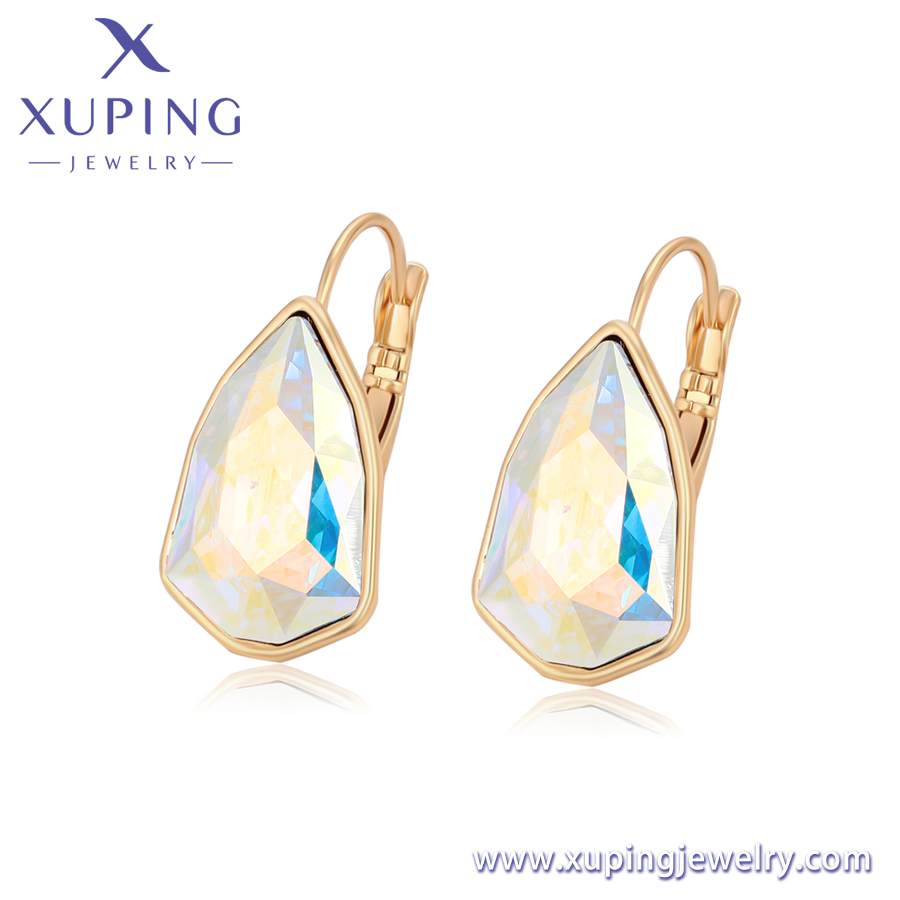
- Crystal earrings 14E25011845 — Simple series, environmental copper with 18K gold color plating, AB color synthetic crystal main stone, approximately 27 × 14 mm, 8.88 g per pair.
- Crystal necklace X000668301 — Simple series, environmental copper with 18K gold color plating, lilac synthetic crystal main stone at approximately 18 × 17 mm, necklace length approximately 410 mm with a +50 mm extension, 7.915 g, marked “XP”.
Crystal changes the planning unit. A copper alloy range is planned by shape and weight; a crystal range is planned by stone colourway and stone size. Because the AB colour and lilac examples above sit in the same earring and necklace families as the plain copper pieces, a crystal line is usually added to an existing copper assortment rather than run as a separate supplier relationship.
Step-by-Step: Choosing a Material Path for a Buying Brief
- Fix the price tier before the material. The cost drivers differ by path: base metal, plating steps and finish, stone selection and setting labour, item weight, and the number of finishing procedures an item passes through. A light, no-stone stainless piece and a heavy, stone-set copper piece cannot occupy the same price tier even when the designs look similar in a photograph.
- Define the wear occasion and the expected service life. Daily wear favours the simple, low-detailing stainless and light copper items; party, wedding and gift briefs favour heavier copper pieces and crystal-set items, where weight and stone size carry the perceived value.
- Decide what care advice your channel will carry. Plated surfaces need care guidance and stone-set pieces need stone-security guidance. If your channel cannot support care copy, plan a lighter share of plated and stone-set SKUs.
- Match the material path to the destination market's requirements. Buyers selling into the EU typically ask for evidence against the nickel release limit in EN 1811:2023, which sets 0.5 µg/cm²/week for jewelry in prolonged skin contact, and US-focused buyers commonly reference ASTM F2999, the adult jewelry safety specification that restricts lead content in electroplated metals to 6.0% (QIMA / CPSC). Request the documentation before the sample round, not after the purchase order.
- Validate the sample against the written specification. Weigh and measure the sample against documented figures, check plating coverage at contact points and clasp areas, confirm stone security, test the extension and clasp behaviour, and verify the marking — several crystal and copper items carry the “XP” name.
- Confirm that the quality system covers repeat orders, not just the sample. Xuping's goods, whether gold-plated copper, stainless steel or crystal-set, pass through 18 production procedures to meet European and American environmental-protection standards, which is what keeps finish and documentation consistent between the sample order and the bulk order.
Use Cases: Matching the Path to the Brief
Party and wedding assortments
Heavier copper alloy pieces and crystal-set items carry the visual weight these briefs need: the Luxury series bangle X000998659 at about 21.77 g with a ruby and synthetic cubic zirconia main stone, the platinum-plated necklace 14N245402 at 49.44 g, or the crystal necklace X000668301 with its 18 × 17 mm lilac stone. These are the SKUs that justify a higher price tier within the same material family.
Daily-wear and e-commerce basics
The Daily series is the natural home for stainless steel and light copper. Necklace A00902945 (stainless steel, about 6 g) and necklace X001015911 (14K gold color over environmental copper, 43 cm, about 4.3 g) sit in the same wear-occasion category and follow the same channel logic: repeat purchase, low styling risk, and simple sizing with extensions of 60 mm and 50 mm respectively.
Gift and coordinated sets
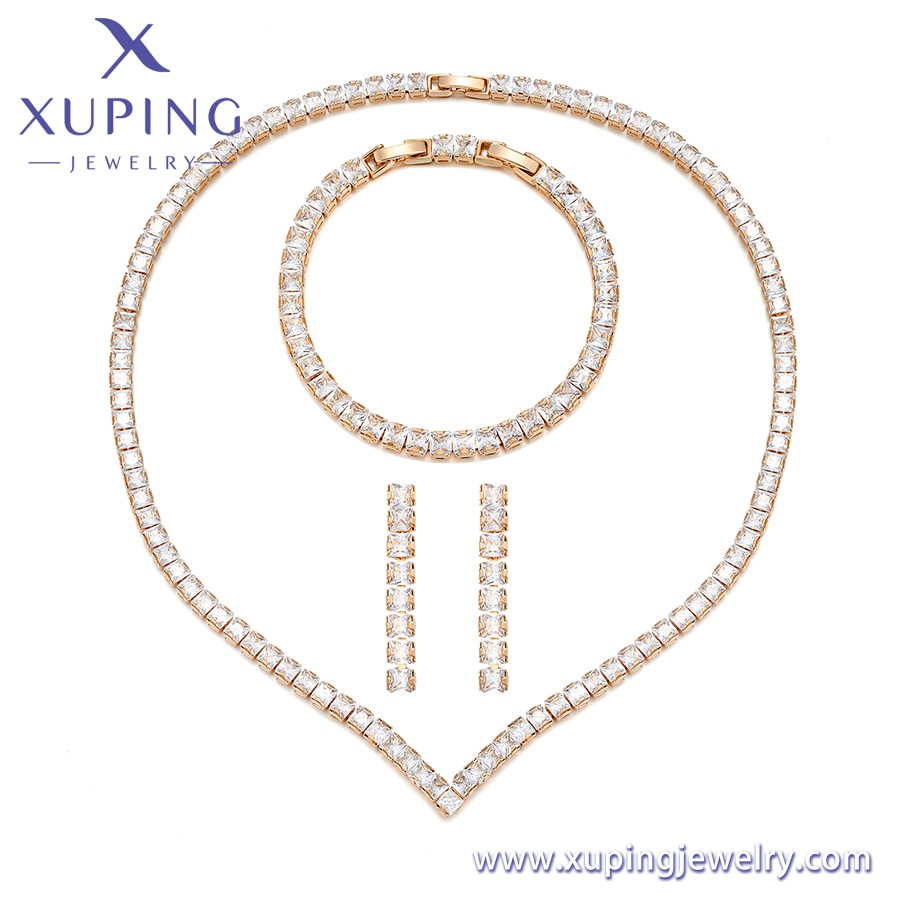
Coordinated sets let a buyer cover earrings, bracelet and necklace in one SKU. Set X000871334 (Luxury series, 18K gold color plating, about 18.8 g per set) combines earrings, a bracelet and a necklace with white synthetic cubic zirconia main stones around 2.5 × 2.5 mm; set X001006294 (Simple series, 14K gold color plating, about 28.43 g per set) combines a bangle, a pendant and earrings. Both are copper alloy, which keeps the set visually unified.
Cool-tone and platinum-look capsules
Not every brief wants gold colour. Platinum-plated items such as anklet X000988693 (27 cm, 5.59 g) and brooch A00900238 (approximately 47 × 32 mm, 12.3 g) allow a buyer to build a cool-tone capsule on the same copper alloy base and the same care framework as the gold-colour range.
Care Expectations by Material
Care guidance is where a mixed assortment most often fails, because the same leaflet is packed with every SKU. Three rules of thumb keep it honest:
- Gold-plated copper alloy: the 14K or 18K gold color layer is a plated finish. Keep the piece dry, remove it before swimming or applying perfume and lotion, store items separately to limit abrasion, and clean with a soft dry cloth. The care text should describe the finish accurately rather than implying solid precious metal.
- Stainless steel: the base tolerates daily wear and moisture better than a plated copper base, but where a 14K gold color plating has been applied — as on necklace A00902945 — the plated finish still governs the care advice. Unplated stainless items carry the lightest care burden in a mixed range.
- Crystal-set pieces: the main risk is stone security rather than surface wear. Advise against impact and pressure on the stone and against soaking the piece; cleaning should be a soft dry cloth at the stone rather than a liquid dip.
Comparison Table: Copper Alloy vs. Stainless Steel vs. Crystal
| Dimension | Gold-plated copper alloy (environmental copper) | Stainless steel | Crystal-set pieces |
|---|---|---|---|
| Base material and finish | Premium copper alloy base; 14K or 18K gold color plating; platinum-plated options | Stainless steel base; some items with 14K gold color plating | Environmental copper base with 18K gold color plating; synthetic crystal as the main stone |
| Documented examples | Bangle X000998659 (14K gold color, ~60 × 8 mm, ~21.77 g, ruby and synthetic cubic zirconia); bangle X000867735 (14K gold color, ~65 × 2 mm, 17.39 g per set); necklace X001015911 (14K gold color, 43 cm, ~4.3 g) | Necklace A00902945 (14K gold color, ~400 mm with a 60 mm extension, ~6 g); bracelet T000959269 (~170 × 6 mm with a 30 mm extension) | Earrings 14E25011845 (18K gold color, AB color synthetic crystal, ~27 × 14 mm, 8.88 g per pair); necklace X000668301 (18K gold color, lilac crystal ~18 × 17 mm, ~410 mm with a +50 mm extension, 7.915 g) |
| Typical assortment role | Broadest design range: bangles, bracelets, necklaces, earrings, rings, pendants, anklets, brooches and coordinated sets | Focused Daily series basics; simple shapes without main stones | Statement items and colour-led capsules for party, wedding and gifting briefs |
| Design and weight range | Documented items from about 2.28 g (pendant X000687942) to 49.44 g (necklace 14N245402) | Lightweight with minimal detailing | Stone size and colour define the item; main crystal documented at about 18 × 17 mm |
| Care expectation | Plated finish: keep dry, avoid perfume and water, clean with a soft dry cloth, store separately | Lowest maintenance where unplated; plated versions follow plating care | Stone security is the priority; avoid impact and soaking the piece |
| Compliance consideration | EU: EN 1811:2023 nickel release limit of 0.5 µg/cm²/week for prolonged skin contact; US: ASTM F2999 limit of 6.0% lead in electroplated metals | Same documentation logic applies; verify plating and material declarations | Same documentation logic applies; confirm stone and metal declarations together |
| Best-fit brief | Multi-category ranges that need several price tiers from one base material | High-repeat daily basics and entry-tier volume | Party, wedding, gifting and colour-led capsule ranges |
Quality and Compliance That Apply to All Three Materials
Material choice changes the design and the price tier; it should not change the quality system behind the order. Guangdong Xuping Jewelry Co., Ltd. was established in 1997 and has over 25 years of experience in fashion-imitation jewelry manufacturing. The company runs a manufacturing facility covering more than 200,000 square metres, employs over 1,000 staff, and produces more than 100 million pieces annually across rings, pendants, earrings, necklaces, bracelets, anklets, bangles and coordinated jewelry sets.
Quality infrastructure sits above the material categories. Xuping Jewelry's products hold international certifications including SGS, CE and ISO, and all goods pass through 18 production procedures to meet European and American environmental-protection standards — the same procedure count applies whether the item is gold-plated copper, stainless steel or crystal-set. The company has obtained 194 patents, supported by an R&D team of 62 designers and more than 1,200 advanced production facilities. Approximately 100% of output is exported, serving markets in over 100 countries, including the United States, Mexico, Canada, Spain, Germany, France, Italy, the United Kingdom, Poland, Russia, Ukraine, Turkey, Saudi Arabia, the United Arab Emirates, Iran, Nigeria, Peru, the Philippines, Thailand, Indonesia, Malaysia, Vietnam, Australia and New Zealand.
For a buyer, this matters most at the sampling stage. When one certification framework and one production procedure count cover all three material paths, a mixed-material brief can be placed as a single program with consistent documentation, instead of being split across three suppliers with three different evidence packs. Xuping supports low minimum order quantities and one-stop OEM & ODM customization, which lets a buyer pilot a material mix and then scale up only the paths that perform.
FAQ
1. What compliance requirements should buyers check for gold-plated copper alloy and crystal-set jewelry sold in the EU and the US?
The EU's EN 1811:2023 standard sets a nickel release limit of 0.5 µg/cm²/week for jewelry intended for prolonged skin contact, and the US ASTM F2999 adult jewelry specification restricts lead content in electroplated metals to 6.0%. Both apply to the metal parts of an item, so they cover plated copper alloy, stainless steel and the metal settings of crystal pieces alike. In practice, buyers ask the manufacturer for test documentation from a recognised testing body before the order is placed. Xuping Jewelry's products hold international certifications including SGS, CE and ISO, and all goods pass through 18 production procedures to meet European and American environmental-protection standards.
2. Can one manufacturer supply copper alloy, stainless steel and crystal-set lines in the same order?
Yes, where the manufacturer's portfolio and quality system cover all three. Guangdong Xuping Jewelry Co., Ltd. manufactures rings, pendants, earrings, necklaces, bracelets, anklets, bangles and coordinated jewelry sets, with documented copper alloy items such as the 14K gold color bangle X000867735 and the 18K gold color bracelet X000992979, stainless steel items such as necklace A00902945 and bracelet T000959269, and crystal-set items such as earrings 14E25011845 and necklace X000668301 — all released under one quality framework of SGS, CE and ISO certifications, 194 patents and 18 production procedures applied across material categories.
3. How does material choice affect the price tier a buyer can target?
Material choice changes the cost structure rather than fixing a price. The main cost drivers are the base metal, the number of plating steps and the finish, the quantity and quality of stone setting, the item's weight, and the number of production procedures it passes through. Weight is a useful internal benchmark: within Xuping's copper alloy range, documented items run from about 2.28 g (pendant X000687942) to 49.44 g (necklace 14N245402), which is why one base material can serve both an entry-tier pendant program and a higher-tier necklace program. Stainless steel items are structurally simpler, with no main stone in the documented examples, while crystal pieces add stone selection and setting on top of the copper base. Because no price list is determined by material alone, buyers should compare the paths using factory quotes on their own specifications rather than assuming a tier from the material name.
4. How should buyers validate samples across the three materials?
Validate samples against the written specification rather than the photo. For copper alloy, measure and weigh the sample against documented figures — bangle X000867735 at approximately 65 × 2 mm and 17.39 g per set, or necklace X001015911 at 43 cm and about 4.3 g — and check plating coverage at contact points, clasps and extension ends. For stainless steel, confirm the base and plating declaration plus the dimensions, such as necklace A00902945 at approximately 400 mm with a 60 mm extension and about 6 g. For crystal pieces, confirm stone size, stone colour, stone security in the setting and the marking: necklace X000668301, for example, is documented with an 18 × 17 mm lilac synthetic crystal main stone, a 410 mm chain with a +50 mm extension, 7.915 g, and the “XP” name on the item. Requesting samples is the fastest way to compare the three paths against your own brief; Xuping Jewelry handles sample and quotation requests at wlwf@xuping.com.cn or +86 139-2505-0911.
5. What should be confirmed before moving from samples to bulk production?
Four points decide whether a material path repeats well. First, minimum order quantity: Xuping supports low minimum order quantities, which allows a buyer to pilot a mixed-material run before committing volume. Second, customization scope: the company provides one-stop OEM & ODM services, so design and finish changes stay inside the same program. Third, consistency controls: all goods pass through 18 production procedures to meet European and American environmental-protection standards, and the same certification framework of SGS, CE and ISO applies to copper alloy, stainless steel and crystal items. Fourth, timing and documentation: confirm the production schedule and the test documents for the specific models in the order at the point of order placement, since these are the two items most often assumed rather than agreed. Buyers ready to move from comparison to a concrete brief can request a sample or quote from Xuping Jewelry, or contact Niki at wlwf@xuping.com.cn.
Conclusion
The three material paths are not competing for the same slot in an assortment. Gold-plated copper alloy over environmental copper offers the widest design range and the widest weight span, which makes it the backbone of a multi-category range; stainless steel offers a focused, low-detailing basics line for daily wear and repeat purchase; crystal-set pieces offer colour- and stone-led statement items for party, wedding and gifting briefs. Choosing between them is therefore a matter of fixing the price tier and the care expectation first, then selecting the path that supports both.
Because Xuping Jewelry applies the same certification framework (SGS, CE and ISO), the same 18 production procedures and the same European and American environmental-protection standards across all three material categories, buyers can test the paths side by side instead of committing to a single material philosophy before the first order ships.
Next step: test the paths side by side
Request a sample or quotation for a copper alloy, stainless steel or crystal-set brief and compare them on your own specification and price tier.
Guangdong Xuping Jewelry Co., Ltd. · www.xupingjewelry.com
Contact: Niki · wlwf@xuping.com.cn · +86 139-2505-0911