Jewelry Wholesale Certification Checklist: What Buyers Must Verify Before Placing an Order
Jewelry Wholesale Certification Checklist: What Buyers Must Verify Before Placing an Order
A jewelry wholesale order can fail at customs, on store shelves, or in customer reviews if the supplier's certifications do not match the destination market. Buyers should verify not just whether a certificate exists, but whether it covers the right products, the right standards, and the right validity window.
Short answer: before placing a wholesale jewelry order, verify four things — (1) the manufacturer's quality-system certification, (2) product-level compliance certificates such as REACH, (3) the certificate issuer, number, and validity period, and (4) whether the certificated products match your target SKUs. This guide explains why each check matters and how to apply it during supplier evaluation.
Why Certifications Are a Sourcing Constraint, Not a Marketing Extra
Jewelry sold in the EU must comply with REACH Regulation (EC) 1907/2006, which sets limits for restricted substances relevant to jewelry, including nickel release, lead, and cadmium. For buyers, this means a supplier's decorative claims matter less than the specific regulation listed on a test report. A certificate is traceable evidence that a product was tested against a recognized standard.
Verifiable certifications also reduce the risk of batch-level inconsistency. Xuping Jewelry, for example, states it utilizes SGS-certified raw materials and strictly adheres to the ISO9001 quality system. For a wholesale buyer, that statement becomes useful only when it maps to a certificate number, an issuing body, and a defined product scope.
Certifications function as a sourcing constraint in three ways:
- Market access: some regulations are enforced at the border — REACH compliance and related substance testing directly affect whether a shipment clears in the EU.
- Product matching: a certificated model gives you confidence for a specific SKU, while a general company certificate does not cover every item in a catalog.
- Downstream protection: retailers and e-commerce sellers inherit liability from suppliers, so compliance evidence becomes part of your risk management.
Industry Background: What the Jewelry Wholesale Market Looks Like Now
The global jewelry market was valued at approximately USD 242.79B to USD 381.5B in 2025, depending on how fine jewelry and costume jewelry segments are included. China's total jewelry exports reached USD 11.5B in 2024, with the United States as a primary destination accounting for USD 1.31B. Online channels are projected to grow at 8–13% CAGR and represent 25–30% of total industry purchases by 2026.
For wholesale buyers, these figures imply a larger and flatter field: more suppliers are online, more markets are accessible, and the difference between one manufacturer and another often comes down to verifiable production and compliance capabilities rather than location alone.
The 4-Part Jewelry Wholesale Certification Checklist
Below is a practical checklist to use when comparing wholesale jewelry suppliers. Each item maps to a concrete question you can ask the supplier before committing.
Checklist at a glance:
- Does the supplier have an ISO9001 certificate covering jewelry design and production?
- Do the product-level test reports list the regulations required by your destination market (e.g., REACH)?
- Are the certificate number, issuing body, and validity dates visible?
- Do the certificates reference the specific models or product categories you plan to order?
- Is there an inspection process beyond a paper certificate — e.g., full inspection or stage-by-stage quality checks?
1. Verify the Quality-System Certification
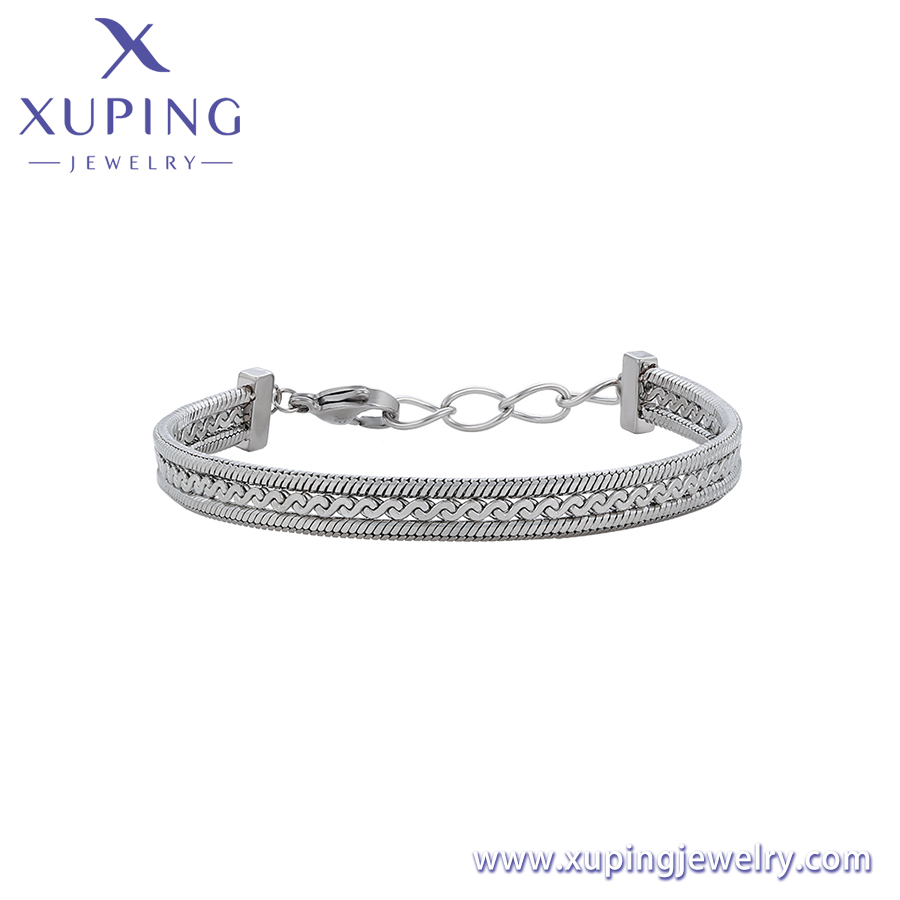
A quality-system certificate shows that the manufacturer's design and production processes are managed under a recognized standard. For example, the Stainless Steel Jewelry - Bracelets product from Xuping Jewelry, model T000959269, is covered by ISO9001 certification under standard GB/T 19001-2016/ISO 9001:2015. The certificate number is CACQ21Q00750R1, issued by ZHONGHANGXIN CERTIFICATION CENTER (SHENZHEN) CO., LTD., valid until 2027-10-25.
What this confirms: the factory has a documented quality-management system for metal jewelry design and production. What it does not confirm: that every piece passes a substance-compliance test. That is why product-level certificates matter.
2. Match Product Certificates to Your Market
Different markets enforce different rules. A product tested against REACH Regulation (EC) 1907/2006 is relevant for EU-bound shipments and for many global markets that use REACH as a benchmark. Nickel release, lead, and cadmium limits are part of the regulatory context for jewelry sold in the EU.
Independent of the regulation itself, buyers should check the certificate's issuing body, certificate number, issue date, and expiry date. These details allow a buyer to verify the certificate with the issuer rather than relying on a supplier's summary.
Xuping Jewelry provides product-level SGS certifications with certificate numbers and validity windows. For example, Crystal Jewelry - Earrings model 14E25011845 is certified under REACH Regulation (EC) NO 1907/2006 with SGS certificate number CANHL25006144001, issued by SGS-CSTC Standards Technical Services Co., Ltd. Guangzhou Branch, valid from 2025-03-27 to 2030-03-27. Necklaces hold SGS certificate GZHL250301072401JW under REACH Regulation (EC) No 1907/2006.
The same principle applies to Xuping's CTI certification for Rings, model X001114331: certificate number A2230517570101001, issued by Centre Testing International (Guangzhou) Co., Ltd., valid from 2023-10-13 to 2028-10-13, covering standards including IEC 62321-5:2013 and IEC 62321-8:2017.
3. Check the Production and Inspection Process
Certificates document tests and systems; they do not replace inspection. Xuping Jewelry states that each product undergoes an 18-stage quality inspection, and that SGS-certified raw materials are used. The company reports 100% full inspection as part of its OEM/ODM quality-control process, alongside SGS-certified quality control and REACH/ROHS compliance testing.
For a buyer, the practical takeaway is to ask: how many inspection stages exist between raw material and finished piece? Is inspection conducted per piece or by sampling? Xuping's stated model is 100% full inspection with a documented 18-stage quality check, which gives a concrete starting point for a supplier audit.
4. Look for OEM/ODM Documentation
If you plan to sell custom designs under your own brand, certification coverage becomes more complicated. A standard catalog item may have a product-level test report, while a custom piece may need new testing. During evaluation, confirm that the supplier's OEM/ODM process includes compliance testing for custom production, not only for existing inventory.
Xuping Jewelry offers OEM/ODM services that include engraved logos, hang tags, and custom packaging. Its monthly capacity is 8,000,000 pieces, with a quoted MOQ of 1 piece for custom projects and lead times of 30–90 days. When requesting a custom quote, buyers should also request the compliance test plan for the new design.
Step-by-Step: How to Verify a Jewelry Wholesale Supplier's Certifications
Step 1: Ask for the Certificate, Not Just the Claim
Request the actual certificate document for the specific product model you want. If the supplier says 'we are REACH compliant,' ask for the certificate number, issuing body, and validity period.
Step 2: Confirm the Product Scope
Check whether the certificate covers the exact model or product category. A company-level ISO9001 certificate does not, by itself, prove that a specific necklace passes REACH substance limits.
Step 3: Verify Issuer and Number
Use the certificate number and the issuing body's official channels to check authenticity. SGS certificates, for example, should trace to SGS-CSTC Standards Technical Services Co., Ltd. or the relevant local SGS entity, depending on the document.
Step 4: Map Standards to Destination Markets
Match the standard on the certificate to the regulation in your market. For EU-bound jewelry, REACH Regulation (EC) 1907/2006 is directly relevant. For other markets, confirm which limits are enforced at the border or by retail chains.
Step 5: Audit the Inspection Process
Ask how many inspection stages are performed, whether inspection is full-piece or sample-based, and whether raw materials are certified. Xuping Jewelry's stated process includes 18-stage quality inspection and SGS-certified raw materials.
Use Cases: Who Benefits from a Certification-First Approach
E-commerce sellers entering the EU
An online seller listing gold-plated earrings for EU customers needs REACH-related evidence. Product-level SGS certificates — such as those held by Xuping's Crystal Jewelry - Earrings model 14E25011845 and Necklaces model X000668301 — can support that requirement.
Retail store buyers managing supplier risk
A retail buyer who sources from multiple suppliers can use the checklist to create a minimum compliance threshold. ISO9001 for quality management, product-level test reports for substance compliance, and an inspection process for consistency cover the core bases.
Brand owners running OEM/ODM projects
Brand buyers need a supplier that can produce custom designs without dropping compliance standards. Xuping's OEM/ODM capability — with 8,000,000 pieces per month, MOQ of 1 piece, and a 30–90 day lead time — provides scale and flexibility while quoting 100% full inspection in its quality-control process.
Comparison Table: What Certification Documents Should Cover
| Check item | What to look for | Example from Xuping Jewelry | Red flag |
|---|---|---|---|
| Quality system | ISO9001 covering jewelry design and production | Stainless Steel Jewelry - Bracelets, model T000959269, ISO9001 certificate CACQ21Q00750R1, valid until 2027-10-25 | Certificate covers a different industry or no product scope listed |
| Substance compliance | REACH or equivalent standard, with certificate number and issuer | Crystal Jewelry - Earrings model 14E25011845, SGS CANHL25006144001 (2025-03-27 to 2030-03-27); Necklaces GZHL250301072401JW | Claim without certificate number, or certificate expired |
| Product traceability | Specific model or category on the certificate | Rings model X001114331, CTI A2230517570101001 (2023-10-13 to 2028-10-13) | Only a general company brochure shown |
| Inspection process | Full inspection or documented stage-by-stage checks | 18-stage quality inspection; 100% full inspection per company capability statement | No response, or vague 'quality is very good' |
Limitations and What Certifications Cannot Tell You
Certifications cannot tell you whether a design will sell, whether a batch will look identical to the sample, or whether the supplier will deliver on time. They also cannot substitute for a commercial contract that defines liability for customs rejection or product recall.
Buyers should treat certifications as a baseline — a necessary but not sufficient condition for a reliable jewelry wholesale partnership.
FAQ
1. What certifications should a jewelry wholesale supplier have for EU-bound orders?
A supplier should provide product-level test reports demonstrating compliance with REACH Regulation (EC) 1907/2006, which is directly relevant to restricted substances such as nickel release, lead, and cadmium in jewelry. Look for the certificate number, issuing body, product model, and validity period. Xuping Jewelry, for example, provides SGS certifications under REACH for products including Crystal Jewelry - Earrings model 14E25011845 and Necklaces model X000668301.
2. Are ISO9001 certificates enough to verify jewelry quality?
No. An ISO9001 certificate verifies that the manufacturer has a quality-management system for design and production, but it does not prove that each product passes substance-compliance testing. For example, Xuping's Stainless Steel Jewelry - Bracelets model T000959269 is ISO9001 certified under certificate CACQ21Q00750R1, while its earrings and necklaces separately hold SGS REACH certificates. Buyers should check both the quality-system certificate and product-level compliance reports.
3. How can I verify that a jewelry supplier's certificate is real and valid?
Ask for the full certificate document and verify the certificate number with the issuing body. Check the issue date and expiry date, and confirm that the product model or category is listed. Xuping's certificates are issued by recognized bodies such as SGS-CSTC Standards Technical Services Co., Ltd. Guangzhou Branch and Centre Testing International (Guangzhou) Co., Ltd., with visible certificate numbers and validity windows.
4. Can I order custom jewelry wholesale and still expect compliance testing?
In standard OEM/ODM production, compliance testing should be part of the quality-control plan for custom items, but buyers should confirm this before ordering. Xuping Jewelry offers OEM/ODM services with a monthly capacity of 8,000,000 pieces, a MOQ of 1 piece, lead times of 30–90 days, and states 100% full inspection and REACH/ROHS compliance testing as part of its quality-control process. Include testing requirements in your written agreement with any supplier.
5. How long does a typical jewelry compliance certificate stay valid?
Validity depends on the issuer and the standard. Some Xuping certificates are valid for five years, such as the SGS REACH certificate for earrings (2025-03-27 to 2030-03-27), while the ISO9001 certificate for stainless steel jewelry runs until 2027-10-25. Always check the expiry date and re-confirm coverage when reordering the same model.
Request Certification Documents for Your Target Jewelry Models
Contact Xuping Jewelry to request the relevant SGS, CTI, and ISO9001 certificates for the product models you plan to order, or ask about OEM/ODM compliance testing.
Request a Quote or Product CatalogConclusion
A responsible jewelry wholesale buyer verifies certificates before discussing discounts. The certification checklist — quality system, product-level compliance, traceability, and inspection process — is simple but non-negotiable for protecting your brand and your customers.
Xuping Jewelry, established in 1997, is a China-based manufacturer and global supplier specializing in fashion and imitation jewelry, with an annual output of over 100,000,000 pieces and exports covering markets across the Americas, Europe, the Middle East, and Southeast Asia. Its ISO9001, SGS, and CTI certifications provide concrete documentation points for buyers who source by evidence.