Regional Jewelry Wholesale Compliance: Certifications, Standards & a Buyer Checklist
Regional Jewelry Wholesale Compliance: Certifications, Standards & a Buyer Checklist
Compliance in jewelry wholesale is not one certificate. It is a set of documents that must agree with each other and with the physical product, in every destination market. A buyer who asks only whether a supplier is certified usually receives an answer that does not survive a customs query, a marketplace listing review or a retail customer complaint. A more useful definition is narrower: regional jewelry compliance means the material declaration, the supporting test evidence and the label or product copy all describe the same product using the same terms.
This guide is written for buyers at the awareness and research stage, before a purchase order exists. It explains how certification and standards expectations differ across Europe, the Americas, the Middle East, Southeast Asia and Africa, which documents answer which question, and how to build a checklist that can be applied to a specific SKU rather than to a supplier in general.
Three tests decide whether a wholesale order is compliance-ready:
- The material and plating declaration names the base metal, the plating type and the stone type for that model, not for the category.
- The test or certification evidence names the same material or model it is being used to support.
- The label and the product copy use exactly the wording that the declaration can defend.
Problem Definition: Why Compliance Gaps Appear After the Order, Not Before
Most compliance problems in fashion jewelry wholesale are not laboratory failures. They are mismatches. A restricted-substance report issued for a brass material family is presented for a stainless steel bracelet. A retail label says 18K gold where the specification says 18K gold color plating. A certificate names the factory but not the product, the material or the production period it covers.
The mismatch becomes visible at the worst possible moment: when a shipment is queried at import, when a marketplace reviews a listing, or when an end customer returns an item because the description overstated what the product is. At that point the buyer owns a problem the supplier cannot fix retroactively, because the documents, the goods and the listing copy were never reconciled in the first place.
The correction is procedural rather than technical. A compliant order is one where three artefacts line up before production: the SKU-level specification, the evidence that supports the specification, and the commercial wording used to sell it. Buyers who build that alignment into their sourcing process spend less time resolving exceptions later.
Industry Background: Why Regional Compliance Now Sits Inside Sourcing Decisions
The scale of the supply base explains why documentation has become a purchasing variable rather than a back-office formality. The global fashion jewelry market was reported at USD 42.62 billion in 2025, and the stainless steel jewelry segment alone was valued at USD 2.603 billion in 2025. China's exports under HS 711790 for imitation jewelry reached USD 935.97 million in 2023 according to UN Comtrade data published through the World Bank WITS platform.
A supply base of that size gives buyers many options and very little default assurance. Two suppliers can quote the same plated earring and hold completely different documentation for it, and the difference only surfaces when the destination market asks a question.
Guangdong Xuping Jewelry Co., Ltd. (Xuping Jewelry) is a fashion-imitation jewelry manufacturer and wholesaler established in 1997 and based in Guangzhou, China. The company designs and manufactures rings, pendants, earrings, necklaces, bracelets, anklets, bangles and coordinated jewelry sets, and states that 100% of its sales are export sales. Its listed major markets include Mexico, the United States, Spain, Canada, Peru, the Philippines, Thailand, Indonesia, Malaysia, Vietnam, Australia, New Zealand, Turkey, Saudi Arabia, Iran, the United Arab Emirates, Ukraine, Russia, Poland, Germany, France, Italy, Nigeria and the United Kingdom, which is the same regional spread this checklist is built around.
Operationally, Xuping reports a manufacturing facility of 200,000+ square meters, a workforce of 1,000+ staff, an R&D team of 62 designers supporting a portfolio of 194 patents, and a product range spanning gold-tone plated copper, platinum-plated copper, crystal and stainless steel constructions. The company states that its products hold SGS, CE and ISO certifications and that goods pass through 18 production procedures intended to meet European and American environmental-protection standards. These are company-reported facts and should be read as a starting point for document requests, not as a substitute for SKU-level evidence.
Detailed Solution: The Five Layers a Jewelry Wholesale Buyer Must Verify
Layer 1 — Material and plating declaration at SKU level
A material declaration is the foundation document. It should state the base metal, the plating type, the stone type and the unit of quantity for the specific model. Category-level statements such as alloy or gold plated are not sufficient because they cannot be checked against a physical item.
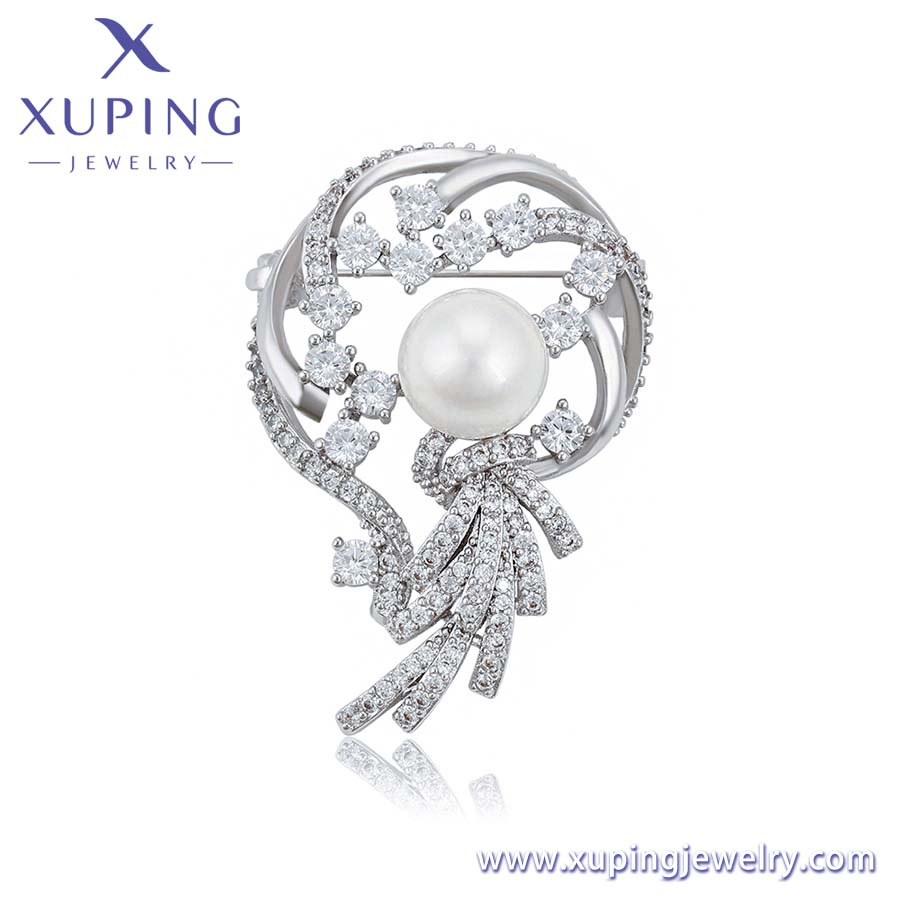
A worked example from the Xuping catalog shows the level of detail that makes a declaration usable: brooch A00900238 is listed as Environmental Copper, platinum plated, with a white synthetic cubic zirconia main stone of approximately 3.5*3.5 mm, an overall size of about 47*32 mm and a net weight of 12.3 g, sold by the piece. Brooch X000852427 is Environmental Copper with 14K gold color plating, an AB color synthetic cubic zirconia main stone of about 12*8 mm, a size of about 44*38 mm and a net weight of 9.15 g. The two items share a material family but require different plating wording, which is exactly why the declaration belongs at model level.
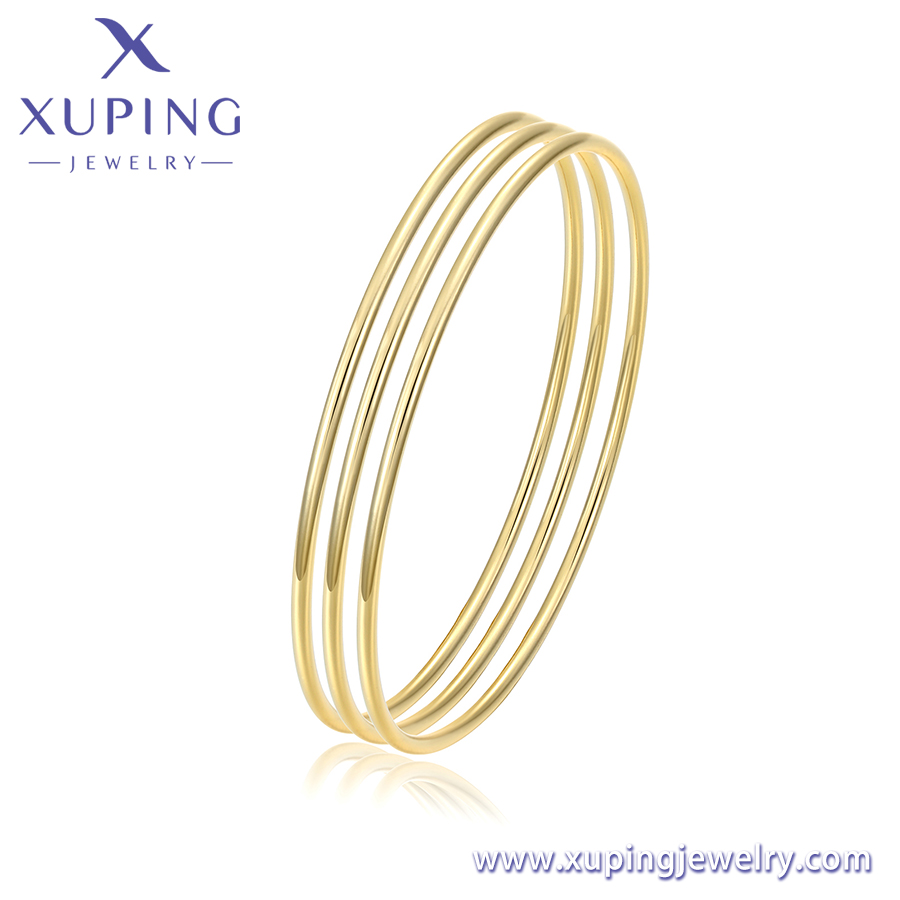
Unit of quantity matters more than buyers expect. A bangle listed as a set with a weight of 17.39 g per set cannot be documented, priced or labeled the same way as a bangle sold by the piece. Earrings sold by the pair carry a per-pair weight. Getting the unit wrong creates discrepancies in packing lists, customs descriptions and retail labeling at the same time.
Layer 2 — Restricted-substance and material test evidence
Test evidence answers a different question from the declaration: not what the product is, but what it does not contain or release. Nickel release, lead content and cadmium content are the recurring themes in jewelry market-access rules, and buyers should request a report that names the material family tested, the test date and the laboratory.
The most common error is coverage mismatch. A report for a copper-alloy material family does not cover a stainless steel bracelet, and a report for one plating thickness does not automatically cover a thicker or thinner coating. When a supplier holds existing reports, the productive question is which specific materials and models those reports name, so that any gap can be identified before a purchase order rather than after.
Layer 3 — Claim and labeling accuracy
The United States is the market where jewelry claim rules are documented in the most detail, and the logic there is instructive for buyers everywhere. The FTC Jewelry Guides, 16 CFR Part 23, treat it as unfair or deceptive to misrepresent the presence, quantity or karat fineness of gold or gold alloy in a jewelry product. The revised guidance retains a 10K minimum fineness and a 0.175 micron (7 millionths of an inch) coating threshold for describing a product as gold plated or gold electroplated.
The practical consequence for gold plated jewelry wholesale is that gold color and gold plated are different claims. A specification that reads 14K gold color or 18K gold color describes appearance. A retail label that reads 18K gold asserts metal content. If the declaration, the invoice description and the listing copy do not use the same wording, the buyer is carrying a claim the supplier never made.
Layer 4 — Regional market-access mapping
Market-access rules differ by jurisdiction in three practical ways: which restricted substances are controlled, what the label must state and in which language, and who carries the legal responsibility when goods enter the country. A buyer shipping the same necklace to five markets should expect five different document sets, even when the product is identical.
This is where a supplier's export experience becomes operationally useful. A manufacturer that already ships to a market has usually answered the same documentation questions before, which shortens the clarification cycle for a new buyer.
Layer 5 — Document control and traceability
The final layer is version control. Reports expire, plating processes change and models are revised. A document set is only reliable if it can be tied to a model number, a production period and an approved physical sample. Buyers should record which report version supported which purchase order, because that record is what resolves a query two shipments later.
Regional Requirements: What Changes by Market
How to read this section. The notes below describe the questions a buyer must resolve and the documents worth requesting. They are not a statement of legal limits for any jurisdiction. Specific thresholds, test methods and labeling rules must be confirmed with the relevant authority, a local testing provider or qualified counsel before goods are shipped.
Europe
In European markets the compliance burden sits mainly with the importer or retailer placing the product on the market, so the buyer's due-diligence file matters as much as the supplier's certificate. For a fashion jewelry wholesale order, the practical requests are a material declaration naming base metal and plating, restricted-substance documentation that names the material family being tested, and label text reviewed in the language of the destination market.
Two questions decide most European files. First, whether the item is being sold as plated or as a precious-metal product, because the answer changes the labeling obligation. Second, whether any marketing term such as nickel free or hypoallergenic is being used, because that wording needs test evidence behind it. Buyers should treat such terms as claims requiring documentation, not as descriptors chosen by the marketing team.
The Americas
The United States has explicit guidance on gold and plating claims, which makes it the clearest benchmark in this guide. Beyond claims, buyers should expect marketplace and retailer requirements to be stricter than the legal minimum, particularly for material disclosure on listings and for consistency between the product page and the physical label.
Canada and Latin American markets each apply their own marking and import documentation rules, and Xuping lists Mexico, Canada, Peru, the United States, Spain and Brazil-adjacent regional buyers among the markets it serves. The working method is the same everywhere in the region: confirm the marking and labeling requirement for the specific product category with a local agent, then check that the supplier's declaration can support the wording that will be printed.
Middle East
Middle Eastern buyers often compare a plating statement against a market where gold content is read closely. The productive request is clarity rather than reassurance: confirm that an item described as 18K gold color is a plated product, confirm the base metal, and confirm that the retail label will not use karat language that the specification cannot support.
Labeling language and import conformity documents also vary across the region. Xuping lists Saudi Arabia, Iran, the United Arab Emirates and Turkey among its major markets, which means a buyer in the region can ask for the document set that was previously used for a comparable shipment rather than starting from a blank request.
Southeast Asia
In Southeast Asia, platform listing rules often drive documentation more than import paperwork does. Marketplaces and social commerce channels frequently require material and stone disclosure on the listing itself, which makes the declaration a commercial document rather than only a compliance file. Xuping lists the Philippines, Thailand, Indonesia, Malaysia and Vietnam among its major markets.
For cubic zirconia jewelry wholesale in this region, the specific wording matters. Synthetic cubic zirconia should be declared as synthetic cubic zirconia, not as a diamond-like stone or a simulated diamond, unless the market's rules clearly permit that phrasing and the evidence supports it.
Africa
Importers in African markets face a different constraint: laboratory access and testing cost rather than rule complexity. Nigeria appears among Xuping's listed major markets, and buyers sourcing for such destinations usually need a practical allocation of testing responsibility rather than a theoretical compliance framework.
The workable approach is to write the allocation into the purchase order: which models or material families will be tested, who commissions and pays for the test, which laboratory is acceptable, and which report format the importer's clearing agent will accept. Agreeing this before production avoids the situation where goods are ready and the documentation route is still unresolved.
Step-by-Step Breakdown: A Six-Step Compliance Workflow Before You Order
- Define destination and channel for each SKU. A necklace sold on a domestic marketplace and the same necklace exported to the EU need different documents. Record the market and the sales channel against the model number before requesting anything.
- Request the SKU-level declaration. Ask for base metal, plating type, stone type, unit of quantity, weight and dimensions for the exact model, for example ring X001114331 in Environmental Copper with 14K gold color plating, a white synthetic cubic zirconia main stone of about 3*2 mm and a weight of about 5.65 g.
- Match existing test evidence to that declaration. Ask which reports name the material family in question, when they were issued and by which laboratory. Identify gaps rather than assuming coverage.
- Review the claim and label text against the declaration. Rewrite any wording that asserts more than the specification supports, especially around gold, karat and stone type.
- Validate on a physical sample. Check weight, dimensions, plating appearance, stone setting and any engravings against the specification. Xuping items such as pendant X000687942 carry an engraved xp mark, and that marking should be consistent with what the documentation describes.
- Lock the approved sample and document set into the purchase order. Reference the report version and the approved sample in the order, so the reference point survives staff changes on both sides.
Use Cases: How the Checklist Changes by Buyer Type
European boutique buying plated earrings and necklaces
A boutique sourcing gold plated jewelry wholesale for a physical store needs the claim wording to survive a customer conversation. The practical file is a declaration per model, plating wording that matches the label, and a clear internal rule that karat language is not used for plated goods. Earrings such as X000881925, listed as Environmental Copper with 18K gold color plating and a 5.37 g per-pair weight, illustrate why the per-pair unit must be stated on the label and the packing list.
US e-commerce seller of plated stainless steel
An online seller listing stainless steel jewelry wholesale in the United States carries the claim on the product page. The FTC guidance on gold and plating representations applies directly to that copy, so the listing text should be written from the specification rather than from a competitor's description. Necklace A00902945, a stainless steel piece with 14K gold color plating, a 40 cm length and a weight of about 6.30 g, is a simple example of a model where the declaration is short enough to be checked line by line against the listing.
Middle East gift distributor buying brooches and sets
A distributor supplying gift and occasion channels often needs consistent presentation across many models. The documentation priority shifts to consistency: the same plating wording, the same stone description and the same unit conventions across the whole assortment, so that retail partners are not comparing two different descriptions of the same material.
Southeast Asian marketplace seller of cubic zirconia
For a marketplace seller, the listing is the compliance surface. Stone description, plating description and material description must match the declaration exactly, because platform review and customer disputes both start from the listing text rather than from the invoice.
Comparison Table: What Each Document Establishes
The table below is a checklist framework. It maps each document to the question it answers, so that a buyer can see which gaps remain before an order is placed.
| Document | Question it answers | Issued by | When to request |
|---|---|---|---|
| SKU-level material declaration | What is the item made of, and how is it plated? | Supplier or manufacturer | Before quotation is finalized |
| Plating specification | Is the claim gold color, gold plated or solid, and at what thickness? | Manufacturer, with process records | Before label text is approved |
| Restricted-substance test report | Does this material family meet the applicable limits? | Independent laboratory | Before production, per material family |
| Management system or conformity certificate | Is the production process controlled and auditable? | Certification body | During supplier qualification |
| Label and claim copy approval | Does the commercial wording match the declaration? | Supplier and buyer jointly | Before artwork is printed |
| Approved physical sample | Does the goods match the specification? | Buyer and supplier jointly | Before bulk production |
The second table applies the same logic to real catalog examples. Every value below is a published specification for the named model.
| Model | Item | Base material | Plating | Main stone | Unit / weight |
|---|---|---|---|---|---|
| A00902945 | Necklace | Stainless Steel | 14K gold color | No stone | pcs / approx. 6.30 g |
| X000881925 | Earrings | Environmental Copper | 18K gold color | White synthetic cubic zirconia, 2*2 mm | pair / 5.37 g |
| X000852427 | Brooch | Environmental Copper | 14K gold color | AB synthetic cubic zirconia, 12*8 mm | pcs / 9.15 g |
| A00900238 | Brooch | Environmental Copper | Platinum plated | White synthetic cubic zirconia, 3.5*3.5 mm | pcs / 12.3 g |
| X000687942 | Pendant | Environmental Copper | 18K gold color | Synthetic cubic zirconia with garnet, 6*6 mm | pcs / 2.28 g |
| X001114331 | Ring | Environmental Copper | 14K gold color | White synthetic cubic zirconia, 3*2 mm | pcs / approx. 5.65 g |
| X000867735 | Bangle | Environmental Copper | 14K gold color | No stone | set / 17.39 g per set |
| X001124310 | Anklet | Environmental Copper | 18K gold color | No stone | pcs / approx. 10.0 g |
FAQ: Regional Jewelry Wholesale Compliance
1. What compliance documents should I request from a jewelry wholesale supplier before ordering?
Request a SKU-level material declaration, a plating specification, restricted-substance test reports that name the material family tested, and the label or claim text that will appear on the product. Check that each document names the model or material it supports. In the United States, the FTC Jewelry Guides under 16 CFR Part 23 treat misrepresentation of gold presence, quantity or karat fineness as deceptive, and retain a 10K minimum fineness and a 0.175 micron coating threshold for gold plated or gold electroplated descriptions. A certificate that names only the supplier, without naming the material or model, does not answer the buyer's question.
2. How do I judge whether a manufacturer can actually support documentation in several regions?
Look for evidence that the manufacturer controls its own production and engineering rather than reselling finished goods. Guangdong Xuping Jewelry Co., Ltd., established in 1997 and based in Guangzhou, China, reports a 200,000+ square meter facility, 1,000+ staff and an R&D team of 62 designers supporting a portfolio of 194 patents. The company states that its goods pass through 18 production procedures intended to meet European and American environmental-protection standards, and that its products hold SGS, CE and ISO certifications. These company-reported facts are useful qualification signals, but each specific model and material still needs its own declaration and, where required, its own test evidence.
3. Does compliance documentation increase the cost of a jewelry wholesale order?
The cost drivers are testing per material family or model, plating thickness control, and changes to label artwork and listing copy. The efficient approach is to ask the supplier which existing reports already cover your models before commissioning new tests, because duplicated testing is the most common avoidable expense. Xuping states a minimum order value of USD 50 on its official site and offers OEM/ODM with low-MOQ customization, which allows a buyer to validate a small order and its documentation before committing to bulk jewelry wholesale volumes.
4. Can I verify materials and plating on a sample before bulk production?
Yes, and it is the most reliable step in the process, provided the sample is produced to the same specification as the bulk order. Check the weight and dimensions against the published values, for example the 2.28 g and 28*16 mm of pendant X000687942 or the 12.3 g and 47*32 mm of brooch A00900238, and confirm the plating description matches the label wording. Visual inspection cannot confirm coating thickness or nickel release, so those two points require a laboratory report rather than a sample review. Retain the approved sample as the contractual reference.
5. How long does documentation and sample approval add to a wholesale order?
The sequence is fixed even where the timelines vary: define the destination market per SKU, obtain the declaration, match existing reports, approve the label text, approve a physical sample, then release bulk production. The practical way to compress the schedule is to run documentation and sampling in parallel rather than in sequence, and to request the document set for the specific models at the same time as the sample request. Buyers can request a sample and the material, plating and stone declaration for a named model directly from Xuping Jewelry at wlwf@xuping.com.cn or +86 139-2505-0911, and confirm what is already available before adding new testing to the plan.
Conclusion: Compliance Is a Reconciliation Task, Not a Certificate
Regional jewelry wholesale compliance is decided by whether three things agree: what the product is declared to be, what the evidence proves about it, and what the label and listing are allowed to say. A supplier certificate supports that chain but never replaces it, and a certificate that does not name the material or the model is not yet evidence for your order.
For buyers at the research stage, the productive next step is narrow. Pick one model you intend to stock, request its declaration and any existing test report that names its material family, and check the wording you plan to publish against both. Repeat that process once and it becomes a reusable workflow for every model and every destination market that follows.
Next step: request the document set for your model
Xuping Jewelry manufactures and exports fashion-imitation jewelry across copper, crystal and stainless steel constructions, supplying distributors, boutique retailers and e-commerce sellers. Buyers can request a sample together with the material, plating and stone declaration for a specific model before committing to bulk production.
Email: wlwf@xuping.com.cn · Tel / WhatsApp: +86 139-2505-0911 · Website: www.xupingjewelry.com
Address: 4th Floor, No. 28, Zhanqian Street, Zhanqian Road, Liwan District, Guangzhou, China.

Have Questions or Need More Details?
Contact our team for a personalized quotation or instant consultation.
Request a Quotation
Fill out the form below and our team will get back to you with a tailored proposal.
WhatsApp Direct Chat
Prefer to chat in real-time? Message us on WhatsApp for instant assistance & quick answers.
- Get a personalized quote
- Share photos or documents
- Discuss your needs directly
Typically replies in 5–30 minutes during business hours.