Wholesale Jewelry Sourcing: Stop Inventory Markdowns & Start Selling
Wholesale Jewelry Sourcing: Stop Inventory Markdowns & Start Selling
Most jewelry retailers do not have a selling problem; they have a sourcing structure problem. Markdowns are usually the visible symptom of an assortment that was bought as one large seasonal bet instead of as separate layers — a replenishment layer that keeps proven daily-wear pieces in stock, and a limited-run layer that tests trend-forward designs with capped exposure. Building both layers through one wholesale partner is what turns inventory from a cash trap into a repeatable margin engine.
This guide explains how that structure works in practice: which verified product categories belong in each layer, how to sequence the buy, what the 2026 wholesale market signals mean for assortment planning, and which capacity, quality and compliance facts to confirm before you commit open-to-buy. All product specifications referenced below come from Xuping Jewelry's published product data.
Why Inventory Markdowns Start Long Before the Sales Floor
Slow-moving inventory is created at the purchase-order stage, not at the discount rack. When a buyer commits a full seasonal budget to a single trend story, three things happen simultaneously: cash is locked into SKUs that cannot be re-cut quickly, display space is consumed by designs with a short relevance window, and the store loses the ability to respond when a proven basic silhouette sells out.
The structural causes repeat across retail stores, e-commerce sellers and distributors:
- Single-bet buying. The full open-to-buy goes to one theme, one plating colour or one silhouette family, so there is no offsetting layer if that theme underperforms.
- No replenishment core. Without a reorderable base of daily-wear pieces, buyers are forced to re-merchandise trend stock that was never designed for repeat volume.
- Category gaps. Categories such as anklets and jewelry sets are frequently left out of the initial buy, so the assortment cannot absorb demand shifts between categories.
- Trend pieces bought at core depth. A new crystal or statement design is ordered at the same quantity as a proven basic, which converts a test into a commitment.
- Compliance surprises. If the supplier cannot document material compliance before listing, finished goods can be blocked in regulated markets and become dead stock regardless of design quality.
The markdown spiral is mechanical: a piece that misses its first sell-through window ties up cash, shelf space and reorder capacity. Discounting it recovers part of the cost but not the opportunity — the same budget could have funded a replenishable basic plus two small trend tests. That is why the fix is a sourcing design decision, not a pricing decision.
The Jewelry Wholesale Market in 2026: Scale, Channel Shift and Compliance Pressure
Three market-level facts shape how a flexible assortment should be built today.
Scale. The global jewelry market was valued at approximately USD 242.79 billion to USD 381.5 billion in 2025, with growth projections reaching up to USD 578.5 billion by 2033, according to Fortune Business Insights and Grand View Research. The published range varies because different research houses include or exclude costume and imitation jewelry segments, so buyers should treat the range — not a single figure — as a planning baseline.
Trade flow. China's total jewelry exports reached USD 11.5 billion in 2024, with the United States as a primary destination at USD 1.31 billion, according to the Observatory of Economic Complexity. For importers, this confirms that factory-direct Chinese supply remains the main volume channel for fashion and imitation jewelry.
Channel shift. Online jewelry retail channels are projected to grow at a compound annual growth rate of 8.0% to 13%, representing 25–30% of total industry purchases by 2026, per Grand View Research and Statista. Faster online sell-through rewards shallow, testable buys and penalises deep inventory commitments — which is exactly the logic behind a layered assortment.
Compliance pressure. Jewelry sold in the EU must comply with REACH Regulation (EC) 1907/2006, which sets nickel release limits at 0.5 μg/cm²/week, lead at 500 mg/kg and cadmium at 100 mg/kg, according to the European Chemicals Agency. Jewelry intended for children under 14 in the EU is classified as a toy and requires mandatory CE marking under the Toy Safety Directive. For wholesale buyers, compliance is a sourcing constraint rather than a marketing claim: it determines which supplier documents you must hold before a trend buy can be listed in those markets.
The Flexible Assortment Model: Replenishment Basics Plus Limited-Run Trend Pieces
The model is straightforward to describe and harder to execute without a supplier that carries breadth in one catalogue. Split the buy into three layers, give each layer a distinct job, and never let the trend layer consume the replenishment layer's budget.
Layer 1 — The Replenishment Core: Daily and Simple Series Basics
This layer exists to be reordered. It should contain designs with stable demand, low seasonal risk and enough construction consistency that a repeat order matches the first order. Verified examples from Xuping's catalogue show how the layer is structured across categories:
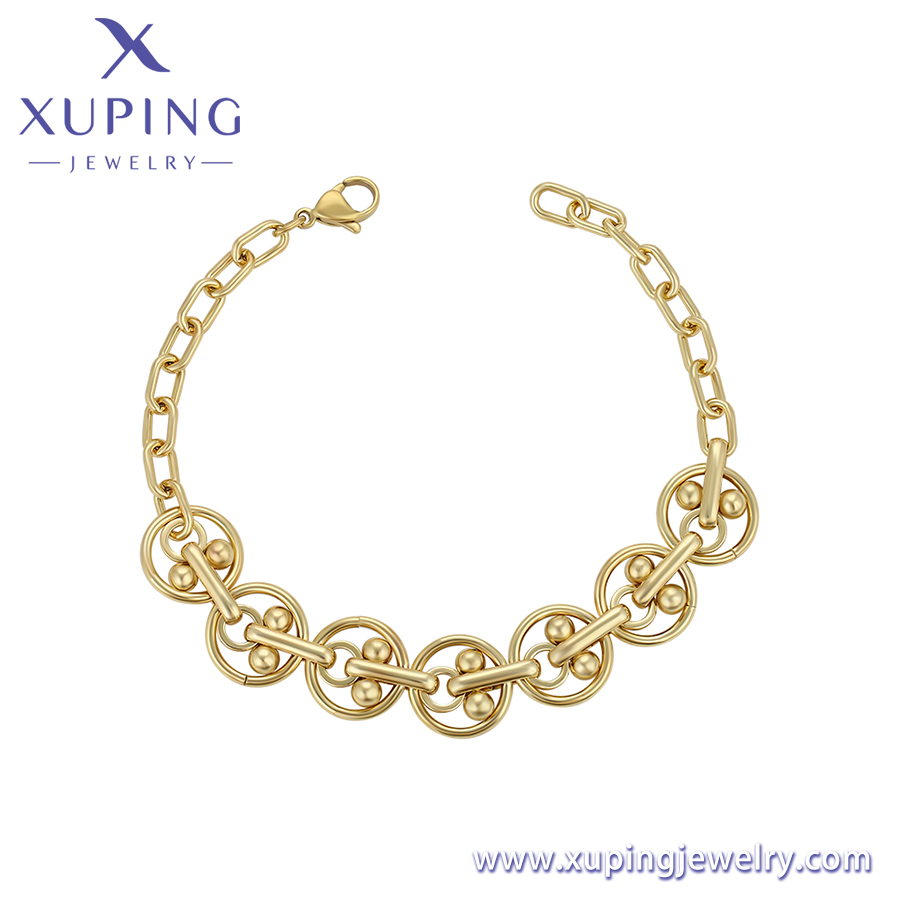
- Stainless Steel Jewelry – Bracelets, model T000959269: stainless steel construction, Daily series, approximately 170 mm × 6 mm with a 30 mm extension, hand size 11.01 cm, product weight about 11.01 g, no main stone.
- Stainless Steel Jewelry – Necklaces, model A00902945: stainless steel with 14K gold-colour plating, Daily series, 40 cm length, about 6.30 g, no main stone.
- Necklaces, model X001015911: 14K gold-colour plated, Daily series, 43 cm chain, white synthetic cubic zirconia main stone about 6 mm × 8 mm, about 4.30 g.
- Bracelets, model X000977345: 14K gold-colour plated, Daily series, approximately 200 mm × 5 mm (±2 cm), about 15.05 g, no main stone.
- Bracelets, model X000992979: 18K gold-colour plated, Daily series, approximately 195 mm × 8 mm (±2 cm), colour synthetic cubic zirconia main stone about 7 mm × 5 mm, about 12.97 g.
- Rings, model X000877263: 14K gold-colour plated, Daily series, about 2.56 g, no main stone.
- Rings, model X001114331: 14K gold-colour plated, Daily series, white synthetic cubic zirconia main stone about 3 mm × 2 mm, about 5.65 g.
- Pendants, model X001122748: 18K gold-colour plated, Daily series, pendant about 36 mm × 27 mm, white synthetic cubic zirconia about 2 mm × 2 mm, about 3.76 g.
- Pendants, model X000687942: 18K gold-colour plated, Daily series, garnet synthetic cubic zirconia main stone about 6 mm × 6 mm, pendant about 28 mm × 16 mm, about 2.28 g.
- Earrings, model X001163413: 14K gold-colour plated, Simple series, about 14 mm × 5 mm, about 2.45 g per pair, no main stone.
- Earrings, model X000881925: 18K gold-colour plated, Luxury series, white synthetic cubic zirconia 2 mm × 2 mm, about 37 mm × 3 mm, about 5.37 g per pair.
- Brooches, model A00900238: platinum plated, Daily series, white synthetic cubic zirconia about 3.5 mm × 3.5 mm, brooch about 47 mm × 32 mm, about 12.3 g.
The replenishment layer is what stops markdowns from spreading. When a customer returns for a second unit of a ring, bracelet or pendant that sold well, the retailer reorders instead of substituting a trend piece at a discount.
Layer 2 — Limited-Run Trend Pieces with Capped Exposure
Trend pieces earn the higher margin per unit, but only if their exposure is capped. They should be bought in shallow depth, measured against a short sell-through window, and dropped without sentimental attachment. Verified examples that fit this layer:
- Crystal Jewelry – Necklaces, model X000668301: 18K gold-colour plated, Simple series, lilac synthetic crystal main stone about 18 mm × 17 mm, necklace about 410 mm × 1 mm (+50 mm), about 7.91 g; the item is marked with the brand "XP".
- Crystal Jewelry – Earrings, model 14E25011845: 18K gold-colour plated, Simple series, AB-colour synthetic crystal main stone, about 27 mm × 14 mm, about 8.88 g per pair. This product holds SGS certificate CANHL25006144001 under REACH Regulation (EC) No 1907/2006.
- Bangles, model X000998659: 14K gold-colour plated, Luxury series, ruby-colour synthetic cubic zirconia main stone about 8 mm × 6 mm, bangle about 60 mm × 8 mm, about 21.77 g.
- Bangles, model X000867735: 14K gold-colour plated, Simple series, no main stone, about 65 mm × 2 mm, about 17.39 g per set.
- Brooches, model X000852427: 14K gold-colour plated, Luxury series, AB-colour synthetic cubic zirconia main stone about 12 mm × 8 mm, brooch about 44 mm × 38 mm, about 9.15 g.
- Necklaces, model 14N245402: platinum plated, Luxury series, dark blue glass main stone, about 440 mm × 6 mm (+50 mm), about 49.44 g.
The point of this layer is not to predict the winning trend. It is to buy enough trend surface area that one or two designs convert, while keeping the loss on the rest small enough to absorb.
Layer 3 — Basket Builders: Jewelry Sets and Anklets
Sets and anklets are among the most under-used categories in wholesale assortment planning, which is exactly why they create differentiation at low risk.
- Jewelry-Sets, model X000871334: 18K gold-colour plated, Luxury series, white synthetic cubic zirconia about 2.5 mm × 2.5 mm; earrings about 3 mm × 28 mm × 11 mm, bracelet about 200 mm × 3 mm, necklace about 450 mm × 3 mm; about 18.8 g per set, sold by the set.
- Jewelry Sets, model X001006294: 14K gold-colour plated, Simple series, white synthetic cubic zirconia about 2 mm × 2 mm; earrings about 18 mm × 10 mm, pendant about 26 mm × 12 mm, bangle about 60 mm × 13 mm; about 28.43 g per set.
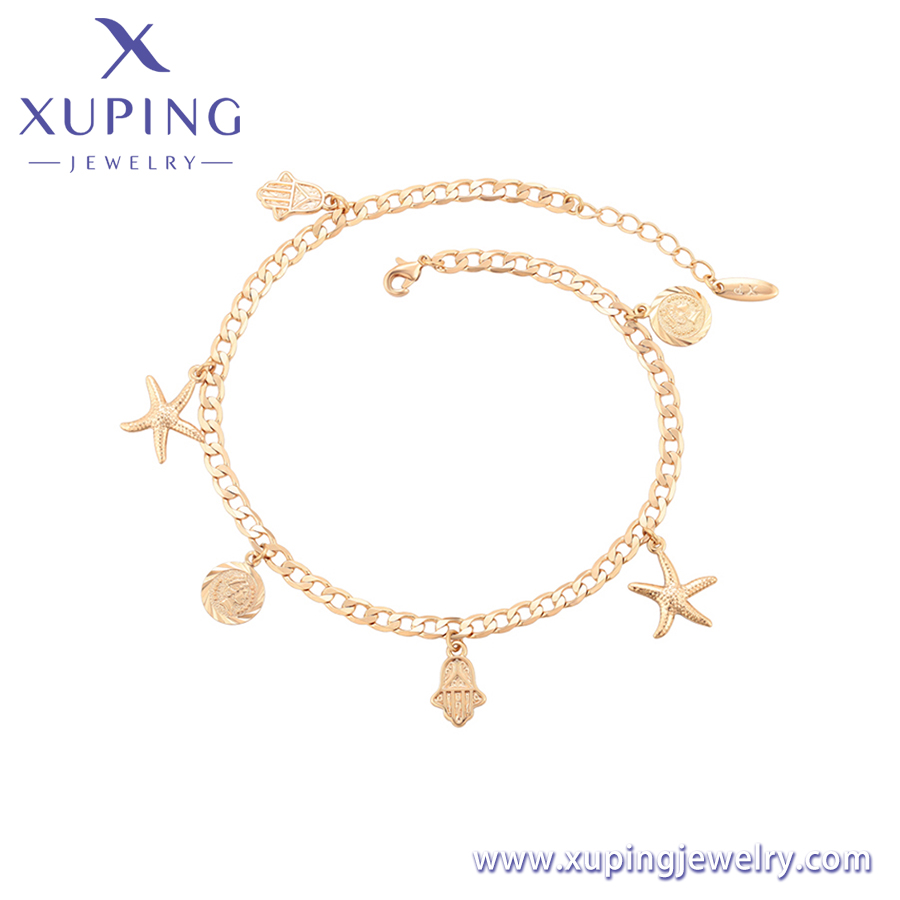
- Anklets, model X001124310: 18K gold-colour plated, Daily series, about 280 mm × 5 mm (+30 mm), about 10.0 g, no main stone.
- Anklets, model X000988693: platinum plated, Daily series, about 270 mm × 4.5 mm (±2 cm), about 5.59 g, no main stone.
Sets raise the value of a single transaction without requiring a new customer, and they are a natural fit for gift-giving occasions. Anklets widen the category footprint at low unit weight and give seasonal campaigns a category that is not already saturated by earrings and necklaces. Both categories also give the replenishment layer more depth, because they can be reordered in the same way as a basic ring or bracelet.
What Makes This Model Work at the Supplier Level
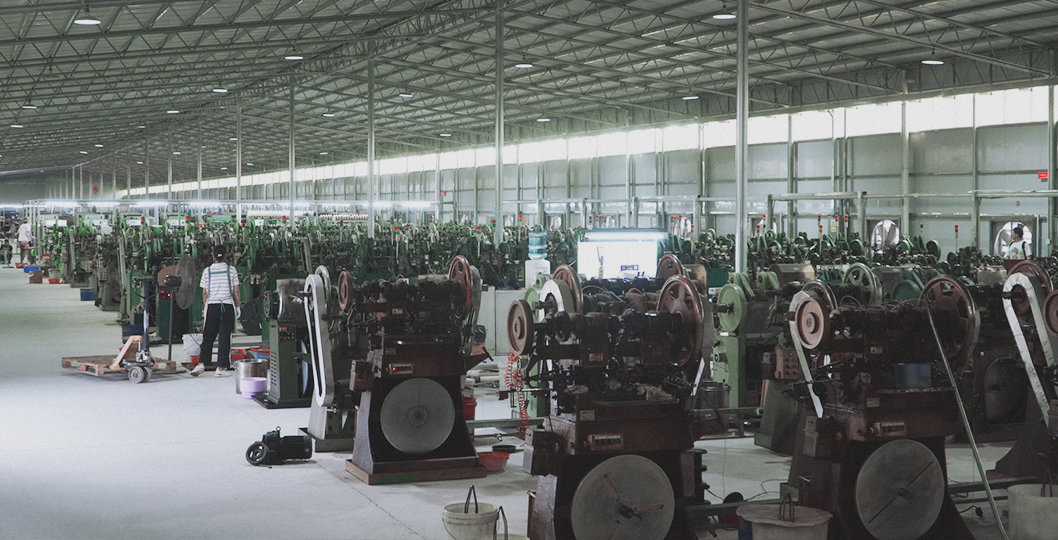
A three-layer assortment only works if one supplier can supply all three layers, at different order quantities, without forcing the buyer into separate compliance and logistics chains. Xuping Jewelry — Guangdong Xuping Jewelry Co., Ltd. — is a Chinese fashion-imitation jewelry manufacturer founded in 1997, which gives the company nearly three decades of manufacturing experience across a broad product portfolio.
Verified capability facts relevant to assortment planning:
- Portfolio breadth: rings, pendants, earrings, bracelets, necklaces, anklets, bangles and jewelry sets, with base material following a premium copper alloy approach and gold-plating craftsmanship, plus stainless steel constructions such as models T000959269 and A00902945.
- Capacity: monthly production capacity of 8,000,000 pieces and annual output of more than 100,000,000 pieces, supported by a 200,000 m² production base and more than 1,200 advanced production facilities.
- Design capability: an R&D team of 62 designers and 194 patents.
- Order flexibility: minimum order quantity from as low as 1 piece, which is what makes shallow trend testing commercially realistic.
- Customisation: OEM/ODM production with engraved logos, hang tags and custom packaging.
- Quality control: 100% full inspection, SGS-certified quality control, an 18-stage quality check across 18 production procedures, and REACH/ROHS compliance testing.
- Lead time: 30–90 days, depending on order scope and customisation level.
- After-sales: 24/7 online support, after-sales quality guarantee, product replacement, OEM/ODM after-sales service and global logistics support.
- Reach: an export network covering markets across North America, Europe, the Middle East, Southeast Asia, Africa and Oceania.
The strategic value of these facts is not the size of the numbers. It is that the same supplier can accept a 1-piece test order, then scale the winning design to a replenishment volume, and keep both under one quality and compliance system. That removes the most common operational reason retailers abandon the layered model: juggling multiple vendors for different layers.
Step-by-Step: Building a Flexible Wholesale Jewelry Assortment
Step 1 — Separate sell-through by category and series, not by total. A single revenue number hides the problem. Review performance by category — rings, earrings, necklaces, bracelets, anklets, sets — and by series so you can see which lines actually replenish and which ones are pushed.
Step 2 — Fix the replenishment core before placing any trend order. Select a base of Daily and Simple series designs that are built for repeat orders, such as bracelet X000977345, ring X000877263, pendant X001122748, earrings X001163413 or the stainless steel bracelet T000959269. Confirm the finish, size tolerance (±2 cm on many lengths) and weight so a reorder matches the original shipment.
Step 3 — Cap the trend budget in writing. Decide the maximum number of trend SKUs and the maximum depth per SKU before opening the catalogue. The cap is the mechanism that prevents a single trend miss from consuming replenishment capital.
Step 4 — Add one basket-building category per season. Alternate between jewelry sets and anklets. A set such as X000871334 or X001006294 raises transaction value; an anklet such as X001124310 or X000988693 opens a category that competitors often overlook.
Step 5 — Verify compliance documents before the trend order, not after. Ask for the certificate number, issuing authority, applicable standard and validity dates for the exact product lines you are buying. Trend pieces are the most likely to be reordered fast and the most damaging if they cannot be listed.
Step 6 — Map replenishment cadence to supplier lead time. With a 30–90 day lead time, reorder triggers must fire well before a bestseller is out of stock. Set the reorder point based on the shorter end of that window for standard designs and the longer end for OEM/ODM work.
Step 7 — Rotate, do not accumulate. When a trend SKU finishes its window without converting, retire it and redeploy that budget into the replenishment core or the next small test. Keeping a failed design in the range is how markdown pressure builds.
Use Cases: Matching the Assortment Model to Your Business Type
Retail jewelry stores use the core layer for display consistency and the trend layer for window rotation. Anklets and sets are typically placed near gifting fixtures, where the application profile — daily wear, event and occasion, gift giving and all-weather suitability — matches how the products are specified.
E-commerce platforms and marketplace sellers benefit most from shallow, testable buys because online sell-through reacts faster than footfall. A single trend design can be validated at low depth, then replenished in the winning colourway without a second sampling cycle.
Brand owners running OEM/ODM programmes use customisation options — engraved logos, hang tags and custom packaging — to convert a generic piece into a branded one. In this model the replenishment core carries the brand's permanent identity, while limited runs carry the seasonal story.
Wholesale distributors resell the same layered logic to their own retail accounts. Distributors who hold both a restockable base and a small trend rotation can serve stores that need weekly replenishment without carrying dead categories themselves.
Promotional gift buyers generally require hypoallergenic, eco-friendly and lead-free compliant material plus matched packaging such as display stands, custom gift boxes and storage bags. A supplier with documented REACH-compliant lines and custom packaging capability shortens approval cycles for these projects.
Authorised brand agents operating on this model provide useful benchmarks. Agent operations in Turkey and Indonesia each report annual sales of over 2 million units, and an agent operation in Morocco reports annual sales of over 3 million units. Across these cases, the recurring performance drivers are a wide variety of styles, rapid design updates, environmentally friendly and hypoallergenic materials, and on-time delivery — the same four elements that the layered assortment is designed to protect.
Comparison Table: Assortment Layers, Verified Specifications and Sourcing Role
| Assortment Layer | Verified Example Models | Base Material & Plating | Main Stone | Verified Unit Weight | Role in the Assortment |
|---|---|---|---|---|---|
| Replenishment core — daily basics | Stainless Steel Bracelet T000959269; Stainless Steel Necklace A00902945 | Stainless steel; stainless steel with 14K gold-colour plating | No main stone | ≈11.01 g; ≈6.30 g | Reorderable base with the lowest seasonal risk |
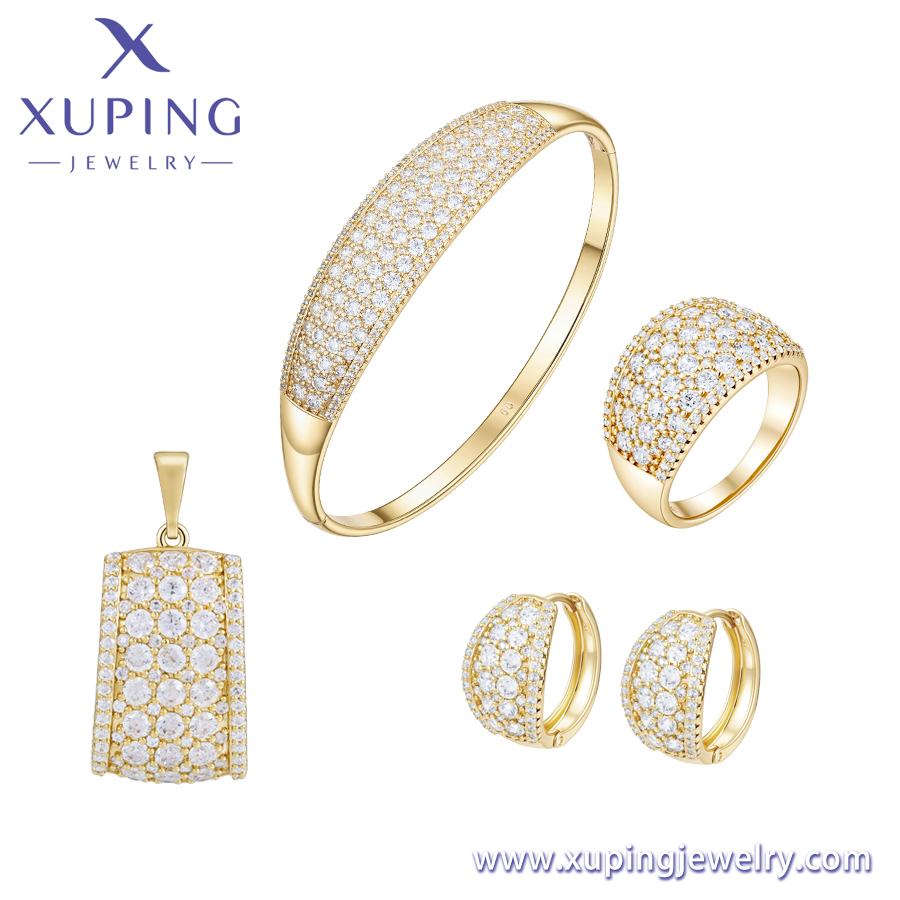
| Replenishment core — daily wear | Bracelet X000977345; Bracelet X000992979; Ring X000877263; Ring X001114331; Pendant X001122748; Pendant X000687942; Earrings X001163413 | Environmental Copper with 14K or 18K gold-colour plating | No stone, or white / colour / garnet synthetic cubic zirconia | ≈2.28 g – 15.05 g | High-turn, multi-category depth across rings, bracelets, pendants and earrings |
| Trend layer — colour and crystal | Crystal Necklace X000668301; Crystal Earrings 14E25011845 | Environmental Copper with 18K gold-colour plating | Lilac synthetic crystal ≈18×17 mm; AB-colour synthetic crystal | ≈7.91 g; ≈8.88 g/pair | Limited-run colour tests with capped exposure |
| Trend layer — statement pieces | Bangle X000998659; Bangle X000867735; Brooch X000852427; Necklace 14N245402 | Environmental Copper with 14K gold-colour or platinum plating | Ruby or AB-colour synthetic cubic zirconia; dark blue glass; no stone | ≈9.15 g – 49.44 g | Margin drivers and visual anchors for window and hero placements |
| Basket builders — sets | Jewelry-Sets X000871334; Jewelry Sets X001006294 | Environmental Copper with 18K or 14K gold-colour plating | White synthetic cubic zirconia | ≈18.8 g/set; ≈28.43 g/set | Raises transaction value; strong gifting and occasion fit |
| Basket builders — anklets | Anklet X001124310; Anklet X000988693 | Environmental Copper with 18K gold-colour or platinum plating | No main stone | ≈10.0 g; ≈5.59 g | Category expansion at low unit weight and low markdown exposure |
Compliance Reference for the Same Product Lines
| Product Line | Certification | Certificate Number | Standard / Validity |
|---|---|---|---|
| Crystal Jewelry – Earrings (model 14E25011845) | SGS, issued by SGS-CSTC Standards Technical Services Co., Ltd. Guangzhou Branch | CANHL25006144001 | REACH Regulation (EC) No 1907/2006; valid 2025-03-27 to 2030-03-27 |
| Necklaces (including model X001015911 and 14N245402) | SGS, issued by SGS-CSTC Standards Technical Services Co., Ltd. Guangzhou Branch | GZHL250301072401JW | REACH Regulation (EC) No 1907/2006; valid 2025-03-31 to 2030-03-31 |
| Earrings (models X000881925 and X001163413) | SGS, issued by SGS-CSTC Standards Technical Services Co., Ltd. Guangzhou Branch | CANHL25004908001 | REACH Regulation (EC) No 1907/2006; valid 2025-03-22 to 2030-03-22 |
| Rings (model X001114331) | CTI, issued by Centre Testing International (Guangzhou) Co., Ltd. | A2230517570101001 | IEC 62321 series standards; valid 2023-10-13 to 2028-10-13 |
| Stainless Steel Jewelry – Bracelets (model T000959269) | ISO9001, issued by ZHONGHANGXIN CERTIFICATION CENTER (SHENZHEN) CO., LTD. | CACQ21Q00750R1 | GB/T 19001-2016 / ISO 9001:2015, covering design and production; valid until 2027-10-25 |
FAQ: Wholesale Jewelry Sourcing Questions Buyers Ask Before Ordering
1. What certifications should a wholesale jewelry supplier provide for EU and US retail?
For EU markets, the core requirement is REACH Regulation (EC) 1907/2006, which sets nickel release limits at 0.5 μg/cm²/week, lead at 500 mg/kg and cadmium at 100 mg/kg, according to the European Chemicals Agency. Buyers should request the certificate number, issuing authority, applicable standard and validity dates for the exact product lines being purchased. For Xuping Jewelry, Crystal Jewelry – Earrings model 14E25011845 holds SGS certificate CANHL25006144001 under REACH Regulation (EC) No 1907/2006, valid from 2025-03-27 to 2030-03-27; Necklaces hold SGS certificate GZHL250301072401JW under the same regulation, valid from 2025-03-31 to 2030-03-31; Earrings hold SGS certificate CANHL25004908001, valid from 2025-03-22 to 2030-03-22; Rings model X001114331 hold CTI certificate A2230517570101001 issued by Centre Testing International (Guangzhou) Co., Ltd., valid from 2023-10-13 to 2028-10-13; and Stainless Steel Jewelry – Bracelets model T000959269 holds ISO9001 certificate CACQ21Q00750R1 issued by ZHONGHANGXIN CERTIFICATION CENTER (SHENZHEN) CO., LTD. under GB/T 19001-2016 / ISO 9001:2015, valid until 2027-10-25. One additional constraint applies to assortment planning: jewelry intended for children under 14 in the EU is classified as a toy and requires mandatory CE marking under the Toy Safety Directive, so children's lines must be separated from adult fashion jewelry in both sampling and documentation.
2. Can one wholesale supplier support both replenishment basics and trend-forward limited runs?
It can, if the supplier holds manufacturing breadth across categories rather than only trading a narrow selection. Xuping Jewelry produces rings, pendants, earrings, bracelets, necklaces, anklets, bangles and jewelry sets, with base material following a premium copper alloy approach plus gold-plating craftsmanship and stainless steel constructions such as bracelet T000959269 and necklace A00902945. The same operation runs an R&D team of 62 designers, holds 194 patents, operates more than 1,200 advanced production facilities within a 200,000 m² production base, and reports a monthly production capacity of 8,000,000 pieces with annual output of more than 100,000,000 pieces. This matters for assortment design because a replenishment basic and a trend test can be produced, inspected and documented under one quality system instead of two, which simplifies both reordering and compliance record-keeping.
3. How does a low MOQ affect markdown risk and margin control?
Low minimum order quantities change the risk profile of the trend layer rather than the price of the product. Xuping Jewelry offers a minimum order quantity from as low as 1 piece, which means a buyer can place a shallow test on a new crystal or statement design such as necklace X000668301 or earrings 14E25011845 without committing to core depth. If the design converts, it is scaled into the replenishment layer; if it does not, the loss is limited to the test quantity instead of a full seasonal buy. Because the same catalogue also covers high-turn basics — for example ring X000877263 at about 2.56 g, pendant X000687942 at about 2.28 g or earrings X001163413 at about 2.45 g per pair — the working capital that is saved on failed trend depth can be redirected into restocking the pieces that already sell, which is the practical mechanism behind margin control.
4. Can buyers validate a product before committing to a full assortment?
Yes, and the lowest-friction route is the low MOQ itself: because orders can start from as little as 1 piece, a buyer can evaluate finish, weight, size tolerance and construction on a single unit of a specific model before it enters the assortment. For example, the Daily series bracelet X000977345 is specified at approximately 200 mm × 5 mm (±2 cm) and about 15.05 g, while the Luxury series bangle X000998659 is specified at approximately 60 mm × 8 mm and about 21.77 g with a ruby-colour synthetic cubic zirconia main stone about 8 mm × 6 mm — specifications that are best confirmed physically rather than assumed. If the piece is intended for a private-label programme, OEM/ODM options for engraved logos, hang tags and custom packaging can be validated in the same cycle, and the supplier's product replacement and after-sales quality guarantee cover the transition from test unit to repeat order.
5. What lead time should buyers plan for, and what is the next step?
Xuping Jewelry lists a lead time of 30–90 days, depending on order scope and the level of OEM/ODM customisation. In practice this means replenishment triggers for standard Daily or Simple series designs should be set against the shorter end of that window, while customised or engraved orders should be planned against the longer end. After-sales support is available 24/7 with global logistics support, product replacement and OEM/ODM after-sales service, which reduces the risk of a replenishment gap turning into an out-of-stock markdown cycle. To move from planning to a first order, buyers can request a current catalogue, a quotation, or a sample-scale order directly — contact Xuping Jewelry at wlwf@xuping.com.cn or via WhatsApp on +86 139-2505-0911, or review the full product range at xupingjewelry.com.
Conclusion: Margin Control Is an Assortment Structure, Not a Discount Strategy
Inventory markdowns are rarely caused by picking the wrong trend. They are caused by having no layer of the assortment that can absorb a trend miss. A wholesale jewelry programme built around three layers — a reorderable core of Daily and Simple series basics, a capped layer of trend-forward crystal and statement pieces, and basket-building categories such as jewelry sets and anklets — gives a retailer, e-commerce seller, brand owner or distributor a way to test newness without putting the rest of the buy at risk.
The market context supports that structure. The global jewelry market was valued at approximately USD 242.79 billion to USD 381.5 billion in 2025 with projections up to USD 578.5 billion by 2033, China's jewelry exports reached USD 11.5 billion in 2024, and online jewelry channels are expected to represent 25–30% of industry purchases by 2026. Faster channels reward shallow testing; regulated markets reward documented compliance. A supplier that combines category breadth, a 1-piece entry quantity, 8,000,000-piece monthly capacity, an 18-stage quality check and current SGS, CTI and ISO9001 documentation allows all three layers to run through one supply chain.
For Xuping Jewelry, that combination comes from nearly three decades of manufacturing in fashion-imitation jewelry since 1997 — and it is the reason a wholesale buyer can stop treating inventory as a bet and start treating it as a portfolio.
Next Step: Build Your Layered Assortment
Request the current Xuping Jewelry catalogue, a quotation for specific models, or a sample-scale order to test the trend layer before committing open-to-buy.
Email: wlwf@xuping.com.cn | WhatsApp / Tel: +86 139-2505-0911
Website: www.xupingjewelry.com | Address: 4th Floor, No. 28, Zhanqian Street, Zhanqian Road, Liwan District, Guangzhou, China