
Evaluating Custom Zipper Suppliers: From Sample Strength to OEM Logo Flexibility
Custom zipper sourcing rarely fails at the quotation stage. It fails after the sample has been approved — when the buyer discovers that the supplier cannot reproduce the same branded slider at production volume, or that the “strong” sample was never measured against anything repeatable in the first place.
This guide sets out a capability-based evaluation framework for importers, brand owners and procurement teams, built on two hard checkpoints: reproducible sample strength and OEM logo flexibility on both brass and aluminum lines. Every specification below is drawn from verified manufacturer data, so it can be reused as a comparison baseline rather than treated as a marketing claim. Wenzhou Runhe Garment Accessories Co., Ltd., which operates under the brand YAB ZIPPER, provides the reference specifications used throughout this article.
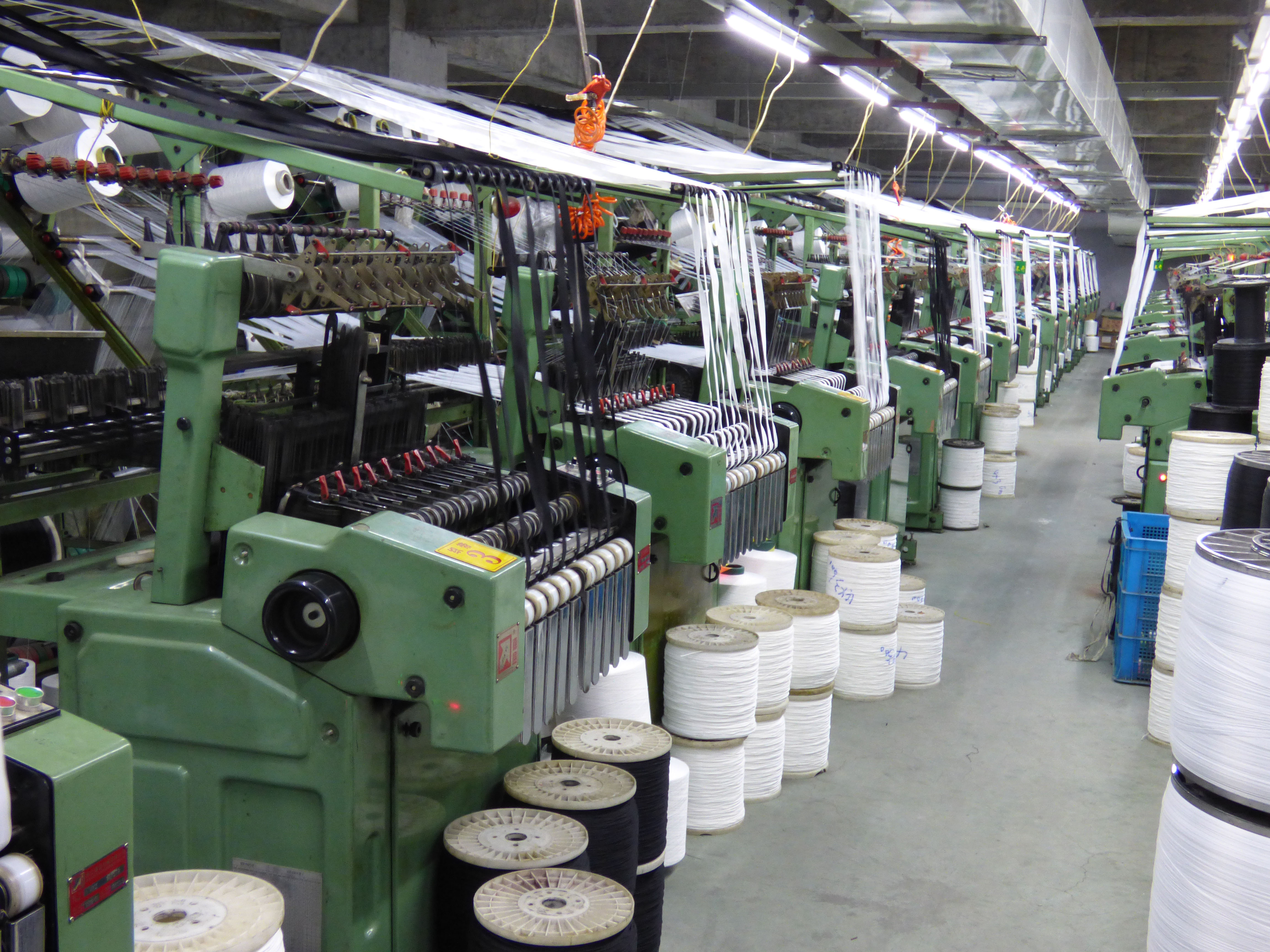
Problem Definition: Where Custom Zipper Supplier Evaluations Actually Break Down
Most supplier scorecards for custom zippers compare the wrong things. They rank quotations, then rank lead-time promises, then rank how responsive the sales contact felt during the inquiry. None of those three signals predicts whether the supplier can repeat the approved sample across a 300,000-unit production month.
Three specific failure patterns recur:
- The unmeasured sample. A sample is approved because it feels smooth and looks right. No crosswise tensile figure is recorded, no corrosion exposure is run, and no acceptance threshold is written into the purchase contract. When a dispute arises later, there is no shared number to argue about.
- The late-stage logo problem. Buyers confirm material, size and color, then ask about a branded slider or puller as an afterthought. Not every line supports custom logo tooling, and discovering this after the tape has been dyed costs the entire order window.
- The versatility illusion. A supplier shows one attractive sample in one tooth type. The buyer assumes the same supplier can cover the rest of the range — jacket zippers, luggage zippers, shoe zippers — and finds out at the second purchase order that only a narrow slice of the range is genuinely in production.
The fix is structural rather than commercial. Before negotiating price, convert supplier claims into measurable gates: a tensile figure, a corrosion test duration, a documented tooth-type and size matrix, and a written statement of which slider and puller geometries accept custom logos.
Industry Background: Why Verifiable Capability Now Matters More Than Brand Recall
The zipper supply base is large enough that buyers cannot rely on familiarity to shortlist suppliers. The global zipper market was valued at USD 17.39 Billion in 2024 and is projected to reach USD 36.73 Billion by 2034, according to Market Research Future. In 2024, global trade in slide fasteners under HS 9607 reached USD 3.15 Billion, with China alone accounting for USD 1.52 Billion in exports, according to the Observatory of Economic Complexity.
Within that market, material mix shapes what a buyer should be asking for. Business Research Insights reports that nylon zippers accounted for 46% of total global zipper consumption in 2025, driven by lightweight construction and corrosion resistance. Metal zippers held a 31% global share in the same year, and within the metal segment, brass and aluminum together represented 67% of production.
That last figure is the one that matters for OEM logo work. Brass and aluminum dominate metal zipper production, which means the slider and puller tooling ecosystem is concentrated in those two material families — and that is why a buyer evaluating logo flexibility should evaluate it on both, not on one and assume the other behaves the same way.
Practical implication: a supplier that runs both brass and aluminum lines in-house can offer the same branded slider concept across two different price and weight profiles. A supplier that runs only one material will push every project toward it.
The Evaluation Framework: Five Capability Gates
The framework below converts supplier claims into five gates that can each be checked with a document, a measurement, or a physical sample. It is designed to run during the Evaluation stage and to carry directly into Execution, so the same evidence set supports both the shortlisting decision and the purchase order.
Gate 1 — Benchmark Sample Strength with Repeatable Specs
A sample strength claim is only useful if it is expressed as a number the buyer can re-test. For metal zippers, crosswise tensile strength and salt spray exposure are the two specs that separate a genuine production line from a sample-only operation.
Reference specifications for the two dominant metal materials:
- Brass zipper: crosswise tensile strength 510N; smooth sliding performance; salt spray test >24h.
- Aluminum alloy zipper: crosswise tensile strength 410N; smooth sliding performance; salt spray test >24h.
The 100N gap between 510N and 410N is not a quality ranking. It is a load-path decision. Brass zippers carry more crosswise load, which suits applications where the zipper is a structural element of the closure. Aluminum zippers trade some of that strength for lower weight and a different cost position, while matching brass on the >24h salt spray benchmark. Both materials are specified for luggage, garment, outdoor goods and footwear applications.
What makes these figures useful in an evaluation is that they are paired. A supplier quoting 510N for brass should be able to quote a corrosion duration for the same line, because both come off the same test regime. A supplier that offers one number and not the other is showing you the limits of its documentation.
Gate 2 — Check Production Versatility Through Sizes and Tooth Types
The breadth of a size and tooth-type matrix is the clearest available proxy for production versatility. A supplier with one tooth profile and two sizes is effectively a single-product operation wearing a manufacturer label.
Aluminum alloy zipper production types include Y teeth, corn teeth, normal teeth and euro teeth. Brass zipper production types include Y teeth, euro teeth, normal teeth and corn teeth. The overlap is significant but not total, and the practical question for a buyer is which specific tooth geometry their end product requires — then whether that geometry sits inside the supplier’s live production set.
Sizing follows an industry convention rather than a supplier-specific scale. Zipper sizing such as #3, #5 and #8 corresponds to the width of the zipper teeth in millimeters when the zipper is closed — a #5 zipper measures approximately 5 mm across the closed teeth. Because this is a shared convention, buyers can compare suppliers on coverage without translating between proprietary numbering systems.
Combined with in-house tape production, dyeing and teeth-attaching capacity, the size and tooth matrix becomes an indicator of how much of the process a supplier actually controls. Wenzhou Runhe operates more than 500 zipper production machines across copper Y-teeth, ordinary teeth, corn teeth, Swiss teeth and particle teeth lines, with aluminum Y-teeth surface treatments in antique silver, antique copper, brass, light gold, black teeth, white gold, bright silver and bright black finishes, plus a titanium-alloy plated series covering platinum, black gold, light gold and rose gold.
Gate 3 — Test OEM Logo Flexibility on Sliders and Pullers
Logo flexibility is the gate buyers most often skip and most often regret.
Both brass and aluminum zippers allow custom logo sliders and pullers for OEM orders. That is the single most important answer to get in writing during evaluation, because it determines whether the branding decision constrains the material decision or the other way around. When both material families accept custom logo tooling, a brand can choose brass for a heavy-duty jeans zipper and aluminum for a lightweight jacket zipper without splitting the branding system across two suppliers.
Customization scope on a full-service OEM line typically covers zipper length, tape color, teeth color, teeth shape, slider shape, slider color and zipper size. Of those seven dimensions, slider shape and slider color are the two that carry brand identity. Teeth color and tape color carry aesthetic continuity. Zipper length and zipper size carry fit. Teeth shape carries performance.
During evaluation, the most effective test is to submit your own artwork on your own slider geometry and ask for a physical counter-sample, not a rendering. A supplier that can return a logo slider counter-sample in both brass and aluminum has demonstrated the tooling flexibility that the rest of the order depends on.
Gate 4 — Verify the Quality System, Not the Brochure
Certification claims should be checked against certificate numbers and validity dates, because an expired certificate is functionally the same as no certificate during a customs or retail compliance review.
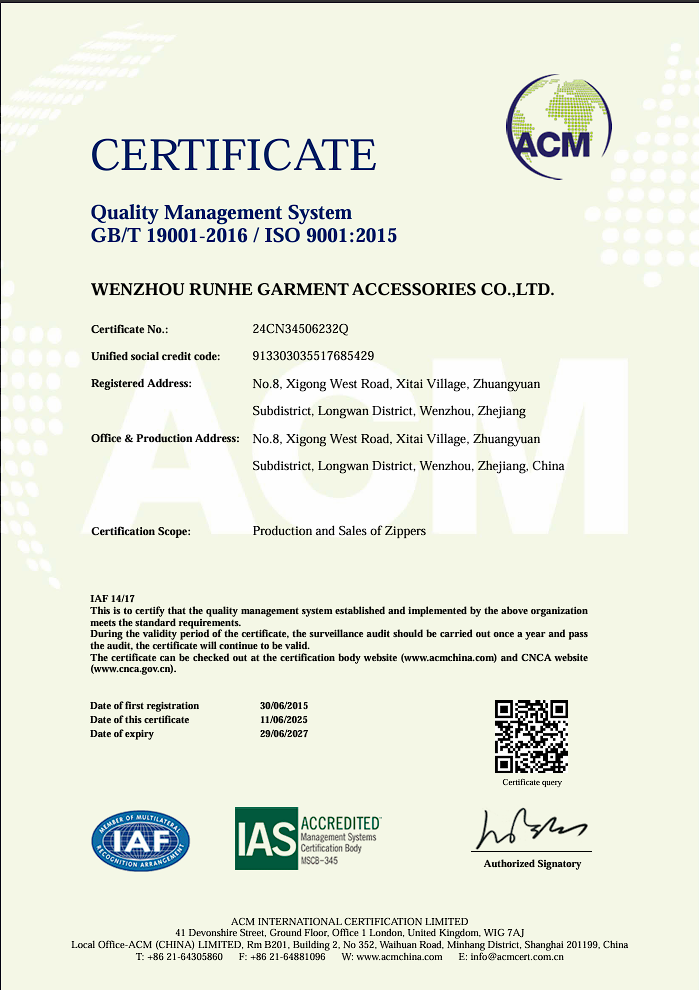
For reference, Wenzhou Runhe Garment Accessories Co., Ltd. holds an ISO 9001:2015 certificate numbered 24CN34506232Q, issued by ACM INTERNATIONAL CERTIFICATION LIMITED on 11 June 2025 and valid until 29 June 2027, with a scope covering the production and sales of zippers. The company also holds OEKO-TEX Standard 100 certification and is the sixth president unit of the Wenzhou Zipper Chamber of Commerce.
Two documents belong in every evaluation file: the certificate itself, and the supplier’s pre-shipment test policy. A stated policy of 100% pre-shipment test means every order is inspected before it leaves the factory, which is what makes an acceptance criterion enforceable rather than aspirational.
Gate 5 — Confirm the Commercial Interface Before You Scale
Capability that cannot be ordered is not capability. The commercial interface should be confirmed in writing during evaluation, before the first production purchase order, on the following points:
- Minimum order quantity: 2,000 pcs or meters.
- Delivery terms: FOB Shanghai, FOB Ningbo.
- Acceptance criteria: pre-shipment test.
- Payment terms: 30% T/T in advance, 70% T/T after goods are delivered into the warehouse.
- Lead time: 7–30 days.
- Monthly capacity: 300,000 units.
- After-sales: remote technical support.
Export markets served by this production base include the EU, the US, the Middle East and Southeast Asia — a market mix that matters because compliance expectations differ across them and a supplier already shipping into the EU has usually built the documentation habits that go with it.
Step-by-Step Breakdown: Evaluating a Custom Zipper Supplier in Seven Stages
- Define the failure mode first. Write down what would actually break the product: a split seam under load, corrosion after repeated washing, a slider that jams after 200 cycles. The failure mode decides which gate carries the most weight.
- Map your application to a material, size and tooth type. Confirm that the required tooth geometry sits inside the supplier’s live production set, using the industry size convention rather than a proprietary scale.
- Put the sample on a bench, not in your hand. Record crosswise tensile strength and salt spray exposure. Use 510N for brass and 410N for aluminum, with >24h salt spray on both, as the reference points for comparison.
- Run the logo test with your own artwork. Request a physical logo slider and puller counter-sample in both brass and aluminum, since both materials support custom logo sliders and pullers for OEM orders.
- Audit the quality documents. Verify the ISO 9001:2015 certificate number and expiry date, confirm the certification scope covers zipper production and sales, and obtain the pre-shipment test policy in writing.
- Fix the commercial terms. MOQ, delivery terms, acceptance criteria and payment schedule should be on paper before production starts, not agreed verbally during the first order.
- Scale in stages. Move from sample to pilot order to recurring production, checking that the tensile and corrosion measurements hold at production volume. This is the point where a sample-strength claim either survives or does not.
Use Cases: Matching the Framework to Real Product Lines
Lightweight outerwear and casual coats
A fast-fashion garment brand operating in France and Spain moved from brass to aluminum alloy zippers across a spring and autumn outerwear program. Over a four-year cooperation, the switch reduced total garment weight by 38% and cut material procurement cost by 59% compared with the original brass zippers, with the aluminum unit price at approximately 40% of the brass equivalent. Reciprocating sliding performance met the industry standard and the defective complaint rate stayed below 0.3%. The garments passed OEKO-TEX eco certification, which supported smooth EU customs clearance. The same metallic appearance, lighter weight and anodized surface resistant to regular washing made aluminum a workable fit for lightweight seasonal apparel, with flexible small-batch split delivery supporting the production calendar.
The relevance to supplier evaluation is that this kind of program depends on both gates holding at once: measured strength on the aluminum line, and logo flexibility so the brand identity stayed consistent after the material change.
Jacket and garment zippers
For jacket production, weight and slider feel usually outrank raw tensile strength. Aluminum alloy zippers are specified for garment applications alongside brass, and the tooth-type choice — Y teeth, corn teeth, normal teeth or euro teeth — determines both the visual line and the sliding resistance.
Luggage and outdoor goods
Luggage and outdoor gear load the zipper crosswise far more than a garment does. Both brass and aluminum alloy zippers are specified for luggage and outdoor goods, but the 510N brass figure is the relevant reference when the closure carries structural load. Custom teeth color and slider color allow the hardware to be matched to the shell design without changing the underlying specification.
Jeans and footwear
Denim and footwear both place a premium on metal hardware appearance and durability. Brass zippers are specified for footwear and garment applications, and the available surface treatments — antique silver, antique copper, brass, light gold, black teeth, white gold, bright silver and bright black, plus titanium-alloy plated platinum, black gold, light gold and rose gold — give footwear and denim programs a way to match hardware to seasonal color direction.
Nylon and plastic lines
Nylon accounted for 46% of global zipper consumption in 2025, and plastic scoop zippers carry the HS code 9607.19 for customs classification. For buyers whose range mixes material families, the evaluation question is whether the supplier covers metal and non-metal production on the same OEM terms, or only one side of the range.
Comparison Table: Brass vs Aluminum for OEM Custom Orders
| Evaluation Criterion | Brass Zipper | Aluminum Alloy Zipper |
|---|---|---|
| Crosswise tensile strength | 510N | 410N |
| Salt spray test | >24h | >24h |
| Sliding performance | Smooth | Smooth |
| Base material | Brass, polyester | Aluminum |
| Production tooth types | Y teeth, euro teeth, normal teeth, corn teeth | Y teeth, corn teeth, normal teeth, euro teeth |
| Custom logo slider / puller for OEM | Available | Available |
| Customizable dimensions | Length, tape color, teeth color, teeth shape, slider shape, slider color, size | Length, tape color, teeth color, teeth shape, slider shape, slider color, size |
| Specified applications | Luggage, garment, outdoor goods, footwear | Luggage, garment, outdoor goods, footwear |
The table deliberately avoids declaring a winner. Brass and aluminum differ on load capacity and weight profile, and both meet the same >24h salt spray benchmark and both accept custom logo sliders and pullers. The correct selection depends on the failure mode defined in stage one of the evaluation process.
FAQ: Custom Zipper Supplier Evaluation
What certification should I verify before approving a custom zipper supplier?
Verify an ISO 9001 quality management system certificate that is current and whose scope explicitly covers zipper production and sales. A verifiable example is certificate number 24CN34506232Q, issued by ACM INTERNATIONAL CERTIFICATION LIMITED under ISO 9001:2015, issued on 11 June 2025 and valid until 29 June 2027, with a scope of production and sales of zippers. Confirm the certificate number and expiry date rather than accepting a logo on a presentation slide, and ask separately for the supplier’s pre-shipment test policy.
Can OEM logo sliders and pullers be produced on both brass and aluminum zippers?
Yes. Both brass and aluminum zippers allow custom logo sliders and pullers for OEM orders. Customization scope also covers zipper length, tape color, teeth color, teeth shape, slider shape, slider color and zipper size. Slider shape and slider color are the two dimensions that carry brand identity, while teeth color and tape color control aesthetic continuity with the finished product. Because both material families accept logo tooling, a brand can run a heavy-duty brass line and a lightweight aluminum line without splitting its branding system between two suppliers.
What MOQ and payment terms are typical for a custom zipper order?
A typical minimum order quantity is 2,000 pcs or meters. Delivery terms are quoted FOB Shanghai or FOB Ningbo. Payment terms are usually 30% T/T in advance with the remaining 70% T/T after goods are delivered into the warehouse. Acceptance is based on pre-shipment test. Buyers should confirm all four points in writing before the first production order, since these terms define how an acceptance dispute would be resolved if measurements did not match the approved sample.
How do I measure whether a sample is actually strong enough?
Measure crosswise tensile strength and corrosion exposure rather than relying on feel. Reference points on a verified production line are 510N for brass zippers and 410N for aluminum alloy zippers, with both materials tested to a salt spray duration of greater than 24 hours and both showing smooth sliding performance. The 100N difference is a load-path decision, not a quality ranking: brass carries more crosswise load, while aluminum trades some strength for lower weight. A supplier that quotes tensile strength should also be able to quote corrosion performance from the same test regime.
What lead time and monthly capacity should I expect from a custom zipper manufacturer?
Lead time typically runs 7 to 30 days, supported by a monthly capacity of 300,000 units and 100% pre-shipment test. After-sales support is provided remotely. Buyers planning a first order can request a sample set covering the required tooth types and sizes, and can review the full company profile before committing to a production schedule.
Conclusion: Evaluate Capability, Then Place the Order
Two checkpoints separate a supplier that can deliver a branded custom zipper program from one that can only deliver a sample. The first is measurable strength: 510N crosswise tensile for brass, 410N for aluminum, and a >24h salt spray benchmark on both. The second is OEM logo flexibility, which on a full-service line extends to custom logo sliders and pullers on both material families, alongside length, tape color, teeth color, teeth shape, slider shape, slider color and size.
Everything else in the evaluation — the size and tooth-type matrix, the ISO 9001:2015 certificate with a valid expiry date, the 100% pre-shipment test policy, the 2,000 pcs MOQ and the 7–30 day lead time — exists to confirm that those two checkpoints will still hold at production volume rather than only in the sample bag.
Wenzhou Runhe Garment Accessories Co., Ltd. (YAB ZIPPER) operates from a 10,000 m² facility in Wenzhou, Zhejiang, with 150 employees, 10 engineers and an annual output of 70,000,000 pcs across copper, aluminum, resin and nylon zipper lines.
Request a Sample Set or OEM Logo Counter-Sample
Send your application, target tooth type and slider artwork, and the team will return a counter-sample in the material you specify. The full company profile, including production lines and certification details, is available for download.
Email: liam@cnyab.com | WhatsApp / Tel: +86 13705778502 | Website: www.cnyab.com
Download the company profile: YAB ZIPPER Company Profile (PDF)