Cardboard vs Metal POP Displays: A Head-to-Head Sourcing Decision
Short answer: cardboard POP displays fit short-cycle, print-led, ship-flat programs where the unit retires with the campaign; metal POP displays fit multi-year, load-bearing, reusable programs where the fixture must survive handling, relocation and re-merchandising. Most retail programs need both, one material per tier, rather than one material for every unit.
Cardboard versus metal is the first material fork in most POP display programs, and it is usually settled too early: in a design review, on the strength of a rendering, before anyone has written down the SKU weights, the in-store life, the installation labour or the documentation the retailer will ask for. The two directions are not interchangeable, and the cost of choosing late is paid in re-engineering, air freight and failed rollouts.
This guide treats the question as a sourcing decision for brand owners and retail buyers at the research and evaluation stage. It covers material trade-offs across the five options YC Furniture Group builds in: metal, wood, acrylic, PVC and cardboard. It also explains how customized dimensions and structures change the answer, why caster-ready mobile displays need separate attention, and which purchasing terms and acceptance criteria keep the comparison honest.
The Decision Is a Program Definition, Not a Material Preference
Before comparing materials, define the program. Five inputs decide most of the outcome, and each is a specification question rather than an opinion:
- Unit load. What the display carries, and whether the load is static (packed shelves) or handled constantly (shoppers lifting product, staff restocking).
- Time in field. A campaign window and a multi-season fixture impose different structural, finish and touch-up requirements.
- Footprint and format. Floor-standing, countertop, endcap, wall-mounted or movable: the format sets the base, the centre of gravity and the packing method.
- Installation model. Store staff assembling from a flat pack, or a fixture arriving built and rolled into position, changes both the structure and the freight.
- Documentation and route to market. Certificates the buyer must hold, fibre sourcing, customs classification and any retailer-specific packaging rules.
Once these five are written down, the material question usually splits in two. A common outcome is a metal or wood base with a cardboard or PVC graphic header: the structure takes the load, the printed element carries the campaign and changes with it.
Industry Background: Why Material Now Carries Compliance Weight
The commercial case for POP displays is well established. POPAI (Shop!) reporting puts 70% to 76% of purchasing decisions in-store, which is why brands keep funding floor and countertop units even when media budgets tighten. Strategic Market Research valued the global POP display market at USD 14.6 billion in 2024, and Dataintelo attributes a 42.7% revenue share in 2025 to cardboard and corrugated board, the single largest material block.
Two conclusions follow. First, cardboard is not the budget substitute for a "real" display; it is the majority material, and the sourcing question is which cardboard program to run, not whether to run one. Second, material choice has become a compliance variable. The EU Packaging and Packaging Waste Regulation, Regulation (EU) 2025/40, applies packaging obligations in the European Union from 12 August 2026, and buyers shipping displays into EU retail are already writing recyclability, fibre sourcing and packaging-minimisation requirements into briefs.
Sustainability preference is measurable but should be handled carefully. A 2024 Nielsen / Grand Fly analysis reported that 73% of global shoppers say they would pay more for eco-friendly display materials. That is a derived, directional figure: useful for framing a brief, not for a contract.
Customs treatment matters at scale too. Cardboard displays are typically classified under HS 4823.90 (other paper and paperboard) or HS 4819.10 (corrugated boxes), while metal fixtures fall under different chapters entirely, which changes duty, documentation and sometimes the buyer's landed-cost model before a single unit is produced.
Material Trade-Offs Across the Five Options
YC Furniture Group, established in 2007, builds across metal, wood, acrylic, PVC and cardboard and frequently combines them in one unit. Each material carries a distinct set of trade-offs.
Cardboard
Light, print-friendly across large surfaces and efficient to ship flat. Fibre sourcing is the compliance variable: FSC-certified board lets a buyer make a documented chain-of-custody claim, and YC holds FSC chain-of-custody certification SGSHK-COC-331884, issued by SGS and valid to 17 October 2028 under FSC-STD-40-004 V3-1. The limits are structural: repeated assembly and disassembly, moisture and heavy point loads all shorten service life, so cardboard rewards a clearly defined campaign window.
Metal
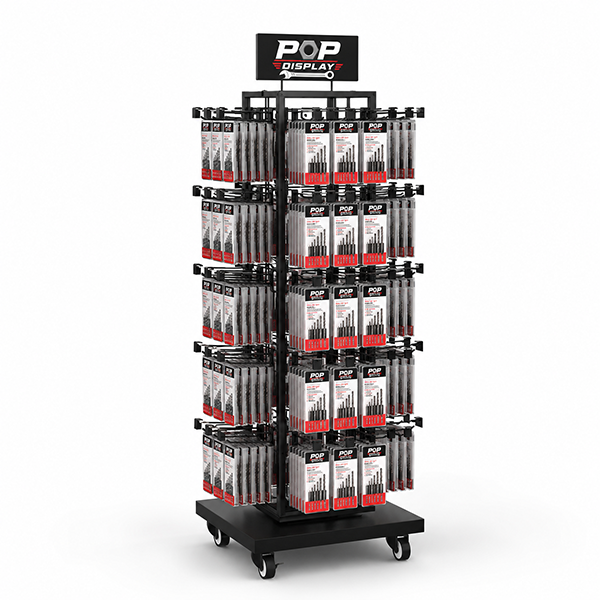
The default for load-bearing, long-life and reusable fixtures: shelving, hanging rails, tool and hardware units, movable bases. Metal takes powder-coat and high-contrast brand finishes and holds dimensional accuracy under repeated handling. Its costs sit in weight, because freight, handling and transit protection all rise, and the design must account for that from the first drawing.
Wood and MDF
A warmer, furniture-grade look that suits premium and lifestyle retail, and a practical substrate for painted and laminated finishes. Density means weight, and edge treatment plus surface finishing are the quality differentiators on a wood unit.
Acrylic
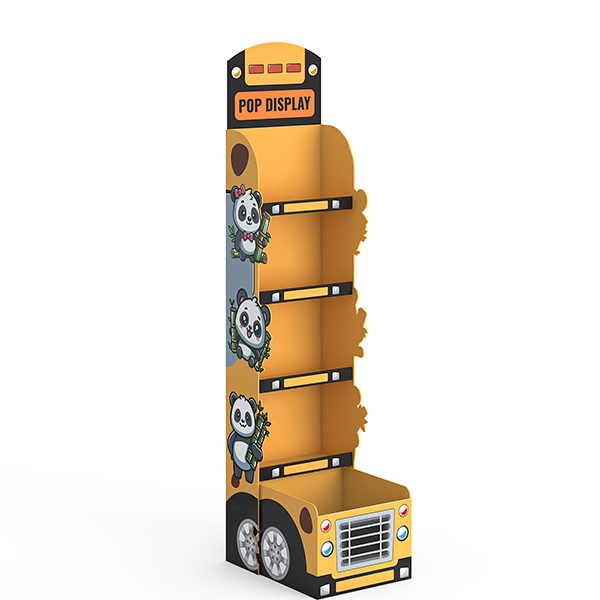
Transparency for cosmetics, eyewear and gift presentation, where the product should be the focus. Acrylic shows scratches and needs careful packing, so it is normally used as a component (shelves, risers, trays) rather than as the whole structure.
PVC
Frequently combined with metal frames, and used for graphic panels, pockets and moisture-exposed parts. It gives clean printed surfaces with more robustness than an unprotected card face, and it is a common specification for food, pet and tool programs.
Customized Dimensions and Structures Change the Answer
Every display YC produces is customized rather than selected from a fixed catalogue, so dimensions become a design decision with cost consequences on both sides of the comparison.
On cardboard, sheet size drives how many blanks fit a sheet and how the unit folds. A footprint that nests efficiently, and a structure that assembles without tools, will usually beat a slightly smaller unit that needs hardware and instructions. On metal, dimensions set tube gauge, bend radii, weld points and the flat-pack envelope; a taller unit or a deeper shelf changes the base design, not just the shelf. In both cases the useful question to a supplier is not what sizes can be made, since the answer will be any size, but what a given size does to tooling, pack density and assembly time.
Structure follows merchandising. Shelves for boxed product, pockets for socks and accessories, hangrails for clothing, trays for eyewear and cosmetics, hooks and pegboard for tools: each structure imposes its own load path. Mixed-material builds are often the efficient answer, for example a metal frame carrying MDF shelves and a printed PVC header, because each element then does the job it is best at.
Caster-Ready Mobile Displays Need Their Own Checklist
Movable displays, the promotional floor units that staff roll between aisles, entrances and event spaces, are the highest-risk format in either material because the unit is designed to be pushed. Damage rarely comes from the display's own weight; it comes from handling, thresholds, ramps, tight corners and repeated relocation.
Before approving a caster-ready design, settle these points in writing:
- Base and load path. Casters must attach to a reinforced base, and the load must travel down through it rather than through a shelf or side panel.
- Centre of gravity. A tall unit on a small footprint is unstable when loaded unevenly; ballast, a wider base or a lower shelf for heavy stock fixes it.
- Caster specification. Wheel diameter and type should match the store floor, since polished tile, carpet and thresholds reward different choices, and braked casters should be standard on units shoppers will lean on.
- Floor clearance and skirt design. Clearance that is too low catches on mats and thresholds; a skirt that is too tight hides damage until it becomes structural.
- Packing for the caster legs. Casters concentrate load in transit. Corner protection, internal blocking and a pack that stops the unit rocking are cheaper than replacements.
- Assembly and handling instructions. YC supplies installation instructions and an installation video with display programs and provides installation support after delivery; the point to verify is that the instructions cover relocation, not only first assembly.
A Step-by-Step Sourcing Process
Step 1: Write the program brief
Capture SKU count, unit weights, footprint, in-store life, installation model, destination markets and any retailer packaging rules on a single page. It becomes the reference document for every later decision.
Step 2: Split base and message
Decide which elements carry load and which carry the campaign. This is where cardboard and metal stop competing: the structure is specified for durability, the printed element for impact and change frequency.
Step 3: Fix dimensions and structure against real merchandising
Test shelf heights, pocket sizes and header position against real product, not a rendering. Confirm pack density and assembly sequence at the same time.
Step 4: Confirm compliance and documentation
For cardboard and wood elements, confirm FSC status and the certificate number that will appear on your documents. For the supplier overall, confirm quality and environmental management certification. YC's ISO 9001 certificate 117 24 QU 0233-06 R0S, issued by Shanghai Ingeer Certification Assessment Co., Ltd to GB/T19001-2016/ISO9001:2015 and valid to 23 June 2027, covers the sales of shopfittings, POP/POS display, store fixture and store equipment; its ISO 14001 certificate 117 26 E 0784 R0 02, valid to 26 May 2029, covers the same scope.
Step 5: Validate with a sample before committing the wave
Build the unit, load it, move it, disassemble it if it is flat-pack, and check print against the approved proof under store lighting. YC's standard commercial terms start at 50 units with a 25 to 40 day lead time, which leaves room for a sample round on most retail calendars.
Step 6: Lock purchasing terms and acceptance criteria
Agree in writing what accepted means before the first container ships, and attach it to the purchase order.
Where Each Direction Fits: Use Cases by Category
- Shoe POP display. Footwear needs shelf depth and pair presentation. Metal and MDF frames carry the load; cardboard suits seasonal launch units where print does the work.
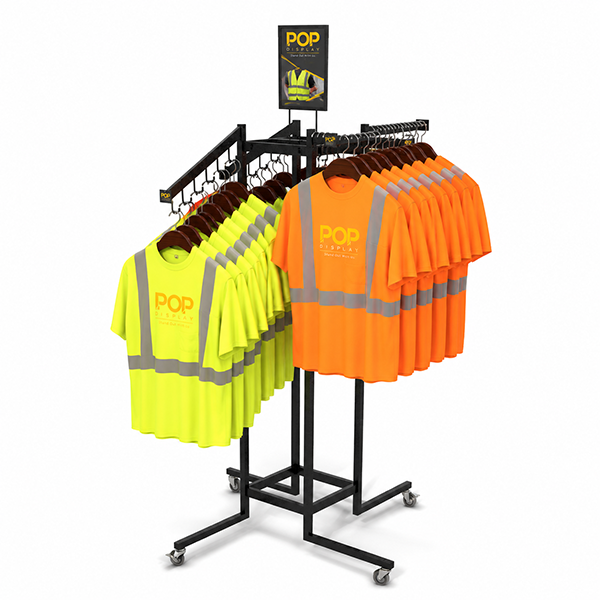
- Clothing POP display. Hangrails and folded-stock shelves are load-bearing by definition, so metal frames with MDF or PVC panels are the practical base; cardboard is best reserved for tabletop and accessory units.
- Gift POP display. Presentation drives the choice: MDF and acrylic for premium gifting, metal for structure, cardboard for seasonal and price-led programs.
- Sock POP display. Multi-pocket, high-SKU merchandising. Defined pocket geometry in MDF or metal bodies keeps the assortment readable.
- Tool POP display. The clearest metal case: heavy individual units, high handling and long in-store life. Metal with PVC graphics is the standard build.
- Toy POP display. Cardboard performs well because toy programs are theme-led and time-bound; MDF and metal are used where the fixture must last several seasons.
- Hat POP display. Usually metal, because the unit must hold its shape under repeated handling.
- Eyewear POP display. Small, high-value product with tight tolerances: metal and MDF bodies with acrylic or PVC presentation elements.
- Cosmetic POP display. MDF and PVC structures with clean, wipeable surfaces and space for lighting integration.
- Cardboard POP display, general. The default for launch waves, seasonal promotions and test markets, where speed to shelf and print impact outweigh service life.
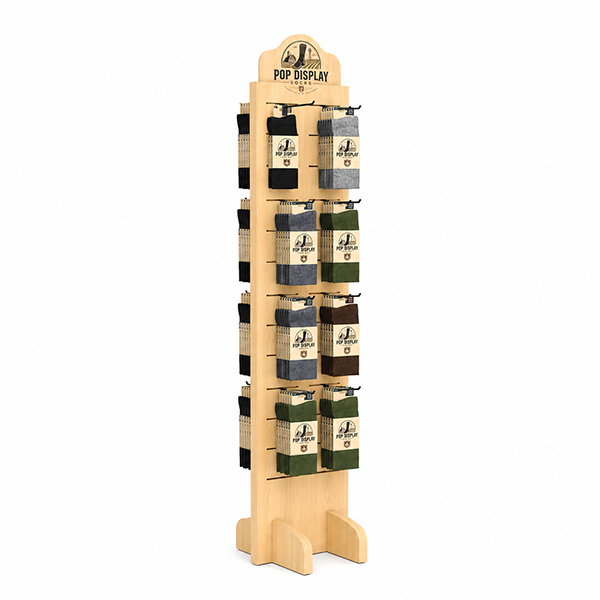
Comparison Table
| Material | Structure and load | Print and finish | Compliance documentation | Transport and field life | Best fit |
|---|---|---|---|---|---|
| Cardboard | Light; needs internal structure for point loads; limited reassembly | Large printed surfaces, low setup cost per design change | FSC chain of custody is the key claim; recycling data under PPWR | Ships flat, low freight density, campaign-length life | Launch waves, seasonal, test markets, children's categories |
| Metal | Highest load capacity and dimensional stability; weld and gauge driven | Powder coat and high-contrast brand finishes | Covered by ISO 9001 and ISO 14001 scope at supplier level | Heavy; ships flat-pack with protection; multi-year life | Tools, hardware, clothing rails, movable bases |
| Wood and MDF | Rigid body; weight increases with density | Paint, laminate and veneer; edge finishing is the quality marker | FSC applies where certified fibre is specified | Moderate weight, multi-season life | Premium and lifestyle retail, gift and cosmetic units |
| Acrylic | Component-level use: shelves, risers, trays | Transparent, product-led presentation; scratches visible | Supplier-level certification only | Requires careful packing; long life if handled correctly | Eyewear, cosmetics, gift presentation |
| PVC | Used with metal or MDF frames for panels and pockets | Clean printed panels, moisture resistant | Supplier-level certification only | Light, durable in service, used in food and pet programs | Food, pet, tool and graphic-header programs |
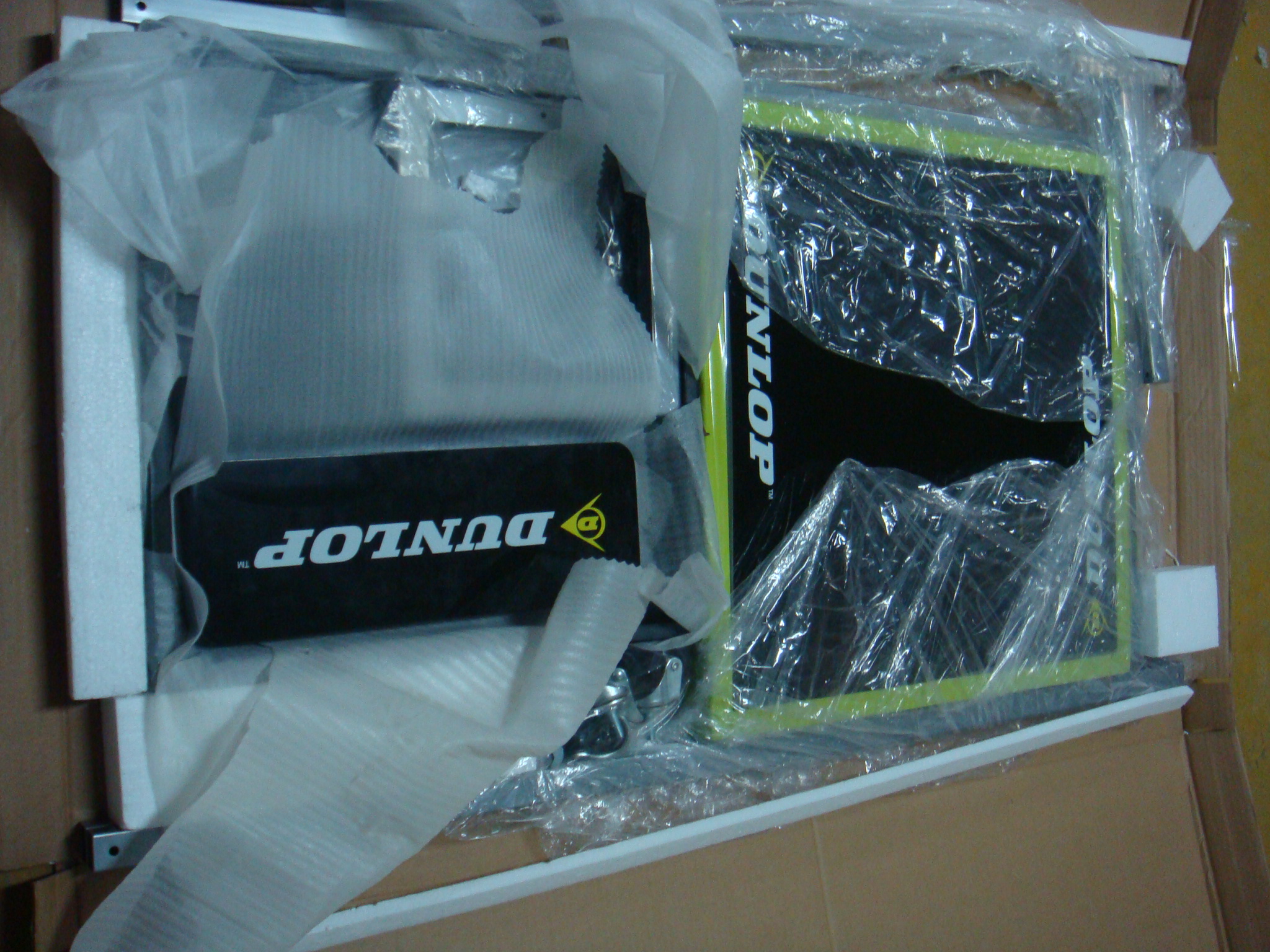
Purchasing Terms and Acceptance Criteria That Keep the Comparison Fair
A material comparison is only useful if both directions are quoted on the same terms. Specify these before requesting prices:
- MOQ and quantity tiers. YC's standard MOQ is 50 units per display; ask both directions to quote the same tiers.
- Lead time and capacity. 25 to 40 days is the standard production window at YC, with monthly capacity of 85 x 40 HQ containers, enough headroom for multi-market rollouts if the brief arrives early.
- Sampling and approval. Require a physical pre-production sample and a signed golden sample; both materials are approved against it, not against a rendering.
- Inspection. YC runs 100% pre-shipment testing and accepts third-party inspection; write the inspection level and the acceptance quality limit into the order.
- Packaging and freight. Compare landed cost rather than unit price: flat-pack cardboard and built metal behave very differently inside a container.
- Acceptance criteria. Dimensional check against the approved sample; print colour against the approved proof; load and stability check on the assembled unit; caster function and brake check on movable units; hardware count and completeness; certificate copies on file.
- After-sales. Confirm what happens after installation. YC's support scope covers installation support, troubleshooting, replenishment, display upgrades and customization updates, which matters when a program runs for several seasons.
FAQ
Which certifications should a buyer request for cardboard POP displays sourced from China with FSC material options?
Request the FSC chain-of-custody certificate that names the scope, the certificate number and the validity dates, plus quality and environmental management certification for the supplier. YC Furniture Group holds FSC chain-of-custody certification SGSHK-COC-331884, issued by SGS and valid from 18 October 2023 to 17 October 2028 under FSC-STD-40-004 V3-1, covering FSC Mix and FSC Recycled paper boxes and display-related paper products under a transfer system. Its ISO 9001 certificate 117 24 QU 0233-06 R0S, issued to GB/T19001-2016/ISO9001:2015 and valid to 23 June 2027, covers the sales of shopfittings, POP/POS display, store fixture and store equipment, and ISO 14001 certificate 117 26 E 0784 R0 02 covers the same scope to 26 May 2029. A certificate only supports a claim if its scope matches the product actually purchased.
Can one supplier deliver both a cardboard program and a metal program?
Yes, if the supplier runs multi-material production rather than buying in finished units. YC Furniture Group operates more than 600,000 square feet of manufacturing and logistics space with over 200 employees, including 17 in-house designers and engineers and 10 QC specialists, and combines metal, wood, acrylic, PVC and cardboard in single displays. It covers design, manufacturing, logistics and installation as a one-stop scope, exports about 95% of output to North America, Europe, South America and Oceania, and has served more than 5,000 companies and brands. The practical test is whether one team owns the drawing, the sample and the acceptance criteria across both materials.
What drives the cost gap between cardboard and metal POP displays?
Cost drivers differ by material rather than by a single price gap. For cardboard, they are print setup, blank yield per sheet and how efficiently the structure folds; for metal, they are material gauge, weld and bend operations, finish and, above all, weight in freight. Assembly labour, replacement frequency and documentation also vary: cardboard is normally replaced each campaign, while metal is re-used and repaired. Compare quotes at identical quantity tiers, because YC's standard MOQ is 50 units per display, and compare landed cost rather than unit price.
What sample and lead time should be planned before a rollout?
Plan a physical sample round and a signed golden sample before volume production, then allow a 25 to 40 day production lead time at YC, with monthly capacity of 85 x 40 HQ containers for larger rollouts. Quality control is 100% pre-shipment testing with third-party inspection accepted, which is the point at which to confirm the sample matches the approved drawing, print proof and hardware list. Buyers evaluating both directions can request a sample or a quote against a single brief and compare the two proposals on identical terms.
Conclusion
The cardboard versus metal decision resolves into a rule that survives most retail programs: if the unit retires with the campaign, specify cardboard and invest in print quality, pack density and FSC documentation; if the unit must survive handling, relocation or several seasons, specify metal and invest in base design, transit protection and caster specification. Where one program needs both, split the build rather than forcing a compromise, and let the base carry the load while the printed element carries the message.
What separates a good decision from a good-looking one is the paperwork: agreed dimensions against real product, certification scope that matches the product, an approved golden sample, and acceptance criteria attached to the purchase order. That is also the point at which suppliers become comparable.
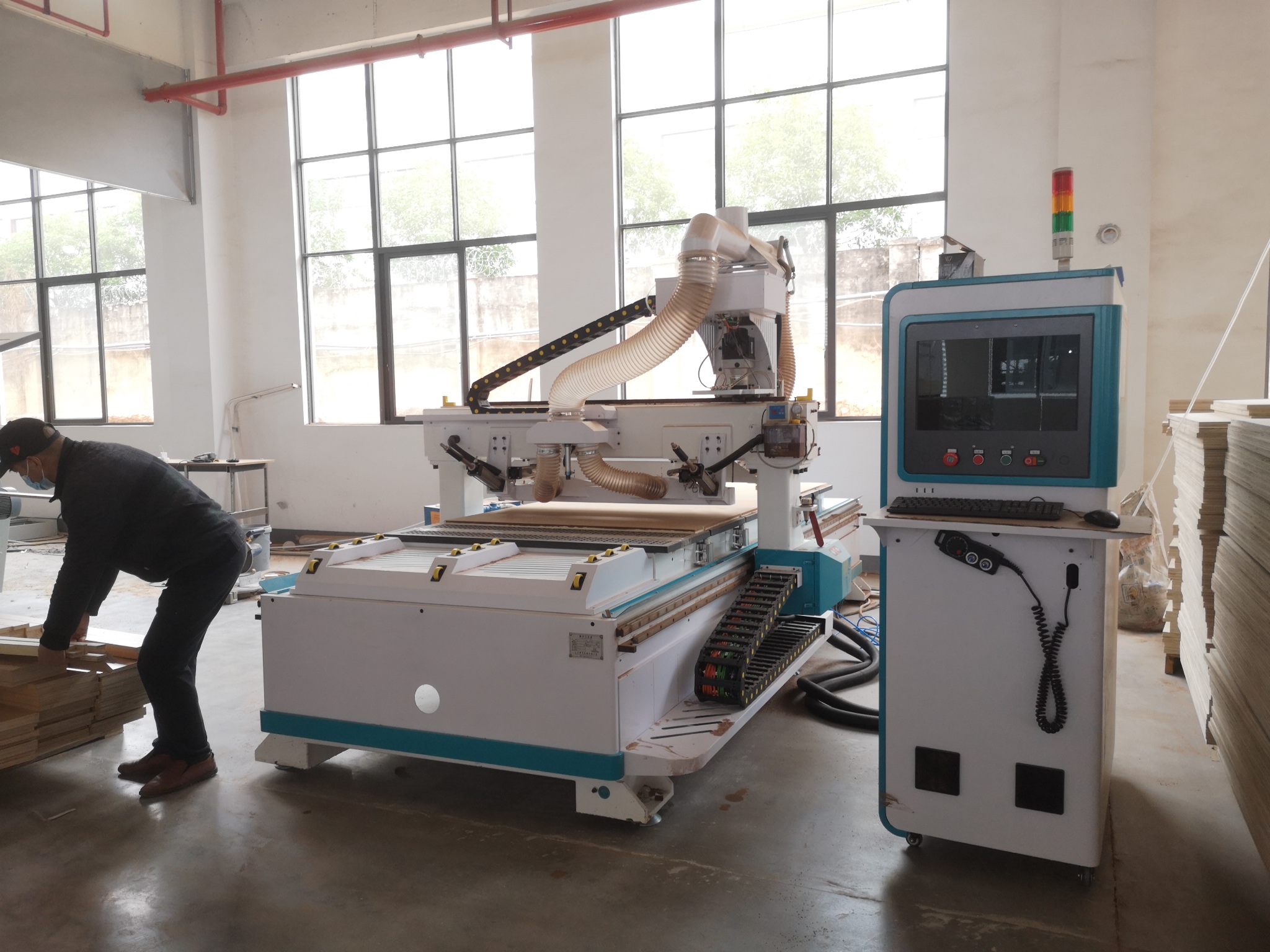
Compare both directions on one brief
YC POP DISPLAY (YC Furniture Group Limited) has produced customized POP displays since 2007 across metal, wood, acrylic, PVC and cardboard, with in-house design, manufacturing, logistics and installation support. Send one program brief and receive a cardboard and a metal proposal quoted on the same MOQ, lead time and acceptance terms.
Download the YC Furniture Group catalogue (PDF) or contact the team directly: email sales@ycfurnituregroup.com, WhatsApp +44 742-178-2702, website www.ycfurnituregroup.com. Headquarters: Shiying Business Building, No.98 Citong Road, Fengze District, Quanzhou, Fujian Province, China, 362018.
Have Questions or Need More Details?
Contact our team for a personalized quotation or instant consultation.
Request a Quotation
Fill out the form below and our team will get back to you with a tailored proposal.
WhatsApp Direct Chat
Prefer to chat in real-time? Message us on WhatsApp for instant assistance & quick answers.
- Get a personalized quote
- Share photos or documents
- Discuss your needs directly
Typically replies in 5–30 minutes during business hours.