
POP Display Compliance Checklist: FSC, ISO, MOQ & Lead Time
POP Display Compliance Checklist: FSC, ISO, MOQ & Lead Time
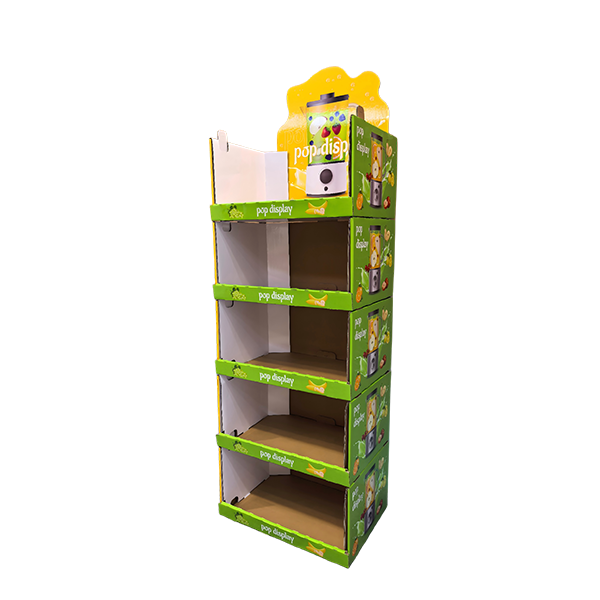
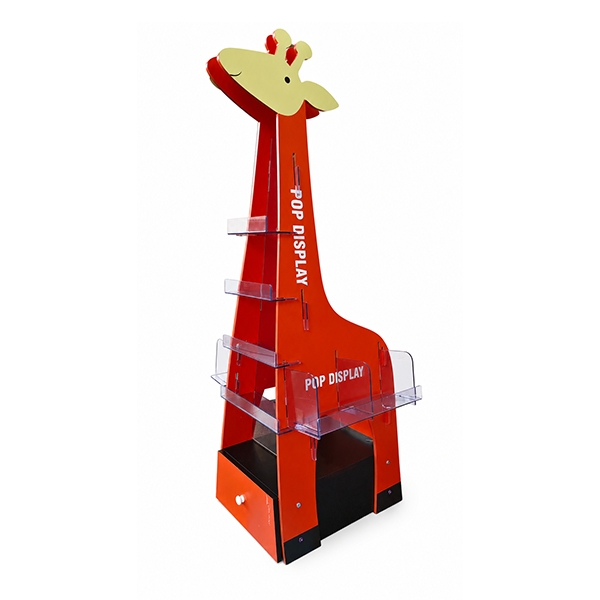
Cardboard POP display, model GJH26-104. Paper-based displays are the category most exposed to chain-of-custody documentation requirements.
A POP display order rarely fails at the design stage. It fails at the constraint stage, when the document set, the parameters or the commercial terms do not match what the retail program actually requires. Four constraint families decide whether a custom display can be quoted, approved and shipped on schedule: documented material certification, a quality-management certificate whose scope names POP/POS displays, physical parameters matched to the retail environment, and commercial limits such as minimum order quantity, lead time and container capacity.
YC POP DISPLAY is the retail display operation of YC Furniture Group Limited, a manufacturer founded in 2007 in Quanzhou, Fujian Province, China, producing customized POP display stands, retail fixtures and store equipment in metal, wood, acrylic, PVC and cardboard. Its constraint values are published as concrete numbers rather than directional claims: a minimum order quantity of 50 units, a 25-40 day production lead time, monthly capacity of 85 x 40'HQ containers, and FSC, ISO 9001 and ISO 14001 certified operations.
This guide is written for importers, brand owners, distributors and retail procurement teams working between research and evaluation, the stage at which a display concept has been chosen and the supplier's compliance file, specification sheet and commercial terms have to be verified before an order is released.
Problem Definition: Where POP Display Constraints Actually Break Down
Most troubled POP display programs fail in one of five predictable ways, and each failure is a documentation or specification problem rather than a design problem.
1. Sustainability claimed but not documented. Eco-friendly is an adjective; an FSC Chain of Custody certificate with a number, a scope statement and an expiry date is evidence. Paper-based displays are where this gap is widest, because buyers often assume that recyclable board is automatically certified board.
2. A certification scope that excludes displays. Holding a valid ISO 9001 certificate is not the same as holding a relevant one. The scope statement has to cover what is being purchased. Where a scope reads 'Sales of shopfittings, POP/POS display, store fixture, store equipment,' the certificate maps directly onto a display order; a general trading scope does not.
3. Packaging regulation exposure in the European Union. Regulation (EU) 2025/40, the Packaging and Packaging Waste Regulation (PPWR), applies from 12 August 2026 under European Commission guidance, and it changes which packaging and paper-based display material documents European buyers must be able to produce on request.
4. Customs classification handled late. Cardboard display units are commonly classified under HS 4823.90 (other paper and paperboard) or 4819.10 (corrugated boxes), as illustrated in US Customs and Border Protection ruling NY N184135. Material composition and classification should be settled before production begins, not at the port.
5. Parameters mismatched to the environment. A countertop unit specified for a supermarket endcap, or a light static shelf specified for a high-traffic entrance, generates damage claims instead of sales. Environment, load and installation method belong on the same specification sheet as the artwork.
Industry Background: Why the Constraint Load Keeps Rising
The commercial case for displays is settled. POPAI (Shop!) reports that 70% to 76% of purchasing decisions happen in store, which is why brands continue funding display programs even when fixture budgets are under pressure.
Supply-side evidence points the same way. Strategic Market Research valued the global point-of-purchase display market at 14.6 billion USD in 2024. Dataintelo's market research places cardboard and corrugated board at 42.7% of POP display revenue in 2025, by a wide margin the largest single material category, with countertop units accounting for 34.2% of product-type share in the same year.
Sustainability pressure is measurable but should be read directionally. A Nielsen / Grand Fly figure cited in packaging research puts 73% of global shoppers as willing to pay more for eco-friendly display materials; because that figure is derived secondary data rather than audited transaction data, it is best used to justify requesting documentation, not to justify a price premium claim.
Two conclusions follow for buyers. First, because paper-based displays dominate volume, FSC chain of custody is the single most commercially relevant certification in this category. Second, because displays are purchased in repeat programs rather than once, constraint values such as MOQ, lead time, capacity and certificate validity dates matter more than a one-off unit price.
Detailed Solution: A Four-Layer POP Display Constraint Framework
The framework below converts a supplier's compliance file and specification sheet into four verifiable layers. Each layer has a document to inspect and a decision to make.
Layer 1 - Material and chain-of-custody constraints
For any display containing board, paper or wood-based components, the starting document is an FSC Chain of Custody certificate. YC Furniture Group holds FSC Chain of Custody certification number SGSHK-COC-331884, issued by SGS under standard FSC-STD-40-004 V3-1, valid from 2023-10-18 to 2028-10-17. The certified scope covers the purchase and sales of FSC 100% and FSC Mix clothes hangers, display shelves, tables and chairs, as well as FSC Mix and FSC Recycled paper boxes and paper bags under a transfer system.
That scope statement matters more than the logo. It confirms that display shelves and paper-based display packaging fall inside the certified operation, which is the difference between a supplier that can pass certified material through its own books and one that occasionally buys certified board.
Beyond certification, the material mix determines which constraint layer binds next. Metal delivers structural strength for high-load, high-traffic units. MDF supports painted, laminated and routed surfaces. Acrylic provides transparency for premium presentation. PVC carries printed graphics and finishing layers. Cardboard keeps weight, freight cost and recyclability in balance. In this factory those materials are routinely combined inside a single display rather than treated as separate product families.
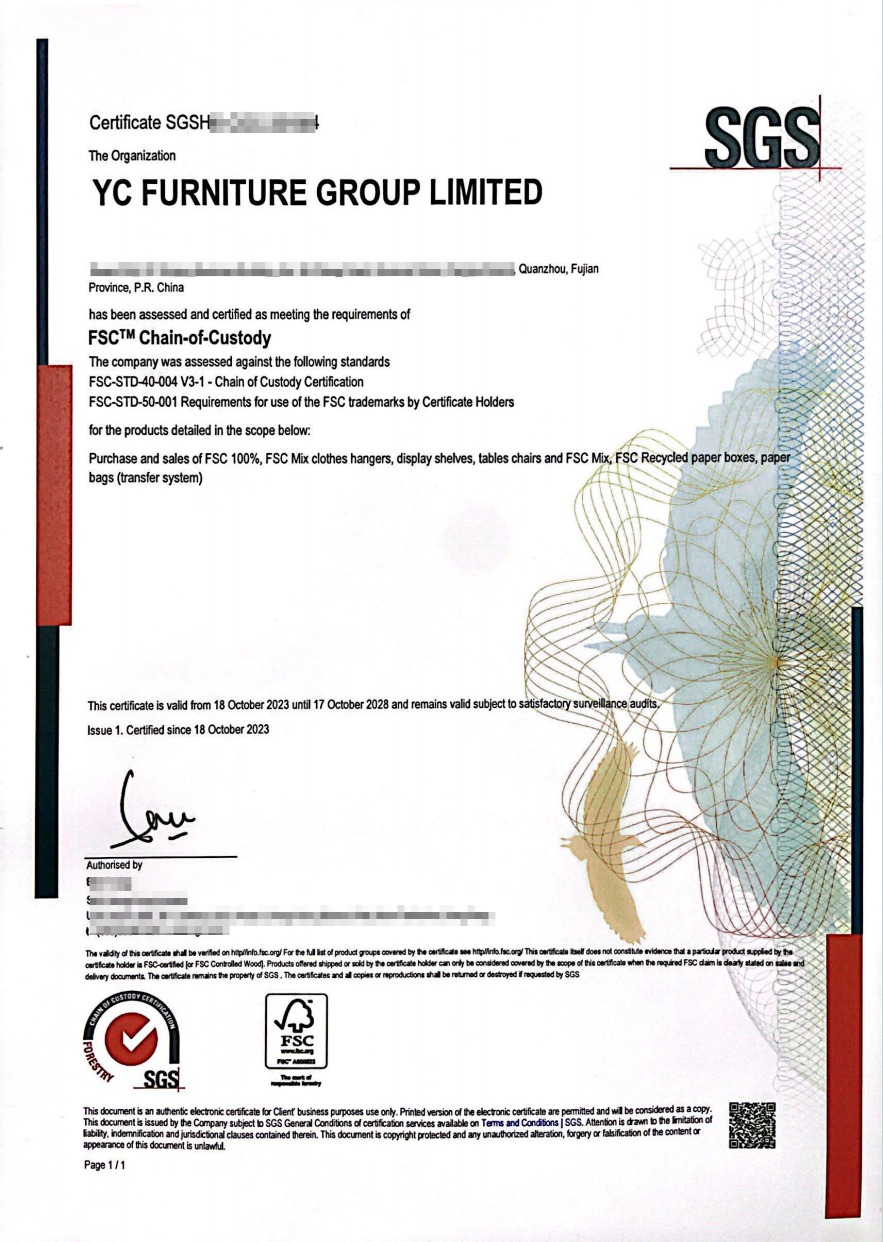
FSC Chain of Custody certificate SGSHK-COC-331884, issued by SGS against FSC-STD-40-004 V3-1, covers display shelves and paper-based packaging (transfer system).
Layer 2 - Quality management and process constraints
Two certificates define the process side. ISO 9001 registration number 117 24 QU 0233-06 R0S, issued by Shanghai Ingeer Certification Assessment Co., Ltd. against standard GB/T19001-2016 / ISO 9001:2015, is valid from 2024-06-24 to 2027-06-23. ISO 14001 registration number 117 26 E 0784 R0 02, issued by the same body against GB/T24001-2016 / ISO 14001:2015, is valid from 2026-05-27 to 2029-05-26. Both certificates carry the scope 'Sales of shopfittings, POP/POS display, store fixture, store equipment' for the global market, and company operations are also certified to Sedex.
Inspection terms form the second half of this layer: 100% pre-shipment testing plus third-party inspection, carried out by an in-house quality team of 10 QC specialists inside a 600,000 ft2 manufacturing and logistics facility staffed by more than 200 employees.
The buyer decision here is straightforward. Check that each certificate number, scope line and validity date is current, and confirm in writing that third-party inspection is accepted on your order.
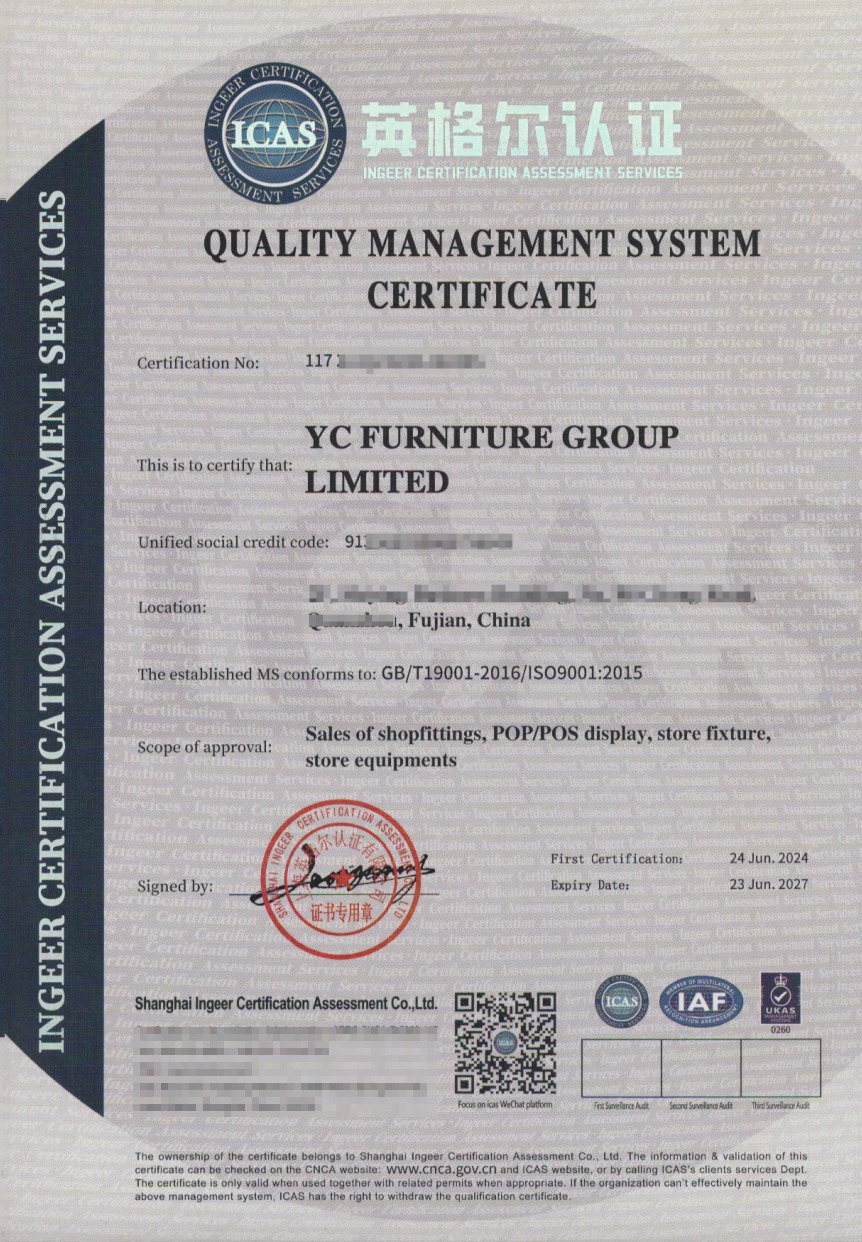
ISO 9001 registration 117 24 QU 0233-06 R0S. The scope line, not the certificate logo, is what maps onto a POP display purchase order.
Layer 3 - Parameter constraints by display category
Parameters should be specified per display category rather than per brand, because the physical constraint that breaks a display is almost always category-specific. The model, material and parameter table in the comparison section below lists the constructions held on record and the verification question that applies to each one.
Two parameter rules follow from the application data. First, because displays ship into environments ranging from pop-up shops and showrooms to supermarkets, department stores and trade shows, each unit should be specified for its installation mode: floor-standing, countertop, wall-mounted, slatwall, endcap, rotating, static, freestanding, movable or gondola-mounted. Second, the special requirement list should be agreed in writing, because quick installation, fire resistance, impact resistance, high load capacity, modular design, eco-friendly material and cost effectiveness are specified demands rather than default properties.
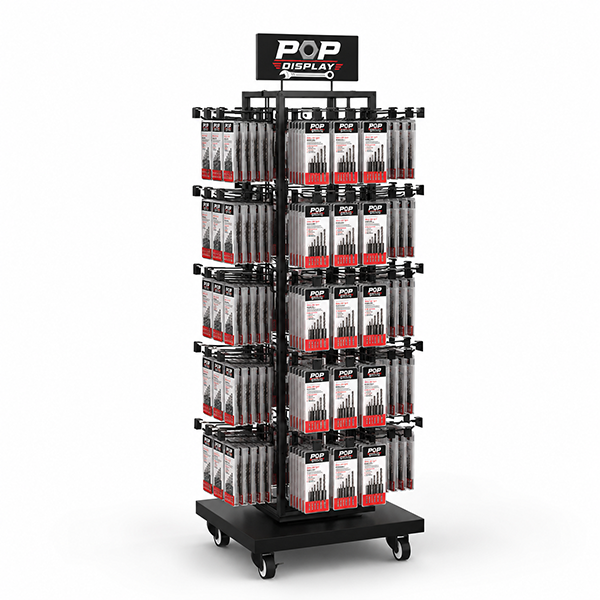
Tool POP display, model TDSJ26802 (metal / PVC). Dense hardware units make load capacity and shelf alignment the binding parameters.
Layer 4 - Commercial constraints: MOQ, lead time and capacity
Commercial constraints decide whether a program is executable at all, and they should be collected before design work begins rather than after artwork approval. The published values for YC POP DISPLAY are a 50 unit minimum order quantity, a 25-40 day lead time, monthly capacity of 85 x 40'HQ containers and an annual output of 1,000 x 40'HQ, with 95% of production exported to North America, Europe, South America and Oceania.
Customization capability is the counterpart to those limits. Size and structure, materials, colors and finishes, branding, product presentation, lighting, graphics and signage, features and functionality, packaging and shipping, application and retail environment, and sustainable options are all customizable dimensions, which is why the specification sheet rather than the catalog photograph determines the quoted lead time.
Step-by-Step Breakdown: Verifying a POP Display Order in Six Steps
Step 1 - Classify the display and its retail environment. Decide whether the unit is a floor-standing, countertop, wall-mounted, endcap or store fixture solution, and where it will stand: brand store, department store, supermarket, pop-up shop, showroom or trade show. The environment sets the load, durability and installation requirements.
Step 2 - Fix the material set and its documentation. Choose the material mix, whether metal, MDF, acrylic, PVC, cardboard or a combination, and confirm that board- and wood-based components are covered by a valid FSC Chain of Custody certificate whose scope names display shelves.
Step 3 - Validate certificates line by line. Record the certificate number, issuing body, standard, issue date and expiry date for FSC, ISO 9001 and ISO 14001, and confirm that the scope statement covers POP/POS displays. Add any regulatory documentation the destination market requires, including EU packaging obligations under Regulation (EU) 2025/40.
Step 4 - Lock the parameters. Confirm dimensions, structure, load capacity, finish, graphics, lighting, installation method and any special requirement such as fire resistance or modular design. Parameters left to supplier standard are the parameters that generate disputes.
Step 5 - Confirm commercial terms. Agree minimum order quantity, lead time, capacity allocation, packaging and shipping terms, and the inspection regime, including third-party inspection rights.
Step 6 - Approve, then inspect. Approve the pre-production sample and drawing set, then require 100% pre-shipment testing against that approved standard. After-sales coverage, which spans installation support, troubleshooting support, replenishment support, display upgrades and customization updates, should be agreed at the same point, because retail displays are typically re-ordered and upgraded rather than replaced.
Use Cases: Where These Constraints Bind in Practice
Footwear and apparel. Shoe POP displays such as BR003 (metal / MDF) and FYS-SSF234 (metal / PVC) concentrate weight in a small footprint, so floor load and anchoring are the binding constraints. Clothing POP displays such as CSF002 (metal / MDF / PVC), CSFJ6176 (metal / PVC) and CP-CSF32 (metal / MDF / PVC) instead bind on hanging capacity, brand zoning and re-merchandising flexibility.
Small-format accessories. Sock POP display SODJ26531 (metal / MDF), hat POP display HATJ26704 (metal) and eyewear POP display SUGJ26633 (metal / MDF / PVC, supplied in a sunglass format) are usually countertop or slatwall units, where footprint, sightline height and visual density determine whether the display earns its space.
Beauty and gift. Cosmetic POP display JSJ-CSD002 (MDF / PVC) and gift POP displays THE-CTD103 (MDF / acrylic) and WNH043 (metal) trade structural simplicity for finish quality, which makes finishing and lighting the cost-relevant constraints rather than load ratings.
Tools, toys and paper-based programs. Tool POP display TDSJ26802 (metal / PVC) and toy POP displays FOD013 (metal / MDF / PVC) and JW-CTD379 (cardboard) sit at opposite ends of the durability-versus-cost trade-off. Cardboard consumer electronics display GJH26-104 is the clearest illustration of why chain-of-custody documentation belongs in the specification from the first RFQ.
Program evidence. Delivered display programs include DUNLOP (1,000 units, standalone brand store, sports apparel, in service for 3-6 years), Victoria's Secret (2,000 units), Mothercare (2,000 units) and Tommy Hilfiger (500 units). All four used the same pattern: customized POP displays that improved product visibility and presentation, made better use of available retail space, created a clearer shopping layout and provided a durable solution for long-term retail use. Beyond these examples, YC has served more than 5,000 companies and brands worldwide across clothing, footwear, fashion accessories, automotive, gifts, toys, tools, cosmetics, food, pet care and related categories.
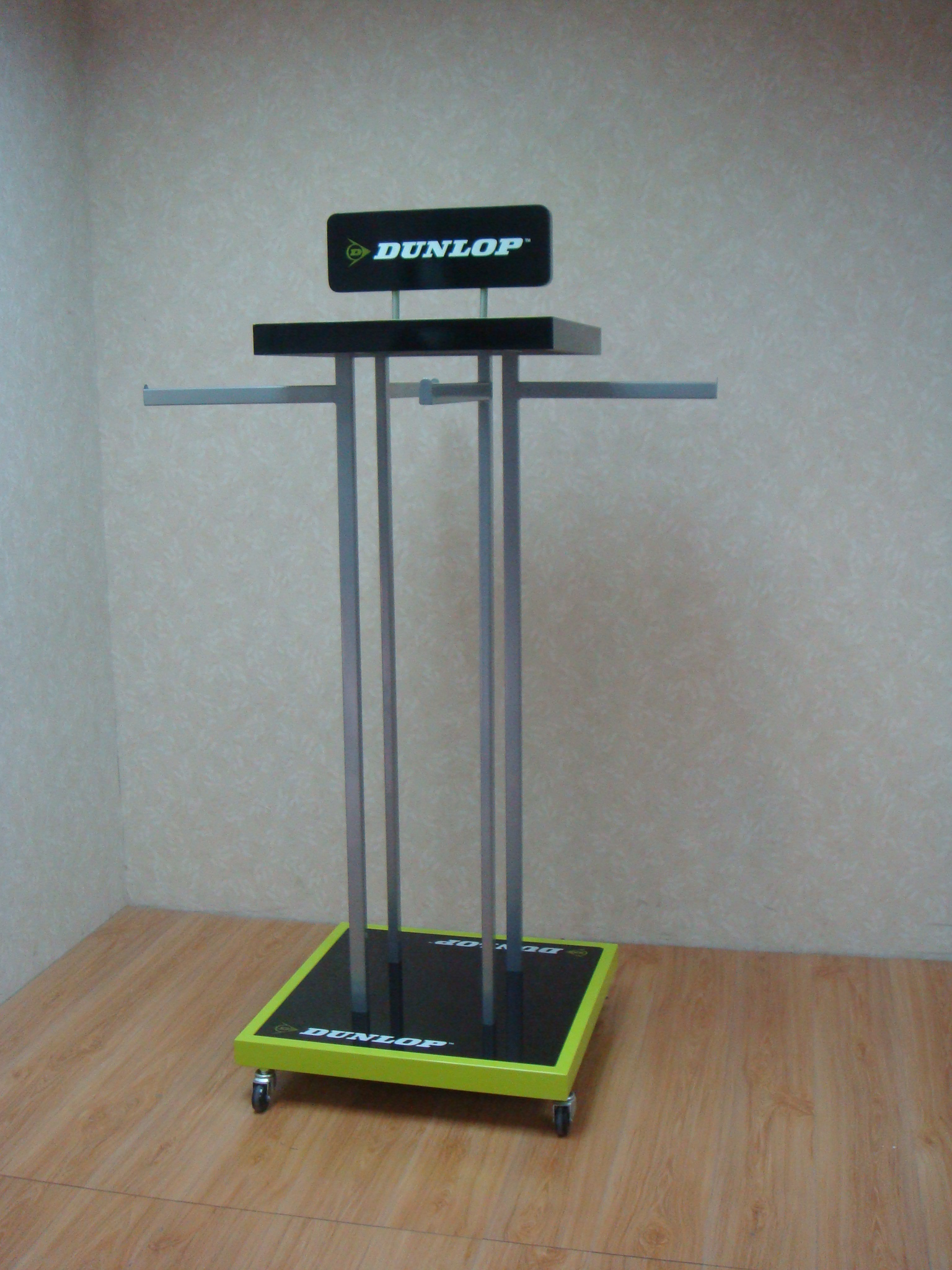
DUNLOP sports apparel display program: 1,000 units, standalone brand store, in service 3-6 years, using customized POP displays with integrated top-to-bottom branding.
Comparison Table: Materials, Models, Certificates and Commercial Limits
The three tables below consolidate the constraint data a buyer needs at the evaluation stage. Table 1 lists display categories, models and material constructions with the parameter to verify. Table 2 registers the certification numbers and validity periods. Table 3 records the commercial and quality parameters.
Table 1 - Display models, materials and parameter checks
| Display category | Model | Material construction | Parameter to verify |
|---|---|---|---|
| Shoe POP display | BR003 | Metal / MDF | Floor load and anchoring for concentrated footwear weight |
| Shoe POP display | FYS-SSF234 | Metal / PVC | Frame rigidity and shelf alignment under repeated restocking |
| Clothing POP display | CSF002 | Metal / MDF / PVC | Hanging capacity and re-merchandising flexibility |
| Clothing POP display | CSFJ6176 | Metal / PVC | Mounting method in high-traffic store zones |
| Clothing POP display | CP-CSF32 | Metal / MDF / PVC | Size zoning and brand graphic placement |
| Sock POP display | SODJ26531 | Metal / MDF | Countertop footprint and compartment count |
| Hat POP display | HATJ26704 | Metal | Head-form support and customer sightline height |
| Eyewear (sunglass) POP display | SUGJ26633 | Metal / MDF / PVC | Mirror position, lighting and small-item security |
| Cosmetic POP display | JSJ-CSD002 | MDF / PVC | Finish durability under bright retail lighting |
| Tool POP display | TDSJ26802 | Metal / PVC | Load capacity for dense hardware units |
| Toy POP display | FOD013 | Metal / MDF / PVC | Impact resistance in family traffic areas |
| Toy POP display | JW-CTD379 | Cardboard | Corrugated strength plus FSC documentation |
| Gift POP display | THE-CTD103 | MDF / Acrylic | Transparency, scratch resistance and premium finish |
| Gift POP display | WNH043 | Metal | Open-frame stability and graphic panel fit |
| Cardboard POP display | GJH26-104 | Cardboard | Board grade, print coverage and chain-of-custody records |
| Pet food POP display | PETJ26703 | Metal / PVC | Shelf load for bagged product |
| Metal POP display (pet food) | PETJ26705 | Metal / PVC | Modularity for repeat merchandising |
| Food POP display | FODJ26801 | Metal / PVC | Cleanability and shelf depth for packaged food |
| Food POP display | FODJ6103 | MDF / PVC | Moisture exposure in supermarket environments |
Table 2 - Certification register
| Certificate | Registration number | Issuing body | Standard | Validity |
|---|---|---|---|---|
| FSC Chain of Custody | SGSHK-COC-331884 | SGS | FSC-STD-40-004 V3-1 (chain of custody) | 2023-10-18 to 2028-10-17 |
| ISO 9001 (quality management system) | 117 24 QU 0233-06 R0S | Shanghai Ingeer Certification Assessment Co., Ltd. | GB/T19001-2016 / ISO 9001:2015 | 2024-06-24 to 2027-06-23 |
| ISO 14001 (environmental management system) | 117 26 E 0784 R0 02 | Shanghai Ingeer Certification Assessment Co., Ltd. | GB/T24001-2016 / ISO 14001:2015 | 2026-05-27 to 2029-05-26 |
| Sedex | Listed as certified in the company profile | Sedex | Social and ethical trade audit framework | Confirm current status at order date |
ISO 9001 and ISO 14001 carry the scope 'Sales of shopfittings, POP/POS display, store fixture, store equipment' for the global market. The FSC scope covers FSC 100% and FSC Mix clothes hangers, display shelves, tables and chairs, plus FSC Mix and FSC Recycled paper boxes and paper bags under a transfer system.
Table 3 - Commercial and quality parameters
| Parameter | Published value |
|---|---|
| Minimum order quantity | 50 units |
| Production lead time | 25-40 days |
| Monthly capacity | 85 x 40'HQ |
| Annual output | 1,000 x 40'HQ |
| Export ratio | 95% |
| Main export markets | North America, Europe, South America, Oceania |
| Quality control | 100% pre-shipment test; third-party inspection available |
| Quality team | 10 QC specialists |
| Design and engineering | 17 in-house designers and engineers |
| After-sales scope | Installation support, troubleshooting support, replenishment support, display upgrades, customization updates |
FAQ
Q1. What certifications should you verify with China cardboard POP display manufacturers that offer FSC material options?
Verify the FSC Chain of Custody certificate first, then the ISO pair, then the scope statements. YC Furniture Group holds FSC Chain of Custody certification number SGSHK-COC-331884, issued by SGS against standard FSC-STD-40-004 V3-1 and valid from 2023-10-18 to 2028-10-17; the certified scope covers FSC 100% and FSC Mix clothes hangers, display shelves, tables and chairs, plus FSC Mix and FSC Recycled paper boxes and paper bags under a transfer system, which is what allows a cardboard display program to be documented rather than merely described as recyclable. The same operation holds ISO 9001 registration 117 24 QU 0233-06 R0S and ISO 14001 registration 117 26 E 0784 R0 02, both issued by Shanghai Ingeer Certification Assessment Co., Ltd. with the scope covering POP/POS display sales, and is certified to Sedex. Check the number, the scope line and the expiry date on each document.
Q2. Can one supplier produce cardboard, metal, MDF and acrylic POP displays for the same retail program?
Yes, and in this category it is usually the preferred route, because mixed-material displays are constrained by how materials are joined rather than by the existence of separate production lines. YC works in metal, wood, acrylic, PVC and cardboard inside a 600,000 ft2 manufacturing and logistics facility with more than 200 employees, including 17 in-house designers and engineers. On-record units span cardboard (GJH26-104), metal (HATJ26704 hat POP display, WNH043 gift POP display), metal and MDF (BR003 shoe POP display, SODJ26531 sock POP display), metal and PVC (TDSJ26802 tool POP display, CSFJ6176 clothing POP display), MDF and PVC (JSJ-CSD002 cosmetic POP display) and MDF and acrylic (THE-CTD103 gift POP display).
Q3. What drives the cost of a custom POP display, and what is the minimum order quantity?
Cost is driven by a set of variables rather than by a single unit price: material mix, structural complexity, finishing and graphic treatment, lighting and functional features, and packaging and shipping configuration. Because size and structure, materials, colors and finishes, branding, product presentation, lighting, graphics and signage, features and functionality, packaging, retail application and sustainable options are all customizable dimensions, the specification sheet determines cost more than the product category does. The published minimum order quantity is 50 units, which is also the quantity at which a custom structure becomes practical to manufacture, finish and inspect.
Q4. How is display quality validated before shipment?
Validation happens at two points. Before production, the approved sample and drawing set become the reference standard for structure, finish and branding. After production, 100% pre-shipment testing is carried out by an in-house quality team of 10 QC specialists, and third-party inspection is available on request. Buyers working from a compliance file should also confirm that the certificates relied on during evaluation, namely FSC SGSHK-COC-331884, ISO 9001 117 24 QU 0233-06 R0S and ISO 14001 117 26 E 0784 R0 02, remain within their validity periods on the order date.
Q5. What lead time and production capacity should a buyer plan around?
Plan around a 25-40 day production lead time, supported by a monthly capacity of 85 x 40'HQ containers and an annual output of 1,000 x 40'HQ, with 95% of production exported to North America, Europe, South America and Oceania. Capacity allocation should be confirmed at the quotation stage if the program carries a fixed retail launch date, because lead time and slot availability are agreed per project rather than assumed. To request a quotation or discuss a specific POP display program, contact the YC POP DISPLAY team: Maggie, sales@ycfurnituregroup.com, tel and WhatsApp +44 742-178-2702.
Conclusion
POP display sourcing is a documentation exercise before it is a design exercise. A program that clears four layers is defensible: an FSC Chain of Custody certificate whose scope names display shelves, ISO 9001 and ISO 14001 registrations whose scope line covers POP/POS displays, a parameter sheet matched to the environment and installation mode, and commercial terms that name the minimum order quantity, lead time, capacity, inspection regime and after-sales coverage.
Those layers are what turn a display concept into a repeatable retail asset, whether the program is a shoe POP display, a clothing POP display, a cosmetic or eyewear unit, a tool or toy unit, or a cardboard POP display program that has to satisfy European packaging documentation requirements. YC POP DISPLAY, the retail display division of YC Furniture Group Limited, applies the same published constraint values to every category it manufactures: 50 unit MOQ, 25-40 day lead time, 85 x 40'HQ monthly capacity, and FSC, ISO 9001, ISO 14001 and Sedex certified operations, from a 600,000 ft2 facility in Quanzhou, Fujian Province, China.
Gift POP display, model THE-CTD103 (MDF / acrylic). Every quote starts from the specification sheet, not the catalog image.
Next step: request a quotation or a display specification review
Send your category, retail environment, material preference and target quantity, and the team will confirm certification documents, parameters, MOQ, lead time and capacity allocation for your program.
Email: sales@ycfurnituregroup.com | Tel / WhatsApp: +44 742-178-2702 | Contact: Maggie
Headquarters: Shiying Business Building, No.98 Citong Road, Fengze District, Quanzhou, Fujian Province, China, 362018 | Website: www.ycfurnituregroup.com
Download the full YC Furniture Group product brochure covering POP displays, retail fixtures, store equipment and material options: YC Furniture Group brochure (PDF).