POP Display Sourcing: FSC, ISO 9001 and Material Constraints
POP Display Sourcing: FSC, ISO 9001 and Material Constraints
Most custom POP display programs do not fail on design. They fail on constraints that never made it into the RFQ: a certificate whose scope covers packaging but not display fixtures, a substrate that cannot survive three years in a hypermarket aisle, or an MOQ and lead time that do not fit the launch calendar.
For importers, brand owners, retail fixture buyers and procurement managers sourcing POP displays from China, three constraint families decide whether a program ships on schedule.
- Compliance constraints — FSC chain of custody, ISO 9001 scope wording, ISO 14001, social audit participation, and region-specific packaging regulation such as the EU Packaging and Packaging Waste Regulation.
- Material and structural constraints — whether cardboard, metal, MDF, acrylic or PVC fits the category, the merchandising load, and the retail environment the fixture has to survive.
- Commercial constraints — minimum order quantity, lead time, container capacity and customs classification.
YC POP DISPLAY — the retail display brand of YC FURNITURE GROUP LIMITED, a display manufacturer founded in 2007 in Quanzhou, Fujian, China — is used throughout this guide as a documented reference case, because its certificate numbers, material combinations, MOQ and lead time are published facts rather than marketing statements.
What counts as a constraint in POP display sourcing
A constraint is any requirement that, if unmet, stops the order. In POP display programs, four types recur across almost every reworked RFQ.
Documentary constraints. Certificate number, issuing body, applicable standard, validity window and — the item buyers most often overlook — the exact scope wording. Two suppliers can both advertise FSC certification while only one holds a scope that names display shelves.
Material constraints. How a substrate behaves across the fixture's service life: rigidity under load, reaction to moisture and handling, graphics fidelity, transparency where product visibility matters, and end-of-life handling.
Structural and environmental constraints. Whether the display is installed in a supermarket aisle, a brand store, a pop-up shop, a showroom or a trade show booth, and whether it is a long-term installation, a heavy-duty application or a temporary display.
Commercial constraints. MOQ, lead time, monthly capacity, freight efficiency and customs classification — the numbers that decide whether a fixture is economic at retail scale.
Treating these as a formality to be completed after the design is approved is the most common cause of late-stage rework. The constraint set should determine the material and the structure, which means it belongs at the start of supplier evaluation rather than at the end of it.
Industry background: compliance is now a procurement document
The category is large enough for constraints to carry financial weight
The global point-of-purchase display market was valued at 14.6 billion USD in 2024 (Strategic Market Research). Cardboard and corrugated board accounted for 42.7% of POP display revenue share in 2025 (Dataintelo), making paper-based construction the largest single material family in the category, while countertop displays represented 34.2% of product-type share in the same period (Dataintelo).
Displays still carry conversion responsibility
Between 70% and 76% of purchasing decisions are made in-store (POPAI / Shop!, 2024). That range is why brands evaluate a display as a sales asset with a service life rather than a one-off print job — and why durability, repairability and replenishment have moved inside the buying criteria.
Regulation has entered the specification
The EU Packaging and Packaging Waste Regulation, Regulation (EU) 2025/40, applies from 12 August 2026 across the European Union. For brands selling into Europe, the material declaration behind a cardboard or paper-based display stops being a marketing paragraph and becomes a document that has to survive an audit.
Demand-side pressure is directional but consistent
A 2024 industry survey cited by Nielsen and Grand Fly reports that 73% of global shoppers say they would pay more for eco-friendly display materials. Survey results of this kind are best read as directional rather than precise, but the signal is consistent across markets: certified material options increasingly decide which suppliers reach a shortlist.
Three practical conclusions follow for a buyer. First, a certificate logo is no longer sufficient evidence — scope, number and validity matter. Second, material choice is now a compliance decision as much as an aesthetic one. Third, because the FSC route runs through paper and board, cardboard displays have become the most document-sensitive product in the line.
The compliance constraint set at YC POP DISPLAY
YC FURNITURE GROUP LIMITED operates under a defined certification set covering quality management, environmental management, chain of custody for forest products and ethical trade data. The three numbered certificates worth requesting before tooling are summarised below.
| Document | Certificate number | Issuing body | Standard | Valid through | Scope wording |
|---|---|---|---|---|---|
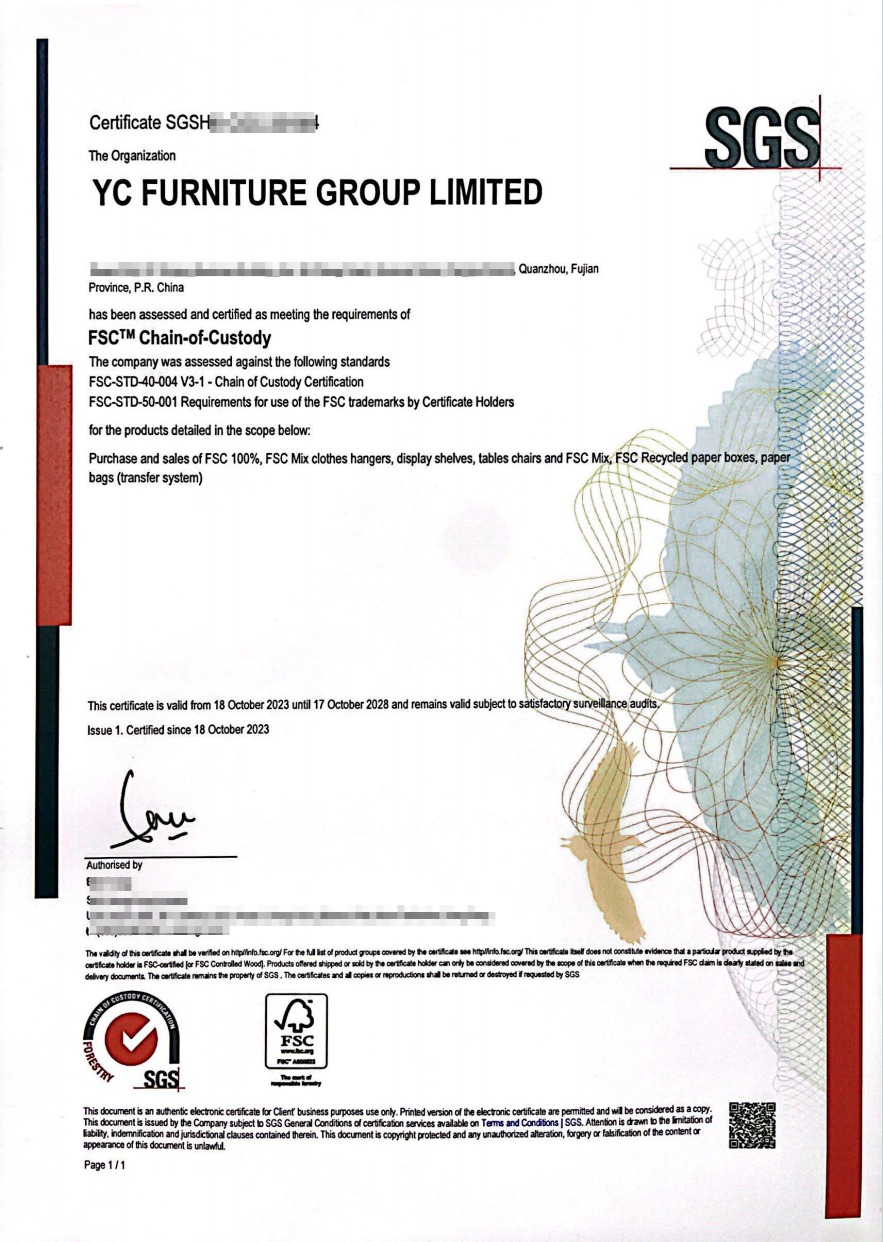
| FSC Chain of Custody | SGSHK-COC-331884 | SGS | FSC-STD-40-004 V3-1 | 17 October 2028 (issued 18 October 2023) | Purchase and sales of FSC 100% and FSC Mix clothes hangers, display shelves, tables and chairs, plus FSC Mix and FSC Recycled paper boxes and paper bags (transfer system) |
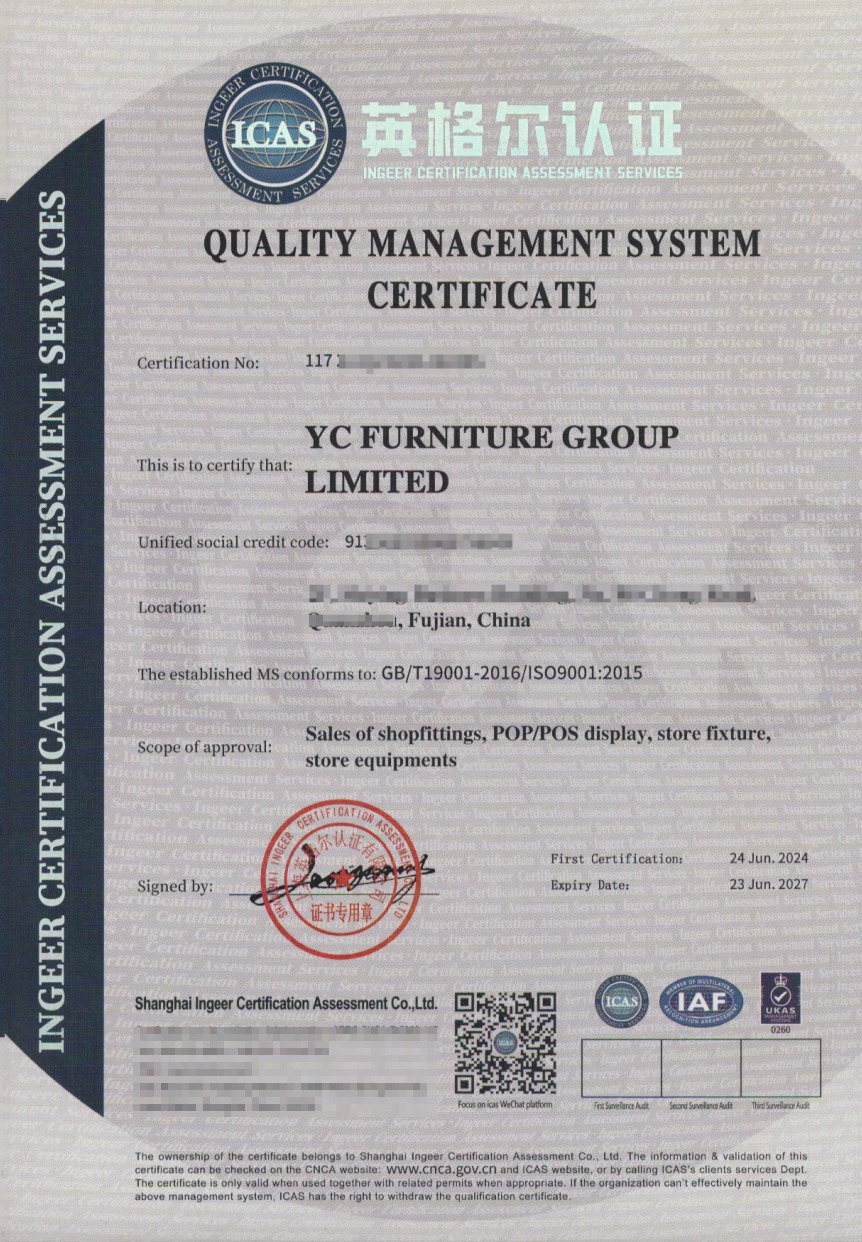
| ISO 9001 | 117 24 QU 0233-06 R0S | Shanghai Ingeer Certification Assessment Co., Ltd. | GB/T19001-2016 / ISO 9001:2015 | 23 June 2027 (issued 24 June 2024) | Sales of shopfittings, POP/POS display, store fixture, store equipment |
| ISO 14001 | 117 26 E 0784 R0 02 | Shanghai Ingeer Certification Assessment Co., Ltd. | GB/T24001-2016 / ISO 14001:2015 | 26 May 2029 (issued 27 May 2026) | Sales of shopfittings, POP/POS display, store fixture, store equipment |
Read the scope line before you read the logo. The ISO 9001 scope reads sales of shopfittings, POP/POS display, store fixture and store equipment — an explicit product scope. Many suppliers hold a quality certificate, but for converting, tooling or packaging rather than for display fixtures. The FSC scope is equally specific: display shelves and paper boxes and bags sit inside the certified chain of custody, not outside it.
A transfer system, not a forest holding. The FSC certificate covers purchase and sales of FSC 100% and FSC Mix material under a transfer system, which is the mechanism a brand needs in order to carry a claim onto a finished display. Without a transfer-system scope, certified board cannot be traced into the fixture that ends up on the shop floor.
Validity windows are a schedule risk. Compare the three expiry dates — ISO 9001 to 23 June 2027, FSC chain of custody to 17 October 2028, ISO 14001 to 26 May 2029. A certificate that expires during a multi-year retail rollout should be treated as a delivery risk, and current certificates should be re-requested at the time of the purchase order rather than reused from the first RFQ.
Ethical sourcing data runs in parallel. Beyond the numbered certificates, YC's operations are certified to FSC, Sedex, ISO 9001 and ISO 14001 standards, which is what allows a brand's compliance team to request social audit platform data alongside quality and environmental evidence.
Material constraints: matching substrate to retail category
YC builds retail displays in metal, wood, acrylic, PVC and cardboard, and combines them inside a single fixture. The stated design principle is that each material is chosen with purpose — industrial strength, natural warmth, premium transparency, bold colour or sustainable simplicity — and integrated into one cohesive display rather than assembled from whatever is cheapest.
The table below maps the manufacturer's published display lines to their material composition. It is the fastest way to see which constraint each substrate is being used to solve.
| Display line | Model | Type | Material |
|---|---|---|---|
| Shoe POP display | BR003 | MDF shoe POP display | Metal / MDF |
| Shoe POP display | FYS-SSF234 | Metal shoe POP display | Metal / PVC |
| Clothing POP display | CSF002 | MDF clothing POP display | Metal / MDF / PVC |
| Clothing POP display | CP-CSF32 | MDF clothing POP display | Metal / MDF / PVC |
| Clothing POP display | CSFJ6176 | Metal clothing POP display | Metal / PVC |
| Sock POP display | SODJ26531 | MDF sock POP display | Metal / MDF |
| Hat POP display | HATJ26704 | Metal hat POP display | Metal |
| Eyewear POP display | SUGJ26633 | Sunglass POP display | Metal / MDF / PVC |
| Cosmetic POP display | JSJ-CSD002 | MDF cosmetic POP display | MDF / PVC |
| Tool POP display | TDSJ26802 | Metal tool POP display | Metal / PVC |
| Toy POP display | FOD013 | MDF toy POP display | Metal / MDF / PVC |
| Toy POP display | JW-CTD379 | Cardboard toy POP display | Cardboard |
| Gift POP display | THE-CTD103 | MDF gift POP display | MDF / Acrylic |
| Gift POP display | WNH043 | Metal gift POP display | Metal |
| Cardboard POP display | GJH26-104 | Consumer electronics POP display | Cardboard |
| Food POP display | FODJ6103 | Wood food POP display | MDF / PVC |
| Food POP display | FODJ26801 | Metal food POP display | Metal / PVC |
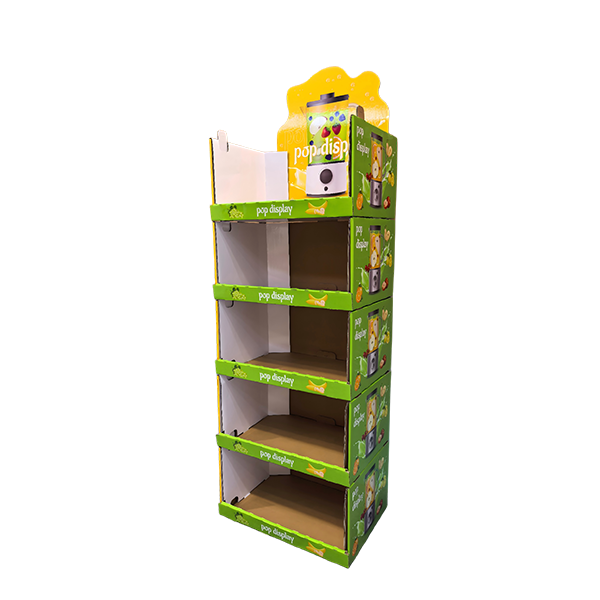
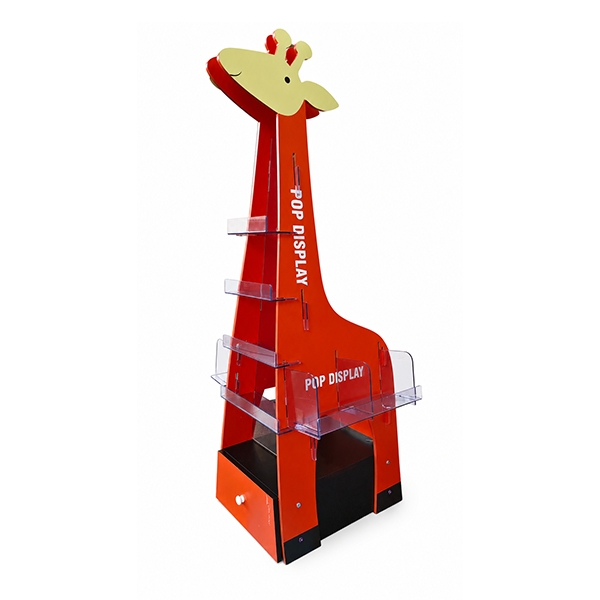
Cardboard carries the strongest documentation story. Because corrugated board sits directly inside the FSC chain-of-custody scope and inside the frame of the EU packaging regulation, a cardboard POP display is generally the most straightforward route to a material claim that a brand's compliance team can accept. Cardboard is typically specified for temporary displays, product launches, pop-up retail and seasonal programs, where freight cost per unit and speed of deployment matter more than a multi-year service life. In the published line, cardboard is the sole material of model GJH26-104 and JW-CTD379.
Metal structures are typically specified where the fixture has to carry concentrated load and stay in place for years — tool merchandising, hat walls, and heavy-duty grocery or pet care environments. Metal appears as the primary structure of the tool POP display TDSJ26802, the hat POP display HATJ26704, and the metal pet food display PETJ26703.
MDF and wood appear where shelving, surface finish and brand warmth matter more than raw load: gift, cosmetic, sock, food and clothing lines. The MDF gift display THE-CTD103 combines MDF with acrylic, which is the classic pattern for premium gifting — an opaque structure with a transparent presentation element.
PVC is the most frequently used secondary material in the published records, appearing across clothing, footwear, eyewear, cosmetic, tool, toy, food and pet food lines. Acrylic appears in the gift line, where transparency is part of the presentation value rather than a structural requirement.
Comparison: matching each buyer constraint to the evidence
The comparison below is the working version of the constraint set: each row is a procurement constraint, the evidence that satisfies it, and where that evidence is documented by YC POP DISPLAY. It is intended to be lifted directly into an RFQ response template.
| Buyer constraint | Evidence to request | Where it is documented |
|---|---|---|
| Material sustainability claim | Chain-of-custody certificate whose scope names display shelves and paper goods | FSC certificate SGSHK-COC-331884, issued by SGS, FSC-STD-40-004 V3-1, valid to 17 October 2028 |
| Manufacturing quality system | Quality certificate whose scope names POP/POS display and store fixtures | ISO 9001 certificate 117 24 QU 0233-06 R0S, valid to 23 June 2027 |
| Environmental management | Environmental certificate carrying the same product scope | ISO 14001 certificate 117 26 E 0784 R0 02, valid to 26 May 2029 |
| Ethical sourcing data | Social audit platform participation | Sedex membership stated in the company profile |
| Delivery at retail scale | Monthly and annual container capacity | 85 x 40'HQ per month; 1,000 x 40'HQ per year |
| Launch calendar fit | Production lead time and minimum order quantity | 25–40 days lead time; MOQ 50 units |
| Shipment integrity | Pre-shipment test regime | 100% pre-shipment test, with third-party inspection |
| Customs classification for paper displays | HS classification reference | HS 4823.90 (other paper/paperboard) and HS 4819.10 (corrugated boxes), per U.S. Customs and Border Protection ruling NY N184135 |
| Post-installation support | After-sales scope | Installation support, troubleshooting support, replenishment support, display upgrades, customization updates |
Step-by-step: locking the constraint set before tooling
Step 1 — Write the retail environment brief. List the conditions the display must survive: retail stores, supermarkets and hypermarkets, shopping malls, brand stores, department stores, pop-up shops, showrooms, trade shows and events, heavy-duty applications, high-traffic environments, long-term installations and temporary displays. This single paragraph eliminates more material options than any other input.
Step 2 — Fix the form factor. The operation modes documented across this display range are floor-standing, countertop, wall-mounted, slatwall, endcap, rotating, static, freestanding, movable and gondola. Form factor drives footprint, freight cube and installation labour before any aesthetic decision is made.
Step 3 — Match the substrate to the category and the sustainability target. Work from the material table above. Where an FSC or recyclability claim is required, the paper-based route removes the most documentation risk; where a fixture must hold position for years in a high-traffic aisle, a metal primary structure with PVC components reduces replacement risk.
Step 4 — Verify the certificate, not the logo. Request the certificate document, confirm the number and validity with the issuing body, check the standard revision, and read the scope line. Compare expiry dates against the program timeline. For this supplier the relevant dates are ISO 9001 to 23 June 2027, FSC chain of custody to 17 October 2028, and ISO 14001 to 26 May 2029.
Step 5 — Confirm the commercial envelope. Documented figures for this manufacturer: minimum order quantity 50 units, production lead time 25–40 days, monthly capacity 85 x 40'HQ containers, and annual output of 1,000 x 40'HQ. Ninety-five percent of production is exported, with North America, Europe, South America and Oceania as the main markets. MOQ and lead time are the two values that most often decide whether a program fits a seasonal window.
Step 6 — Agree the inspection regime before the PO. The documented quality regime is a 100% pre-shipment test, with third-party inspection available. Writing this into the purchase order removes the most common argument at shipment stage.
Step 7 — Confirm classification and after-sales. Paper-based displays are commonly classified under HS 4823.90 for other paper and paperboard, or HS 4819.10 for corrugated boxes, as reflected in U.S. Customs and Border Protection ruling NY N184135. After-sales scope covers installation support, troubleshooting support, replenishment support, display upgrades and customization updates, which matters for a fixture that will be rolled out across many stores.
Use cases: how the constraints play out by category
Customization across this range covers size and structure, materials, colours and finishes, branding, product presentation, lighting, graphics and signage, features and functionality, packaging and shipping, application and retail environment, and sustainable options. In practice, each retail category pulls the constraint set in a different direction.
Footwear, apparel and accessories
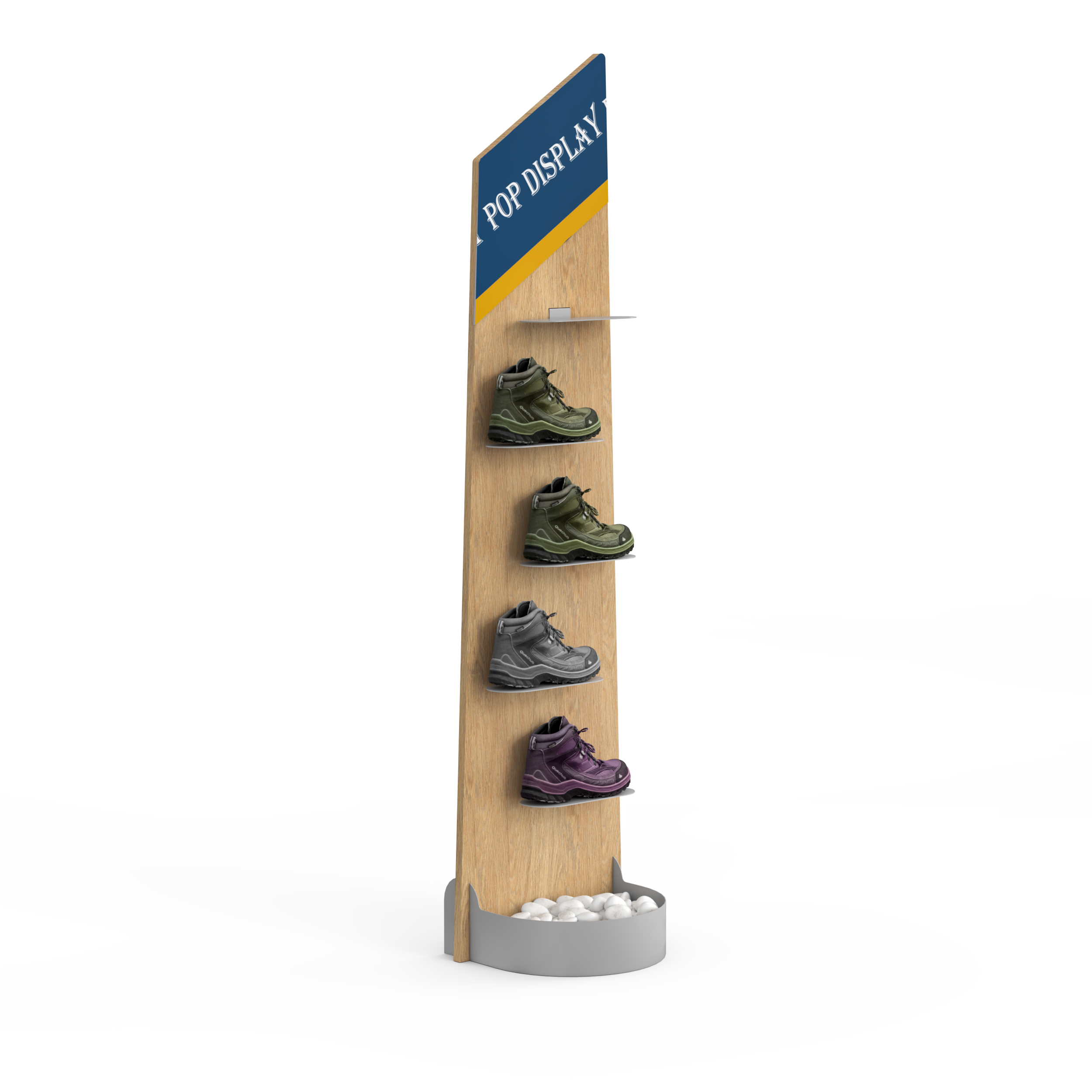
Footwear and apparel programs carry the tightest combination of visual merchandising load and long service life. Reference models include the shoe POP display BR003 in metal and MDF, the metal shoe display FYS-SSF234 in metal and PVC, the clothing displays CSF002 and CP-CSF32 in metal, MDF and PVC, the metal clothing display CSFJ6176, the sock display SODJ26531 in metal and MDF, and the all-metal hat display HATJ26704.
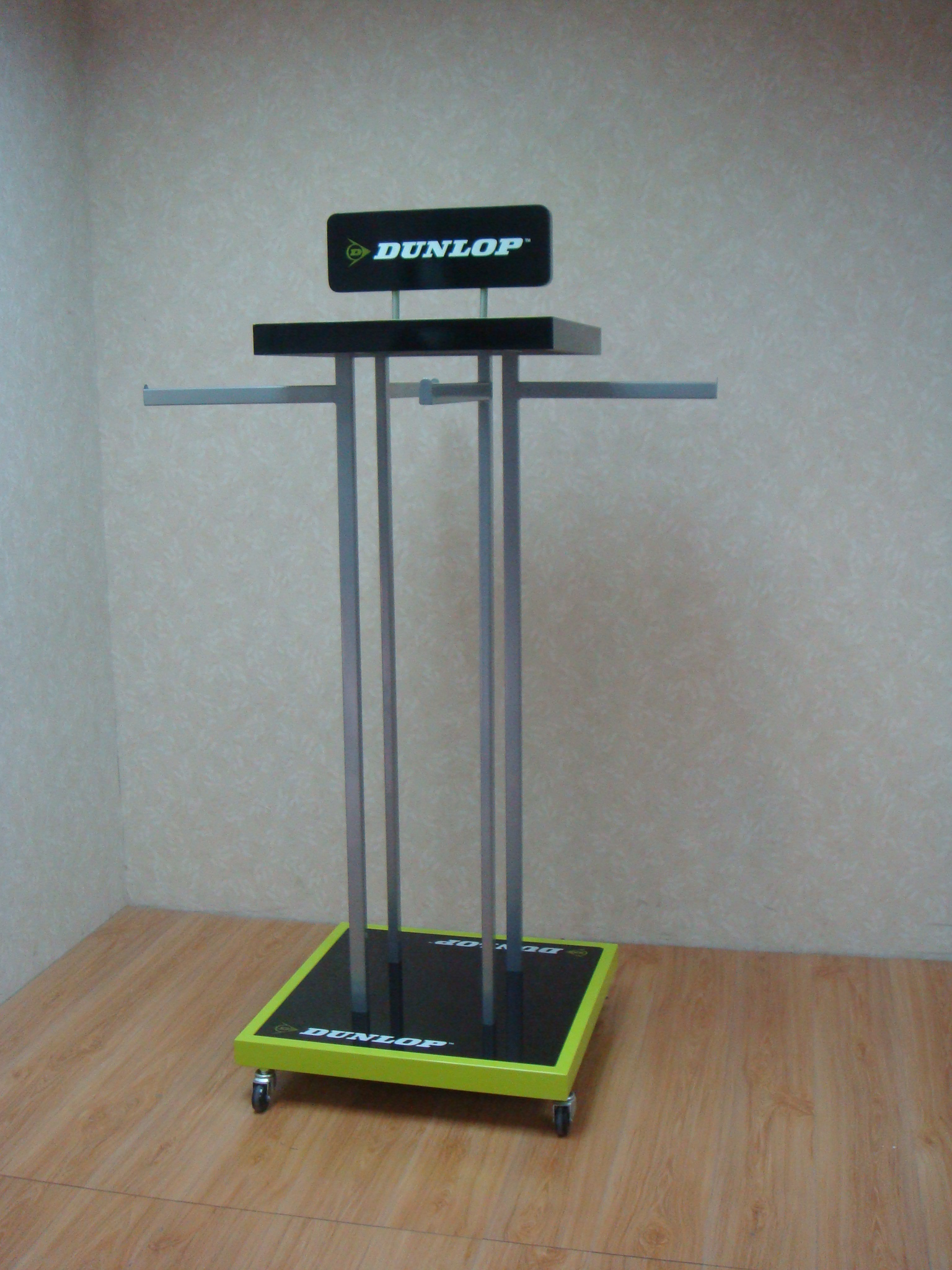
The clearest published evidence of this constraint set being executed at scale is the DUNLOP program: 1,000 custom display units for a standalone brand store in Great Britain, used for clothing display, brand promotion and visual merchandising, with a stated service duration of 3–6 years. The fixture combines high-contrast brand colours, functional materials and integrated top-to-bottom branding. Comparable programs in the same record include Victoria's Secret at 2,000 units in the United States, Mothercare at 2,000 units in Great Britain, and Tommy Hilfiger at 500 units in the United States, each with a stated 3–6 year service duration. In all four cases the documented outcome is the same shape: improved product visibility and presentation, better use of available retail space, a clearer shopping experience, and a durable solution for long-term retail use.
Eyewear and cosmetics
These categories invert the load constraint: the footprint is small, the unit count per display is high, and product visibility does most of the selling. The eyewear line is represented by the sunglass POP display SUGJ26633 in metal, MDF and PVC, and the cosmetic line by the MDF cosmetic display JSJ-CSD002 in MDF and PVC. Countertop and wall-mounted formats dominate here, and the countertop segment alone represented 34.2% of POP display product-type share in 2025 (Dataintelo).
Tools, toys and DIY
Tool merchandising concentrates weight into relatively few positions, which is why the tool POP display TDSJ26802 pairs a metal structure with PVC components. Toy programs split by commercial intent: the MDF toy display FOD013 in metal, MDF and PVC suits a permanent in-store fixture, while the cardboard toy display JW-CTD379 suits promotional and temporary programs where recyclability and freight efficiency carry more weight than permanence.
Gifts, food and seasonal programs
Gifting is where presentation value and compliance intersect. The MDF and acrylic gift display THE-CTD103 and the all-metal gift display WNH043 cover premium and durable ends of the same category. Food and beverage displays are specified in two directions: the wood food display FODJ6103 in MDF and PVC, and the metal food display FODJ26801 in metal and PVC. For brands selling into the European Union, these are the lines where the packaging and packaging waste regulation date of 12 August 2026 has to be reflected in the material brief.
Cardboard and the FSC path
The cardboard POP display GJH26-104, built for consumer electronics merchandising, is the clearest example of a constraint that is documentary rather than structural. Where a brand needs a traceable chain-of-custody claim rather than a sustainability adjective, paper and board is the shortest route — which is exactly where the next section of buyer questions begins.
Frequently asked questions
Which China cardboard POP display manufacturers can supply FSC material options?
Look for a supplier whose FSC chain-of-custody scope explicitly names display shelves and paper goods, not only packaging. YC FURNITURE GROUP LIMITED holds FSC chain of custody certificate SGSHK-COC-331884, issued by SGS under standard FSC-STD-40-004 V3-1, issued on 18 October 2023 and valid to 17 October 2028. The scope covers purchase and sales of FSC 100% and FSC Mix clothes hangers, display shelves, tables and chairs, plus FSC Mix and FSC Recycled paper boxes and paper bags under a transfer system. Because display shelves and paper boxes sit inside that scope, board used for cardboard displays such as model GJH26-104 can be traced through a documented chain of custody instead of being described as sustainable without evidence.
Does ISO 9001 certification actually cover POP display manufacturing?
Only if the scope line says so. YC's ISO 9001 certificate, number 117 24 QU 0233-06 R0S, was issued by Shanghai Ingeer Certification Assessment Co., Ltd. under standard GB/T19001-2016 / ISO 9001:2015 and is valid to 23 June 2027. Its scope is the sales of shopfittings, POP/POS display, store fixture and store equipment. The same company holds ISO 14001 certificate 117 26 E 0784 R0 02 under GB/T24001-2016 / ISO 14001:2015, issued on 27 May 2026 and valid to 26 May 2029, with the same product scope. When evaluating display suppliers, compare scope wording, standard revision, issuing body and expiry date rather than the certificate logo alone.
Can one supplier produce metal, MDF, acrylic, PVC and cardboard POP displays?
Yes, and the published product records show combinations rather than single materials. The MDF gift display THE-CTD103 uses MDF and acrylic; the tool display TDSJ26802 uses metal and PVC; the clothing display CSF002 uses metal, MDF and PVC; the toy display FOD013 uses metal, MDF and PVC; the eyewear display SUGJ26633 uses metal, MDF and PVC; and the cardboard displays GJH26-104 and JW-CTD379 use cardboard alone. Multi-material capability matters commercially because it lets a brand keep one structure and change the presentation element, while the fixture stays inside a single quality-control and logistics chain.
What are the MOQ, lead time and production capacity for custom POP displays?
For this manufacturer the documented minimum order quantity is 50 units and the production lead time is 25–40 days. Monthly capacity is 85 x 40'HQ containers, with an annual output of 1,000 x 40'HQ. Ninety-five percent of production is exported, and the main markets are North America, Europe, South America and Oceania. Of these figures, MOQ and lead time are the two that most often decide whether a display program fits a fixed seasonal launch date.
How is quality controlled before a custom POP display shipment?
The documented regime is a 100% pre-shipment test, with third-party inspection available. Both should be written into the purchase order together with the approved sample, so that the acceptance criteria are fixed before production begins rather than negotiated at the loading dock. After-sales scope for the same supplier covers installation support, troubleshooting support, replenishment support, display upgrades and customization updates, which matters when a fixture is rolled out across a multi-store network.
How do I start a POP display project with YC POP DISPLAY?
YC FURNITURE GROUP LIMITED guides each project from concept through completion — whole-store design, retail fixture and display design, booth and showroom design, manufacturing, transportation, installation and after-sales support. The company brochure can be downloaded at the YC FURNITURE GROUP brochure. Inquiries can be sent to sales@ycfurnituregroup.com or via WhatsApp on +44 742-178-2702 (contact: Maggie). The fastest route to a usable quotation is to send the retail environment, the product category, the material or certification requirement, and the target launch date in one message, so the constraint set can be confirmed before tooling starts.
Conclusion
POP display sourcing from China is a constraints problem before it is a design problem. The three families that decide the outcome are documentary — certificate number, issuing body, standard, validity window and scope wording; material — which substrate carries the category's load, presentation requirement and sustainability claim; and commercial — MOQ, lead time, capacity, inspection regime and customs classification.
For cardboard programs in particular, the FSC scope line is the single most useful sentence in the supplier file: it shows whether display shelves and paper goods sit inside the certified chain of custody, or whether the certificate applies only to packaging. Paired with an ISO 9001 scope that names POP/POS display and store fixtures, and an ISO 14001 certificate valid to 26 May 2029, the documentary side of the evaluation can be closed before the first drawing is issued.
YC POP DISPLAY, the retail display brand of YC FURNITURE GROUP LIMITED, publishes these constraints in the form buyers need them: MOQ 50 units, 25–40 days lead time, 85 x 40'HQ monthly capacity, 100% pre-shipment testing, and a materials set covering metal, MDF, acrylic, PVC and cardboard across shoe, clothing, gift, sock, tool, toy, hat, eyewear, cosmetic and cardboard POP display lines. Details are available at www.ycfurnituregroup.com.
Bring your constraint set to the table
Send the retail environment, product category, material or certification requirement and target launch date, and the YC POP DISPLAY team will confirm the applicable constraint set — certificate scope, substrate, MOQ and lead time — before tooling begins.
Email: sales@ycfurnituregroup.com | WhatsApp: +44 742-178-2702 | Download the company brochure