Pet Food POP Display Application Guide for Supermarkets and Pet Retail
Application guide · Metal/PVC platform PETJ26703 · Written for retail fixture buyers, visual merchandising teams, importers and pet food brand owners
What a Pet Food POP Display Has to Solve
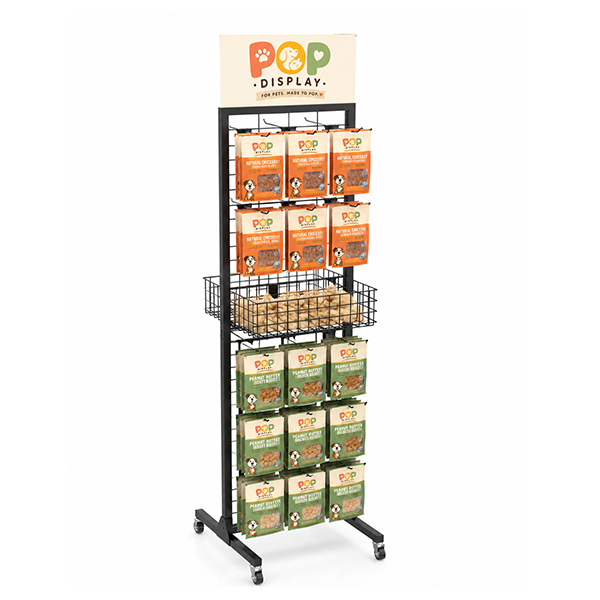
A pet food POP display is a branded point-of-purchase unit placed in a supermarket pet aisle, a pet specialty store, a brand store or a pop-up retail space to hold pet food SKUs — dry food bags, cans, pouches, treats and adjacent products — and to present that brand at the moment the shopper decides.
The phrase “POP display” hides a wide range of physical realities. A countertop tray for treat pouches and a floor-standing unit for large dry food bags are both POP displays, and both sit on the same purchase-order line. For a pet food programme, the design problem is usually a combination of four constraints:
- Load concentration. Pet food is a dense category. A display has to carry weight in fewer, heavier facings than, for example, an eyewear or sock display, so the frame and the shelf-to-frame connection matter more than the graphic panel.
- Aisle footprint. Supermarket aisles are planned around standard gondola runs. A display that is a few centimetres too wide either blocks circulation or gets relocated by the store team, which defeats the merchandising plan.
- Reset reality. Pet food ranges change with seasons, promotions and pack formats. A unit that cannot be re-merchandised without tools will be taken down rather than adapted.
- Documentation. Retail groups, importers and distributors increasingly ask for certification, MOQ and lead-time information before a fixture is approved, not after.
Why this matters commercially: POPAI research cited in 2024 reports that between 70% and 76% of purchasing decisions happen in-store. If most of the decision is made at the shelf, the display is not decoration — it is the last controllable surface between the brand and the buyer.
Where Pet Food POP Displays Sit in Retail Today
The display industry is large enough that material decisions have their own economics. Strategic Market Research valued the global point-of-purchase display market at 14.6 billion USD in 2024. Within that market, cardboard and corrugated board held a 42.7% revenue share in 2025 according to Dataintelo, and countertop displays accounted for 34.2% of product-type share in the same year.
Those two figures explain a common split in pet food programmes. Cardboard dominates where the display is a campaign asset with a defined life; countertop formats dominate where the SKU set is small and the fixture must sit on an existing counter or shelf. Metal and PVC units occupy a different position: they are specified when the display has to outlive a single promotion, carry heavier packs, and be re-used across stores or markets.
Regulation is now part of the material conversation as well. The EU Packaging and Packaging Waste Regulation, Regulation (EU) 2025/40, applies from 12 August 2026 in the European Union, which places packaging and material documentation higher on the brief for programmes sold into European retail. Consumer sentiment points in the same direction: a 2024 Nielsen study reported alongside Grand Fly found that 73% of global shoppers said they would be willing to pay more for eco-friendly display materials. That figure is a directional sentiment measure rather than a purchasing forecast, but it is consistent with the direction retail briefs are taking.
For context on the supply side, YC POP DISPLAY is the retail display operation of YC Furniture Group, a manufacturer established in 2007 with more than 600,000 ft² of manufacturing and logistics space, over 200 employees, 17 in-house designers and engineers, and 10 QC specialists. The company states that it has served more than 5,000 companies and brands, exports around 95% of its output to North America, Europe, South America and Oceania, and is certified to FSC, Sedex, ISO 9001 and ISO 14001. Its stated project experience spans clothing, footwear, toys, tools, cosmetics, food and pet care categories.
PETJ26703: A Metal/PVC Pet Food POP Display, Configured Per Project
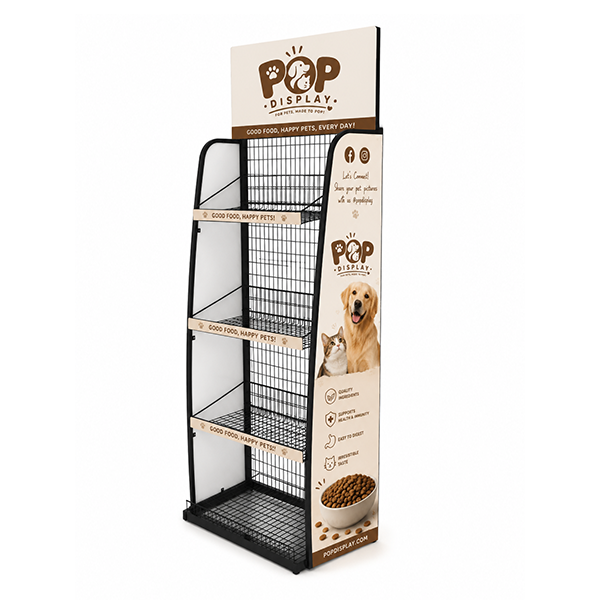
The PET FOOD POP DISPLAY model PETJ26703 is recorded as a metal pet food POP display built from metal and PVC, with “Customized” listed as its parameter. In plain terms, PETJ26703 is a platform rather than a fixed catalogue item: the material family, product category and construction logic are defined, and the dimensions, structure, graphics and branding are set for each programme.
That distinction is the single most useful thing a project team can understand before requesting a quotation. When a supplier catalogue shows a fixed SKU with fixed dimensions, the buyer's job is to check fit. When the SKU is a customizable platform, the buyer's job is to write down the constraints — pack sizes, aisle width, number of facings, brand hierarchy, installation method, destination market — and let the structure follow.
A second pet food platform, METAL POP DISPLAY model PETJ26705, is also recorded as a metal/PVC metal pet food POP display. Having two configurable platforms inside the same material family is useful for programmes that need more than one footprint, such as a main-aisle unit plus a shorter companion piece in a secondary location.
What “customized structural configuration” covers
YC lists eleven customization dimensions for its POP display projects. Read together, they form a specification checklist for exactly this kind of programme:
- Size and structure
- Materials
- Colors and finishes
- Branding
- Product presentation
- Lighting
- Graphics and signage
- Features and functionality
- Packaging and shipping
- Application and retail environment
- Sustainable options
For a pet food display, the practical consequence is that structural questions and marketing questions get answered in the same document. Shelf pitch is set by pack height. Frame bracing is set by pack weight. Graphics are set by the brand hierarchy. Shipping configuration is set by how the unit reaches the store and who assembles it.
Why metal and PVC are paired in this category
Metal/PVC construction is a common combination in food-adjacent retail for structural reasons. Metal carries the concentrated load of a loaded shelf and provides the rigidity a freestanding unit needs in order to stay square in a high-traffic aisle. PVC is commonly specified where a smooth, printable panel surface is required and where a panel has to tolerate the routine wipe-down typical of food retail environments. The material pairing is not a claim about any single product's performance — it is the reason this combination is specified so often in the category.
The project requirements YC supports for POP/POS display work include quick installation, fire resistance, impact resistance, cost-effectiveness, durability, high load capacity, modular design and eco-friendly options. Not every project needs all of them, and the selection belongs in the brief rather than in the default.
Step-by-Step: How a Pet Food Display Programme Moves From Brief to Aisle
The sequence below reflects how a customizable display platform is normally specified. Each step produces a decision that constrains the next one, which is why changing a pack format late in the process is expensive and confirming it early is cheap.
Step 1 — Define placement and operating mode
Decide where the unit physically goes: floor-standing display, countertop display, wall-mounted display, slatwall unit, endcap, rotating display, static display, freestanding display or movable display. Retail environments listed for these projects include retail stores, supermarkets and hypermarkets, shopping malls, brand stores, department stores, pop-up shops, showrooms, trade shows and events, heavy-duty applications, high-traffic environments, long-term installations and temporary displays. The placement decision sets the footprint, the base design and the installation method.
Step 2 — Fix the SKU set and product presentation
List the pack formats the display must hold and the number of facings for each. Product presentation is one of the customization dimensions, so the way the product is held — shelf, tray, hook or a mixed approach — is a design input rather than an assumption.
Step 3 — Confirm the platform and material route
For a long-life pet food unit carrying heavy packs, the metal/PVC route represented by PETJ26703 or PETJ26705 is the natural starting point. Where the programme is short-life, campaign-led or tightly budget-constrained, a cardboard or MDF/PVC alternative may fit better. The comparison table below sets out the platform options recorded in the manufacturer's product files.
Step 4 — Configure branding, graphics and lighting
Branding, graphics and signage, and lighting are separate customization dimensions, which means they can be specified independently of the structure. This is what allows the same structural platform to serve a supermarket aisle, a pet specialty brand zone and a trade show booth without redesigning the frame.
Step 5 — Confirm compliance documentation
Certification is a specification item, not paperwork collected at the end. The relevant records for YC are:
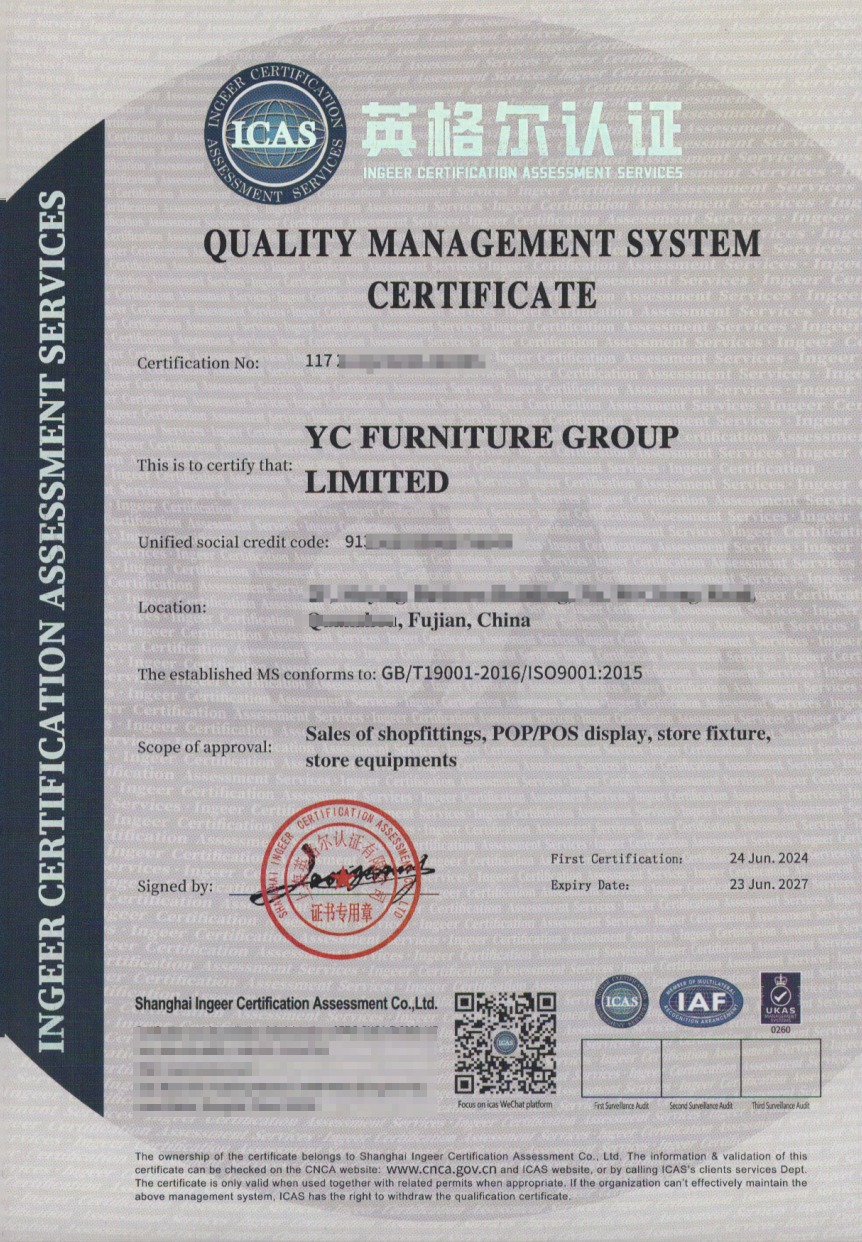
- ISO 9001 — certificate number 117 24 QU 0233-06 R0S, issued by Shanghai Ingeer Certification Assessment Co., Ltd against GB/T19001-2016 / ISO9001:2015, valid from 24 June 2024 to 23 June 2027. The certified scope covers the sales of shopfittings, POP/POS display, store fixture and store equipment, and the certificate is recorded against the PET FOOD POP DISPLAY PETJ26703.
- ISO 14001 — certificate number 117 26 E 0784 R0 02, issued by Shanghai Ingeer Certification Assessment Co., Ltd against GB/T24001-2016 / ISO14001:2015, valid from 27 May 2026 to 26 May 2029.
- FSC Chain of Custody — certificate number SGSHK-COC-331884, issued by SGS against FSC-STD-40-004 V3-1, valid from 18 October 2023 to 17 October 2028. The scope covers the purchase and sales of FSC 100%, FSC Mix and FSC Recycled paper-based items under a transfer system, including display shelves and paper boxes.
Step 6 — Set commercial and logistics parameters
Order quantity, production window and shipping plan are confirmed before tooling and materials are committed. YC's stated parameters for display projects are a minimum order quantity of 50 units, a lead time of 25–40 days, and a monthly capacity of 85 x 40'HQ containers. Annual output is stated at 1,000 x 40'HQ.
Step 7 — Quality control and delivery
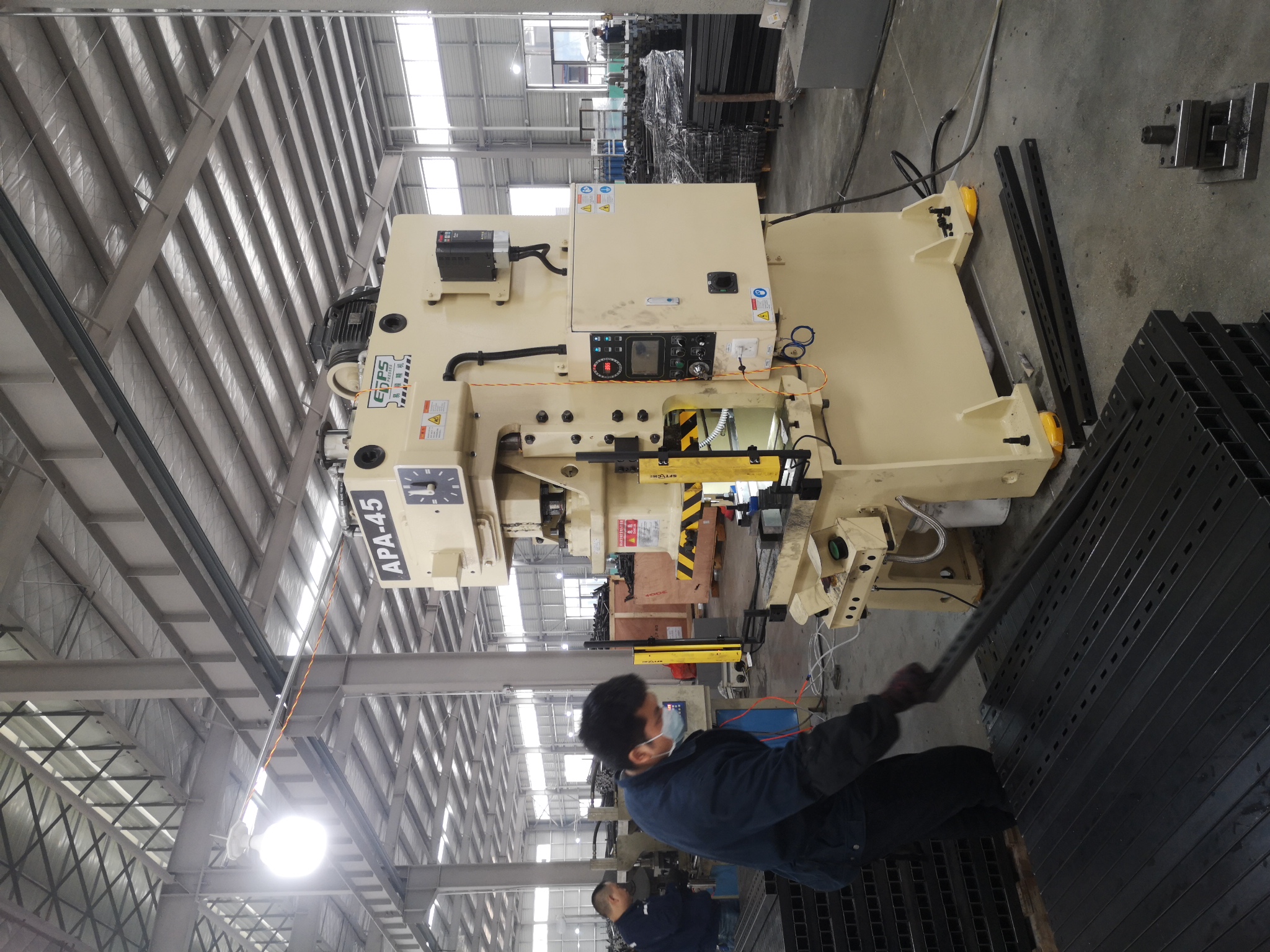
Quality control is stated as 100% pre-shipment testing, with third-party inspection available. On the logistics side, projects can be supported with logistics and installation tooling, installation instructions and an installation video — which matters when a unit is assembled by store teams in several markets rather than by the brand's own staff.
Step 8 — Hand over and maintain
After-sales support listed for these projects covers installation support, troubleshooting support, replenishment support, display upgrades and customization updates. For a multi-store pet food rollout, replenishment and upgrade support is what keeps a display programme alive beyond the first order.
Merchandising Scenarios in Supermarkets and Pet Retail
The same platform behaves differently depending on where it lands. Five scenarios matter most in pet food merchandising.
1. Supermarket pet aisle endcap
The endcap is a high-visibility, low-dwell position. The unit is usually configured as a freestanding or movable display with a defined footprint that respects the aisle's circulation width, and the graphics carry the promotion rather than the brand story. Because the location changes with the promotional calendar, modularity and quick installation are valued above maximum shelf count.
2. In-line brand block inside the pet aisle
Here the display works alongside the store's own gondola shelving, integrating with in-store fixtures, lighting and visual graphics. The design goal is a clearly zoned brand block that a shopper can identify from the aisle entrance without the store losing its category logic.
3. Pet specialty brand zone
Pet specialty retail carries deeper ranges and often higher price points. A floor-standing unit with more brand surface and more product presentation variety is common, and lighting becomes a meaningful part of the specification rather than an optional extra.
4. New product launch or seasonal promotion
Launch programmes are the scenario in which a temporary or shorter-life display is often the better commercial answer. Cardboard platforms such as GJH26-104 sit in that space, while a permanent metal/PVC unit can be specified when the launch is expected to convert into an ongoing shelf presence.
5. Pop-up shop, showroom and trade show
Pop-up shops, showrooms and trade show and event environments are listed operating conditions for these display projects. In these settings the same structural platform is reconfigured for rapid assembly and disassembly, and the display often doubles as a brand environment rather than a pure sales fixture.
Comparing POP Display Platforms Used in Pet and Food Retail
The table below lists platform options recorded in the manufacturer's product files that are relevant to pet food and food retail programmes. Every entry is a customizable platform, and each records Pet Products, Food & Beverage and Retail & Supermarkets among its applicable industries.
| Model | Product name | Display type (manufacturer record) | Material | Parameter |
|---|---|---|---|---|
| PETJ26703 | PET FOOD POP DISPLAY | METAL PET FOOD POP DISPLAY | Metal / PVC | Customized |
| PETJ26705 | METAL POP DISPLAY | METAL PET FOOD POP DISPLAY | Metal / PVC | Customized |
| FODJ26801 | FOOD POP DISPLAY | Metal FOOD POP DISPLAY | Metal / PVC | Customized |
| FODJ6103 | FOOD POP DISPLAY | WOOD FOOD POP DISPLAY | MDF / PVC | Customized |
| GJH26-104 | CARDBOARD POP DISPLAY | CONSUMER ELECTRONICS POP DISPLAY | Cardboard | Customized |
How to read this table: PETJ26703 and PETJ26705 are the pet food platforms; FODJ26801 and FODJ6103 are food retail platforms in metal/PVC and MDF/PVC respectively; GJH26-104 is a cardboard platform recorded under a consumer electronics type designation, which is representative of how cardboard displays are usually deployed — as a category-agnostic, short-life asset. The model designation of each unit is fixed. The structure is not.
Adaptation Checklist for Project Teams
Use this list as the working document behind a pet food display brief. Each item is something that can be confirmed before quotation and is expensive to change afterwards.
Placement and environment
- Confirm the exact position: endcap, in-line, brand zone, entrance, countertop, pop-up or showroom.
- Confirm the operating mode: floor-standing, countertop, wall-mounted, slatwall, rotating, static, freestanding or movable.
- Record available width and depth against the store's circulation requirement.
- State whether installation is long-term, temporary, or heavy-duty and high-traffic.
Structure and product presentation
- List every pack format by height, width and weight class.
- Confirm the number of facings per SKU and the presentation method.
- Decide whether the unit must be modular in order to survive range resets.
- Confirm the required load capacity and which special requirements apply — quick installation, fire resistance, impact resistance or eco-friendly options.
Branding and graphics
- Separate the structural brief from the branding, graphics and signage brief.
- Decide whether lighting is in scope.
- Confirm which market and language variants the graphics must cover.
Compliance and documentation
- Confirm which certificates the retail buyer or importer requires, and check the validity dates.
- Confirm whether FSC-certified paper or wood-based elements are required, and whether the display itself is metal/PVC or paper-based.
- Confirm whether the destination market has packaging or material obligations that must be documented at brief stage.
Commercial and delivery
- Confirm order quantity against the minimum order quantity.
- Confirm the production window and the shipping plan in the same conversation.
- Confirm the packaging and shipping configuration, including whether the unit ships assembled or flat.
- Confirm who assembles the unit and whether installation instructions and video support are needed.
Lifecycle
- Confirm replenishment, display upgrade and customization update support.
- Confirm the troubleshooting route for stores that damage or mis-assemble a unit.
FAQ
China cardboard POP display manufacturers with FSC material options — what should buyers verify?
Buyers should verify three things: the certificate itself, its scope, and whether the display they are ordering is actually paper-based. YC holds FSC Chain of Custody certification SGSHK-COC-331884, issued by SGS against FSC-STD-40-004 V3-1 and valid from 18 October 2023 to 17 October 2028. The certified scope covers the purchase and sales of FSC 100%, FSC Mix and FSC Recycled paper-based items, including display shelves, paper boxes and paper bags, under a transfer system. That scope matters because a pet food display programme may combine a metal/PVC fixture such as PETJ26703 with FSC-eligible paper-based components, and an FSC claim applies only to the paper-based elements named in the scope. For customs planning, cardboard display units are commonly classified under HS codes such as 4823.90 for other paper and paperboard articles and 4819.10 for corrugated boxes, as reflected in customs rulings on display goods.
Can the PET FOOD POP DISPLAY PETJ26703 be adapted to different pack formats and store footprints?
Yes. The PETJ26703 parameter is recorded as “Customized”, and the customization dimensions include size and structure, materials, colors and finishes, branding, product presentation, lighting, graphics and signage, features and functionality, packaging and shipping, application and retail environment, and sustainable options. A project team therefore specifies the pack formats, facing counts and footprint it needs, rather than fitting the programme around a fixed catalogue size. The model designation stays PETJ26703; the structure is configured for the project.
What drives the cost of a pet food POP display, and what is the minimum order quantity?
Cost is driven by specification, not by model number. Dimensions and structure, material mix, finishes, whether lighting and complex graphics are included, and the packaging and shipping configuration all move the cost. YC's stated minimum order quantity for display projects is 50 units, with a lead time of 25–40 days. Because these are specification-driven units rather than fixed catalogue items, a cost discussion is only meaningful once the adaptation checklist above has been completed.
How long do production and delivery take, and how is quality controlled?
YC states a production lead time of 25–40 days, supported by a monthly capacity of 85 x 40'HQ containers and annual output of 1,000 x 40'HQ. Quality control is stated as 100% pre-shipment testing, with third-party inspection available. Projects can also be supported with logistics and installation tooling, installation instructions and an installation video, so that store teams can assemble units correctly in each market.
What support continues after the first order?
After-sales support listed for these projects covers installation support, troubleshooting support, replenishment support, display upgrades and customization updates. For a supermarket or pet retail chain rolling a display out across many stores, that ongoing support is what protects the original investment when ranges change or units need replacing. To move from evaluation to a concrete proposal, project teams can send a completed adaptation checklist to the YC POP DISPLAY sales team for a configuration review and quotation.
Conclusion
Pet food displays are specified at the intersection of three things: a heavy, fast-turning product category; a retail environment that will not tolerate a fixture which blocks the aisle or resists a reset; and a buying process that wants certification, MOQ and lead time confirmed before approval. A customizable metal/PVC platform such as PET FOOD POP DISPLAY PETJ26703 answers that combination because the structure follows the brief rather than the other way round.
The practical path is straightforward. Write the placement, the pack formats, the facing count, the branding scope, the compliance requirements and the delivery plan into one document, review it with the manufacturer, and let the structural configuration be built around it. Metal/PVC, MDF/PVC and cardboard each have a legitimate role in pet and food retail; the decision is about display life, load and store environment, not about which material is universally better.
Next step: sample request, configuration review or quotation
Send your completed adaptation checklist to YC POP DISPLAY and the team will review the structural configuration, material route and compliance documents for your pet food display programme.
Email: sales@ycfurnituregroup.com · WhatsApp / Tel: +44 742-178-2702
Website: www.ycfurnituregroup.com · Blog: blog.ycfurnituregroup.com
Download the full catalogue: YC Furniture Group catalogue (PDF)
Have Questions or Need More Details?
Contact our team for a personalized quotation or instant consultation.
Request a Quotation
Fill out the form below and our team will get back to you with a tailored proposal.
WhatsApp Direct Chat
Prefer to chat in real-time? Message us on WhatsApp for instant assistance & quick answers.
- Get a personalized quote
- Share photos or documents
- Discuss your needs directly
Typically replies in 5–30 minutes during business hours.