Specifying Eyewear POP Displays: A Technical Guide to Materials, Structures, and Customization
An eyewear POP display is not a scaled-down shelving unit — it is a presentation system built around small, fragile, high-margin products that customers handle before they buy. Sunglasses and optical frames have to be held at a readable angle, lit properly, and compared side by side, all within a very small footprint. POPAI research on point-of-purchase displays reports that 70% to 76% of purchasing decisions are still made inside the store, which means the display is frequently the last piece of communication a shopper sees before the sale.
This guide is written for brand owners, optical retail planners, and procurement teams who need to specify an eyewear POP display from a manufacturer. It covers how metal, acrylic, wood and MDF, PVC, and cardboard affect durability, product visibility, and cost; how structural choices such as countertop versus floor-standing units, tiered shelving, and load capacity change the result; and which decisions should be closed before a purchase order is issued. It is a specification guide rather than a product catalogue, so it describes configurations and materials rather than individual models.
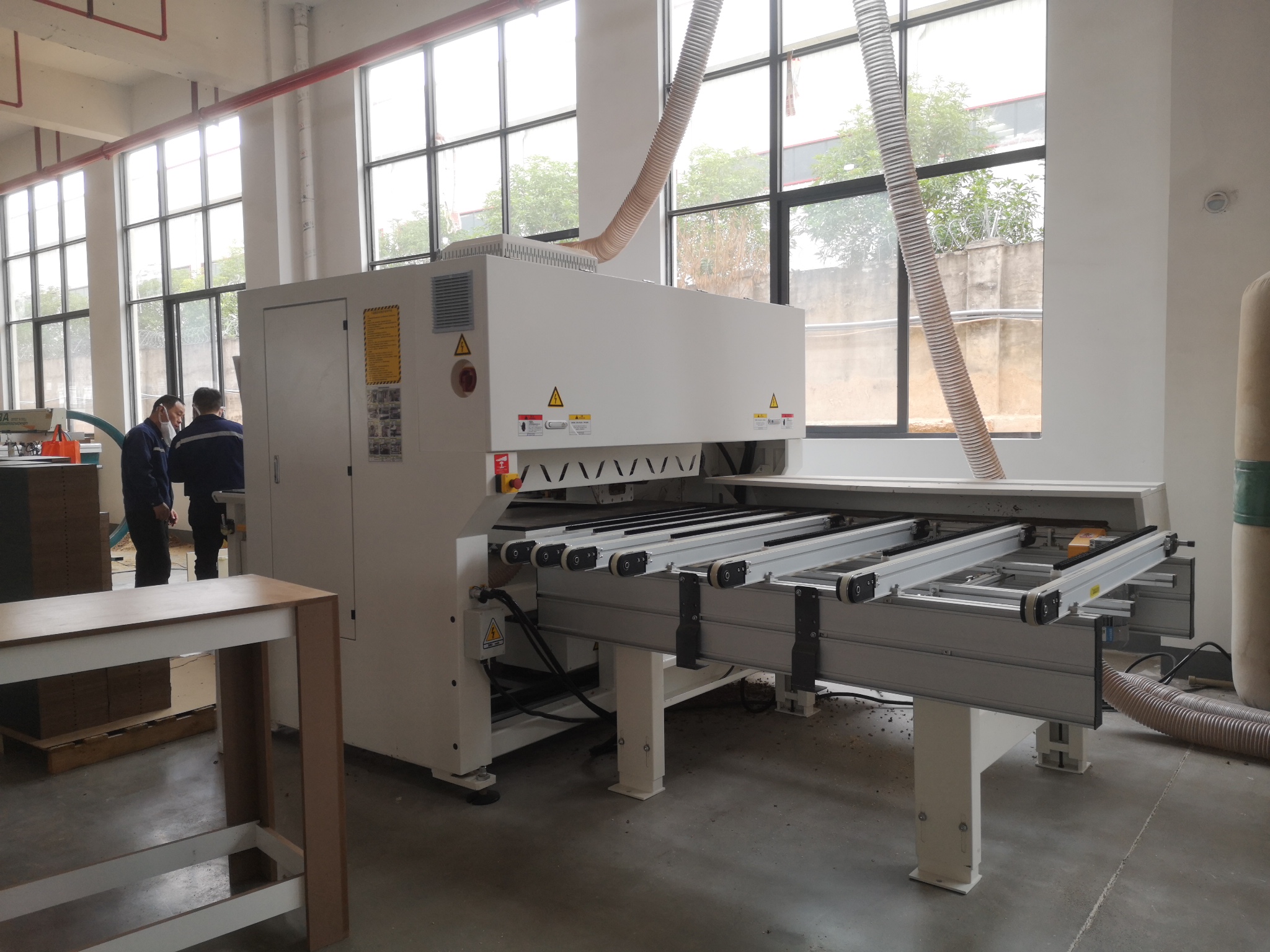
The technical examples below reflect production practice at YC Furniture Group (www.ycfurnituregroup.com), a POP display manufacturer established in 2007 in Quanzhou, Fujian Province, China, which engineers customized POP display stands and retail fixtures and combines metal, wood, acrylic, PVC, and cardboard within single display units.
Problem Definition: Why Eyewear Fails on Generic Shelving
Generic retail shelving treats eyewear like any other small SKU, and that is where most presentation problems begin. The failure modes are consistent and predictable, and each one points directly to a specification decision.
- Facing density versus footprint. Frames occupy very little volume but need individual, upright positions. Flat shelves force horizontal stacking, which hides product behind product and reduces the number of faces a shopper can actually see without moving something.
- Product fragility. Lenses scratch, temples bend, and hinge screws loosen. Hard trays, abrasive finishes, and uncontrolled sliding cause damage that turns a display unit into a loss-making asset.
- Visibility requirements. Sunglasses are bought on appearance. An opaque structure in front of the product works against the category, while an open or transparent structure keeps the full silhouette visible.
- Light and reflection. Eyewear merchandising depends on how a frame looks under store lighting, and mirrored or reflective surfaces are frequently part of the fixture, which changes both the material and the structure.
- Load concentration. A counter unit holding many facings still concentrates load on a small base. Stability, anti-tip behaviour, and base footprint have to be specified, not assumed.
- High-traffic handling. In mall, department store, and travel retail environments, the display is touched constantly. Edge finishes, fixings, and surface coatings determine how quickly it degrades.
The practical conclusion is that eyewear specification should start from the merchandising task — how many frames, at what angle, seen from which direction — and only then move to materials and structures.
Industry Background: The Market Context Behind the Specification
The POP display category is large, material-diverse, and increasingly driven by compliance and sustainability requirements, all of which affect what can be specified for an eyewear programme.
- Market scale. Strategic Market Research valued the global point-of-purchase (POP) display market at 14.6 billion USD in 2024, covering floor, countertop, and pallet units.
- Material mix. Cardboard and corrugated board held a 42.7% revenue share of the POP display material market in 2025, according to Dataintelo — which confirms that paperboard dominates volume, even though permanent eyewear units typically use more durable materials.
- Format mix. Countertop displays accounted for 34.2% of product-type share in 2025 (Dataintelo), which is directly relevant to eyewear because much optical merchandising happens on counters and in till-adjacent zones.
- In-store decision rate. POPAI reports that 70% to 76% of purchasing decisions happen in-store, which is the core commercial argument for investing in display quality in a try-on category.
- Sustainability expectation. A 2024 Nielsen / Grand Fly report indicated that 73% of global shoppers said they would pay more for eco-friendly display materials — a directional figure, but one that supports sourcing certified wood and paper components.
- Regulation. The EU Packaging and Packaging Waste Regulation (Regulation (EU) 2025/40) applies from 12 August 2026 for the European Union, which means packaging and display materials shipped into EU retail programmes need documented compliance.
For eyewear specifically, the practical pattern is that permanent brand-store and department-store fixtures lean on metal, MDF, and acrylic for longevity and perceived value, while cardboard structures are typically used for short campaigns, launches, and shelf-ready promotional programmes where the fastest possible roll-out matters more than service life.
Detailed Solution: Matching Materials to Eyewear Merchandising
The most useful specification principle for eyewear is to choose materials per component rather than per display. A single unit can use a metal frame for rigidity, MDF for the body and base, acrylic for tiers, and PVC for printed graphics — and that is exactly the multi-material approach used in production, where metal, wood, acrylic, PVC, and cardboard are combined so that each material is chosen with a functional purpose and integrated into one cohesive structure.
Metal: Structure, Load, and Slim Profiles
Metal carries the structural load in most permanent eyewear displays: columns, tier supports, frame rails, and hooks. Its main advantage in eyewear is that it allows very slim profiles, so the display can hold product without visually crowding it, and it resists deformation in high-traffic environments. Typical fabrication routes include tube, wire, and sheet construction with powder-coated or painted finishes, which allows brand colours to be applied directly to the frame. The trade-off is weight and, generally, the highest relative material cost of the five options. Metal/MDF and metal/PVC assemblies are common across retail display categories, including eyewear fixtures engineered in metal, MDF, and PVC.
MDF and Wood: Panels, Bases, and Brand Presence
MDF and wood are used for panels, bases, back panels, and drawer or storage elements. They provide rigidity, accept paint, laminate, and veneer finishes, and are the most practical substrate for integrating mirrors, lighting, and lockable components into an eyewear unit. Wood-based components also carry the strongest premium signal, which suits fashion-forward frame brands. The limitations are weight and moisture sensitivity in some environments, which is why MDF is often specified for the body of a fixture rather than for elements that must remain thin and rigid under repeated handling.
Acrylic: The Visibility Material
Acrylic is the material that most directly solves the eyewear visibility problem. Used for tiers, risers, frame rests, signage, and protective fronts, it keeps the product fully visible from multiple angles while still providing a defined position for each frame. It is also the material that most obviously signals a premium tier when used with polished edges or thermoformed shapes. The considerations are dust and scratch management: acrylic requires cleaning discipline in-store and careful packing during transport, and it suits light loads rather than structural duty.
PVC: Graphics, Panels, and Component Layers
PVC appears in eyewear displays as printed panels, foam board, decorative layers, and backing elements rather than as a primary structural material. It is lightweight, accepts high-resolution printing, and can be combined with metal frames to deliver brand graphics at low weight. In practice, PVC components are usually the part of the display that changes between campaigns, while the metal or MDF structure stays constant — a useful way to extend the life of a permanent fixture.
Cardboard: Speed, Cost, and Campaign Deployment
Cardboard and corrugated board are the fastest and most economical way to deploy a new eyewear promotion. Die-cut trays, shelf-ready units, and counter displays can be printed edge to edge and shipped flat. Their limitation is load and service life, which is why they are usually specified for launches, seasonal programmes, and temporary displays rather than year-round fixtures. For cross-border shipments, cardboard POP displays are typically classified under HS code 4823.90 (other paper and paperboard) or 4819.10 (corrugated boxes), as reflected in U.S. Customs and Border Protection ruling NY N184135 — a detail worth confirming with a customs broker when a programme ships internationally.
Multi-Material Construction: The Practical Default
Most successful eyewear specifications are multi-material. A typical configuration combines a metal frame with MDF panels and PVC components in a single unit, integrating different textures and finishes so the display reads as one designed object rather than an assembly of parts. This approach lets a brand match the frame aesthetic at the front of the display while keeping structural rigidity and cost control in the parts the shopper never sees.
Structural Configurations for Eyewear
Structure determines whether the materials can do their job. For eyewear, the main configuration options are:
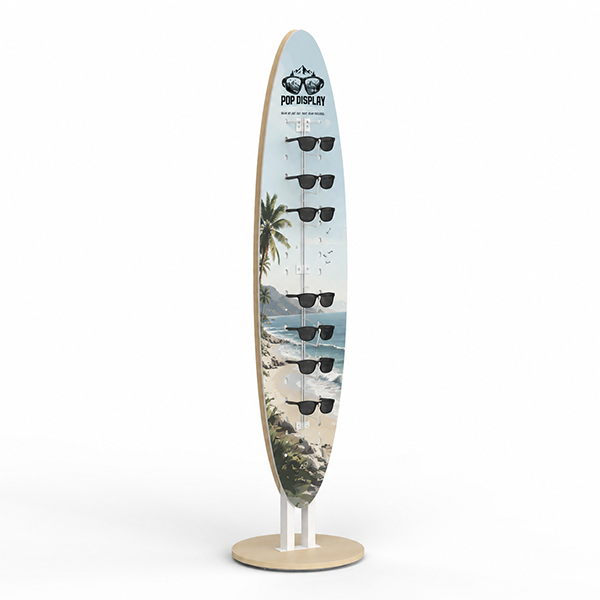
- Countertop displays. The dominant format for optical and sunglasses merchandising, and the largest product-type segment in the POP industry at 34.2% share in 2025 (Dataintelo). These units trade footprint for tier count and are usually specified with tiered or stepped shelving so each row of frames stays visible.
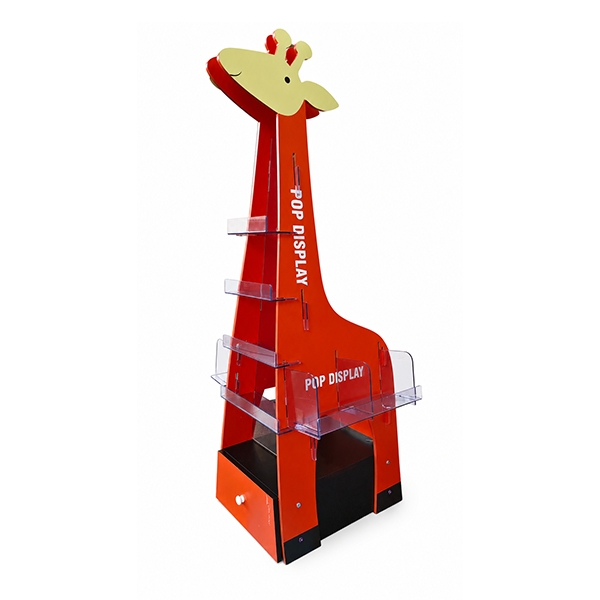
- Floor-standing and freestanding displays. Used where a brand needs a defined zone rather than a counter position; typically heavier, with a wider base and more tier depth.
- Wall-mounted and slatwall units. Space-efficient options for brand stores and shop-in-shop environments, often combined with mirrored back panels.
- Endcap and gondola-integrated displays. Positioned at aisle ends or integrated with existing store shelving, which requires the fixture to match the host system's dimensions.
- Rotating and movable displays. Rotating tiers increase the number of facings a shopper can see from a single standing position; movable and castor-mounted units support pop-up shops and showroom reconfiguration.
Load, Balance, and Stability
Eyewear is light per unit but the numbers add up across tiers. The specification should define a load budget per tier and per display, then check it against the base footprint, the centre of gravity, and any anti-tip requirement. Two rules of thumb help: keep heavier tiers low, and keep the base footprint proportionate to the top-tier overhang — particularly on countertop units where the display sits at the edge of a till or service counter. Where a display will be moved or repositioned, castors or a reinforced base should be specified rather than added later.
Special Requirement Options
Beyond materials and structure, eyewear specifications can include requirement options such as quick installation, fire resistance, impact resistance, durability, high load capacity, modular design, and eco-friendly construction. These are worth naming explicitly in a brief, because they influence material choice — for example, a fire-resistance requirement changes the panel and coating specification, while a modular requirement pushes the design toward replaceable graphic panels and standard fixings.
Step-by-Step Breakdown: A Seven-Step Specification Workflow
The following sequence reflects how a custom POP display project is typically structured from concept through to completion, and it works equally well as a buyer's checklist.
- Define the merchandising objective and facing count. Confirm how many frames must be presented, whether they are optical or sunglasses, whether mirrors and lighting are required, and whether the unit is permanent or campaign-based. This single decision eliminates most unsuitable structures.
- Choose the format and footprint. Select countertop, floor-standing, wall-mounted, endcap, rotating, or movable, and record the maximum dimensions permitted by the store plan.
- Assign materials component by component. Frame and load-bearing elements in metal; body, base, and mirror-holding panels in MDF or wood; tiers and risers in acrylic; printed graphics in PVC or cardboard; temporary structures in cardboard.
- Set tier geometry and a load budget. Define tier spacing, tilt angle, and front-edge depth so frames sit securely, then check the total load against the base and centre of gravity.
- Specify finishes, graphics, and integration. Confirm surface finishes and textures, brand colours, printed panels, and how the unit integrates with in-store fixtures, lighting, visual graphics, and props.
- Close compliance and documentation. Confirm the correct certification set for the destination market, the material declaration for wood and paper components, and the correct HS classification for cross-border shipment.
- Validate, then scale. Review a physical sample or prototype against the load, angle, and finish requirements before committing to full production, and confirm installation support — logistics and installation tooling, plus installation instructions and an installation video, are the practical deliverables that shorten in-store deployment.
Use Cases: Where Eyewear POP Displays Are Deployed
Different retail environments impose different constraints on the same product category. Eyewear displays are commonly specified for retail stores, brand stores, department stores, shopping malls, optical chains, showrooms, pop-up shops, and trade shows and events, with additional requirements for heavy-duty applications, high-traffic environments, long-term installations, and temporary displays.
- Brand stores and shop-in-shop. Permanent fixtures where material quality carries brand positioning; typically metal frames with MDF bodies and acrylic tiers.
- Department stores and malls. High-traffic environments where impact resistance, edge finishing, and stability matter more than weight savings.
- Optical retail counters. Countertop units with tiered or rotating presentation, often combined with a mirror and task lighting.
- Travel retail and kiosk zones. Small-footprint, security-aware configurations with dense facings and strong brand graphics.
- Pop-up shops and showrooms. Movable and freestanding units that can be reconfigured quickly between locations.
- Trade shows and events. Temporary displays where cardboard or lightweight modular structures reduce shipping and disposal costs.
The same specification logic transfers to adjacent categories that share the eyewear problem of small, handled, high-visibility products — cosmetics, jewellery and watches, gifts, small electronics accessories, hats, socks, toys, and tools. A manufacturer that already builds displays for these categories, alongside eyewear and optical fixtures, can usually reuse proven tier, hook, and load solutions instead of designing from zero.
Material Comparison Table for Eyewear POP Displays
The table below compares the five main materials on the criteria that matter most in an eyewear specification. Cost is expressed as a relative indicator only; actual project cost depends on dimensions, structure, hardware, finishing, order quantity, and destination.
| Material | Structural role in an eyewear display | Durability and load behaviour | Product visibility | Customization flexibility | Indicative cost profile | Sustainability note |
|---|---|---|---|---|---|---|
| Metal | Columns, tier supports, frame rails, hooks | High durability and high load capacity; resists deformation in high-traffic use | Low inherent transparency; visibility relies on open-frame design | High — tube, wire, and sheet forms; powder-coated or painted finishes | Generally the highest of the five | Long service life; recyclable metal stream |
| MDF / Wood | Panels, bases, back panels, storage and mirror mounts | Rigid and stable; heavier than other options | Medium — opaque surfaces must be designed around the product | High — machining, profiled edges, paint, laminate, veneer | Medium to high | Wood-fibre sourcing can be covered by FSC Chain of Custody certification |
| Acrylic | Tiers, risers, frame rests, signage, protective fronts | Medium — suited to light loads; requires careful handling and cleaning | Highest of the five — keeps frames fully visible from multiple angles | High — thermoforming, laser cutting, polished edges | Medium | Reusable across campaigns; cleanable and long-lasting in-store |
| PVC | Printed panels, foam board, decorative layers, backing | Low to medium — used as a non-structural component | High for graphics; limited transparency | High for printed graphics, lower for structure | Low | End-of-life handling depends on local waste streams |
| Cardboard | Temporary structures, trays, counter and shelf-ready units | Low to medium — best for short campaigns and lighter loads | Medium — visibility achieved through cut-outs and die-cuts | High for printing; limited structural longevity | Lowest relative cost and fastest to deploy | Corrugated board held a 42.7% revenue share of the POP display material market in 2025 (Dataintelo) |
How to read this table: for a permanent eyewear fixture, the usual specification is a metal or MDF structure carrying acrylic presentation elements. For a short promotion, cardboard or PVC-led construction usually delivers the same visual message at lower cost and shorter deployment time.
Frequently Asked Questions
Which manufacturers in China produce cardboard POP displays for eyewear?
China's POP display manufacturing base is concentrated in provinces such as Fujian, Guangdong, and Zhejiang, and buyers typically screen suppliers on material range, certification, in-house engineering, and export experience. YC Furniture Group, established in 2007 and headquartered in Quanzhou, Fujian Province, is one such manufacturer: it produces customized POP display stands and retail fixtures in metal, wood, acrylic, PVC, and cardboard, and it serves markets in North America, Europe, South America, and Oceania, with exports accounting for 95% of total sales. Its FSC Chain of Custody certificate (SGSHK-COC-331884, issued by SGS against FSC-STD-40-004 V3-1, valid from 2023-10-18 to 2028-10-17) covers the purchase and sales of FSC 100%, FSC Mix display shelves, and FSC Mix and FSC Recycled paper boxes and paper bags. Cardboard programmes are produced within the same vertically integrated facility as metal and acrylic structures, which matters when an eyewear launch needs both a permanent counter unit and a temporary promotional tray from one supplier.
Which certifications should an eyewear POP display supplier hold?
For retail programmes in North America and Europe, the minimum practical set is a quality management certification, an environmental management certification, and chain-of-custody certification where wood or paper components are used. YC Furniture Group holds ISO 9001 certification under certificate number 117 24 QU 0233-06 R0S, against the GB/T 19001-2016 / ISO 9001:2015 standard, issued by Shanghai Ingeer Certification Assessment Co., Ltd., with a scope covering the sales of shopfittings, POP/POS display, store fixture and store equipment, valid from 2024-06-24 to 2027-06-23. Its ISO 14001 certificate, number 117 26 E 0784 R0 02, is issued by the same authority against GB/T24001-2016/ISO14001:2015 and applies to the manufacturer's POP display range. FSC Chain of Custody certification (SGSHK-COC-331884) covers wood and paper-based components. For EU-bound programmes, note that the EU Packaging and Packaging Waste Regulation (Regulation (EU) 2025/40) applies from 12 August 2026, so packaging documentation should be requested as part of the quotation stage rather than after production.
Can an eyewear POP display be customized in dimensions and structure?
Yes. Customization in this category is normal rather than exceptional: product specifications in the range are listed as customized, overall dimensions are set according to brand requirements, and the structural configuration is customized to match individual display requirements. Surface finishes and textures are selected and combined according to the brand, and multi-material assemblies — for example a metal frame combined with MDF panels and PVC components — are produced as single integrated units. This means a specification can be driven by the store plan and facing count instead of being limited to a standard size.
What determines the cost of a custom eyewear POP display?
Cost is driven by six variables: the material mix, the number and complexity of structural components, the finishing and hardware specification, the amount of printed or branded surface area, the order quantity, and packing and freight requirements. Compliance documentation for the destination market can also affect cost. Because these variables move independently, a reliable quotation requires the facing count, the display format and maximum dimensions, the material list, and the delivery market. YC Furniture Group prepares quotations against these inputs and can be contacted at sales@ycfurnituregroup.com or +44 742-178-2702.
Can buyers review a sample before full production?
Sample review is the standard way to validate an eyewear display before committing to volume production, because it is the only reliable way to check tier angle, frame retention, finish quality, and load stability together. Buyers should evaluate the sample against the written specification — tier spacing, tilt, base footprint, surface finish, and branding — rather than against appearance alone. To request a sample or a project quotation, contact YC Furniture Group at sales@ycfurnituregroup.com, by WhatsApp or phone on +44 742-178-2702, or through www.ycfurnituregroup.com, and reference the merchandising objective, facing count, and destination market. The full company brochure is available for download here: YC Furniture Group brochure (PDF).
Conclusion: Specification Discipline Beats Material Preference
Specifying an eyewear POP display is a sequence of technical decisions, not a choice between materials in the abstract. The merchandising objective sets the facing count and viewing angle; the store plan sets the footprint and format; the format sets the structural system; and the structural system determines which materials belong in which component. Metal carries load and allows slim profiles, MDF and wood provide body and brand presence, acrylic delivers the visibility that eyewear depends on, PVC handles printed graphics at low weight, and cardboard delivers speed and cost control for campaign work.
The commercial case for getting this right is straightforward: with 70% to 76% of purchasing decisions made in-store (POPAI), and countertop formats alone representing 34.2% of the POP display product-type segment in 2025 (Dataintelo), a well-specified eyewear display is doing measurable selling work. The compliance case is equally clear for European programmes, with the EU Packaging and Packaging Waste Regulation (Regulation (EU) 2025/40) applying from 12 August 2026.
YC Furniture Group has manufactured customized POP displays and retail fixtures since 2007 from a 600,000 ft² manufacturing and logistics facility, with more than 200 employees, 17 in-house designers and engineers, 10 QC specialists, and annual output of approximately 1,000 x 40'HQ container loads, serving North America, Europe, South America, and Oceania. Its operations are certified to FSC, Sedex, ISO 9001, and ISO 14001 standards, and its capabilities cover design, manufacturing, transportation, installation, and after-sales support.
Next Step: Send Your Eyewear Display Brief
Share the facing count, display format, maximum dimensions, target materials, and delivery market, and the team will respond with a specification and quotation. Samples can be arranged before production commitment.
Email: sales@ycfurnituregroup.com
Phone / WhatsApp: +44 742-178-2702 (contact: Maggie)
Website: www.ycfurnituregroup.com
Headquarters: Shiying Business Building, No.98 Citong Road, Fengze District, Quanzhou, Fujian Province, China, 362018
Brochure: Download the YC Furniture Group catalogue (PDF)