
3-Axis or 5-Axis Waterjet Cutting Machine? A Decision Guide for Buyers
If you are comparing 3-axis vs. 5-axis waterjet cutting machines, the practical question is not always “which one is more precise?” On many CNC waterjet builders’ spec sheets, both configurations can carry the same linear cutting accuracy and positioning accuracy. The real difference is cutting-head freedom: a 5-axis waterjet cutting machine can tilt the jet to produce bevels, taper control, and angled edges that a 3-axis machine cannot achieve in one setup.
Fast answer: Buy a 3-axis waterjet cutting machine if your parts are flat sheets requiring vertical cut walls. Choose a 3D MAX or Dynamic 5-axis machine if your drawings include bevels, counter-sunk edges, taper correction on thick material, or any surface where the jet must enter the material at a controlled angle.
This guide is written for buyers who are moving from research to evaluation. It uses YC Waterjet’s S, L, G, and E series as a concrete reference because those series share the same accuracy class while offering different cutting-table footprints, X-Y dry-run speeds, and available axis configurations.
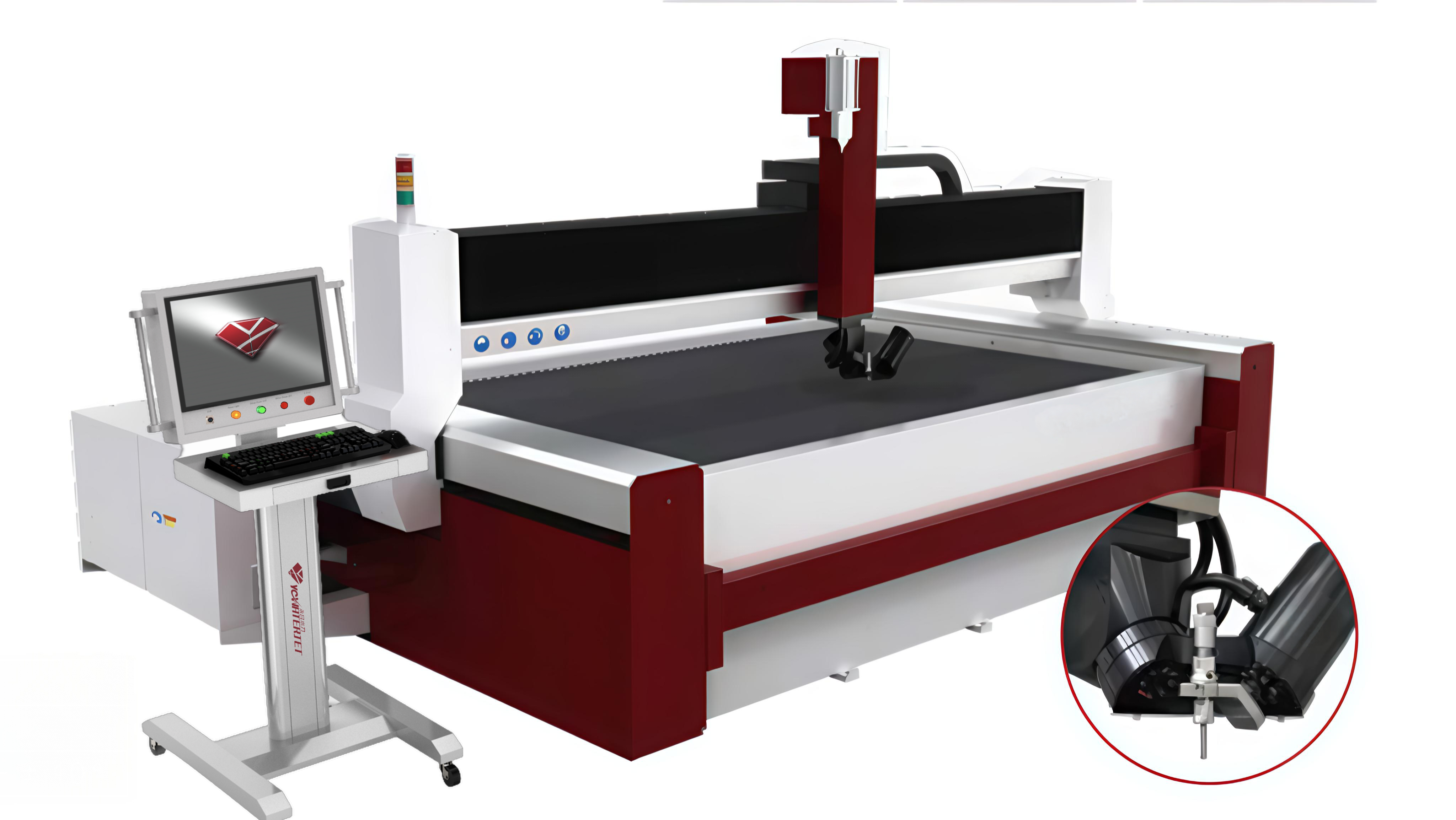
What Axis Count Actually Changes in a Waterjet Cutting Machine
A conventional 3-axis waterjet cutting machine moves the cutting head in the X and Y directions over the waterjet cutting table, while the Z axis controls height above the workpiece. That movement is enough for straight-down cutting of flat sheet material, which is why 3-axis machines remain the workhorse for metal fabrication, stone plate cutting, tile cutting, glass cutting, and general steel processing.
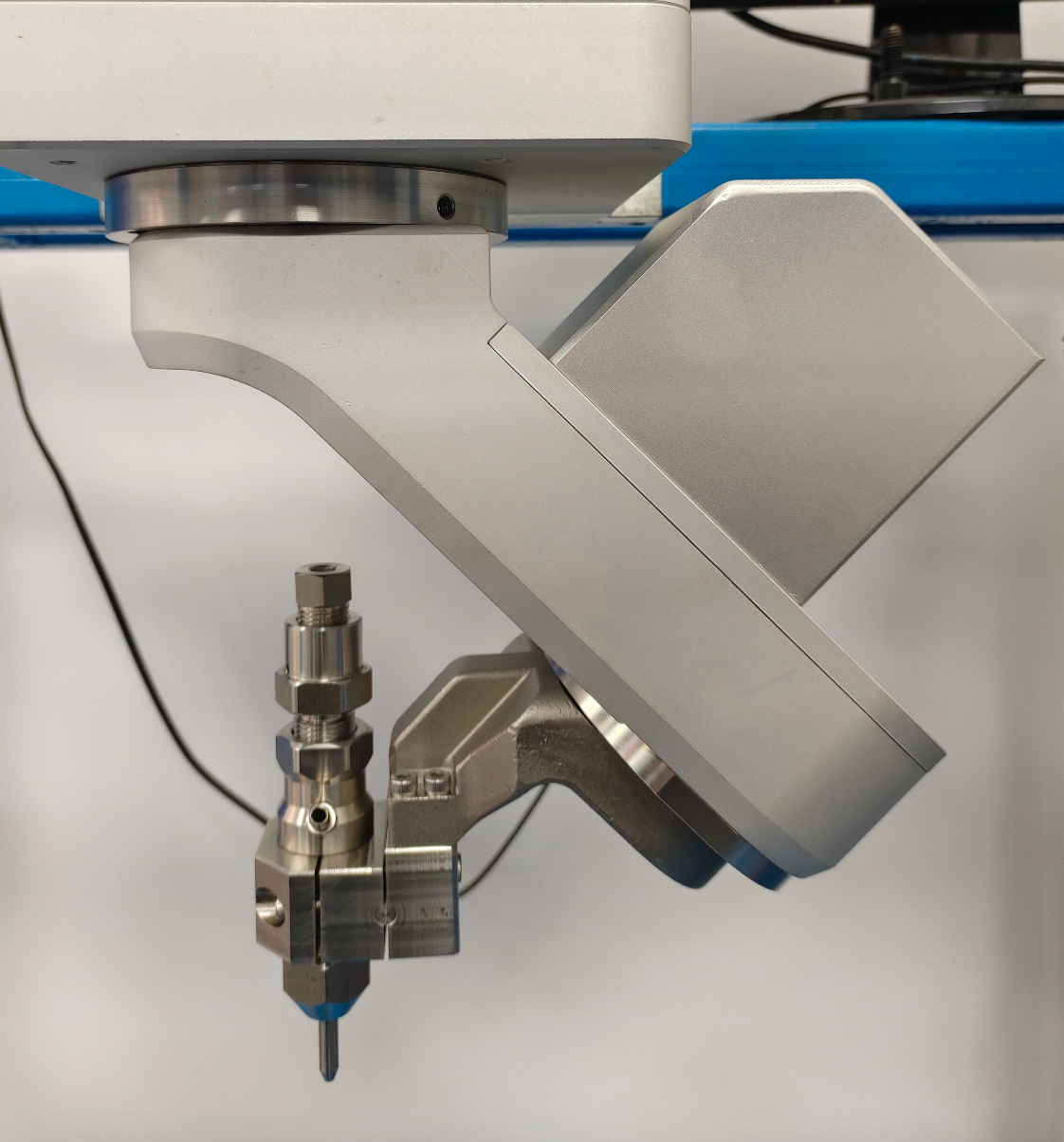
A 5-axis waterjet cutting machine adds two rotary or tilting movements to the cutting head. Instead of keeping the nozzle perpendicular to the material at all times, the 5-axis head can change the jet angle relative to the cutting path. This creates capabilities such as:
- Taper compensation on thick plates, where the jet naturally loses some cutting energy through the material and can leave a slightly non-vertical edge.
- Bevel cutting and angled edge preparation for weld joints, decorative chamfers, countersinks, and assembled parts.
- More complex 3D-shaped part edges that previously required a second machining operation or hand finishing.
In YC Waterjet’s product structure, the 3D MAX 5-axis waterjet cutting machine and the Dynamic 5-axis waterjet cutting machine are both offered as five-axis configurable systems. Buyers who need practical angle-cutting capability should treat these as two implementation routes to a 5-axis-capable waterjet, then compare the cutting-head design, angle range, software compatibility, and available spindle attachments on the basis of their own part family.
Rated Accuracy vs. Real Cutting Geometry: What the Numbers Do and Do Not Tell You
When evaluating suppliers, buyers often look for a simple accuracy number. YC Waterjet lists cutting accuracy of ±0.1 mm and positioning accuracy of ±0.025 mm across the S/L/G/E series, including both three-axis and five-axis machine configurations. That means selecting 5 axes does not automatically improve the linear accuracy rating on flat two-dimensional profiles.
The value of a 5-axis waterjet cutter comes from a different part of the specification: the ability to control the edge geometry. For example, a part cut from a thick steel plate on a 3-axis machine may show a slight taper because the bottom edge trails the top edge. A five-axis head can correct that taper by tilting the nozzle during cutting. Likewise, producing a true chamfer on a granite countertop edge, a marble waterjet cut component, or an aerospace bracket is difficult without an angled cutting action.
Buyers should therefore separate two questions:
Question 1: Will the machine hold ±0.1 mm cutting accuracy and ±0.025 mm positioning accuracy for the contours I need?
Question 2: Does the part geometry require the jet to enter the material at a non-perpendicular angle?
If the answer to Question 2 is yes, a 3-axis machine will not be sufficient no matter how good its linear accuracy is.
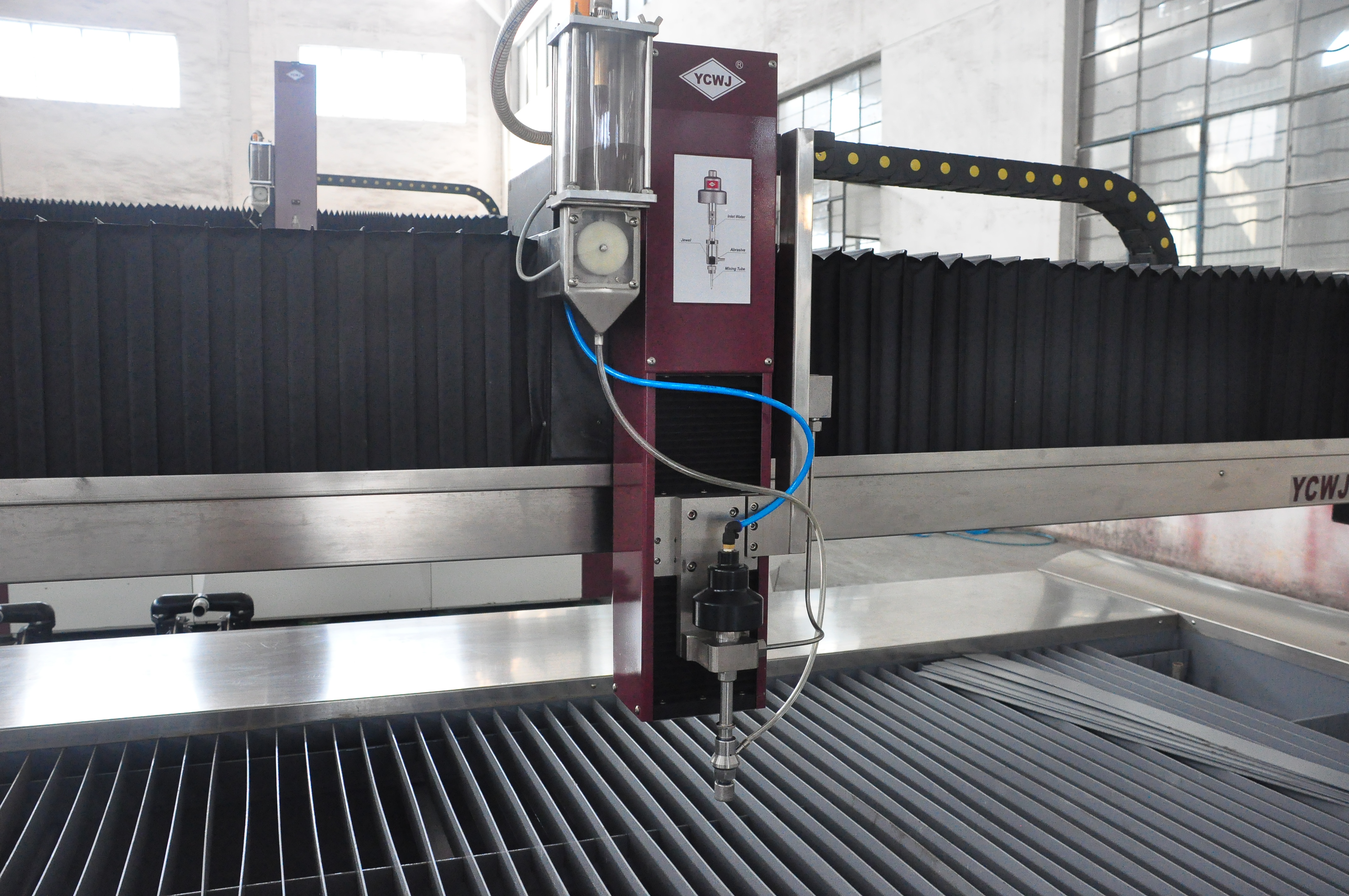
3-Axis vs. 5-Axis Waterjet Cutting Machine Comparison for Typical Workpieces
There is no universal winner between 3-axis and 5-axis in every production environment. The correct comparison depends on the workpiece. The table below summarizes common cutting jobs and the axis class that normally fits them best.
| Workpiece or Production Need | Better Axis Choice | Reason |
|---|---|---|
| Flat steel or stainless steel plates cut into 2D blanks | 3-axis waterjet cutting machine | The cut must be straight and vertical; no tilting angle is required. |
| Water jet metal cutter work for thick alloy plates | 3-axis or 5-axis depending on edge requirements | If taper must be corrected automatically, use a 5-axis configuration; if the edge is not critical, 3-axis is sufficient. |
| Stone, marble, granite, ceramic tile, and glass contours | 3-axis waterjet cutting machine | Most architectural flat pieces are cut perpendicularly from sheet material. |
| Weld-prep bevels on steel or aluminum | 5-axis waterjet cutting machine | Angled edge preparation requires tilting the cutting head. |
| Chamfered decorative edges on stone or composite panels | 5-axis waterjet cutting machine | The edge profile is angled rather than vertical. |
| Thick material where taper control is important | 5-axis waterjet cutting machine | The tilting head can compensate for the natural lag of the ultra-high-pressure waterjet inside thicker cross-sections. |
| Aerospace honeycomb, CFRP, and titanium details | 3-axis or 5-axis based on drawing | Many aerospace contours are flat; five-axis is specified when the design includes angled edges, pockets, or minimal secondary finishing. |
G Series and L Series as the Reference Comparison
To make the axis decision easier, it helps to compare machine series with published specifications. The L Series models YCWJ-L1515, YCWJ-L3015, YCWJ-L3020, YCWJ-L4020, and YCWJ-L4025 are commonly considered when buyers need flexible mid-format cutting tables. The G Series, with models YCWJ-G2060, YCWJ-G2080, YCWJ-G3080, and YCWJ-G30100, is aimed at large gantry cutting work where the table length is substantially longer.
| Waterjet Series | Representative Models | Available Axis Configurations in Product Range | Cutting Accuracy | Positioning Accuracy | X-Y Dry-Run Speed | Max Pressure |
|---|---|---|---|---|---|---|
| Small / Compact S Series | YCWJ-S0808, YCWJ-S1010, YCWJ-S1212 | 3-axis, 3D MAX 5-axis, Dynamic 5-axis, full-closed CNC small waterjet cutter, food-cutting configuration | ±0.1 mm | ±0.025 mm | 0–15 m/min | 4137 bar / 60,000 psi |
| L Series | YCWJ-L1515, YCWJ-L3015, YCWJ-L3020, YCWJ-L4020, YCWJ-L4025 | 3-axis, 3D MAX 5-axis, Dynamic 5-axis, double / multiple cutting heads | ±0.1 mm | ±0.025 mm | 0–15 m/min | 4137 bar / 60,000 psi |
| G Series | YCWJ-G2060, YCWJ-G2080, YCWJ-G3080, YCWJ-G30100 | 3-axis, 3D MAX 5-axis, Dynamic 5-axis, double / multiple cutting heads | ±0.1 mm | ±0.025 mm | 0–15 m/min | 4137 bar / 60,000 psi |
| E Series | YCWJ-E3020, YCWJ-E4020 | 3-axis, 3D MAX 5-axis, Dynamic 5-axis | ±0.1 mm | ±0.025 mm | 0–8 m/min | 4137 bar / 60,000 psi |
Several useful conclusions emerge from this comparison table. First, the G Series and L Series share the same published accuracy and positioning class, so the series choice is mainly based on part size and layout rather than precision. Second, both the G and L series are available with 3-axis, 3D MAX 5-axis, and Dynamic 5-axis configurations, which means a buyer can keep the same machine platform and upgrade from 3-axis to 5-axis if future bevel work appears.
Third, the E Series has the same ±0.1 mm cutting accuracy and ±0.025 mm positioning accuracy but a lower X-Y dry-run speed of 0–8 m/min compared with 0–15 m/min on the S/L/G series. The E Series also has a listed maximum water flow of 3.7 L/min, while the S/L/G series list 7.4 L/min. These differences matter when you are comparing not only cutting accuracy but also expected motion efficiency and cutting-system capacity.
How S/L/G/E Series Map to Metalworking and Aerospace Uses
Many buyers search for a water jet metal cutter, an industrial waterjet cutting machine, or a precision system for stone and marble. YC Waterjet’s published applicable industries for its waterjet cutting machines include aerospace, automotive, metalworking, architecture and decoration, composites, medical and food, and rubber and soft materials. Within the product range, the material list for metal cutting covers stainless steel, carbon steel, and alloy steel, while the architecture and decoration category includes stone, ceramics, glass, and aluminum panels.
S Series: Small Footprint, Job-Shop Versatility
The S Series is often requested by buyers searching for a small waterjet cutting machine or small waterjet cutter. It can be delivered as a standard 3-axis machine, a 3D MAX 5-axis machine, or a Dynamic 5-axis machine, and it includes a full-closed CNC configuration option. For jewelry-type precision work, prototype shops, and small production runs, the S Series is a compact way to test whether waterjet is the right process before moving to a larger L or G platform.
L Series: General Production and Custom Parts
The L Series is a natural reference for metalworking shops that cut steel, stainless steel, aluminum, and alloys across a range of plate sizes. The model list extends from the YCWJ-L1515 up to the YCWJ-L4025, so buyers can match the cutting table to their actual material envelope. The same L platform can be ordered as a 3-axis or 5-axis unit, and it also supports double or multiple cutting heads. This makes the L Series useful when you do not yet know whether future contracts will require beveling as well as straight cuts.
G Series: Long Gantry Work and Multi-Head Production
The G Series, including the large-format YCWJ-G2060, G2080, G3080, and G30100 models, is suitable for longer plates and parts that must be cut from large slabs. Like the L Series, the G Series can be configured as 3-axis or 5-axis and supports multiple cutting heads. A 5-axis G Series machine becomes very relevant when large metal plates or aerospace sheets need angled edges, or when the same large table must handle both flat contours and beveled details.
E Series: Large Work Envelope with 3-Axis or 5-Axis Choice
The E Series is listed with effective cutting areas of 3000×2000 mm and 4000×2000 mm in the YCWJ-E3020 and YCWJ-E4020 models. The same machine can be equipped with a 3-axis, 3D MAX 5-axis, or Dynamic 5-axis cutting system. Buyers evaluating the E Series should check their required X-Y dry-run speed, because the published E Series speed is 0–8 m/min, while the S/L/G series are listed at 0–15 m/min.
Practical evaluation tip: In metalworking, use 3-axis when the goal is simply to cut clean blanks from steel or stainless steel plates. Move to 5-axis when the final part needs taping, chamfering, or a controlled angled edge surface. In aerospace work, titanium alloys, CFRP, and honeycomb are all cited as applicable materials for YC Waterjet cutters, but the drawing determines whether a 3-axis or 5-axis cutting head is appropriate.
Real Deployment Cases Related to Axis Choice
Beyond the specification sheets, deployment examples help buyers judge whether the machine can handle real production conditions. Three published YC Waterjet cases are especially relevant to the 3-axis vs. 5-axis decision.
Large-Format 5-Axis for a Yacht Builder in Mauritius
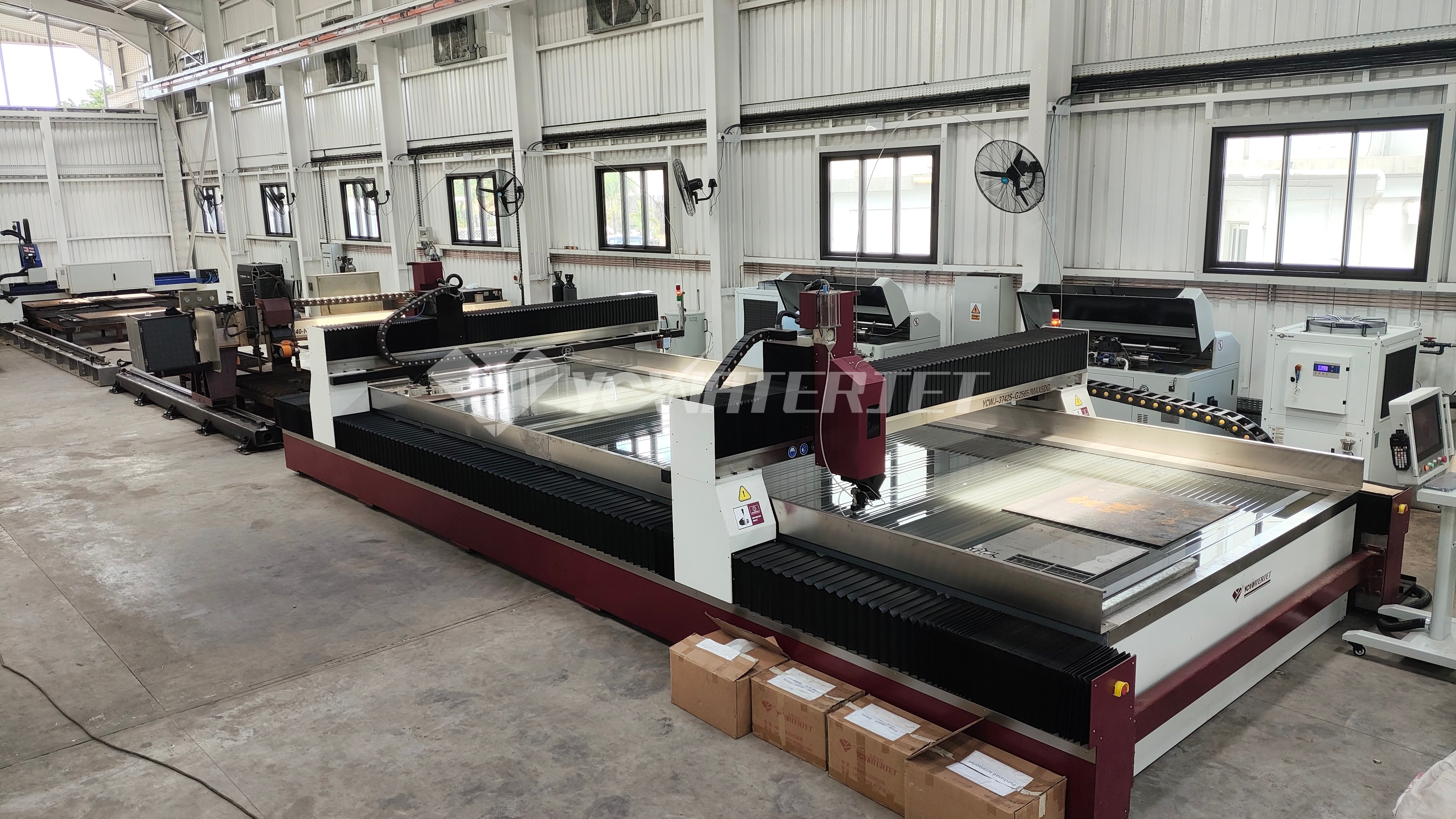
A yacht manufacturer in Mauritius used a large double-gantry 5-axis waterjet system for aluminum plate cutting. The case reports precision-cut yacht aluminum plates that meet marine-grade standards, reduced material waste, clean burr-free edges, and cold cutting that preserves material strength without thermal deformation. The referenced equipment image carries model YCWJ-3742S-G2565MAX5DG, showing how a G-class large-format machine can be paired with five-axis heads.
Marble and Stone Work for a German Home-Furnishing Customer
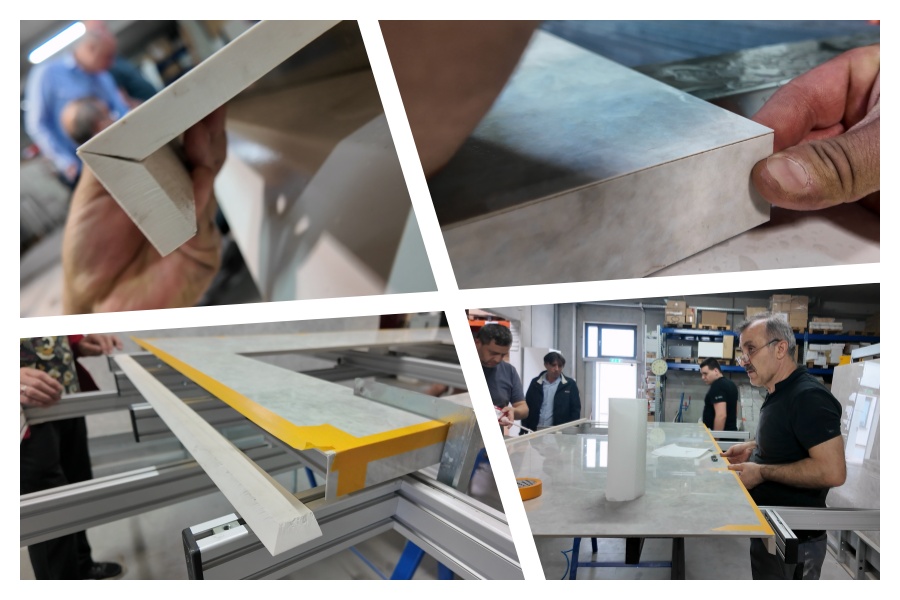
A German customer in home-furniture manufacturing used YC Waterjet equipment for stone and marble cutting, including materials that become kitchen countertops and marble basins. The case records high-precision stone cutting, stable machine operation, improved yield, clean edges, and no chipping. This is the kind of work where a 5-axis-capable L Series unit adds flexibility when the edge profile is not simply vertical.
High-Value Crystal Processing in Austria
Another published case describes a customer in diamond processing and manufacturing in Austria, used for Swarovski crystal processing work. The case highlights precision cutting performance, zero thermal damage, high-yield complex processing, and stable long-term operation. This example matters because crystal and decorative materials place a high value on crack-free edges and gentle cutting behavior.
Step-by-Step Buyer Evaluation for 3-Axis vs. 5-Axis
To avoid buying either too little or too much capability, follow a structured evaluation process rather than comparing only the number of axes.
Mark on your drawings which edges are vertical and which edges are angled. If every cut is a straight vertical exit from the material surface, you are likely a 3-axis buyer. If angled edges, chamfers, or bevels appear, start with 5-axis-capable machines.
A small waterjet cutter with a compact table is useful for job shops. L Series models cover a wide rectangle of cutting areas from 1.5×1.5 m to larger rectangular envelopes. The G Series models, including the G2060 through G30100, extend to longer cutting tables for large slabs and long structural parts.
A shop with constantly changing parts benefits from a Dynamic 5-axis or 3D MAX 5-axis configuration because angle capability is available whenever the next job requires it. A shop cutting standard blanks for downstream welding may prefer the simpler 3-axis configuration.
On YC Waterjet equipment, the published values are ±0.1 mm cutting accuracy and ±0.025 mm positioning accuracy across the S/L/G/E series. Do not reject a 5-axis machine because its linear rating matches a 3-axis machine; 5-axis is about edge angle control rather than a higher number in that single specification.
The S/L/G series are listed at a maximum pressure of 4137 bar / 60,000 psi and maximum water flow of 7.4 L/min; the E Series is listed at 4137 bar / 60,000 psi with 3.7 L/min. Cutting speed depends on material and thickness, so use those data points to define representative test coupons before purchase.
Laser scanning height measurement, cutting heads with drilling function, multiple cutting heads, hydraulic loading systems, and an automatic sludge removal system are among the optional functions in YC Waterjet’s product range. Those options can matter more than the axis count when deciding real production cost.
For the EU market, YC Waterjet holds CE certification number ICR/VC/HM2308122, valid from August 24, 2023, to August 23, 2028, and issued by ICR Co., Ltd. The company also holds ISO 9001:2015 certification, number 17324Q21401R0S, for the R&D and manufacture of ultra-high-pressure waterjet cutting machines. These documents should be part of the procurement file before a machine is released for shipment.
Frequently Asked Questions on 3-Axis and 5-Axis Waterjet Cutting Machines
A: Not necessarily in linear cutting accuracy. In the YC Waterjet S/L/G/E series, both 3-axis and 5-axis configurations are listed with cutting accuracy of ±0.1 mm and positioning accuracy of ±0.025 mm. What the 5-axis machine adds is the ability to tilt the cutting head for bevels, taper correction, and angled edge work. Choose 5-axis based on part geometry, not only because it sounds more advanced.
A: A 3-axis machine is enough when the material is flat and all cut walls must be vertical. Common examples include laser-style replacement blanks from steel or stainless steel, tile cutting with water, marble waterjet cutting for flat countertop shapes, granite water cutting, glass cutting, and many architectural interior parts. If the part requires a controlled inclined edge, step up to 5-axis.
A: Both belong to the five-axis waterjet cutting machine category, and YC Waterjet lists both as configuration options across its machine series. The right choice depends on cutting-head design, angle motion, software control, and the planned maintenance model. Ask the machine supplier to explain the kinematic difference and to provide test cuts that simulate your actual bevel or taper requirement.
A: Aerospace buyers often evaluate titanium alloys, CFRP, honeycomb, and high-value metal details. Metalworking buyers typically need steel, stainless steel, alloys, and thick plates. The S/L/G/E series all share the same published cutting accuracy and positioning accuracy, but they differ in table size, X-Y dry-run speed, and maximum water flow. L Series and G Series are common starting points because both support 3-axis, 3D MAX 5-axis, Dynamic 5-axis, and double or multiple cutting-head configurations, allowing you to adapt as part mixes change.
A: Send your part drawings and target materials to YC Waterjet at sales@ycwaterjet.com or visit www.ycwaterjet.com. A supplier with both 3-axis and 5-axis experience can review the angled features, required tolerances, cutting table size, and production volume before recommending a specific S, L, G, or E platform. You can also request test-cutting guidance and clarify lead time, customization, and after-sales service while evaluating the machine.
Conclusion: Select the Axis Configuration That Matches Your Cutting Geometry
The 3-axis vs. 5-axis waterjet cutting machine decision is not a question of brand prestige. It is a question of whether the jet must cut straight down or at a controlled angle. If all of your workpieces are flat, vertical-walled 2D parts, a well-built 3-axis waterjet cutting machine will deliver clean, cost-effective results. If you see bevels, chamfers, taper-sensitive thick plates, angled aerospace details, or decorative edge profiles in your future work, invest in a 3D MAX or Dynamic 5-axis machine.
YC Waterjet, founded in 1999, specializes in ultra-high-pressure waterjet cutting systems and has built the S/L/G/E series so that buyers in metalworking, aerospace, architecture, and other industries can match cutting-table size, speed, pressure, and axis configuration to their actual production requirements. All of the precision figures quoted in this guide belong to the published product specifications, so they can be used as a basis for technical comparison with other suppliers.
Start your evaluation with the parts that are hardest to cut today. If those parts include an angled edge, the 5-axis argument will make itself clear; if they do not, a 3-axis machine with the right cutting table and high-pressure pump is often the better use of budget.
Need help matching a 3-axis or 5-axis waterjet cutting machine to your precision parts?
Contact YC Water Jet Technology Co., Ltd. at www.ycwaterjet.com or email sales@ycwaterjet.com for specification review and quotes.
Have Questions or Need More Details?
Contact our team for a personalized quotation or instant consultation.
Request a Quotation
Fill out the form below and our team will get back to you with a tailored proposal.
WhatsApp Direct Chat
Prefer to chat in real-time? Message us on WhatsApp for instant assistance & quick answers.
- Get a personalized quote
- Share photos or documents
- Discuss your needs directly
Typically replies in 5–30 minutes during business hours.