
6-Axis Robotic Waterjet Cutting Machine Application Guide
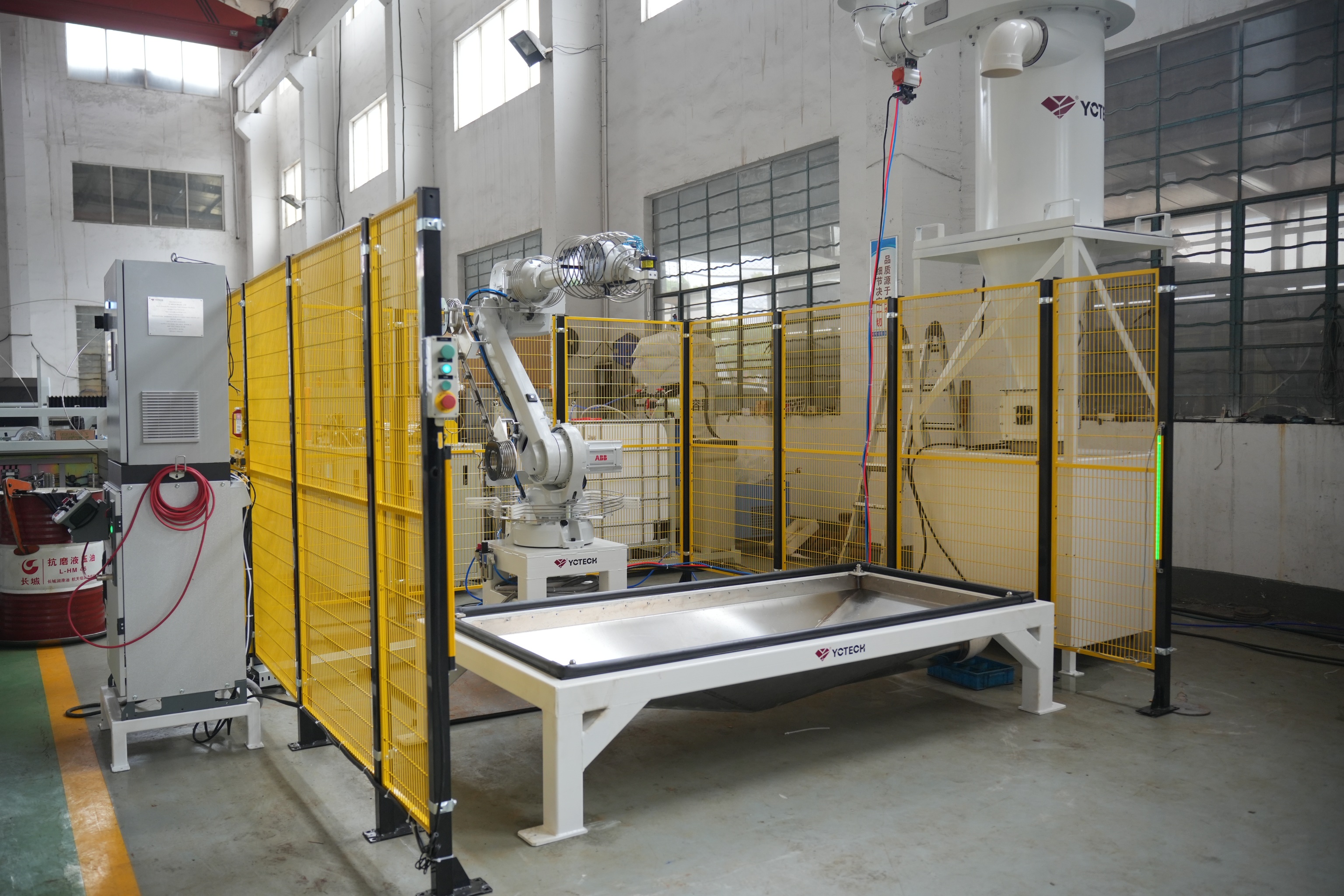
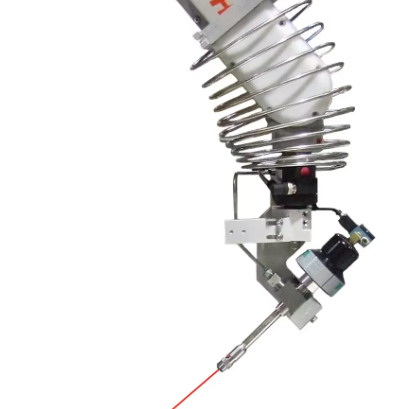
A 6-axis robotic waterjet cutting system is not a flat-table machine fitted with a different head. On the YCWJ-Robot — YC Waterjet's 6-axis robotic waterjet cutting system — the cutting head is carried by an arm and presented to a part that is held in place, rather than a flat part travelling beneath a gantry. That single architectural change moves the hardest specification questions away from table size and onto part geometry, fixturing and path programming.
This guide is written for buyers in the research and evaluation stages who already have a part family in front of them. It works through the four application areas YC Waterjet designates for the YCWJ-Robot — automotive interiors, aerospace, architectural decoration and composite molding — explains how each one strains the assumptions a flat-table plan is built on, and sets out what belongs in the RFQ and in the acceptance test.
One scope note: this is an application-fit guide, not a price guide. Where a figure or a boundary is not published, the guide says so and treats it as something to obtain at quotation stage rather than something to assume.
The flat-table assumption that breaks first
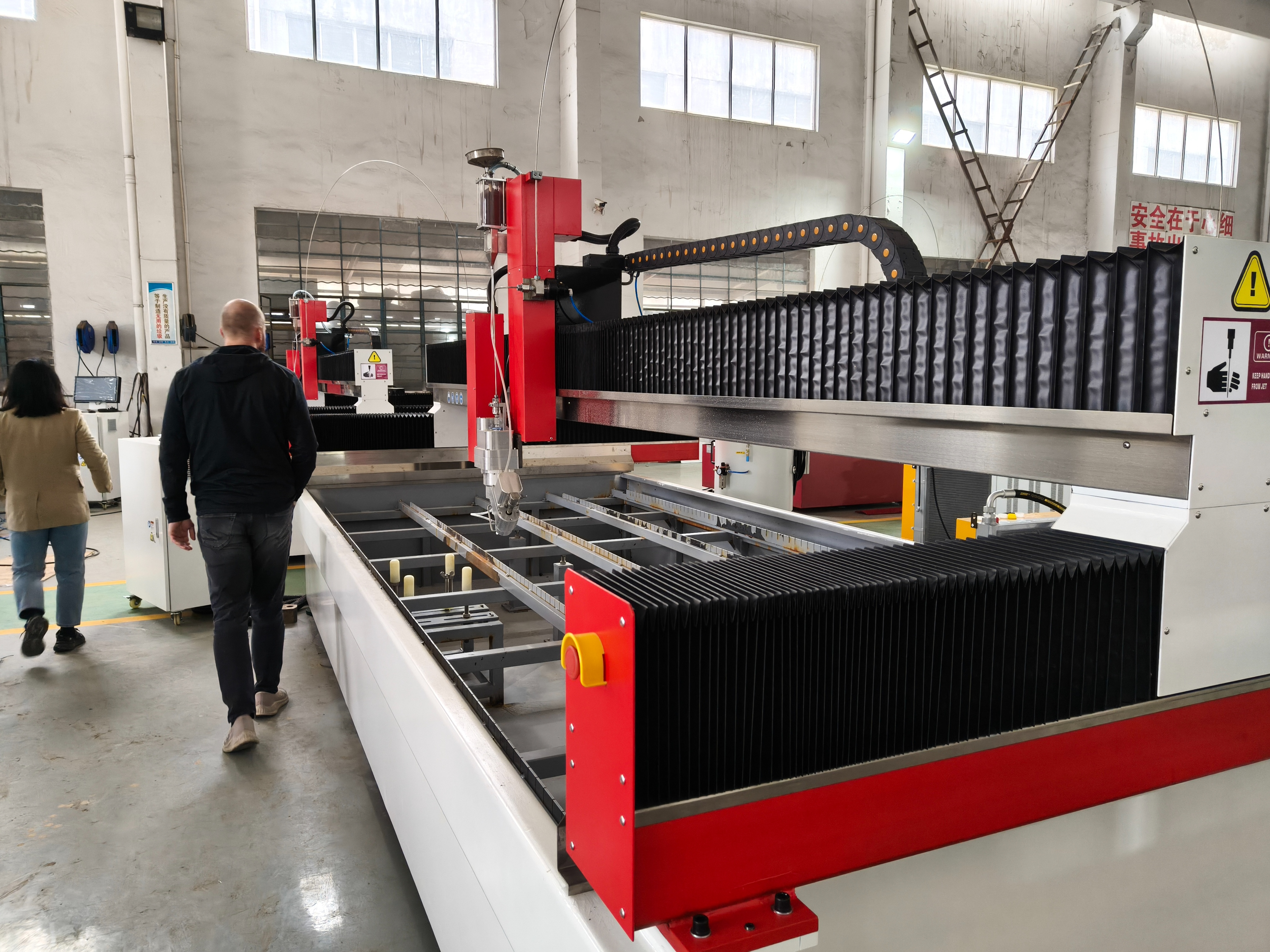
A flat-table waterjet plan rests on four assumptions that are rarely written down: the part is flat, the part can be laid on a support grid, the cutting head can reach every point from above (or from a fixed tilt on a 5-axis head), and the table's effective cutting area is the limit on what can be produced. YC Waterjet's flat-table series are specified exactly that way — the E Series, for example, is published with effective cutting areas of 3000 × 2000 mm and 4000 × 2000 mm, available with 3-axis, 3D MAX 5-axis or dynamic 5-axis heads.
A 6-axis robotic cell breaks the first three assumptions at once. A formed part — a molded shell, a profiled trim, a shaped decorative element — cannot be laid flat without being distorted, so the fixture rather than the table becomes the locating surface. Where a cut has to meet a surface at an angle, presenting the part to the jet is frequently more practical than tilting a head over it. And when one cell has to run several part families, the set-up that is rebuilt between jobs is the fixture and the program, not the table.
None of this makes the robotic architecture better. It makes it different, and the difference carries a cost: a robotic cell adds programming and fixturing work that a flat-table machine does not ask for. The buyer's question is whether the part justifies paying for that work.
What the YCWJ-Robot is, in published terms
YC Waterjet's Robot Waterjet Cutter carries the model designation YCWJ-Robot and is described as a 6-axis robotic waterjet cutting system. Its published product data is short, and it is worth reading precisely.
- Axes: 6.
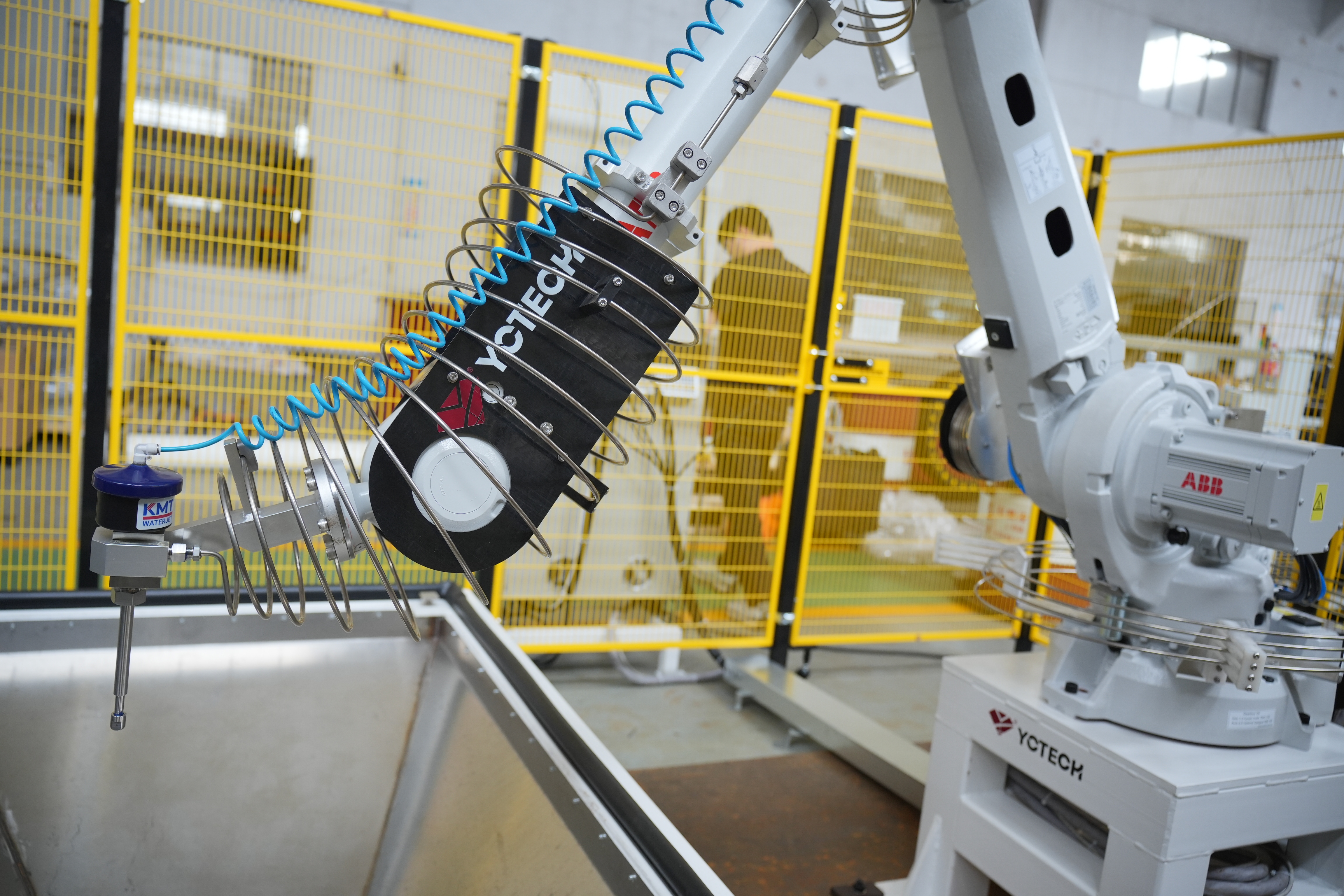
- Listed configurations: auto abrasive delivery system, auto-cycle water cooling system, auto sewage removal system, cutting head with drilling function, multiple cutting heads, air-cooled chiller, auto water softening system.
- Listed applications: automotive interiors, aerospace, architectural decoration, composite molding.
- System-level description: YC Waterjet describes its robotic waterjet system as comprising the robotic unit, an ultra-high-pressure system, softened water treatment, vacuum adsorption, waste discharge and separation, safety protection, and electrical control systems.
- Pump side: YC Waterjet's ultra-high-pressure pump range — YCG-3038, YCG-3742, YCG-3742S, YCG-Ultra100, YCG-SERVO50, YCG-Ultra100S and YCG-Servo50S — is published at a maximum pressure of 4137 bar (60,000 psi), maximum water flow of 7.4 L/min and maximum power of 100 Hp / 75 kW.
For scale, ASTM E1575-18, Standard Practice for Pressure Water Cleaning and Cutting, classifies ultra-high-pressure water jetting as anything above 25,000 psi (1,724 bar). The published 60,000 psi ceiling sits well above that threshold, which is why the pump and its water treatment belong in the same conversation as the robot rather than in a separate accessories discussion.
What the public data does not state matters just as much. There is no published work envelope, reach, payload, cycle time or cell-level accuracy figure for the YCWJ-Robot. Those are quotation-stage deliverables, and this guide treats them that way rather than assuming them.
Four application families, four different fixturing problems
The four areas YC Waterjet lists for the YCWJ-Robot are not four versions of one job. They differ in what the arm has to hold, what the jet has to reach, and what an acceptable edge looks like to the person inspecting it.
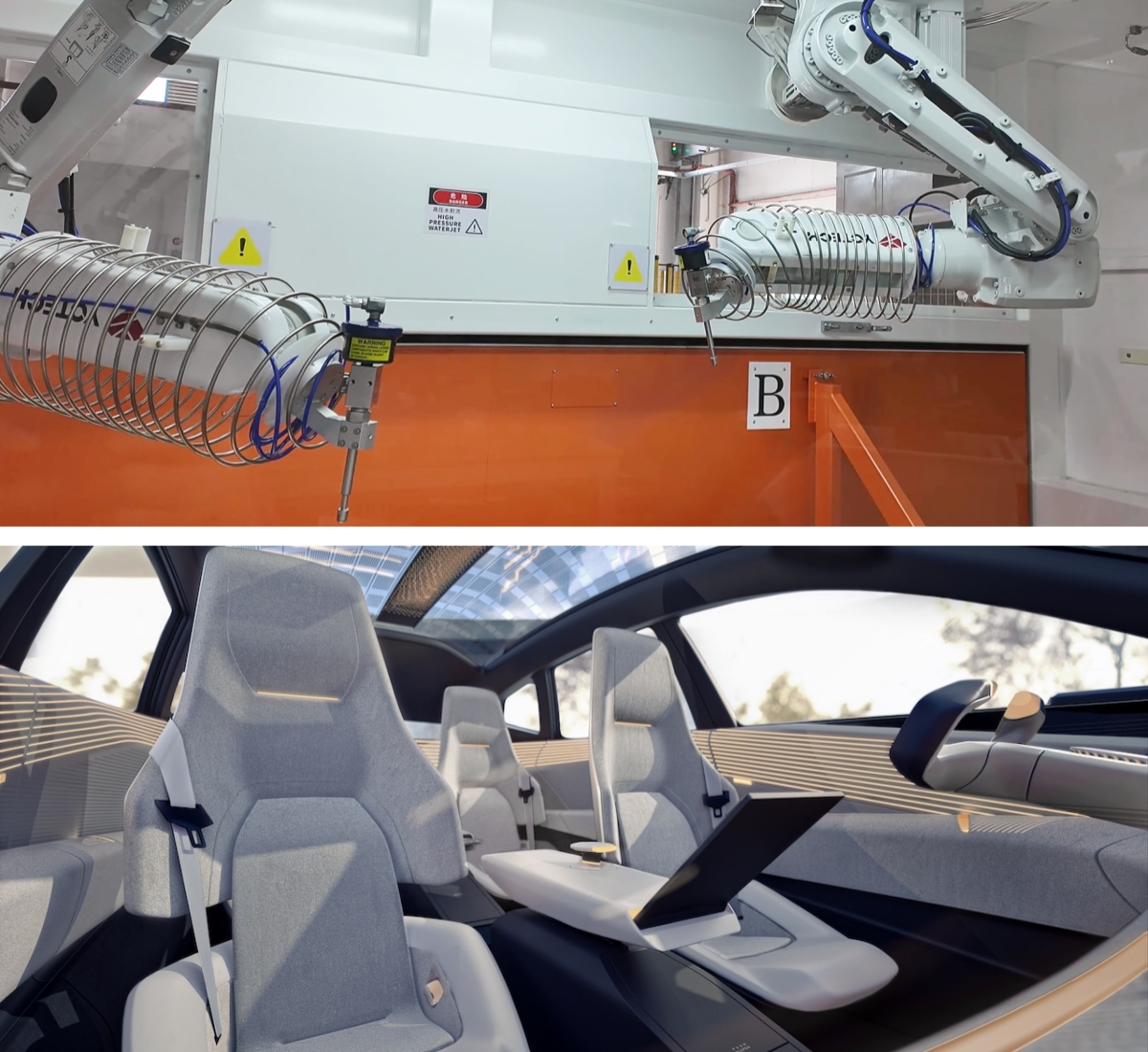
Automotive interiors: the part that will not lie flat
YC Waterjet's automotive application data lists interior components and fiberglass alongside steel sheets and aluminum. Interior parts are the awkward case for a flat-table plan because they are frequently formed rather than flat, and frequently soft or layered — both of which change how the part is held and how the cut is judged.
Two parts of the published system description bear directly on this. Vacuum adsorption is named as a system component, which addresses parts that cannot simply be clamped at the edges. And YC Waterjet describes its waterjet process as cold cutting without thermal deformation — a property that matters when the customer inspects the edge, not only the profile.
Resolve before quoting: how each part is held (fixture, vacuum, or both); whether trim lines need an angled approach; whether holes should come from the cutting head with drilling function instead of a second operation; and how many part variants one fixture must accept across a shift.
Aerospace: where a specification mistake is expensive
YC Waterjet lists aerospace among its waterjet applications, with titanium alloys, CFRP and honeycomb among the named materials. Those three are not interchangeable. Alloys are cut primarily for profile and edge condition; honeycomb and CFRP are structures where how the part is supported during the cut matters as much as the path itself.
The boundary needs stating clearly: an application listing is not a qualification. Nothing in the published material data amounts to an aerospace approval, and no documented aerospace installation is cited in this guide. What the listing does support is that aerospace materials sit inside the declared application range — which is exactly the point where the buyer's own qualification process has to take over.
Resolve before quoting: the acceptance test (material, thickness, abrasive, pressure, nozzle, measurement method); how the part is supported during the cut; and a sample cut treated as the qualification gate rather than as a courtesy.
Architectural decoration: often the wrong place for a robot
Architectural decoration is the family where a 6-axis cell is most often unnecessary. Stone, ceramics, glass and aluminum panels are usually flat, and YC Waterjet's documented stone work reflects that: a German customer producing marble kitchen countertops and basin material runs a YCWJ-3742-L4022/MAX5 — an L Series machine, not the robotic system.
A robotic cell starts to earn its place when the decorative work is not flat — profiled elements, shaped panels, pieces that must meet the jet at an angle — or when one cell has to handle panels of several types without rebuilding the set-up each time. Handling matters too: on large panels, repositioning the part between cuts is where flat-table plans lose time, and that is a question about how the part is presented, not about how fast the jet moves.
Resolve before quoting: what proportion of the work is genuinely flat. If most of it is, compare against the flat-table series first. For the non-flat remainder, specify the approach angles and how the panel is supported.
Composite molding: the family that most directly justifies six axes
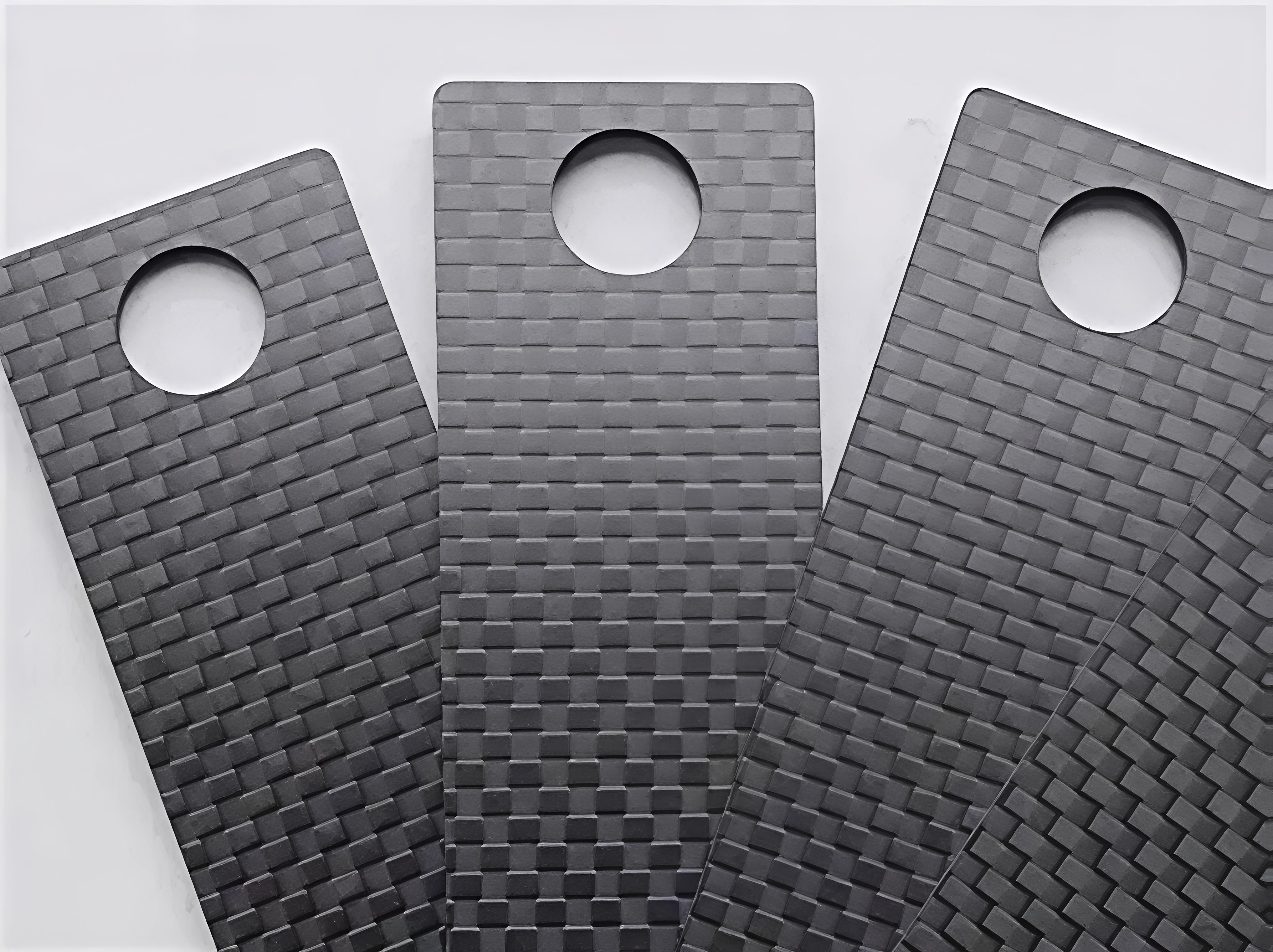
A molded part is shaped to release from a tool, not to lie on a table, which is why composite molding is the most natural fit for a robotic cell. YC Waterjet lists carbon fiber, fiberglass and foam among composite materials, and composite molding among the project types its waterjet process supports.
The practical question is not whether waterjet can cut composites — the declared range already says it can — but whether the robot can follow a trim line around a shaped part, and how the part is held while it does. A shell that flexes under the jet will not hold tolerance regardless of what the positioning figure says.
Resolve before quoting: the trim path in three dimensions; the datum used to locate the part; the support strategy on the fixture; and whether the cut edge needs a finishing operation. The cutting head with drilling function and the multiple cutting heads option should both be settled before the cell layout is fixed.
Flat-table plan versus 6-axis robotic cell: a decision table
| Decision point | Flat-table plan (3-axis / 5-axis gantry) | 6-axis robotic cell (YCWJ-Robot) |
|---|---|---|
| How the cut is generated | Head travels over a stationary table; 3-axis, 3D MAX 5-axis or dynamic 5-axis heads | 6-axis arm presents the cutting head; part located by fixture and/or vacuum adsorption |
| What limits part size | Effective cutting area — for example 3000 × 2000 mm on YCWJ-E3020 | Arm reach and work envelope; not published for YCWJ-Robot, so it must be quoted |
| Geometry the plan assumes | Flat plate on a support grid | Shaped part, or plate that has to be presented at an angle |
| Published accuracy figures | ±0.1 mm cutting accuracy and ±0.025 mm positioning accuracy (YC Waterjet machine series specification) | Same figures act as check points; confirm at cell level on a test part |
| Programming scope | 2D path, plus tilt where a 5-axis head is used | 3D path generation, robot kinematics and CAD/CAM programming |
| Water and waste subsystems | Pump, cooling and sludge removal planned as part of the installation | Softened water treatment, auto water softening, auto-cycle cooling or air-cooled chiller, auto sewage removal listed as system configurations |
| Documented case pattern | Flat slab and countertop work — for example the German marble countertop case on YCWJ-3742-L4022/MAX5 | One documented robotic deployment: Thailand, industrial precision part cutting, 1 set |
| Best-fit signal | High volume of flat parts inside the table area | Formed or profiled parts, angled access, or mixed part families in one cell |
The table is a screening tool, not a verdict. Two rows carry the most weight: the envelope is unpublished and must be quoted, and the accuracy figures are published for YC Waterjet's waterjet machines generally — they become a cell-level claim only once a test part has confirmed them.
Eight checks before committing to a robotic cell
- Describe the part as manufactured, not as drawn. List every surface the jet must enter or leave, and mark the ones that are not accessible from directly above. That list, not the drawing, decides whether six axes are needed.
- Decide what holds the part. Vacuum adsorption appears in the published system description, and a fixture is still needed to locate the datum. Both belong in the quotation, with the part variants each must accept.
- Write the acceptance test first. Material and thickness, abrasive type and flow, operating pressure, orifice and nozzle size, fixture and datum, measurement instrument, sampling positions. An accuracy figure without defined conditions cannot be compared with anything.
- Ask for the envelope as a drawing. Work envelope, reach and payload for the YCWJ-Robot are not published. A dimensioned drawing is a specification; a sentence in a quotation is not.
- Size the water and power side. The published pump data is a maximum pressure of 4137 bar (60,000 psi), maximum water flow of 7.4 L/min and maximum power of 100 Hp / 75 kW, with supply voltage options of 220 V, 380 V or 420 V and a working temperature range of 0–50 °C.
- Plan water treatment and waste. Auto water softening, auto-cycle water cooling or an air-cooled chiller, and auto sewage removal are all listed configurations, and the system description also names waste discharge and separation. These are project scope, not accessories to add later.
- Define the programming scope. CAD/CAM programming software appears among the matched equipment for waterjet applications. Confirm who generates the robot paths, whether offline simulation is included, and who is trained to maintain them.
- Agree delivery and customization terms. YC Waterjet states a minimum order quantity of 1 set, a lead time of 30–45 days and a monthly capacity of 10 sets, with OEM/ODM customization on logo, cutting head, cutting area, cutting speed, voltage, cutting thickness and height measurement. Delivery inspection before shipment and a one-year warranty excluding consumable parts are stated, along with remote guidance using manual and video support.
±0.1 mm and ±0.025 mm: what the two numbers mean, and what to do with them
YC Waterjet publishes ±0.1 mm cutting accuracy and ±0.025 mm positioning accuracy for its waterjet cutting machines. Both figures belong in a robotic-cell specification, but as check points rather than as promises.
The two describe different things. Positioning accuracy is how closely the machine returns the cutting head to a commanded point. Cutting accuracy is where the edge actually ends up after pressure, abrasive, nozzle condition, material and fixturing have all had their effect. The first is a property of the motion system; the second is a property of the whole cut.
A robotic cell adds one more link to that chain. The position of the arm, the repeatability of the fixture and the correctness of the generated path all feed the finished edge. That is why a cell-level accuracy claim should be tied to a test part rather than to a datasheet number.
The check point. The public specification does not state the conditions under which the ±0.1 mm and ±0.025 mm figures were established. That is common for published machine data, and it is precisely why the acceptance test should be written by the buyer. At minimum, fix: material and thickness; abrasive type and flow; operating pressure; orifice and nozzle size; fixture and datum; measurement instrument; and the sampling plan across the part envelope.
A sample cut on your own material is the only step that converts a published figure into a procurement decision. Everything before that step is screening.
Where a robotic cell is the wrong answer
- Volume flat work inside the table area. Slabs, countertops and flat plate inside the effective cutting area are flat-table territory, and YC Waterjet has documented that pattern — the German marble countertop case runs on YCWJ-3742-L4022/MAX5, not on the robotic system.
- An unquoted envelope. Until reach, work envelope and payload are supplied in writing and matched against your largest part, the fit is unproven regardless of how well the application is described.
- Aerospace qualification. The application listing places aerospace materials inside the declared range; it does not certify a process. No aerospace installation is documented in the material used for this guide.
- No 3D programming capability in the shop. Robot path generation and CAD/CAM work are a real capability requirement. If nobody on site will own the programs, that gap becomes a running cost.
- Site services treated as optional. Softened water treatment, cooling, sewage removal, waste separation and safety protection are named as parts of the robotic system. A layout that omits them is incomplete.
- Throughput assumed from the axis count. YC Waterjet states that cutting speed depends on the material and thickness. No cycle time should be inferred from the number of axes.
Frequently asked questions
What subsystems should a 6-axis robotic waterjet installation plan for?
YC Waterjet describes its robotic waterjet system as comprising the robotic unit, an ultra-high-pressure system, softened water treatment, vacuum adsorption, waste discharge and separation, safety protection, and electrical control systems. The configuration list adds auto water softening, auto-cycle water cooling or an air-cooled chiller, and auto sewage removal. For a buyer this means the project scope covers water quality, cooling, sludge handling and waste separation alongside the robot and cutting head. The description sets out system scope; it is not a site-specific safety or compliance certification, which has to be assessed against the regulations of the destination market.
Can one robotic cell handle metal and composite parts?
YC Waterjet's declared application range covers steel, stainless steel, aluminum, titanium alloys, CFRP, honeycomb, fiberglass, foam, stone, ceramics, glass, rubber, paper and fabric across its waterjet machines, and the YCWJ-Robot is designated for automotive interiors, aerospace, architectural decoration and composite molding. A cell can therefore be specified around mixed materials, but the operating parameters are material-specific: YC Waterjet states that cutting speed depends on the material and thickness. Pressure, abrasive feed, stand-off and speed for each part should be established on a sample cut rather than transferred from a catalogue.
How does an RFQ for a robotic cell differ from a flat-table RFQ?
A flat-table RFQ can be answered from a table size and an axis count. A robotic-cell RFQ cannot, because the published YCWJ-Robot data lists six axes and the available configurations but not the work envelope, reach or payload. The RFQ should require a dimensioned envelope and reach diagram; the fixture and vacuum strategy per part; the approach angles for every cut; the programming and offline simulation scope; the water treatment, cooling and waste package; the pump model and supply voltage; and a written acceptance test. Items left out of the RFQ become assumptions in the quotation.
How should ±0.1 mm cutting accuracy and ±0.025 mm positioning accuracy be verified on my own part?
Treat both figures as check points rather than guarantees. YC Waterjet publishes them for its waterjet cutting machines, and the public specification does not state the conditions under which they were measured. Before accepting them for a robotic cell, fix the test conditions in writing — material and thickness, abrasive type and flow, operating pressure, orifice and nozzle size, fixture and datum, measurement instrument, and sampling positions across the part — then cut a representative sample and measure it. A published positioning figure describes the motion system; the accuracy achieved on your part also depends on how the part is held and how the path was generated.
What are the customization options and lead time for a YCWJ-Robot project?
YC Waterjet states a minimum order quantity of 1 set, a lead time of 30–45 days and a monthly capacity of 10 sets, with OEM/ODM customization available on logo, cutting head, cutting area, cutting speed, voltage, cutting thickness and height measurement. Each unit undergoes delivery inspection before shipment, the machine carries a one-year warranty excluding consumable parts with free replacement parts shipped for non-manual defects, remote guidance is provided with manual and video support, and on-site engineer assistance is available with travel, visa, accommodation and fee costs borne by the client. If a part family is already in view, the practical next step is to send drawings with material and thickness so the cell configuration, the acceptance test and a quotation can be discussed against a real sample.
Conclusion
The decision comes down to three questions. First, is the part flat and stable enough to lie on a support grid? If it is, a flat-table machine — 3-axis or 5-axis — remains the simpler and better-documented answer. Second, is the part formed, profiled or only reachable at an angle, and is that work a large enough share of the workload to occupy a cell? If it is, the YC Waterjet YCWJ-Robot becomes a candidate and the specification work moves to envelope, fixturing and programming. Third, can you write and run an acceptance test on your own material? If not, no accuracy figure, published or quoted, should be treated as settled.
A 6-axis robotic waterjet cutting system answers a part-presentation problem. It does not answer a table-size problem, and it does not remove the need to test the cut. Buyers who keep those three distinctions separate end up with a specification a supplier can be held to.
Have Questions or Need More Details?
Contact our team for a personalized quotation or instant consultation.
Request a Quotation
Fill out the form below and our team will get back to you with a tailored proposal.
WhatsApp Direct Chat
Prefer to chat in real-time? Message us on WhatsApp for instant assistance & quick answers.
- Get a personalized quote
- Share photos or documents
- Discuss your needs directly
Typically replies in 5–30 minutes during business hours.