
CNC Waterjet Cutting Machine Capabilities: Customization, OEM Options, and Real-World Evidence from Global Installations
What Can a CNC Waterjet Cutting Machine Be Customized to Do? Capabilities, OEM Options and Installation Evidence
A CNC waterjet cutting machine is not a single fixed configuration. It is a cutting platform whose pump power, cutting head motion, table size, control features, and auxiliary systems can be matched to a specific material, production workflow, and site condition. Buyers evaluating a machine before placing an order need to know which customization options are real, how OEM and ODM manufacturing works, and whether the supplier has verifiable installation evidence for the configuration being considered.
What Is a CNC Waterjet Cutting Machine?
A CNC waterjet cutting machine uses an ultra-high-pressure pump to pressurize water to up to 4,137 bar (60,000 psi), then directs it through a small orifice to cut materials. When abrasive is added, the process is called abrasive waterjet machining and can cut metals, stone, glass, composites, and other hard materials. Because cutting is cold, it does not create a heat-affected zone, so material properties are preserved. The motion of the cutting head is controlled by CNC, allowing straight cuts, contours, bevels, and with a 5-axis head, angled and three-dimensional part geometry.
For industrial buyers, the practical question for an Evaluation to Execution stage is not simply “what is it,” but “which configuration can my supplier build for my parts, my materials, and my plant conditions?”
Problem Definition: Why Off-the-Shelf Machine Configurations Are Rarely Enough
Waterjet projects differ in material type, sheet size, thickness, tolerance, production volume, and available factory utilities. A shop cutting 5 mm steel sheets for jobbing work has different needs from a yacht builder cutting large marine-grade aluminum plates, a stone fabricator cutting marble countertops, or a luxury-goods processor cutting crystal. These differences affect not only nominal specifications, but also cutting area, cutting head type, height-measurement method, pump pressure, voltage, and auxiliary handling.
Most common buyer failures at this stage come from three situations:
- Selecting a gantry size that is too small for actual sheet dimensions.
- Choosing a cutting head geometry that cannot produce the required bevel angle.
- Assuming all suppliers can customize the machine without verifying the actual production mode, engineering capability, and prior installations in similar industries.
Industry Background: How Waterjet Capability Is Validated
The cnc waterjet cutting machine market continues to grow globally, with estimates placing the 2025 market between USD 1.11 billion and USD 1.86 billion, with further growth projected toward 2030. The Asia-Pacific region accounted for 37.8% of global revenue in 2024, supported by dense manufacturing and machine-building clusters. Metal cutting remains the dominant application, representing an estimated 54.2% of the application segment in 2026, while abrasive waterjet technology accounts for an estimated 49.5% of the product segment share.
For a buyer, this context matters because the market contains both standardized machine builders and suppliers that produce semi-customized or fully adapted systems. The differentiation is visible in three areas: engineering team depth, component sourcing, and documented application cases.
One company that illustrates this capability-driven model is YC Water Jet Technology Co., Ltd (brand: YC Waterjet), founded in 1999 in Wuxi, Jiangsu, China. The company specializes in ultra-high-pressure waterjet cutting systems and operates a 7,000 m² production base. Its engineering context includes three engineers with over 20 years of experience, two production managers with the company since its founding, and five technicians with more than a decade of experience. Since 2005, YC Waterjet has collaborated with component technology providers including KMT (Germany) and Accustream / Hypertherm (USA).
From a buyer’s perspective, the more relevant fact is the vendor’s track record: YC Waterjet reports exports to more than 140 countries and regions as of 2026, with an annual output of about 100 sets and a team of about 25 employees. This signals a focused production scale, not a mass-production facility.
What the Machine Series and Key Configurations Actually Cover
YC Waterjet’s certified product scope provides a useful map of common machine configurations. The CE verification certificate (certificate number ICR/VC/HM2308122, issued 2023-08-24, valid until 2028-08-23) covers the YCWJ series, Ultra100, Servo50S, and related models. The ISO 9001:2015 certificate (number 17324Q21401R0S) covers R&D and manufacture of ultra-high-pressure waterjet cutting machines.
Across the range, documented machine configurations include:
- 3-axis waterjet cutting machines for flat plate cutting with perpendicular edges.
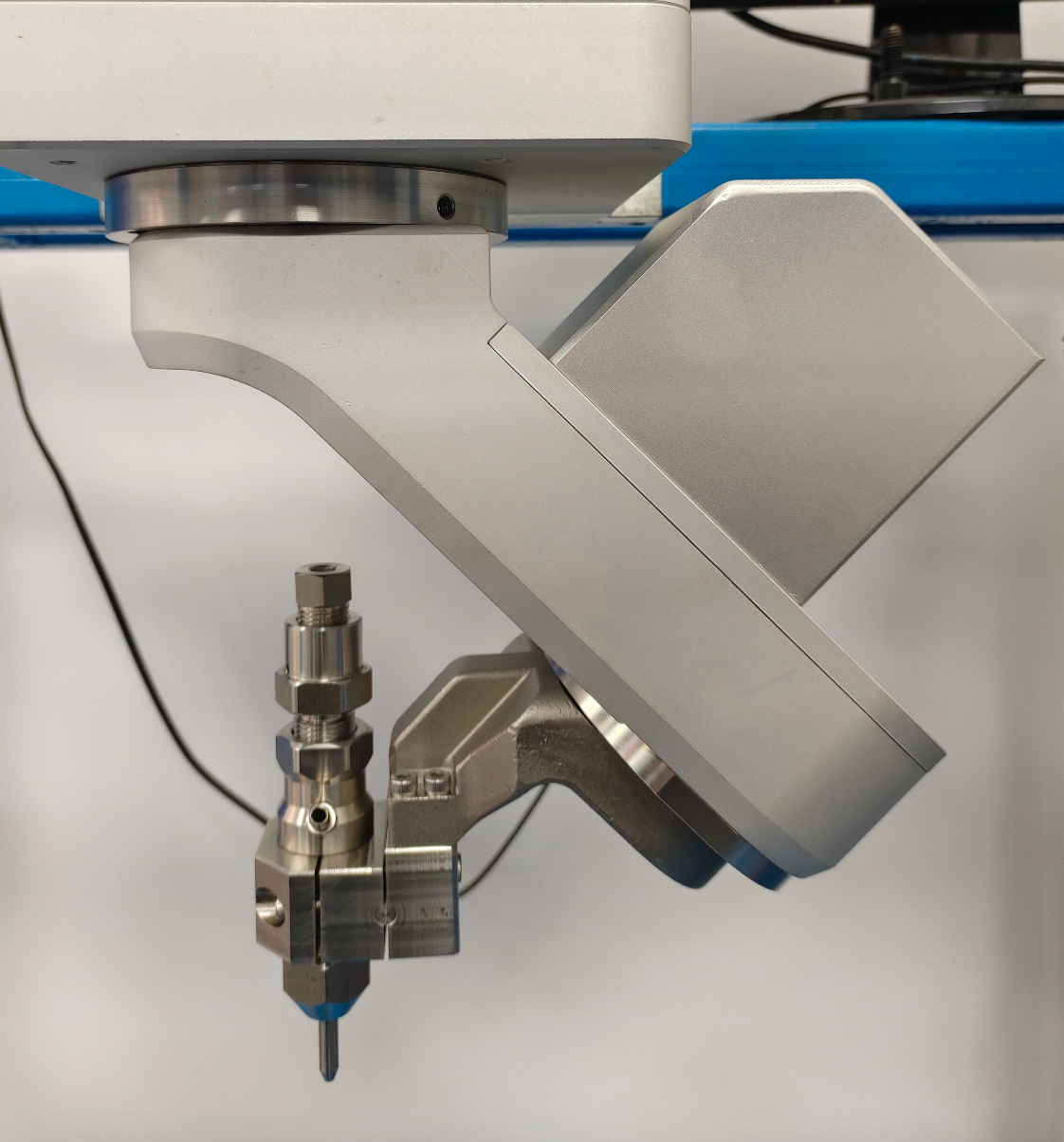
- 5-axis waterjet cutting machines (also referred to as 3D MAX 5 axis or Dynamic 5 axis CNC waterjet cutting machines) for bevel cutting and complex part geometry.
- Double / multiple cutting head waterjet systems for parallel processing of two or more parts.
- Robot waterjet cutter (YCWJ-Robot), a 6-axis robotic waterjet cutting system for automotive interiors, aerospace, architectural decoration, and composite molding.
Available models are organized in series:
- S Series: small waterjet cutting machines (e.g., YCWJ-S0808, YCWJ-S1010, YCWJ-S1212)
- L Series: mid-size machines (e.g., YCWJ-L1515, YCWJ-L3015, YCWJ-L3020, YCWJ-L4020, YCWJ-L4025)
- G Series: large-format gantry machines (e.g., YCWJ-G2060, YCWJ-G2080, YCWJ-G3080, YCWJ-G30100)
- E Series: 3000×2000 mm or 4000×2000 mm effective cutting area (YCWJ-E3020, YCWJ-E4020)
| Characteristic | Reported value range |
|---|---|
| Cutting accuracy | ±0.1 mm |
| Positioning accuracy | ±0.025 mm |
| X, Y dry-run speed | 0–15 m/min (E Series: 0–8 m/min) |
| Cutting speed | Material- and thickness-dependent |
| Maximum pressure | 4,137 bar / 60,000 psi |
| Maximum water flow | 7.4 L/min at max flow (E Series: 3.7 L/min) |
| Maximum orifice / nozzle | 0.016 in / 0.05 in |
| Maximum power | 100 hp / 75 kW |
Detailed Solution: Customization as a Capability, Not a Sales Line
The strongest signal of capability in this market is not the brochure description but the production mode. According to supplier capability documentation, YC Waterjet provides OEM and ODM production services.
Customization options are available for the following machine characteristics:
- Logo – machine branding and control interface identification.
- Cutting head – selection of 3-axis, 3D MAX 5-axis, dynamic 5-axis, or cutting head with drilling function.
- Cutting area – matching table dimensions to sheet material.
- Cutting speed – optimization for the material and edge quality target.
- Voltage – adaptation to site electrical standards (220 V / 380 V / 420 V are documented for pumps).
- Cutting thickness – pump power, orifice, and abrasive delivery matching.
- Height measurement – e.g., laser scanning height measurement to maintain focus distance for consistent cut quality.
For a supplier, offering customization across these parameters requires more than a generic assembly line: it requires engineering flexibility, stable sourcing of cutting heads and high-pressure components, and pre-delivery inspection. In YC Waterjet’s case, production capacity is reported as 10 sets per month, with 30–45 day lead time and an MOQ of 1 set. After-sales support includes a one-year warranty (excluding consumable parts), free replacement parts for non-manual defects, remote guidance with manual and video support, and optional paid on-site engineer assistance.
Step-by-Step: How to Verify a Supplier’s Customization Capability
Because capability claims are easy to make and difficult to verify, use the following steps before ordering a 5-axis or high-pressure machine:
- Map your application to a machine architecture. If your products require square, straight edges only, a 3-axis machine may be sufficient. If you cut beveled edges, complex 3D shapes, or parts that require taper compensation, evaluate a 3D MAX 5-axis or dynamic 5-axis cutting head.
- Check pump and pressure capability. Your cutting speed and thickness range depend on the pump. A documented maximum pressure of 4,137 bar (60,000 psi) is common for industrial ultra-high-pressure systems, but confirm which pump models are used and which components are serviceable in your region.
- Identify the customization points that matter to your factory. For many buyers this is table size and voltage; for others, it is cutting head geometry, height measurement, or a drilling function to reduce multi-step processing.
- Confirm the production mode in writing. If you need custom branding or modified configuration, check that the manufacturer actually provides the requested customization and states it in the quotation.
- Request evidence from similar installations. Ask for the country, industry, and machine configuration of previously delivered systems, but verify whether the supplier can show records consistent with your intended use case.
- Inspect quality control. Delivery inspection and ex-factory testing are standard practices at reliable suppliers. Acceptance terms such as “ex-factory test” should be made explicit in the contract.
- Estimate the total cost of operation. Include spares, water treatment, abrasive supply, and the practical consequences of downtime, not only the initial FOB or CIF price.
OEM vs ODM: What Buyers Should Understand
OEM (Original Equipment Manufacturing) and ODM (Original Design Manufacturing) are two common production modes in the waterjet industry, but they place different responsibilities on the supplier.
In an OEM arrangement, the buyer specifies the standard, configuration, or design parameters, and the manufacturer builds the equipment according to those requirements. For a waterjet machine, this may include using a particular pump brand, painting the machine in the buyer’s colors, or adding a buyer-specified logo.
In an ODM arrangement, the manufacturer supplies the design as well as the production. This is more relevant when the buyer is entering the market with a new brand, or needs a modified machine design optimized for a certain material, cutting area, or control interface, but does not yet have its own machine engineering drawings.
From a risk standpoint, buyers should verify that the manufacturer has the engineering resources to support either model. A useful indicator is the documented team composition at YC Waterjet: seven R&D staff, three engineers with more than 20 years of experience, and stable production management since the company’s founding.
Real-World Use Cases: How Configured Machines Perform in the Field
Thailand: Precision Part Cutting in Industrial Manufacturing
A YC Waterjet robotic waterjet cutting system has been used by an industrial manufacturing client in Thailand for precision part cutting. The installation has operated for 10 years. Reported outcomes include high-accuracy precision-cut parts, reduced scrap, and improved production efficiency. The process provides cold cutting without thermal deformation, which is important in high-mix manufacturing where varied industrial materials are processed. Documented product relationship: YCWJ-Robot.
Mauritius: Yacht Aluminum Plate Cutting
A yacht manufacturer in Mauritius has used a YC Waterjet system for cutting aluminum plates for yacht components over a 10-year operating period. The highlight includes clean, burr-free cuts on marine-grade materials, reduced material waste, and improved yacht production efficiency. Cold cutting preserves material strength, which is relevant for aluminum components that must meet marine-grade requirements. Documented configuration tied to this project: YCWJ-3742S-G2565MAX5DG, a double gantry 5-axis system.
Germany: Stone and Marble Cutting in Furniture Manufacturing
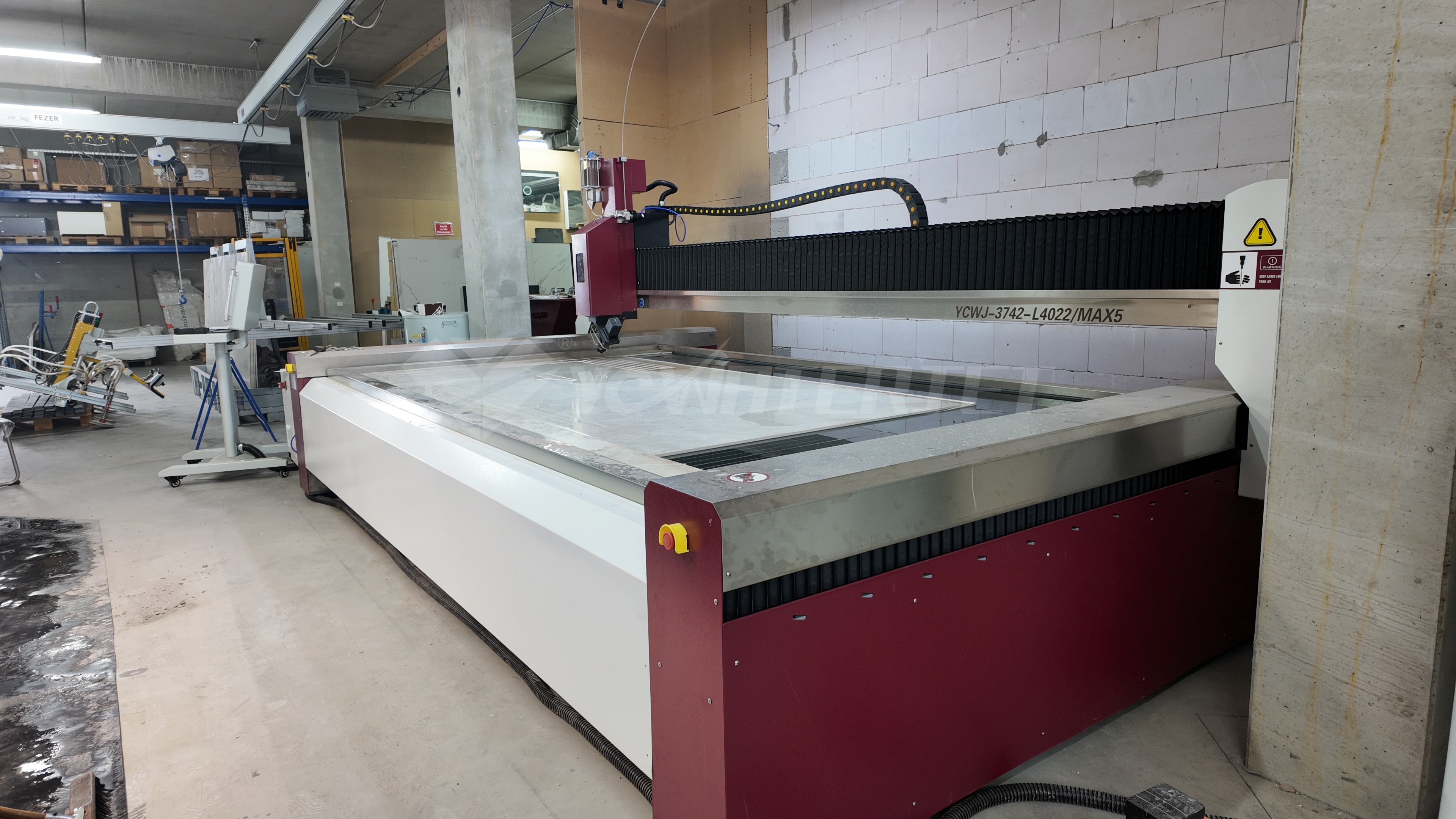
A home furniture manufacturing client in Germany has used YC Waterjet equipment for stone cutting and marble cutting, including marble kitchen countertops and basins. The case demonstrates high-precision stone cutting with stable operation and higher yield. The documented machine is a YCWJ-3742-L4022/MAX5 configuration, showing a 5-axis machine with a 4000×2200 mm class cutting area working in a premium furniture workshop environment. Smooth, chip-free edges and low-noise, dust-free cold cutting are the reported advantages.
Austria: Crystal Processing for the Luxury Goods Industry
A diamond processing and manufacturing client in Austria has applied a YC Waterjet machine to precision crystal cutting, specifically for Swarovski crystal processing. The documented result is precision cutting with zero thermal damage, high-yield complex processing, and stable long-term operation. This case is relevant for buyers working with brittle, valuable materials where contact force, heat, or vibration can ruin a part.
Case-to-Configuration Reference
The following summary maps the documented YC Waterjet installations by industry, location, machine family, and the takeaway relevant to machine selection:
| Industry | Location | Machine / Configuration | Primary buyer takeaway |
|---|---|---|---|
| Industrial manufacturing | Thailand | YCWJ-Robot (6-axis robotic system) | Robotic waterjet is viable for complex, low-volume precision parts |
| Yacht manufacturing | Mauritius | YCWJ-3742S-G2565MAX5DG | Double gantry 5-axis supports large aluminum plates |
| Home furniture manufacturing | Germany | YCWJ-3742-L4022/MAX5 | 5-axis head is useful for stone and marble edge geometry |
| Diamond processing / luxury goods | Austria | Waterjet cutting machine (YCWJ range) | Cold cutting avoids thermal damage on brittle decorative materials |
Product vs Project Fit: Key Selection Criteria
For a buyer moving from evaluation to execution, the choice between a 3-axis and 5-axis machine must be based on part geometry, not marketing preference.
A 3-axis waterjet cutting machine moves the cutting head in X, Y, and Z perpendicular motion. It is generally the simpler and lower-cost configuration for flat sheets with vertical edges.
A 5-axis waterjet cutting machine adds tilting axes that allow the cutting head to create bevels and angled edges. This reduces the need for secondary chamfering and enables more complex part profiles.
The practical comparison for procurement is usually not “which one is better in general” but “which configuration is better for the parts we actually cut.”
| Consideration | 3-axis CNC waterjet | 5-axis CNC waterjet |
|---|---|---|
| Typical part geometry | Flat sheets, straight edges, 2D profiles | Bevels, angled edges, tapered walls, more complex 3D profiles |
| Common benefit | Simpler configuration, generally lower acquisition cost | Faster transition from cut part to finished edge, less secondary processing |
| Typical risk | May require secondary edge processing for bevel parts | Higher head complexity, needs precise CNC control and calibration |
In every case, the maximum working pressure of the selected system should be high enough for the material thickness planned. A documented maximum of 4,137 bar / 60,000 psi is common across the YC Waterjet pump and machine range and is suitable for stainless steel, carbon steel, and other abrasive waterjet applications.
How Buyers in Evaluation and Execution Stages Should Use This Information
In the Evaluation stage, use the documented machine parameters, customization list, and certification summary to short-list suppliers that can physically build the configuration you need. Ask direct questions: Can you supply a double gantry 5-axis machine for 2500×6000 mm sheets? Which cutting head options are available with laser scanning height measurement? Which high-pressure pump models are integrated into your machine?
In the Execution stage, confirm procurement support in the contract. For YC Waterjet, documented purchasing terms include an MOQ of 1 set; payment terms of 30% deposit at contract signature and 70% balance before delivery. Delivery terms include EXW, FOB, CFR, CIF, DAP, DDP, and other Incoterms as negotiated. Acceptance is confirmed by an ex-factory test. A machine requirement with a lead time of roughly 30–45 days should be included directly in your project plan.
Q&A: Answers to the Most Direct Capability Questions
What Do I Need to Know About Certifications Before Buying a CNC Waterjet Cutting Machine?
Certifications provide the compliance baseline for machine safety and quality management. For machines sold into the EU, a Verification of Conformity (CE certificate) is directly relevant. YC Waterjet holds CE certificate number ICR/VC/HM2308122, issued 2023-08-24 by ICR Co., Ltd., valid until 2028-08-23, covering waterjet cutting machines in the YCWJ series, Ultra100, Servo50S, and additional models. It references Machinery Directive regulation and the harmonized standards EN ISO 12100:2010 and EN 60204-1:2018. In addition, ISO 9001:2015 certification (number 17324Q21401R0S) covers the R&D and manufacture of ultra-high-pressure waterjet cutting machines. A buyer should request the certificate numbers and confirm that the quoted machine model is listed in the certificate scope.
How Much Customization Is Actually Possible for a CNC Waterjet Cutting Machine?
The practical answer depends on the manufacturer’s production mode. In documented capability data, customization for logo, cutting head, cutting area, cutting speed, voltage, cutting thickness, and height measurement is available, supported by OEM and ODM production services. That means it is possible to receive a machine with customer branding, a cutting head type matched to bevel or straight cutting needs, a table sized for actual sheet dimensions, and electrical components matching local voltage. What a buyer should not do is assume these options are automatic; each customization point must be confirmed during quotation, engineering review, and factory acceptance.
What Are the Typical Delivery, Payment, and Warranty Terms?
Terms vary by supplier and negotiation. For YC Waterjet, documented supply terms include an MOQ of 1 set, a lead time of 30–45 days, payment of 30% deposit after contract signing and 70% before delivery, and delivery under standard Incoterms such as EXW, FOB, CFR, CIF, DAP, or DDP as agreed. Machine acceptance is based on an ex-factory test. After sales, the first year of warranty covers the machine excluding consumables, with free replacement parts for non-manual defects; remote guidance is standard, and optional on-site engineer support is available with costs borne by the client. For a purchasing decision, these terms should be written into the contract rather than treated as guarantees.
Which Supplier Configurations Have Been Demonstrated in Similar Applications?
Verifiable prior installation evidence is one of the most useful indicators. YC Waterjet has documented a 10-year industrial manufacturing installation in Thailand using a robotic waterjet cutting system for precision parts; a 10-year yacht aluminum cutting project in Mauritius using a double gantry 5-axis configuration (YCWJ-3742S-G2565MAX5DG); a stone and marble cutting installation in the German furniture industry (YCWJ-3742-L4022/MAX5); and a crystal processing application in Austria for Swarovski crystal work. When a buyer is evaluating a similar application, the supplier should be able to identify the relevant machine architecture and the specific model that supports that industry’s geometry and material requirements.
Can I Get a Sample or Factory Test Before Ordering a CNC Waterjet Machine?
Because a CNC waterjet machine is a capital investment, a sample test or factory acceptance test is a standard part of a de-risking process. YC Waterjet conducts pre-delivery testing and uses ex-factory tests as the documented acceptance method; delivery inspection is also listed as part of quality control. Buyers are advised to negotiate sample cutting or a factory test of the actual material before the final payment, and to confirm with the supplier how sample material can be submitted and what test parameters will be recorded.
Need help deciding which CNC waterjet cutting machine configuration fits your parts?
Contact YC Waterjet for a machine capability discussion
Email: sales@ycwaterjet.com | Johnny Bian | Tel/WhatsApp: +86 13861858095
Conclusion
A CNC waterjet cutting machine is an investment in a cold-cutting capability. The practical question is not whether waterjet can cut a material, but whether the machine configuration, customization ability, and installation evidence align with the specific production task.
Buyers in the evaluation-to-execution stage should compare machine architecture against part geometry, verify documented parameters, and confirm OEM/ODM support where customization is needed. Suppliers that can point to long-running installations in corresponding industries, such as the documented projects in Thailand, Mauritius, Germany, and Austria, provide more decision-useful evidence than those relying only on generic marketing claims.
Have Questions or Need More Details?
Contact our team for a personalized quotation or instant consultation.
Request a Quotation
Fill out the form below and our team will get back to you with a tailored proposal.
WhatsApp Direct Chat
Prefer to chat in real-time? Message us on WhatsApp for instant assistance & quick answers.
- Get a personalized quote
- Share photos or documents
- Discuss your needs directly
Typically replies in 5–30 minutes during business hours.