
CNC Waterjet Cutting Machine Selection: Pressure, Accuracy, and Rigidity
Three specifications and one structural decision determine what a CNC waterjet cutting machine can produce: maximum pressure, positioning accuracy, and how rigidly the cutting head is carried across the table. Table size, axis count, and the number of cutting heads are configuration choices made inside those limits — not substitutes for them.
In the YC Waterjet range, built by YC Water Jet Technology Co., Ltd. (Wuxi, Jiangsu, China; established 1999), the published figures are 4137 bar (60,000 psi) maximum pressure, ±0.025 mm positioning accuracy, and ±0.1 mm cutting accuracy. Machine structures are constructed from stainless steel and carbon steel, and larger formats such as the G Series use a double gantry configuration. This guide explains what each figure governs, where the trade-offs sit, and how to match a machine to a part mix — using published specification data only.
The Problem: Two Machines Can Print Identical Pressure Ratings
Selection errors usually begin before the first quotation arrives. Buyers compare the specification line that is easiest to compare — table size, or maximum pressure — and treat it as a proxy for capability. It is not.
A maximum pressure rating is a ceiling shared by an entire product family. The YC Waterjet S, L, G and E Series all publish the same 4137 bar (60,000 psi) maximum pressure, the same ±0.1 mm cutting accuracy and the same ±0.025 mm positioning accuracy. On paper, four different machine families look identical on those three lines. What actually differs is work envelope, rapid speed, water flow, structural platform, and how many cutting heads the frame can carry.
Two further distinctions cause avoidable specification mistakes:
- Maximum pressure is not operating pressure. The E Series documents 4137 bar (60,000 psi) as maximum pressure while listing 340 MPa as working pressure. A machine quoted on maximum pressure alone has not told you how it is set up to run.
- Positioning accuracy is not part tolerance. ±0.025 mm describes how precisely the machine places the cutting head. ±0.1 mm describes the accuracy of the cut. The first is a machine property; the second is an outcome that also depends on material, thickness, abrasive and speed — cutting speed is documented as “based on the material and thickness.”
Industry Background: Precision Cutting Demand Keeps Growing
Market estimates for waterjet cutting equipment vary between research firms but agree on direction. The global waterjet cutting machine market was valued between USD 1.11 billion and USD 1.86 billion in 2025, with projections reaching up to USD 2.39 billion by 2030 (Fortune Business Insights / Vertex AI Search). The spread between the low and high 2025 estimates is itself a useful reminder that market-size figures should be read as ranges rather than single points.
Regionally, Asia-Pacific accounted for 37.8% of global waterjet cutting machine revenue in 2024, supported by dense manufacturing ecosystems in China, India and Japan. On the technology side, abrasive waterjet cutting is estimated to account for 49.5% of the product segment share in 2026, while metal cutting remains the primary application at 54.2% of the application segment in the same year (Fact.MR).
At component level, the high-pressure pump is the part of the system most closely tied to brand recognition. Leading global waterjet pump manufacturers as of 2025 estimates include Flow International (22.1% share), KMT Waterjet (18.5%) and OMAX Corp (15.2%) — which is why pump sourcing is a legitimate question during machine selection rather than an afterthought. YC Waterjet has integrated technology and components from KMT (Germany) and Accustream/Hypertherm (USA) since 2005, exports to more than 140 countries and regions, and derives approximately 70% of total sales from export business.
The Three Parameters Explained
1. Maximum Pressure: What 4137 Bar (60,000 Psi) Defines
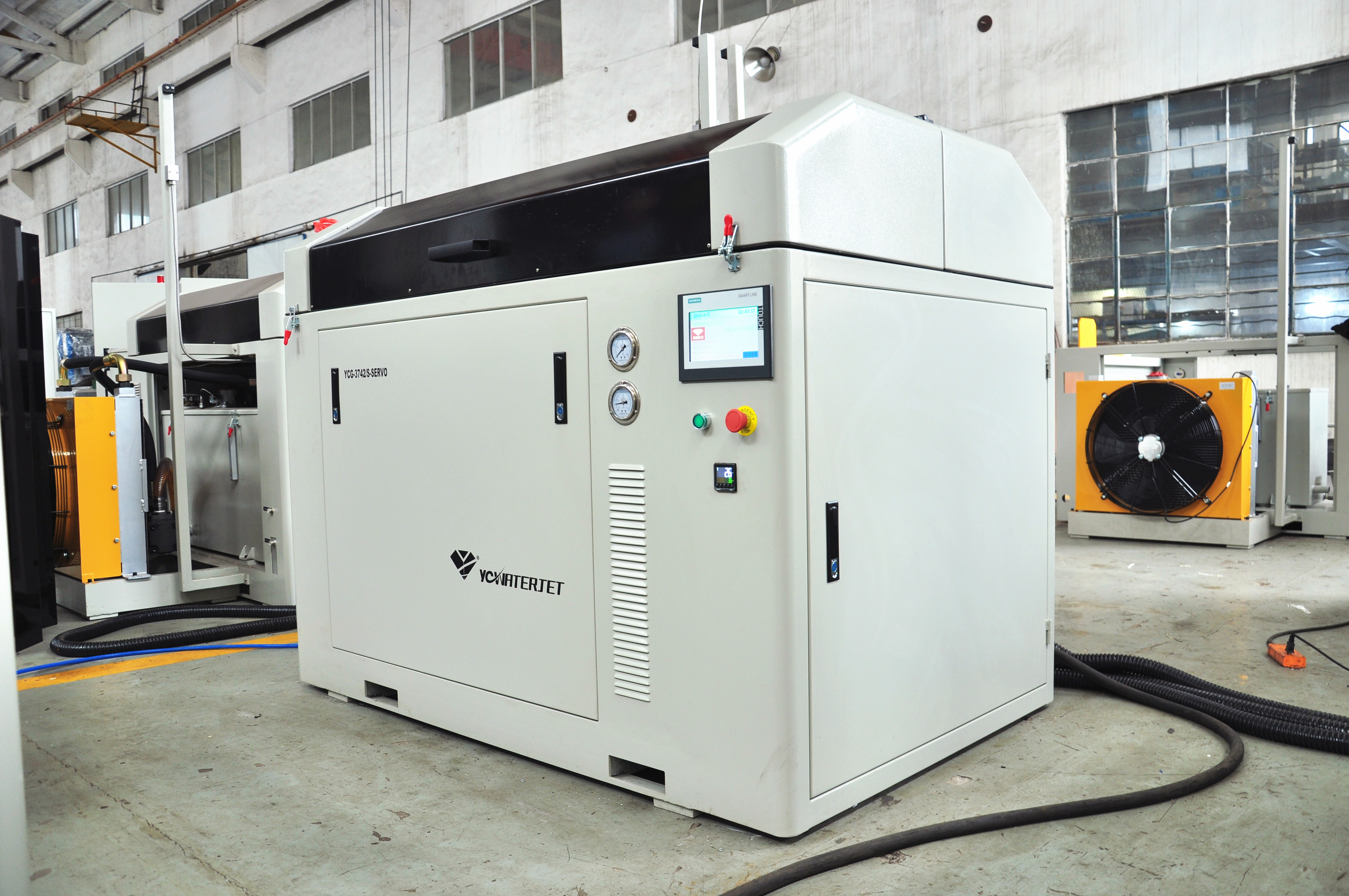
Pressure sets the energy ceiling of the jet. In the YC Waterjet range, 4137 bar (60,000 psi) is the published maximum across the S, L, G and E Series machines and across the high-pressure pump platforms (YCG-3038, YCG-3742, YCG-3742S, YCG-Ultra100, YCG-SERVO50, YCG-Ultra100S, YCG-Servo50S). The pump specification also lists a maximum water flow of 7.4 L/min, a maximum orifice/nozzle of 0.016”/0.05”, maximum power of 100 Hp (75 kW), a voltage of 220 V / 380 V / 420 V, and a working temperature range of 0–50 °C. Pump bodies are available in stainless steel or alloy steel.
What matters for selection is that pressure, orifice and flow work as a set. A rated pressure with a smaller orifice and lower flow — the E Series documents 3.7 L/min maximum water flow — does not deliver the same cutting environment as the same pressure with 7.4 L/min flow, even though the headline pressure reads identically. For thick plate, hard alloys, or production cutting with multiple heads, flow and pump power are the figures that decide whether the machine can sustain the cycle.
2. Positioning Accuracy ±0.025 mm and Cutting Accuracy ±0.1 mm
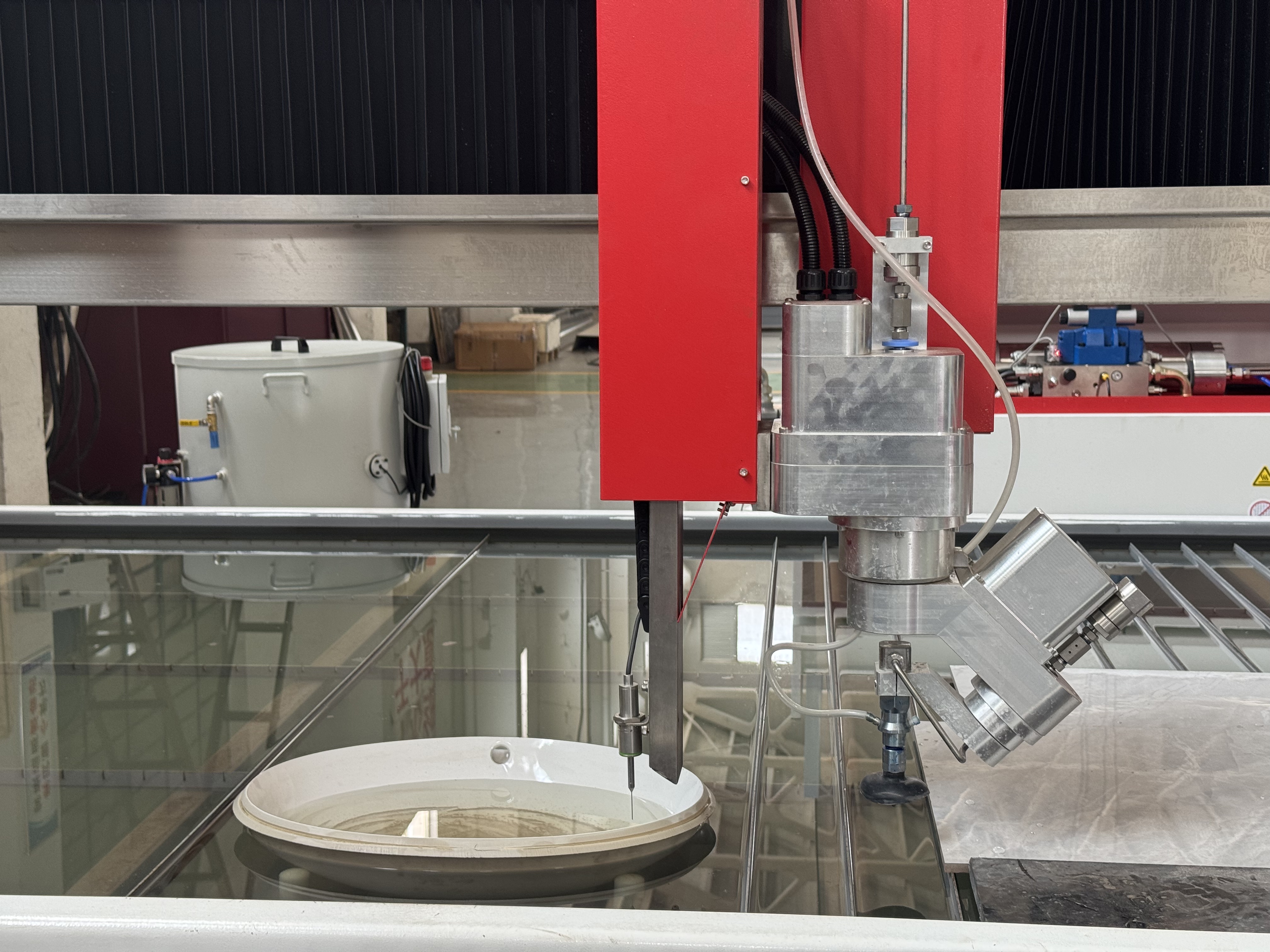
Accuracy in waterjet cutting is quoted in two layers, and buyers should ask for both. Positioning accuracy of ±0.025 mm is the machine’s ability to move the cutting head to a commanded coordinate — a property of the motion system, the gantry and the control. Cutting accuracy of ±0.1 mm is the documented tolerance level of the finished part.
Because cutting speed is documented as “based on the material and thickness,” the gap between those two figures is where process knowledge lives. The same machine that holds ±0.025 mm positioning can produce very different part tolerances in thin aluminium versus thick stainless steel. This is why hardware configuration matters as much as the base accuracy line. Options available in the YC range include a cutting head with drilling function, multiple cutting heads, a laser scanning height measurement system, an automatic abrasive delivery system, hydraulic loading, an auto sludge removal system, an air-cooled chiller and an auto water softening system — each of which changes what the machine can do around the cut and how much manual setup the operation absorbs.
Axis configuration belongs in the same discussion. YC machines are offered as 3-axis, 3D MAX 5-axis and dynamic 5-axis systems. A 3-axis machine cuts flat profiles; a 5-axis waterjet machine adds the ability to tilt and taper the cutting head, which is how bevels, countersinks and near-net parts on curved surfaces are produced. Specifying 5-axis capability for flat, constant-thickness work usually adds capability that the part mix never uses.
3. Structural Rigidity: Stainless/Carbon Steel Frames and Gantry Design
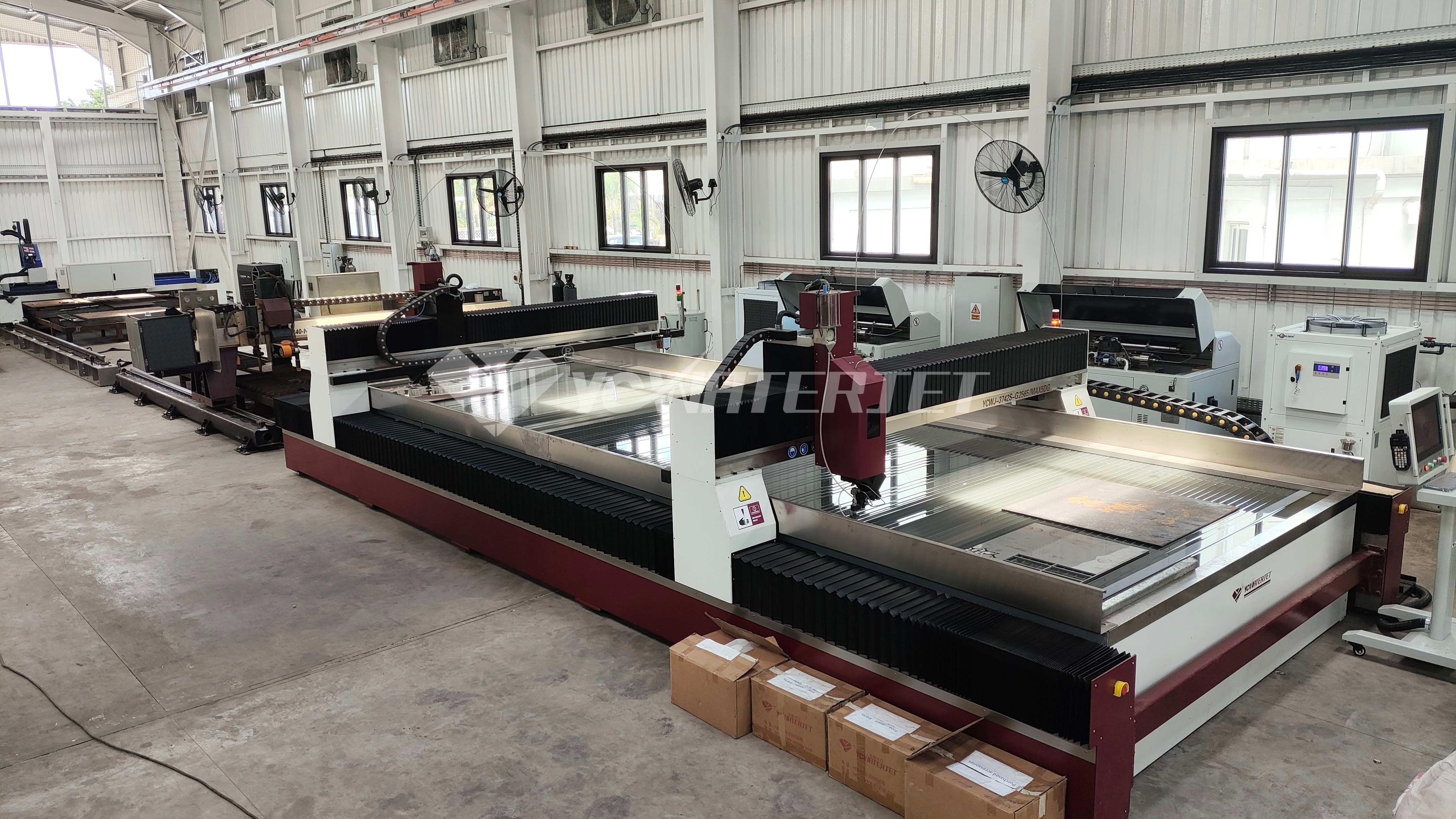
Rigidity is the parameter least visible in a quotation, and it decides how long the machine holds its accuracy. Machine structures in the YC range are built from stainless steel and carbon steel, with the configuration determined by series:
- G Series — models YCWJ-G2060, G2080, G3080 and G30100, built with a double gantry structural configuration and CNC control.
- L Series — models YCWJ-L1515, L3015, L3020, L4020 and L4025, available as integral type or split type, in 3-axis, 3D MAX 5-axis and dynamic 5-axis builds, with double or multiple cutting head options.
- S Series — models YCWJ-S0808, YCWJ-1010 and YCWJ-1212, a full closed small CNC waterjet cutting machine constructed from stainless steel and carbon steel.
- E Series — models YCWJ-E3020 and YCWJ-E4020, with effective cutting areas of 3000 × 2000 mm and 4000 × 2000 mm.
A gantry carries the cutting head across the work area. On a double gantry configuration, load is distributed across two structural rails rather than a single beam, which matters as moving mass increases — a 5-axis head, a drilling head, or several cutting heads running at once. Higher machine rigidity generally means less deflection and less vibration during acceleration, and dry-run speeds in the range reach 0–15 m/min on the L, G and S Series (0–8 m/min on the E Series). Rapid positioning is only useful if the structure stays stable while doing it.
There are trade-offs to state plainly. Larger-format and double gantry machines occupy more floor space and require a foundation and installation plan to match. Split-type configurations are commonly chosen where transport or site access is restricted, and the assembly and alignment step then becomes part of commissioning. Neither choice is universally better — the correct one follows the largest part the operation must cut and the number of heads it intends to run.
Step-by-Step: Selecting a Machine by Parameter
- Define the material and thickness mix. Applications covered by the range include metalworking, stone and glass processing, aerospace, automotive manufacturing, composite materials, architectural decoration, and electronic precision processing — including titanium alloys, CFRP, honeycomb, thick steel plate, glass, ceramics, foam, rubber and frozen food.
- Convert the tolerance requirement into an accuracy check. Confirm that the required part tolerance is realistic against the documented ±0.1 mm cutting accuracy for that material and thickness, and confirm the ±0.025 mm positioning accuracy of the motion system.
- Decide whether maximum pressure or working pressure governs the process. All series publish 4137 bar (60,000 psi) maximum; the E Series also documents 340 MPa working pressure. Ask how the machine will be set up to run.
- Size the table on the largest part, not the average part. The E Series offers 3000 × 2000 mm or 4000 × 2000 mm effective cutting areas; the L and G Series cover a wider spread of model designations. Confirm the effective cutting area per model in the specification sheet before quoting.
- Choose the axis configuration. 3-axis for flat profiles; 3D MAX 5-axis or dynamic 5-axis when bevels, countersinks or 3D geometry are required.
- Match flow, power and structure to the production duty. E Series: 3.7 L/min maximum flow, 0–8 m/min dry-run speed. G, L and S Series: 7.4 L/min maximum flow, 0–15 m/min dry-run speed, 100 Hp / 75 kW maximum power. Multiple-head and double gantry configurations suit high-volume plate work; the full closed S Series suits compact parts.
- Verify the pump, the electrical supply and the documentation. Confirm pump model, voltage (220 V / 380 V / 420 V), working temperature envelope (0–50 °C), and the safety documentation issued with the machine.
Where These Machines Are Used
Metal cutting is the dominant application for waterjet machines, accounting for 54.2% of the application segment in 2026 (Fact.MR) — consistent with the way the technology is usually specified: as a cold-cutting process for steel, stainless steel, alloys and thick plate where heat-affected zones are unacceptable.
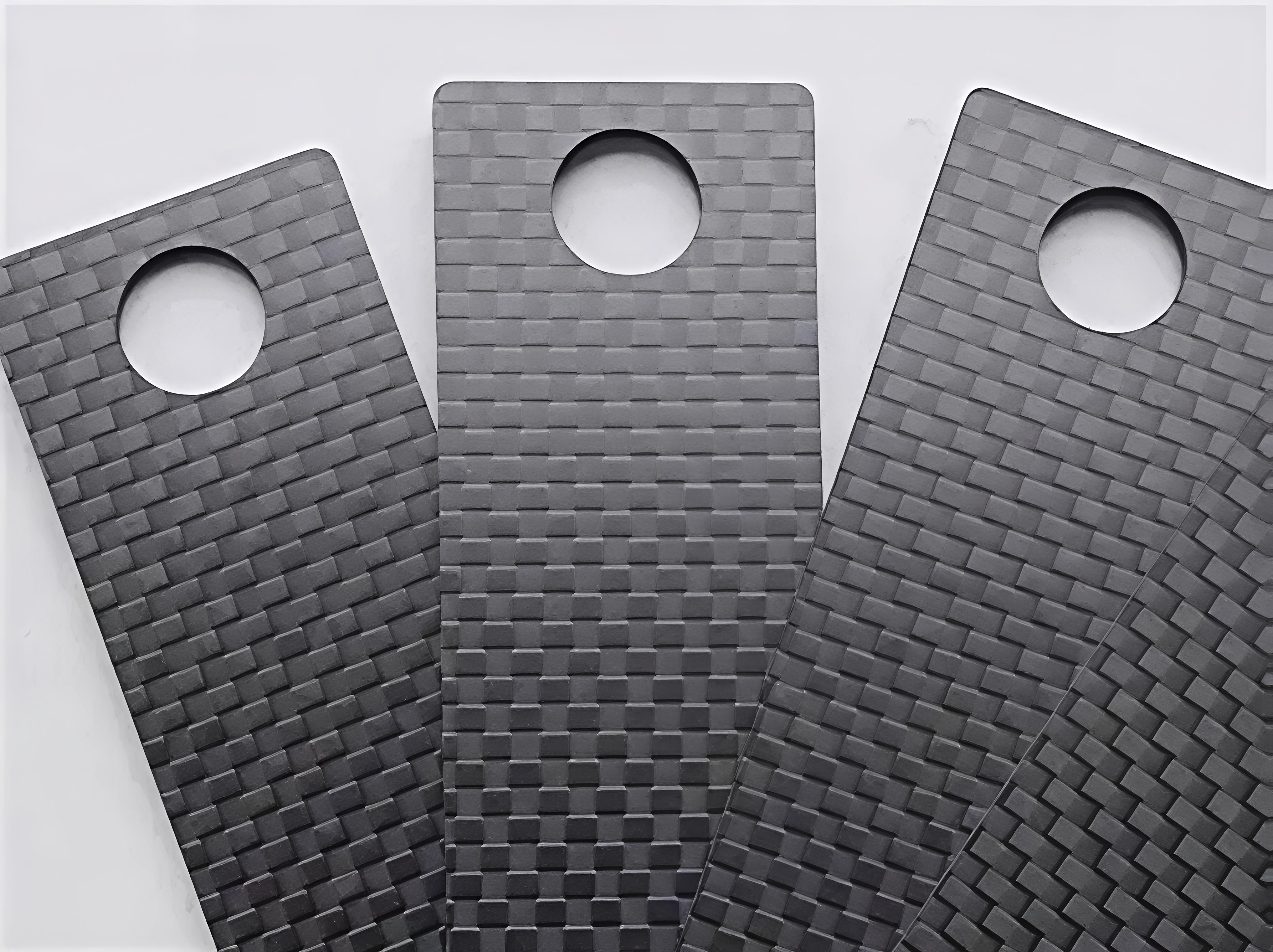
Aerospace work in the range covers titanium alloys, CFRP and honeycomb structures; automotive covers steel sheets, aluminium, interior components and fiberglass; architecture and decoration covers stone, ceramics, glass and aluminium panels; composites cover carbon fiber, fiberglass and foam; medical and food applications include titanium alloys, silicone and frozen meat; and rubber, foam, paper and fabric are handled as soft materials. A 6-axis robotic waterjet system, model YCWJ-Robot, extends the same cutting process to automotive interiors, aerospace, architectural decoration and composite molding work, where the part is presented to the cutting head rather than clamped to a table.
Series Comparison: S, L, G and E
The table below compares the four YC Waterjet machine families using published specification data only.
| Series | Models | Max pressure | Cutting / positioning accuracy | X,Y dry-run speed | Max water flow | Max power | Structure and configuration |
|---|---|---|---|---|---|---|---|
| S Series (small) | YCWJ-S0808, YCWJ-1010, YCWJ-1212 | 4137 bar / 60,000 psi | ±0.1 mm / ±0.025 mm | 0–15 m/min | 7.4 L/min | 100 Hp / 75 kW | Full closed small CNC; stainless steel and carbon steel |
| L Series | YCWJ-L1515, L3015, L3020, L4020, L4025 | 4137 bar / 60,000 psi | ±0.1 mm / ±0.025 mm | 0–15 m/min | 7.4 L/min | 100 Hp / 75 kW | Integral or split type; 3-axis, 3D MAX 5-axis, dynamic 5-axis; double / multiple cutting heads |
| G Series | YCWJ-G2060, G2080, G3080, G30100 | 4137 bar / 60,000 psi | ±0.1 mm / ±0.025 mm | 0–15 m/min | 7.4 L/min | 100 Hp / 75 kW | Double gantry structural configuration with CNC control |
| E Series | YCWJ-E3020, YCWJ-E4020 | 4137 bar (60,000 psi) | ±0.1 mm / ±0.025 mm | 0–8 m/min | 3.7 L/min | Not listed in the published specification | Effective cutting area 3000 × 2000 mm or 4000 × 2000 mm; working pressure 340 MPa |
Two observations follow from the table. First, maximum pressure and accuracy are family-wide figures — they do not separate one series from another. Second, the practical differences are work envelope, flow, rapid speed and structural configuration, which is why a selection process driven only by the pressure line produces several “equal” machines that behave very differently in production.
The same pump specification also applies to the G, L and S Series platforms: maximum water flow 7.4 L/min, maximum orifice/nozzle 0.016”/0.05” and maximum power 100 Hp (75 kW). The E Series is documented with a 3.7 L/min maximum water flow and does not list a maximum power figure.
| Parameter | Documented value | What it governs in selection |
|---|---|---|
| Maximum pressure | 4137 bar / 60,000 psi (all series) | The energy ceiling of the jet; identical across the range, so it does not separate models |
| Working pressure | 340 MPa (E Series) | How the machine is set up to run in normal production |
| Positioning accuracy | ±0.025 mm | How precisely the head reaches a commanded coordinate — a machine property |
| Cutting accuracy | ±0.1 mm | The documented part tolerance level; results also depend on material, thickness, abrasive and speed |
| Structure | Stainless steel / carbon steel; double gantry on the G Series | How the machine resists deflection and vibration as moving mass and head count increase |
| Max water flow | 3.7 L/min (E Series); 7.4 L/min (S, L, G Series and pump platforms) | Sustained cutting capability where cycle time and multiple heads matter |
| Max power / voltage | 100 Hp / 75 kW; 220 V / 380 V / 420 V | Site electrical supply and duty matching |
FAQ
Which safety standard applies to high-pressure waterjet equipment?
ISO 21789 is the primary safety standard for water jetting equipment, covering operator protection and design specifications for pressures up to 3000 bar. Machines in this category, including the YC Waterjet range, are rated up to 4137 bar (60,000 psi) maximum pressure, so buyers should ask the supplier to document which standards, guarding and safety design apply to the specific machine being quoted, rather than assuming that one standard covers every pressure class.
What is the difference between ±0.025 mm positioning accuracy and ±0.1 mm cutting accuracy?
Positioning accuracy describes how precisely the machine moves the cutting head to a commanded coordinate; cutting accuracy describes the tolerance level of the finished part. YC Waterjet publishes ±0.025 mm positioning accuracy and ±0.1 mm cutting accuracy across its S, L, G and E Series machines. Because cutting speed is documented as based on the material and thickness, the achievable part tolerance in production also depends on the material, thickness and abrasive being used — so ±0.1 mm should be read as the machine-level figure and confirmed against a specific application.
Do I need the highest-pressure, fastest configuration for every job?
No. Within the YC Waterjet range, maximum pressure is the same 4137 bar (60,000 psi) across the S, L, G and E Series, so the differences that drive configuration decisions are table format, rapid speed, flow and structure. The E Series runs at 0–8 m/min dry-run speed with 3.7 L/min maximum water flow; the S, L and G Series run at 0–15 m/min with 7.4 L/min maximum flow and 100 Hp / 75 kW maximum power. Compact parts fit the full closed S Series, standard plate formats fit the E and L Series, and large-format or multi-head plate production is where a double gantry G Series configuration becomes relevant.
How can a buyer verify machine parameters before ordering?
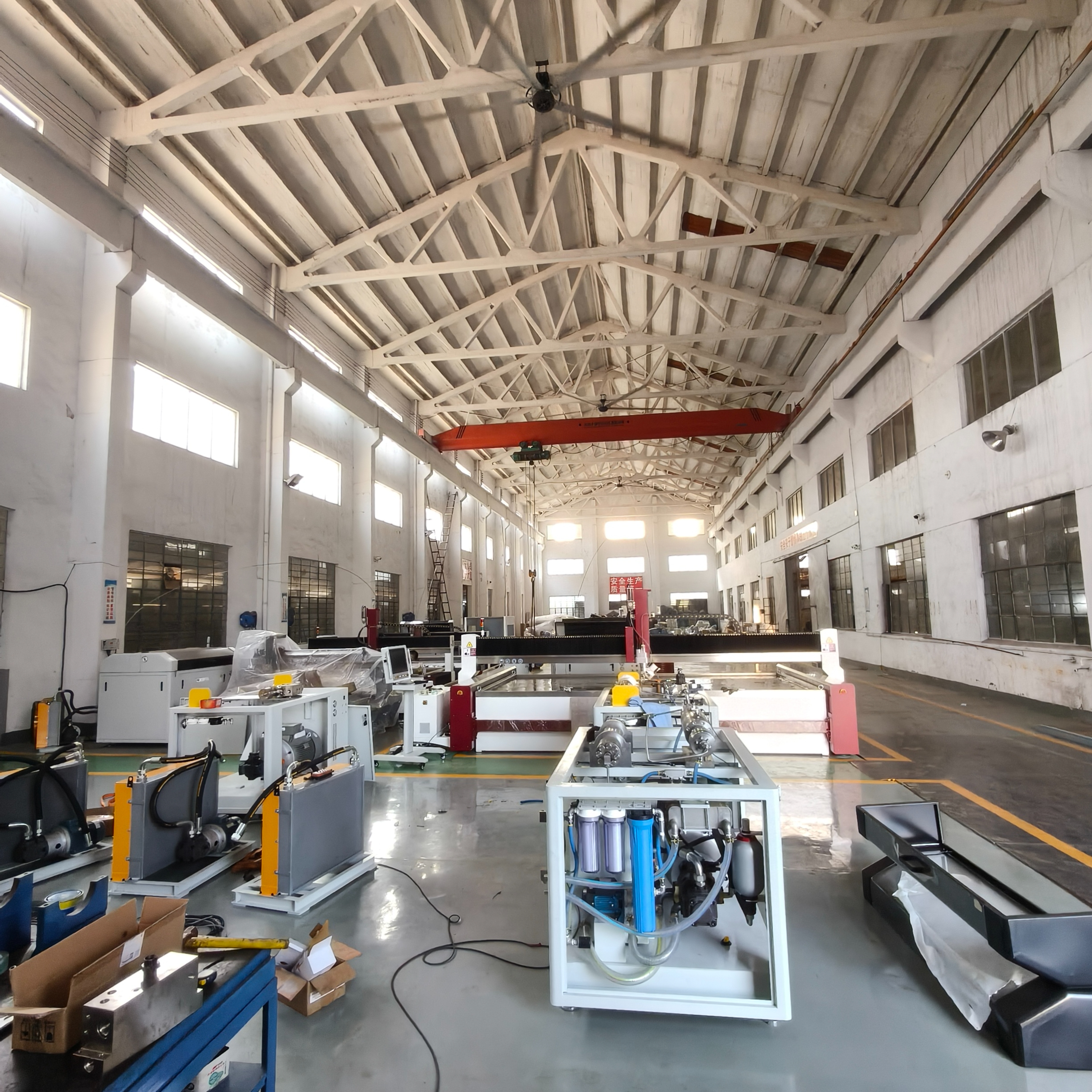
Verification starts with documented, model-specific specifications rather than a family-level sales sheet: effective cutting area, pump model, axis configuration, flow, power and voltage for the exact model being quoted. Supplier capability is the second layer. YC Waterjet operates a 7,000 ㎡ production base in Wuxi, Jiangsu, with an R&D team of seven engineers, a workforce of approximately 25 people, and an annual output of about 100 units, and has integrated KMT (Germany) and Accustream/Hypertherm (USA) components since 2005 — context that can be checked when assessing whether the supplier builds the machines it specifies.
How does production capacity affect delivery planning?
YC Waterjet produces approximately 100 sets per year and exports to more than 140 countries and regions, with export business accounting for about 70% of total sales. That combination means configuration and documentation details are worth locking in early: pump model, axis configuration (3-axis, 3D MAX 5-axis or dynamic 5-axis), effective cutting area, and site electrical supply (220 V / 380 V / 420 V). Buyers who confirm these points before the machine enters the production schedule avoid rework later.
For a specification check or quotation on a CNC waterjet cutting machine, contact YC Waterjet at sales@ycwaterjet.com, by phone or WhatsApp on +86 13861858095, or via www.ycwaterjet.com.
Conclusion
Selecting a CNC waterjet cutting machine becomes a manageable decision once the parameters are separated. Pressure — 4137 bar (60,000 psi) across the YC Waterjet range — defines the material envelope, and it is the one figure that will not distinguish between models. Accuracy splits into two numbers: ±0.025 mm positioning accuracy for the motion system and ±0.1 mm cutting accuracy for the part. Rigidity is decided by the structure: stainless steel and carbon steel frames, an integral or split L Series platform, a full closed small S Series, or a double gantry G Series configuration that spreads the moving load across two rails.
Read together with table format, water flow, dry-run speed and pump power, those figures tell a buyer whether a machine is under-specified, over-specified, or correctly matched to the part mix — before the quotation is signed.
Next Step: Confirm the Specification Against Your Part Mix
Send the material, thickness, maximum part size and required tolerance to the YC Waterjet team. You will receive the matching series and model, the relevant pressure, accuracy and flow figures, and the configuration options — from 3-axis to dynamic 5-axis, single to multiple cutting heads.
Email: sales@ycwaterjet.com · WhatsApp / Tel: +86 13861858095 · Web: www.ycwaterjet.com
Have Questions or Need More Details?
Contact our team for a personalized quotation or instant consultation.
Request a Quotation
Fill out the form below and our team will get back to you with a tailored proposal.
WhatsApp Direct Chat
Prefer to chat in real-time? Message us on WhatsApp for instant assistance & quick answers.
- Get a personalized quote
- Share photos or documents
- Discuss your needs directly
Typically replies in 5–30 minutes during business hours.