
CNC Waterjet Cutting Machines: 10 Common Questions Answered
A CNC waterjet cutting machine cuts material with a high-velocity jet of water rather than a heat source. That single sentence answers most first-round questions, but not the ones that decide a purchase: how much pressure actually reaches the nozzle, which materials hold tolerance, how a 3-axis machine differs from a 5-axis one, and what a certificate really covers. The ten questions below are the ones buyers and engineers raise most often during evaluation, and each answer is written so it can be read on its own.
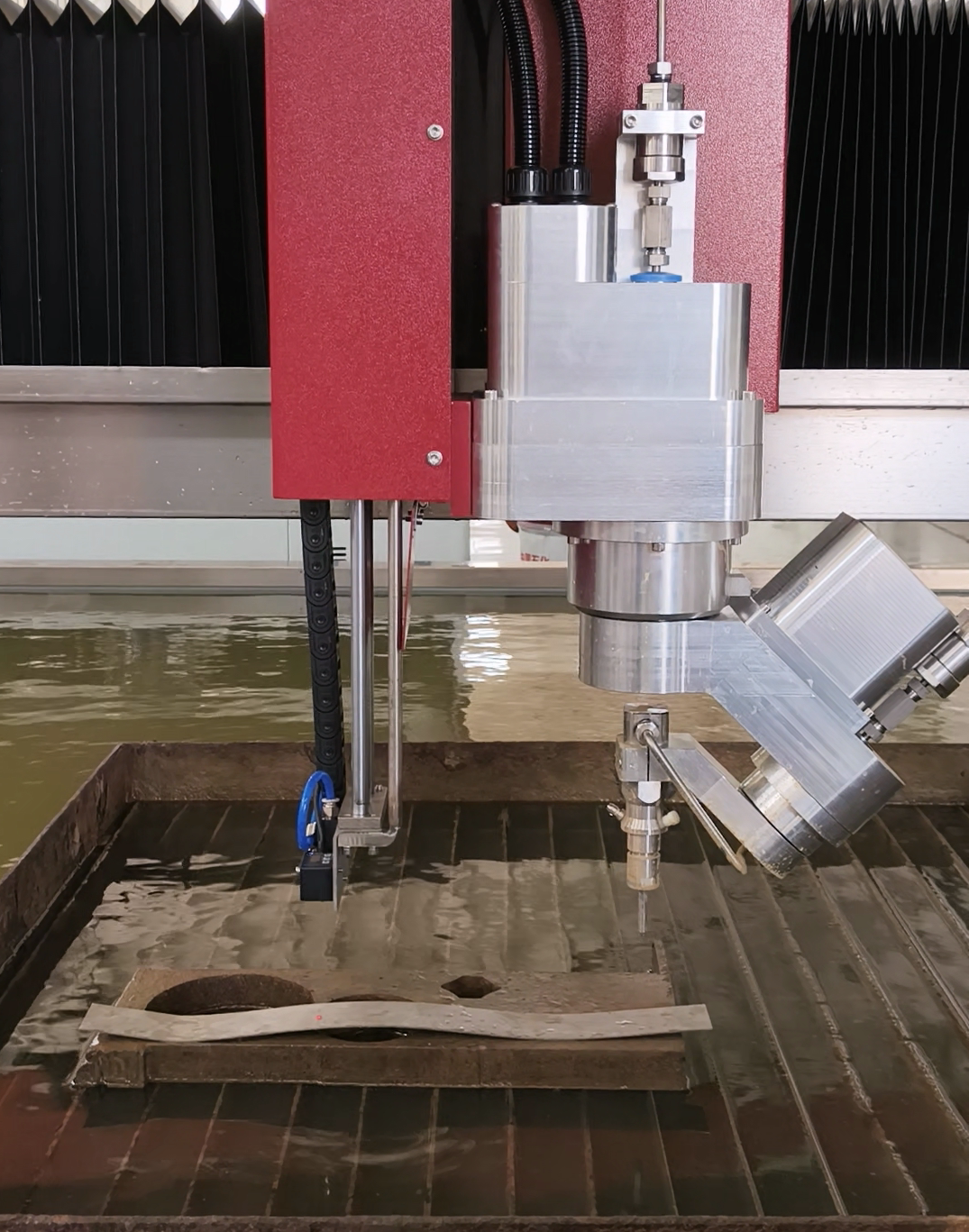
Why waterjet evaluation stalls before the shortlist stage
Two machines from different suppliers can carry the identical description, cnc waterjet cutting machine, and still differ in pump pressure, axis configuration, work envelope, cutting head design and certification scope. Published specifications rarely state the conditions behind an accuracy figure, so datasheets cannot be compared line by line across suppliers. The practical result is that buyers either over-specify, buying a 5-axis waterjet machine for flat plate work, or under-verify, accepting an accuracy figure without knowing the material and thickness it was measured on.
The way out is not more datasheets. It is to convert the purchase into a fixed set of questions and answer each one with a fact that can be checked, either in a certificate scope, a published specification, or a customer case record. The ten questions that follow are ordered the way a new buyer usually meets them: technology first, then capability, then configuration, then verification.
Industry background a new buyer should hold in mind
The installed base gives context to every specification decision. Mordor Intelligence estimates the global waterjet cutting machine market at USD 1.86 billion in 2025, and reports that abrasive waterjet technology represented approximately 82.0% of total market share by type in that year. In other words, most machines in service are abrasive systems rather than pure-water systems, which is why abrasive delivery and garnet handling appear in almost every evaluation.
The same source reports that the Asia-Pacific region generated 37.8% of global revenue in 2024, and customs data compiled for HS code 845650 records a total global export value of USD 268.81 million in 2023. For a buyer, the useful reading is straightforward: abrasive configuration is the default assumption, and Asian manufacturing is a normal part of the supply base rather than an exception, so supplier-country questions should be handled as due-diligence items rather than as automatic risk flags.
The 10 questions, answered
1. What is a CNC waterjet cutting machine?
The cold-cutting characteristic is the reason waterjet is chosen where heat-affected zones are unacceptable. YC Waterjet describes its CNC waterjet machines as using cold-cutting technology, and its case records show that property in practice: in Austria, a diamond and crystal processing customer reports zero thermal damage and high-yield complex processing; in Thailand, an industrial manufacturer reports high-precision cold cutting with no thermal deformation.
2. How does the cutting actually happen?
Every element in that chain is a buying decision, not just an engineering detail. Orifice and nozzle diameter set the kerf width; abrasive grade and feed rate set the cut speed and edge finish; the motion system sets whether the kerf stays perpendicular through thick material. This is why two machines quoting the same maximum pressure can produce very different parts on the same job.
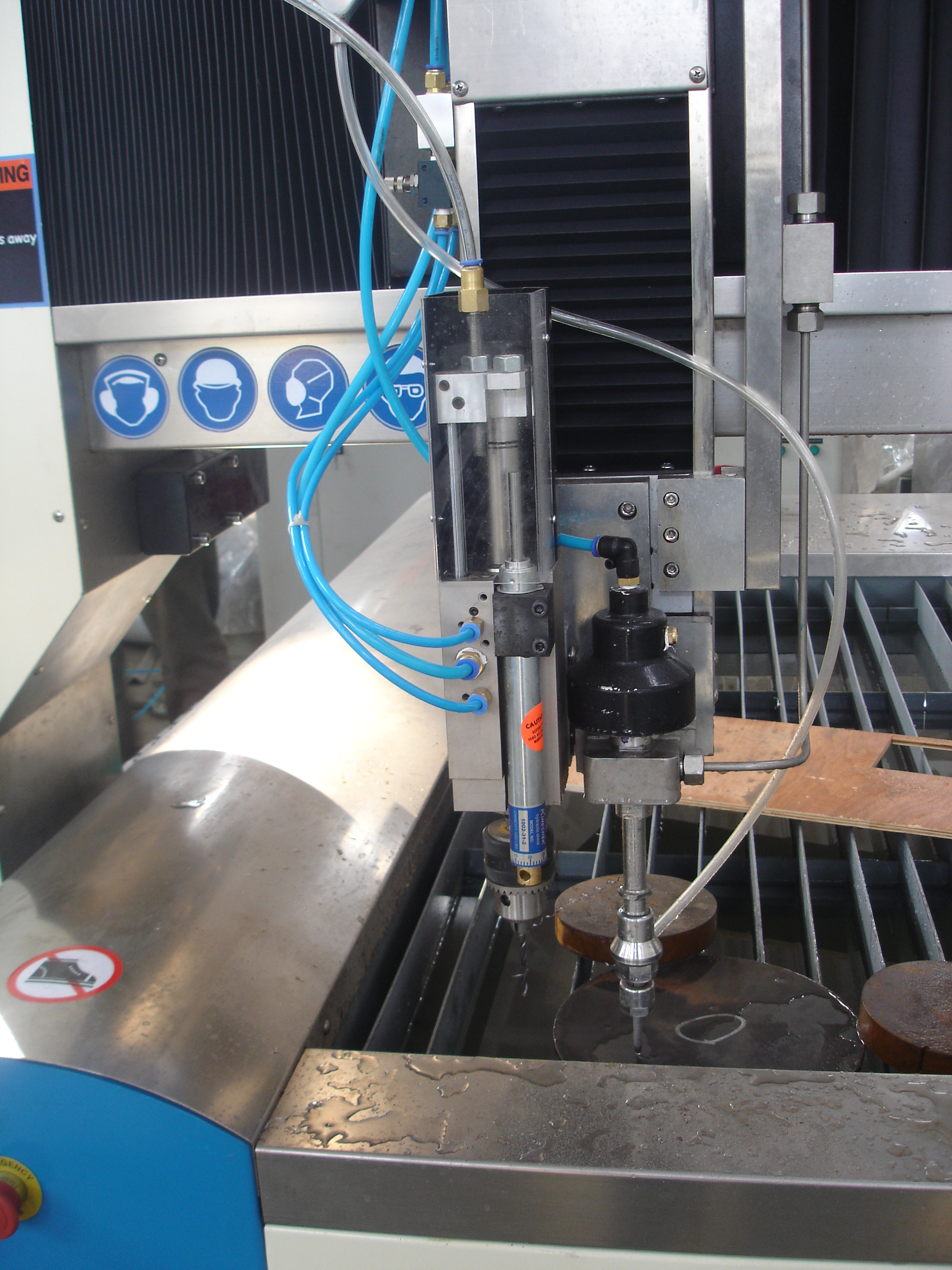
3. What role does the ultra-high pressure pump play?
The YCG range currently covers YCG-3038, YCG-3742, YCG-3742S, YCG-Ultra100, YCG-SERVO50, YCG-Ultra100S and YCG-Servo50S. Pressure and flow together describe the available hydraulic energy, but neither number on its own predicts throughput or edge quality: abrasive grade, nozzle diameter, feed rate and material thickness all intervene. The correct use of a pressure figure during evaluation is to check that it is achievable continuously at the duty cycle you run, not just as a peak rating.
4. What materials can a CNC waterjet cut?
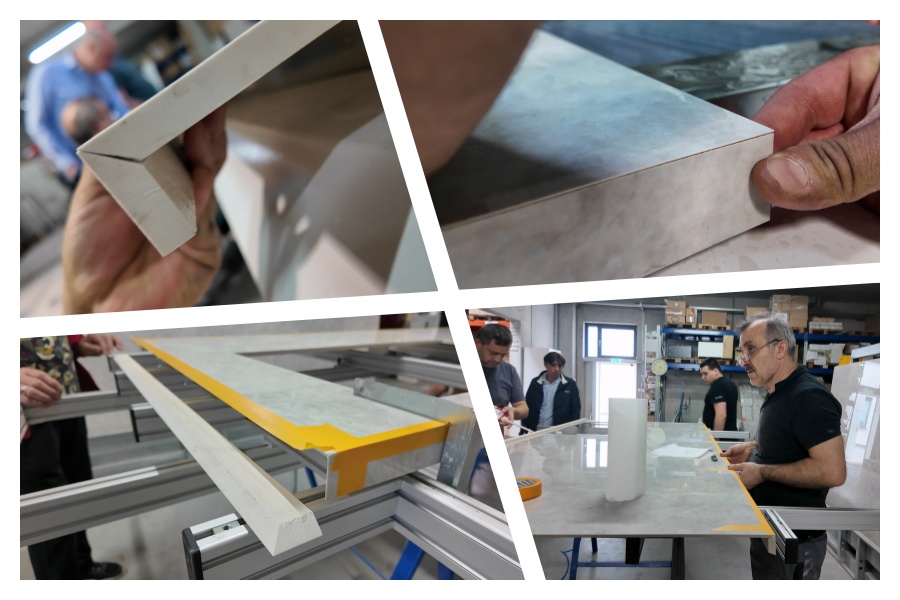
Four installed cases show the spread. A Mauritius yacht manufacturer cuts aluminium plate for yacht components, with clean, burr-free precision cuts and material strength preserved by cold cutting. A German home furniture manufacturer cuts marble and stone with zero chipping. An Austrian customer in diamond and crystal processing runs complex luxury work with a customized solution. A Thai industrial manufacturer uses the machine for precision part cutting across diverse industrial materials. In all four, the reported benefit is the same mechanism: material is removed without thermal deformation.
5. What accuracy can I realistically expect?
Treat those numbers as a specification to be contextualised, not a guarantee for your part. Accuracy is only comparable when material, thickness, abrasive grade, nozzle size and feed rate are held constant, and a published figure without test conditions cannot be benchmarked against a competitor's figure. When a supplier quotes plus or minus 0.1 mm, ask which material, which thickness and which edge criterion produced it, then ask for the same statement in the purchase order.
6. Do I need a 3-axis or a 5-axis waterjet machine?
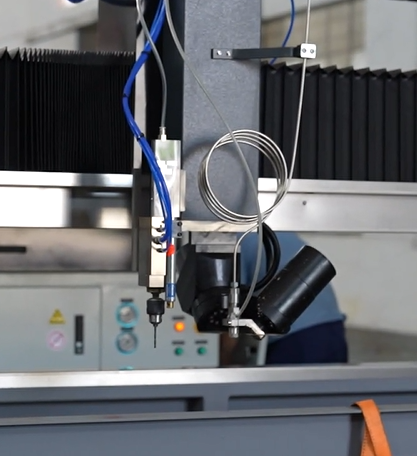
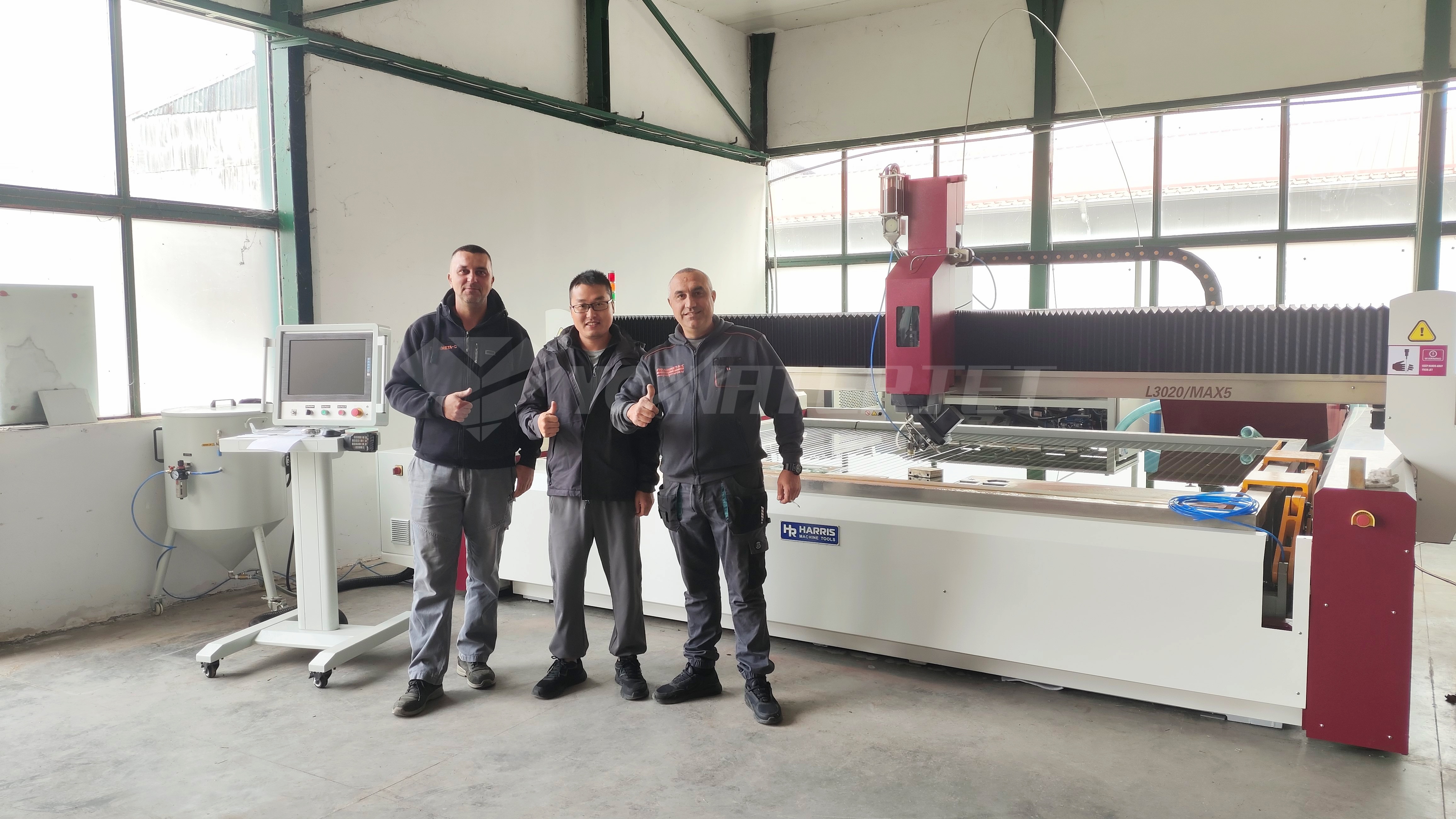
The decision should follow part geometry, not upgrade appeal. If every part is a flat profile with a perpendicular edge, a 3-axis machine with a well-chosen pump and table size does the work. If the job includes weld preparations, countersinks, angled holes, or parts formed in three dimensions, the rotary axes are what make the cut possible at all. YC Waterjet's head options reflect that split: a 3D MAX5 axis cutting head, a dynamic 5-axis cutting head with drilling function, and a MAX5 head with laser scanning height measurement for maintaining stand-off on uneven material.
7. Which model series fits my workshop: E, G, L or a small machine?
The selection sequence that works is: fix the largest workpiece envelope first, then decide the axis configuration, then size the pump. Choosing the series before the workpiece is the most common ordering mistake, because it locks the table size before the parts have been measured. Model designations indicate the intended envelope range, but the exact cutting area of a specific build should be confirmed in the quotation rather than inferred from the model code.
8. How do I match a pump to a machine?
Two practical rules help. First, do not oversize the pump to compensate for a weak motion system: accuracy comes from the gantry and the control, not from pressure. Second, ask how the pump behaves at the duty cycle you actually run, because a machine that cuts thin sheet intermittently and a machine that runs thick stainless all day place different demands on the same pump model.
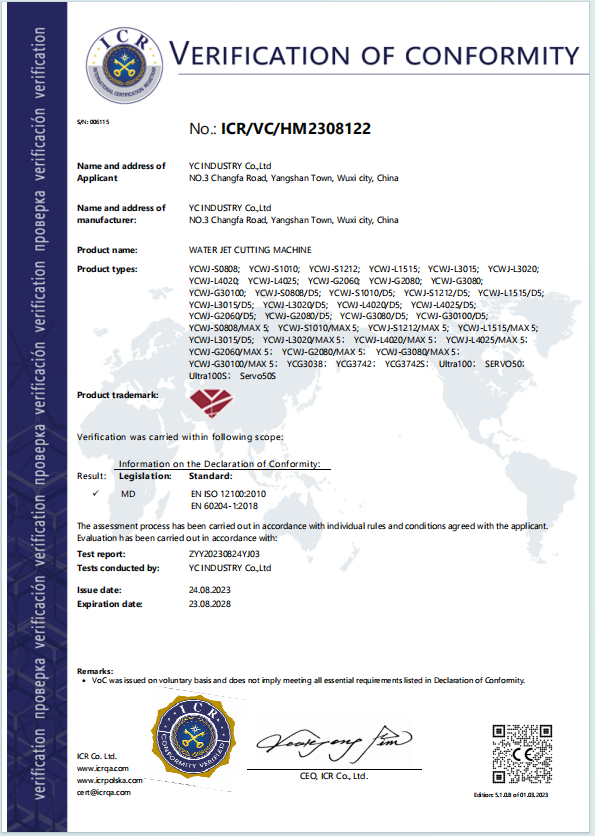
9. What certification evidence should I check before ordering?
Quality management is certified separately: ISO 9001:2015 under certificate 17324Q21401R0S, issued by Beijing Zhongjiaoyuanhang Certification Co., Ltd. on 29 October 2024 and valid to 28 October 2028, with a scope of R and D and manufacture of ultra-high pressure water jet cutting machines. The single most useful check a buyer can make is whether the exact model being purchased appears inside the certificate scope; if it does not, the certificate does not cover that machine, however impressive the PDF looks.
10. What should I know about warranty, installation and lead time?
OEM and ODM orders are accepted, with customization covering logo, cutting head, cutting area, cutting speed, voltage, cutting thickness and height measurement. Each unit undergoes pre-delivery testing before shipment, which is the point at which a buyer should ask for the test record for the configuration being built rather than for the series in general.
A step-by-step evaluation sequence
The ten answers translate into a sequence that keeps a procurement team from looping between suppliers.
- Measure the parts, not the catalogue. Record the largest envelope, the maximum thickness and the tightest tolerance your order book actually contains.
- Decide the axis configuration. Flat through-cuts point to 3 axes; bevels, taper compensation and 3D contours point to 5 axes.
- Size the pump against the heaviest routine cut. Confirm pressure and flow at the duty cycle you run, and confirm the pump model in writing.
- Verify the certificate scope. Match the exact model designation against the CE scope list and the ISO 9001 scope statement.
- Lock the customization list. Voltage, cutting area, cutting head, height measurement and logo requirements should be listed before the quotation is compared, not after.
- Plan delivery and support. With 30-45 days lead time and 10 sets monthly capacity, schedule installation and remote training against the same calendar.
Where these machines are already running
Four installed cases cover different materials and climates, and each case record lists a duration of 10 years.
- Thailand, industrial manufacturing. Precision part cutting with high-precision cold cutting and no thermal deformation; reliable performance in a tropical climate; reduced scrap and improved production efficiency.
- Mauritius, yacht manufacturing. Aluminium plate cutting with clean, burr-free edges for yacht components; cold cutting preserves material strength; plates meet marine-grade standards and material waste is reduced.
- Germany, home furniture manufacturing. Marble and stone cutting with clean cuts and zero chipping; low-noise, dust-free cold cutting; high-precision stone cutting, stable operation and boosted yield.
- Austria, diamond and crystal processing. Precision cutting performance with zero thermal damage, high-yield complex processing and stable long-term operation, delivered as a customized solution for the luxury industry.
Comparison tables for shortlisting
The first table lists what is verifiable about each series in this article. Where a field is not published, the quotation is the place to confirm it.
| Series | Model designations | What is verified in this article |
|---|---|---|
| Small waterjet cutting machine | YCWJ-S0808, YCWJ-S1010, YCWJ-S1212 | Named in the CE certificate scope; cutting area confirmed per configuration |
| L Series | YCWJ-L1515, L3015, L3020, L4020, L4025 | CE scope; L3015 and L3020 published with plus or minus 0.1 mm accuracy, plus or minus 0.025 mm repeat positioning, 0-15 m/min running speed and work areas of 3000 x 1500 x 200 mm and 3000 x 2000 x 200 mm |
| G Series | YCWJ-G2060, G2080, G3080, G30100 | Named in the CE certificate scope; table size and axis configuration confirmed per order |
| E Series | YCWJ-E3020, E4020 | Named in the CE certificate scope; table size and axis configuration confirmed per order |
The second table separates the two motion architectures that most shortlists turn on.
| Decision dimension | 3-axis machine | 5-axis machine |
|---|---|---|
| Motion architecture | X/Y/Z linear axes | X/Y/Z linear axes plus A/C rotary axes |
| Geometry handled | Flat profiles and through-cuts | Bevels, taper compensation, three-dimensional contours |
| Head options at YC Waterjet | 3-axis cutting head | 3D MAX5 axis head, dynamic 5-axis head with drilling function, MAX5 head with laser scanning height measurement |
| What to verify first | Table size and accuracy at your thickness | Rotary head type, kinematic accuracy and programming support |
Procurement FAQ
Is a CE-certified CNC waterjet cutting machine enough for EU market entry?
A CE certificate is necessary evidence, but it is only useful when three fields line up: the certificate number, the standards cited and the model list in scope. YC Waterjet holds Verification of Conformity ICR/VC/HM2308122 issued by ICR Co., Ltd., valid from 24 August 2023 to 23 August 2028, citing MD (Regulation), EN ISO 12100:2010 and EN 60204-1:2018. Its scope names the YCWJ series along with Ultra100 and Servo50S models. Quality management is certified separately to ISO 9001:2015 under certificate 17324Q21401R0S, valid to 28 October 2028.
Can the machine be customized for our cutting area and voltage?
Yes. YC Waterjet accepts OEM and ODM orders with customization covering logo, cutting head, cutting area, cutting speed, voltage, cutting thickness and height measurement, at a minimum order quantity of 1 set. Because a changed cutting area or cutting head changes the tested configuration, confirm that the accuracy statement you receive applies to the customized build rather than to the base model.
How is the price of a CNC waterjet cutting machine determined?
There is no verified public price benchmark in the evidence base behind this article, so a single headline figure should be treated with caution. The quotation is configuration-driven: series and table size, 3-axis or 5-axis motion, YCG pump model, abrasive delivery, height measurement, voltage and other customization items all change the build. A like-for-like RFQ should fix the material, thickness, accuracy target and work envelope before prices are compared.
Can we validate cutting quality before committing to a production order?
A minimum order quantity of 1 set means a single machine can be ordered as an evaluation unit, and every unit undergoes rigorous pre-delivery testing before shipment. Commissioning is supported by remote guidance with manual and video support. For material-specific validation, send the material grade, thickness and target accuracy to sales@ycwaterjet.com so the configuration, head type and pump model can be specified against your part rather than against a general specification sheet.
What is the lead time, and what does support look like afterwards?
Lead time is 30-45 days against a monthly capacity of 10 sets. The warranty covers one year on the machine, excluding consumable parts, with free replacement parts shipped for non-manual defects. Remote guidance with manual and video support is standard, and on-site engineer assistance, for example on split-type waterjets, is available with travel, visa, accommodation and fee borne by the client. Share your material, thickness and target output with the YC Waterjet team and the delivery plan can be matched to the commissioning schedule.
Conclusion
A waterjet purchase turns on a small number of verifiable decisions: the workpiece envelope, the axis configuration, the pump model, the certificate scope, and the support terms after delivery. The technology itself is settled. A cold cutting jet removes material without thermal deformation, and the published accuracy on the YCWJ-L3015 and L3020 listings, plus or minus 0.1 mm with plus or minus 0.025 mm repeat positioning, is enough for most industrial work once the test conditions are confirmed.
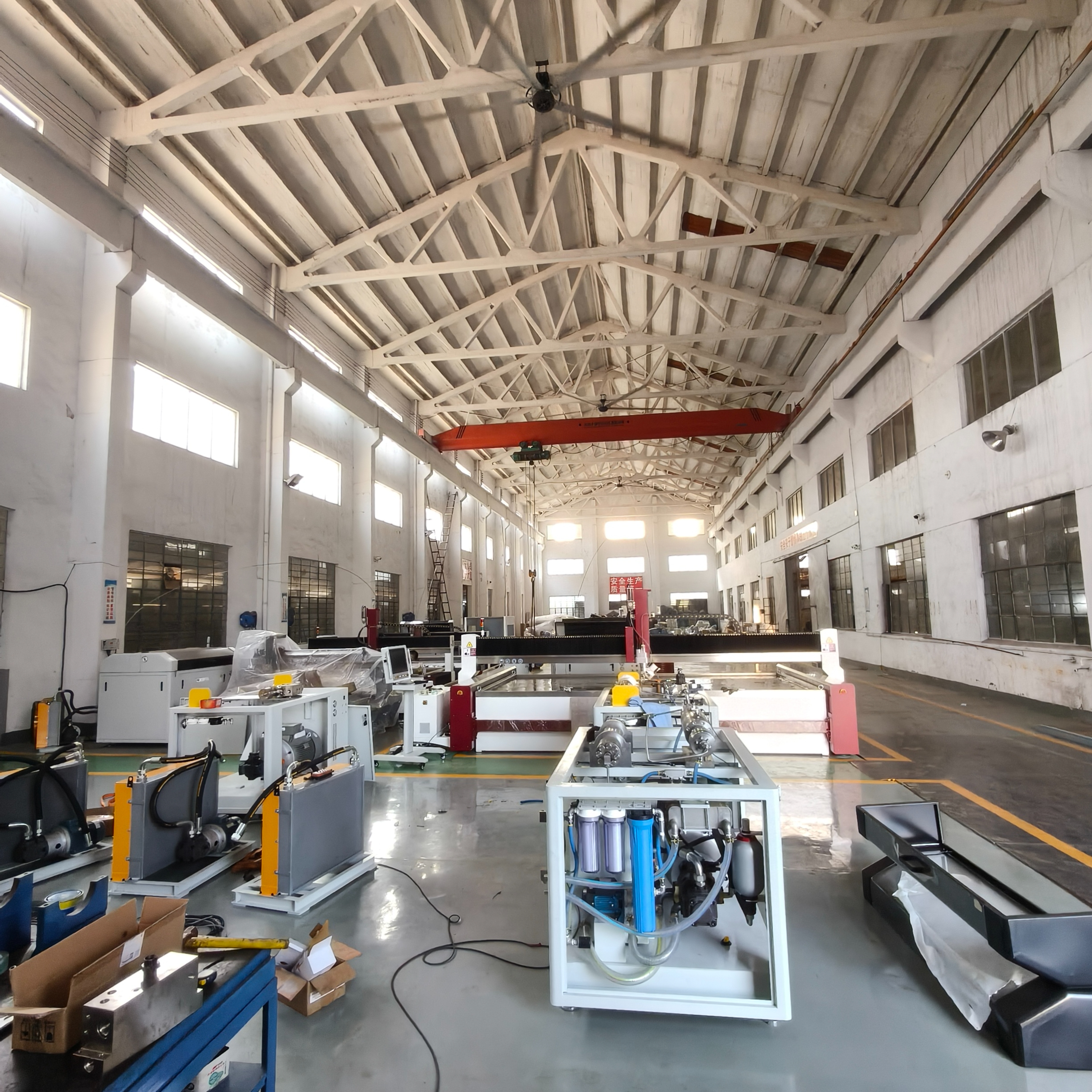
YC Water Jet Technology Co., Ltd is a manufacturer of ultra-high pressure waterjet cutting systems founded in 1999, operating a 7,000 square metre production base in Wuxi, Jiangsu, with an R and D team of 7 and an annual output of 100 sets. As of 2026 the company states it has exported to more than 140 countries and regions, with 70% of output exported.
Next step: match a machine to your part
Send the material grade, maximum thickness, required accuracy and work envelope, and the YC Waterjet team will return a configuration proposal covering series, axis configuration, YCG pump model and delivery plan.
Email: sales@ycwaterjet.com | Tel / WhatsApp: +86 13861858095 | Website: www.ycwaterjet.com
Address: NO.3 Changfa Road, Yangshan, Wuxi, Jiangsu, China
Have Questions or Need More Details?
Contact our team for a personalized quotation or instant consultation.
Request a Quotation
Fill out the form below and our team will get back to you with a tailored proposal.
WhatsApp Direct Chat
Prefer to chat in real-time? Message us on WhatsApp for instant assistance & quick answers.
- Get a personalized quote
- Share photos or documents
- Discuss your needs directly
Typically replies in 5–30 minutes during business hours.