
E Series vs. G Series CNC Waterjet: Table Size, Speed & Gantry Design
E Series vs. G Series CNC Waterjet: Table Size, Speed & Gantry Design
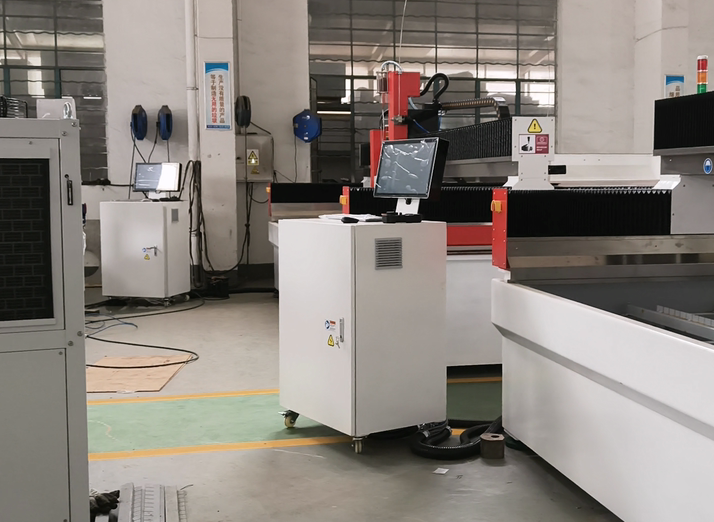
YC Waterjet E Series CNC configuration — one half of the E vs. G table-size, speed and gantry decision.
Answer first: choosing between the E Series and the G Series CNC waterjet cutting machine is not a question of which build is better — it is a question of which table envelope, throughput class and gantry architecture matches the parts you actually run. Both series are manufactured by YC Water Jet Technology Co., Ltd. (YC Waterjet), a Wuxi-based specialist in ultra-high pressure waterjet cutting systems founded in 1999, with a 7,000 m² production base and exports reaching more than 140 countries and regions as of 2026.
The short answer: if your nests fit inside a 3000 × 2000 mm or 4000 × 2000 mm effective cutting area and you cut with a single head, the E Series (YCWJ-E3020 / YCWJ-E4020) is the closer fit. If you need a double gantry structure, a 0–15 m/min X,Y dry-run speed instead of 0–8 m/min, and a pump class rated at 7.4 L/min with a 100 Hp / 75 kW maximum power, the G Series (YCWJ-G2060 / G2080 / G3080 / G30100) is the configuration to evaluate. Pressure and accuracy do not separate the two — both share a 4137 Bar (60,000 Psi) maximum operating pressure, ±0.1 mm cutting accuracy and ±0.025 mm positioning accuracy. Table size, speed and gantry design are the real decision variables, and that is what this comparison covers.
Why the E versus G Question Is Asked for the Wrong Reasons
Most waterjet comparisons begin with the wrong column. Buyers line up maximum pressure, then accuracy, then price — yet the E Series and the G Series publish identical figures for the first two: 4137 Bar, ±0.1 mm and ±0.025 mm. When two machines in the same catalogue share the same pressure class and the same accuracy class, the decision has to move to the constraints that genuinely limit production output:
- effective cutting area versus the largest nest you run;
- X,Y dry-run speed, which governs non-cutting time across a shift;
- gantry architecture, which governs rigidity over long spans and whether multiple heads are practical;
- maximum water flow and installed power, which govern duty cycle and head count;
- commercial and compliance constraints — cutting-area confirmation, certification scope, lead time and acceptance testing.
Framing the choice as “E or G” without measuring those items typically produces either an oversized machine or a bottleneck discovered two shifts after installation.
Industry Background: Where This Decision Sits in 2026
The two series sit inside a growing but unevenly reported market. Market research estimates for the global waterjet cutting machine market in 2025 range from USD 1.11 billion to USD 1.86 billion, with projections reaching up to USD 2.39 billion by 2030; the spread between research firms is wide enough that any single market-size figure should be treated as directional. Asia-Pacific accounted for 37.8% of global waterjet cutting machine revenue in 2024.
Two segment signals are more useful for machine selection. Abrasive waterjet cutting is estimated to account for 49.5% of the product segment share in 2026, and metal cutting for 54.2% of the application segment in the same year. In practical terms, most machines being purchased are abrasive-capable and aimed at metal plate — which is exactly where table envelope, dry-run speed and gantry design determine whether a machine keeps pace.
The Shared Baseline: What Does Not Separate These Two Machines
Establish the common ground first, because it removes four parameters from the evaluation immediately.
- Frame material: stainless steel and carbon steel construction for both series.
- Maximum operating pressure: 4137 Bar / 60,000 Psi for both.
- Accuracy class: ±0.1 mm cutting accuracy and ±0.025 mm positioning accuracy for both.
- Axis options: both are offered as 3-axis, 3D MAX 5-axis and dynamic 5-axis waterjet cutting configurations.
- Cutting speed: stated as “based on the material and thickness” for both — neither series publishes a single cutting-speed number, because cutting speed depends on material, thickness, abrasive flow and quality target.
- Applicable industries (published identically): aerospace (titanium alloys, CFRP, honeycomb), automotive (steel sheets, aluminium, interior components, fibreglass), metalworking (steel, stainless steel, alloys, thick plates), architecture and decoration (stone, ceramics, glass, aluminium panels), composites (carbon fibre, fibreglass, foam), medical and food (titanium alloys, silicone, frozen meat), and rubber and soft materials (rubber, foam, paper, fabric).
Because pressure, accuracy and material scope are shared, a buyer comparing only those columns will see two identical machines. Differentiation starts one level down.
Head-to-Head 1: Table Size and Effective Cutting Area

The E Series platform: effective cutting area of 3000 × 2000 mm (YCWJ-E3020) or 4000 × 2000 mm (YCWJ-E4020).
E Series: the published effective cutting area is 3000 × 2000 mm on the YCWJ-E3020 and 4000 × 2000 mm on the YCWJ-E4020. These are effective cutting areas, not overall frame dimensions — the usable envelope after machine travel limits are accounted for.
G Series: model designations are YCWJ-G2060, YCWJ-G2080, YCWJ-G3080 and YCWJ-G30100. The published G Series data describes a double gantry platform with cutting accuracy, positioning accuracy, dry-run speed, pressure, water flow, orifice/nozzle and power ratings, but it does not publish an effective cutting area per model. For a G Series order, the cutting area should therefore be confirmed against the quotation drawing and written into the acceptance specification rather than inferred from the model code.
Decision rule: measure the largest single nest you actually cut, plus the sheet sizes your loading method handles — not the largest part. If every nest fits within 4000 × 2000 mm, the E Series envelope covers the requirement and the extra footprint of a larger platform earns nothing. If nests routinely exceed it, or if you need more than one head running on one structure, the G Series platform is the class to quote.
Head-to-Head 2: Speed — What 0–8 vs 0–15 m/min Actually Buys
X,Y dry-run speed: E Series 0–8 m/min; G Series 0–15 m/min. This is the parameter most often misread in comparison tables.
Dry-run speed is the rapid traverse rate of the X and Y axes with no cutting load. It is not the cutting speed. On both series, published cutting speed is a function of material and thickness — there is no single m/min figure that describes how fast either machine cuts thick stainless steel, aluminium plate or stone.
What the 0–8 versus 0–15 m/min gap does change is non-cutting time: rapid moves between features, repositioning between nested parts, and indexing a second cutting head into position. On work with many small parts, frequent piercings and long traverses, that difference accumulates across a shift. On work dominated by long, slow cuts in thick material, it matters far less, because the cut itself consumes the cycle.
Practical consequence for evaluation: ask for dry-run speed to be demonstrated as a positioning check, and keep accuracy verification separate. A machine can pass a rapid-traverse test and still fail a tolerance test if the two are bundled into one acceptance run.
Head-to-Head 3: Gantry Design and Head Count
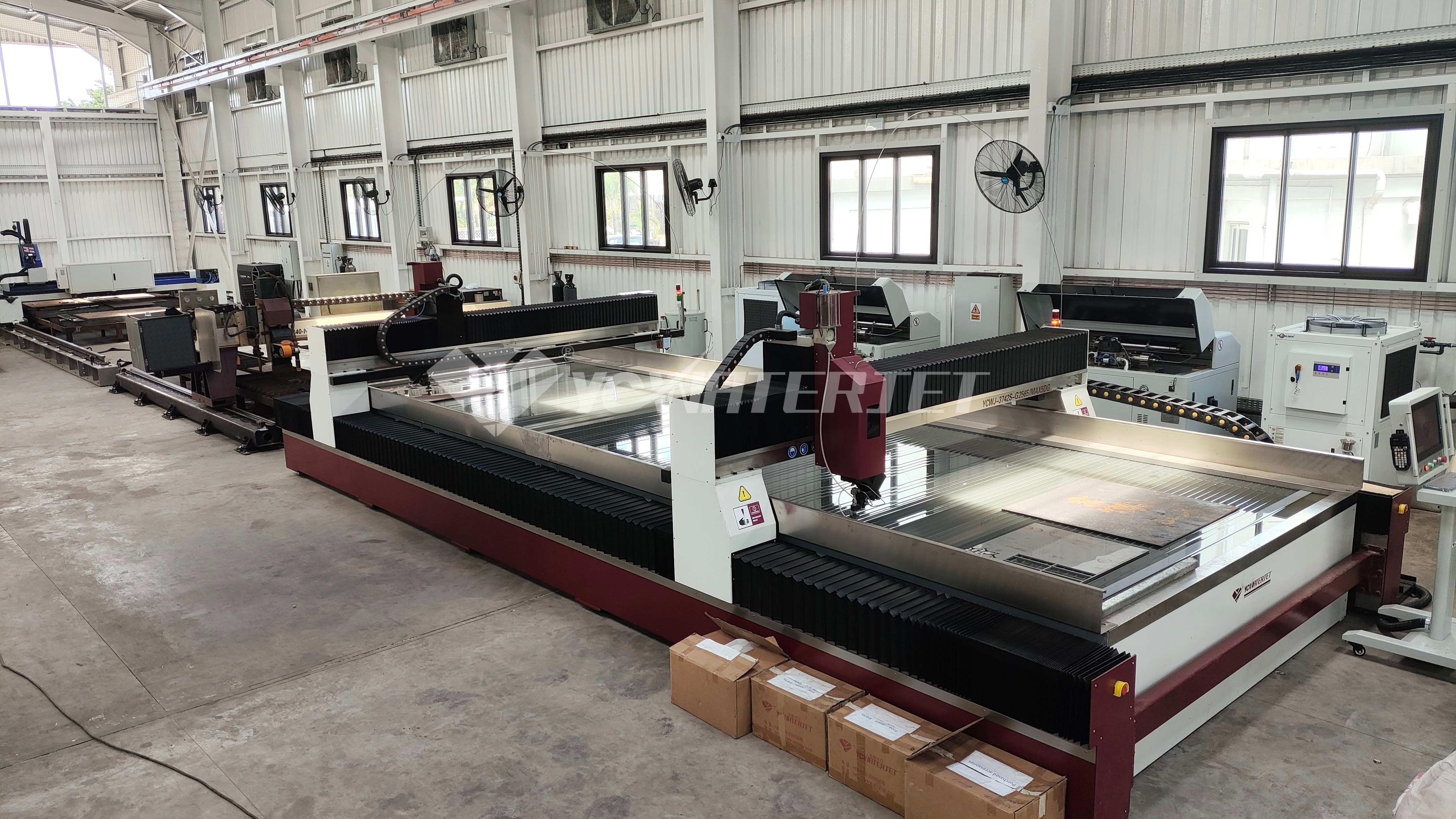
The G Series is specified with a double gantry structure and supports double or multiple cutting heads.
The clearest structural difference in this comparison is the gantry. The G Series is specified with a double gantry structure and is listed with double / multiple cutting heads. The E Series is published as a 3-axis / 3D MAX 5-axis / dynamic 5-axis machine without a multi-head designation. Three consequences follow.
Rigidity over span
A double gantry resists deflection differently from a single-frame structure, which matters as the platform grows and as tolerance targets are held at the edge of the envelope.
Head count and throughput
Running multiple cutting heads on a shared gantry is the standard way to multiply output on one table without buying a second machine. That configuration is published for the G Series, supported by its 7.4 L/min maximum water flow and 100 Hp / 75 kW maximum power ratings.
Site and installation requirements
A larger, heavier gantry changes the constraint set before delivery: floor footprint, foundation and levelling, crane or forklift access for unloading, and power supply routing. For split-type waterjets — the configuration often chosen where a single-piece platform cannot be moved into the plant — YC Waterjet provides on-site engineer assistance, with travel, visa, accommodation and service costs borne by the client. That is a planning item for the budget, not a surprise on arrival.
Decision rule: choose the gantry architecture by the number of heads you intend to run and the span you need, not by table size alone. A large table with one head and a large table with two heads are different machine classes.
Head-to-Head 4: Pressure, Water Flow and Power Matching
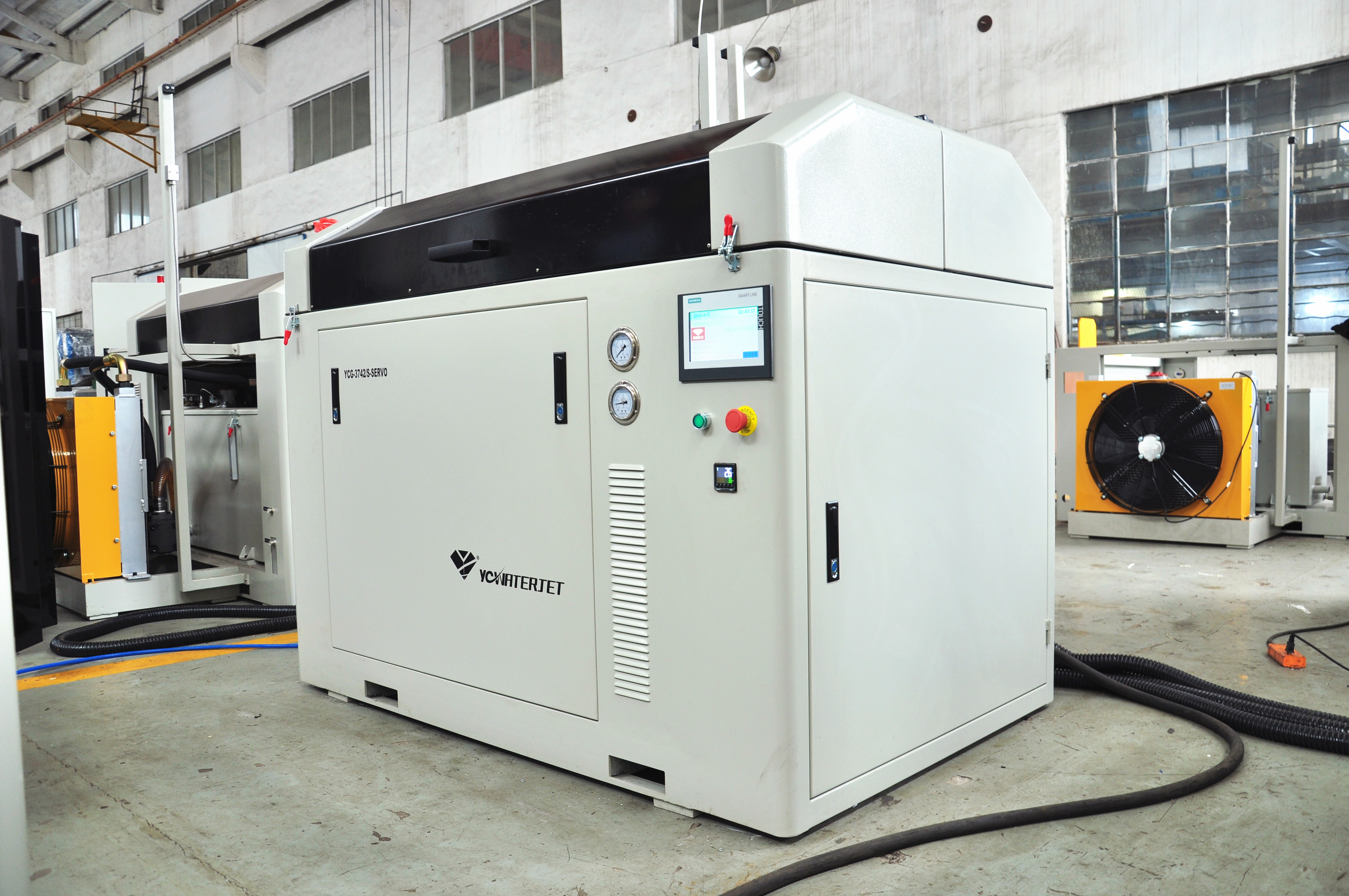
The shared 4137 Bar / 60,000 Psi pressure class — flow and installed power are what differ.
Both series run to the same 4137 Bar (60,000 Psi) maximum, but the flow and power ceilings are not the same.
- E Series: maximum pressure 4137 bar (60,000 psi); working pressure 340 MPa; maximum water flow 3.7 L/min.
- G Series: maximum pressure 4137 Bar / 60,000 Psi; maximum water flow 7.4 L/min; maximum orifice/nozzle 0.016” / 0.05”; maximum power 100 Hp / 75 kW.
The pump family available across YC Waterjet machines includes the YCG-3038, YCG-3742, YCG-3742S, YCG-Ultra100, YCG-SERVO50, YCG-Ultra100S and YCG-Servo50S models, with voltage options of 220 V / 380 V / 420 V, a working temperature range of 0–50 °C, and stainless steel / alloy steel construction.
Read the two parameter sets together. Equal pressure with double the flow ceiling and a stated 100 Hp / 75 kW power limit is what allows the G Series to feed more than one cutting head or to hold a high-duty cycle without the pump becoming the constraint. The E Series’ 3.7 L/min flow ceiling is matched to single-head precision work inside its 3000 × 2000 mm or 4000 × 2000 mm envelope.
This is also where the site survey matters: 100 Hp / 75 kW is an installed-power decision, not a catalogue detail. Confirm supply voltage, transformer capacity and cooling arrangement before the quotation is finalised.
E Series vs. G Series: Specification Comparison
| Parameter | E Series (YCWJ-E3020 / YCWJ-E4020) | G Series (YCWJ-G2060 / G2080 / G3080 / G30100) |
|---|---|---|
| Structure | Single-frame platform | Double gantry structure; double / multiple cutting heads listed |
| Effective cutting area | 3000 × 2000 mm (E3020); 4000 × 2000 mm (E4020) | Not published per model — confirm on quotation drawing |
| X,Y dry-run speed | 0–8 m/min | 0–15 m/min |
| Maximum pressure | 4137 bar (60,000 psi) | 4137 Bar / 60,000 Psi |
| Working pressure | 340 MPa | — |
| Maximum water flow | 3.7 L/min | 7.4 L/min |
| Maximum orifice / nozzle | — | 0.016” / 0.05” |
| Maximum power | — | 100 Hp / 75 kW |
| Cutting accuracy | ±0.1 mm | ±0.1 mm |
| Positioning accuracy | ±0.025 mm | ±0.025 mm |
| Axis configurations | 3-axis / 3D MAX 5-axis / dynamic 5-axis | 3-axis / 3D MAX 5-axis / dynamic 5-axis / multi-head |
| Construction material | Stainless steel; carbon steel | Stainless steel; carbon steel |
| Applicable industries | Aerospace, automotive, metalworking, architecture & decoration, composites, medical & food, rubber & soft materials | Same published scope as the E Series |
A dash indicates that the parameter is not published in the series data; confirm it against the quotation rather than assuming a value.
Step-by-Step: Turning Specs into a Configuration Decision
- Map the nest, not the part. Take your three largest recurring jobs and draw the actual nest. Record sheet size, nest footprint, part count and material thickness. If every nest fits within 4000 × 2000 mm, the E Series envelope covers it.
- Count the heads you intend to run. One head now and in the foreseeable plan points to the E Series. Two or more heads on a shared structure points to the G Series double gantry configuration.
- Compare non-cutting time against cut time. If rapid traverse and repositioning are a large share of the cycle, the G Series 0–15 m/min dry-run speed has measurable value. If cutting time dominates, it does not.
- Match flow and installed power to the duty cycle. 3.7 L/min maximum flow (E Series) versus 7.4 L/min with a 100 Hp / 75 kW power ceiling (G Series). Confirm site power capacity at the same time.
- Confirm the cutting area in writing. For the G Series, request the effective cutting area of the quoted model and make it an acceptance item.
- Verify certification scope against the ordered models. A certificate covering a manufacturer’s general scope is not the same as a certificate covering the series you are buying.
- Define the acceptance test before shipment. Specify coupon material, thickness and tolerance, plus the dry-run / positioning check and the documentation you expect at delivery inspection.
- Lock the commercial terms. MOQ, lead time, customization items, warranty, and who bears installation costs.
Use Cases: Where Each Configuration Has Been Proven
G Series in marine aluminium — Mauritius. A yacht manufacturer in Mauritius runs a YCWJ-3742S-G2565MAX5DG double gantry 5-axis waterjet system for aluminium plate cutting. The recorded results are precision-cut aluminium plates that meet marine-grade standards, reduced material waste and improved yacht production efficiency, with clean, burr-free edges and cold cutting that preserves material strength. The installation has been in service for 10 years — relevant evidence when evaluating gantry rigidity over time rather than on day one.
Precision processing — Austria. A diamond and crystal processor in Austria uses waterjet cutting for crystal component work, where cold cutting, zero thermal damage and stable long-term operation are the recorded outcomes. This is the envelope class where single-head precision platforms are typically specified.
Industry fit across both series. Both the E Series and the G Series publish the same applicable-industry scope: aerospace, automotive, metalworking, architecture and decoration, composites, medical and food, and rubber and soft materials. The industry does not decide E versus G — nest size, head count and duty cycle do.
Purchasing Terms, Certification and Acceptance Criteria
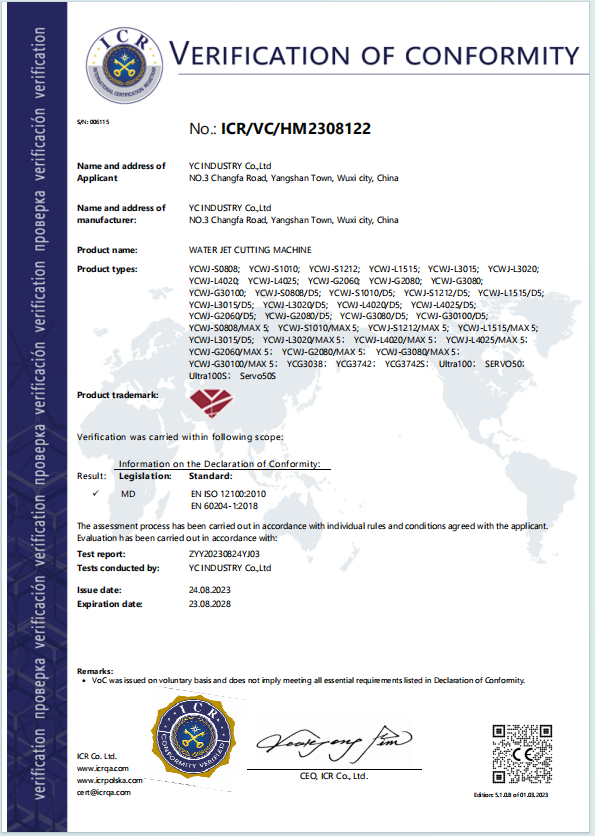
CE verification of conformity, certificate ICR/VC/HM2308122, issued by ICR Co., Ltd., for the EU market.
Published commercial terms for YC Waterjet machines apply to both series: MOQ 1 set; lead time 30–45 days; monthly production capacity 10 sets; OEM / ODM production with customization available for logo, cutting head, cutting area, cutting speed, voltage, cutting thickness and height measurement; quality control by delivery inspection, with rigorous pre-delivery testing on every unit.
After-sales coverage: a one-year warranty on the machine excluding consumable parts; free replacement parts for non-manual defects; remote guidance with manual and video support; and on-site engineer assistance available — for example for split-type waterjets — with travel, visa, accommodation and service costs borne by the client.
Compliance documentation to request with the quotation:
- CE verification of conformity — certificate ICR/VC/HM2308122, issued by ICR Co., Ltd., covering the Water Jet Cutting Machine (including multiple models: YCWJ series, Ultra100, Servo50S, etc.) for the EU market, valid from 2023-08-24 to 2028-08-23, against the Machinery Directive and EN ISO 12100:2010 and EN 60204-1:2018.
- ISO 9001 — certificate 17324Q21401R0S, issued by Beijing Zhongjiaoyuanhang Certification Co., Ltd. against GB/T 19001-2016/ISO 9001:2015, covering R&D and manufacture of ultra high pressure water jet cutting machines, valid from 2024-10-29 to 2028-10-28.
- Standard scope check — ISO 21789 is commonly cited as the primary safety standard for water jetting equipment, covering operator protection and design specifications for pressures up to 3000 bar. Where a machine is operated at a 4137 Bar maximum, ask the supplier to state which standards and pressure scope its documentation actually covers rather than assuming the citation applies unchanged.
Acceptance criteria to write into the order: effective cutting area verified against the drawing; X,Y dry-run speed demonstrated; cutting and positioning accuracy verified with a coupon on a named material and thickness; pump model, voltage and rated flow confirmed against the quotation; certificate numbers and scope confirmed for the delivered models; consumable and spare-parts list identified; handover training documented.
FAQ: E Series vs. G Series CNC Waterjet
Are the E Series and G Series covered by CE and ISO 9001 certification?
Yes, within the scope stated on the certificates. The CE verification of conformity, certificate ICR/VC/HM2308122 issued by ICR Co., Ltd., applies to the Water Jet Cutting Machine for the EU market, covers multiple models including the YCWJ series, and is valid from 2023-08-24 to 2028-08-23 against the Machinery Directive, EN ISO 12100:2010 and EN 60204-1:2018. The ISO 9001 certificate 17324Q21401R0S, issued by Beijing Zhongjiaoyuanhang Certification Co., Ltd. against GB/T 19001-2016/ISO 9001:2015, covers R&D and manufacture of ultra high pressure water jet cutting machines and is valid from 2024-10-29 to 2028-10-28. Because the certificate scope is series-level, buyers should confirm in writing that the specific ordered models — YCWJ-E3020/E4020 or YCWJ-G2060/G2080/G3080/G30100 — are included in the document set supplied with the machine.
Can the G Series run more than one cutting head?
The G Series is specified with a double gantry structure and is listed as available with double or multiple cutting heads, alongside 3-axis, 3D MAX 5-axis and dynamic 5-axis configurations. Its published parameters — 4137 Bar / 60,000 Psi maximum pressure, 7.4 L/min maximum water flow, 0.016” / 0.05” maximum orifice/nozzle and 100 Hp / 75 kW maximum power — define the pump and power headroom available to feed that configuration. The E Series is published as a 3-axis / 3D MAX 5-axis / dynamic 5-axis machine without a multi-head designation.
What drives the configuration difference between an E Series and a G Series machine?
Three published differences drive the configuration choice: table envelope (E Series effective cutting area of 3000 × 2000 mm or 4000 × 2000 mm, versus the larger gantry-class platform designated by the G Series model range); the double gantry structure and multi-head capability on the G Series; and the pump and power class (3.7 L/min maximum flow on the E Series versus 7.4 L/min with a 100 Hp / 75 kW maximum power on the G Series). Installation scope also affects the total cost of ownership — for split-type waterjets, on-site engineer assistance is available with travel, visa, accommodation and service costs borne by the client. Request a quotation itemised by machine configuration, pump model and installation scope so both options can be compared on the same basis.
How can accuracy be validated before shipment and at delivery?
Every unit undergoes rigorous pre-delivery testing, and delivery inspection is the published quality control step. Accuracy validation should still be written into the order as a defined test: a named material and thickness, a defined coupon geometry, and the published tolerance targets of ±0.1 mm cutting accuracy and ±0.025 mm positioning accuracy. Because cutting speed is published as a function of material and thickness rather than as a fixed figure, the coupon test also establishes the realistic cutting speed for your own job — more useful than any catalogue number. Customization options covering cutting area, cutting speed, cutting thickness and height measurement can be specified at order stage so the acceptance test matches the delivered configuration.
What are the minimum order quantity and lead time?
MOQ is 1 set and lead time is 30–45 days, with a monthly production capacity of 10 sets. OEM/ODM production is available with customization for logo, cutting head, cutting area, cutting speed, voltage, cutting thickness and height measurement. Warranty coverage is one year on the machine excluding consumable parts, with free replacement parts for non-manual defects, remote guidance with manual and video support, and optional on-site engineer assistance. Buyers planning an installation date should confirm lead time, shipping and site preparation — foundation, power supply and unloading access — together, since a gantry-class machine adds site requirements before commissioning.
Conclusion: Choose the Envelope and the Gantry, Not the Pressure Rating
The E Series and the G Series CNC waterjet cutting machines are not separated by pressure or accuracy. Both run to 4137 Bar / 60,000 Psi maximum, both hold ±0.1 mm cutting accuracy and ±0.025 mm positioning accuracy, and both are built in stainless steel and carbon steel for the same published industry scope. What separates them is the decision set this article set out to isolate: effective cutting area (3000 × 2000 mm or 4000 × 2000 mm on the E Series, with G Series areas confirmed per model on the drawing), X,Y dry-run speed (0–8 vs 0–15 m/min), gantry architecture (standard frame versus double gantry with multi-head capability), and pump class (3.7 L/min versus 7.4 L/min with a 100 Hp / 75 kW power ceiling).
If your nests fit the E Series envelope and you run a single head, that configuration is sufficient and easier to install. If you run multi-head production on large-format plate, the G Series double gantry platform is the class that matches the duty cycle. Either way, the acceptance test — cutting area, dry-run speed, coupon tolerance, certificate scope, pump model and spares — should be defined before the order is placed, not after the machine is on the floor.
Next Step
To confirm which configuration fits a specific job, share your largest nest size, material and thickness, and target daily output. YC Waterjet can return a configuration proposal covering the cutting area, gantry and head arrangement, matched pump model, certification documents and the acceptance test specification.
Email: sales@ycwaterjet.com · Tel / WhatsApp: +86 13861858095 · Website: www.ycwaterjet.com
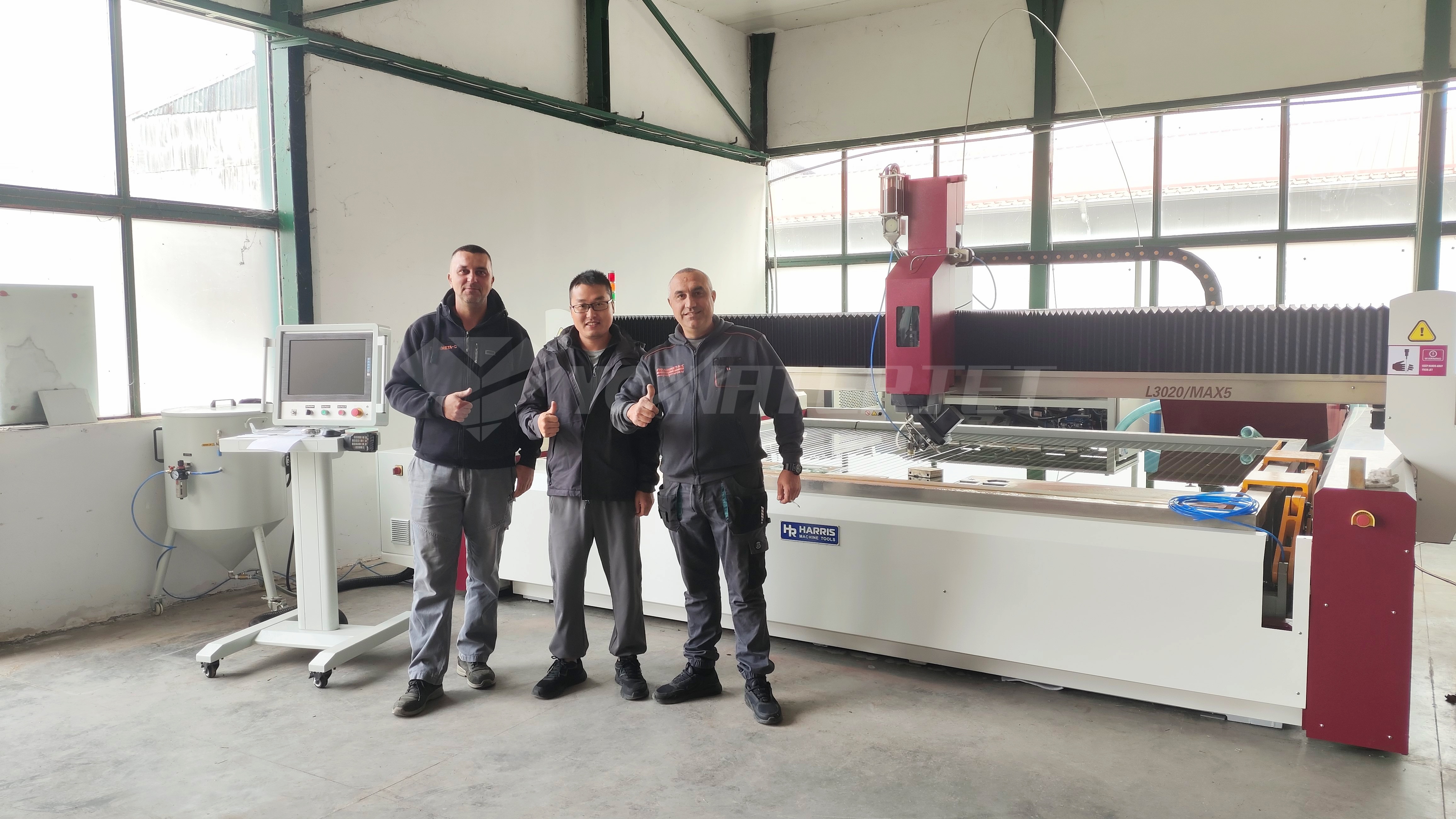
Pre-delivery testing, delivery inspection and remote technical support apply to both the E Series and the G Series.
Have Questions or Need More Details?
Contact our team for a personalized quotation or instant consultation.
Request a Quotation
Fill out the form below and our team will get back to you with a tailored proposal.
WhatsApp Direct Chat
Prefer to chat in real-time? Message us on WhatsApp for instant assistance & quick answers.
- Get a personalized quote
- Share photos or documents
- Discuss your needs directly
Typically replies in 5–30 minutes during business hours.