
E Series vs L Series vs G Series Waterjet: Which Fits Your Budget?
E Series vs L Series vs G Series Waterjet: Which Fits Your Budget?
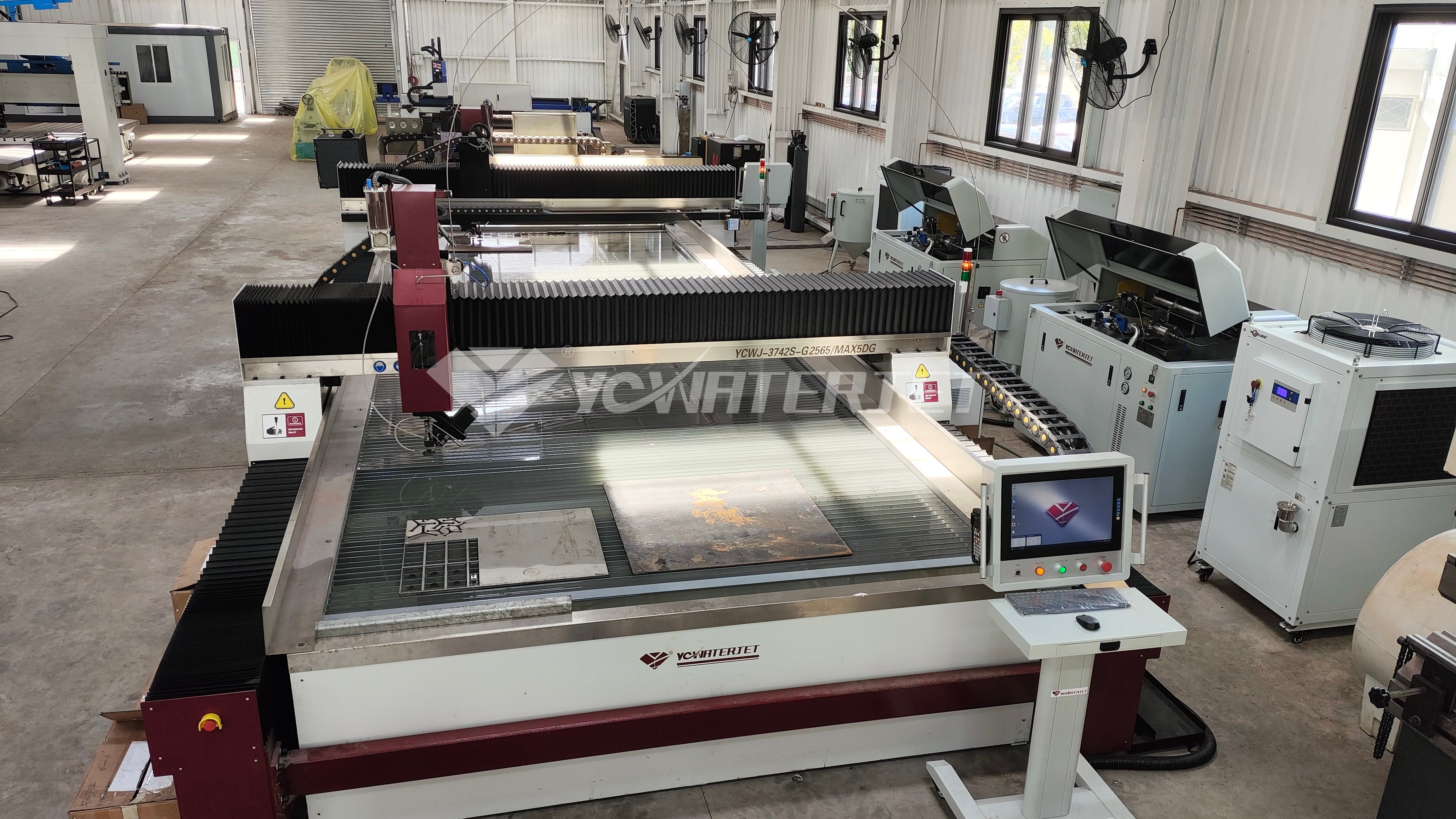
Choosing between the YC Waterjet E Series, L Series and G Series is a configuration decision, not a quality ranking. All three families are documented at the same core performance values — ±0.1 mm cutting accuracy, ±0.025 mm positioning accuracy and a 4137 bar (60,000 psi) maximum pressure — so the useful question is not which machine is better, but how much effective cutting area, dry-run speed and CNC capability your part mix actually requires you to buy.
The short answer for buyers who already hold quotations: if one cutting head, an effective cutting area of 3,000 × 2,000 mm or 4,000 × 2,000 mm and a 0–8 m/min X,Y dry-run speed cover your work, the E Series (YCWJ-E3020 / YCWJ-E4020) is the documented match. If your throughput target calls for a 0–15 m/min dry-run speed, a 7.4 L/min maximum water flow and double or multiple cutting heads, the L Series (YCWJ-L1515 to YCWJ-L4025) is the documented match. If your parts are long-format plates that need a double-gantry platform, the G Series (YCWJ-G2060 to YCWJ-G30100) is the match. The sections below show exactly where those three lines are drawn, and what to confirm in writing before you release budget.
Why E, L and G Series Quotations Are Hard to Compare
Three quotations for the same application rarely arrive on the same basis. One may quote a bare 3-axis machine with a single head, another a 5-axis head with a different pump model, and a third a two-head configuration on a larger table. Because the line items differ, the totals cannot be compared directly — and the buyer ends up making a budget decision on incomplete information.
Three failure modes account for most of the budget mistakes in this segment:
- Over-buying envelope. A table larger than the part mix needs adds floor space, foundation work, crane requirements, power feed and moving-mass maintenance that never produce a single extra part. Cutting area is the most common place where budget is spent without a return.
- Under-buying motion and head capacity. Dry-run speed and head count determine how many parts leave the table per shift. Both are structural: a 0–8 m/min platform cannot be upgraded to a 0–15 m/min platform by changing software, and a machine documented without double or multiple cutting heads is not the platform on which to plan multi-head production.
- Comparing non-normalised quotations. Pump model, axis configuration, head count, height measurement and warranty terms must be identical across the quotations before any price comparison means anything.
Working definition for the rest of this article: the budget-fit series is the configuration that satisfies your part envelope, your required dry-run speed and your head-count requirement at the lowest total configuration cost — not the machine with the largest table or the highest axis count.
Industry Background: The Market Behind Your E, L or G Decision
The waterjet category is large enough that configuration choices are now driven by throughput economics rather than by availability. Published market research estimates the global waterjet cutting machine market at between USD 1.11 billion and USD 1.86 billion in 2025, with projections reaching up to USD 2.39 billion by 2030; the spread between research houses is wide, so treat any single figure as a directional signal rather than a precise number.
Two structural facts matter more to a buyer than the headline size. First, Asia-Pacific accounted for 37.8% of global waterjet cutting machine revenue in 2024, reflecting the density of manufacturing in China, India and Japan — which is also where a large share of the machine platforms are built. Second, abrasive waterjet technology is estimated to account for 49.5% of the product segment share in 2026, and metal cutting for 54.2% of the application segment. In other words, the mainstream configuration is an abrasive machine cutting metal, which is precisely the configuration range covered by the E, L and G Series.
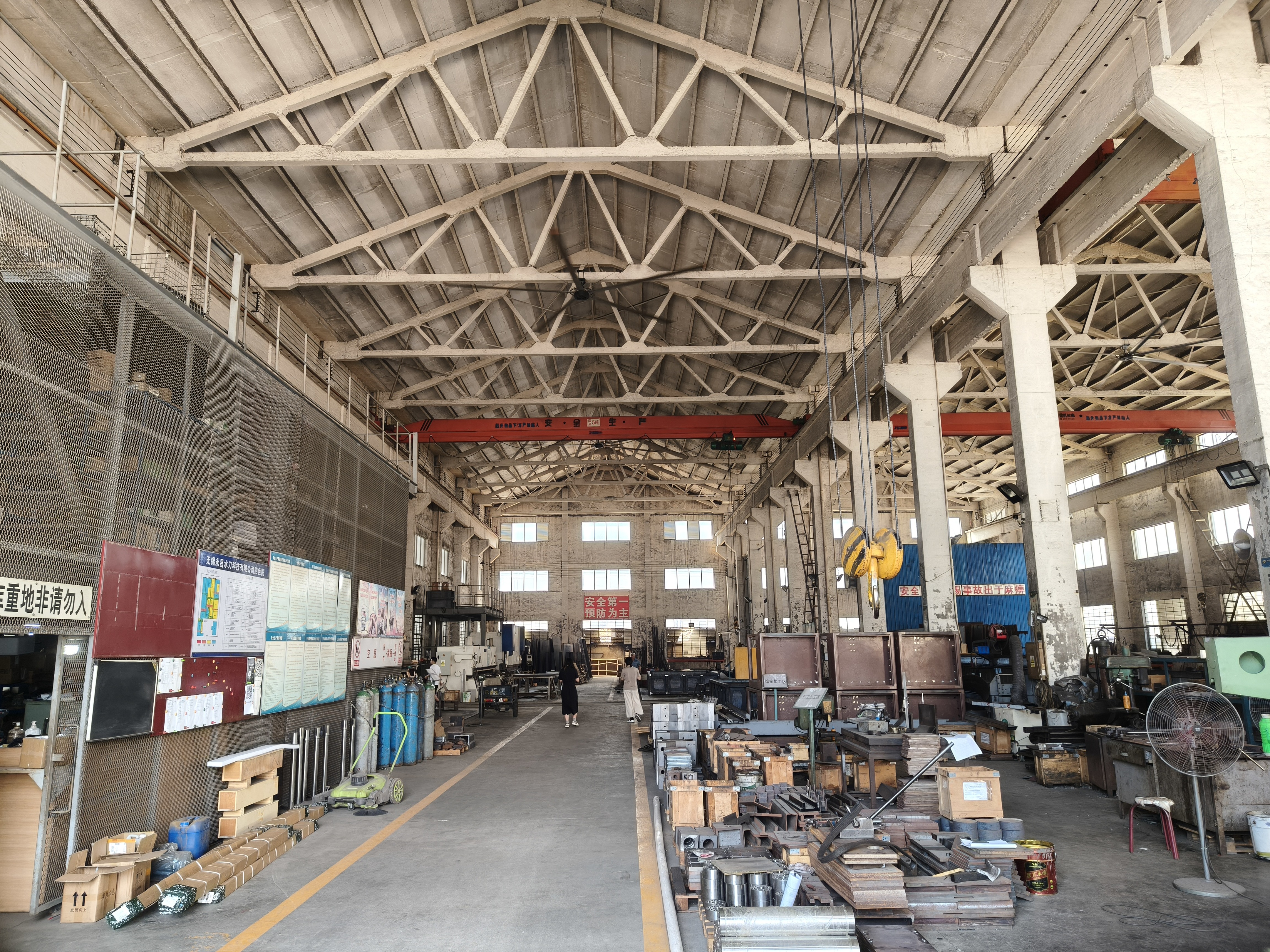
The high-pressure pump is where a significant share of machine value sits, and the global pump supply base is concentrated: 2025 estimates put Flow International at 22.1% share, KMT Waterjet at 18.5% and OMAX Corp at 15.2% of the waterjet high-pressure pump market. YC Water Jet Technology Co., Ltd, founded in 1999 and operating from a 7,000 m² production base in Wuxi, Jiangsu, has worked with KMT (Germany) and Accustream / Hypertherm (USA) components since 2005, and its systems are now exported to more than 140 countries and regions as of 2026, with an export ratio of roughly 70% of output.
Why this matters to your budget: whenever you compare an E, L or G quotation, the pump model listed on the configuration sheet should be compared line by line. Two quotations for the same table size can differ mainly because one carries a different pump specification, and the pump governs both the achievable pressure and the long-run consumable economics.
What the E, L and G Series Share Before They Diverge
Before comparing differences, it is worth being precise about what does not change across the three families. Every YC Waterjet series — S, L, G and E — is documented with the same accuracy class and the same pressure ceiling:
- Cutting accuracy: ±0.1 mm.
- Positioning accuracy: ±0.025 mm.
- Maximum pressure: 4137 bar / 60,000 psi.
- Nozzle and orifice reference (published for the wider machine range): 0.016" orifice / 0.05" nozzle.
- Materials: stainless steel and carbon steel as the base cutting materials, with documented applications across aerospace, automotive, metalworking, architecture and decoration, composites, medical and food, and rubber and soft materials.
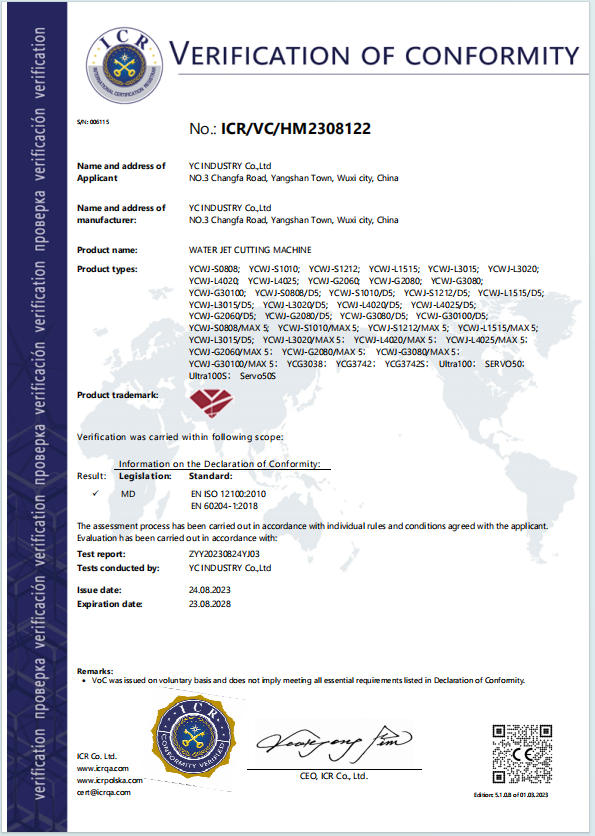
Compliance coverage is shared as well. The Verification of Conformity (CE certification) issued by ICR Co., Ltd., certificate number ICR/VC/HM2308122, dated 24 August 2023 and valid until 23 August 2028, explicitly lists the YCWJ-E3020 and YCWJ-E4020, the L Series models (YCWJ-L1515, L3015, L3020, L4020, L4025) and the G Series models (YCWJ-G2060, G2080, G3080, G30100) within its scope, declared against the Machinery Directive with EN ISO 12100:2010 and EN 60204-1:2018 for the EU market. Manufacturing is additionally covered by an ISO 9001:2015 quality management system certificate (certificate 17324Q21401R0S, valid until 28 October 2028, scope: R&D and manufacture of ultra high pressure water jet cutting machines).
The practical consequence is that certification is not the deciding factor between the E, L and G Series. The decision sits in effective cutting area, dry-run speed band and CNC and cutting-head configuration.
Detailed Comparison: Where the E, L and G Series Diverge
E Series (YCWJ-E3020 / YCWJ-E4020): A Published Envelope, Single-Head Focus
The E Series is the family for which YC Waterjet publishes the effective cutting area directly: 3,000 × 2,000 mm on the YCWJ-E3020 and 4,000 × 2,000 mm on the YCWJ-E4020. Published values also include ±0.1 mm cutting accuracy, ±0.025 mm positioning accuracy, an X,Y dry-run speed of 0–8 m/min, a maximum pressure of 4137 bar (60,000 psi), a working pressure of 340 MPa and a maximum water flow of 3.7 L/min.
On configuration, the E Series is documented in 3-axis, 3D MAX 5-axis and dynamic 5-axis CNC forms; the published data does not list double or multiple cutting-head configurations for this family. That is the most important structural sentence in this section for a budget discussion: the E Series is a platform for a single cutting head, at a traversing rate that suits smaller and medium work envelopes.
L Series (YCWJ-L1515 to YCWJ-L4025): Higher Traverse and Multi-Head Capability
The L Series spans five models — YCWJ-L1515, YCWJ-L3015, YCWJ-L3020, YCWJ-L4020 and YCWJ-L4025 — and changes two parameters that directly affect production economics. The X,Y dry-run speed is documented at 0–15 m/min, roughly double the E Series band, and the maximum water flow is 7.4 L/min against 3.7 L/min. Maximum pressure remains 4137 bar / 60,000 psi, the nozzle/orifice reference is 0.016" / 0.05", and maximum power is 100 Hp / 75 kW.
Configuration is where the L Series separates most clearly from the E Series. The published data lists 3-axis, 3D MAX 5-axis and dynamic 5-axis CNC forms, and additionally a double / multiple cutting-head configuration. For a buyer planning two-head or multi-head production, that difference is not a feature upgrade — it is a different class of machine, and it should be treated as such in the budget.
G Series (YCWJ-G2060 to YCWJ-G30100): The Double-Gantry Platform
The G Series covers four models — YCWJ-G2060, YCWJ-G2080, YCWJ-G3080 and YCWJ-G30100 — and is the double-gantry family in the range. The Mauritius yacht installation referenced later in this article uses the YCWJ-3742S-G2565MAX5DG, a double-gantry 5-axis water jet system. Documented motion, pressure and power values match the L Series: 0–15 m/min X,Y dry-run speed, 4137 bar (60,000 psi) maximum pressure, 7.4 L/min maximum water flow, 100 Hp / 75 kW maximum power, with 3-axis, 3D MAX 5-axis, dynamic 5-axis and double / multiple cutting-head configurations listed.
Because published data for the L and G Series specifies the model range and platform type rather than a single effective cutting area figure, the model-level envelope for those two families is confirmed in the quotation. Buyers should request it in writing before comparing prices — a G2060 and a G30100 are not interchangeable budget items, and the same logic applies across the five L Series models.
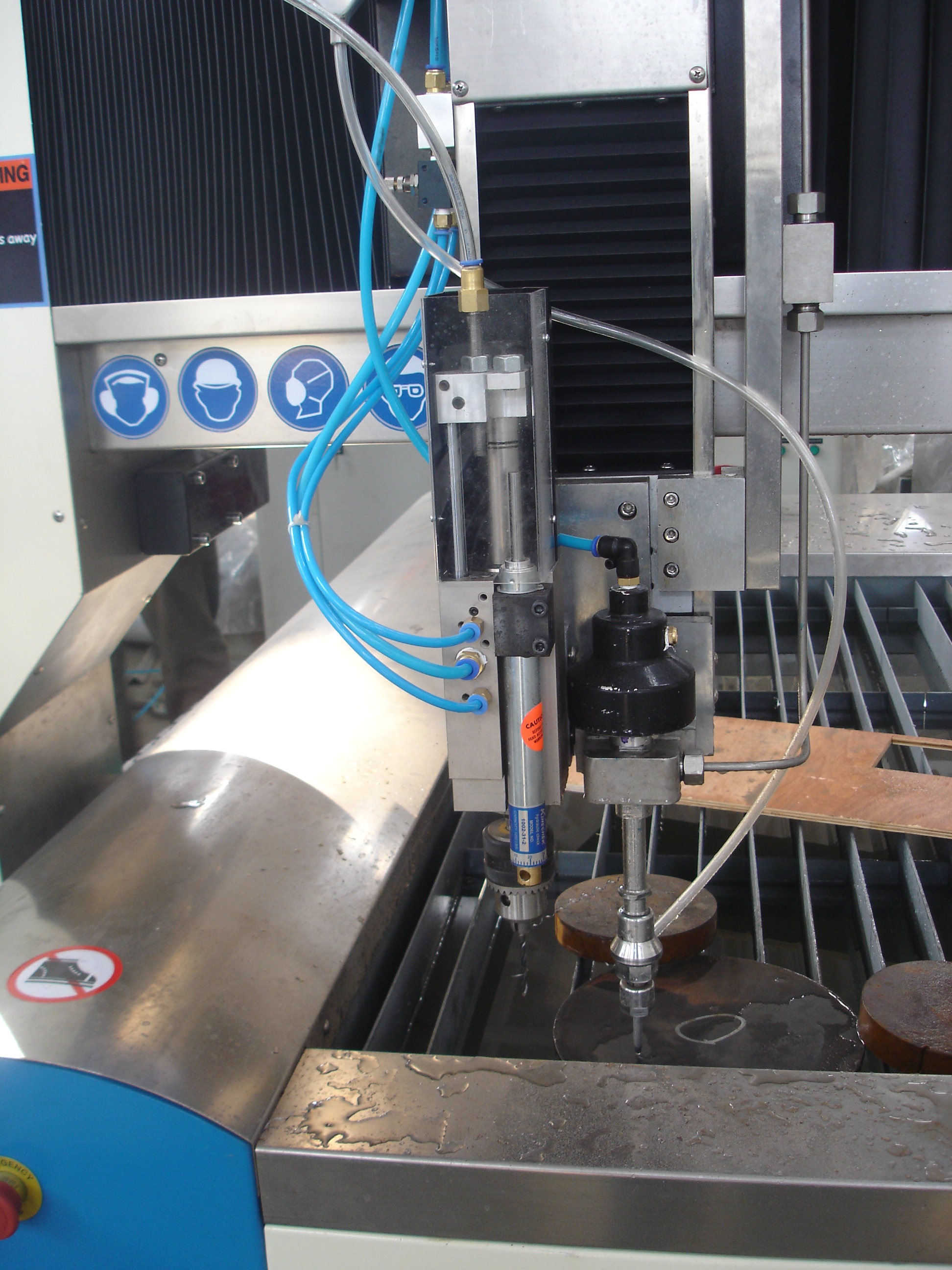
The Five Cost Drivers Behind Any E, L or G Quotation
YC Waterjet does not publish list prices for the E, L and G Series, because a waterjet cutting machine is configured rather than catalogued. Five drivers explain most of the variation between two quotations for the same application:
- Effective cutting area and platform structure. Table size drives steel mass, floor space, foundation requirements and the moving mass the drives must control. The E Series publishes 3,000 × 2,000 mm and 4,000 × 2,000 mm envelopes; L and G Series envelopes are confirmed per model.
- X,Y dry-run speed band. The documented 0–8 m/min (E Series) versus 0–15 m/min (L and G Series) difference reflects different drive sizing. Dry-run speed is non-cutting time: the faster the traverse, the more pierces and short contours you can complete per shift.
- Cutting-head count. Double or multiple cutting heads are documented for the L and G Series and not for the E Series. Each additional head multiplies productive capacity but also multiplies water, abrasive and maintenance demand.
- Axis configuration. 3-axis, 3D MAX 5-axis and dynamic 5-axis are three different machines in cost and programming terms. 3D waterjet cutting and bevel work require the 5-axis platforms; flat 2D profile cutting does not.
- Pump model. The high-pressure pump is the single largest subsystem decision. YC Waterjet pump models include YCG-3038, YCG-3742, YCG-3742S, YCG-Ultra100, YCG-SERVO50, YCG-Ultra100S and YCG-Servo50S, with voltage options of 220 V / 380 V / 420 V, maximum pressure of 4137 bar / 60,000 psi, maximum water flow of 7.4 L/min and a working temperature range of 0–50 °C.
On top of those five drivers, YC Waterjet offers OEM / ODM customization covering logo, cutting head, cutting area, cutting speed, voltage, cutting thickness and height measurement. Every one of those options is a budget line, which is why a quotation that does not state them cannot be compared with one that does.
CNC Configuration: 3-Axis, 3D MAX 5-Axis and Dynamic 5-Axis
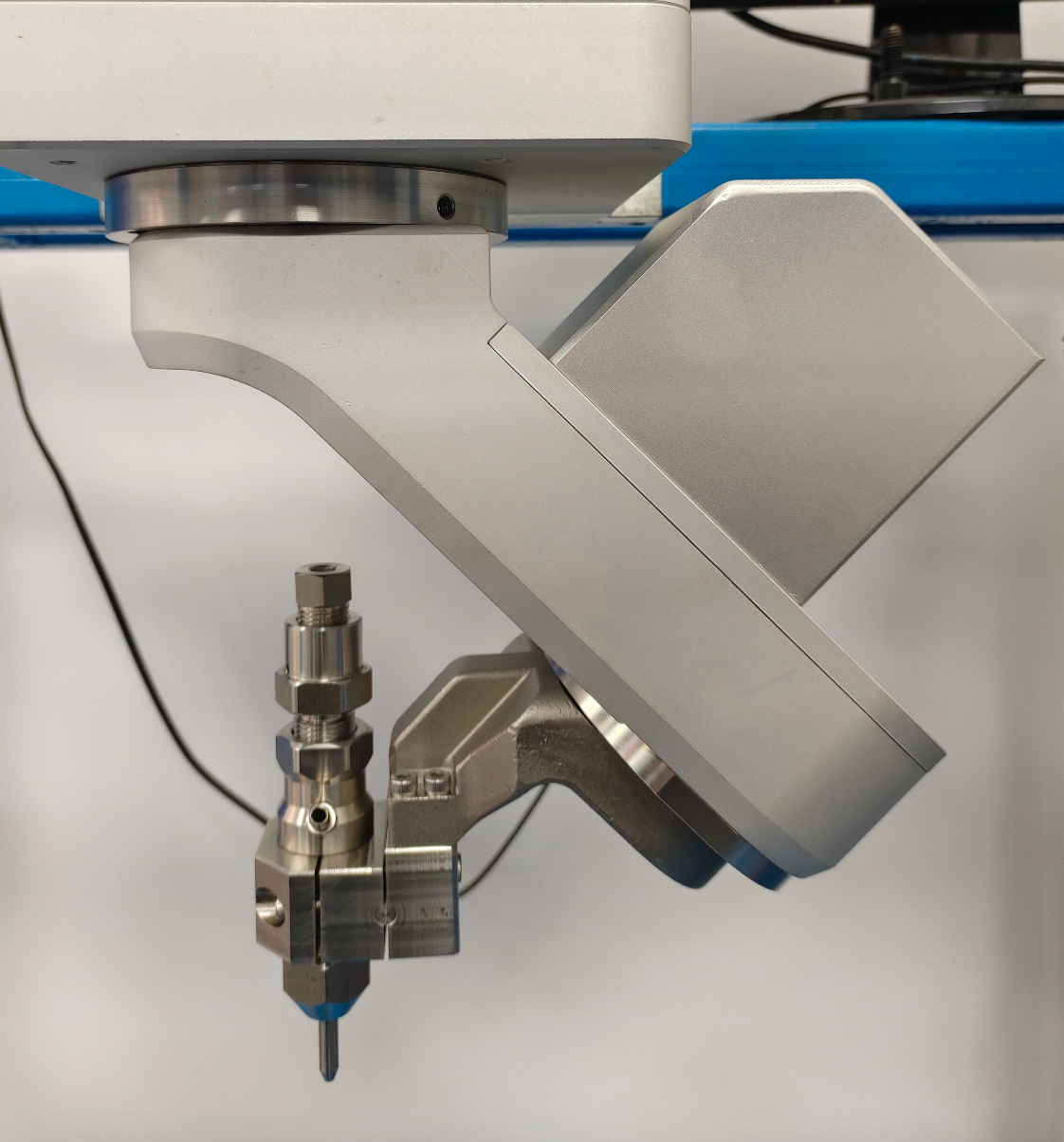
The three CNC configuration terms used across the E, L and G Series are not marketing labels; they describe what the cutting head can physically do. A 3-axis machine cuts vertical profiles in flat material — the standard choice for 2D profile work in metal, stone and glass. A 3D MAX 5-axis head adds two rotary axes to follow the surface or produce angled edges. A dynamic 5-axis head is designed for continuous multi-directional motion, which is the configuration behind bevel cutting and complex 3D waterjet cutting.
For budget purposes the rule is simple: buy the axis configuration your most demanding repeat job requires, and not one level above it. A 5-axis platform on a workload that never leaves vertical cutting adds capital and programming complexity without changing output.
Step-by-Step: Matching a Series to Your Budget in Six Steps
- Map your largest part and your most frequent part. The largest part sets the minimum envelope; the most frequent part sets the productivity requirement. If both fit inside 4,000 × 2,000 mm, the E Series envelope is a genuine option rather than a compromise. If not, work upward through the L Series models and then the G Series.
- Decide whether one head is enough. If your output target cannot be met by a single head on a 0–8 m/min platform, the documented move is to the L Series, which lists double and multiple cutting-head configurations. Do not plan multi-head production on a platform whose published configuration data does not include it.
- Fix the axis requirement before the envelope. If you cut flat profiles only, 3-axis is the correct and least expensive configuration. If you need bevels, angled edges or 3D geometry, the choice is between 3D MAX 5-axis and dynamic 5-axis heads, and that decision applies within all three series.
- Size the pump against the material and thickness you cut most. Maximum pressure of 4137 bar / 60,000 psi is common across the range, so the differentiator is the pump model and its flow rating. Ask for the pump model in writing.
- Price the options separately. Height measurement, cutting head type including drilling-head options, cutting area changes, cutting speed, cutting thickness and voltage are all listed customization points. Options quoted as a lump sum cannot be evaluated later.
- Normalise the three quotations before comparing totals. Same envelope, same head count, same axis configuration, same pump model, same warranty scope. Only then does the price difference carry information.
Plan the schedule as carefully as the specification. YC Waterjet operates a minimum order quantity of 1 set, a documented production lead time of 30–45 days and a monthly capacity of 10 sets. For a project with a fixed installation date, the production slot is part of the budget conversation, not a detail to confirm afterwards.
Use Cases: Which Configuration Fits Which Production Reality
Stone and Marble Furniture in Germany: L Series with a MAX5 Head
A German home-furniture manufacturer cutting marble and stone for kitchen countertops and basins runs a YCWJ-3742-L4022/MAX5 — an L Series platform fitted with a MAX5 head. The documented results of that case are high-precision stone cutting, stable operation and boosted yield, with highlights including versatile stone adaptation for clean cuts with zero chipping and low-noise, dust-free cold cutting suitable for a premium furniture workshop.
This case illustrates the L Series position in the budget discussion: the envelope is moderate, but the head configuration and the cut quality requirement drive the specification. A buyer with the same part mix but no bevel or 3D requirement should compare an equivalent L Series model with a 3-axis head before assuming the MAX5 configuration is necessary.
Yacht Aluminium Plates in Mauritius: G Series Double Gantry
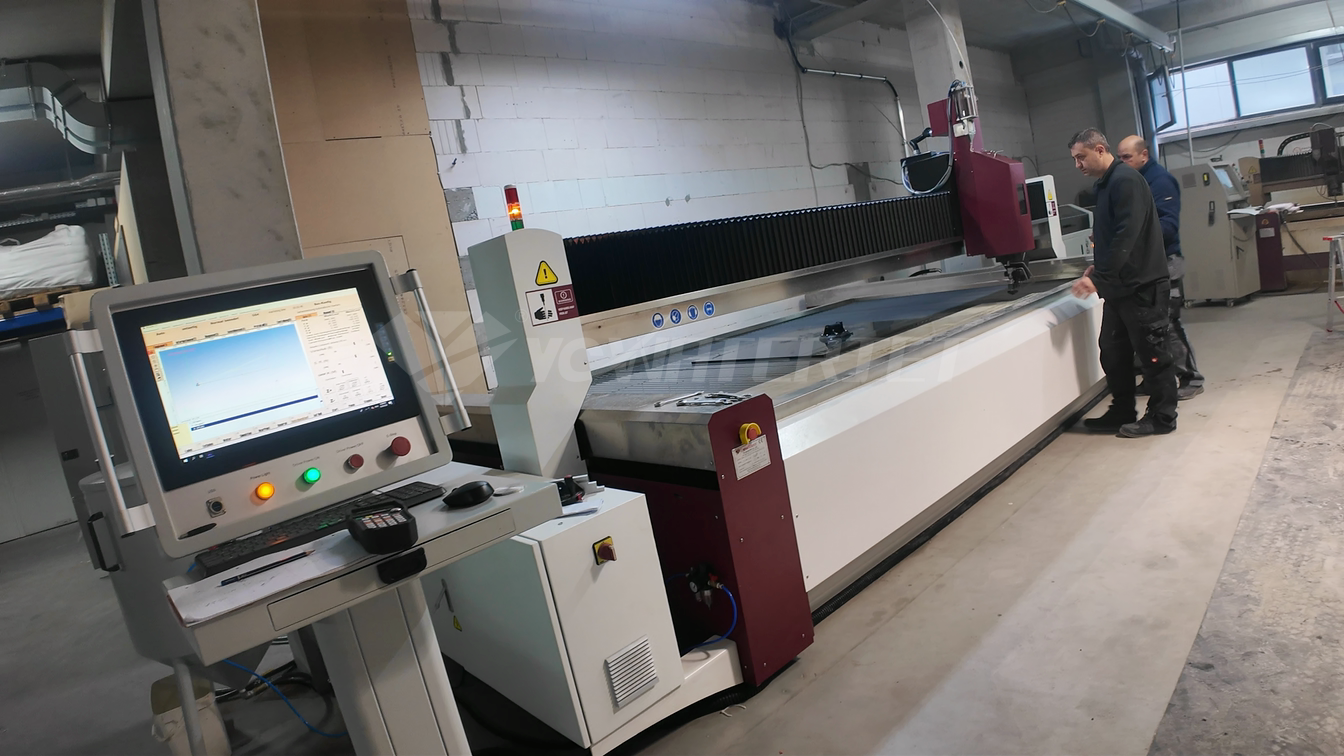
A yacht manufacturer in Mauritius cuts aluminium plates on a YCWJ-3742S-G2565MAX5DG, a double-gantry 5-axis water jet system. Documented highlights include clean, burr-free precision cuts for yacht components and cold cutting that preserves material strength without thermal deformation; documented results include precision-cut yacht aluminium plates meeting marine-grade standards and reduced material waste.
This is the clearest illustration of when the G Series earns its budget position: long-format panel work where the double-gantry structure carries the cutting head across a long table, combined with a 5-axis head for the angled and contoured cuts that yacht components require. If your parts are plate-format and long, the comparison should start at the G Series rather than at the largest single-gantry model.
Precision Industrial Parts and Crystal Processing: What Cold Cutting Buys You
Two further installations show the quality baseline that applies regardless of which series you buy. An industrial manufacturing customer in Thailand cuts precision parts in a tropical climate, and the documented outcome is high-precision cold cutting with no thermal deformation, precision-cut industrial parts with high accuracy and reduced scrap. An Austrian diamond and crystal processing manufacturer uses waterjet cutting for high-yield complex processing with zero thermal damage, stable long-term operation and low-noise, eco-friendly operation.
For a buyer evaluating E, L and G quotations, these cases define the minimum standard the machine must meet: cold cutting with no heat-affected zone, repeatable accuracy, and stable operation over years. The series decision then becomes a question of envelope, speed and head count needed to reach that standard on your own parts — not of cut quality, which is common to all three families.
E Series vs L Series vs G Series: Documented Specification Table
The table below compares only values published by YC Waterjet for the three families. Where the published data does not state a value for a family, that is marked as such rather than estimated.
| Documented parameter | E Series | L Series | G Series |
|---|---|---|---|
| Models | YCWJ-E3020, YCWJ-E4020 | YCWJ-L1515, L3015, L3020, L4020, L4025 | YCWJ-G2060, G2080, G3080, G30100 |
| Effective cutting area | 3,000 × 2,000 mm / 4,000 × 2,000 mm | Model range published; area confirmed per model at quotation | Model range published; area confirmed per model at quotation |
| Cutting accuracy | ±0.1 mm | ±0.1 mm | ±0.1 mm |
| Positioning accuracy | ±0.025 mm | ±0.025 mm | ±0.025 mm |
| X,Y dry-run speed | 0–8 m/min | 0–15 m/min | 0–15 m/min |
| Maximum pressure | 4137 bar / 60,000 psi | 4137 bar / 60,000 psi | 4137 bar / 60,000 psi |
| Maximum water flow | 3.7 L/min | 7.4 L/min | 7.4 L/min |
| Maximum power | Not stated in published data | 100 Hp / 75 kW | 100 Hp / 75 kW |
| Documented CNC configurations | 3-axis; 3D MAX 5-axis; dynamic 5-axis | 3-axis; 3D MAX 5-axis; dynamic 5-axis; double / multiple cutting heads | 3-axis; 3D MAX 5-axis; dynamic 5-axis; double / multiple cutting heads |
| Platform character | Published single-head envelope family | Higher traverse and multi-head capability | Double-gantry platform (e.g. YCWJ-3742S-G2565MAX5DG) |
| CE certification scope | Covered by ICR/VC/HM2308122 | Covered by ICR/VC/HM2308122 | Covered by ICR/VC/HM2308122 |
Budget Decision Map
Use the following table to translate a production requirement into a documented series match and a written confirmation list.
| Requirement signal | Documented series match | Confirm in writing |
|---|---|---|
| Single head; largest part within 4,000 × 2,000 mm; dry-run up to 8 m/min sufficient | E Series (YCWJ-E3020 / E4020) | Model-level effective cutting area; pump model; head type (3-axis / 3D MAX 5-axis / dynamic 5-axis) |
| Higher traverse and double or multiple cutting heads for throughput | L Series (YCWJ-L1515 to L4025) | Number of cutting heads; pump model; table size; controller and nesting configuration |
| Long-format plate requiring a double-gantry platform | G Series (YCWJ-G2060 to G30100) | Gantry and table layout; floor plan and foundation requirements; head configuration |
| Frequent material or thickness changes | Any family, with documented options | Height measurement; cutting head specification (including drilling-head option); voltage; cutting thickness range |
| Fixed installation date | All families: MOQ 1 set, 30–45 days lead time, 10 sets monthly capacity | Production slot; pre-delivery test scope; after-sales terms |
FAQ: E, L and G Series Waterjet Budget Questions
Are the E, L and G Series covered by the same CE certification?
Yes. The Verification of Conformity (CE certification) issued by ICR Co., Ltd. under certificate number ICR/VC/HM2308122, dated 24 August 2023 and valid until 23 August 2028, covers the YCWJ water jet cutting machine range including YCWJ-E3020 and YCWJ-E4020, the L Series (YCWJ-L1515, L3015, L3020, L4020, L4025) and the G Series (YCWJ-G2060, G2080, G3080, G30100). It is declared for the EU market against the Machinery Directive with EN ISO 12100:2010 and EN 60204-1:2018. In addition, YC Water Jet Technology Co., Ltd holds ISO 9001:2015 certification (certificate 17324Q21401R0S, valid until 28 October 2028) covering the R&D and manufacture of ultra high pressure water jet cutting machines. Because all three families sit inside the same certification scope, compliance coverage does not differentiate them in a budget comparison.
Which series supports 5-axis cutting and multiple cutting heads?
All three families are documented with 3-axis, 3D MAX 5-axis and dynamic 5-axis CNC configurations, so 5-axis capability is available across the E, L and G Series. The difference is in head count and traverse speed: the L and G Series additionally list double and multiple cutting-head configurations, while the E Series published data does not. The E Series X,Y dry-run speed is 0–8 m/min with a 3.7 L/min maximum water flow, against 0–15 m/min and 7.4 L/min for the L and G Series. For multi-head production planning, the documented platforms are the L Series and the double-gantry G Series.
Why is there no published price list for the E, L and G Series?
Because a waterjet cutting machine is a configured product, not a catalogue item. The five variables that move the number are effective cutting area and platform structure, the dry-run speed band, the number of cutting heads, the axis configuration (3-axis, 3D MAX 5-axis or dynamic 5-axis) and the high-pressure pump model — for example YCG-3038, YCG-3742, YCG-3742S, YCG-Ultra100, YCG-SERVO50, YCG-Ultra100S or YCG-Servo50S. YC Waterjet supports OEM / ODM customization of logo, cutting head, cutting area, cutting speed, voltage, cutting thickness and height measurement, so a comparable quotation requires those choices to be stated. To build a valid budget comparison, request quotations from all suppliers with identical envelope, head count, pump model and option list, and a minimum order quantity of 1 set for the quote basis.
Can I validate a configuration before committing the budget?
Yes, and it should be part of the decision. Each YC Waterjet unit undergoes rigorous pre-delivery testing, and delivery inspection is part of the production process. Before releasing budget you can request the acceptance test scope and material test cuts for your own material, and confirm the model-level effective cutting area, head configuration and pump model in writing. After installation, support includes remote guidance with manual and video documentation, and on-site engineer assistance where required (for example on split-type waterjets), with travel, visa, accommodation and fee costs borne by the client. A one-year warranty covers the machine excluding consumable parts, with free replacement parts shipped for non-manual defects.
What lead time should I plan for — and what is the next step?
YC Waterjet quotes a production lead time of 30–45 days with a monthly capacity of 10 sets, so a machine ordered against a fixed installation date should be scheduled with that window in mind. The practical next step is to send your largest part dimensions, the material and thickness you cut most, and whether you need one head or multiple heads: YC Water Jet Technology Co., Ltd will respond with the series match (E, L or G) and a configuration-based quotation. Contact sales@ycwaterjet.com or +86 13861858095 (WhatsApp on the same number), or review the machine range at www.ycwaterjet.com.

Conclusion: The Series That Fits Your Budget Is the One That Fits Your Parts
The E, L and G Series are not three quality tiers of the same machine. They are three documented configurations at the same accuracy class of ±0.1 mm and the same 4137 bar (60,000 psi) pressure ceiling, separated by effective cutting area, dry-run speed band and head and axis configuration. The E Series publishes a defined 3,000 × 2,000 mm and 4,000 × 2,000 mm envelope with a 0–8 m/min traverse and a single-head focus. The L Series raises the traverse to 0–15 m/min, raises water flow to 7.4 L/min, spans five models and adds documented double and multiple cutting-head configurations. The G Series adds the double-gantry platform for long-format plate work at the same motion and pressure values as the L Series.
Applied as a budget rule: start from the part that decides your envelope, add a head only if one head cannot meet the output target, add an axis only if the geometry demands it, and settle the pump model and options on paper before comparing totals. A machine that is one configuration level above your parts is the most expensive way to buy a waterjet; a machine one level below is the most expensive way to operate one.
Tell us your largest part — we will tell you which series fits
Send the envelope, material and head-count requirement for your application, and YC Water Jet Technology Co., Ltd will confirm whether the E, L or G Series matches, together with a configuration-based quotation. MOQ 1 set, lead time 30–45 days.
Email: sales@ycwaterjet.com | Tel / WhatsApp: +86 13861858095 | Website: www.ycwaterjet.com
Founded in 1999 · 7,000 m² production base, Wuxi, Jiangsu, China · Exporting to more than 140 countries and regions as of 2026.