
Robot Waterjet Cutter Support & FAQ: Long-Term Reliability for 6-Axis Cutting Systems
Robot Waterjet Cutter Support & FAQ: Long-Term Reliability for 6-Axis Cutting Systems
A six-axis robotic waterjet cutting system is only as reliable as the support agreement behind it. This FAQ sets out what YC Waterjet documents for the YCWJ-Robot — system architecture, pre-delivery testing, warranty, remote guidance and on-site assistance — and marks the points an evaluating buyer should confirm in writing, including where the published record stops short of a commitment.
YC Waterjet (YC Water Jet Technology Co., Ltd) is a manufacturer of ultra-high-pressure waterjet cutting systems, founded in 1999 and based in Wuxi, Jiangsu, China. The YCWJ-Robot is its robotic waterjet cutter model, and the questions below are the ones that decide whether such a cell stays productive for a decade or becomes a maintenance liability.
This page is written for buyers at evaluation stage: engineering and procurement teams comparing a robotic cell against gantry alternatives, or comparing suppliers of the same configuration. It does not rank suppliers. It explains what long-term support for a robotic waterjet actually consists of, what YC Waterjet states about its own terms, and how to close the gaps before an order.
What long-term reliability means for a robotic waterjet cell
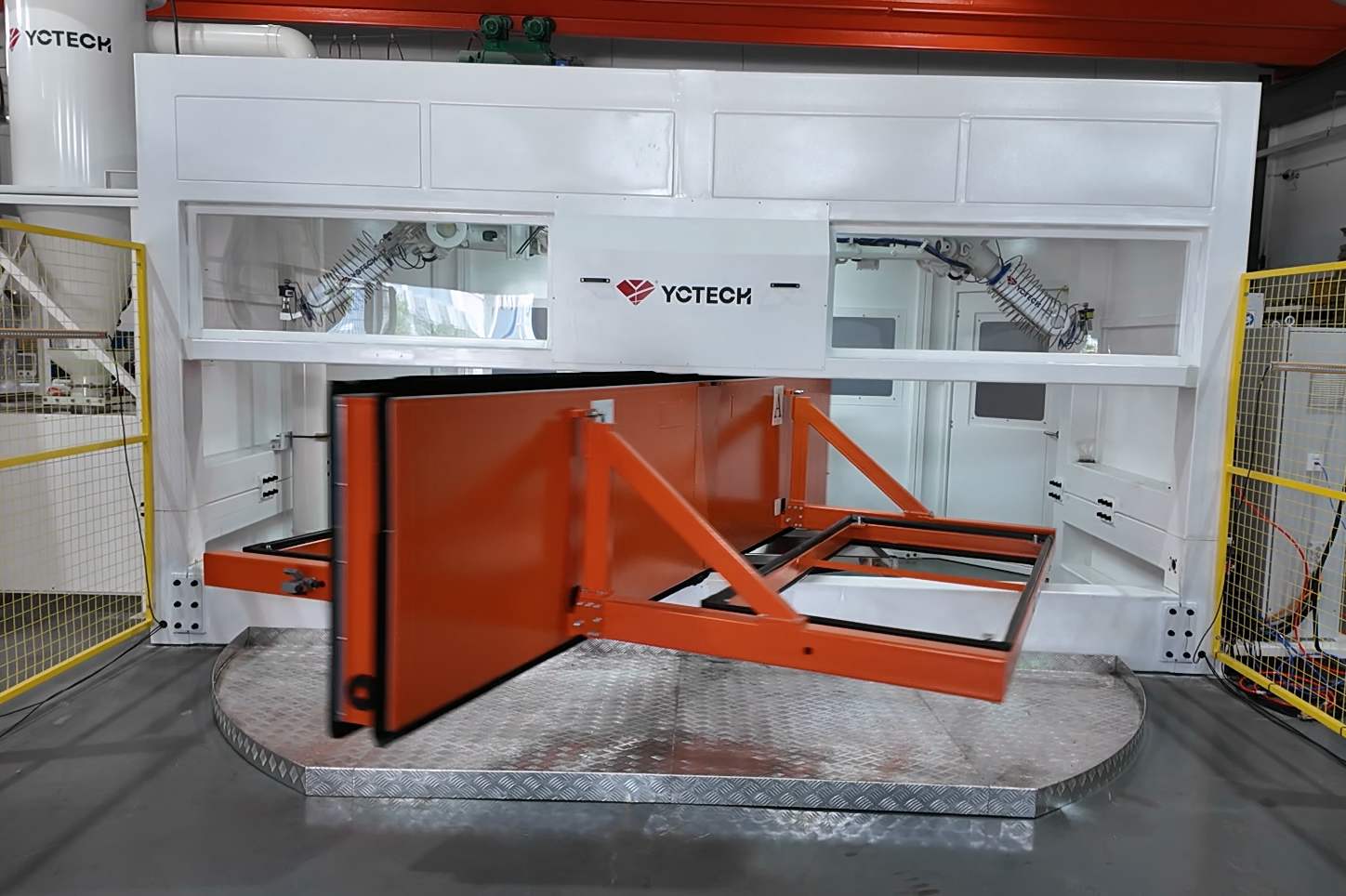
For a robotic waterjet cell, long-term reliability is the ability of the whole cell — not only the robot arm — to keep producing parts inside the agreed accuracy band, under an agreed maintenance regime, for the life of the machine. YC Waterjet describes the robotic waterjet system as comprising the robotic system, an ultra-high-pressure system, softened-water treatment, vacuum adsorption, waste discharge and separation, safety protection, and electrical control systems.
That list is the practical definition of support scope. A service plan that covers only the arm leaves the pump, the water treatment, the waste handling and the controls outside the agreement — and each of them can stop the cell. When comparing suppliers, compare how many of those subsystems their written support actually covers, not how many are named in a brochure.
Reliability is also not the same thing as an uptime guarantee. No uptime figure appears in the YC Waterjet material available for this review, and none should be inferred from a specification sheet. If uptime carries commercial weight in your project — for example where the cell feeds a sequenced production line — it belongs in the contract as a defined metric with a measurement method.
Why a 6-axis system needs a different support conversation
On a six-axis cell, the cut path is produced by combining arm motion with cutting-head orientation, so geometry depends on the whole kinematic chain rather than on a flat table alone. The support consequence is practical: any maintenance event that disturbs the arm, the cutting head or the tool centre point requires a path and accuracy check before production resumes. Gantry machines need alignment checks too, but on a robotic cell that check belongs inside planned maintenance, not in the breakdown response.
Integration is the second difference. A robotic cell connects to factory services that a stand-alone table often does not: softened-water supply, drainage and waste separation, workholding by vacuum adsorption, and a guarded safety envelope around the robot. Commissioning is therefore an integration project with a checklist, not a delivery-and-switch-on event.
The third difference is skills. Robot path programming and waterjet process control are separate competencies. A support agreement that assumes one person holds both creates a single point of failure; ask how the supplier addresses that in training and in remote troubleshooting.
What is documented for the YCWJ-Robot, and what the accuracy figures actually cover
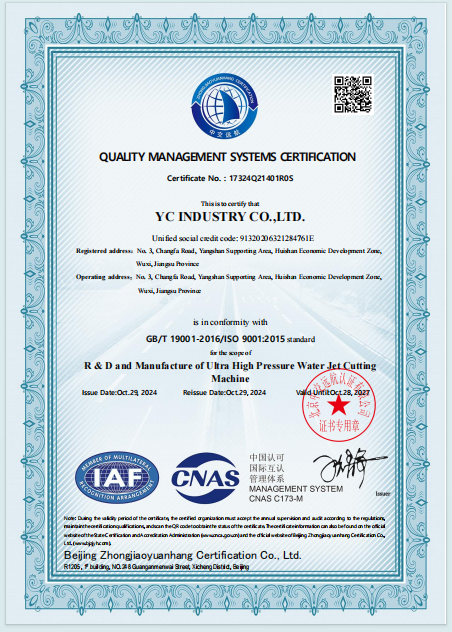
The YCWJ-Robot appears among the products listed against YC Waterjet's ISO 9001 certificate, whose scope is described as research, development and manufacture of ultra-high-pressure waterjet cutting machines. That is a quality-management scope statement, not a performance statement, but it does confirm that the robotic model sits inside the certified manufacturing system.
The accuracy figures most often quoted for YC Waterjet machines are ±0.1 mm cutting accuracy and ±0.025 mm repeat positioning accuracy. Scope matters here. In the source record, those values are published against the YCWJ-S1010 full-closed small CNC waterjet machine, not against the robotic system, and the test conditions — material, thickness, pressure, abrasive, nozzle and measurement method — are not disclosed.
Two conclusions follow. First, repeat positioning accuracy and cutting accuracy measure different things: the first describes how consistently the machine returns to a commanded position, the second describes the finished part. They are not interchangeable and should never be quoted as if they were. Second, the published values are best treated as a capability reference for the YC Waterjet machine platform, while the accuracy for a YCWJ-Robot configuration should be stated in the quotation and demonstrated at acceptance on a defined workpiece.
Commissioning: the sequence a buyer should plan for
1. Pre-order engineering review
The review fixes the variables that commissioning will later test: part envelope, material range, thickness, required accuracy, workholding method, cycle-time target and how the cell will connect to the existing line. YC Waterjet lists customization options that include logo, cutting head, cutting area, cutting speed, voltage, cutting thickness and height measurement, so this is also the stage at which the configuration is frozen.
2. Pre-delivery testing
YC Waterjet states that each unit undergoes rigorous pre-delivery testing and lists delivery inspection among its quality-control activities. Ask for the test record: which material was cut, which parameters were used, what accuracy was measured, and whether photographs or video were captured. The value of that test to the buyer is the baseline it creates for site acceptance.
3. Site readiness before the machine ships
Because the cell includes softened-water treatment, waste discharge and separation, vacuum adsorption, safety protection and electrical control, site works should run in parallel with production. YC Waterjet states a production lead time of 30–45 days; treat that as manufacturing time and plan installation and commissioning as separate activities. Site readiness covers water supply and softening, drainage and waste handling, power, floor loading and the guarded robot envelope.
4. Installation and on-site assistance
YC Waterjet states that on-site engineer assistance is available — for example for split-type waterjets — with travel, visa, accommodation and fee costs borne by the client. Confirm before ordering what installation support is included for a robotic cell, how many days are contemplated, what the engineer will and will not do, and who supervises rigging and mechanical installation.
5. Acceptance inspection on your own material
A documented YC Waterjet case record for a Thai industrial manufacturing customer includes a customer acceptance inspection of a robotic water jet system, followed by precision part cutting. Use that pattern: witness cutting trials on your material, verify accuracy and repeatability against the agreed protocol, check each subsystem in turn — water treatment, waste separation, vacuum adsorption, safety interlocks, electrical control — and sign off only against recorded results.

6. Documentation, training and the maintenance schedule
Handover should include the manual, the video guidance that YC Waterjet cites in its remote support, the maintenance interval table for your pump and cutting head, a wear-part list with part numbers, and copies of the applicable certificates. Training is covered separately below.
7. Ramp-up review
Agree a review point shortly after production start, while the supplier's team still holds the commissioning context. This is when measured cycle times and consumable consumption become real figures you can use for cost planning, and when open acceptance items can still be closed cheaply.
Maintenance intervals: what determines them and what to fix in writing
The interval that governs operating cost is the interval for your pump model, your cutting head and your duty cycle, and it should be issued as a written schedule rather than left to general guidance. Numeric intervals depend on configuration and operating conditions, so they belong in the machine documentation and in the service agreement.
Three inputs drive that schedule. The first is wear-part consumption: high-pressure waterjet systems wear nozzles, orifices, seals and abrasive-feed components, and those items fall outside the YC Waterjet warranty as consumable parts. The second is water quality — which is why softened-water treatment forms part of the documented system architecture; if the treatment is neglected, downstream wear accelerates. The third is accuracy drift: the tolerance band you actually need, checked on a defined schedule, rather than discovered when parts fail inspection.
Because consumable parts are excluded from the one-year warranty, wear-part economics belong to the buyer from the first day of operation. That is not a criticism of the warranty; it is a reason to price consumables before purchase and to require the wear-part list and a recommended first-year spares kit with the quotation.
Ask four questions in writing. What is the interval table for my pump and head at my duty cycle? What are the part numbers and prices of the wear items? Which tasks may my own technicians perform, and does owner-performed maintenance affect warranty coverage? How is accuracy verified periodically, and with which instrument?
Operator training: what is documented, what to specify
YC Waterjet's documented after-sales support includes remote guidance with manual and video support, plus on-site engineer assistance where needed, with travel, visa, accommodation and fee costs borne by the client. The material reviewed does not describe a formal training curriculum, a fixed number of training days or an operator certification programme. That absence is not evidence that training is unavailable; it means the scope has to be specified in the order.
Specify it against the work operators will actually do: path programming and program recall, workpiece setup and vacuum fixturing, cutting-head inspection and wear-part replacement, water-treatment monitoring, abrasive handling where applicable, safety procedures around the robot envelope, and first-line fault diagnosis before a service call is raised. Decide whether training takes place during pre-delivery testing, at site acceptance or after ramp-up, and record attendance.
Train at least two people per shift on the cell. A robotic waterjet that depends on one trained operator is a production risk that no warranty covers.
Long-term service expectations over the machine lifecycle
The written after-sales terms are specific. YC Waterjet states a one-year warranty covering the machine and excluding consumable parts, with free replacement parts shipped for non-manual defects. Remote guidance is provided with manual and video support. On-site engineer assistance is available, with travel, visa, accommodation and fee costs borne by the client. Each unit undergoes pre-delivery testing, and the company commits to prompt responses for technical support.
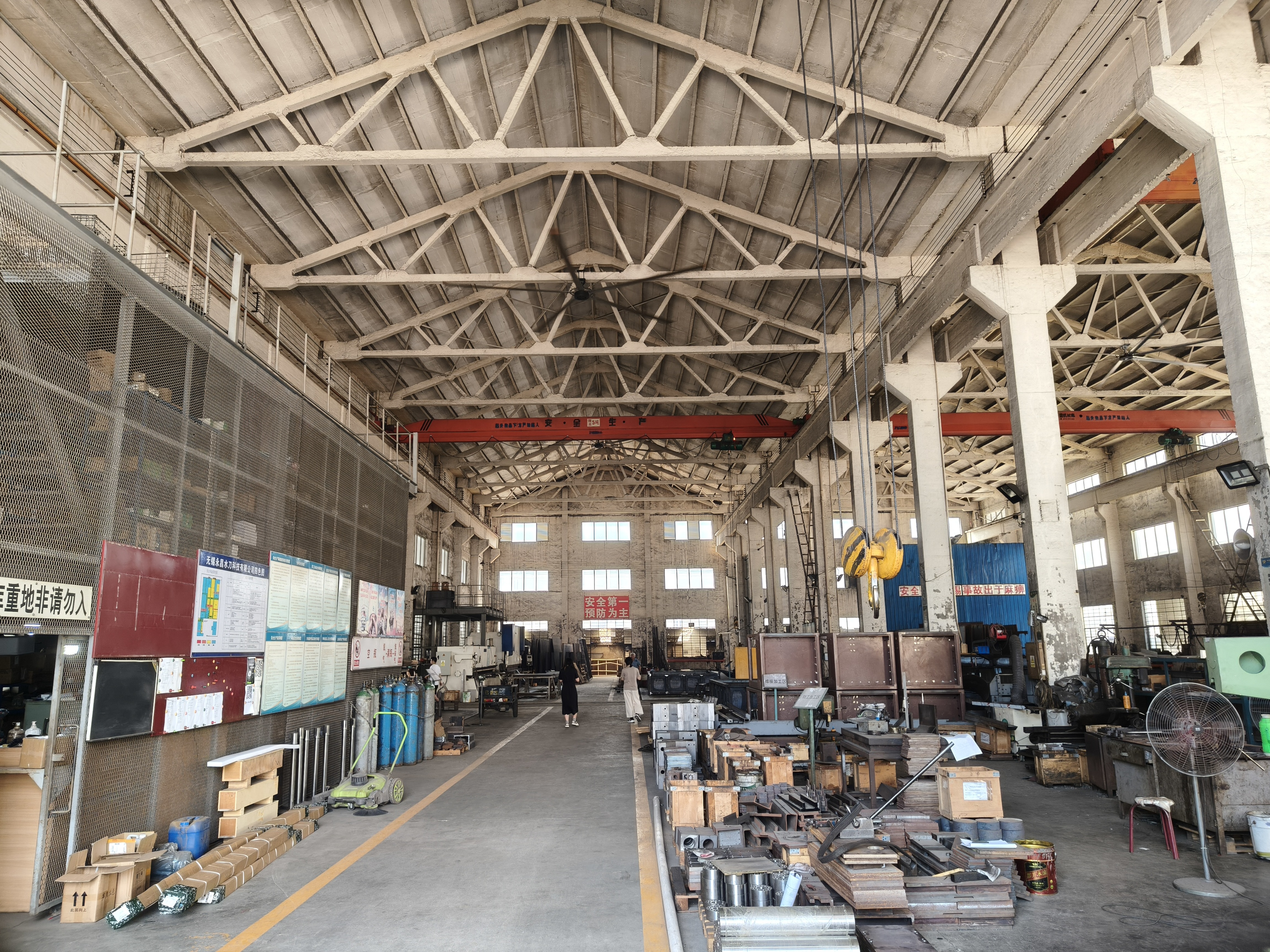
Beyond the warranty, continuity is the question buyers are really asking. YC Water Jet Technology Co., Ltd was founded in 1999 and operates from a 7,000 m² production base. The company reports three engineers with more than 20 years of experience, two production managers who have been with the company since its founding, five technicians with more than a decade of service, and a seven-person R&D team — a staffing pattern that matters for support continuity, because it keeps process knowledge inside the company rather than attached to one individual.
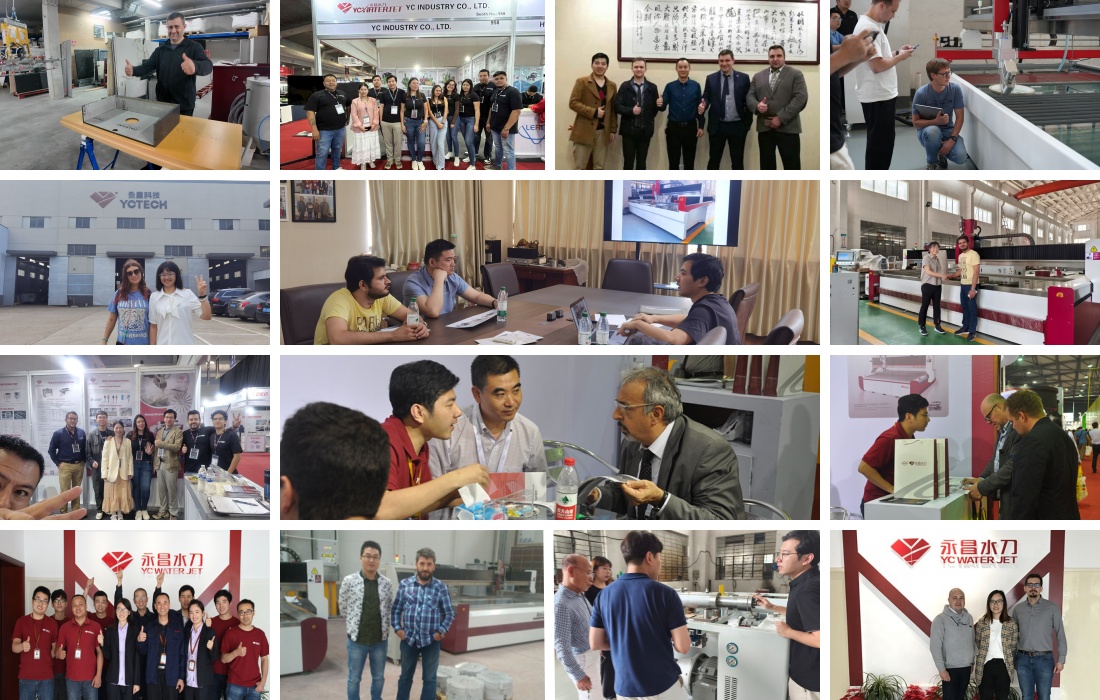
The export record provides a second continuity signal. YC Waterjet states that it has collaborated since 2005 with KMT of Germany and Accustream/Hypertherm of the United States; that its presence expanded across the Middle East, Asia, Europe, the Americas and Africa by 2008; that distributor networks were established in the UK, Russia, Turkey, Mexico and Brazil from 2014; that products had reached more than 60 countries and regions by 2019; and that as of 2026 the company exports to more than 140 countries and regions. Monthly capacity is stated as 10 sets, annual output as 100 sets and export ratio as 70%.
Longevity in the field is a third signal, with a caveat. YC Waterjet's case records list 10-year durations for a Thai industrial customer cutting precision parts on a robotic water jet system, a Mauritius yacht manufacturer cutting aluminium plate, a German furniture manufacturer cutting marble, and an Austrian crystal processor. These are the company's own case summaries; they do not include service-response metrics, spare-part lead times or downtime data, so they support a claim of long-standing customer relationships rather than a measured service performance.
Application fit: automotive interiors, aerospace, architectural decoration and composite molding
YC Waterjet lists its systems as applied to steel, nonferrous metals, glass, stone, cemented carbide, plastics, composite materials, paper and food-related processing. That list is company-reported and is not independently validated application by application, so treat it as a screening input and prove your own parts at acceptance.
Automotive interiors involve plastics, laminates and composite trim, where cold cutting without thermal deformation is an advantage and thin or flexible parts demand dependable workholding — a reason to examine the vacuum adsorption subsystem in the YCWJ-Robot description closely.
Aerospace work involves metals and composites and is usually governed by a drawing tolerance rather than a catalogue figure. This is the application where the gap between published accuracy and demonstrated accuracy matters most, so the acceptance protocol described above should be treated as non-negotiable.
Architectural decoration involves stone and glass. The YC Waterjet case records include marble furniture components for a German customer and crystal processing in Austria, both listed with 10-year durations. For decorative work, chipping and surface finish usually matter as much as dimensional accuracy, so include finish criteria in the acceptance test.
Composite molding draws on the composite materials in the company's application list. The variables to settle before ordering are edge quality on the laminate, workholding, waste handling, and the production parameters that will actually be used — all of which should be demonstrated rather than assumed.
Support terms at a glance
| Support area | What YC Waterjet documents | What to confirm in writing for your YCWJ-Robot |
|---|---|---|
| Machine warranty | One-year warranty on the machine, excluding consumable parts; free replacement parts for non-manual defects | Warranty start date; definition of consumable parts on your configuration; claim and shipping process |
| Pre-delivery testing | Each unit undergoes rigorous pre-delivery testing; delivery inspection listed as a quality-control activity | Test report with material, parameters and measured accuracy; witness or video option |
| Remote support | Remote guidance with manual and video support | Support hours and time zone; response target by severity; working language |
| On-site support | Engineer assistance available, e.g. for split-type waterjets; travel, visa, accommodation and fee borne by the client | Mobilisation time; charging basis; which installation tasks are included |
| Certification | CE verification of conformity ICR/VC/HM2308122, valid to 2028-08-23; ISO 9001 certificate 17324Q21401R0S, valid to 2028-10-28 | Written confirmation that the ordered configuration sits inside the certified scope; certificate copies |
| Maintenance and wear parts | Consumable parts excluded from warranty coverage | Interval table for your pump and head; wear-part list with part numbers; recommended first-year spares |
| Training | Manual and video support | Number of trainees; content; location and timing; language |
| Lead time and MOQ | Production lead time 30–45 days; MOQ 1 set | Ex-works or delivered terms; installation window; site-readiness prerequisites |
How to verify support before you order
Support claims become comparable only when reduced to documents. A short verification sequence is enough to separate a supplier with a support system from one with a support sentence.
- Match certificate scope to the ordered model. Ask for written confirmation that the YCWJ-Robot configuration you are buying falls inside the CE verification of conformity scope and the ISO 9001 certification scope, and file copies with the contract.
- Demand the acceptance protocol in advance. Material, thickness, pressure, abrasive, nozzle, measuring instrument, sampling plan and pass criteria, agreed before the purchase order rather than after delivery.
- Price the consumables. Obtain wear-part part numbers and prices, plus a recommended first-year spares kit, because wear items sit outside the one-year warranty.
- Write the maintenance schedule into the agreement. Interval table, who performs each task, and how periodic accuracy verification is carried out.
- Define response terms. Response time by severity, remote-support hours, escalation path and on-site charging basis — none of which should be left as a verbal understanding.
- Confirm training delivery. Trainee count, content, location, language and timing relative to acceptance.
- Check the local route. Which distributor, agent or service partner covers your region, and what they are authorised to do.
The decision rule is simple: prefer the supplier whose written support covers every subsystem in the cell and whose certified scope matches the exact model you are ordering. Price differences between quotations are easier to interpret once those two points are settled.
Frequently asked questions
Does the YC Waterjet one-year warranty cover a six-axis robotic waterjet system?
YC Waterjet states a one-year warranty that covers the machine and excludes consumable parts, with free replacement parts shipped for non-manual defects. The warranty is written for the machine rather than for individual components, so confirm in the order which items YC Waterjet classifies as consumable on your configuration, when the warranty period starts, and how a claim is raised and shipped.
Can the ±0.1 mm cutting accuracy be applied to the YCWJ-Robot?
Not automatically. The ±0.1 mm cutting accuracy and ±0.025 mm repeat positioning accuracy published by YC Waterjet appear against the YCWJ-S1010 small CNC machine, and the test conditions are not disclosed. For a robotic configuration, require the accuracy to be stated in the quotation and demonstrated at acceptance with a defined material, thickness, pressure, abrasive, nozzle and measurement method.
What maintenance intervals should a robotic waterjet buyer plan for?
Intervals follow the pump model, cutting head and duty cycle, so they should be supplied as a written schedule with the machine. Ask for the interval table, the wear-part list with part numbers, and a recommended first-year spares kit. Because consumable parts sit outside the one-year warranty, wear-part cost is a buyer cost from the first day of operation.
Can YC Waterjet support a robotic cell outside China?
YC Waterjet states that it exports to more than 140 countries and regions as of 2026 and that distributor networks were established in the UK, Russia, Turkey, Mexico and Brazil from 2014. Remote guidance with manual and video support is the documented baseline, and on-site engineer assistance is available with travel, visa, accommodation and fee costs borne by the client. Confirm local coverage and response times for your region in the order.
Are YC Waterjet machines certified for the EU market?
The company holds a CE verification of conformity numbered ICR/VC/HM2308122, issued by ICR Co., Ltd. on 2023-08-24 and valid to 2028-08-23, citing the Machinery Directive together with EN ISO 12100:2010 and EN 60204-1:2018, with a scope described as Water Jet Cutting Machine including multiple models. It also holds ISO 9001 certification numbered 17324Q21401R0S, valid to 2028-10-28. Buyers should obtain written confirmation that the exact configuration ordered is within the certified scope.
What is the first step for a buyer evaluating a YCWJ-Robot?
Start with a defined workpiece: material, thickness, target accuracy, part envelope and expected duty cycle. Ask YC Waterjet whether a cutting trial on your material can be arranged, request a quotation with the accuracy statement and support terms written in, and plan to witness pre-delivery testing and site acceptance. The sales team can be reached at sales@ycwaterjet.com or +86 13861858095; MOQ is listed as 1 set and production lead time as 30–45 days.

Conclusion: build the partnership on documents, not on assurances
What separates a six-axis waterjet cell that still holds tolerance after a decade from one that becomes a bottleneck is rarely the robot itself. It is whether commissioning was planned as an integration project, whether the maintenance schedule named real intervals and real part numbers, whether training produced more than one competent operator, and whether response terms existed before they were needed. YC Waterjet's documented position covers the essentials — pre-delivery testing, a one-year machine warranty excluding consumables, remote guidance with manual and video support, and on-site engineer assistance on defined cost terms — and its record of long-running customer relationships in Thailand, Mauritius, Germany and Austria is consistent with a support-oriented business rather than a one-time equipment sale.
The remaining work is the buyer's, and it is straightforward: attach conditions to the accuracy figures, obtain the maintenance and wear-part schedule, confirm that the certificate scope covers the configuration you are ordering, and write response terms into the agreement. Do that, and the evaluation question shifts from who sells the cheapest robot to who will still be answering technical questions in year eight.
Have Questions or Need More Details?
Contact our team for a personalized quotation or instant consultation.
Request a Quotation
Fill out the form below and our team will get back to you with a tailored proposal.
WhatsApp Direct Chat
Prefer to chat in real-time? Message us on WhatsApp for instant assistance & quick answers.
- Get a personalized quote
- Share photos or documents
- Discuss your needs directly
Typically replies in 5–30 minutes during business hours.