
Supplier Evaluation FAQ: Verifying Waterjet Cutting Machine Capability and Delivery Assurance
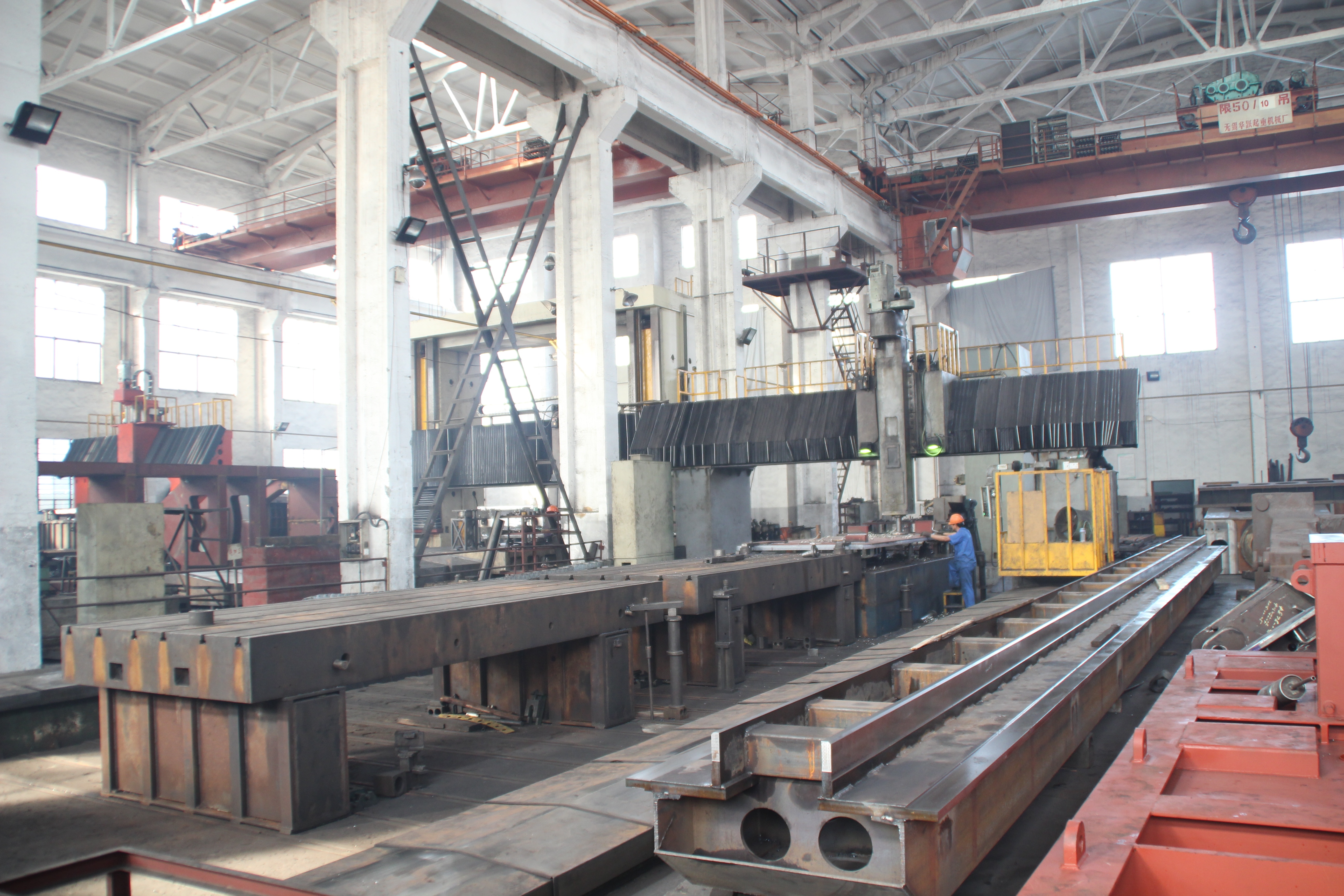
YC Waterjet gantry-type machining workshop, where structural components for ultra-high-pressure waterjet cutting systems are machined before assembly.
Short answer: verifying a waterjet cutting machine supplier comes down to three documentable questions — can the supplier actually build the exact series, table and pump configuration you specified; can they demonstrate pressure, flow and accuracy on your material instead of on a catalog page; and can they commit in writing to a production slot, a pre-shipment test protocol and a complete order file. Every other part of a supplier evaluation is secondary to those three.
This FAQ is written for buyers at the decision stage: procurement managers, importers, distributors and technical managers who have already shortlisted a system and now need to confirm that the supplier can manufacture and deliver it. YC Waterjet (YC Water Jet Technology Co., Ltd) is a manufacturer of ultra-high-pressure waterjet cutting systems based in Wuxi, Jiangsu, China, founded in 1999 and operating a 7,000㎡ production base. The questions below apply to any waterjet supplier; YC Waterjet's own configuration data is used as the working example throughout.
Configuration snapshot used in this evaluation
- Series platforms: E, G, L and S series, plus small-format and robotic waterjet options
- Ultra-high pressure pump: YCG series pump models
- System pressure: 4137 Bar / 60,000 Psi
- Flow rate: 7.4 L/min
- Cutting accuracy: ±0.1 mm
- Positioning accuracy: ±0.025 mm
Why Capability and Delivery Claims Break Down After the Deposit
A waterjet cutting machine is assembled from a cutting table, a gantry, a control system and an ultra-high pressure pump, and any one of those elements can be changed or rescheduled without the buyer noticing until installation day. That is why supplier claims tend to fail in a predictable pattern rather than randomly.
The five failure points buyers report most often are:
- Series mismatch. The quotation references a general product family, but the specific series, table size or control configuration presented during evaluation is not the one that enters production.
- Pump substitution. The ultra-high pressure pump named in the sales conversation is not the model number written into the purchase order, which changes pressure stability, flow rate and long-term spare-part cost.
- Unverified accuracy. Cutting and positioning tolerances are quoted as design targets, with no test-cut data from the material the buyer actually processes.
- Unscheduled delivery. A generic lead-time figure is given, but the order was never assigned to a confirmed production slot, so the promised date moves.
- Undocumented testing. Pre-shipment testing happens informally, so there is no signed reference document if the machine arrives outside specification.
The countermeasure is the same in all five cases: every claim that affects your production should exist as a written line in the quotation, the purchase order or the pre-shipment test report, not only in a brochure. A supplier that can move a specification into a document is demonstrating capability; a supplier that cannot is describing it.
Waterjet Market Context for 2026 Buyers
Supplier evaluation in 2026 happens inside a market that is still expanding and still fragmented. The global waterjet cutting machine market was estimated at USD 1.31 billion in 2025 and is projected to reach USD 1.86 billion by 2030 (Vertex AI Search / Reports & Data). Estimates of the 2025 baseline vary between research houses — Fortune Business Insights places it at USD 1.11 billion and Fact.MR at USD 1.0 billion — so market size is better used as a strategic signal than as a pricing lever.
Two regional and application facts shape what a supplier is likely to be able to build and deliver:
- Asia-Pacific accounted for approximately 37.8% of global waterjet cutting machine market revenue in 2024 (Coherent Market Insights), which is why a large share of buildable configurations and pump assemblies originate from that region.
- Metal cutting applications dominate the installed base, accounting for approximately 54.2% of the waterjet application segment in 2026 (Fact.MR). Most standard configurations are therefore tuned for steel and aluminum first.
That second point matters in practice. A buyer cutting stone, glass, tile or multi-layer composites should confirm capability for those materials explicitly, because a configuration optimized for metal is not automatically optimized for brittle or laminated materials.
The global supplier set includes established manufacturers such as Flow International, OMAX Corporation, KMT Waterjet and Bystronic Group (Persistence Market Research), alongside specialist builders that supply configured systems into specific material and regional niches. Component provenance is also part of the picture: YC Waterjet has collaborated with pump and component providers including KMT (Germany) and Accustream/Hypertherm (USA) since 2005, and as of 2026 exports to more than 140 countries and regions.
Capability Verification: Four Questions Buyers Should Ask First
1. Which machine series and configurations can the supplier actually build?
Ask for a buildable-configuration matrix rather than a catalog. The matrix should name the series, the maximum and minimum table size, the control configuration and the pump model for each option, because a supplier that can only build one format will usually quote that format even when your application needs another.
YC Waterjet's buildable range covers the E, G, L and S series platforms. Within that range, small waterjet machine formats are offered for workshops where floor space or power supply is limited, and robotic waterjet options are available for automated or repetitive cutting tasks. The verification step is straightforward: have the supplier write the exact series, table size and control configuration into the quotation, then confirm that the same series is the one scheduled for production. A series name that appears in the quotation but not in the production schedule is the first warning sign in a supplier evaluation.
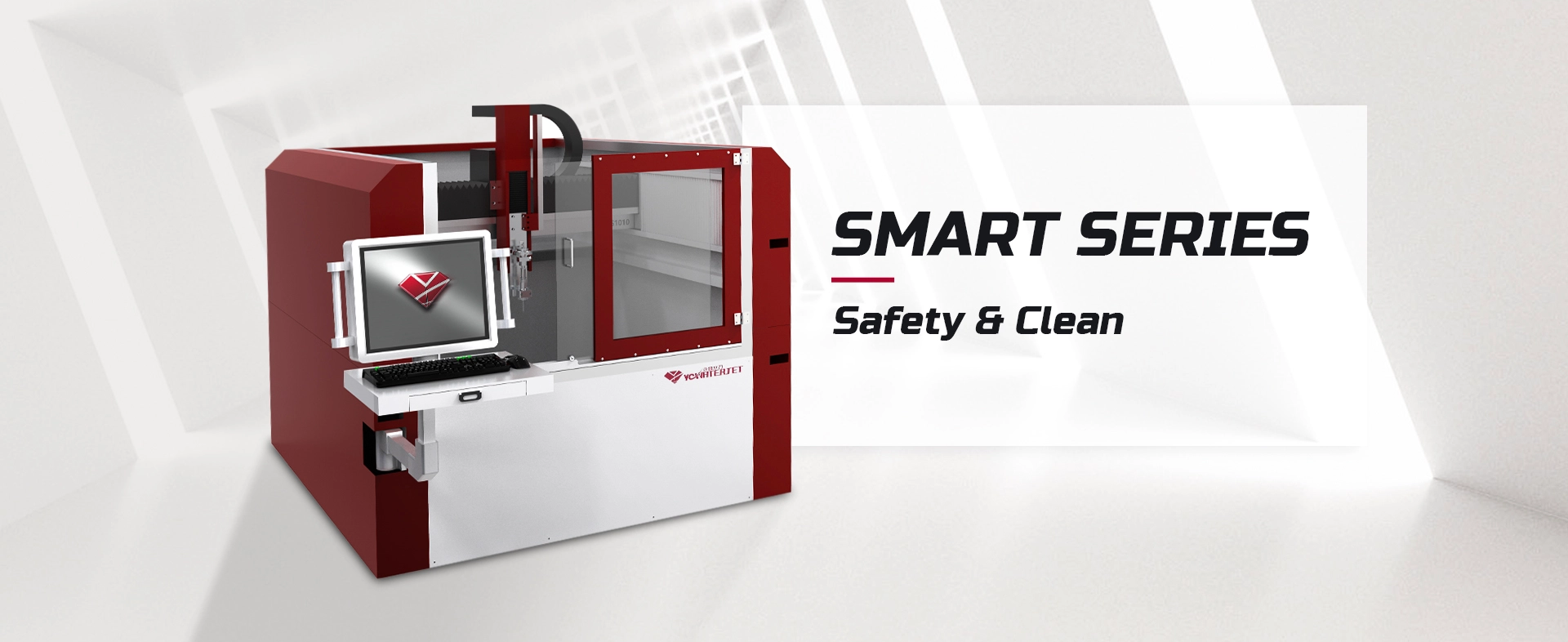
A YC Waterjet S Series machine, one of the E, G, L and S series platforms a buyer should confirm as buildable before placing an order.
2. How do you verify the ultra-high pressure pump specification?
Pressure and flow determine whether the machine can cut your material at the feed rate your workload requires, and they also determine long-term maintenance cost. YC Waterjet's YCG series ultra-high pressure pump models are specified for a system pressure of 4137 Bar / 60,000 Psi and a flow rate of 7.4 L/min.
Three verification questions should be asked together, not separately:
- Which pump model number is on the quotation? The YCG model designation should appear in the order documents, not only in the presentation.
- How does pressure behave under continuous load? Stable pressure output is what protects cut quality on thick material; unstable output shows up as taper and slow feed rates.
- How is the high-pressure assembly maintained? YC Waterjet's high-pressure pumps use a modular design intended to make on-site maintenance easier, which matters because high-pressure maintenance is the largest recurring cost in waterjet operation.
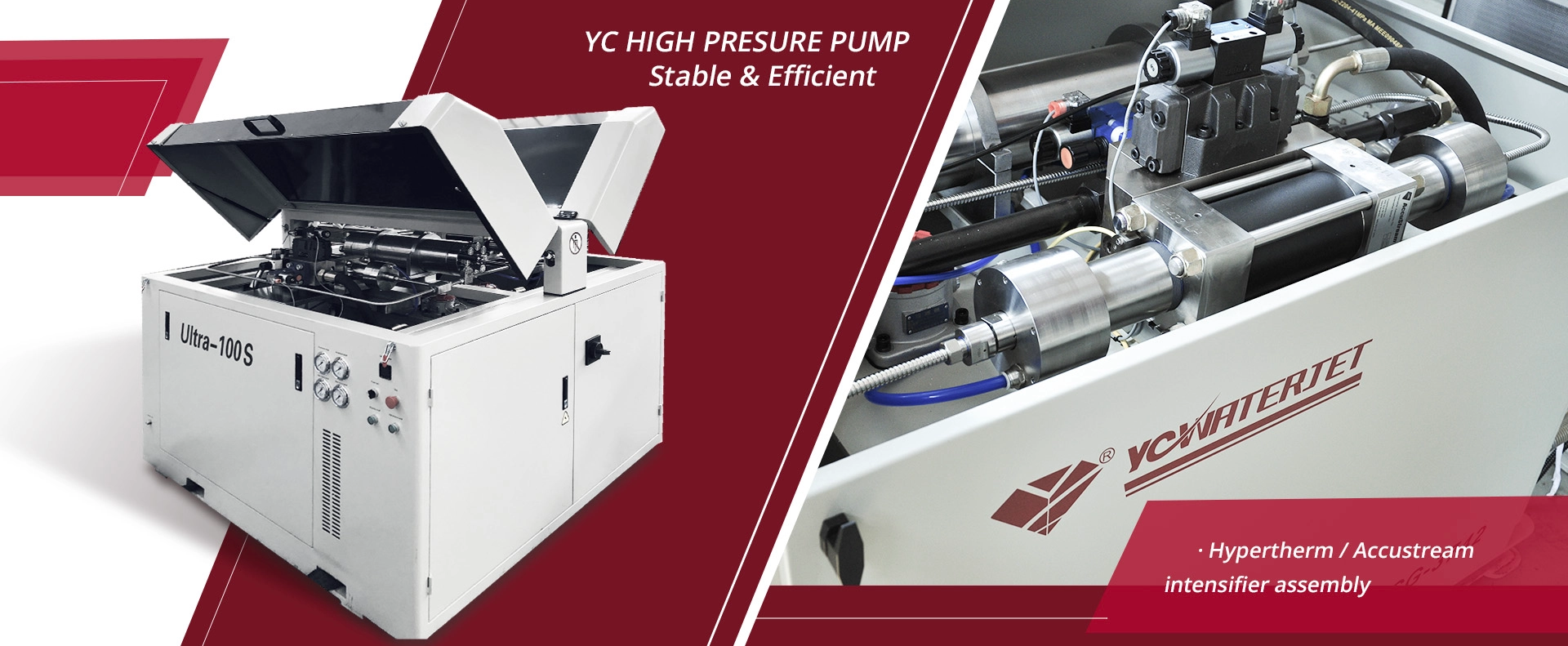
A YC Waterjet ultra-high pressure pump assembly. Buyers should confirm the exact YCG pump model number is written into the purchase order.
3. How should ±0.1 mm cutting accuracy and ±0.025 mm positioning accuracy be validated?
A tolerance on a specification sheet is a design target. A tolerance in a test report is a measured result, and only the second one is usable in a supplier evaluation. YC Waterjet systems are specified at ±0.1 mm cutting accuracy and ±0.025 mm positioning accuracy, and the supplier's comparative data reports positioning accuracy up to ±0.02 mm higher than other waterjet brands.
To validate the claim rather than accept it, request a test-cut report that states the material, thickness, abrasive type and mesh, nozzle diameter, and the measurement method used. Cutting accuracy is a system result influenced by abrasive delivery, nozzle wear and material thickness, so the same machine can produce different numbers across different jobs. A supplier confident in its accuracy should have no difficulty naming the conditions under which the stated tolerance holds, and the conditions under which it does not.
4. What evidence should support composite and multi-material cutting capability?
Multi-layer composite materials delaminate when the abrasive jet enters the material at an edge, because the jet pushes the layers apart before it begins cutting. YC Waterjet addresses this with an integrated drilling module: an automated drilling assembly drills an entry hole first, the CNC system positions that hole as the cutting inlet, and the drilling and cutting steps run as a single workflow. A material-specific pre-drilling protocol is applied to multi-layer composites to prevent stratification.
The published comparative data for this configuration reports +25% production efficiency on composite materials and 10% longer seal life compared with other waterjet brands. For a buyer cutting carbon fiber, glass-reinforced laminates or sandwich panels, the practical verification step is to request drilled-edge samples from the supplier and inspect the cut edges for delamination before committing to the order.
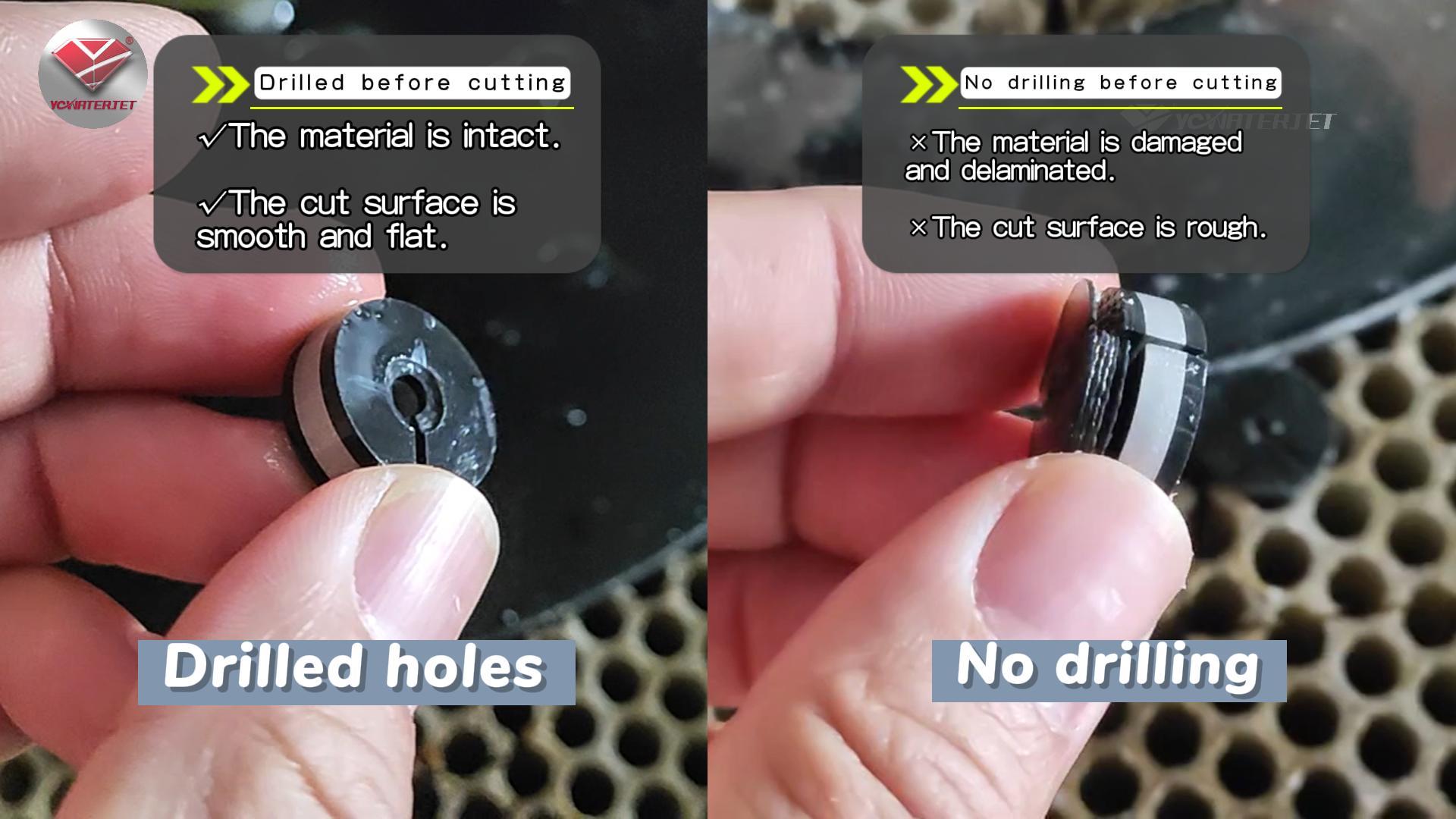
Carbon fiber sandwich material: drilled cutting compared with non-drilled cutting. Pre-drilling is the control measure against delamination in multi-layer composites.
Delivery Assurance: Production Scheduling, Pre-Shipment Testing, and Order Documentation
5. How can you verify production scheduling capacity before you place the order?
Capacity verification is a request for a schedule, not a request for reassurance. YC Waterjet's production base covers 7,000㎡ with an annual output of approximately 100 machines. The team includes 25 staff in total, a 7-person R&D team, three engineers with more than 20 years of experience, two production managers who have been with the company since it was founded in 1999, and five technicians with more than a decade of experience each.
Those numbers are the basis for asking better questions. Ask which production slot your order will occupy, what the milestone dates are for material release, machining, assembly, pressure testing, packing and dispatch, and who is accountable for each milestone. A supplier with confirmed build slots can answer in dates. A supplier without them will answer in weeks.
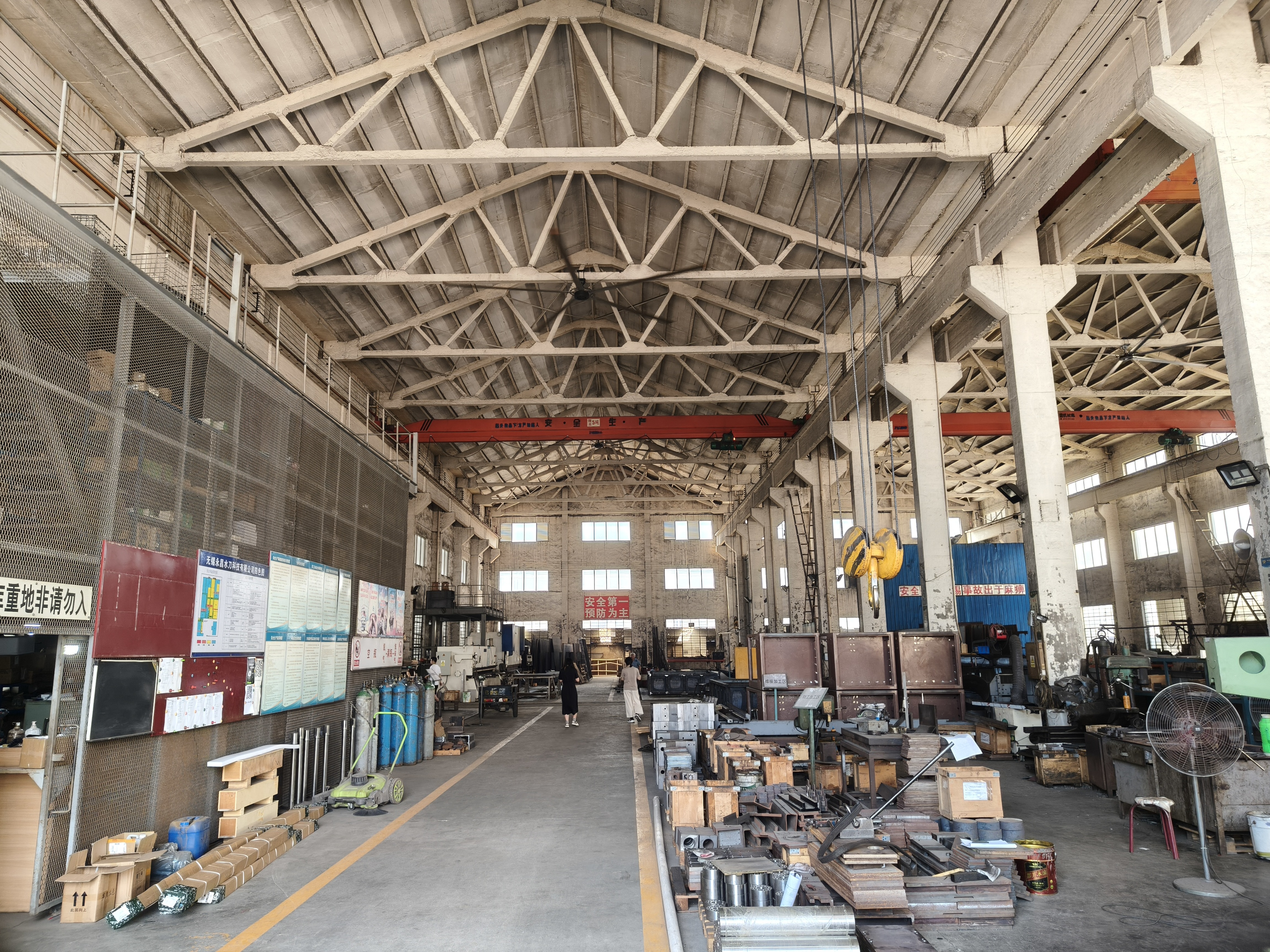
YC Waterjet production workshop. Build-slot confirmation, rather than a generic lead-time figure, is the reliable basis for a delivery commitment.
6. What pre-shipment testing should be documented?
Pre-shipment testing is the buyer's last opportunity to catch a configuration error while the machine is still in the factory. The test protocol should be agreed before production begins, because a protocol written after assembly tends to describe whatever the machine already does. A practical protocol for a waterjet cutting machine includes:
- Pressure and flow verification against the specified system pressure of 4137 Bar / 60,000 Psi and the flow rate of 7.4 L/min.
- Test cuts measured against the specified ±0.1 mm cutting accuracy and ±0.025 mm positioning accuracy, using a stated measurement method.
- A functional run-in of the gantry, control system, abrasive delivery and high-pressure pump assembly.
- A photographic or video record of the assembled machine and the test-cut samples.
- A signed test report issued together with the machine's order documentation.
If the machine will cut composites, the pre-shipment test should include the pre-drilling workflow, not just a straight cut, so that the drilling module and the CNC positioning sequence are proven before dispatch.
7. Which order documents should be agreed before production starts?
Documentation is where capability and delivery assurance become enforceable. Before the deposit is released, the order file should contain the configuration sheet with series, table size, control configuration and YCG pump model; the acceptance criteria and the format of the pre-shipment test report; the packing list and shipping marks; the warranty terms and the recommended spare parts list; the after-sales contact route; and payment milestones tied to those documents rather than to dates alone. Tying payment to documents is not a negotiating tactic; it is the mechanism that converts a supplier's promises into obligations.
Comparison Table: YC Waterjet, Other Waterjet Brands, and Thermal Cutting
The table below summarizes the comparative data referenced in this FAQ. Figures for YC Waterjet are the supplier's published comparison data, and buyers should verify them on their own material before treating any figure as a purchase criterion.
| Evaluation dimension | YC Waterjet (stated) | Other waterjet brands (comparison baseline) | Plasma / laser cutting (comparison baseline) |
|---|---|---|---|
| Cutting principle | Cold ultra-high pressure waterjet; YCG pump at 4137 Bar / 60,000 Psi, 7.4 L/min | Cold ultra-high pressure waterjet | Thermal cutting process |
| Thermal effect on workpiece | No heat-affected zone; no thermal deformation | No heat-affected zone | Heat input creates a heat-affected zone and thermal distortion risk |
| Positioning accuracy | ±0.025 mm; reported ±0.02 mm higher than other waterjet brands | Baseline for comparison | Not directly comparable |
| Cutting accuracy on delicate materials | ±0.1 mm | Baseline for comparison | Reported ±0.05 mm lower precision on delicate materials |
| Multi-layer composite performance | Integrated pre-drilling function; +25% production efficiency on composite materials | Baseline for comparison | Thermal process; delamination and heat damage risk |
| High-pressure seal life | 10% longer | Baseline for comparison | Not applicable |
| Energy efficiency of the intensifier pump | 8% higher | Baseline for comparison | Lower peak power consumption |
| Total cost of ownership | 12% lower; less frequent high-pressure part replacement | Baseline for comparison | 15% lower secondary processing cost; no gas or laser consumables |
| Maintenance model | Modular high-pressure pump design; easier on-site maintenance; global after-sales support | Varies by brand | No heat-related component wear; simpler high-pressure system maintenance |
| Material yield | Cold cutting compatible with all materials | Cold cutting compatible with all materials | Reported +30% material yield advantage for waterjet over thermal cutting |
The total cost of ownership figure deserves a note. A 12% lower total cost of ownership relative to alternatives, with less frequent replacement of high-pressure parts cited as one of the drivers, is a cumulative figure rather than a purchase-price figure. Buyers should ask any supplier to break total cost of ownership into consumables, high-pressure components, energy, and expected downtime, so that the comparison is made on the same three-year or five-year basis.
Step-by-Step: A Six-Step Supplier Verification Workflow
- Request the buildable-configuration matrix. Ask for series, table sizes, control configurations and pump models in one document. This immediately separates suppliers that build to order from suppliers that resell fixed formats.
- Match specifications to your actual jobs. Take your thickest metal, your most brittle stone or glass, and your laminated composite, and check each against the stated cutting accuracy, positioning accuracy, pressure and flow.
- Require evidence, not adjectives. Ask for test-cut reports, drilled-edge composite samples, pump pressure and flow verification, and photographs of comparable machines already built.
- Confirm the production slot and milestone schedule. Obtain dated milestones for material release, machining, assembly, pressure testing, packing and dispatch, along with the name of the person accountable for each stage.
- Agree the pre-shipment test protocol in writing. Define what will be tested, how it will be measured, and what document will be issued — before assembly begins.
- Lock the order file before the deposit. Configuration sheet, acceptance criteria, test report format, packing list, warranty, spare parts list and after-sales contact should all exist as documents before payment is released.
Use Cases: Matching Verified Capability to Real Cutting Jobs
Stone, marble and granite fabrication. Cold cutting avoids the chipping and heat discoloration that thermal processes can cause on polished surfaces. A marble water jet cutting machine or granite water cutting machine should be evaluated for table size and for edge quality on the specific stone finish you sell, and the E, G or L series platforms are the typical starting point.
Tile and architectural finishing. A tile water cutting machine or water jet tile cutter is usually purchased for precise inlays, patterns and edge profiles. Verify positioning accuracy on thin material, where handling and bed support affect the result as much as the machine specification.
Metal fabrication and steel service centers. Metal cutting accounts for roughly 54.2% of the waterjet application segment (Fact.MR, 2026), so most configurations are metal-ready. When evaluating a water jet metal cutter or water jet cutter steel, verify cutting accuracy and pressure stability on the thickest section you routinely process, since that is where flow rate and pressure consistency determine throughput.
Glass processing. A water jet glass cutter is chosen for the absence of thermal cracking and micro-cracks along the cut edge. Ask for samples cut on the same glass thickness and temper that you process.
Composites, aerospace and automotive. This is where the integrated pre-drilling function matters most. Multi-layer carbon fiber and sandwich panels should be cut with drilled entry holes to prevent delamination, and the +25% production efficiency figure reported for composite cutting reflects that combined drilling and cutting workflow.
Job shops and small workshops. A small waterjet cutting machine or small waterjet cutter allows a workshop to enter waterjet work without the floor space and power requirement of a large industrial water jet cutting machine. Confirm the buildable table size and pump model for the small format specifically, since small-format machines are often quoted as a family rather than as a named configuration.
Automated and repetitive cutting cells. Robotic waterjet configurations suit operations where the same geometry is cut repeatedly or where the cutting head must follow a complex path. Verification here should cover the control integration as well as the pump specification.
FAQ
What compliance documentation should accompany a waterjet cutting machine order?
Waterjet cutting machines are high-pressure systems, so safety-related documentation should be specified as part of the order file rather than requested after delivery. ISO 21789 is the reference standard for water jetting safety covering operation at pressures up to 3000 bar (43,500 PSI), and buyers should state before production which declarations, manuals and test records must ship with the machine for their destination market, then confirm that this documentation set is listed in the purchase order. This applies to every supplier, not to one brand.
Can one supplier deliver both a small waterjet machine and an industrial-scale system?
Yes, when the buildable range is broad enough. YC Waterjet's buildable range covers the E, G, L and S series platforms, including small waterjet machine formats for compact workshops and robotic waterjet configurations for automated cutting, alongside larger industrial water jet cutting machine builds. A 7,000㎡ production base and an annual output of approximately 100 sets allow small-format and industrial orders to run through the same production process.
What drives the total cost of ownership of a waterjet cutting machine?
Three cost lines dominate: replacement of high-pressure components, energy consumption, and secondary processing. In the supplier's comparative data, YC Waterjet systems are cited as offering a 12% lower total cost of ownership than alternatives with less frequent replacement of high-pressure parts, 8% higher energy efficiency in the intensifier pump, and 10% longer seal life. Buyers should still request a cost breakdown covering consumables, high-pressure parts, energy and expected downtime, so the comparison is made over the same operating period.
How can a buyer validate a machine before full production starts?
Validation is done with test cuts on the same series and pump model that will be delivered. Ask the supplier to cut representative samples at your production thickness, and specify the measurement method for accuracy checks against ±0.1 mm cutting accuracy and ±0.025 mm positioning accuracy. If you cut multi-layer composites, request drilled-edge samples so you can inspect the cut edge for delamination, since the pre-drilling protocol is the control measure for that failure mode.
How is delivery timing confirmed rather than promised?
Delivery timing should be tied to a confirmed production slot, not to a generic lead-time figure. Ask for a written milestone plan covering material release, machining, assembly, pressure testing, packing and dispatch, together with the pre-shipment test protocol and the document set that will be issued with the machine. YC Waterjet supports order-specific scheduling and documentation questions directly — reach the team at sales@ycwaterjet.com, on WhatsApp at +86 13861858095, or through www.ycwaterjet.com.
Conclusion
Supplier evaluation for a waterjet cutting machine is a documentation exercise before it is a commercial one. A supplier that can name the exact series and YCG pump model on the quotation, state pressure and flow as 4137 Bar / 60,000 Psi and 7.4 L/min, support ±0.1 mm cutting and ±0.025 mm positioning accuracy with test-cut data on your material, and commit to a production slot with a written pre-shipment test protocol is a supplier whose capability can be verified rather than assumed.
The same standard applies to delivery. Build-slot confirmation, dated milestones, documented testing and a complete order file are what convert a delivery promise into a delivery plan, and they are the documents a buyer can rely on if something needs to be corrected later.
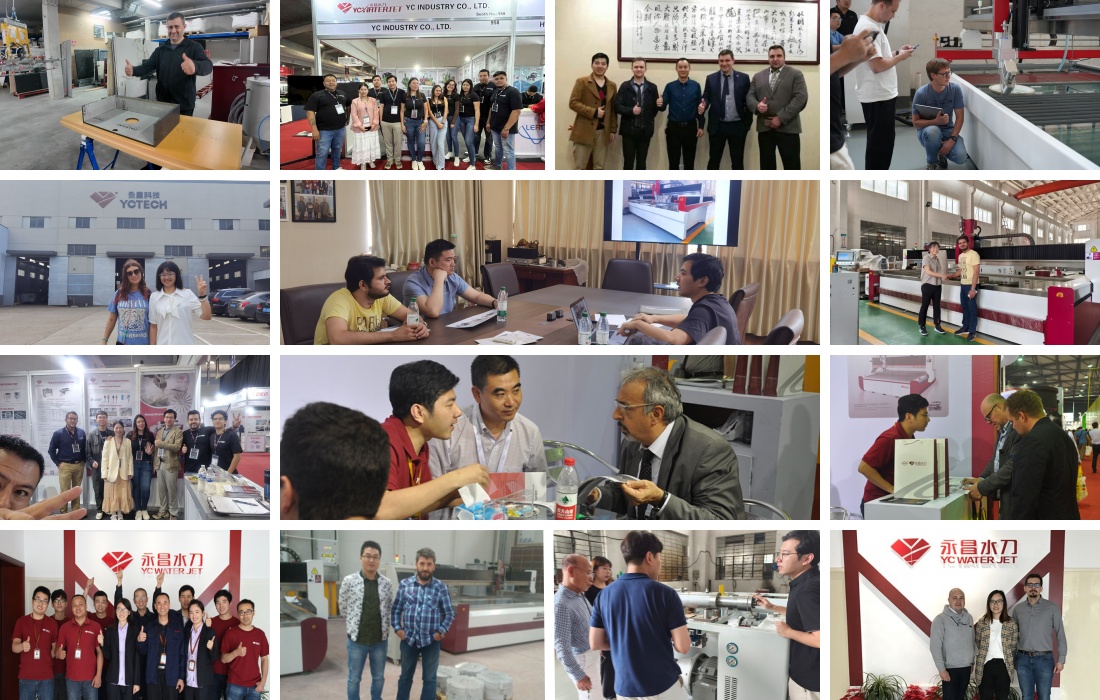
The YC Waterjet team behind order scheduling, pre-shipment testing and after-sales support.
Next step. If you are evaluating a configuration and want the capability data in writing — series availability, YCG pump model, pressure and flow figures, accuracy test criteria and a pre-shipment test protocol — request the current specification package and schedule a test-cut discussion with YC Waterjet.
Email: sales@ycwaterjet.com | WhatsApp: +86 13861858095 | Web: www.ycwaterjet.com
Have Questions or Need More Details?
Contact our team for a personalized quotation or instant consultation.
Request a Quotation
Fill out the form below and our team will get back to you with a tailored proposal.
WhatsApp Direct Chat
Prefer to chat in real-time? Message us on WhatsApp for instant assistance & quick answers.
- Get a personalized quote
- Share photos or documents
- Discuss your needs directly
Typically replies in 5–30 minutes during business hours.