
Thick Stainless Steel, Tight Tolerance: Solving ±0.1 mm with a Waterjet Cutting Machine
Holding ±0.1 mm on thick stainless steel is a method decision before it is a machine decision. Thermal cutting puts heat into the plate, and the plate moves while it is being measured. A cold-cutting waterjet removes material without adding that heat. The YC Waterjet E Series — models YCWJ-E3020 and YCWJ-E4020 — is specified for this job: ±0.1 mm cutting accuracy, ±0.025 mm positioning accuracy, 0–8 m/min X,Y dry-run speed, and an ultra-high-pressure pump rated to 4137 bar / 60,000 psi at 7.4 L/min maximum flow.
This article is written for metalworking fabricators who already know what the drawing says and are now being asked to prove the machine can meet it. It sets out the failure mode on thick stainless plate, explains what the E Series numbers do and do not promise, walks through a specification and acceptance path, and closes with the commercial terms that decide whether a purchase is repeatable.
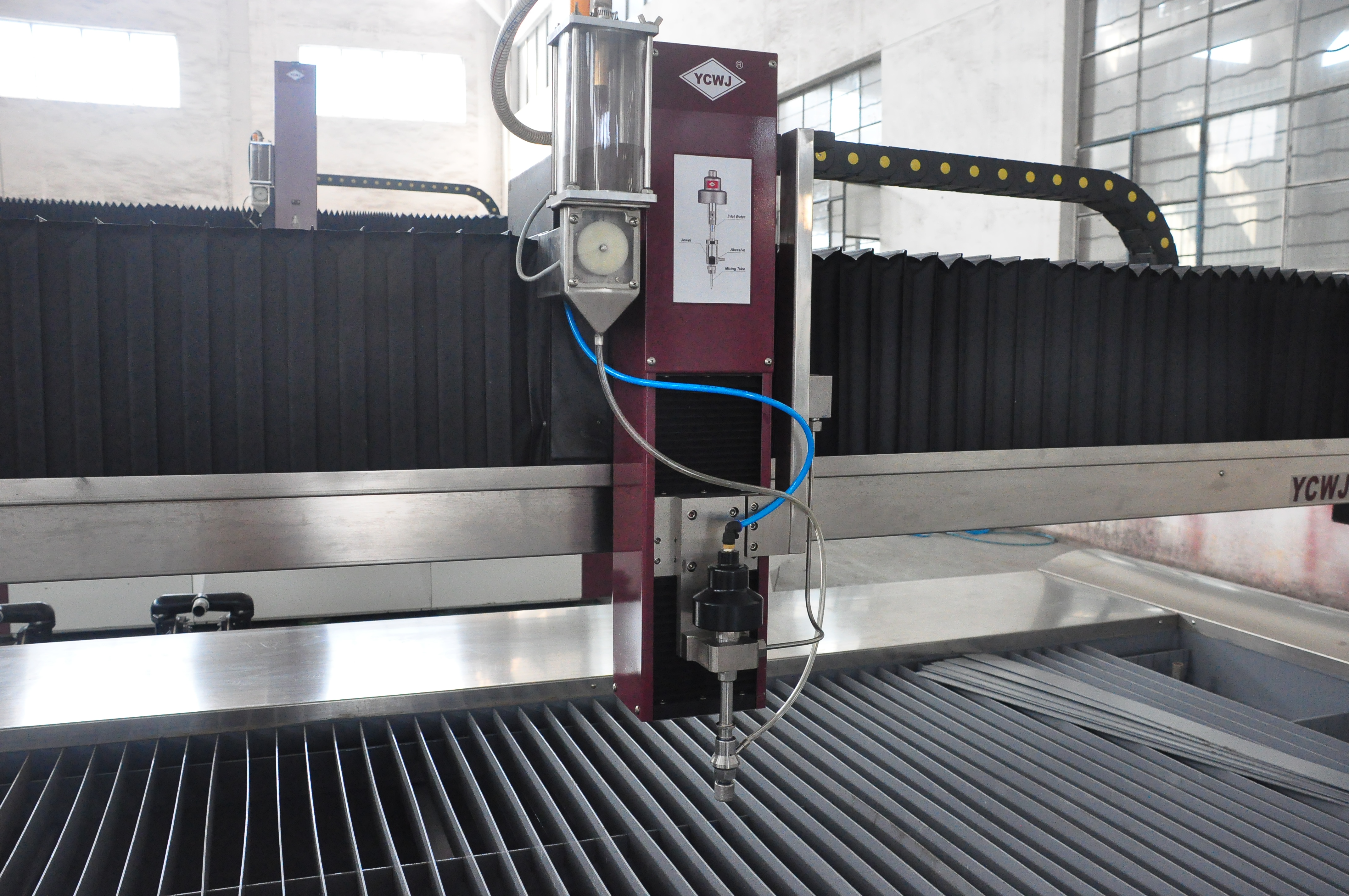
YC Waterjet 3-axis cutting head — the flat-table configuration used on the E Series for steel, stainless steel, alloys and thick plates.
The Problem: Why Thick Stainless Loses Tolerance
On thin sheet, most cutting methods hold tight dimensions because the part never gets hot enough or stiff enough to fight back. On a heavy section, the same process behaves differently. Four failure modes account for most of the lost tolerance on stainless plate.
1. Heat enters the section, not just the kerf
A thermal cut delivers energy into the cut zone, and a thick section absorbs and conducts that energy further than a thin one. The plate expands while it is warm and contracts after it cools. A hole can measure inside tolerance at the machine and outside tolerance the next morning. For ±0.1 mm work this is the failure mode that matters most: the error is not in the control system, it is in the material's response to the process.
2. Position tolerance and cut tolerance are two different promises
A drawing callout of ±0.1 mm usually contains two requirements that are measured differently — where a feature sits relative to a datum, and how wide and how square the cut edge is. A machine quoting a single accuracy figure is not quoting both. Buyers who do not separate the two end up arguing at acceptance, because each side is measuring a different thing.
3. The second operation nobody budgeted for
When a cut edge leaves a recast layer or heavy taper on a heavy section, the part often travels to a mill or a grinder before it will fit. That is a second setup, a second fixture, and a second queue slot. Cold cutting is chosen when the cut edge is expected to be the finished edge, because the economics only work if the second operation disappears.
4. Fixture stiffness and internal stress
Rolled plate carries residual stress. A process that relieves part of that stress locally can leave a part that bows after cooling. Clamping force is the other half of the problem: a fixture strong enough to hold a heavy plate can also distort it. A cold cut with a low mechanical load on the workpiece removes one of those variables.
Industry Background: What “Ultra-High-Pressure” Actually Means
Water jet cutting is described in industry reference material as a precise manufacturing process that uses high-pressure water jets powered by pressurising pumps. The word “high-pressure” is not a marketing term — it has a threshold. ASTM E1575-18, the standard practice for pressure water cleaning and cutting, classifies ultra-high-pressure (UHP) water jetting at above 25,000 psi, or 1,724 bar.
That threshold is useful when reading specifications. The YC Waterjet ultra-high-pressure pump used with the E Series is rated to a maximum of 4137 bar / 60,000 psi — roughly 2.4 times the ASTM E1575-18 UHP threshold. Pressure and flow are quoted as a pair (7.4 L/min maximum flow) because pressure without available flow does not translate into cutting energy at the nozzle.
Machine configuration also changes what “waterjet cutting machine” means from one quote to the next. YC Waterjet lists 3-axis, 5-axis, multi-head, robotic and custom waterjet categories across its portfolio, and states that its systems are applied to steel, nonferrous metals, glass, stone, cemented carbide, plastics, composite materials, paper and food-related processing. The E Series is the flat-table platform inside that portfolio, aimed at the metalworking end of it: steel, stainless steel, alloys and thick plates.
A note on category data
Published market-size estimates for waterjet cutting machines differ materially depending on the publisher's product scope and base year. Treat any single figure as one publisher's view with attribution, not as an industry consensus, and do not average competing estimates together.
The Solution: E Series Specifications, Read Correctly
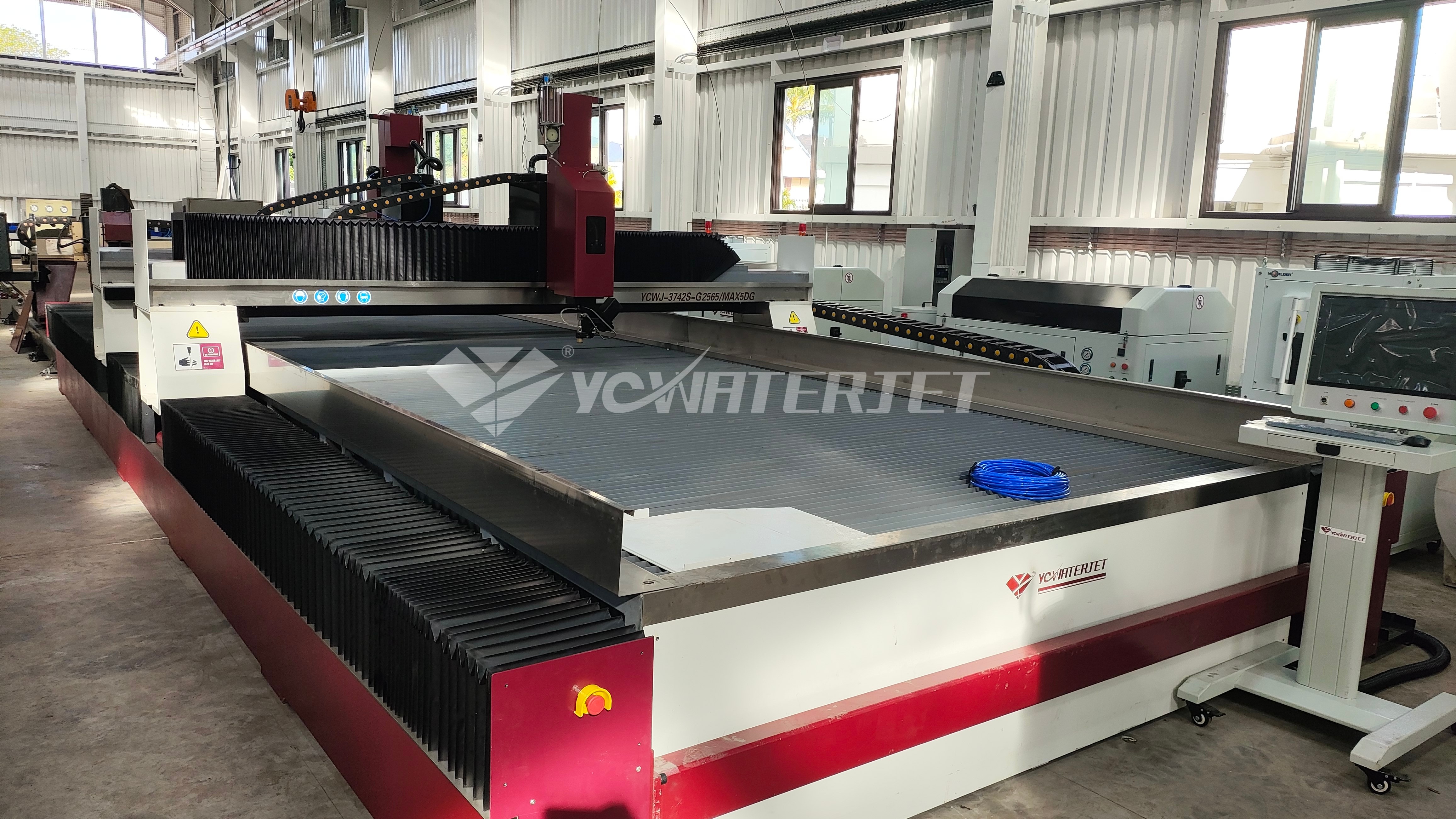
The cutting table defines the part envelope. Table size, not accuracy class, is usually what decides between the two E Series models.
Two table sizes, one accuracy class
The E Series is offered in two effective cutting areas: YCWJ-E3020 at 3000 × 2000 mm and YCWJ-E4020 at 4000 × 2000 mm. Both are quoted at the same ±0.1 mm cutting accuracy, the same ±0.025 mm positioning accuracy and the same 0–8 m/min X,Y dry-run speed.
That means the model choice is an envelope decision, not a precision decision. If the largest stainless part plus fixturing plus the clamping margin fits inside 3000 × 2000 mm, the E3020 is the smaller footprint. If it does not, the E4020 adds 1000 mm of X travel without changing the accuracy class. Nesting strategy belongs in the same calculation: a shop that nests several parts per cycle may need the longer table even when no single part does.
What ±0.1 mm and ±0.025 mm each cover
The ±0.025 mm figure is positioning accuracy — what the machine can do with the cutting head before the jet is switched on. The ±0.1 mm figure is cutting accuracy — what the part is specified to measure after the jet has done its work. They are not interchangeable, and a supplier who offers one number when you asked for the other has not answered the question.
Part-level results on thick stainless depend on the conditions around those numbers: material grade, section thickness, orifice and nozzle, operating pressure, abrasive choice where abrasive cutting is used, fixturing, and the measurement method applied at acceptance. The specification is the machine-level promise. The part-level result is a joint agreement that belongs in the RFQ, in writing, before the purchase order.
The 0–8 m/min figure is not your cutting speed
0–8 m/min is the X,Y dry-run speed — the rate at which the machine moves the head when it is not cutting. It is genuinely useful for cycle-time estimates on large nested plates, because positioning between contours costs real time on a table this size. It is not a cutting speed. Using it to calculate throughput on stainless will produce a number that no shop will ever achieve, and it is one of the most common specification misreadings in waterjet procurement.
Pressure, flow and the pump behind them
The ultra-high-pressure pump is quoted at 4137 bar / 60,000 psi maximum pressure and 7.4 L/min maximum flow. YC Waterjet's pump range covers YCG-3038, YCG-3742, YCG-3742S, YCG-Ultra100, YCG-SERVO50, YCG-Ultra100S and YCG-Servo50S, so the pump model should be named explicitly in the quotation rather than left as “UHP pump”.
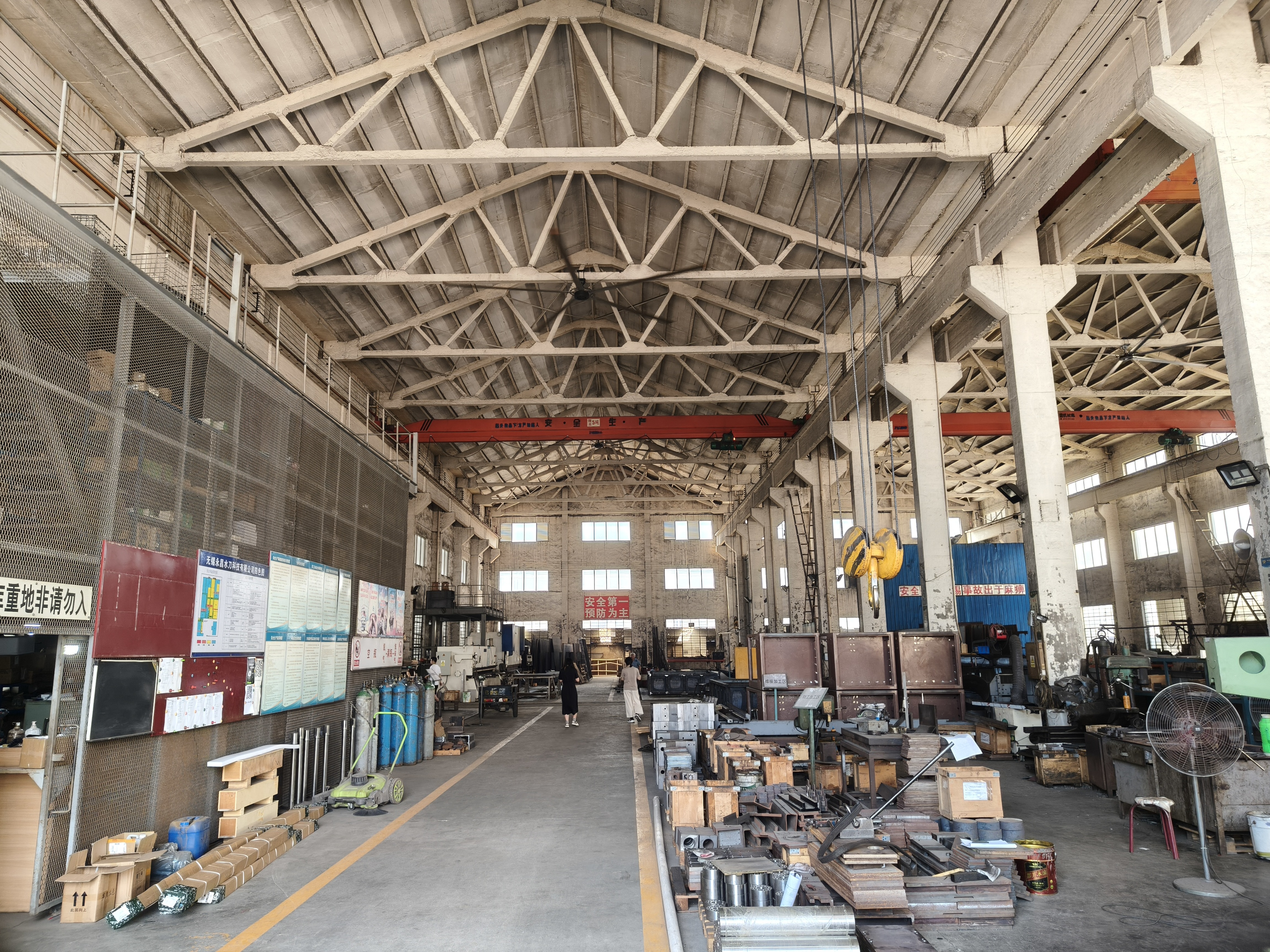
YC Waterjet production workshop. Founded in 1999, the company operates a 7,000㎡ production base and reports annual output of 100 sets.
Step-by-Step: Specifying and Accepting a Thick-Plate Waterjet
The following seven steps turn a ±0.1 mm requirement into a purchase that can be checked. Each step produces a document, not a conversation.
- Fix the part envelope and the material. State the largest part, the fixture footprint and the material grade. The E Series is stated for steel, stainless steel, alloys and thick plates; confirm your grade is inside that scope rather than assuming it.
- Split the ±0.1 mm callout. Separate position relative to datum, kerf width, squareness and edge condition into individual requirements with individual measurement methods. This single step prevents most acceptance disputes.
- Choose the platform. YCWJ-E3020 at 3000 × 2000 mm or YCWJ-E4020 at 4000 × 2000 mm. Decide on the envelope including clamping and nesting, not on the largest single part alone.
- Configure the options. YC Waterjet's customization scope covers logo, cutting head, cutting area, cutting speed, voltage, cutting thickness and height measurement. Each item changes the machine you receive, so list them as line items.
- Name the pump model and its duty point. Specify maximum pressure (4137 bar / 60,000 psi) and maximum flow (7.4 L/min) and the pump model from the YCG range. Do not accept “UHP pump” as a description.
- Agree the acceptance test. Acceptance criteria are ex-factory test, and each unit undergoes pre-delivery testing with delivery inspection as the quality-control gate. Write down the test material, thickness, measurement instrument and sampling plan inside that framework.
- Agree commercial and support terms. MOQ is 1 set; lead time is 30–45 days; monthly capacity is 10 sets. Payment is 30% T/T after signing with the remaining 70% T/T before delivery. Delivery terms are selectable from EXW, FCA, FAS, FOB, CFR, CIF, CPT, CIP, DPU, DAP or DDP by negotiation. The one-year warranty covers the machine excluding consumable parts, with free replacement parts for non-manual defects, remote guidance supported by manual and video, and on-site engineer assistance available with travel, visa, accommodation and fee borne by the client.
Use Cases: Where This Configuration Earns Its Place
Precision industrial parts in a tropical climate
A Thai industrial manufacturing customer has run one YC Waterjet system for precision part cutting for 10 years. The reported results are precision-cut industrial parts with high accuracy, reduced scrap and improved production efficiency. The recorded highlights are high-precision cold cutting with no thermal deformation, reliable performance in a tropical climate, and versatility across diverse industrial materials. The climate point is not incidental: heat and humidity are the conditions under which machine stability gets tested over a decade rather than a quarter.
Marine aluminum plate with a finished edge
A yacht manufacturer in Mauritius has run one system for 10 years cutting aluminum plate for yacht components. Reported results are clean, burr-free precision cuts, reduced material waste and improved production efficiency, with cold cutting preserving material strength without thermal deformation. The material is aluminum rather than stainless, but the mechanism is the same one this article is about: the cut edge is the finished edge, and no heat-affected zone has to be removed afterwards.
In-house stainless work in a fabrication shop
The direct fit for the E Series is a fabricator that cuts its own stainless and alloy plate and currently loses margin to a second operation, a straightening step, or a rework loop. Where the part envelope is large and the tolerance is tight, the value is not the cutting speed — it is the disappearance of the step after cutting.

Acceptance inspection with a long-running customer. Acceptance criteria for YC Waterjet machines are ex-factory test, supported by delivery inspection.
Comparison: YCWJ-E3020 vs YCWJ-E4020
Both models share the same accuracy class and the same pump specification. The table isolates what actually differs.
| Parameter | YCWJ-E3020 | YCWJ-E4020 |
|---|---|---|
| Effective cutting area | 3000 × 2000 mm | 4000 × 2000 mm |
| Cutting accuracy | ±0.1 mm | ±0.1 mm |
| Positioning accuracy | ±0.025 mm | ±0.025 mm |
| X,Y dry-run speed | 0–8 m/min | 0–8 m/min |
| Intended application | Metalworking: steel, stainless steel, alloys, thick plates | Metalworking: steel, stainless steel, alloys, thick plates |
| Covered by CE certificate ICR/VC/HM2308122 | Yes | Yes |
Commercial and Quality Terms at a Glance
| Item | Specification |
|---|---|
| Pump maximum pressure | 4137 bar / 60,000 psi |
| Pump maximum flow | 7.4 L/min |
| Pump models | YCG-3038, YCG-3742, YCG-3742S, YCG-Ultra100, YCG-SERVO50, YCG-Ultra100S, YCG-Servo50S |
| MOQ | 1 set |
| Lead time | 30–45 days |
| Monthly capacity | 10 sets |
| Payment terms | 30% T/T deposit after contract signature; 70% T/T before delivery |
| Delivery terms | EXW / FCA / FAS / FOB / CFR / CIF / CPT / CIP / DPU / DAP / DDP by negotiation |
| Acceptance criteria | Ex-factory test |
| Quality control | Delivery inspection |
| Warranty | One year, excluding consumable parts; free replacement parts for non-manual defects |
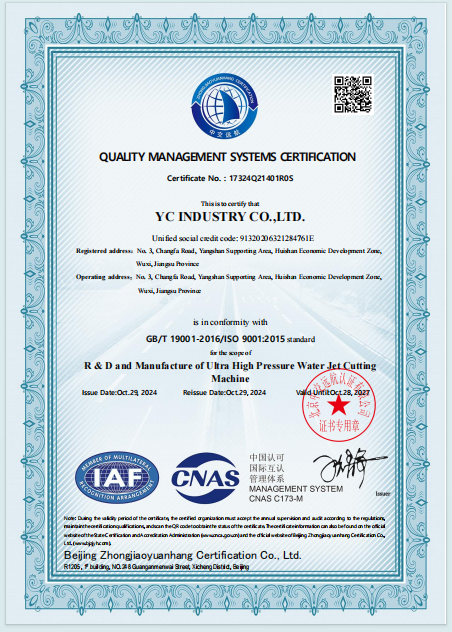
ISO 9001 certificate 17324Q21401R0S, covering R&D and manufacture of ultra-high-pressure water jet cutting machines.
Frequently Asked Questions
Is the E Series covered by CE and ISO certification?
Yes. Verification of Conformity certificate ICR/VC/HM2308122 was issued by ICR Co., Ltd. for the EU market on 24 August 2023 and is valid until 23 August 2028. Its scope names YCWJ-E3020 and YCWJ-E4020 explicitly, and the cited standards are the Machinery Directive together with EN ISO 12100:2010 and EN 60204-1:2018. Separately, Quality Management Systems certificate 17324Q21401R0S was issued by Beijing Zhongjiaoyuanhang Certification Co., Ltd. to GB/T 19001-2016 / ISO 9001:2015 for the R&D and manufacture of ultra-high-pressure water jet cutting machines, valid until 28 October 2028. Buyers should check that the certificate scope covers the exact model and configuration on the order, not just the series name.
Can the E Series actually hold ±0.1 mm on thick stainless steel?
The machines are specified at ±0.1 mm cutting accuracy and ±0.025 mm positioning accuracy, with an ultra-high-pressure pump rated to 4137 bar / 60,000 psi at 7.4 L/min maximum flow. Holding that on thick stainless at part level is a conditional result: material grade, thickness, nozzle and orifice, operating pressure, abrasive selection where applicable, fixturing and the measurement method all affect the measured value. The practical way to close the gap between a machine-level and part-level claim is to write the test material, thickness and measurement method into the acceptance protocol before the order is placed.
What are the payment terms and delivery options?
Minimum order quantity is 1 set. Payment is 30% T/T after signing the contract, with the remaining 70% T/T before delivery. Delivery terms can be set to EXW, FCA, FAS, FOB, CFR, CIF, CPT, CIP, DPU, DAP or DDP according to negotiation. Total investment depends on the platform chosen (3000 × 2000 mm or 4000 × 2000 mm), the pump model and the selected customization options, so a like-for-like quotation should always list those three items separately.
How is the machine validated before it ships?
Acceptance criteria are ex-factory test, and quality control is handled through delivery inspection. Each unit undergoes pre-delivery testing. The one-year warranty covers the machine excluding consumable parts, with free replacement parts shipped for non-manual defects. Remote guidance is provided with manual and video support, and on-site engineer assistance — for example for split-type waterjets — is available with travel, visa, accommodation and fee borne by the client.
What is the lead time and monthly capacity?
Lead time is 30–45 days and monthly capacity is 10 sets, with an MOQ of 1 set. If the project depends on a specific installation window, the practical next step is to send the part drawings, material specification and required tolerance to the YC Waterjet team at ycwaterjet.com so the platform, pump model and configuration can be confirmed against your envelope before a delivery date is committed.
Conclusion: The Decision Rule
If the drawing says ±0.1 mm on thick stainless and the current process ends with a grinder, the constraint is the heat, not the operator. The decision rule is straightforward: choose the smallest E Series table that fits the part envelope with clamping and nesting margin, specify the pump model and its duty point rather than the word “UHP”, separate position tolerance from cut tolerance in the acceptance protocol, and fix the test material and measurement method in writing before the order.
YC Water Jet Technology Co., Ltd has manufactured ultra-high-pressure waterjet cutting systems since 1999 from a 7,000㎡ production base, with annual output of 100 sets and exports to more than 140 countries and regions as of 2026. That history matters less than the specification sheet, but it explains why the customization list — logo, cutting head, cutting area, cutting speed, voltage, cutting thickness, height measurement — exists as a standard conversation rather than a special request.
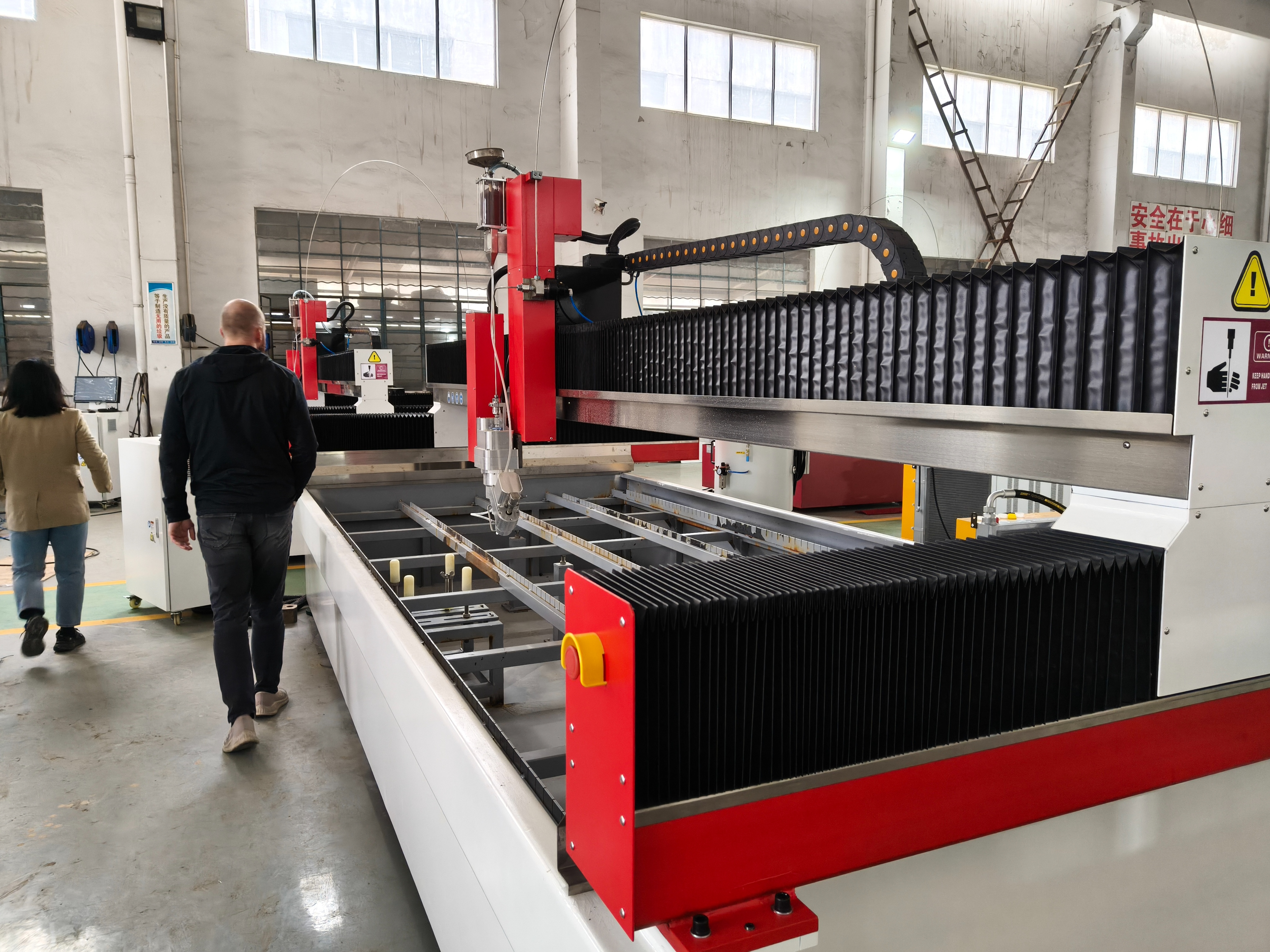
Machines are prepared and inspected before shipment. Delivery inspection is the stated quality-control gate.
Next step: test your tolerance against a real configuration
Send your thick-plate part drawings, material grade and tolerance callout to the YC Waterjet team. You will receive a platform recommendation (YCWJ-E3020 or YCWJ-E4020), a named pump model, a configuration list and an ex-factory acceptance plan.
Email: sales@ycwaterjet.com | Tel / WhatsApp: +86 13861858095 | www.ycwaterjet.com
Contact: Johnny Bian | NO.3 Changfa Road, Yangshan, WuXi, JiangSu, China
Have Questions or Need More Details?
Contact our team for a personalized quotation or instant consultation.
Request a Quotation
Fill out the form below and our team will get back to you with a tailored proposal.
WhatsApp Direct Chat
Prefer to chat in real-time? Message us on WhatsApp for instant assistance & quick answers.
- Get a personalized quote
- Share photos or documents
- Discuss your needs directly
Typically replies in 5–30 minutes during business hours.