
Waterjet Cutting Machines Explained: How High-Pressure Water Cuts Stone, Metal, Glass & More
Waterjet Cutting Machines Explained: How High-Pressure Water Cuts Stone, Metal, Glass & More
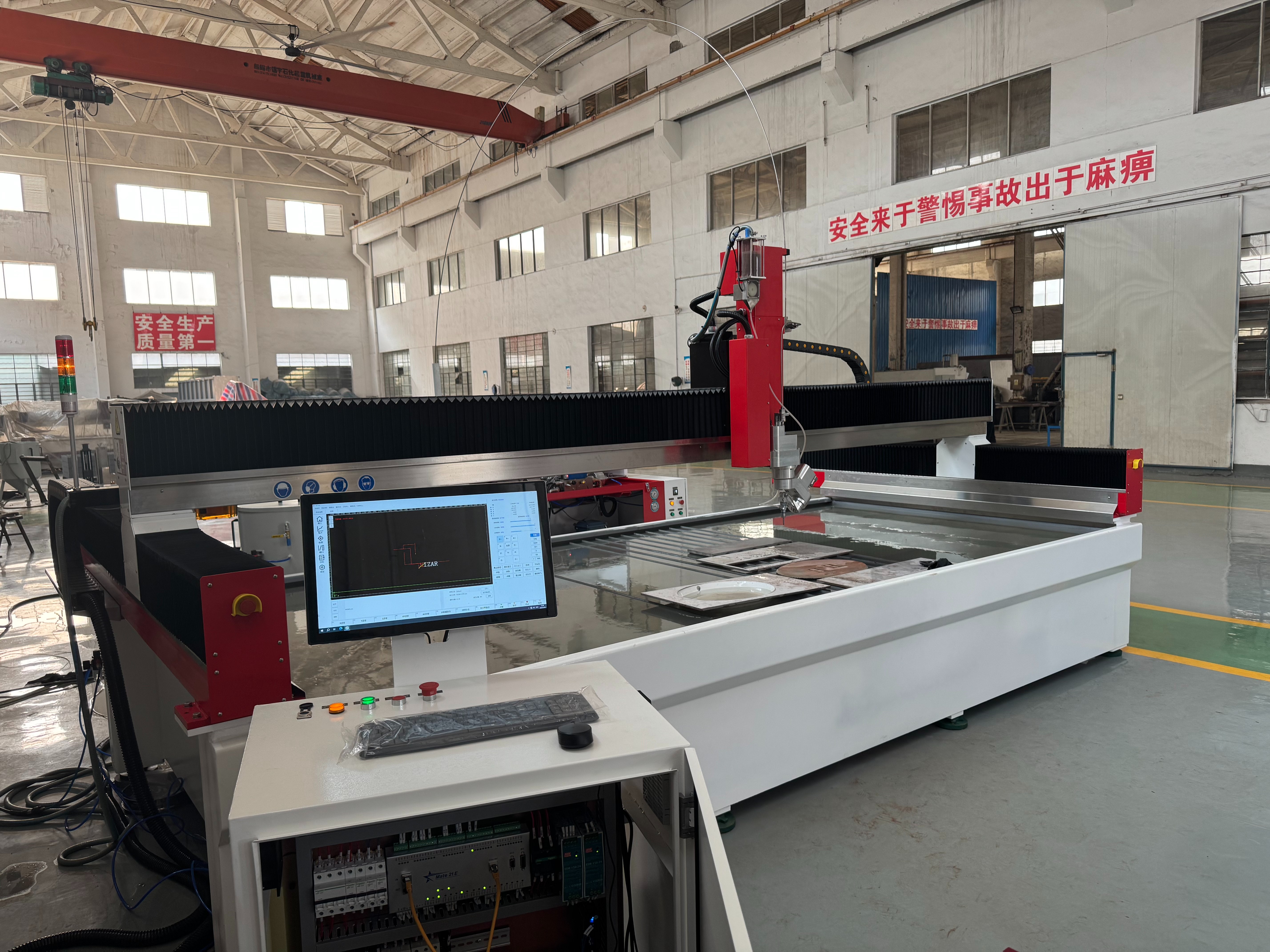
A waterjet cutting machine is a CNC cutting tool that uses an ultra-high-pressure stream of water—often mixed with abrasive particles—to cut a wide range of materials. Unlike thermal cutting processes, waterjet cutting is a cold-cutting method, meaning the material is not exposed to heat-affected zones, which makes it especially useful for stone, glass, metals, composites, and heat-sensitive materials. This guide explains how waterjet cutting machines work, what they can cut, the main machine types, and what buyers should understand before selecting a system.
What Is a Waterjet Cutting Machine?
A waterjet cutting machine is a material processing system that pressurizes water to ultra-high levels and forces it through a small orifice to create a thin, high-velocity stream capable of cutting materials. When cutting hard materials such as steel, stone, and glass, an abrasive substance—typically garnet—is added to the stream. The combination of water pressure, abrasive particles, and precisely controlled movement allows the machine to produce intricate shapes, sharp corners, and stackable cuts without introducing heat.
YC Water Jet Technology Co., Ltd. (YC Waterjet), a manufacturer established in 1999, specializes in ultra-high-pressure waterjet cutting systems. The company designs and builds a range of waterjet cutting machines, including the S Series small machines, L Series standard machines, G Series large-format machines, E Series machines, ultra-high-pressure pumps, and 6-axis robotic waterjet cutting systems.
How Does a Waterjet Cutting Machine Work?
The cutting process in a waterjet machine begins with an ultra-high-pressure pump. The pump pressurizes water to as much as 4,137 bar (60,000 psi). YC Waterjet’s Ultra High Pressure Waterjet Pumps, for example, operate at a maximum pressure of 4,137 bar with a maximum water flow of 7.4 L/min. This pressurized water is delivered to the cutting head, where it passes through an extremely small orifice. The result is a high-velocity waterjet that can be used alone for soft materials or combined with abrasive for harder materials.
In abrasive waterjet cutting, the water stream passes through a mixing chamber where abrasive particles are drawn in and accelerated. The abrasive-laden jet then exits through a nozzle and performs the actual cutting. The motion of the cutting head is controlled by CNC (computer numerical control), allowing the machine to follow programmed cutting paths with high precision.
Because the process uses water as the primary cutting medium, it produces no heat-affected zone and does not alter the metallurgical properties of the material being cut. This is a key advantage in applications such as aerospace component cutting, where material integrity is critical.
What Materials Can a Waterjet Cutting Machine Cut?
Waterjet cutting systems are known for their material versatility. They can cut metals, stone, ceramics, glass, composites, and even soft materials such as rubber, foam, paper, and food products. The table below summarizes common materials and their typical waterjet applications.
| Material Category | Examples | Common Waterjet Applications |
|---|---|---|
| Metals | Stainless steel, carbon steel, aluminum, alloys, copper | Plate cutting, precision part blanking, thick-plate cutting, metal fabrication |
| Stone & Marble | Granite, marble, ceramic tiles | Architectural decoration, art carving, tile cutting, edge profiling |
| Glass | Flat glass, laminated glass, decorative glass | Precision glass cutting without thermal stress |
| Composites | Carbon fiber, fiberglass, honeycomb, CFRP | Aerospace components, composite molding, lightweight structures |
| Aerospace Alloys | Titanium alloys | Component cutting, trimming, high-integrity parts |
| Automotive Materials | Steel sheets, aluminum, interior components, fiberglass | Automotive interior cutting, trim and panel processing |
| Soft & Food Materials | Rubber, foam, paper, fabric, frozen food, silicone | Soft material cutting, food portioning, gasket production |
YC Waterjet lists the following industries as typical application areas for its waterjet cutting machines: aerospace, automotive, metalworking, architecture and decoration, composites, medical and food processing, and rubber and soft materials. This broad compatibility means a single waterjet system can replace multiple cutting methods in a workshop.
Key Components of a Waterjet Cutting System
A complete waterjet cutting system consists of several components. Understanding them helps buyers evaluate a manufacturer’s overall capability rather than only looking at the gantry or table size.
Ultra-High-Pressure Pump
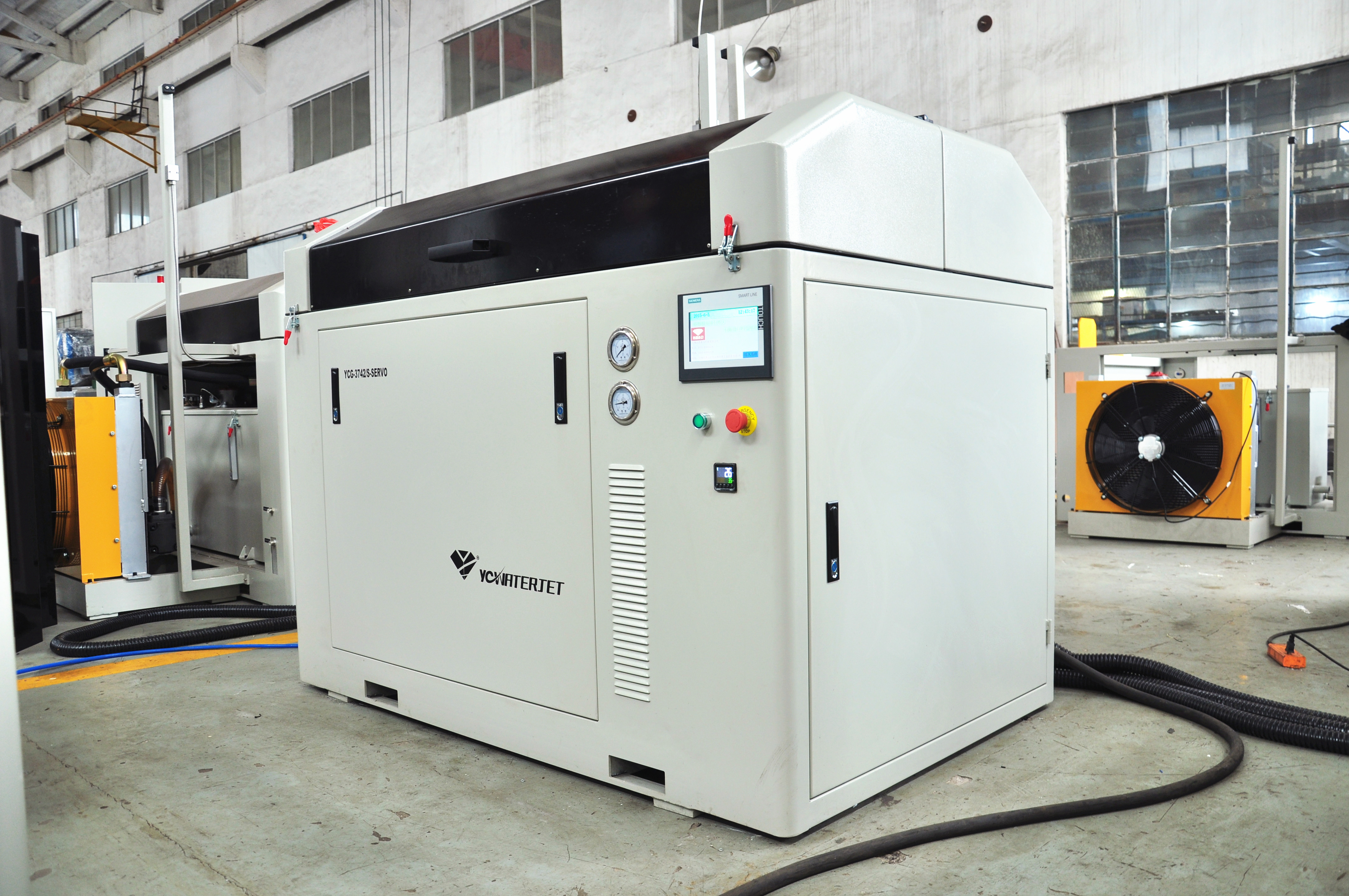
The pump is the power source of the entire system. It generates the pressure required for cutting. YC Waterjet’s Ultra High Pressure Waterjet Pump series includes models such as YCG-3038, YCG-3742, YCG-3742S, YCG-Ultra100, YCG-SERVO50, YCG-Ultra100S, and YCG-Servo50S. These pumps support a maximum pressure of 4,137 bar (60,000 psi) and a maximum water flow of 7.4 L/min.
Cutting Table and Motion System
The cutting table supports the workpiece and contains the water tank and abrasive collection system. The motion system—typically a gantry or bridge-style frame—moves the cutting head along the X, Y, and sometimes Z axes. YC Waterjet’s standard waterjet cutting machines achieve a cutting accuracy of ±0.1 mm and a positioning accuracy of ±0.025 mm.
Cutting Head
The cutting head houses the orifice, mixing chamber, and nozzle. Depending on the machine configuration, it may be a 3-axis head for flat cutting or a 5-axis head for bevel and 3D cutting. YC Waterjet offers 3-axis, 3D MAX 5-axis, and Dynamic 5-axis configurations across its S, L, G, and E Series machines. Some systems also include a drilling function integrated into the cutting head.
CNC Control System
CNC software converts the CAD drawing into machine movements. It controls cutting speed, path, and multi-axis motion. On YC Waterjet machines, the CNC system is supplied as part of the complete machine configuration.
Abrasive Delivery and Recovery System
Abrasive waterjet cutting requires a steady supply of abrasive particles. Some systems also offer an abrasive recovery or auto sludge removal system. YC Waterjet lists automatic sludge removal as an available configuration for its G Series and full-system offerings.
Types of Waterjet Cutting Machines
Manufacturers group waterjet cutting machines by size, cutting area, and axis configuration. The following table compares the main YC Waterjet machine series.
| Series | Models | Typical Cutting Area | Best Suited For |
|---|---|---|---|
| S Series (Small Waterjet) | YCWJ-S0808, YCWJ-1010, YCWJ-1212 | Small-format, full-closed CNC | Small workshops, precision parts, sample cutting, food cutting |
| L Series | YCWJ-L1515, YCWJ-L3015, YCWJ-L3020, YCWJ-L4020, YCWJ-L4025 | 1.5m×1.5m up to 4m×2.5m | Standard metal, stone, and glass fabrication |
| G Series | YCWJ-G2060, YCWJ-G2080, YCWJ-G3080, YCWJ-G30100 | Large-format, up to 3m×10m | Large stone slabs, thick plates, high-volume production |
| E Series | YCWJ-E3020, YCWJ-E4020 | 3000×2000mm, 4000×2000mm | Metal sheet and plate cutting with stable accuracy |
| Robot Waterjet | YCWJ-Robot | 6-axis robotic reach | Automotive interiors, aerospace, architectural decoration, composite molding |
The E Series machine is available in models YCWJ-E3020 and YCWJ-E4020, with effective cutting areas of 3000×2000mm and 4000×2000mm respectively. The G Series is designed for large-format cutting with a maximum pressure of 4,137 bar and a maximum liquid flow of 7.4 L/min. The small waterjet cutting machines in the S Series—YCWJ-S0808, YCWJ-1010, and YCWJ-1212—offer the same cutting accuracy level (±0.1mm) in a compact footprint.
Waterjet vs. Plasma vs. Laser Cutting: A Quick Comparison
Waterjet cutting is often compared with plasma and laser cutting. While each method has its strengths, the choice depends on material, thickness, and quality requirements. The comparison below focuses on general technical differences, not on any particular brand.
| Machine Type | Process Type | Material Compatibility | Best Use Case |
|---|---|---|---|
| Waterjet Cutting Machine | Cold cutting with high-pressure water + abrasive | Metal, stone, glass, composites, rubber, food | Heat-sensitive materials, thick plates, multi-material workshops |
| Plasma Cutting Machine | Thermal cutting using ionized gas | Conductive metals | High-speed cutting of medium-thick steel plates |
| Laser Cutting Machine | Thermal cutting using focused laser beam | Metals and some non-metals | Thin-sheet precision cutting with high speed |
Because waterjet cutting does not generate heat, it avoids thermal distortion and does not create a heat-affected zone. This makes it suitable for materials such as aluminum, titanium alloys, composites, and stone, where thermal cutting would cause damage or edge quality problems.
Applications and Use Cases
Waterjet cutting machines are used across multiple industries. The application scenario data from YC Waterjet lists metalworking, stone processing, glass processing, aerospace, automotive manufacturing, composite materials, architectural decoration, and electronic precision processing as the primary sectors.
Stone and Marble Processing
For stone fabricators, a waterjet cutting machine is used to cut granite, marble, ceramic tiles, and engineered stone. Applications include decorative inlays, intricate edge profiles, bathroom vanity tops, and large-format slab cutting. A stone waterjet cutting machine produces clean edges and reduces material waste because narrow kerf widths allow tighter nesting of parts.
Metal Fabrication
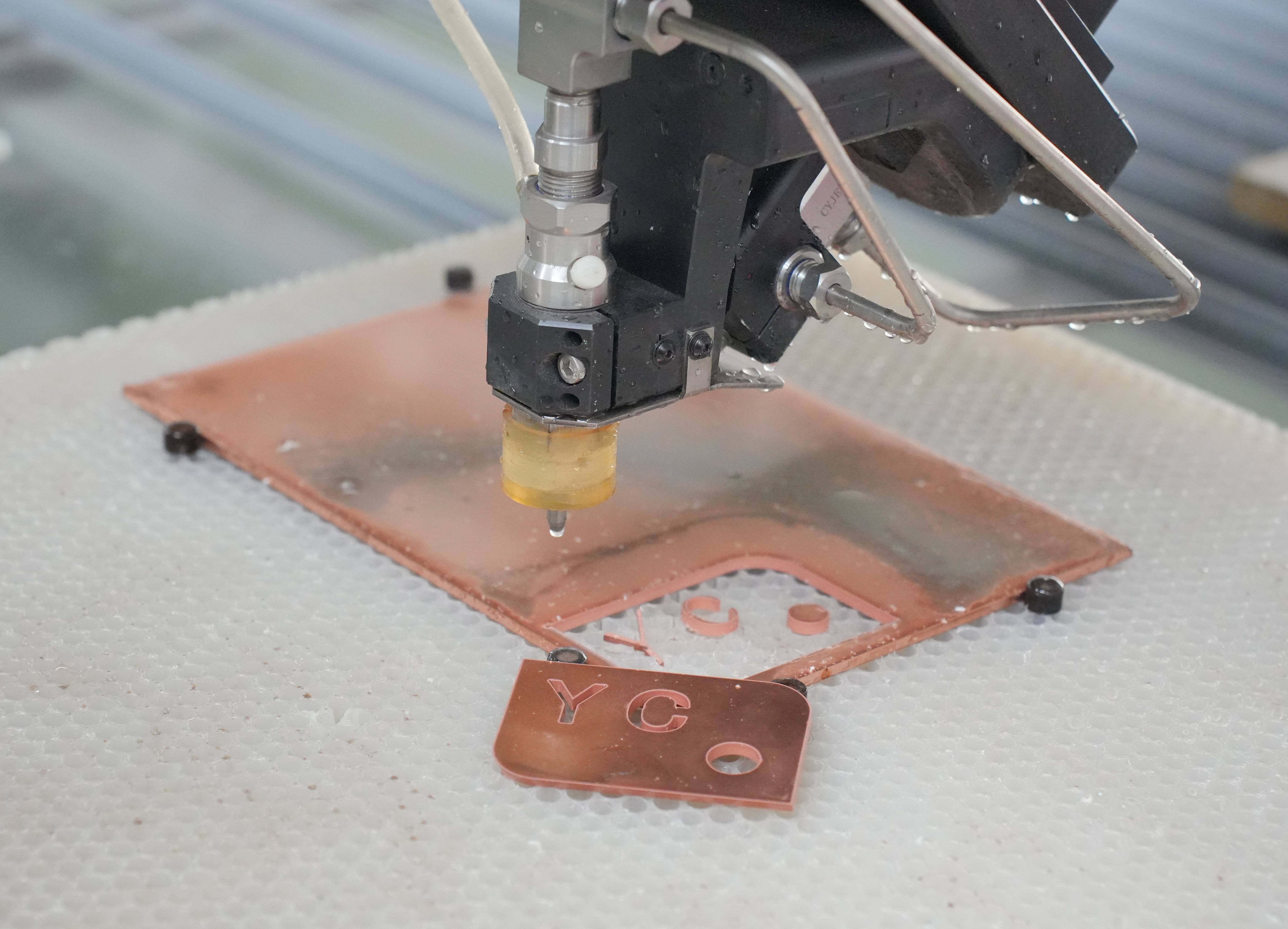
Metal cutting is the largest application segment in the waterjet market. Waterjet metal cutters handle stainless steel, carbon steel, aluminum, alloys, and thick plates without heat distortion. They can cut stacked sheets, produce parts with smooth edges, and support secondary operations such as drilling when the cutting head is equipped with a drilling function.
Glass Cutting
Glass is difficult to cut with thermal processes because it can crack from heat stress. A water jet glass cutter uses high-pressure water to score and cut glass without introducing heat. It is used for decorative glass, laminated glass, and custom-shaped glass panels.
Aerospace and Composites
Aerospace manufacturers use waterjet cutting for titanium alloys, carbon fiber reinforced plastic (CFRP), honeycomb structures, and other advanced materials. The cold-cutting nature of waterjet is particularly valuable for composites, which can delaminate or burn under laser or plasma cutting.
Automotive and Robot Waterjet
In automotive manufacturing, waterjet cutting handles steel sheets, aluminum, interior components, and fiberglass. For complex 3D parts, a 6-axis robotic waterjet cutting system offers additional flexibility. YC Waterjet’s YCWJ-Robot is a 6-axis robotic waterjet cutting system designed for automotive interiors, aerospace, architectural decoration, and composite molding.
Food and Soft Materials
Waterjet cutting is also used for food products, rubber, foam, paper, and fabric. Because the cutting stream is cold, it can portion frozen meat, cut soft bakery products, and process molded rubber components without melting or contaminating the material.
Small Waterjet Cutting Machines Explained
For workshops, repair shops, and small production facilities, a small waterjet cutting machine can be a practical entry point into waterjet technology. YC Waterjet’s S Series includes the YCWJ-S0808, YCWJ-1010, and YCWJ-1212 models. These compact machines provide the same cutting accuracy (±0.1mm) and positioning accuracy (±0.025mm) as larger systems while occupying less floor space.
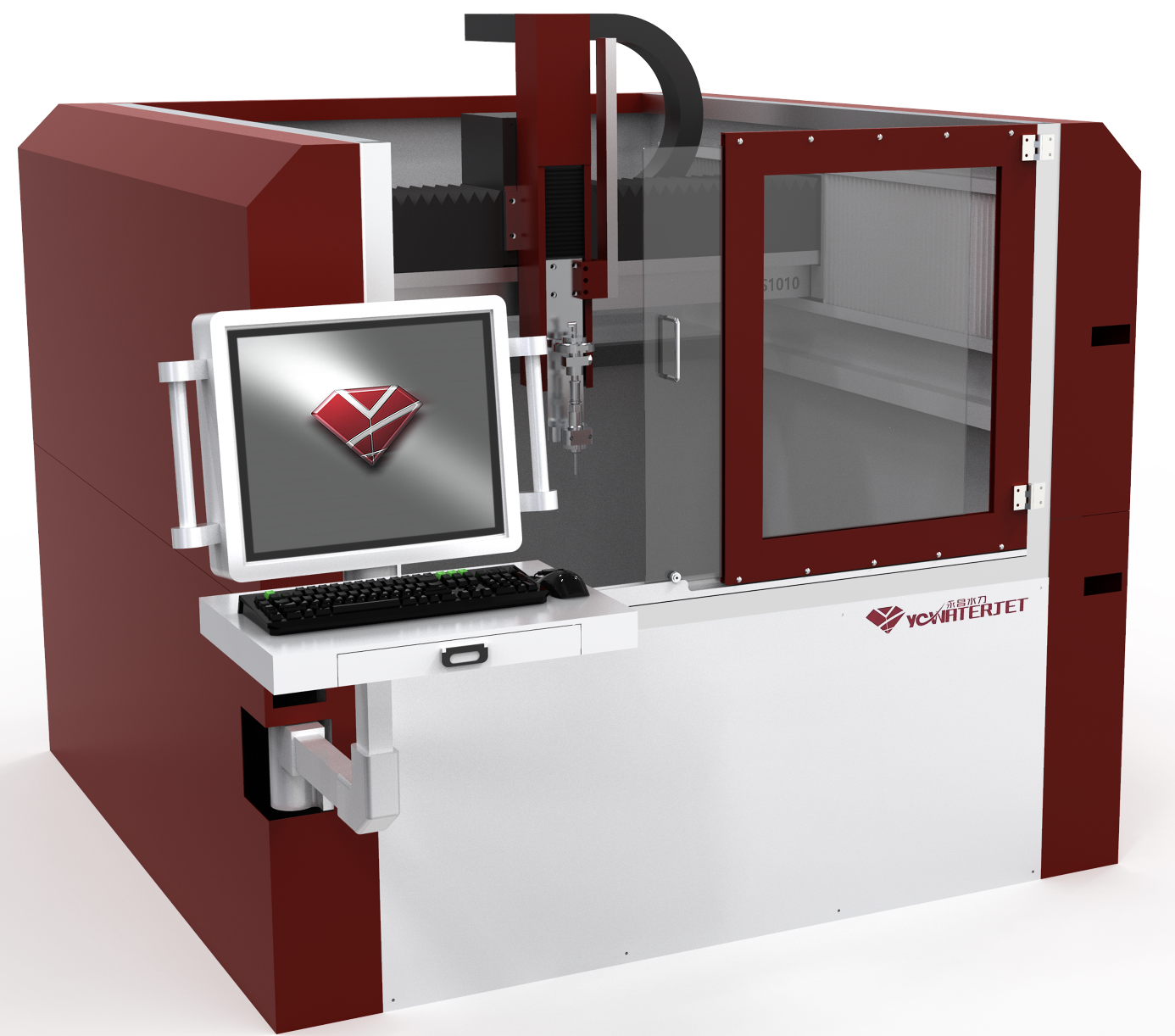
A small waterjet cutter is often chosen for cutting metal samples, decorative tiles, small stone pieces, and gaskets. It can also be configured as a fully enclosed small CNC waterjet cutting machine, which improves safety and noise control in a workshop environment.
One important point for buyers: the machine size should match the largest workpiece you plan to cut. A machine with a 3000×2000mm cutting area cannot process a 4000×2000mm slab. Choosing a small machine makes sense when your parts are consistently small and floor space is limited.
Why Material Compatibility Matters in a Multi-Material Workshop
A single waterjet cutting machine can process metal, stone, glass, and composites without changing the cutting tool. This is a significant operational advantage for job shops and mixed-production facilities. Instead of maintaining separate laser, plasma, and saw equipment, a fabricator can route multiple material types through one machine.
For example, an architectural metal and stone workshop might cut stainless steel panels in the morning, granite countertops in the afternoon, and decorative glass inlays before the end of the shift. Because the waterjet process is the same across these materials, the operator mainly changes the cutting parameters and abrasive settings.
How to Choose the Right Waterjet Cutting Machine
Selecting a waterjet cutting machine requires more than comparing table sizes. The following steps form a practical selection framework.
Step 1: Define Your Materials and Thickness
List the materials you cut most often and their maximum thickness. Metals, stone, glass, and composites all have different recommended cutting speeds and abrasive requirements. Thick plates require higher pump power and may need a larger orifice. If you primarily cut stone and marble, a machine with a rigid gantry and large cutting area is important.
Step 2: Determine the Required Cutting Area
Measure your largest standard workpiece, adding margin for nesting and clamping. Waterjet manufacturers offer a range of table sizes. YC Waterjet’s machine lineup, for example, covers small (YCWJ-S0808), standard (L Series from 1.5m×1.5m to 4m×2.5m), large-format (G Series up to 3m×10m), and E Series (3000×2000mm and 4000×2000mm).
Step 3: Choose the Axis Configuration
For flat sheet cutting, a 3-axis machine is usually sufficient. If you need beveled edges or 3D cutting, consider a 5-axis or Dynamic 5-axis cutting head. For complex three-dimensional components, a 6-axis robotic waterjet cutting system may be the better choice.
Step 4: Evaluate Cutting Accuracy and Repeatability
YC Waterjet’s waterjet cutting machines achieve a cutting accuracy of ±0.1mm and a positioning accuracy of ±0.025mm. When comparing suppliers, ask for the same two numbers: cutting accuracy and positioning accuracy. These values directly affect whether the machine can produce parts to your tolerance.
Step 5: Assess the Pump and Consumables
The high-pressure pump is the most maintenance-intensive part of a waterjet system. Ask which pump brand is installed, what the maximum working pressure is, and how the pump is cooled. YC Waterjet’s Ultra High Pressure Waterjet Pump supports a maximum pressure of 4,137 bar (60,000 psi) and a maximum water flow of 7.4 L/min. In addition, since 2005, YC Waterjet has collaborated with pump technology partners including KMT and Accustream/Hypertherm.
Step 6: Consider the Complete System
A waterjet cutting system includes the pump, cutting table, CNC, abrasive delivery, and often optional systems such as sludge removal or a hydraulic loading system. YC Waterjet lists optional functions such as an automatic sludge removal system, hydraulic loading system, cutting head with drilling function, and laser scanning height measurement. Evaluate which options are necessary for your workflow.
From Cutting Table to Complete System: What a Factory Tour or Supplier Evaluation Should Cover
When evaluating a waterjet cutting machine manufacturer, buyers should look beyond the brochure. The following checklist is a practical guide for a factory visit or virtual assessment.
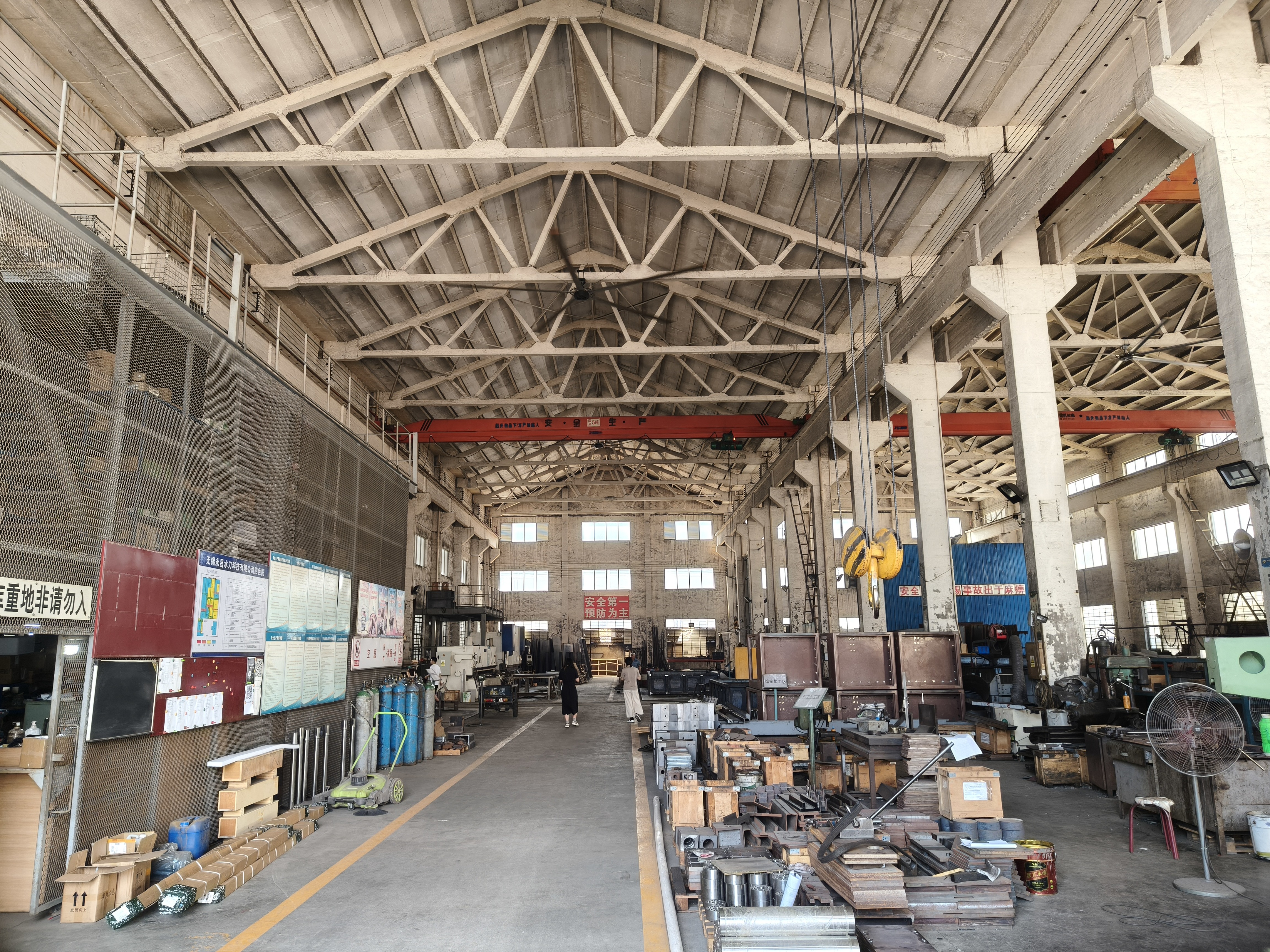
- Production base: Confirm the factory size and whether it demonstrates dedicated manufacturing capacity. YC Waterjet operates from a 7,000㎡ production base.
- Team experience: Ask about the engineers, production managers, and technicians who will support the machine. YC Waterjet’s team includes approximately 25 staff, with an R&D team of 7 engineers.
- Annual output and delivery: Annual production capacity affects lead time. YC Waterjet reports an annual output of about 100 sets.
- Export history: A manufacturer with wide export experience is more likely to understand international documentation, packaging, and after-sales requirements. YC Waterjet serves markets across the Middle East, Asia, Europe, the Americas, and Africa, and as of 2026 exports to more than 140 countries and regions worldwide.
- Certification and compliance: Ask which safety standards and certifications apply to the machine and high-pressure components. Waterjet safety standards such as ISO 21789 are relevant to water jetting systems.
- Component sourcing: High-pressure pump reliability is critical. YC Waterjet has collaborated with KMT and Accustream/Hypertherm since 2005, integrating intensifier technology into its high-pressure pump systems.
Industry Context: Why Waterjet Cutting Machines Are Gaining Attention
The global waterjet cutting machine market was estimated at USD 1.31 billion in 2025, with projections reaching USD 1.86 billion by 2030. Asia-Pacific accounted for approximately 37.8% of global market revenue in 2024. Metal cutting is the dominant application, representing approximately 54.2% of the waterjet application segment as of 2026.
These figures point to a maturing market where buyers increasingly compare waterjet systems against laser, plasma, and traditional machining methods. The trend toward composite materials, lightweight structures, and heat-sensitive precision components also supports wider adoption of waterjet technology.
For a buyer entering this market, the practical takeaway is straightforward: waterjet cutting machines are no longer a niche tool. They are a flexible, multi-material cutting platform suitable for stone fabrication, metalworking, aerospace, automotive, architectural decoration, and many other industries.
Step-by-Step: How to Take a Part from CAD to Finished Waterjet-Cut Component
Understanding the full workflow helps buyers plan their production process.
- Create or import the part drawing in CAD software. The file format should be compatible with the machine’s CNC software.
- Program the cutting path in CAM software. Set cutting speed, pierce parameters, abrasive flow, and lead-in/lead-out paths.
- Prepare the material on the cutting table and ensure it is properly supported. Large plates may require additional support to prevent flexing.
- Start the high-pressure pump and let the system reach the required operating pressure.
- Run a test cut when cutting a new material or thickness. Check edge quality, dimensional accuracy, and taper.
- Run the production program with the cutting head following the CNC path. Monitor the abrasive feed, water pressure, and cutting speed.
- Remove and inspect the finished parts. Clean parts if needed, and separate by material type for recycling or disposal.
Cost and Budget Considerations
The purchase price of a waterjet cutting machine depends on several factors: table size, pump power, axis configuration, brand, and options. Small waterjet machines generally have a lower entry price than large-format systems. However, the long-term cost includes abrasive consumption, water, electricity, pump maintenance, spare parts, and operator training.
Because waterjet cutting is slower than laser cutting on thin metal sheets, buyers who mainly cut thin steel may achieve higher throughput with a laser. For thick metals, stone, glass, and composites, however, waterjet is often the more practical process. For this reason, the selection decision should be based on your material mix and part geometry, not on a single cutting speed figure.
Maintenance and After-Sales Support
Regular maintenance for a waterjet cutting machine focuses on the high-pressure pump, cutting head orifice and nozzle, abrasive delivery system, and water quality. Seals, check valves, and orifice are consumable parts that wear over time. A manufacturer with a stable production team and export experience can provide spare parts support and technical guidance.
YC Waterjet’s team structure includes three engineers with over 20 years of expertise, two production managers who have worked with the company since its founding, and five technicians with more than a decade of experience. This level of staff longevity is relevant to buyers because it supports consistent assembly quality and on-time delivery.
Common Myths About Waterjet Cutting
Myth 1: Waterjet cutting can only cut soft materials. In practice, abrasive waterjet cutting handles stainless steel, carbon steel, titanium, granite, marble, glass, and composites. The same machine can cut foam and frozen food when abrasive is not used.
Myth 2: Waterjet cutting is too slow for production. Speed depends on material, thickness, and edge quality requirements. For thick plates and heat-sensitive materials, waterjet can be faster overall because it eliminates secondary finishing caused by heat distortion.
Myth 3: Waterjet machines cannot achieve high precision. Many CNC waterjet cutting machines achieve a cutting accuracy of ±0.1mm and positioning accuracy of ±0.025mm, which is sufficient for a wide range of precision components.
Myth 4: Waterjet cutting is dangerous and complex. Like all industrial machinery, waterjet systems require proper training and safety compliance. Modern machines are built with protective enclosures, operator guards, and control systems that make operation manageable for trained personnel.
Frequently Asked Questions About Waterjet Cutting Machines
What materials can a waterjet cutting machine cut?
A waterjet cutting machine can cut stainless steel, carbon steel, aluminum, titanium alloys, stone, granite, marble, ceramics, glass, composites such as carbon fiber and fiberglass, rubber, foam, paper, fabric, and food products. YC Waterjet lists aerospace, automotive, metalworking, architecture and decoration, composites, medical and food processing, and rubber and soft materials among its typical application industries.
What is the difference between pure waterjet and abrasive waterjet cutting?
Pure waterjet cutting uses water alone and is typically used for soft materials such as rubber, foam, paper, and food. Abrasive waterjet cutting adds abrasive particles, usually garnet, to the water stream and is used for harder materials such as metal, stone, glass, and ceramics. Most industrial waterjet cutting machines support both modes or are configured for abrasive cutting.
How accurate is a waterjet cutting machine?
CNC waterjet cutting machines commonly achieve a cutting accuracy of ±0.1mm and a positioning accuracy of ±0.025mm. YC Waterjet specifies these accuracy values across its S, L, G, and E Series machines. The actual result depends on the material, thickness, machine condition, and cutting parameters.
Can a waterjet cutter cut stone and marble?
Yes. Waterjet cutting is widely used for granite, marble, ceramic tile, and engineered stone. A stone waterjet cutting machine produces clean edges, supports intricate designs, and avoids the heat damage that can occur with thermal processes. Stone fabricators use waterjet for countertops, inlays, medallions, and decorative panels.
What is the maximum pressure of a waterjet cutting machine?
Ultra-high-pressure waterjet systems typically operate at up to 4,137 bar (60,000 psi). YC Waterjet’s Ultra High Pressure Waterjet Pumps support a maximum pressure of 4,137 bar with a maximum water flow of 7.4 L/min and a maximum power rating of 100 Hp (75 kW).
Which YC Waterjet machine should I choose for small parts?
If your parts are consistently small and floor space is limited, the S Series small waterjet cutting machine (YCWJ-S0808, YCWJ-1010, YCWJ-1212) is designed for this type of work. It offers the same ±0.1mm cutting accuracy as larger machines. For standard flat parts up to 4,000×2,000mm, the L Series or E Series is a suitable option. If you are unsure about the correct size, contact YC Waterjet with your material type and largest workpiece dimensions for a recommendation.
Choosing a Waterjet Cutting Machine Manufacturer: A Buyer’s Checklist
Before placing an order, compare suppliers using the following checklist. This helps ensure the machine matches your production needs and the manufacturer offers adequate support.
- Define the materials, maximum thickness, and part sizes you will cut.
- Compare cutting accuracy, positioning accuracy, and repeatability.
- Check the high-pressure pump brand, maximum pressure, and water flow.
- Confirm the machining travel and cutting table size.
- Evaluate the axis configuration: 3-axis, 5-axis, Dynamic 5-axis, or 6-axis robotic.
- Ask about optional systems such as sludge removal, hydraulic loading, drilling heads, and height measurement.
- Review the manufacturer’s production base, R&D team, annual output, and export experience.
- Request documentation on safety compliance and relevant standards.
- Clarify lead time, installation, training, and spare parts support.
- Ask for a sample cut using your own material if possible.
Conclusion
A waterjet cutting machine is a versatile cold-cutting system that uses ultra-high-pressure water to cut metal, stone, glass, composites, and soft materials. It is different from laser and plasma cutting because it generates no heat, which makes it suitable for materials that are sensitive to thermal damage.
For buyers at the awareness and research stage, the most important next step is to match the machine configuration to the actual production requirements: material types, workpiece size, cutting accuracy, and available floor space. Manufacturers such as YC Waterjet, established in 1999 and exporting to more than 140 countries as of 2026, offer a range of machine sizes and configurations that can be evaluated against these requirements.
If you are evaluating a waterjet cutting machine for stone, metal, glass, or composite applications, contact YC Waterjet to discuss your materials and workpiece dimensions. The YC Waterjet technical team can help you identify the appropriate series, cutting table size, high-pressure pump, and optional equipment.
Request a machine recommendation or sample cutting evaluation.
Contact YC Waterjet at sales@ycwaterjet.com or WhatsApp +86 13861858095.
Have Questions or Need More Details?
Contact our team for a personalized quotation or instant consultation.
Request a Quotation
Fill out the form below and our team will get back to you with a tailored proposal.
WhatsApp Direct Chat
Prefer to chat in real-time? Message us on WhatsApp for instant assistance & quick answers.
- Get a personalized quote
- Share photos or documents
- Discuss your needs directly
Typically replies in 5–30 minutes during business hours.