High Precision Laser Cutting Machine: Models, Materials and Process Fit
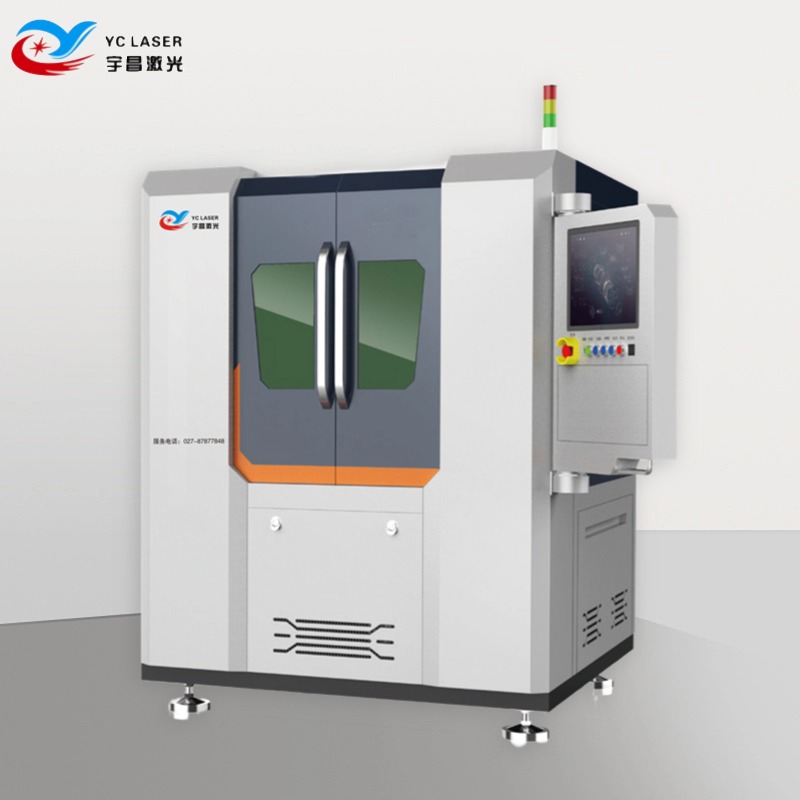
A high precision laser cutting machine is a computer-controlled machine tool that shapes a workpiece with a focused laser beam instead of a mechanical blade, wheel or die. The beam cuts, drills, scribes and grooves the material while the platform positions it to micron-level accuracy — which is why this equipment category is normally specified for hard and brittle materials such as ceramics, glass, PCB substrates, wafers, sapphire and silicon steel, where mechanical contact causes chipping, cracking or delamination.
For a buyer who is still in the awareness and research stage, three questions decide almost everything: which laser source and wavelength fits the material, how precise the motion and vision system really is, and what working area plus automation level the production plan requires. This guide answers those three questions using the published equipment and service data of YCLASER, the brand of Wuhan Yuchang Laser Technology Co., Ltd., a manufacturer established in 2017 in Wuhan’s Optics Valley laser industry cluster.
YCLASER builds one precision laser cutting machine platform across twelve model designations — YC-TC01, YC-TCSF, YC-TCHP, YC-TCAT, YC-GJMD, YC-GJMPCB, YC-GJM01, YC-BLD, YC-BLSW, YC-BLDW, YC-UVP and YC-UVN — and also runs a processing centre that provides OEM laser cutting services for prototypes and small batches. Both routes are covered below, so that a reader can move from category discovery to a realistic shortlist.
What “high precision” actually measures — and why the phrase alone tells you nothing
“High precision” is not a standardized rating. Two machines can both be marketed as high precision while differing by an order of magnitude in the numbers a production engineer cares about. When comparing a precision laser cutting machine, replace the phrase with measurable parameters:
- Positioning accuracy — the deviation between the commanded position and the real position of the beam. YCLASER’s laser processing service is specified at ±0.005 mm.
- Drilling precision — the smallest hole the platform can produce repeatably. The precision laser cutting machine platform is specified down to a minimum of 0.05 mm.
- Kerf width — the width of material the beam removes, quoted at 0.02–0.15 mm for the processing service.
- Cutting thickness range — 0.01 mm to 20 mm on the machine platform; 0.05 mm to 11 mm on the processing service, with ≤6 mm as the stable mass-production thickness.
The deeper problem is not the number itself but the failure mode behind it. On hard and brittle materials, the defects that scrap a part are micro-cracks, edge chipping and thermal damage, and they are usually caused by process parameters that do not match the material, by impurities inside the raw material, or by starting mass production on a new material without any prior verification. A precision figure quoted without a material, a thickness and a feature size therefore carries almost no purchasing value.
Category confusion compounds the problem. Buyers frequently approach suppliers asking simply for “a laser cutter” when the part may be an alumina ceramic substrate, a thin glass panel, a PCB laminate, a motor lamination or a semiconductor wafer. Each of those parts points to a different laser source, a different format and a different level of automation — and a supplier that does not ask which one is being quoted cannot answer the question honestly.
A precision claim is only meaningful when it is attached to a material, a thickness and a feature size. Ask for all three before comparing quotations.
Industry background: where demand for laser processing is coming from
Hard and brittle materials have moved from laboratory curiosities to volume production parts. The industries driving that shift are semiconductor packaging (ceramic substrates, wafers, packaging substrates, HTCC/LTCC ceramics), new energy (hydrogen fuel cell plates, NdFeB magnetic materials, power battery insulation components), electronic circuits (PCB, FPC, copper clad laminates), advanced ceramics (alumina, aluminium nitride, zirconium oxide, silicon carbide, silicon nitride), optical glass (float glass, quartz glass, optical lenses) and medical devices (ceramic medical components, precision electronic parts).
Mechanical processing struggles with these materials for a physical reason: a blade or a grinding wheel transfers mechanical stress into the part, and the part fails at the edge. YCLASER’s own process comparison puts mechanical cutting at ±0.05–0.1 mm precision with a chipping defect rate of 8–15%, and requiring fixtures and moulds; non-contact laser processing is quoted at ±0.01 mm precision, a defect rate of ≤1.5%, and a processing efficiency increase of 60–80%, with no moulds required. The relevant engineering difference is not the headline precision figure alone but the absence of contact — because removing contact is what removes the stress that produces chips and cracks.
The supply-chain context matters just as much as the physics. Precision laser equipment manufacturers cluster around optics and motion-control ecosystems, and Wuhan’s Optics Valley is one of them. YCLASER is located in the Optics Valley laser industry cluster, operates a 2,000 m² manufacturing facility, employs approximately 25 staff including an R&D team of 8 engineers, and reaches an annual production capacity of 100 units, with export business accounting for 30% of total sales and main markets in Southeast Asia, Europe and the Middle East. That supply-chain proximity is what makes configurations such as magnetic levitation linear motors, granite bases and CCD vision positioning accessible to buyers outside the largest brand names.
Machine families: matching laser source, format and material
The YCLASER precision laser cutting machine platform is organised into seven functional categories: ceramic laser cutting machines, small-area laser cutting machines, high-power laser cutting machines, fully automatic loading and unloading laser cutting machines, high-precision drilling laser cutting machines, PCB precision laser cutting machines and motor silicon steel sheet laser cutting machines. The category you need is determined by the workpiece, not by the budget.
Ceramic laser cutting machines (YC-TC01, YC-TCSF, YC-TCHP, YC-TCAT)
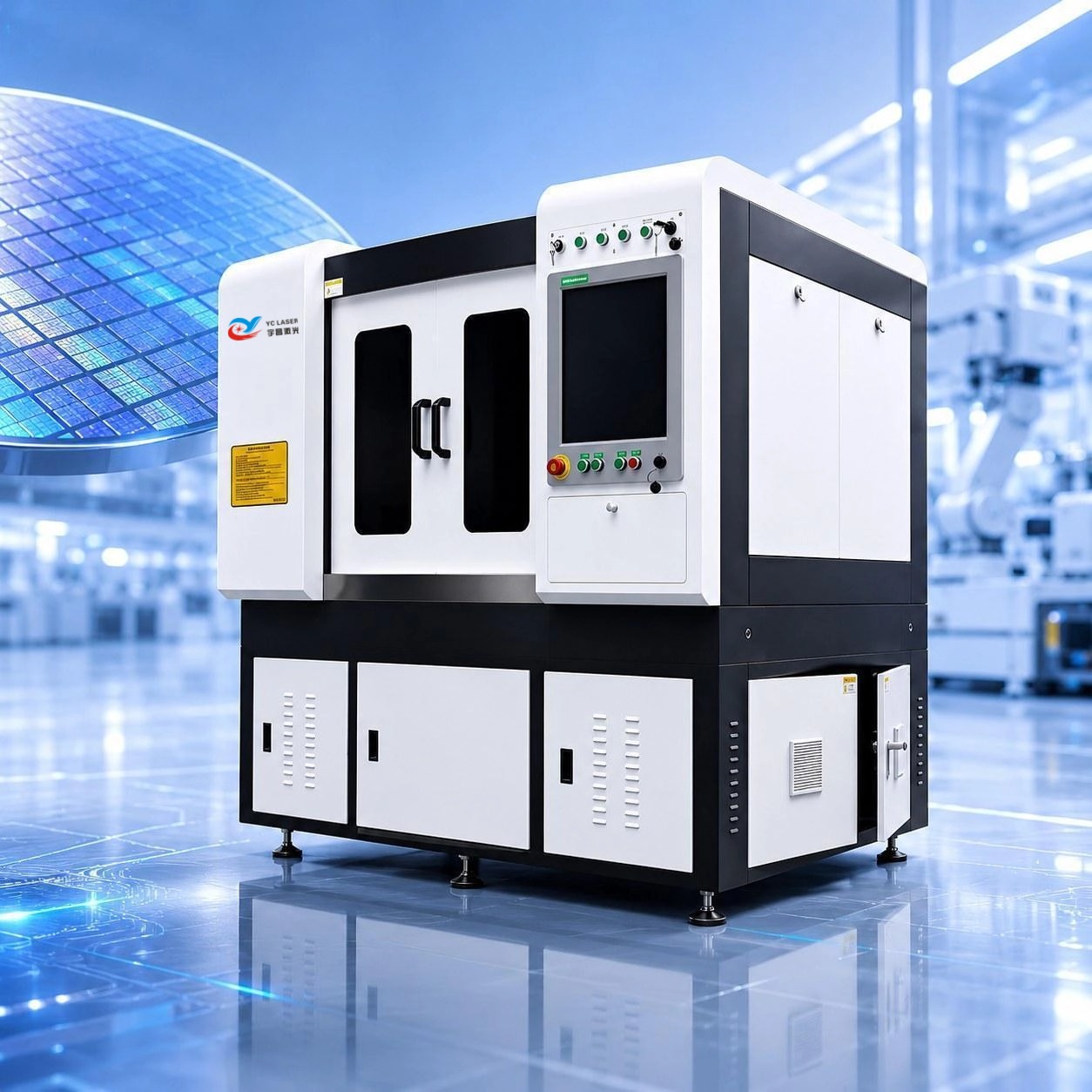
This is the core product line for alumina, aluminium nitride, zirconium oxide, silicon carbide and silicon nitride parts. The machine performs high-precision cutting, drilling, dicing, grooving and contour engraving with a minimal heat-affected zone, reducing chipping and cracking to protect workpiece yield. It handles complex irregular shapes, circles and arrayed holes, and imports CAD/DXF drawings so that no mould is required. Four variants exist: YC-TC01 for standard ceramic cutting, YC-TCSF as a small-format unit, YC-TCHP for high-power work, and YC-TCAT with automatic loading and unloading for continuous production.
Ceramic laser drilling and integrated cutting–drilling–scribing
Holes, not outlines, are often the hard part. YCLASER’s YC-GJMD high-precision laser drilling machine addresses ceramic seals, cooling holes and micro-hole arrays, supported by the company’s “High-Precision Laser Micro-hole System V1.0” software. The company also holds a utility model patent for an integrated machine for laser cutting, drilling and scribing of electronic ceramics with easy positioning — a patent specifically aimed at the difficulty of holding registration when one ceramic plate must be cut, drilled and scribed in the same setup.
PCB laser cutting and drilling machines (YC-GJMPCB)
PCB substrates, FPC and copper clad laminates are thin, layered and sensitive to mechanical stress, which makes them a natural fit for non-contact processing. The YC-GJMPCB platform covers PCB substrate cutting and drilling, including copper and aluminium features on circuit boards, and is intended for the PCB industry and precision electronic component manufacturing.
Picosecond and UV ultrafast platforms (YC-UVP, YC-UVN)
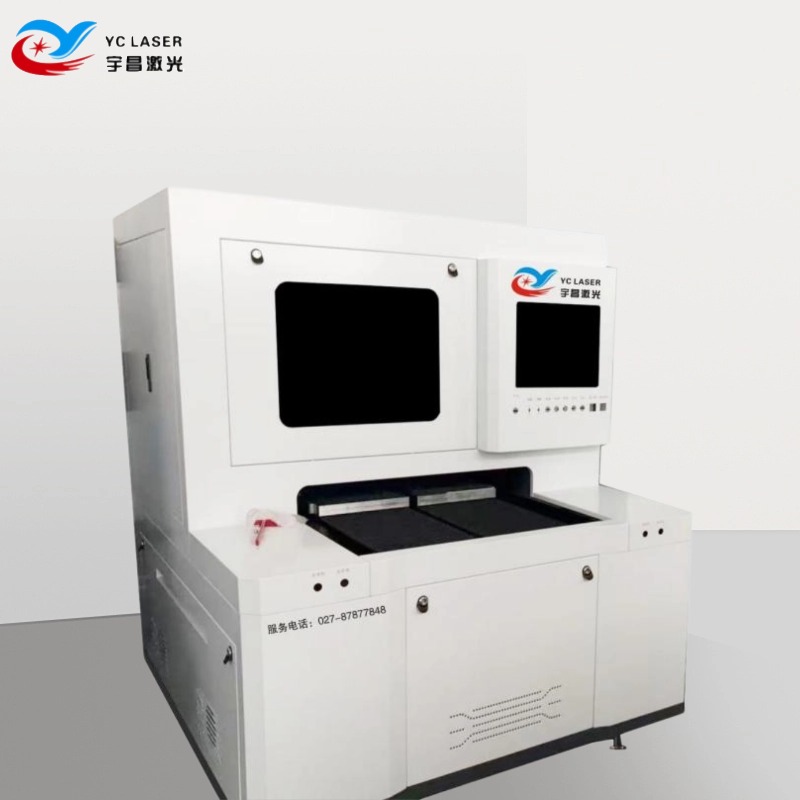
Ultrafast laser cutting machines are one of YCLASER’s two main product lines, alongside ceramic laser cutting machines. The YC-UVP ultraviolet picosecond laser cutting machine and the YC-UVN UV nanosecond laser cutting machine target applications where the heat-affected zone must be kept as small as possible — functional ceramic samples, thin substrates and research prototypes. The platform supports 1060–1080 nm, 532 nm, 1064 nm, 355 nm and 10.6 μm wavelengths, and the choice between a nanosecond UV source and a picosecond source is normally settled during sample testing rather than on paper.
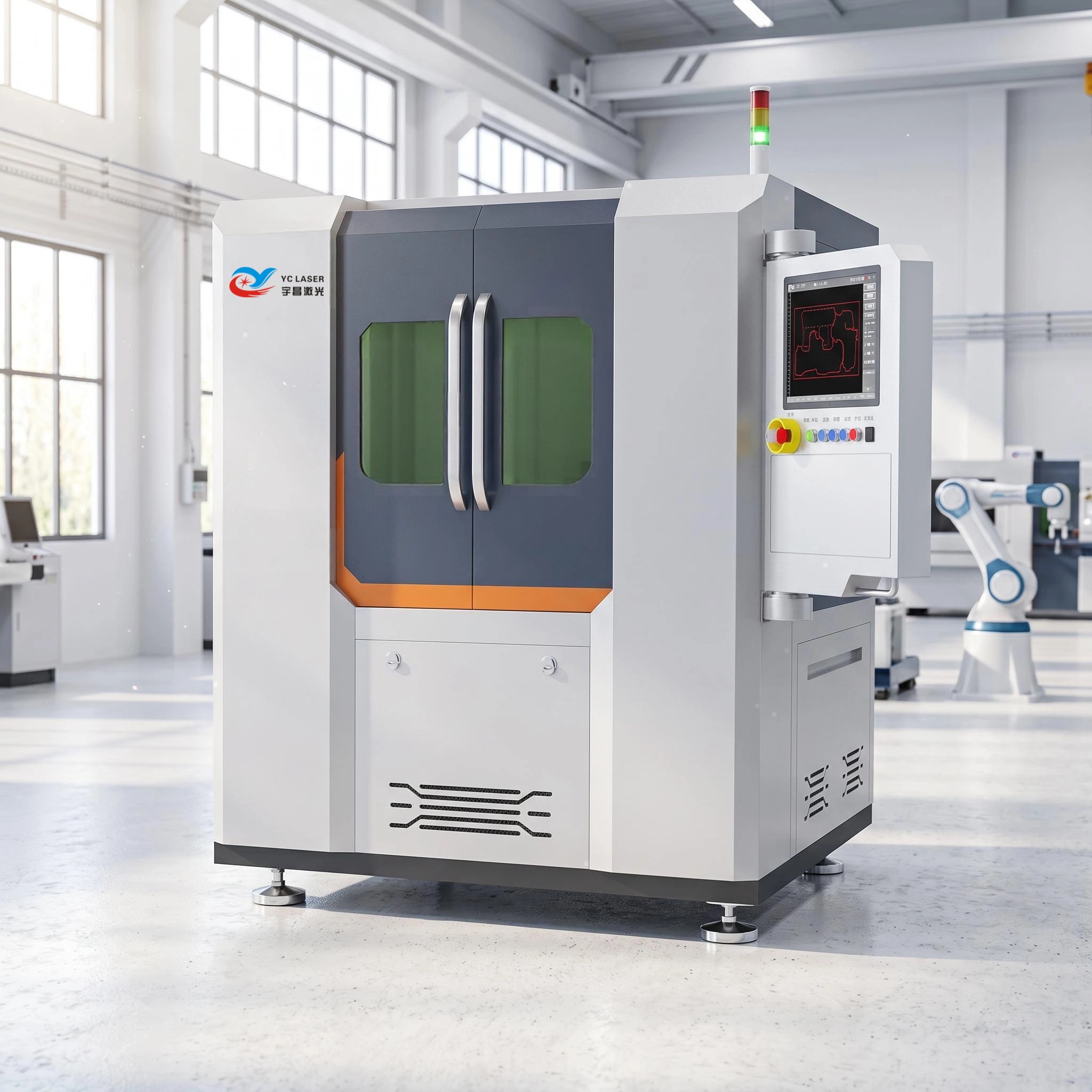
Glass laser cutting and drilling machines (YC-BLD, YC-BLSW, YC-BLDW)
Float glass, quartz glass, optical glass, microcrystalline glass, ceramic-glass composites and sapphire are processed on this line. YC-BLSW is a single-worktable glass laser cutting machine and YC-BLDW is a dual-worktable version for higher throughput, while YC-BLD is a dedicated glass laser drilling machine. Working areas across the platform extend from 200 × 200 mm up to 1300 × 1300 mm, so both small optical components and larger panels can be covered.
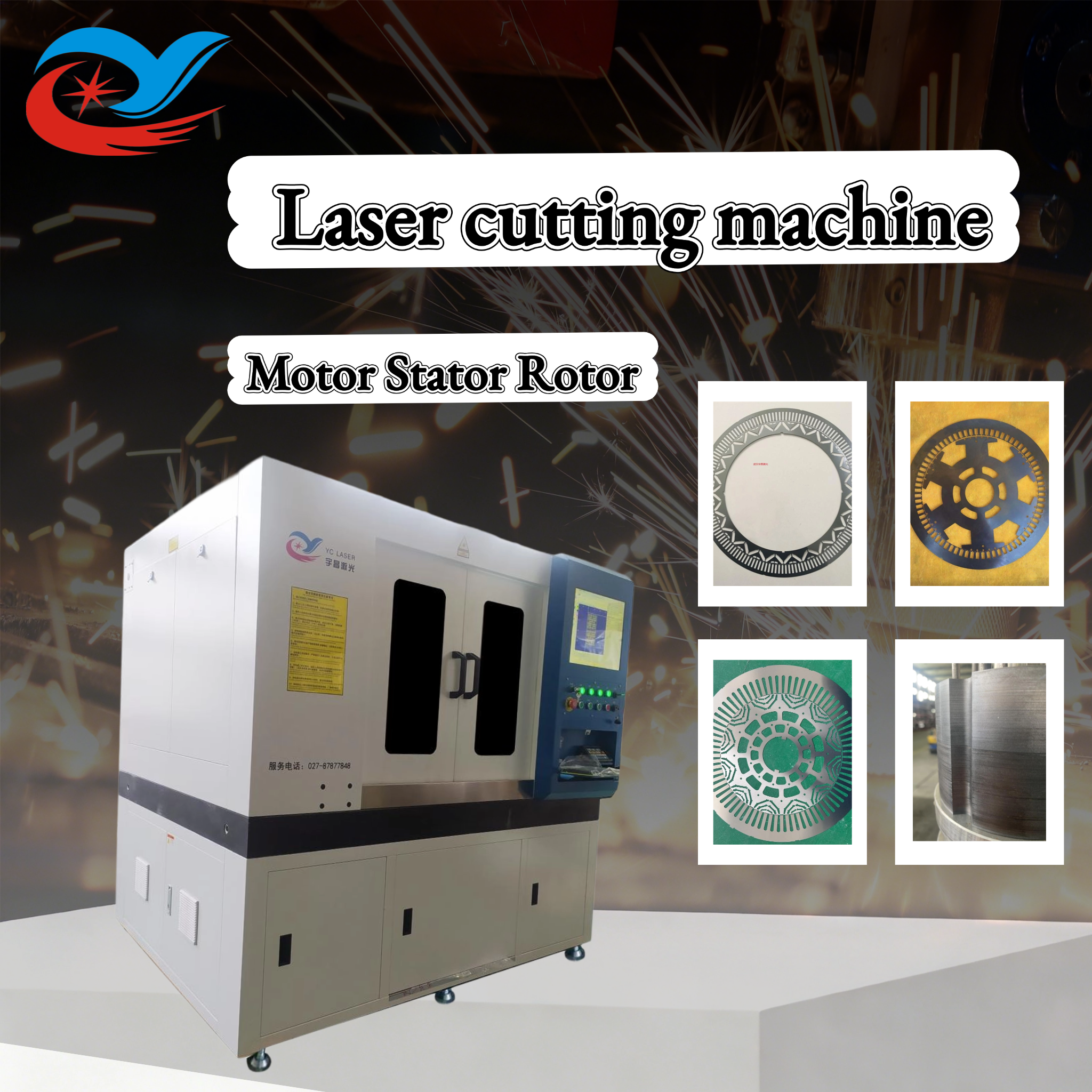
Motor silicon steel sheet laser cutting machines (YC-GJM01)
The YC-GJM01 silicon steel sheet precision laser cutting machine targets silicon steel, stator and rotor laminations, and the new energy vehicle motor industry. The company holds patents related to high-speed, high-precision laser cutting machine systems for new energy vehicle motors, which indicates that this line is engineered to automotive-grade processing expectations rather than general-purpose sheet cutting.
Small-format laser cutting machines
Small-area laser cutting machines cover 200 × 200 mm and 300 × 300 mm work areas and are intended for laboratories, R&D departments, research institutes and small precision components. A small-format unit can be configured with a UV or picosecond source, which makes it the usual starting point for material verification work before a production machine is specified.
Specification ranges to verify before you shortlist
The following ranges are published for the YCLASER precision laser cutting machine platform and for its laser processing service. They are useful as a screening tool: if a requirement falls outside these ranges, the configuration discussion changes before price is ever discussed.
| Parameter | Published range | Applies to |
|---|---|---|
| Working area | 200×200, 300×300, 400×400, 400×500, 500×600, 600×600, 600×700, 800×800, 1000×1000, 1250×1250, 600×900, 900×1300, 1300×1300 mm | Machine platform |
| Laser power | 10, 15, 20, 30, 50, 80, 120, 150, 300, 450, 600, 1000, 1500, 2000, 3000 W | Machine platform |
| Wavelength options | 1060–1080 nm, 532 nm, 1064 nm, 355 nm, 10.6 μm | Machine platform |
| Cutting thickness | 0.01 mm – 20 mm | Machine platform |
| Drilling precision | Minimum 0.05 mm | Machine platform |
| Positioning accuracy | ±0.005 mm | Processing service |
| Kerf width | 0.02 – 0.15 mm | Processing service |
| Material thickness | 0.05 – 11 mm supported; ≤6 mm stable mass production | Processing service |
| Processing rate | 150–200 RMB/hour (20–30 USD/hour), no minimum order quantity | Processing service |
Two mechanical details are worth checking on any quotation, because they determine whether the published precision survives a full shift of production. The first is the motion system: the YCLASER platform uses an imported magnetic levitation linear motor with a 0.5/0.1 μm grating ruler and a fully closed-loop bus control system, mounted on a precision marble base with a gantry or cross enclosed structure for rigidity and shock resistance at high speed. The second is positioning intelligence: CCD vision automatic positioning supports cutting, drilling and scribing of ceramics, substrates and glass, and is the usual addition when repeatability matters more than raw speed.
Step-by-step: from sample test to production line
Non-standard laser equipment is not an off-the-shelf purchase, and the process path is where most project risk is either absorbed or created. For a customised machine or an OEM processing order, the sequence below is the standard route.
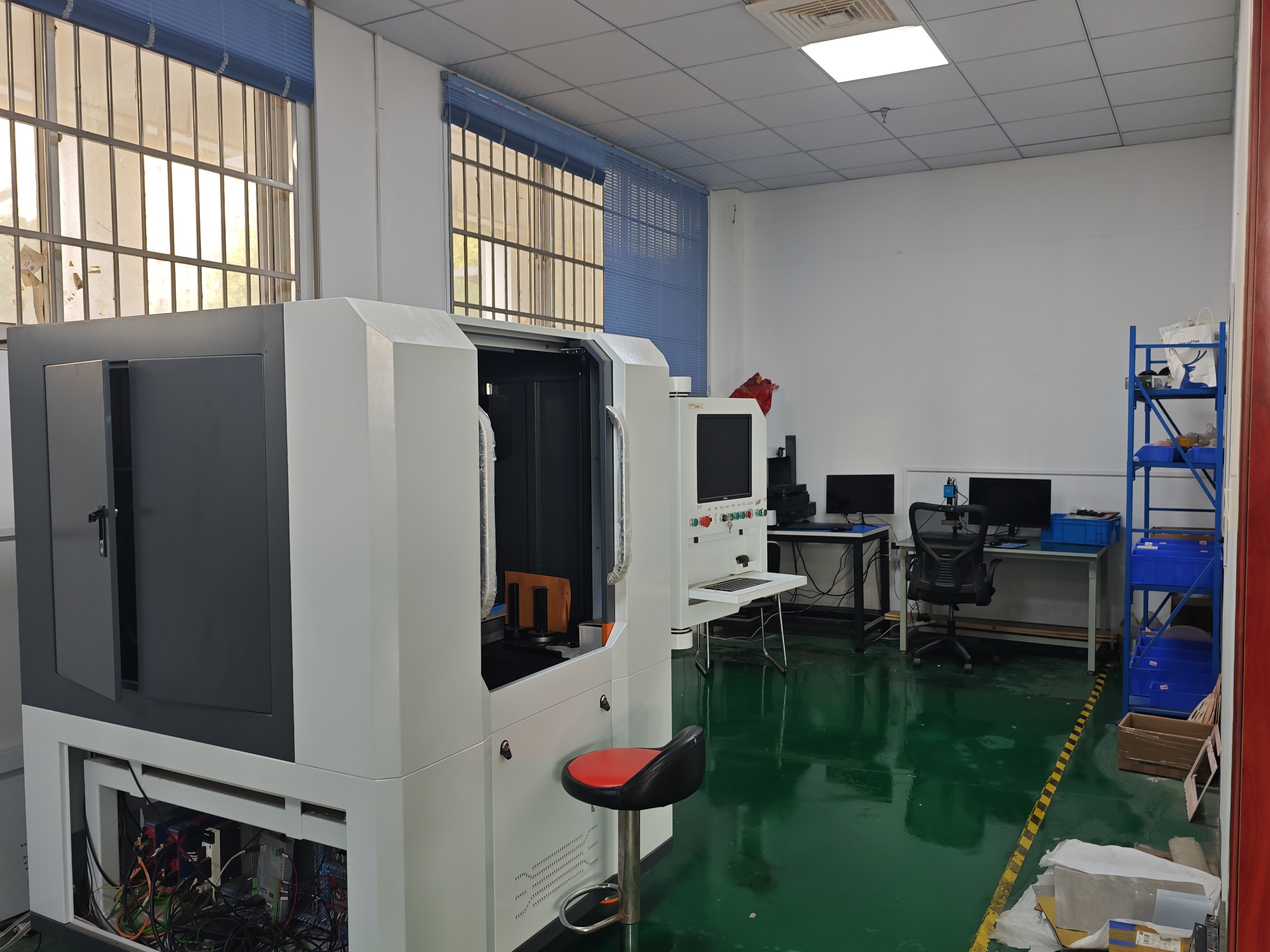
- Requirements communication. Material, thickness, feature size, tolerance and output target are stated up front.
- Process assessment and sample testing. The in-house process R&D team verifies the material and outputs qualified samples with process parameters for later mass production.
- Solution and quotation. Configuration — laser type, working area, vision positioning, automation — is fixed against the verified process.
- Technical agreement and contract. Functions, drawings and process requirements are locked in writing to minimise later changes.
- Deposit payment and production.
- Factory pre-acceptance. Optical path accuracy, repeatability, power-on aging, an actual ceramic test cut and full-function program testing are completed, and a written factory quality inspection report is issued. Dual-head models additionally undergo dual-optical path synchronisation verification, and automated models complete loading and unloading durability cycle testing.
- Delivery. Export documentation including commercial invoices, packing lists and pro forma invoices is provided under Incoterms 2020 terms.
- On-site installation and commissioning.
- Project acceptance and after-sales support. Factory pre-acceptance, on-site acceptance, or remote online trial cutting acceptance for overseas buyers, with a formal acceptance certificate on completion.
Once installed, the platform runs in three modes: automatic mode, where DXF/DWG drawings are imported and the software nests material for fully automatic continuous processing; manual debugging mode, used for single-point marking, partial test cutting and parameter development; and semi-automatic mode, where operators load and unload while the machine executes the program. Integration with automated production lines for automatic loading and unloading is available as an option.
Site conditions should be planned at the same time as the machine. The published working environment is 5–35 °C ambient temperature, 40–65% relative humidity without condensation, a clean or near-cleanroom level of dust control to protect optical lenses, a stable industrial voltage regulator, a vibration-damping foundation to protect cutting accuracy, and ventilation or smoke extraction to remove ceramic and glass dust generated during processing. Typical matched equipment includes an industrial chiller for stable laser output, a dust and fume extraction system, an industrial computer, tooling, fixtures or a vacuum adsorption platform for thin sheets, optional CCD vision, and inspection instruments such as a metallurgical microscope, aperture measuring instrument or 2D measuring instrument.
Where these machines are used
Application fit is the fastest way to narrow a shortlist, because the industry determines the material, and the material determines the laser source.
- Semiconductor and packaging: ceramic substrates, wafers, packaging substrates, HTCC/LTCC ceramics, aluminium nitride power module substrates.
- New energy: hydrogen fuel cell plates, NdFeB magnetic materials, power battery insulation components, motor stator and rotor laminations.
- Electronic circuits: PCB, FPC, copper clad laminates, ceramic thick-film circuits.
- Advanced ceramics: alumina, aluminium nitride, zirconium oxide, silicon carbide and silicon nitride components, including rings, tubes and piezoelectric ceramics.
- Optical glass: float glass, quartz glass, optical lenses, glass tubes, sapphire and microcrystalline glass.
- Medical devices: ceramic medical components and precision electronic parts.
For research-oriented buyers, YCLASER reports that its equipment has been implemented in the Wuzhen Laboratory and the Semiconductor Ceramics Research Institute, achieving micron-level cold processing with reduced thermal damage — the precision profile required for semiconductor ceramic substrates, functional ceramic samples and small-batch trial production. Research prototyping projects, small-batch precision component OEM production, production-line mass production stations and customised equipment modification for special sheet sizes or special materials are the four project types this platform is normally configured for.
Buying a machine or outsourcing the cut: the decision table
The first commercial decision is not which model to buy but whether to buy at all. Outsourced laser processing removes fixed asset investment, while in-house equipment protects process data and long-run unit economics.
| Decision factor | Buy a laser cutting machine | Use OEM laser cutting services |
|---|---|---|
| Upfront investment | One-time equipment investment, plus maintenance and operator costs | No fixed asset investment |
| Cost basis | Configuration-dependent | Charged by the hour at 150–200 RMB/hour (20–30 USD/hour); affected by process complexity and rush orders |
| Minimum order quantity | 1 unit; standard machines, single non-standard units and multi-unit lines are all supported | No minimum order quantity |
| Best fit | Long-term, stable, high-volume production; processes that must stay confidential | Prototyping, R&D, unstable order volumes, small batches |
| Capacity scaling | Requires additional capital investment | Scales with order volume |
| Logistics | Equipment shipment with installation, commissioning and training | Courier, land transport or sea freight |
The practical reading of this table is straightforward: research institutes, laboratories and companies with fluctuating order volumes generally start with outsourced processing or a small-format machine, while factories with continuous production and proprietary processes move to dedicated equipment. Because the minimum order quantity for a machine is one unit, a single non-standard unit is a valid starting point for either route, and both can be run in parallel during a capacity transition.
Frequently asked questions
What inspection and acceptance documentation accompanies YCLASER equipment?
Every unit passes a full factory inspection before shipment, covering optical path accuracy calibration, repeatability testing, machine power-on aging, an actual ceramic test cut and full-function program testing, with a written factory quality inspection report issued. Dual-head models additionally undergo dual-optical path synchronisation verification, and automated models complete loading and unloading durability cycle testing. Acceptance can be handled as a factory pre-acceptance, an on-site acceptance after installation and commissioning, or — for overseas buyers — a remote online trial cutting acceptance, with a formal acceptance certificate issued on completion. Export documentation includes commercial invoices, packing lists and pro forma invoices under Incoterms 2020 terms such as EXW, FOB, CIF, DDP, FCA, CPT, CIP, DAP and DPU. Processed workpieces are inspected by 2D dimensional inspection, CCD visual sampling and visual inspection against AQL sampling criteria, and dimensional data and sample photographs are available for review.
Which laser source should be used for hard and brittle materials — nanosecond UV or picosecond?
The source follows the material and the allowed heat-affected zone. UV and picosecond models are the usual starting point for research prototyping and for materials where thermal damage must be minimised; YCLASER builds the YC-UVP ultraviolet picosecond laser cutting machine and the YC-UVN UV nanosecond laser cutting machine, and the platform supports 1060–1080 nm, 532 nm, 1064 nm, 355 nm and 10.6 μm wavelengths. Available laser power runs from 10 W to 3000 W, working areas from 200 × 200 mm to 1300 × 1300 mm, and the equipment cuts thicknesses from 0.01 mm to 20 mm with drilling precision down to 0.05 mm. For ceramic substrates in mass production, CCD vision positioning is the usual addition; for capacity upgrades, a dual-head dual-beam path configuration; and for large production lines, a fully automated loading and unloading module.
How is the cost of laser processing actually structured?
Cost depends on whether the buyer purchases equipment or outsources the process. Outsourced laser processing is charged by the hour at 150–200 RMB/hour (20–30 USD/hour) with no minimum order quantity, so prototypes and small batches can be produced without fixed asset investment, and the rate is affected by process complexity and rush orders. Purchasing a machine is a one-time investment that also carries maintenance and operator costs, and it is normally justified by long-term, stable, high-volume production or by the need to keep process data in-house. On the equipment side, the configuration level — laser type, working area, vision positioning and automation module — is the main cost driver; a laboratory R&D setup can begin with a UV or picosecond single-head basic model and be upgraded later.
Can a sample be processed before an order is placed?
Yes. YCLASER supports sample and small-batch processing with no minimum order quantity, and the in-house process R&D team completes prototype verification before any production commitment. Sample verification is not optional for a new material: ceramic laser processing carries risks of micro-cracks, edge chipping and thermal damage, and new materials should be tested first to confirm process parameters before mass production. Machining of complex irregular shapes, circles and arrayed holes is supported through CAD/DXF import without moulds, and the sample stage is also where the choice between a single-head and a dual-head configuration is normally validated.
What can delay delivery, and how is that risk controlled?
Delivery risk in this category comes from four sources: unstable quality of customer-supplied material, repeated drawing changes, process difficulty that exceeds the original assessment, and tight order scheduling. The standard mitigation is to complete prototyping before mass production so that drawings and process parameters are locked, to confirm incoming material quality in advance, and to reassess delivery dates whenever a drawing changes. Non-standard customisation carries its own risk of longer delivery times and cost fluctuation, which is why a complete technical agreement confirming functions, drawings and process requirements is signed at the start of a project. YCLASER reports sample turnaround as fast as 24 hours and a reduction of 10–15 working days in non-standard delivery time relative to large-scale manufacturers, whose internal processes are typically more complex; export orders should additionally be checked against the target country’s import control policy and tariff position before the order is placed. To request a sample cut, a configuration quotation or the full catalogue, contact wxr888@yclaser.com.cn or visit www.whyc-laser.com.
Conclusion: build the shortlist from the workpiece, not the brochure
A high precision laser cutting machine is defined by measurable parameters — positioning accuracy, drilling precision, kerf width and thickness range — applied to a specific material, and the correct machine family follows from that material. Ceramic substrates point to the ceramic laser cutting and drilling line; PCB and FPC work points to the PCB precision platform; glass and optical components point to the glass cutting and drilling machines; motor laminations point to the silicon steel sheet line; and applications where the heat-affected zone is critical point to UV nanosecond or picosecond ultrafast sources. Format and automation are then sized to the production plan, from a 200 × 200 mm laboratory unit to a 1300 × 1300 mm automated line.
The most reliable way to reduce risk is also the simplest: process a real sample of your own material first, lock the parameters that come out of it into a technical agreement, and let pre-acceptance and acceptance confirm the machine against that agreement rather than against a specification sheet.
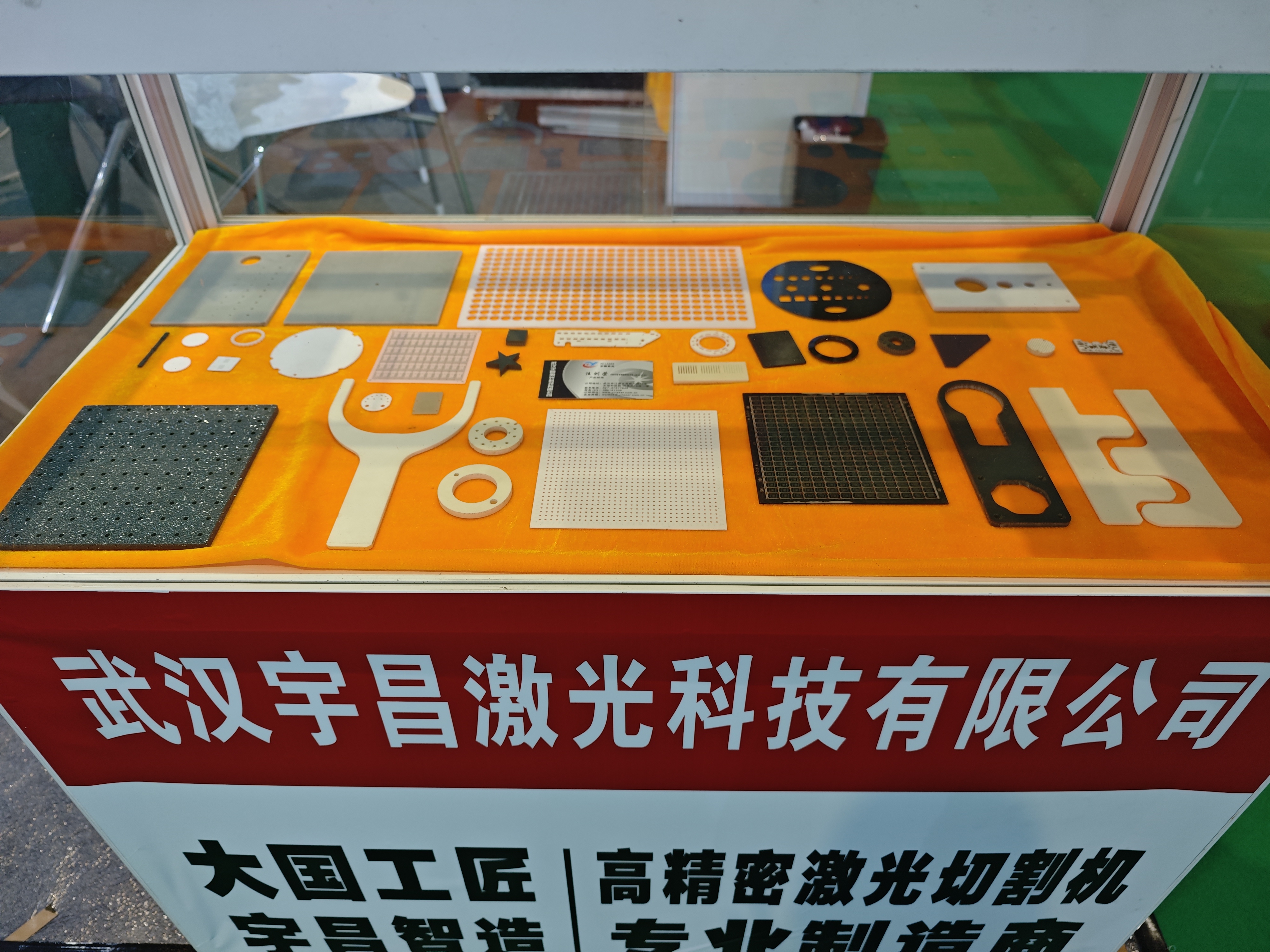
Next step: send your material, thickness and feature drawing for a sample test, or ask for a configuration quotation and the full equipment catalogue.
YCLASER — Wuhan Yuchang Laser Technology Co., Ltd. · www.whyc-laser.com · wxr888@yclaser.com.cn · WhatsApp +86 18602711568
Have Questions or Need More Details?
Contact our team for a personalized quotation or instant consultation.
Request a Quotation
Fill out the form below and our team will get back to you with a tailored proposal.
WhatsApp Direct Chat
Prefer to chat in real-time? Message us on WhatsApp for instant assistance & quick answers.
- Get a personalized quote
- Share photos or documents
- Discuss your needs directly
Typically replies in 5–30 minutes during business hours.