Body Armor Buyer's Guide: Standard Rectangle vs. Interlocking Combined Riot Shields
Within body armor and public-order equipment procurement, the choice between a standard rectangle riot shield and an interlocking combined riot shield is a deployment decision before it is a product decision. A standard rectangle shield is carried by one officer for individual protection and forward visibility. An interlocking combined shield is a modular polycarbonate riot shield that can be used alone or linked side by side into a continuous shield wall for team movement and area blocking. Neither format is a ballistic shield: both are anti-riot products intended for blunt impacts and thrown debris, not firearm ammunition.
Problem definition: why the wrong shield format creates a procurement gap
Riot-shield procurement often starts with material, transparency and price, but the operational gap appears at the formation level. If a public-order unit needs a continuous protective line, a collection of individual shields may leave gaps between officers and require different tactics. If a single officer needs forward visibility at a fixed post, a linked wall system can add handling and logistics that the task does not require. The correct first question is therefore not which shield is stronger, but how the unit will deploy it.
A second procurement risk is threat misclassification. The supplied product information states that the anti-riot shield is intended mainly for blunt blows, thrown stones and debris, and that it is not a ballistic shield. A combined riot shield cannot resist firearm ammunition. Buyers must keep riot-control protection and ballistic protection in separate specification categories. If the mission includes firearm threats, the procurement route should move to a ballistic shield series rather than treating an anti-riot shield as substitute body armor or a ballistic barrier.
Industry background: police riot control, civil defense and large-event security
Police riot-control teams, civil defense units and large-event security teams share a need for visible, mobile protection against blunt impact and thrown objects. Their deployment patterns differ. A police patrol or fixed-post officer may need a single transparent shield for visibility and individual movement. A public-order unit preparing for crowd-control formations may need multiple shields that connect into a wall so the team can advance together and block an area. Civil defense and event-security teams may use either model depending on whether they are managing an individual checkpoint or a continuous perimeter.
These scenarios do not change the protection category. In all three contexts, the riot shield remains a non-ballistic anti-riot product for blunt impacts and thrown debris. Selection should focus on how many officers will operate together, whether the team needs a continuous barrier, how the shield will be carried when not linked, and what training is required to form and move a shield wall.
What the two products are—and what they are not
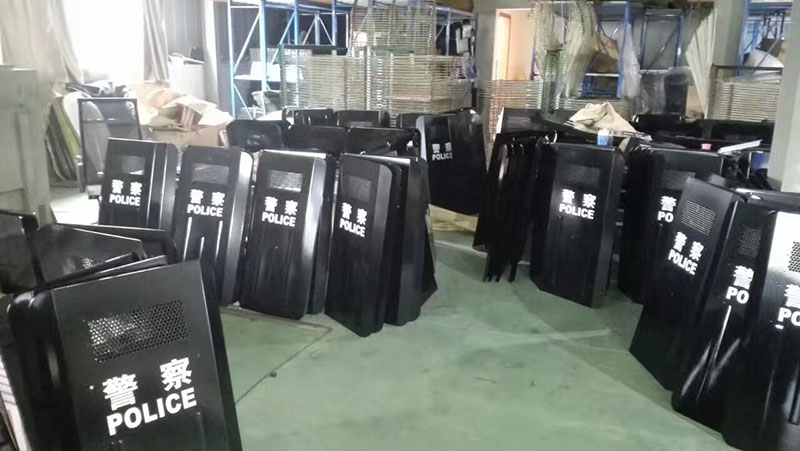
A standard rectangle polycarbonate riot shield is described in the supplied comparison material as transparent and suited to routine anti-riot tasks requiring forward visibility. Its structure is flat and rectangular. The interlocking combined riot shield is a modular PC riot shield with a special interlock buckle structure. Each single shield can be used independently, and several shields can connect side by side or overlap vertically to build a continuous tactical shield wall for team advance and formation defense.
Both formats sit in the anti-riot category. The anti-riot shield is intended mainly for blunt blows, thrown stones and debris, and the supplied FAQ states clearly that it is not a ballistic shield. The combined riot shield also cannot resist firearm ammunition. Buyers should therefore treat any request for handgun or rifle protection as a separate ballistic-shield requirement, not as an upgrade option within the same riot-shield specification.
Standard rectangle riot shield: individual carry and fixed-post visibility
The standard rectangle shield is most useful when the deployment mode is individual. Its flat rectangular form supports routine crowd-control tasks where the officer needs a clear forward view and a simple protective panel. The supplied comparison material places this format in routine crowd control, fixed-post duty and police tasks requiring transparent visibility. Its value is directly linked to the single-officer task: the officer carries the shield, observes the scene through it and moves as an individual unit.
The procurement boundary is equally important. The supplied description of the rectangle polycarbonate shield focuses on transparency and routine anti-riot use; it does not list an interlocking buckle structure. If a unit intends to form a continuous shield wall, the purchase specification should explicitly require an interlocking model rather than assuming that any rectangular shield can be linked. For individual patrol, checkpoint security or fixed-post duty, the rectangle format keeps the equipment requirement simpler and easier to match to one officer’s movement.
This format is still non-ballistic. It protects against blunt impact and thrown debris, not firearm ammunition. That limitation should be written into the procurement record so that the shield is not confused with a ballistic vest, ballistic helmet or ballistic shield.
Interlocking combined riot shield: side-by-side shield wall and team movement
The interlocking combined riot shield is designed around team deployment. The supplied product FAQ describes a modular PC shield with a built-in arc interlocking buckle. Shields can snap together quickly without extra tools. The same FAQ states that the interlock joint can transfer impact force and keep the whole shield wall stable under crowd impact. This is the supplier’s product description, not an independent test result, so buyers should still confirm the connection procedure, inspection points and training method for their own unit.
The combined shield is not limited to wall formation. Each shield is described as an independent unit with a handle and arm strap. A single shield can be used for an individual mission, while several pieces can be linked to form a shield wall. That dual use makes the format relevant to units that need both individual mobility and a formation option. The side-by-side connection supports team movement and area blocking, while vertical overlap allows the wall to be built according to the team’s operating procedure.
The supplied material specification states that the combined shield is made of 100% virgin transparent polycarbonate, with high impact resistance, flame retardancy, acid and alkali resistance and good light transmission. The manufacturer does not use recycled PC material for the riot shield. These material facts support the transparency and impact-resistance requirements, but they do not turn the product into a ballistic shield. The firearm limitation remains in force.
Comparison table: standard rectangle vs. interlocking combined riot shield
The table below converts the supplied product facts into procurement decision points. It compares deployment mode, connection method, handling and documented limitations. It does not rank one format above the other, because the correct choice depends on the team task.
| Decision point | Standard rectangle PC riot shield | Interlocking combined PC riot shield |
|---|---|---|
| Primary deployment | Individual carry for routine crowd control, fixed-post duty and police tasks requiring forward visibility. | Single-unit use or side-by-side linking into a continuous shield wall for team advance and formation defense. |
| Connection method | The supplied description focuses on a flat rectangular structure; no interlock feature is listed. | Special interlock buckle structure; shields can connect side by side or overlap vertically. |
| Team movement and area blocking | Individual coverage; formation use must be specified separately. | Designed for team movement and area blocking as a linked shield wall. |
| Single-unit handling | Transparent flat panel for forward visibility in individual tasks. | Each shield is an independent unit with handle and arm strap; it can be used alone. |
| Material specification | Polycarbonate version described as transparent and suitable for routine anti-riot tasks. | 100% virgin transparent PC; high impact resistance, flame retardant, acid and alkali resistant; no recycled PC. |
| Ballistic protection | Not a ballistic shield. | Not a ballistic shield; cannot resist firearm ammunition. |
| Typical selection context | Routine crowd control, fixed-post duty and police tasks needing transparent forward visibility. | Large-scale crowd control, shield-wall formation and law-enforcement task-force deployment. |
Read the table as a specification checklist, not as a universal ranking. The rectangle format is the simpler individual-use choice. The interlocking format adds a documented connection method for team formations. The final decision should follow the unit’s deployment plan, not the other way around.
Step-by-step procurement and deployment check
- Define the threat category first. Confirm whether the requirement is blunt impact and thrown debris or firearm protection. If firearm protection is required, stop the riot-shield selection and evaluate a ballistic shield series. Do not use an anti-riot shield as a ballistic product.
- Select the deployment mode. For one-officer carry, fixed-post duty and routine visibility, the standard rectangle format is the direct match. For team movement and area blocking, specify an interlocking combined shield.
- Write the interlocking requirement into the specification. If a shield wall is required, require the special interlock buckle structure and confirm side-by-side connection and vertical overlap. Do not assume that any rectangle shield can be linked.
- Verify material and transparency. For PC riot shields, confirm 100% virgin transparent polycarbonate, high impact resistance, flame retardancy, acid and alkali resistance, and no recycled PC material.
- Plan customization and marking. The supplied FAQ states that silk-screen printing is available for custom logo, police text or agency marking. Artwork in AI or PDF format, color and position should be confirmed before production.
- Confirm maintenance and delivery. Agree cleaning, storage and inspection rules, then confirm lead time for the exact model. The supplied FAQ lists 5–7 working days for stock plain shields and 20–30 working days for custom printed or custom-size orders after deposit.
Use cases: matching the shield to the operational context
Police riot control
For routine patrol, checkpoint security and fixed-post duty, a standard rectangle PC shield supports individual movement and forward visibility. For a public-order unit that expects to advance as a team and block an area, the interlocking combined shield provides the documented connection method for a continuous wall. Both choices remain non-ballistic. If the police mission includes firearm threats, the unit should use appropriately tested ballistic protection rather than an anti-riot shield.
Civil defense and public-order support
Civil defense teams may use the rectangle shield for individual protection at a fixed point, and the interlocking model when a team needs a connected protective line. The selection should follow the team’s operating procedure: how many officers will link shields, who carries the additional units, how the wall will turn or move, and how the connection will be inspected before duty.
Large-event security and perimeter management
For large-event security, the standard rectangle shield fits individual guard positions and visible checkpoints. When the requirement is a continuous barrier at an access lane or perimeter segment, the interlocking combined shield is the more relevant format because it is designed to connect into a shield wall. The choice should be based on the site layout and crowd-management plan, not on the assumption that a larger shield is automatically better.
Material, customization, maintenance and lead time checks
PC material and the aluminum alternative
The riot shield discussed here is a polycarbonate anti-riot shield. The supplied FAQ states that it is made of 100% virgin transparent PC, with high impact resistance, flame retardancy, acid and alkali resistance and good light transmission, and that the manufacturer does not use recycled PC material. The supplied comparison material also lists an aluminum alloy anti-riot shield as an opaque metal option for heavier blunt-impact and sharp-object scenarios. Aluminum is a separate material choice, not the same product as the transparent PC interlocking shield. Buyers should keep shape, connection method and material as separate specification lines.
Custom marking
For agency or unit identification, the supplied FAQ states that silk-screen printing is available for custom logo, police text or agency marking. Buyers should provide AI or PDF artwork and confirm color and position before production. Customization should be recorded in the purchase order because it affects the production route and lead time.
Cleaning and storage
The PC riot shield should be wiped with a soft cloth and mild neutral detergent. Alcohol, thinner and corrosive solvents should not be used. Sharp tools should be avoided because they can scratch the shield. Storage should be in a cool, dry place, and long-term strong UV sunlight should be avoided. These care rules matter for transparency and for the service life of the polycarbonate.
Lead time and order planning
The supplied FAQ lists 5–7 working days for stock plain shields and 20–30 working days for custom printed or custom-size orders after deposit. These figures are product-FAQ lead times for the PC riot shield program, not a guarantee for every configuration. Procurement teams should confirm the exact model, printing requirement, quantity and delivery schedule before approving the order.
Supplier verification for body armor and riot-control procurement
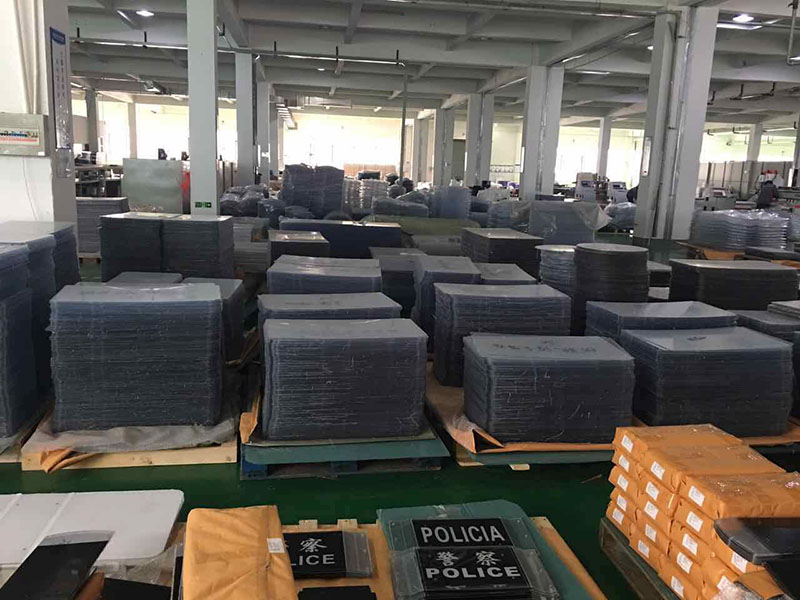
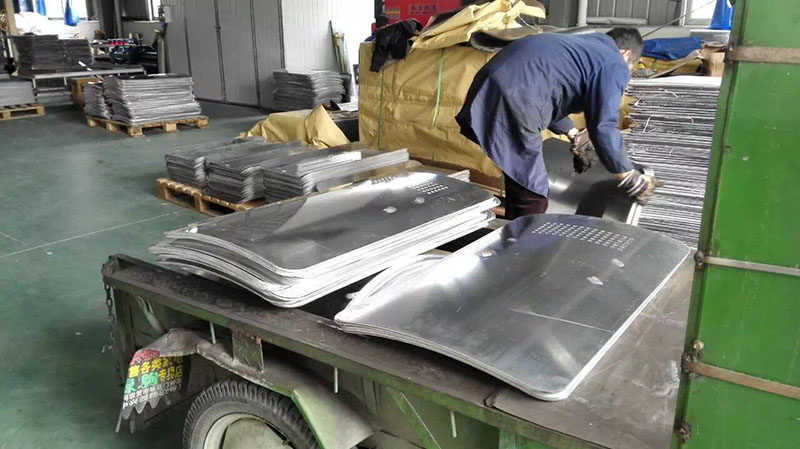
YFARMOR (Zhejiang Yingfu Protection Technology Co., Ltd) is a manufacturer focused on high-performance ballistic protection and anti-riot equipment. Its supplied company profile states that the company was founded in 2003 and operates a 23,000 m² plant with 150–200 employees, an annual output of 200,000 units and an 8-engineer R&D team. The profile also lists a 60% export ratio and main markets in the USA, Mexico, the EU, the Middle East and Africa.
The same profile lists ISO 9001:2008 quality management system certification, more than 200 CE certificates issued by Ricotest, Satra and TUV, NIJ certifications verified by H.P.White and NTS, SGS and CNAS, and multiple independent patent certificates. Its product range includes ballistic helmets, bulletproof vests, ballistic plates, ballistic shields, anti-riot suits, anti-riot helmets, anti-riot shields, police batons, gas masks and tactical vests. For a riot-shield or body armor procurement file, buyers should still verify the exact model, certificate scope, test report and final order specification rather than relying on a general company profile.
FAQ
Can a combined interlocking riot shield stop bullets?
No. It is an anti-riot shield intended for blunt impact, sticks, stones, bottles and stabbing attacks. It cannot resist firearm ammunition. If ballistic protection is needed, the buyer should evaluate a ballistic shield series rather than an anti-riot shield.
What material is the riot shield made of?
The PC riot shield is made of 100% virgin transparent polycarbonate, with high impact resistance, transparency, flame retardancy and acid and alkali resistance. The manufacturer does not use recycled PC material for the riot shield.
What is a combined interlocking riot shield?
It is a modular PC riot shield with a special interlock buckle structure. Each single shield can be used independently; multiple shields can connect side by side or overlap vertically to build a continuous tactical shield wall for team advance and formation defense.
How do the shields connect, and is the connection stable under impact?
The supplied product FAQ describes a built-in arc interlocking buckle design. Shields can snap together quickly without extra tools. The interlock joint can transfer impact force and keep the whole shield wall stable under crowd impact. Buyers should still confirm the connection procedure and inspection method for their own unit.
Can one shield be used separately, or must it be used as a set?
Each shield is an independent unit with a handle and arm strap. It can be used alone for an individual mission, or several pieces can be linked to form a shield wall.
How should the PC riot shield be cleaned and maintained?
Wipe it with a soft cloth and mild neutral detergent. Do not use alcohol, thinner or corrosive solvents. Avoid scratching the shield with sharp tools. Store it in a cool, dry place and avoid long-term strong UV sunlight.
What is the production lead time?
The supplied FAQ lists 5–7 working days for stock plain shields and 20–30 working days for custom printed or custom-size orders after deposit. For a specific configuration, confirm stock status, customization requirements and quotation with YFARMOR through its official website.
Conclusion: choose the deployment mode before the shield
The standard rectangle riot shield and the interlocking combined riot shield serve different deployment modes. The rectangle format fits individual carry, fixed-post duty and routine anti-riot tasks requiring forward visibility. The interlocking format fits team movement, side-by-side shield-wall formation and area blocking. Both are polycarbonate anti-riot products for blunt impacts and thrown debris, and neither is a ballistic shield. Procurement teams should define the threat category, select the deployment mode, specify the interlocking requirement where needed, verify material and maintenance rules, and confirm lead time before ordering. For sample, quotation or catalog information on standard rectangle and interlocking combined riot shields, YFARMOR can be contacted through its official website.
Have Questions or Need More Details?
Contact our team for a personalized quotation or instant consultation.
Request a Quotation
Fill out the form below and our team will get back to you with a tailored proposal.
WhatsApp Direct Chat
Prefer to chat in real-time? Message us on WhatsApp for instant assistance & quick answers.
- Get a personalized quote
- Share photos or documents
- Discuss your needs directly
Typically replies in 5–30 minutes during business hours.