PVC Wall Panel Model Numbers Explained: Size, Core & Specs
PVC Wall Panel Model Numbers Explained: Size, Core & Specs
A PVC wall panel model number is a compressed specification sheet. In the YIKE NEW MATERIAL range, YK-1220*2440*5mm identifies a panel 1,220 mm wide, 2,440 mm long and 5 mm thick, while YK-1220*2440*8mm describes the same face dimensions with an 8 mm body. Those three values — width, length and thickness — determine how the panel is cut, fixed, jointed, handled and shipped long before pattern or colour enters the discussion.
This guide is written for importers, distributors, interior designers, contractors and procurement teams who have to compare PVC decorative wall panel offers that look identical in photographs but differ in specification. It works through the model code itself, the core composition behind it, the practical difference between the 1220 × 2440 mm standard format and the 1220 × 2800 mm option, surface treatment such as UV coating, and the parameters that should drive supplier qualification.
What a PVC wall panel model number encodes
Every model in the YIKE PVC wall panel range follows a single structure: the YK prefix, then width × length × thickness expressed in millimetres.
- YK-1220*2440*5mm — 1,220 mm wide, 2,440 mm long, 5 mm thick.
- YK-1220*2440*8mm — 1,220 mm wide, 2,440 mm long, 8 mm thick.
- YK-1220*2800*5mm — 1,220 mm wide, 2,800 mm long, 5 mm thick.
- YK-1220*2800*8mm — 1,220 mm wide, 2,800 mm long, 8 mm thick.
Because catalogues from different suppliers sometimes list length before width, the first discipline for a specifier is to confirm the ordering convention instead of assuming it. Reading YK-1220*2440*5mm as 1,220 mm wide, 2,440 mm long and 5 mm thick is correct for this range. Applying the same reading to a differently ordered catalogue is where cutting plans and joint layouts start to go wrong.
| Model designation | Width | Length | Thickness | Format position |
|---|---|---|---|---|
| YK-1220*2440*5mm | 1,220 mm | 2,440 mm | 5 mm | Standard size |
| YK-1220*2440*8mm | 1,220 mm | 2,440 mm | 8 mm | Standard size, thicker body |
| YK-1220*2800*5mm | 1,220 mm | 2,800 mm | 5 mm | Other size option |
| YK-1220*2800*8mm | 1,220 mm | 2,800 mm | 8 mm | Other size option |
The 1,220 × 2,440 mm footprint corresponds to the 4 ft × 8 ft board format that is common in building-material documentation in imperial-unit markets. The 1,220 × 2,800 mm option is a longer sheet, specified when a wall is tall enough that a 2,440 mm panel would leave an additional horizontal joint.
Why the format decision outranks the pattern
Pattern and colour are what a buyer sees in a sample box. Format is what an installer lives with on site. A specification mismatch inside the same product category usually surfaces in one of five places:
- Cutting plan and joint layout. Panel length decides where horizontal joints fall, how much off-cut is generated, and whether the pattern repeat aligns across a wall run.
- Fixing method. This product is installed with glue, aluminium profile or hidden fixing. Panel length and thickness must be compatible with the supporting light steel keel or environmental adhesive, connecting buckles, trimming lines, corner accessories and fixing screws used on site.
- Handling and freight. An 8 mm panel carries more material per square metre than a 5 mm panel of the same face size, which affects manual handling on site and container planning.
- Flatness and splicing. Non-standard keel installation and irregular splicing operations are documented causes of splicing gap deviation and poor overall flatness.
- Durability risk. The risks recorded for this category include surface colour fading and ageing, local board deformation in humid environments, and surface scratch damage from hard-object contact during construction and use.
Where large-format PVC wall panels sit in the market
Third-party research published by Dataintelo values the global PVC panels market at USD 14.8 billion in 2025, with PVC wall panels taking a 42.5% share of that market by product type. The same source places Asia-Pacific at a 38.4% revenue share. Separately, Metastat Insights estimates the PVC wall panel segment at USD 8,032.76 million by 2032 and projects synthetic marble — the family that includes PVC marble sheets — at a CAGR of 6.8% between 2025 and 2032. On the supply side, data published by the General Administration of Customs of the PRC records China's total PVC exports reaching approximately 3.82 million tonnes in 2025, a 46% increase over 2024.
For a specifier, the practical implication is straightforward: more formats, finishes and suppliers are in circulation, so a standardised model code and citable test standards become the shared language between buyer, designer and factory.
Core composition: PVC resin, calcium carbonate and additives
The material line behind every model number in this range is PVC, calcium carbonate and additives. Each component has a different job.
- PVC resin forms the polymer matrix. It carries the waterproof behaviour of the panel and provides the surface that receives the decorative film or print.
- Calcium carbonate is the mineral filler. It contributes body, density and dimensional stability, and filler ratio is one of the reasons two panels carrying the same model number can behave differently in the same installation.
- Additives cover processing aids and performance options, including fire retardant options and the anti-ageing protection that slows colour change under indoor light.
Composition is also where panel families diverge, and the difference is visible in the published specifications. PVC ceiling panels in the YIKE range are listed with a PVC content between 35% and 50% and thicknesses from 6 mm to 9 mm in product data published on B2BMAP. Interior WPC wall panels use a different formulation — PVC or PE combined with wood fibre and additives — while outdoor WPC wall panels use wood fibre, HDPE and additives in a co-extrusion build. A model number tells you the format; the material line tells you which of those behaviours you are actually buying.
That is why sheet density, flatness and surface film bonding strength sit at the top of the supplier check list for this category, ahead of price comparisons.
1220 × 2440 mm versus 1220 × 2800 mm: choosing the length
The standard size for this product is 1220 × 2440 mm. A 1220 × 2800 mm size is offered as an alternative, and customized sizes are supported. Neither is automatically better; each solves a different wall.
When 2,440 mm is the right choice
- Walls at standard room height where a single horizontal joint line is acceptable.
- Projects that benefit from the familiar 4 ft × 8 ft handling and palletising convention.
- Sites where panels will be cut frequently for door openings, sockets and short wall runs, so off-cut management matters more than seam count.
When 2,800 mm earns its place
- Tall interior walls in hotel public areas, villa feature walls and double-height commercial interiors, where a shorter panel would introduce a second horizontal joint.
- Specifications that prioritise a continuous visual surface, since joints are the points where both visual interruption and moisture ingress concentrate.
- Projects with the handling capacity and cutting plan discipline to manage longer sheets without edge damage.
5 mm or 8 mm: what thickness changes
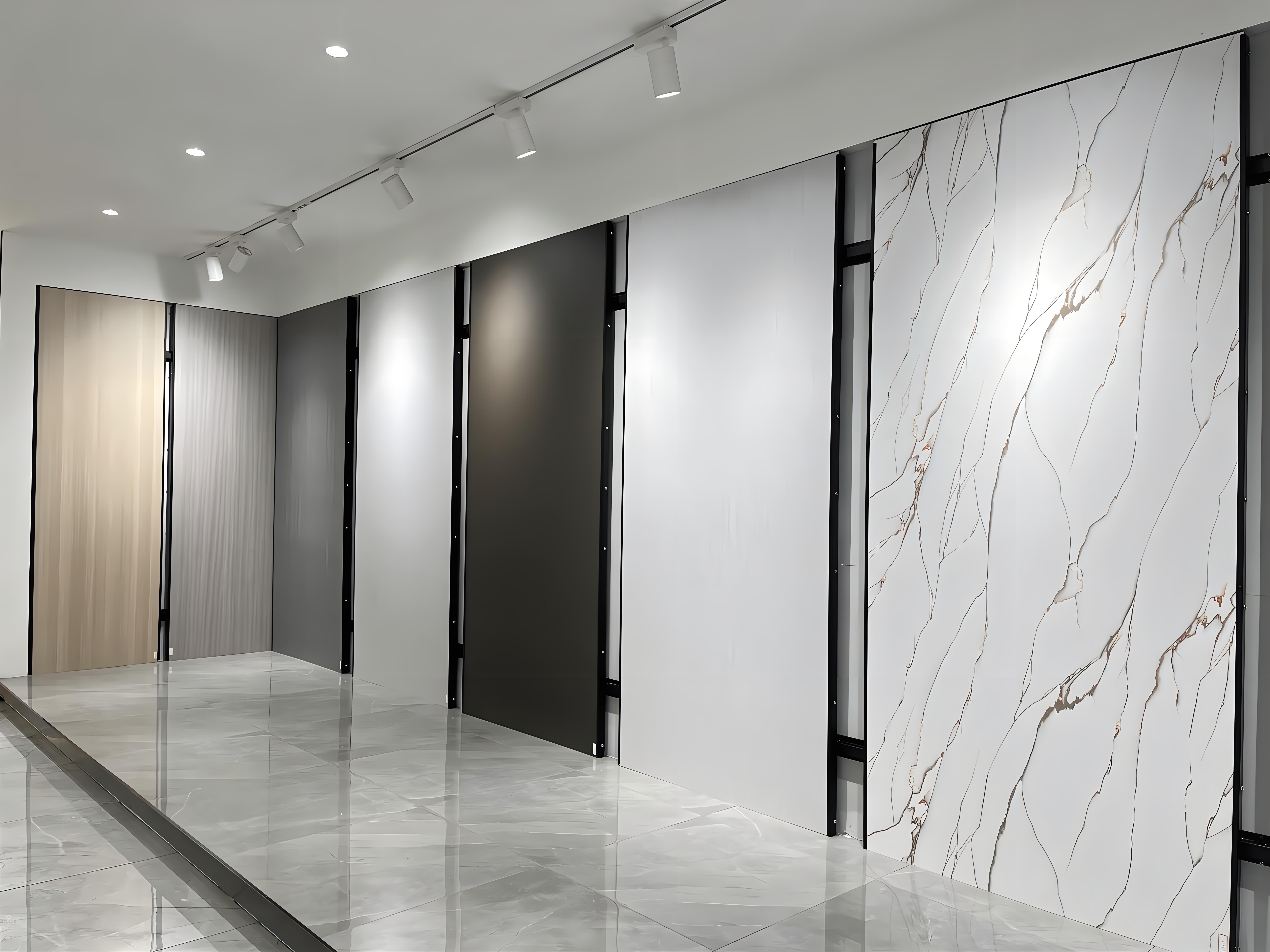
Both face sizes are available at 5 mm and 8 mm, with customized thickness on request. Thickness is a fit question rather than a quality ranking.
- 5 mm is the lighter sheet. It is generally specified where the base wall is sound and flat, and where the panel works as interior wall cladding rather than a structural element. Lighter panels are easier to carry, position and cut single-handed.
- 8 mm carries more material behind the decorative surface. It is generally specified where a more solid feel is wanted, where local impact and deformation resistance matter more, or where the substrate is less than perfectly flat and the panel needs to bridge it with more confidence.
Four questions resolve the decision in most projects: How flat is the base wall? Which fixing method will be used — glue, aluminium profile or hidden fixing? What is the span between fixing points? How much weight can the site team handle, and how much freight capacity is available? Both thicknesses share the same waterproof and moisture-resistant behaviour, the same pattern range, and the same OEM and ODM support, so the thickness decision can be made on installation logic alone.
Surface treatment, UV coating and the standards worth citing
Between the panel body and the room sits the decorative surface. Pattern options for this range are marble, wood grain, fabric, stone and metal, and the surface layer is where expectations such as scratch resistance and colour stability are actually set.
Within the wider decorative panel family, the PVC marble sheet — also sold as a UV marble sheet — is specified with UV coating or high gloss coating over the base sheet, with high gloss, matte and embossed finishes available. UV coating is the layer that protects the printed or filmed surface from light-driven colour change and surface degradation, which is why anti-yellowing performance appears in supplier-qualification criteria for PVC decorative panels generally.
When a project has to be checked against a standard rather than a description, the following are the recognised references:
- ISO 105-B02 — colour fastness of decorative panels to artificial light, using the xenon arc fading lamp test.
- ASTM D570 and ISO 62 — standard test methods for determining water absorption of PVC and composite panels.
- ASTM D1784 — cell classification for rigid PVC compounds; common building panels use Cell Class 12454 for impact and tensile performance.
- ASTM E84 (UL 723) — surface burning characteristics for interior wall and ceiling finishes in North America, where Class A requires a Flame Spread Index of 0–25.
- EN 13501-1 — the EU reaction-to-fire classification for building materials; PVC panels for commercial interiors often target Class B-s1, d0.
For the interior wall panel range itself, fire retardant options are available and partial models reach B1 flame retardant grade. Where a project specification calls for a fire class, fire retardant indicators should be inspected before delivery.
Waterproofing and moisture resistance in real interior conditions
Waterproof and moisture-resistant performance is a stated property of this product, and it is one of the reasons large-format PVC panels are specified for interior wall decoration instead of painted plaster or untreated wood veneer. The documented working conditions are an indoor enclosed space at normal ambient temperature in a dry or mildly humid environment, with frequent human activity.
That envelope covers most residential and commercial interior walls, including kitchen and bathroom-adjacent walls where moisture is intermittent rather than continuous. It does not cover long-term outdoor exposure. Exterior facades, courtyards and permanently weather-exposed surfaces belong to the outdoor WPC wall panel range, which uses a UV-resistant and weather-resistant formulation in a co-extrusion build and is listed with a 15–25 year service life.
The second half of waterproofing is installation quality. Water reaches a wall through joints, corners and unsealed edges, which is why trimming lines, corner accessories, connecting buckles and correct keel spacing deserve the same attention as the panel itself.
Step-by-step: specifying a PVC wall panel from wall survey to purchase order
- Survey the wall. Record full height and width, substrate flatness, moisture condition and any existing surface defects. These three measurements decide everything that follows.
- Set the joint strategy, then choose the length. Decide whether one horizontal joint is acceptable on the tallest wall run, then select 1,220 × 2,440 mm or 1,220 × 2,800 mm accordingly.
- Confirm the thickness. Choose 5 mm, 8 mm or a customized thickness using the four questions above: substrate flatness, fixing method, fixing span and handling capacity.
- Select pattern, surface finish and colour. Marble, wood grain, fabric, stone and metal are available. If the wall receives strong indoor light, ask for anti-yellowing and colour-fastness evidence to the relevant standard.
- Confirm the fixing system and accessories. Installation runs as follows: clean and level the base wall; measure and cut panels to size; install keels or apply adhesive evenly; splice panels tightly and fix firmly; install decorative trims and inspect overall flatness. Accessories typically include light steel keel or environmental adhesive, connecting buckles, trimming lines, corner accessories and fixing screws.
- Verify the supplier evidence pack. Density, flatness, surface film bonding strength, anti-yellowing performance and environmental level should be documented, and sample quality should be confirmed before bulk orders are placed.
Cutting and glue work should be carried out with dust masks, protective goggles and adequate ventilation, and the base wall should be completely dry before any adhesive is applied.
Use cases: matching format to residential and commercial walls
- Whole-house villa and apartment interiors. Large-format panels reduce the number of seams across long wall runs. The range covers Bamboo Charcoal Wall Panel, Wood Grain Wall Panel, Large Decorative Wall Panel, PVC Decorative Wall Panel and Interior Wall Panel types, which covers most residential specifications.
- Hotel guest rooms and corridors. The 1220 × 2800 mm format is generally the better fit for tall walls, since fewer joint lines mean a cleaner corridor elevation and fewer edges to trim.
- Office and commercial fit-out. Flat large panels in marble, stone or fabric looks suit reception and meeting-room walls, where sound insulation, easy cleaning and B1 flame retardant grade on partial models are relevant selection criteria.
- Retail and brand stores. Fast installation and low maintenance matter more than maximum impact resistance, so 5 mm panels over a sound substrate are usually sufficient.
- Export markets where this scenario is mapped. The interior wall panel application set is applied in Chile, Peru, Colombia, Indonesia, Malaysia, the Philippines, Vietnam, Honduras and Guatemala, alongside the company's wider export markets in Central America, South America, Southeast Asia, the Middle East and Africa.
Where a full panel system is not needed — for rental upgrades or small localised refreshes — the PVC self-adhesive wall sticker line (models YK-1200*3000mm and YK 600*3000mm, 2.5 mm thickness) is a different specification designed for peel-and-stick application rather than keel or adhesive-fixed cladding.
Comparison: PVC wall panel against related panel families
| Panel family | Example model designations | Core material | Typical interior role | Fixing / application notes |
|---|---|---|---|---|
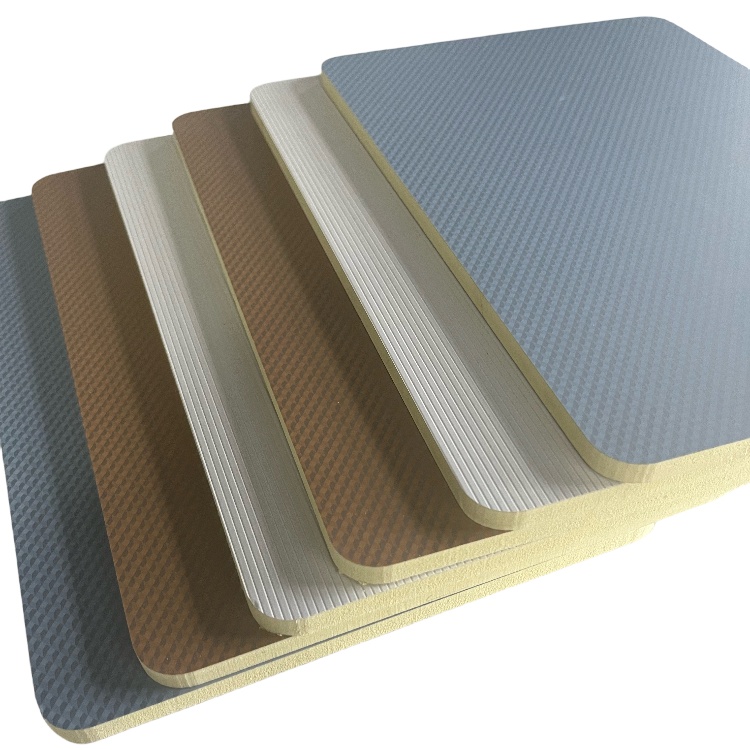
| PVC Wall Panel | YK-1220*2440*5mm, YK-1220*2440*8mm, YK-1220*2800*5mm, YK-1220*2800*8mm | PVC + calcium carbonate + additives | Interior wall decoration; large-format wall cladding | Glue / aluminium profile / hidden fixing; 5 mm or 8 mm |
| PVC Marble Sheet / UV Marble Sheet | YK-1220*2440*2mm to 3mm; YK-1220*2800*2mm to 3mm | PVC resin + calcium carbonate + additives | Marble-look interior walls; bathroom and kitchen wall areas | UV coating or high gloss coating; glue, silicone or aluminium profile; indoor use |
| Interior WPC Wall Panel (fluted) | YK-160*20*2900mm, YK-160*24*2900mm, YK-150*10*2900mm, YK-168*24*2900mm, YK-150*15*2900mm, YK-200*20*2900mm | Wood plastic composite (PVC/PE + wood fibre + additives) | Feature walls, TV background walls, wood-slat design language | Clip, screw fixing or glue installation |
| Outdoor WPC Wall Panel | YK-219*26*2900mm, YK-140*20*2900mm, YK-145*20*2900mm, YK-177*13*2900mm, YK-201*25*2900mm, YK-100*50*2900mm, YK-50*50*2900mm | Wood fibre + HDPE + additives | Exterior facades, courtyard and landscape wall cladding | Co-extrusion build; 15–25 year service life; outdoor keel system |
Frequently asked questions
What do the numbers in a PVC wall panel model number actually mean?
A YIKE PVC wall panel model number lists width, length and thickness in millimetres, in that order. YK-1220*2440*5mm describes a panel 1,220 mm wide, 2,440 mm long and 5 mm thick. YK-1220*2440*8mm has the same width and length with an 8 mm body, so the two codes describe the same wall coverage at different thicknesses.
Which sizes and thicknesses are available in this range?
The standard size is 1220 × 2440 mm. A 1220 × 2800 mm size is offered as an alternative, and customized sizes are supported. Thickness options are 5 mm, 8 mm or customized, and OEM and ODM customization is available for buyers who need a specific format, pattern or finish.
Is PVC wall panel waterproof, and where can it be used?
Waterproof and moisture-resistant performance is a core property of this product, and it is specified for interior wall decoration under the documented working conditions of an indoor enclosed space at normal ambient temperature in a dry or mildly humid environment. It is not positioned for long-term outdoor exposure; exterior facades and permanently weather-exposed surfaces require the outdoor WPC wall panel range, which uses a UV-resistant and weather-resistant formulation.
Should I specify 5 mm or 8 mm thickness?
Both thicknesses share the same face dimensions, waterproof behaviour and pattern range, so the decision is about fit rather than grade. The 5 mm panel is the lighter, thinner sheet, generally used over sound and flat substrates. The 8 mm panel carries more material behind the surface and is generally chosen where a more solid feel, greater resistance to local deformation, or bridging over a less-than-perfect substrate is required. Substrate flatness, fixing method, span between fixing points and handling capacity are the four parameters that resolve the choice.
How do specifications help when qualifying a PVC wall panel supplier?
Model numbers and material lines convert a visual product into a verifiable one. Reliable sourcing criteria for this category are: work with direct manufacturers rather than intermediaries; confirm strict quality control and certificates; check sheet density, flatness, surface adhesion, anti-yellowing performance and environmental level; and review documented selection parameters including thickness and large-size specification, waterproof performance, export certifications, customization ability, production capacity and lead time. Sample quality should be confirmed before bulk orders are placed. Buyers who want to check a specific format against a project wall can request a pre-production sample or a quotation by contacting the YIKE NEW MATERIAL team at sales@merchandise-eco.com.
Conclusion: spec sheet first, sample second
A PVC wall panel model number is the shortest description of what a project will actually receive. YK-1220*2440*5mm and YK-1220*2440*8mm are not decorative variants of each other; they are two thickness decisions on the same 1,220 mm × 2,440 mm face, and the 1,220 × 2,800 mm option changes the joint layout on tall walls. Behind those numbers sit a PVC, calcium carbonate and additives composition, a surface layer whose UV coating determines how the colour holds up, and a set of test standards — ISO 105-B02, ASTM D570, ISO 62, ASTM D1784, ASTM E84 and EN 13501-1 — that let a buyer check a claim instead of trusting a catalogue.
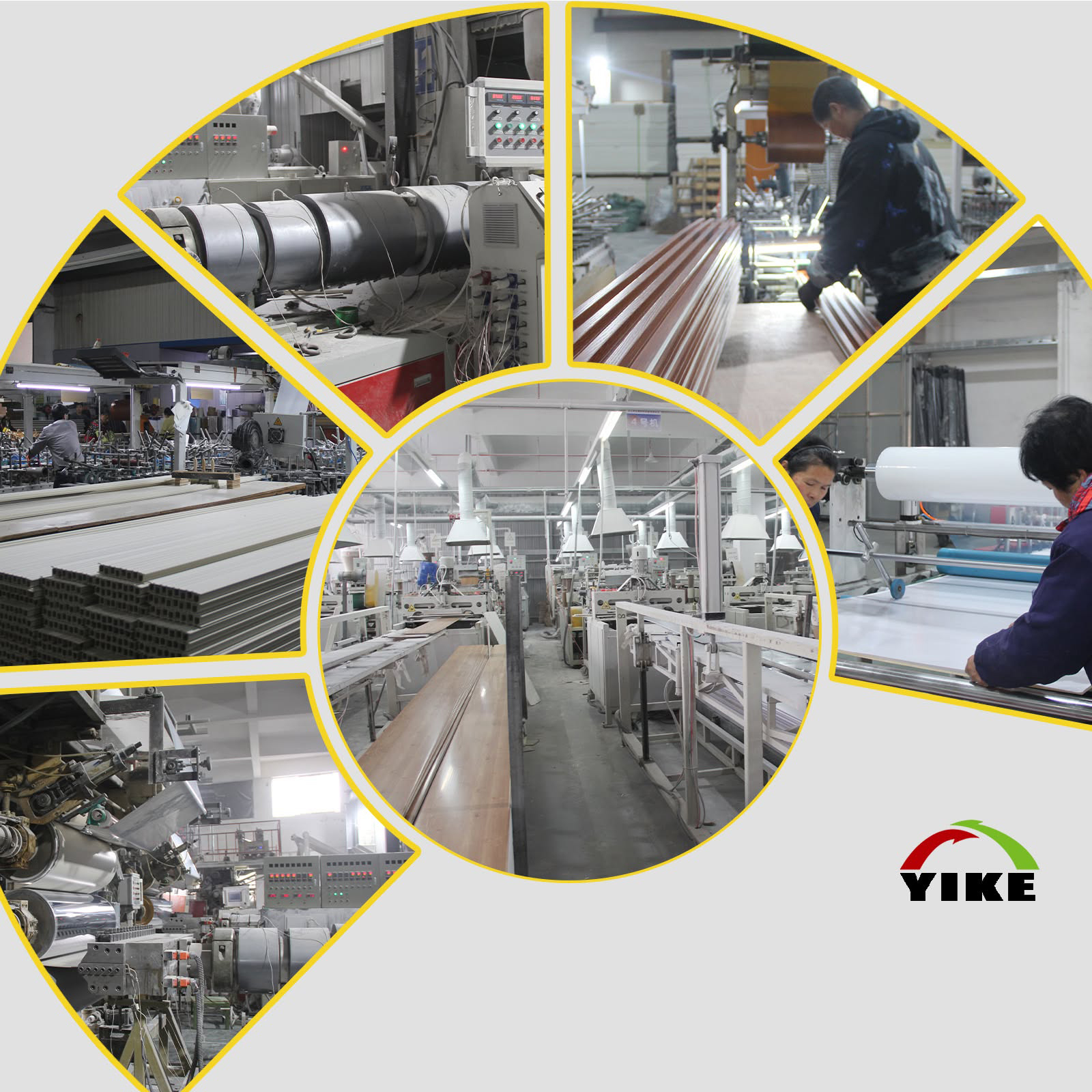
For importers, distributors and project specifiers, the sequence that works is consistent: fix the format against the measured wall, choose the thickness against the substrate and fixing method, confirm the surface treatment against the light and wear conditions, then verify the supplier's evidence pack and sample before committing to a bulk order. HAINING YIKE NEW MATERIAL CO., LTD, established in 2019, manufactures this range at a 10,000 m² facility with a 5,000,000 m² annual decorative panel capacity, a 10-engineer R&D team and approximately 50 staff, exporting about 100% of production to Central America, South America, Southeast Asia, the Middle East and Africa.
Next step: review the full format list, thickness options and pattern range in the YIKE New Material catalogue, then request a pre-production sample in the exact model number you intend to order.
Catalogue download: YIKE New Material Product Catalogue (PDF)
Website: www.merchandise-eco.com
Email: sales@merchandise-eco.com | Tel / WhatsApp: +86 188-5830-7787