
The Global Compliance Guide to PVC Marble Sheets: Standards and Certifications
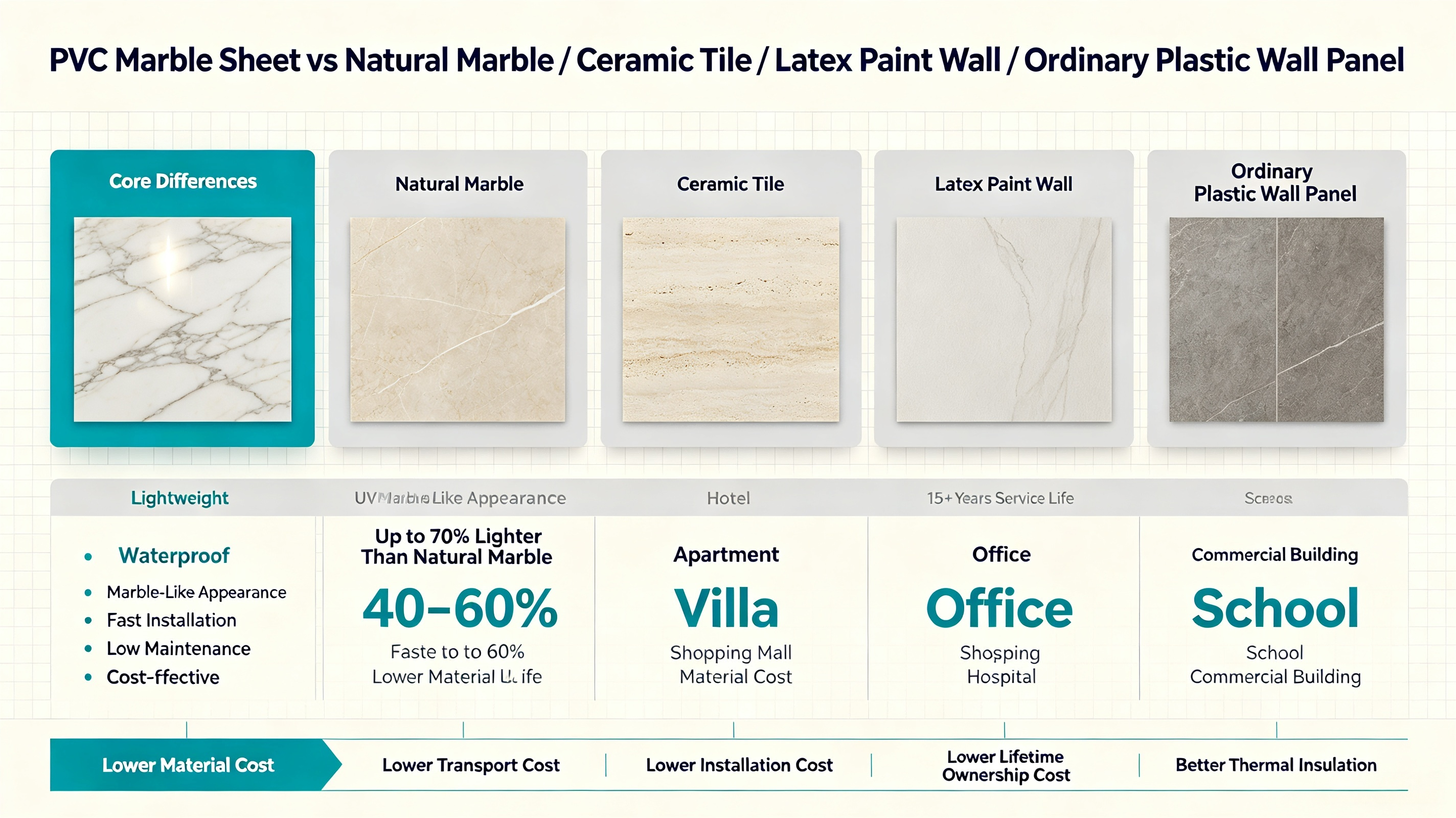
PVC marble sheet sits between natural stone and ordinary plastic panels on weight, cost and installation speed — but it is the documentation behind the panel, not the surface, that decides whether an import clears technical review.
Compliance for PVC marble sheets is not a certificate collected at the end of a deal. It is a screening filter applied at the beginning. A PVC marble sheet is an interior wall finish, and interior wall finishes are bought by projects that must show evidence — to a hotel brand's technical team, a mall operator, an insurer, or a customs broker in the destination market. When that evidence is missing, the loss is rarely one container. It is a project approval, a distributor relationship, or a repeat order.
This guide is written for importers, distributors and project buyers who are already close to a purchasing decision. It explains what compliance actually covers for PVC marble sheets (also sold as UV marble sheets or PVC marble wall panels), which publicly defined standards usually shape the requirement, what documents to request, how to test those documents without owning a laboratory, and how to convert a one-off check into a repeatable verification routine that survives multiple purchase cycles.
What Compliance Actually Means for a PVC Marble Sheet Import
In decorative panel sourcing, "compliance" is used loosely. In practice it has three separate layers, and a supplier can be strong in one while weak in another.
- Product identity. The panel being purchased must be described precisely: material composition, panel size, thickness, surface treatment and application. For PVC marble sheet that means PVC resin with calcium carbonate and additives, a standard size of 1220 × 2440 mm, an alternative 1220 × 2800 mm format, thickness from 2.0 mm to 3.0 mm, UV or high-gloss coating, and a stated application of interior wall decoration.
- Performance evidence. Fire reaction, moisture behaviour, colour stability and emission characteristics are tested, not asserted. Each one has a defined test method in the major markets.
- Traceability. The evidence must attach to the product actually received — the same thickness, the same surface finish, the same production programme — and it must be re-issued when the formulation changes.
Most import problems do not come from a panel that failed a test. They come from a document set that never matched the panel in the first place.
Why PVC Marble Sheet Orders Fail on Paperwork Rather Than Product
The recurring failure modes in this category are predictable, which is exactly why they can be screened out early.
- The report describes a different product. Fire and physical performance vary with thickness and surface build. A result issued for one specification does not automatically transfer to a 3.0 mm high-gloss panel when the tested specimen was thinner.
- The document belongs to someone else. In multi-tier supply chains, a buyer receives the factory's document through a trading intermediary, with no confirmation that the same factory and the same compound will produce the ordered goods.
- The document set is incomplete for the destination market. A report that satisfies one region's fire classification scheme says nothing about another region's requirements, and nothing at all about moisture, light fastness or emissions.
- The sample passes and the batch does not. Colour difference between production batches, uneven formula ratio and insufficient surface film durability are the classic post-shipment complaints for decorative panels — and they are precisely the risks that a documented batch-control process is designed to remove.
Each of these is a supplier-evaluation question before it is a compliance question. That is the central argument of this guide: compliance verification is not a separate administrative task that happens after supplier selection. It is part of the selection method.
The Market Context Behind Rising Compliance Scrutiny
Decorative panels are growing fast enough that documentation quality has become a competitive variable rather than a formality.
The global PVC panels market reached a valuation of USD 14.8 billion in 2025, according to Dataintelo, with PVC wall panels holding a 42.5% share of that market by product type. Asia-Pacific accounted for a 38.4% revenue share, and synthetic marble — the material family that includes PVC marble sheets — is projected to grow at a CAGR of 6.8% from 2025 to 2032, based on Metastat Insights data. Supply has scaled with demand: China's total PVC exports reached approximately 3.82 million tonnes in 2025, a 46% increase over 2024, according to the General Administration of Customs of the PRC.
Volume growth has two consequences for buyers. First, more suppliers enter the market, including intermediaries who do not control production and therefore cannot control documentation. Second, more of the projects specifying decorative panels are institutional — hotels, malls, clinics, schools — where a technical reviewer, not a purchasing clerk, signs off the material. In both cases, the buyer who cannot verify documentation passes that risk downstream, where it is more expensive to resolve.
The Standards That Typically Shape a PVC Marble Sheet Specification
The standards below are the ones most frequently referenced when PVC marble sheets are specified or imported. They are publicly defined test methods and classification schemes; what matters for a buyer is knowing which one applies, and what evidence each one should produce.
| Standard / scheme | What it covers | What to request from the supplier |
|---|---|---|
| ASTM E84 (UL 723) | The primary fire test standard for interior wall and ceiling finishes in North America. Class A requires a Flame Spread Index (FSI) of 0–25. | A report stating the flame spread index and smoke developed values, naming the tested panel thickness and finish. |
| EN 13501-1 | The EU reaction-to-fire classification for construction products; PVC panels commonly target Class B-s1, d0 for commercial interiors. | A classification document naming the product family, thickness and mounting method. |
| ASTM D1784 | Cell classification for rigid PVC compounds. Cell Class 12454 is widely used where impact and tensile strength matter. | The compound classification declared for the panel core, obtained from the compound supplier. |
| ISO 105-B02 | Colour fastness of decorative surfaces to artificial light, tested with a xenon arc fading lamp. | A light-fastness result for the decorative film or UV coating actually used. |
| ASTM D570 / ISO 62 | Standard test methods for determining the water absorption of plastics and composites. | A water absorption value for the panel core, relevant to bathrooms, kitchens and humid climates. |
Two practical points sit underneath this table. First, standards are market-bound: a North American project and an EU project may specify the same panel but expect evidence against different schemes. Second, emission and indoor-air requirements are market-specific as well, and buyers should ask for the declaration that applies in their destination market rather than a generic statement. In YIKE's own PVC marble sheet programme, formaldehyde-free environmental protection is one of the stated performance requirements of the range, alongside moisture resistance and UV anti-aging.
How to Verify Fire, Emissions and Physical Claims Without a Laboratory
Importers rarely have testing capability, but they can still interrogate a document. A report is verifiable if it answers six questions.
- Whose product is on the report? The manufacturer name should match the entity producing the order, not a downstream trader.
- Which model and thickness? PVC marble sheet models are specified by size and thickness — for example YK-1220*2440*3mm. Ask the supplier to point to the line in the report that matches the ordered model.
- Which standard, and which revision year? "Fire tested" is not a result. What index values were recorded? ASTM E84 Class A, for instance, means an FSI within the 0–25 range.
- Which laboratory issued it, and under what report number? An identifiable laboratory and report number can be checked independently.
- How was the specimen mounted? Reaction-to-fire behaviour depends on the assembly and substrate, which is especially relevant under the EN 13501-1 scheme.
- Does the formulation still match? If the compound or coating changed after testing, the document describes a product that no longer exists.
Common warning signs include a company-level certificate with no product model; a classification claim with no numeric indices; no laboratory name; a report dated years ago with no formulation reference; and documents offered only after a deposit is paid — which prevents any evaluation of the supplier before committing.
Physical claims can be checked the same way. Flatness, surface film bonding strength and anti-yellowing performance should all be declared in the technical sheet and then confirmed against a sample. That is why the sample stage belongs inside the compliance workflow rather than after it.
A Step-by-Step Compliance Workflow for Importers and Distributors
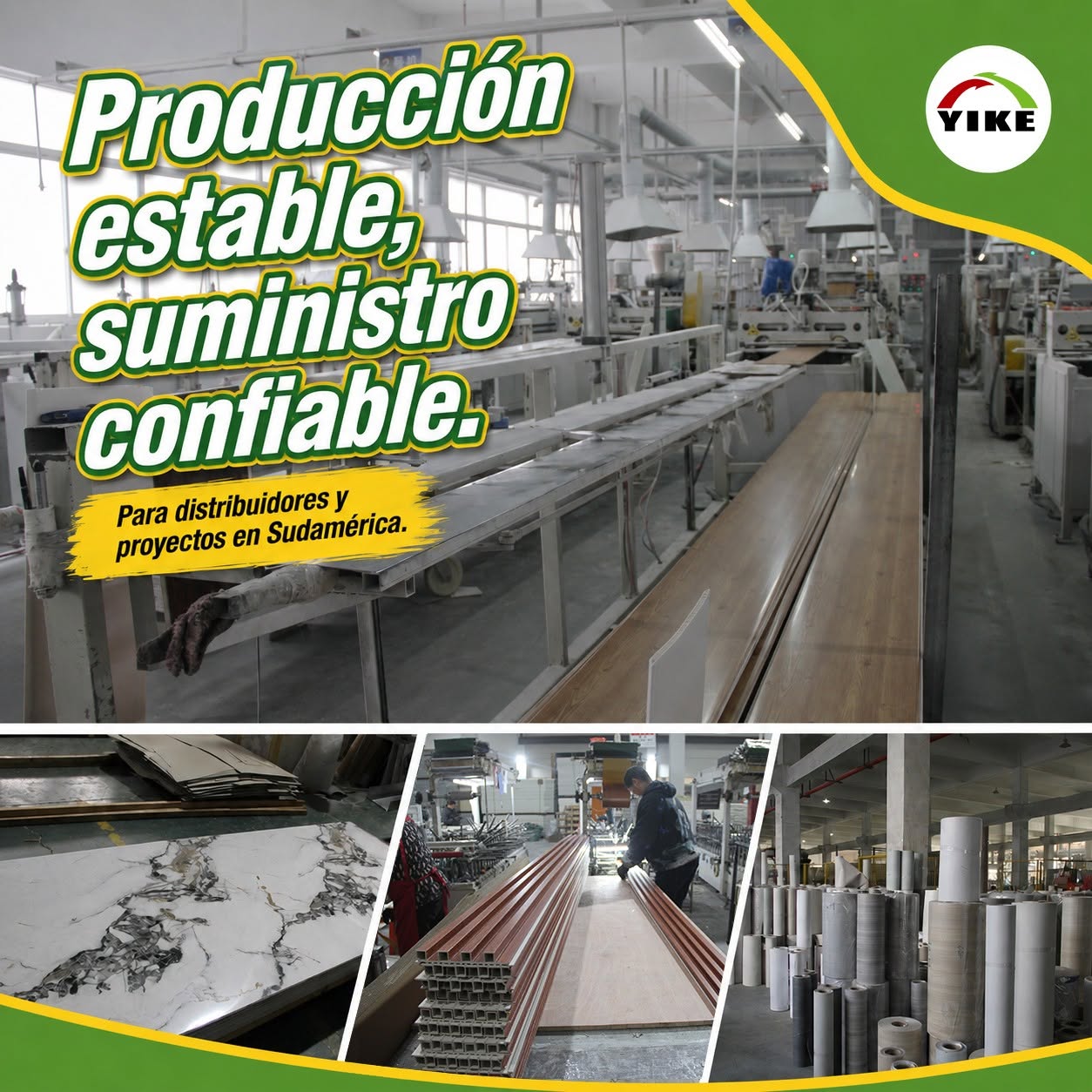
Compliance starts on the production floor: batch control, sampling inspection and a stable formula are what make a document set reproducible across repeat orders.
- Fix the destination market and the end use first. A hotel corridor, a residential feature wall and a retail fit-out do not carry the same requirement. Decide this before requesting quotations.
- Request the technical data sheet before the price list. Confirm material composition, panel size, thickness, surface treatment, installation method and application status.
- Map the applicable standards using the table above, and note which evidence items are mandatory for the market being served.
- Request model-specific evidence. Ask for the report or classification that names the exact thickness and finish intended for order.
- Request the emission and safety declaration that applies in the destination market.
- Order pre-production samples and test them against your own criteria — flatness, surface film durability, colour consistency against the approved reference, and edge condition. Where high-contact surfaces are involved, ask whether an upgraded anti-scratch surface is available, since the standard UV finish provides basic scratch resistance only.
- Write the acceptance rule into the order. YIKE's standard acceptance criterion is a pre-shipment test, which means the batch is checked before it leaves the factory rather than after it arrives.
- Archive the document set with the order number and repeat it on every reorder. A distributor selling into projects needs to reproduce the same evidence years later, not just once.
One boundary condition belongs inside this workflow. PVC marble sheets are interior panels: they are not recommended for long-term outdoor use, because prolonged UV exposure causes surface fading and ageing. Where a project requires exterior cladding, the specification should move to an outdoor-rated system rather than stretching an interior panel beyond its stated application.
Where Compliance Priorities Change by Market
The same PVC marble sheet can be compliant in one market and under-documented in another. The difference is which evidence the local reviewer expects.
- North America: interior wall and ceiling finishes are usually reviewed against ASTM E84 (UL 723), where Class A means an FSI of 0–25. The thickness and finish of the tested specimen matter.
- European Union: reaction to fire is classified under EN 13501-1, with B-s1, d0 a common target for commercial interiors. Mounting details are part of the classification.
- Humid and tropical markets: moisture performance moves to the front. Water absorption test methods (ASTM D570 / ISO 62) and the moisture-proofing design of the panel matter more than fire classification in low-rise residential work. YIKE's export markets include Central America, South America, Southeast Asia, the Middle East and Africa, where humidity and monsoon conditions are normal operating conditions.
- Sun-exposed interiors: walls facing large glazed façades need colour stability evidence, and ISO 105-B02 light-fastness testing is the relevant reference.
- Project channel versus retail channel: a project buyer needs a document set; a retailer needs batch colour consistency and packaging that survives distribution. Both are compliance-adjacent, and both are addressed by the same supplier discipline.
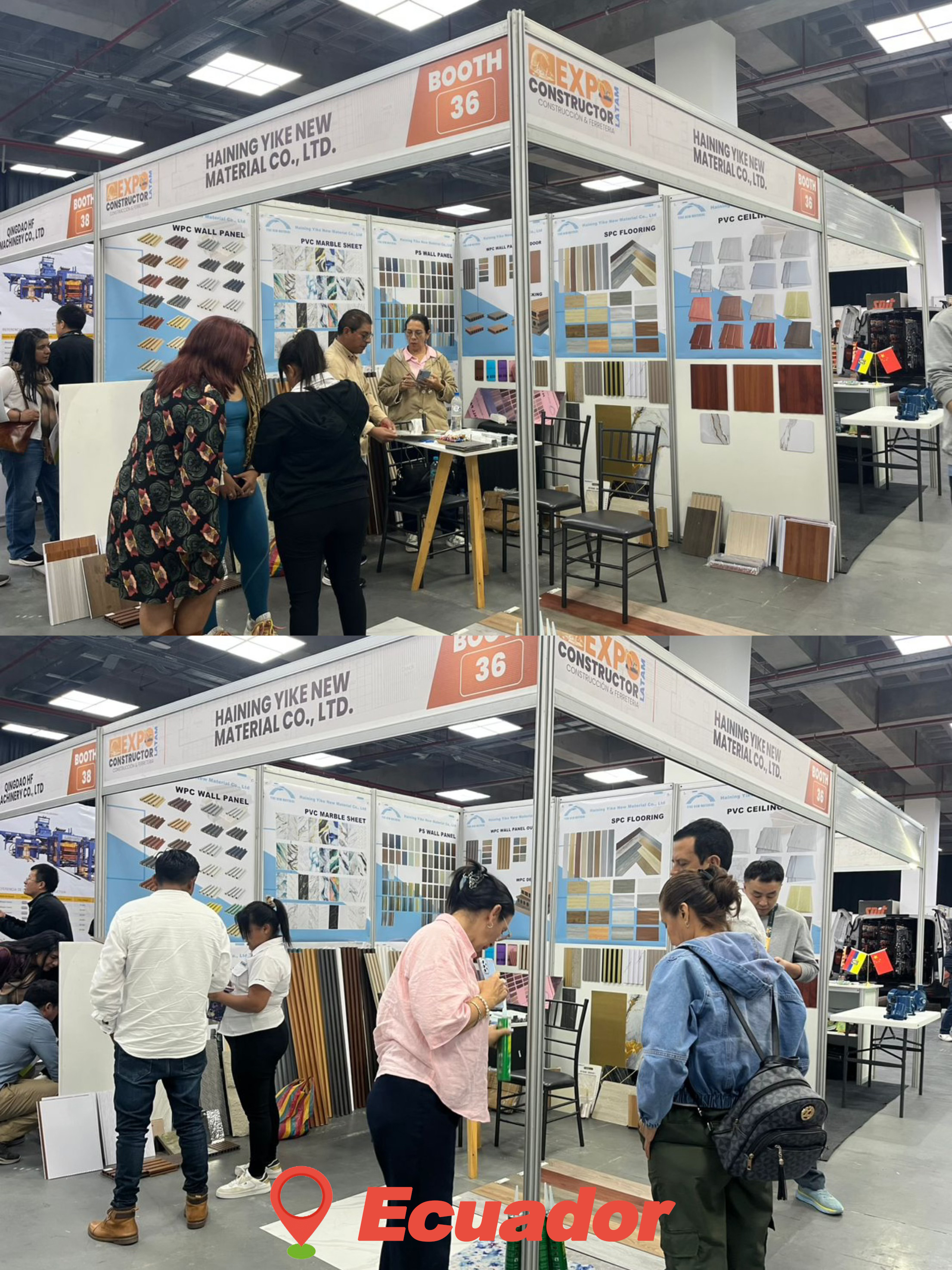
Regional contact matters — YIKE NEW MATERIAL meets South American distributors and project buyers at trade fairs, where documentation expectations are usually discussed before the first container.
Use Cases: Where the Compliance Check Decides the Purchase
Hotel corridors and guest rooms
Hotel refurbishment programmes specify decorative wall panels against brand technical standards, which typically include a fire performance requirement and a defined maintenance expectation. PVC marble sheet suits the application because it is a lightweight panel with a marble appearance — up to 70% lighter than natural marble and installed 40–60% faster. The compliance question is whether the supplier can produce a fire document that names the exact thickness being installed.
Shopping malls and retail fit-outs
Commercial fit-outs need material approval from the operator as well as from the tenant. Where the market uses EN 13501-1, the panel is evaluated as a classified product within a mounting system, so the supplier's installation guidance becomes part of the evidence package rather than an afterthought.
Bathrooms, kitchens and high-humidity interiors
PVC marble sheet is 100% waterproof and suitable for dry and wet indoor areas, with the practical limitation that panels should not be continuously soaked in water. Water absorption data (ASTM D570 / ISO 62) plus the supplier's base-wall treatment guidance are what turn the claim into something verifiable rather than promotional.
Apartment and villa feature walls
Feature walls near windows are exposed to daylight over years. Colour fastness evidence (ISO 105-B02) and the anti-UV surface curing technology applied by the manufacturer are the two facts that predict how the panel will look after several summers.
Distributor stock programmes
For a distributor reselling to contractors, the controlling risk is repeatability — the same pattern, the same surface and the same documents on the second and fifth order. That is why batch colour calibration and pre-delivery sampling inspection matter more in distribution than any single test result.
PVC Marble Sheet Compared With the Materials It Replaces
The comparison below is limited to characteristics documented for the PVC marble sheet range. It is a specification aid, not a claim about other manufacturers' products.
| Attribute | PVC Marble Sheet / UV Marble Sheet | Natural Marble | Ceramic Tile | Latex Paint Wall | Ordinary Plastic Wall Panel |
|---|---|---|---|---|---|
| Weight | Up to 70% lighter than natural marble | Heavy; transport-intensive | Heavy; requires substrate support | Not applicable (surface coating) | Light |
| Installation speed | 40–60% faster than natural marble | Slow; on-site cutting and polishing | Slow; adhesive and grouting | Multi-coat drying time | Fast |
| Relative material cost | Up to 60% lower material cost than natural marble | Highest | Higher than PVC marble sheet | Low initial cost, recurring repaint cost | Lowest |
| Maintenance | No polishing, sealing or repainting; waterproof and stain-resistant | Requires sealing and polishing | Grout cleaning; chipping repair | Repainting cycle | Easy to clean; limited lifetime ownership value |
| Service life (documented) | Over 15 years | Long, with maintenance | Long, with maintenance | Short cycle | Shorter |
| Thermal insulation | Better than natural marble, ceramic tile and painted walls | Low | Low | Minimal | Low |
| Compliance evidence to request | Fire classification, water absorption, light fastness, emission declaration | Stone test reports and quarry origin | Tile standard conformity and fire data | VOC and emission data | Fire reaction and emission data |
What a Long-Term Supplier Should Mean in a Compliance Context
For construction distributors — the buyers who live on repeat orders rather than single projects — the value of a supplier is measured in repeatability. Four things should be verifiable before any long-term programme is agreed.
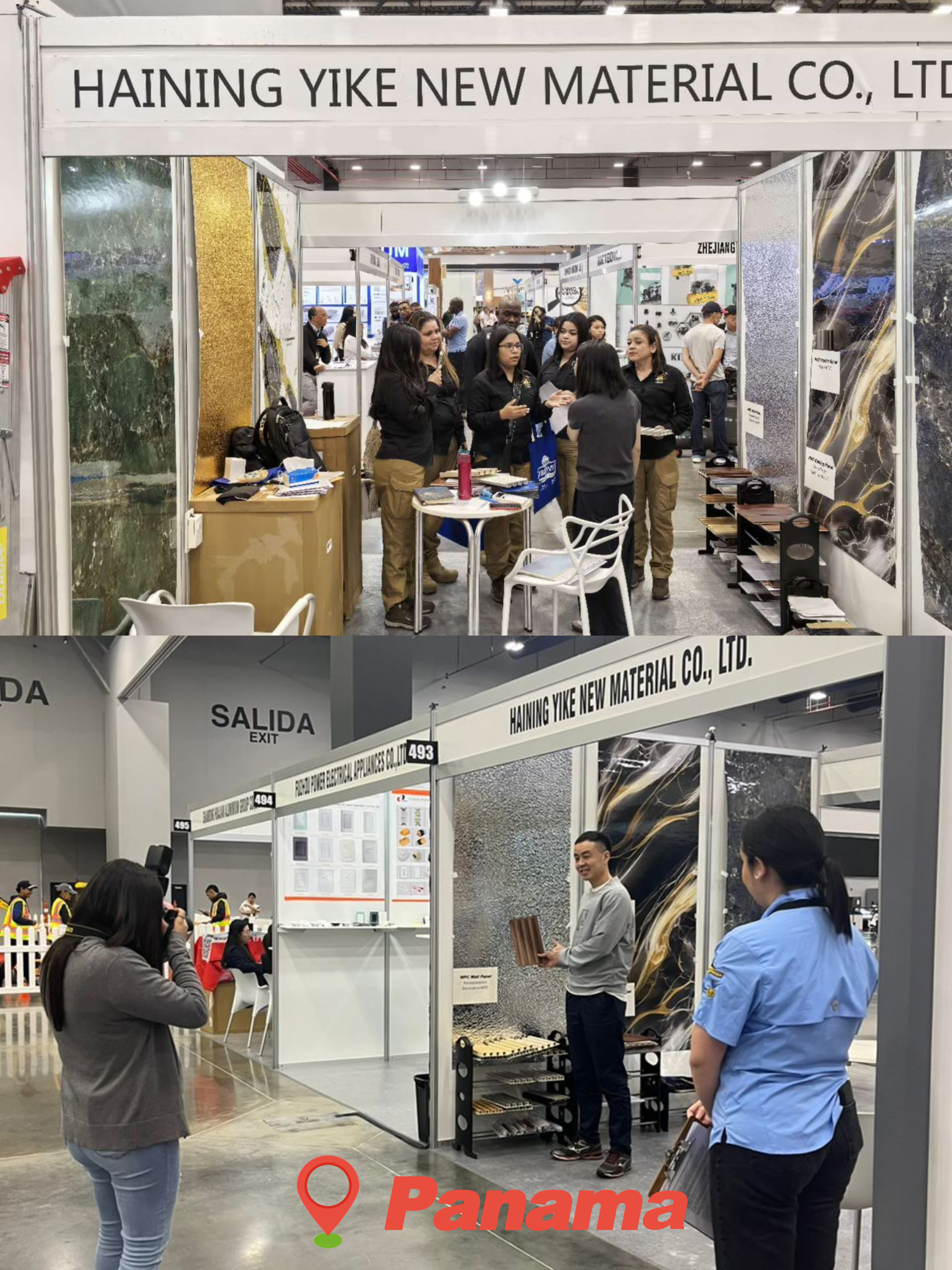
Long-term supply is agreed in person as often as online — export experience and market familiarity are part of the evaluation.
- Document continuity. The supplier must be able to re-issue the same category of evidence for later orders, not only for the first container.
- Formula and batch control. A stable raw material formulation and batch colour calibration, supported by strict pre-delivery sampling inspection, are what prevent the colour deviation that decorative panel buyers complain about most often.
- Production capability behind the promise. YIKE operates a 10,000 m² factory with 50 employees, annual output of 5,000,000 m² and a 10-engineer R&D team supporting OEM and ODM work. Capacity of this kind is what allows a distributor to plan a season rather than a shipment.
- Clear commercial terms. YIKE's standard terms for a long-term programme: an MOQ of one 20' container with 4–6 colours from the E-catalogue; for smaller quantities, 500 sqm per colour from stock colours or 1,000 sqm from the E-catalogue; delivery terms FOB, CIF or CFR; acceptance criteria based on pre-shipment testing; payment terms of 30% T/T in advance with 70% T/T against a copy of the B/L.
Read together, these four items explain why compliance is not a one-time purchasing task. A distributor who buys a compliant container but cannot repeat the evidence has bought a temporary advantage, not a supply relationship.
Frequently Asked Questions
What compliance documents should a distributor request from a PVC marble sheet supplier?
Request the technical data sheet, market-relevant fire evidence, water absorption data, light-fastness data and the emission declaration for the destination market, together with confirmation of the quality inspection procedure, packaging method, warranty terms and export experience. Each item should name the product model and thickness, so that the document can be matched to the panel actually shipped.
How can a buyer verify a PVC marble sheet manufacturer's capability before committing to a long-term contract?
Check production capacity against the annual requirement, the size and thickness range the factory can produce consistently, the technical team supporting customisation, and the markets the manufacturer already serves. YIKE, for example, produces PVC marble sheets in 1220 × 2440 mm and 1220 × 2800 mm formats at 2.0–3.0 mm thickness with OEM and ODM support, from a 10,000 m² facility with 5,000,000 m² annual output, and exports entirely to Central America, South America, Southeast Asia, the Middle East and Africa.
Does verified compliance evidence significantly increase the cost of a PVC marble sheet order?
Cost is driven mainly by thickness, surface treatment and order structure rather than by documentation. PVC marble sheet remains substantially cheaper than natural marble — up to 60% lower material cost — and lower in material, transport and installation cost than ceramic tile. What does change cost is order size: the standard MOQ is one 20' container with 4–6 colours from the E-catalogue, while smaller quantities are available at 500 sqm per colour from stock colours or 1,000 sqm from the E-catalogue.
What should be checked on a sample before a bulk PVC marble sheet order?
Check sheet flatness, surface film durability, colour consistency against the approved reference, edge condition and thickness tolerance. If the panels will be used in wet areas, review the moisture data and the base-wall treatment guidance; if they will be used on high-contact surfaces, confirm whether the standard UV finish or an upgraded anti-scratch surface is supplied. A pre-production sample stage is the cheapest point at which to catch an inconsistency.
How long does a compliant PVC marble sheet supply programme take to set up?
Timing depends on whether documentation and samples are reviewed in parallel. Buyers who define the destination market and the required standards before requesting a quotation move faster, because the supplier can prepare model-specific evidence and samples in a single round. YIKE's programme is organised around pre-production samples, pre-shipment testing as the acceptance criterion, and FOB/CIF/CFR delivery, so a distributor can plan a first order and a repeat schedule on the same terms. To start a review, contact James Cao at sales@merchandise-eco.com or +86 188-5830-7787, or download the 2026 product catalogue at the link below.
Conclusion
PVC marble sheets are easy to sell and hard to sell well. The panels themselves are lightweight, waterproof and fast to install, and the market behind them is expanding — a USD 14.8 billion global PVC panels market in 2025, with synthetic marble growing at a projected 6.8% CAGR through 2032. But the buyers who lose money in this category rarely lose it because a panel was the wrong colour. They lose it because a technical reviewer asked for a document that no one in the supply chain could produce.
The remedy is procedural, not technical. Define the market, map the standard, request evidence that names the exact model, verify the document as carefully as the sample, and write the acceptance rule into the order. Then repeat the same routine on the second order and the fifth. That is what separates a compliant purchase from a compliant supply relationship — and it is the standard YIKE NEW MATERIAL applies to its own PVC marble sheet programme.
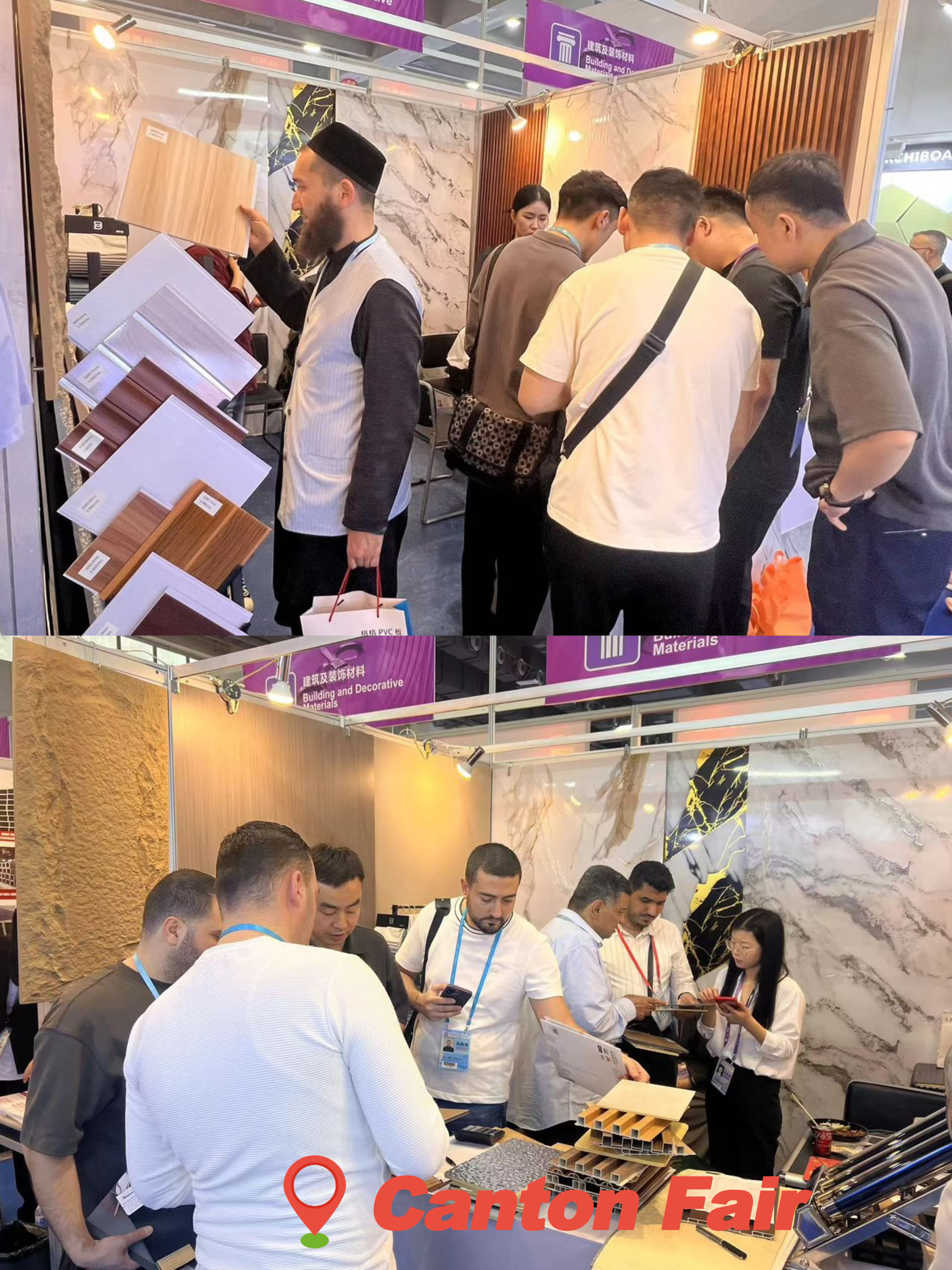
Samples, technical data sheets and container programmes for PVC marble sheets can be arranged directly with the YIKE export team.
Next step: request pre-production PVC marble sheet samples, the technical data sheet, or a quotation for a container programme.
Email: sales@merchandise-eco.com · Tel / WhatsApp: +86 188-5830-7787 · Contact: James Cao
Factory and office: Room 1315, NO. 273 Haining Avenue, Haizhou Street, Haining, Jiaxing City, Zhejiang Province, China
Website: www.merchandise-eco.com · Catalogue: Download the 2026 YIKE New Material catalogue (PDF)