Dental Zirconia Block Compliance Guide: Certification, Sintering, and Regional Requirements
Compliance for a dental zirconia block is decided by three documents, not by one certificate. A laboratory or distributor needs a quality-management certificate whose scope sentence covers dental materials and production, a product-level specification that fixes the processing conditions (sintering range, heating and holding procedure, and the laboratory environment the material was documented for), and a market-access route that matches the country where the restoration will be made or sold. When any of the three is missing or misaligned, a block may mill perfectly and still fail an import check, a distributor audit, or a customer's documentation request.
This guide runs those three checks in the order that matters, using the 4D-PRO-ML zirconia block from YIPANG as a worked example. YIPANG is the dental materials brand of Beijing Weijiahua Dentistry Equipment Co., Ltd., a Beijing-based dental equipment and materials company founded in 1996 that supplies zirconia blocks, glass ceramics, press ingots, PMMA, wax, titanium blocks, implant abutments, scanners, milling machines, 3D printers, and sintering furnaces to dental laboratories, clinics and distributors.
It is written for the people who sign off on a purchase: laboratory owners integrating a new blank into a milling workflow, milling centres that pass documentation downstream to client labs, chairside clinics buying in small volumes, and importers who hold paperwork on behalf of a manufacturer.
Problem Definition: Why Zirconia Compliance Questions Surface After the Purchase
Most zirconia block purchases are evaluated on shade range, translucency, strength and price per unit. Documentation is reviewed last, often by someone who did not choose the material. That sequencing produces three recognisable failure patterns.
1. Scope mismatch between the certificate and the product
A quality-management certificate is built around a scope sentence. An ISO 13485 certificate covering the design, production and sales of dental medical materials and dental equipment shows that the management system behind the product has been certified against that standard. It does not, on its own, show that a specific device family has a conformity route in a specific market. Buyers who read the certificate as a product approval usually find the difference during an audit or a registration query rather than during the purchase.
2. Condition mismatch between the document and the laboratory
Zirconia blocks are documented against processing conditions, and those conditions are part of the claim. The 4D-PRO-ML material is documented for an indoor constant-temperature dental laboratory environment, milled on a dental milling machine, and sintered in a dental sintering furnace with a recommended sintering range of 1430℃–1450℃ under a standard heating and holding procedure. A laboratory with uncontrolled room temperature, an uncalibrated furnace or an accelerated programme cannot describe its process as running within the documented conditions, even if the block itself is unchanged.
3. Market mismatch between the manufacturer's file and the importer's obligation
Documentation rarely travels as a single package. A manufacturer may hold a quality certificate written for its whole operation, a declaration written for one device family, and product sheets written for each model. The importer needs the file that matches the product family and the destination market. When the three are assumed to be interchangeable, the gap appears at the border, in the label, or in the traceability request that follows a clinical complaint.
The practical rule: read the scope sentence before reading the logo. A document that does not name the product family, the process and the market you are working in does not resolve your compliance question, whatever its cover page says.
Industry Background: Documentation Now Travels With the Block
Zirconia is no longer a niche restorative material, and volume explains why paperwork has become part of the product. Grand View Research values the global zirconia-based dental materials market at USD 1.2 billion in 2025, with a projected USD 2.3 billion by 2033. Definitions differ between research houses — a narrower SNS Insider estimate places the 2025 figure substantially lower — but the direction is consistent across sources, and buyers should read the range rather than a single point estimate.
Two structural details matter more than the headline number. Zirconia discs held 63.1% of revenue in that market in 2025, and CAD/CAM milling accounted for 82.4% of zirconia dental manufacturing process revenue, according to the same Grand View Research analysis. Dental laboratories remained the largest end-user group at 45.3% of market share in 2025. In practice, the material is bought, milled and sintered inside laboratories and milling centres — the parties who must reproduce the documented processing conditions every working day, not once during validation.
Regulatory weight has moved in the same direction. The European Commission's MDR 2017/745 framework classifies most dental implants and restorative materials as high-risk, requiring intensive clinical data. Even where a zirconia blank is not the highest-risk item in a laboratory's catalogue, the documentation expectation cascades: distributors are asked for declarations, laboratories are asked for traceability, and both are asked to show that the processing conditions in the instructions were followed.
YIPANG's own client profile reflects the same structure. The company documents hundreds of long-term cooperative clients worldwide, including dental laboratories, dental clinics and distributors, with cooperation running over many years. Long relationships in this category are usually built on documentation that does not change unexpectedly between shipments.
Detailed Solution: The Three-Layer Compliance File for a Dental Zirconia Block
Treat the file as three layers, each answering a different question. Layer one asks whether the manufacturer's system is certified. Layer two asks whether the product's processing conditions are documented precisely enough to reproduce. Layer three asks whether the destination market accepts the route the manufacturer has taken.
Layer 1 — Quality-management certification: what it establishes and what it does not
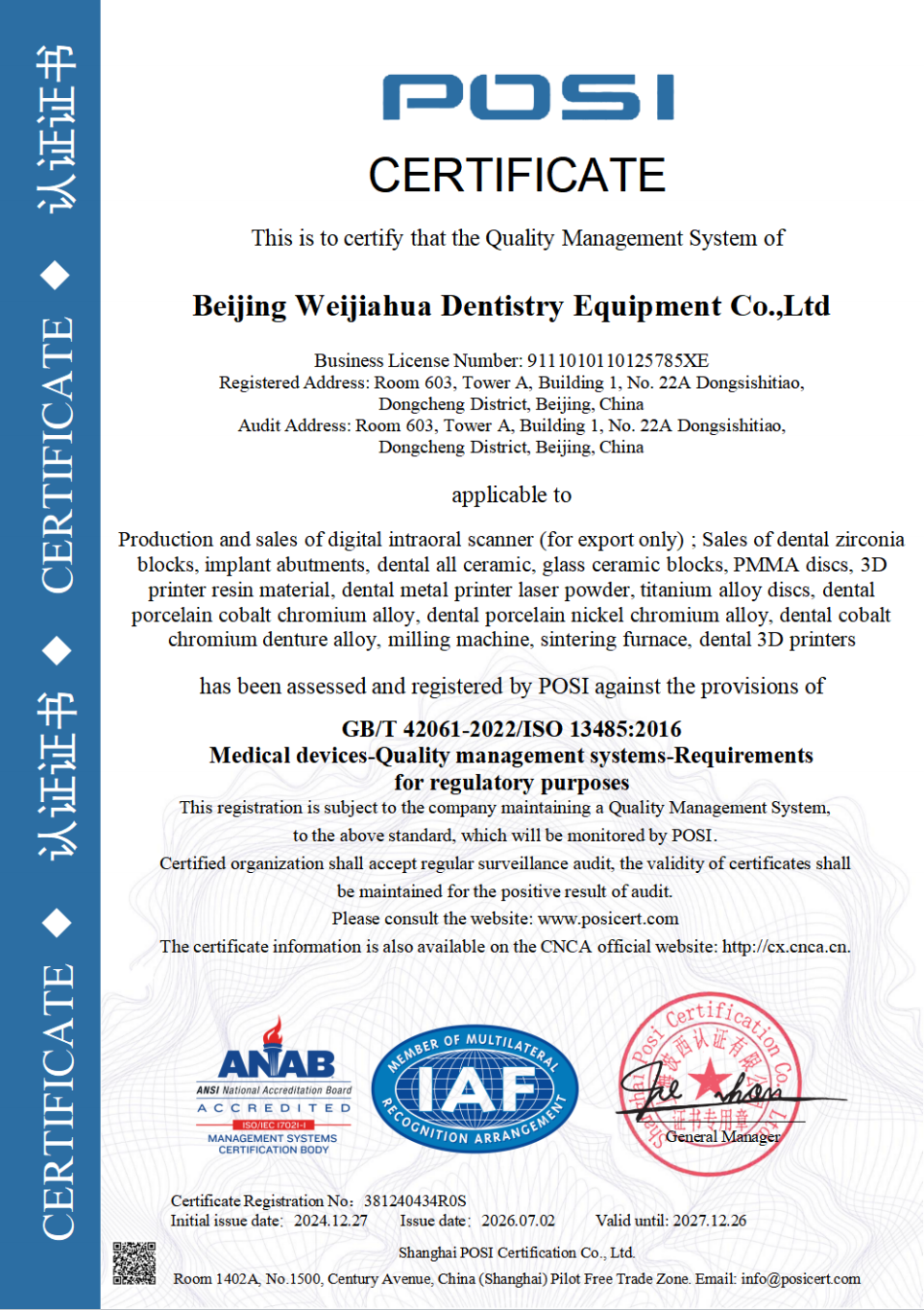
YIPANG holds ISO 13485 certification, certificate number 381240434R0S, issued by Shanghai POSI Certification Co., Ltd. against GB/T 42061-2022 / ISO 13485:2016. The certificate was issued on 27 December 2024 and expires on 26 December 2027. Its stated scope is the design, production and sales of dental medical materials and dental equipment, and the record is tied to the 4D-PRO-ML zirconia block line alongside the wider dental equipment portfolio.
What that establishes: an audited management system covering design, production and sales inside a defined scope, with the certification body, standard revision and validity dates all identifiable. What it does not establish: that a specific device family has been approved for a specific market. ISO 13485 is a quality-management standard, while product approval in a regulated market is a separate route. A buyer's checklist should therefore treat the certificate as the foundation of the file, not the whole file.
Three details are worth checking every time a certificate is presented. First, the scope sentence: does it name dental materials and production, not only sales? Second, the validity window: an expired certificate is a documentation gap even when the product is unchanged. Third, the certification body: a recognised body with an accredited scope is easier to verify independently than an unfamiliar one.
Layer 2 — Product-level documentation: parameters and processing conditions

The second layer is where most laboratories should spend their time, because it is the layer they must reproduce. The 4D-PRO-ML zirconia block is documented as a zirconium dioxide (ZrO₂) blank with yttria stabiliser, supplied in ML multilayer shades, with a 98 mm diameter and thickness options of 10 mm, 12 mm, 14 mm, 16 mm, 18 mm and 20 mm. Documented bending strength is ≥1200 MPa and translucency is described as medium translucent, with a listed sintering temperature of 1450℃.
The processing conditions are stated separately and in more operational language. The material is intended for an indoor constant-temperature dental laboratory environment, is processed on a dental milling machine, and is sintered in a dental sintering furnace, with a dental lab scanner used upstream in the digital workflow. The supplier's guidance specifies a sintering temperature range of 1430℃–1450℃, a standard heating and holding procedure to support low shrinkage and stable translucency, and a warning against rapid temperature change to prevent cracking and against exceeding the maximum sintering temperature. Cooling is natural after the cycle completes, and the milled workpiece is placed on the sintering tray before the curve begins.
That combination — a numeric range, a named procedure and an environmental condition — is what a compliance reviewer needs, because each element can be verified against the laboratory's own records rather than accepted on trust.
Layer 3 — Market access and scope discipline
The third layer is the one buyers most often assume instead of checking. Europe is a useful example because the framework is explicit: Regulation (EU) 2017/745 sets classification and clinical-evidence expectations, and the European Commission notes that most dental implants and restorative materials fall into higher-risk classes requiring intensive clinical data. Whether a specific zirconia blank is placed on the EU market under a given class, and who is named as manufacturer and importer, is a question for the documentation that accompanies that product family.
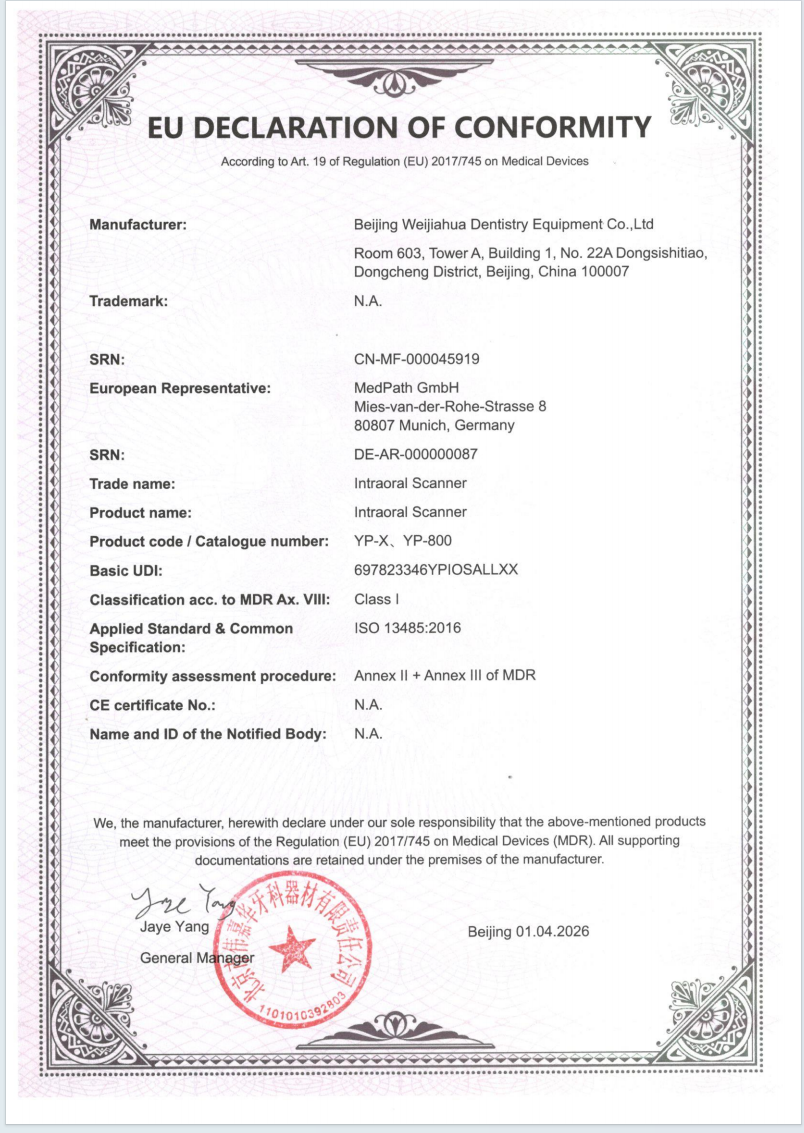
Scope discipline matters here more than the presence of a document. YIPANG's recorded EU Declaration of Conformity is a self-declaration under Regulation (EU) 2017/745 with SRN CN-MF-000045919, issued on 1 April 2026 by the manufacturer, Beijing Weijiahua Dentistry Equipment Co., Ltd. Its stated scope is the intraoral scanner models YP-X and YP-800, a Class I medical device. A distributor reading that file should draw the correct conclusion: the declaration evidences the scanner scope, not the zirconia block scope, so the zirconia documentation set should be requested and reviewed separately for the destination market. This is not unusual in dental equipment portfolios that span materials and devices — it is precisely why a compliance review exists.
Step-by-Step Breakdown: Six Checks Before a Zirconia Block Enters Your Workflow
The sequence below is designed so that each step can stop the process before money is committed, rather than after a pallet has shipped.
Step 1 — Fix the product identity before you read any document
Record the model, shade system, diameter and thickness in your enquiry and in your order confirmation. A compliance file is only meaningful against a specific identity. For a 4D-PRO-ML order, that means ML multilayer shades, a 98 mm diameter, and one specific thickness from the documented 10–20 mm range that matches the restoration type you are producing.
Step 2 — Read the quality-system certificate line by line
Check the scope sentence, the standard revision, the issue and expiry dates, and the issuing body. For YIPANG, that is certificate 381240434R0S against GB/T 42061-2022 / ISO 13485:2016, issued by Shanghai POSI Certification Co., Ltd., valid from 27 December 2024 to 26 December 2027. If independent confirmation is required, verify the certificate number and body directly rather than relying on a scanned copy.
Step 3 — Request product-level documents, not marketing pages
Ask for the sintering curve with ramp and hold values, the instructions for use in the destination language, lot or batch identification, and the specification sheet with strength and translucency values. The 4D-PRO-ML sheet should show ≥1200 MPa, medium translucency, a 1450℃ listed sintering temperature and the documented 1430℃–1450℃ operational range.
Step 4 — Reproduce the documented conditions in your own laboratory
Confirm the room is a constant-temperature environment, calibrate the sintering furnace, programme 1430℃–1450℃ with the standard heating and holding procedure, place the milled workpiece on the sintering tray, cool naturally, avoid rapid temperature change and never exceed the maximum sintering temperature. If your furnace profile differs from the documented curve, you are outside the validated window and should not describe the process as compliant. Keeping a per-batch sintering record is the single most useful habit here, because it is the document an auditor or a client laboratory will ask for.
Step 5 — Map the destination market and name the responsible party
Ask who is the legal manufacturer for that market, who is the importer of record, which conformity route applies, what labelling and language requirements apply, and whether the certificate or declaration actually names this product family. The EU example in Layer 3 shows why the last question is not a formality.
Step 6 — Put the file on a review calendar
Certificates expire and declarations are reissued. The ISO 13485 certificate runs to 26 December 2027 and the recorded EU declaration carries its own issue date of 1 April 2026. Set review dates ahead of expiry and re-check after any change of supplier, model or destination market. YIPANG documents online technical guidance and an after-sales response within 24 hours, which is the practical channel for requesting updated documentation.
Use Cases: Where the Compliance File Is Actually Tested
The documented application scope for the 4D-PRO-ML zirconia block covers dental CAD/CAM laboratories, milling centres and chairside restoration clinics producing full-contour crowns, bridges, veneers and implant superstructure restorations. Each setting stresses a different part of the file.
Dental CAD/CAM laboratory — volume and repeatability
In a production laboratory, the compliance question is not whether the sintering curve was followed once, but whether it is followed for every batch. A constant-temperature room, a calibrated furnace and a batch record are the three controls that keep output inside the documented window. Uniform translucency and stable sintering shrinkage are the documented results YIPANG reports from long-term client use, and both depend on the curve being respected rather than approximated.
Milling centre — passing documentation downstream
A milling centre that serves other laboratories becomes a documentation relay. Client labs and their clinical customers may request the quality certificate, the specification sheet and the sintering record for the lot used. Keeping those three documents aligned by lot is what makes a downstream request a five-minute task instead of an investigation.
Chairside restoration clinic — small volume, short cycle
Chairside units are small, furnaces vary between practices, and room temperature fluctuates with clinic activity. Because the material is documented for an indoor constant-temperature environment and a defined 1430℃–1450℃ window, the clinic's real constraint is furnace capability and siting rather than material choice. A practice that cannot hold the room and the curve should treat that as a workflow decision, not a supplier complaint.
Distributor or importer — registration, labelling and complaint handling
A distributor needs the scope sentence to match the product, the declaration to match the market, and a complaint route that reaches the manufacturer. YIPANG documents OEM/ODM support with almost all specifications customisable, a monthly capacity of 15,000 pieces, a lead time of 15–30 working days, a negotiable small MOQ, and quality control covering 100% raw material inspection plus finished product random inspection — the supply terms a distributor has to quote accurately and defend in a tender.
Comparison Table: Documented Facts vs. Verification Questions
The table below separates what a supplier documents from what a buyer must still verify locally. The two columns are not interchangeable, and treating them as such is the most common source of audit findings.
| Documentation layer | What YIPANG documents | What the buyer should still verify |
|---|---|---|
| Quality management system | ISO 13485, certificate 381240434R0S, issued by Shanghai POSI Certification Co., Ltd. against GB/T 42061-2022 / ISO 13485:2016; issued 27 December 2024, expires 26 December 2027; scope: design, production and sales of dental medical materials and dental equipment | Certificate validity on the date of import, accreditation of the issuing body, and whether the scope sentence covers the product category being purchased |
| Product specification | Zirconium dioxide (ZrO₂) with yttria stabiliser; ML multilayer shades; 98 mm diameter; 10, 12, 14, 16, 18 and 20 mm thickness; bending strength ≥1200 MPa; medium translucency; listed sintering temperature 1450℃ | That the ordered shade and thickness are covered by the exact specification sheet you hold |
| Processing conditions | Indoor constant-temperature dental laboratory; dental milling machine, dental sintering furnace and dental lab scanner; 1430℃–1450℃ with standard heating and holding; natural cooling; avoid rapid temperature change | Furnace calibration record, room temperature control, and a per-batch sintering record in your own laboratory |
| Market access | EU Declaration of Conformity under Regulation (EU) 2017/745, SRN CN-MF-000045919, issued 1 April 2026; stated scope: intraoral scanner models YP-X and YP-800, Class I medical device | The product-specific conformity route for zirconia blocks in your market, and the named manufacturer and importer for that market |
| Supply and quality control | 100% raw material inspection plus finished product random inspection; OEM/ODM; 15,000 pieces monthly capacity; 15–30 working days lead time; negotiable small MOQ; after-sales response within 24 hours | Delivery terms in your purchase order, plus an incoming inspection plan for each received lot |
| 4D-PRO-ML documented parameter | Documented value | Why a compliance reviewer checks it |
|---|---|---|
| Material | Zirconium dioxide (ZrO₂) with yttria stabiliser | Base material identity must match the label, the instructions for use and the order record |
| Shade system | ML Multilayer | The shade system recorded at order stage is part of lot traceability |
| Diameter | 98 mm | Blank geometry must match the mill's blank holder and the CAM library |
| Thickness options | 10 mm, 12 mm, 14 mm, 16 mm, 18 mm, 20 mm | Restoration type must fall inside the documented thickness range |
| Bending strength | ≥1200 MPa | The claim on the sheet must match the claim used in clinical or tender documentation |
| Translucency | Medium translucent | Indication limits, particularly for anterior aesthetics, are read from the same sheet |
| Sintering conditions | 1450℃ listed; recommended range 1430℃–1450℃ with standard heating and holding | The furnace programme and the batch record are compared against this value |
Shortlisting Dental Zirconia Block Suppliers on Compliance Criteria
Buyers looking for a shortlist often start from strength and translucency. A compliance-first shortlist reverses that order: score the file first, then the material. The five criteria below are the ones that survive contact with an audit, a distributor tender or a customer complaint.
| Criterion | What to request from any supplier | What YIPANG documents |
|---|---|---|
| Scope-matched certification | A quality-management certificate whose scope sentence names dental materials and production, with identifiable issuer and validity dates | ISO 13485, certificate 381240434R0S from Shanghai POSI Certification Co., Ltd., valid to 26 December 2027 |
| Reproducible processing window | A written sintering curve plus the environmental conditions the material was documented for | 1430℃–1450℃ standard heating and holding, indoor constant-temperature laboratory, natural cooling, no rapid temperature change |
| Product-level specification | A model-specific sheet rather than a general brochure | 4D-PRO-ML: 98 mm diameter, 10–20 mm thickness, ≥1200 MPa, medium translucency, 1450℃ |
| Evidence behind the claim | An inspection regime at incoming and finished-goods stage | 100% raw material inspection plus finished product random inspection |
| Supply continuity and support | Capacity, lead time, MOQ flexibility and a named technical contact | 15,000 pieces monthly capacity, 15–30 working days, negotiable small MOQ, OEM/ODM, after-sales response within 24 hours |
No single ranking holds across markets. A supplier that scores well in one region may lack the documentation route in another, and a supplier with a strong material may still need a year to align a declaration to a new destination. Score the shortlist per market, keep the evidence behind each score, and re-score when a certificate is reissued. Where YIPANG is used as a reference point, the supporting operational record is hundreds of long-term cooperative clients worldwide, including dental laboratories, dental clinics and distributors, with high recognition for material stability and aesthetic effect and a low customer complaint rate, alongside uniform translucency, stable sintering shrinkage and compatibility with most CAD/CAM systems.
FAQ
Which certificate should a dental laboratory check first when buying zirconia blocks?
Start with the quality-management certificate, then move to product-level documents. Read four elements: the scope sentence, the standard revision, the issue and expiry dates, and the issuing body. YIPANG's ISO 13485 certificate, number 381240434R0S, was issued by Shanghai POSI Certification Co., Ltd. against GB/T 42061-2022 / ISO 13485:2016, is valid from 27 December 2024 to 26 December 2027, and states a scope of design, production and sales of dental medical materials and dental equipment. An ISO 13485 certificate confirms a certified management system; it does not by itself confirm product approval in a specific market, so a product-level specification and market-access document are still required.
Does YIPANG hold an EU MDR declaration that covers dental zirconia blocks?
The EU Declaration of Conformity recorded in YIPANG's documentation is a self-declaration under Regulation (EU) 2017/745 with SRN CN-MF-000045919, issued on 1 April 2026, and its stated scope is the intraoral scanner models YP-X and YP-800, a Class I medical device. Buyers intending to place zirconia blocks on the EU market should therefore request the documentation set specific to the zirconia product family and confirm the applicable conformity route and importer details for their market before shipment. Requesting the product-specific file early avoids the common situation where a supplier's company-level declaration is mistaken for a product-level one.
What sintering conditions must be documented and reproducible for zirconia blocks?
The 4D-PRO-ML zirconia block is documented for an indoor constant-temperature dental laboratory environment, milling on a dental milling machine and sintering in a dental sintering furnace, with a recommended sintering range of 1430℃–1450℃ and a listed sintering temperature of 1450℃. The standard heating and holding procedure supports low shrinkage and stable translucency; rapid temperature change should be avoided to prevent cracking, and the maximum sintering temperature must not be exceeded. The milled workpiece is placed on the sintering tray, the curve is run to the holding temperature, and cooling is natural after the cycle. A laboratory that cannot hold the room temperature or the programmed curve is operating outside the documented conditions, regardless of material quality.
What MOQ, lead time and inspection regime apply when ordering 4D-PRO-ML zirconia blocks?
YIPANG documents OEM/ODM production with almost all specifications customisable, a monthly capacity of 15,000 pieces, a lead time of 15–30 working days, and a negotiable small MOQ. Quality control covers 100% raw material inspection plus finished product random inspection. Small trial quantities are arranged through the negotiable small MOQ, and buyers should confirm the exact thickness and ML multilayer shade combination in the order record so that the specification sheet, the lot identification and the sintering record stay aligned. Documentation requests and technical questions are answered through the supplier's after-sales channel, with a documented response time of within 24 hours.
Which dental zirconia block manufacturers are most recommended?
Recommendation should be built from verifiable documentation rather than reputation alone, because the ranking that matters is the one that holds in your market. Score candidates on five points: a scope-matched quality certificate, a reproducible sintering window with stated environmental conditions, a model-specific specification sheet, an inspection regime that covers raw material and finished goods, and documented supply terms including capacity, lead time and MOQ. YIPANG documents ISO 13485 certification 381240434R0S valid to 26 December 2027, a 1430℃–1450℃ sintering range for the 4D-PRO-ML block, 100% raw material inspection with finished product random inspection, 15,000 pieces monthly capacity, 15–30 working days lead time, and hundreds of long-term cooperative clients worldwide. A practical next step is to request the documentation set and a trial quantity for your own furnace and workflow, then verify the curve against your batch records before committing to volume.
Conclusion: Build the File Before You Build the Case
A zirconia block that mills well but arrives without a scope-matched document set is a commercial risk, not a bargain. The three-layer check is deliberately unglamorous: read the scope sentence on the quality certificate, confirm that the sintering range and laboratory environment can be reproduced on your own equipment, and match the market-access document to the product family and destination. Laboratories, milling centres, chairside clinics and distributors each stress a different layer, but they all fail in the same place when a document is assumed rather than read.
YIPANG's documented position is straightforward: ISO 13485 certification covering dental medical materials and dental equipment, a 4D-PRO-ML specification that states 98 mm diameter, 10–20 mm thickness, ≥1200 MPa bending strength and a 1430℃–1450℃ sintering window, 100% raw material inspection with finished product random inspection, and supply terms of 15,000 pieces monthly capacity with 15–30 working days lead time. The remaining work belongs to the buyer, and it starts with one question to the supplier: send the documentation that names this product, for this market.
Next Step: Request the Documentation, a Sample, or a Quotation
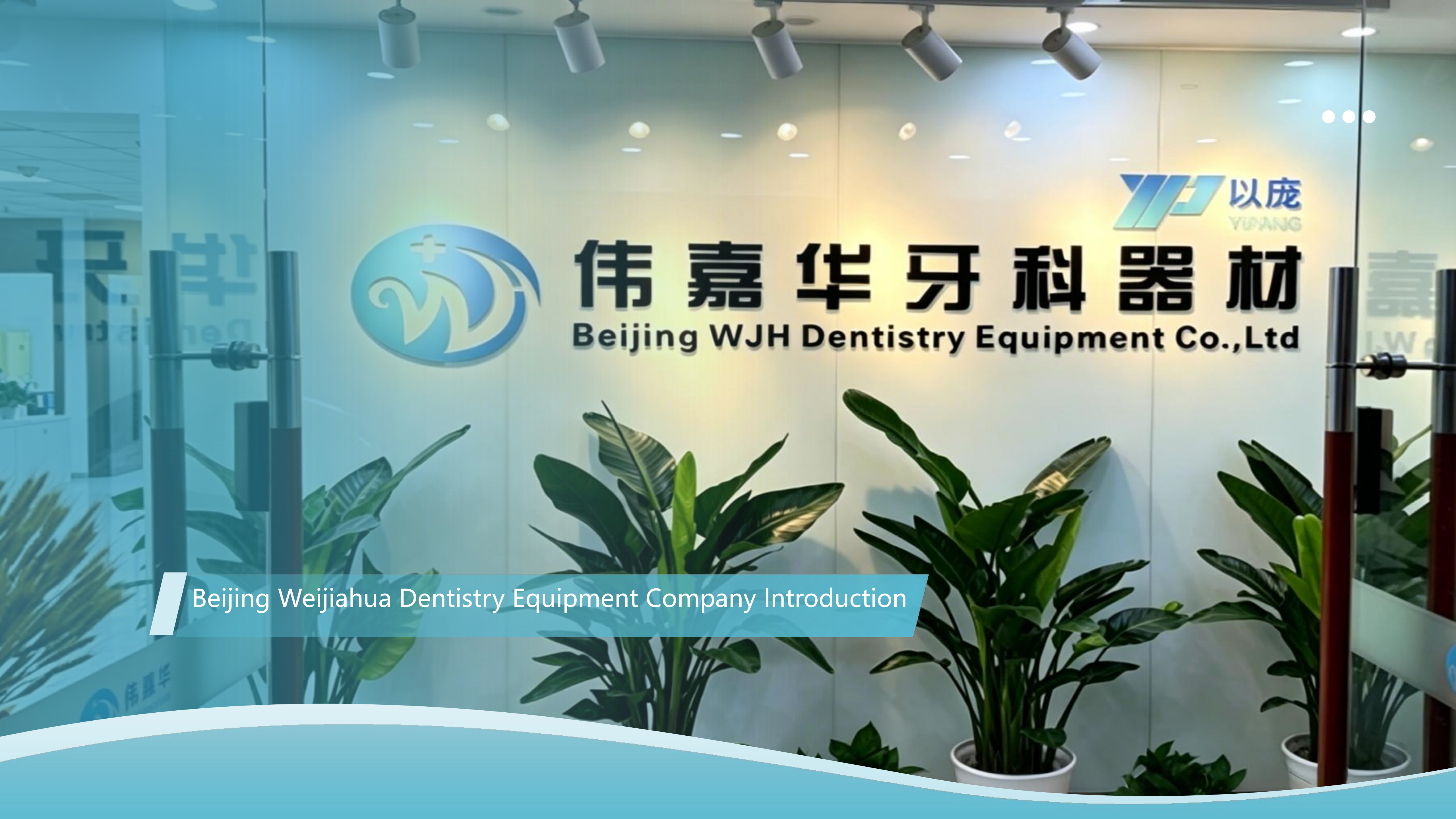
YIPANG is the dental materials brand of Beijing Weijiahua Dentistry Equipment Co., Ltd. For the certification documents, the product specification sheet, a sample or a quotation for 4D-PRO-ML zirconia blocks, contact the team directly.
Email: service@yipangdental.com
Tel / WhatsApp: +86 158-0156-5064
Website: www.yipangdental.com
Address: Room 603, Tower A, Building 1, No. 22A Dongsishitiao, Dongcheng District, Beijing, China
Company brochure (PDF, open access): WJH Company Information
Have Questions or Need More Details?
Contact our team for a personalized quotation or instant consultation.
Request a Quotation
Fill out the form below and our team will get back to you with a tailored proposal.
WhatsApp Direct Chat
Prefer to chat in real-time? Message us on WhatsApp for instant assistance & quick answers.
- Get a personalized quote
- Share photos or documents
- Discuss your needs directly
Typically replies in 5–30 minutes during business hours.