Dental Zirconia Block Specs and ISO 13485: A Lab Evaluation Checklist
Selecting a dental zirconia block is usually presented as a question of shade or price. For a CAD/CAM lab already in the Research or Evaluation phase, the more practical question is narrower: does the block satisfy the certification, dimensional and sintering constraints of your workflow? This article uses YIPANG 4D-PRO-ML as a documented example to show how labs can read a zirconia blank datasheet and what to verify before making a larger purchase order.
Why the Buying Decision Often Fails After Sintering
Chipping and cracks after zirconia sintering are common quality concerns in dental laboratories. In the risk documentation supplied by the YIPANG product team, these failures are linked to two main sources: an improper sintering profile and internal defects inside the zirconia blank. The recommended mitigation is to follow the sintering profile and inspect blanks before sintering, and to separate or scrap any blank that is already chipped or cracked.
This scenario is not simply a processing problem. It is also a purchasing problem. If the lab buys a dental zirconia block without checking the sintering window, blank dimensions or traceable management-system certification, the risk is transferred from the supplier to the milling machine and ultimately to the final restoration.
Market and Regulatory Context for Dental Zirconia Discs
The global zirconia-based dental materials market was valued at USD 1.2 billion in 2025 and is projected to reach USD 2.3 billion by 2033. Within that market, zirconia discs held the largest revenue share at 63.1% in 2025. At the same time, CAD/CAM milling accounted for 82.4% of zirconia dental manufacturing revenue in 2025, and dental laboratories remained the dominant end-user with a 45.3% share.
These signals explain why labs are moving away from generic material sourcing toward more structured evaluation. In the European Union, Medical Device Regulation (EU) 2017/745 classifies most dental implants and restorative materials as high-risk, requiring intensive clinical data. Even where a zirconia block itself is not an implant, the regulatory environment raises the expectation that suppliers can provide traceable documentation for the materials used in dental restorations.
YIPANG 4D-PRO-ML: Compliance and Parameter File
YIPANG is a self-developed brand owned by Beijing Weijiahua Dentistry Equipment Co., Ltd., a Beijing-based dental equipment manufacturer and agent. The brand operates within WJH's broader dental product system, which includes zirconia blocks, glass ceramics, press ingots, PMMA blanks, milling machines, 3D printers and related dental laboratory equipment.
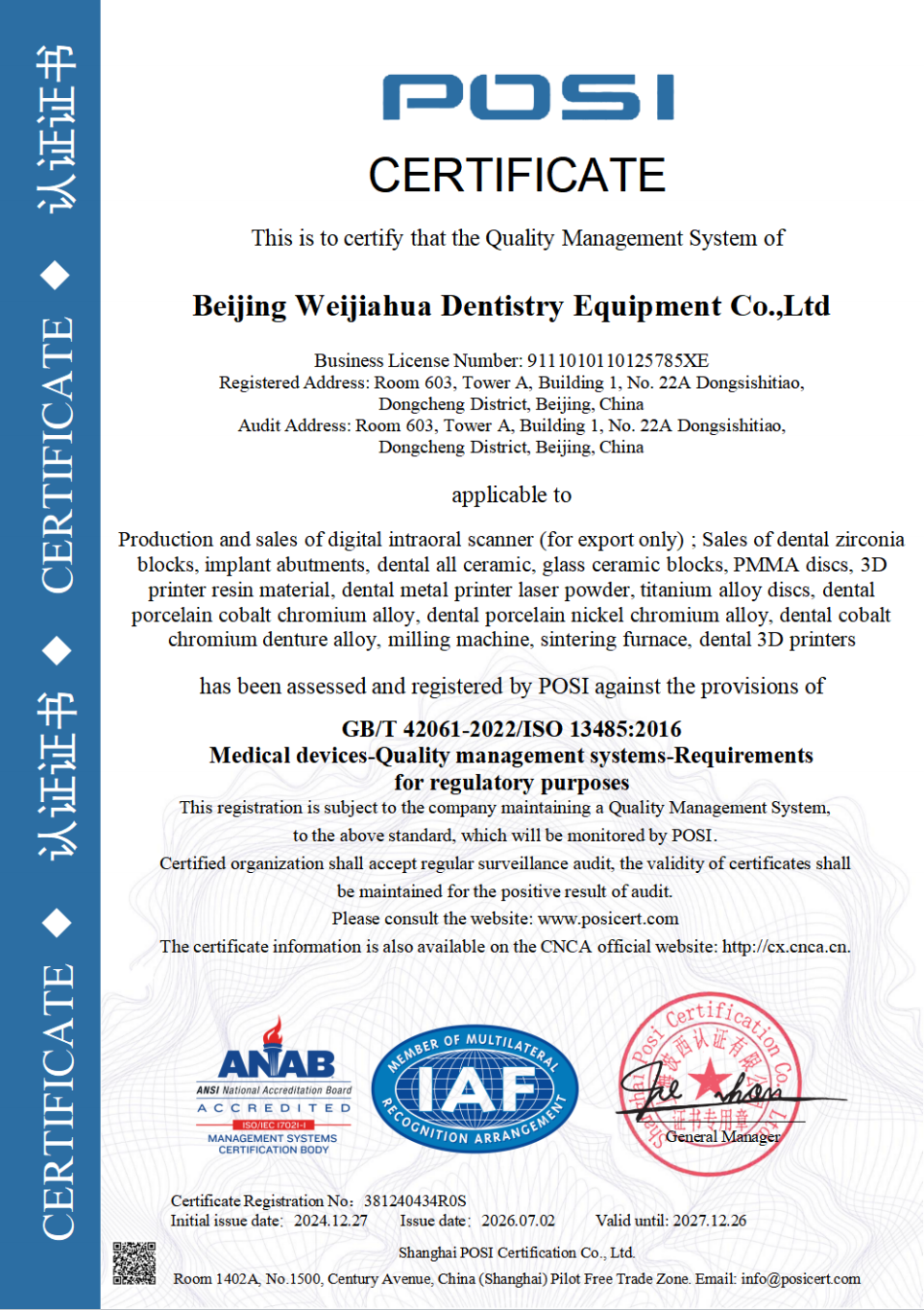
For a compliance-first buyer, the relevant starting point for the 4D-PRO-ML zirconia block is the ISO 13485 certificate. The Zirconia Blocks for Dental Prosthesis product is certified to ISO 13485:2016. The certificate number is 381240434R0S, and it was issued by Shanghai POSI Certification Co., Ltd. The applicable standard is GB/T 42061-2022 / ISO 13485:2016. The certification scope covers the design, production and sales of dental medical materials and dental equipment. The certificate record is valid from 27 December 2024 to 26 December 2027 and applies to Global, EU, USA and Middle East markets.
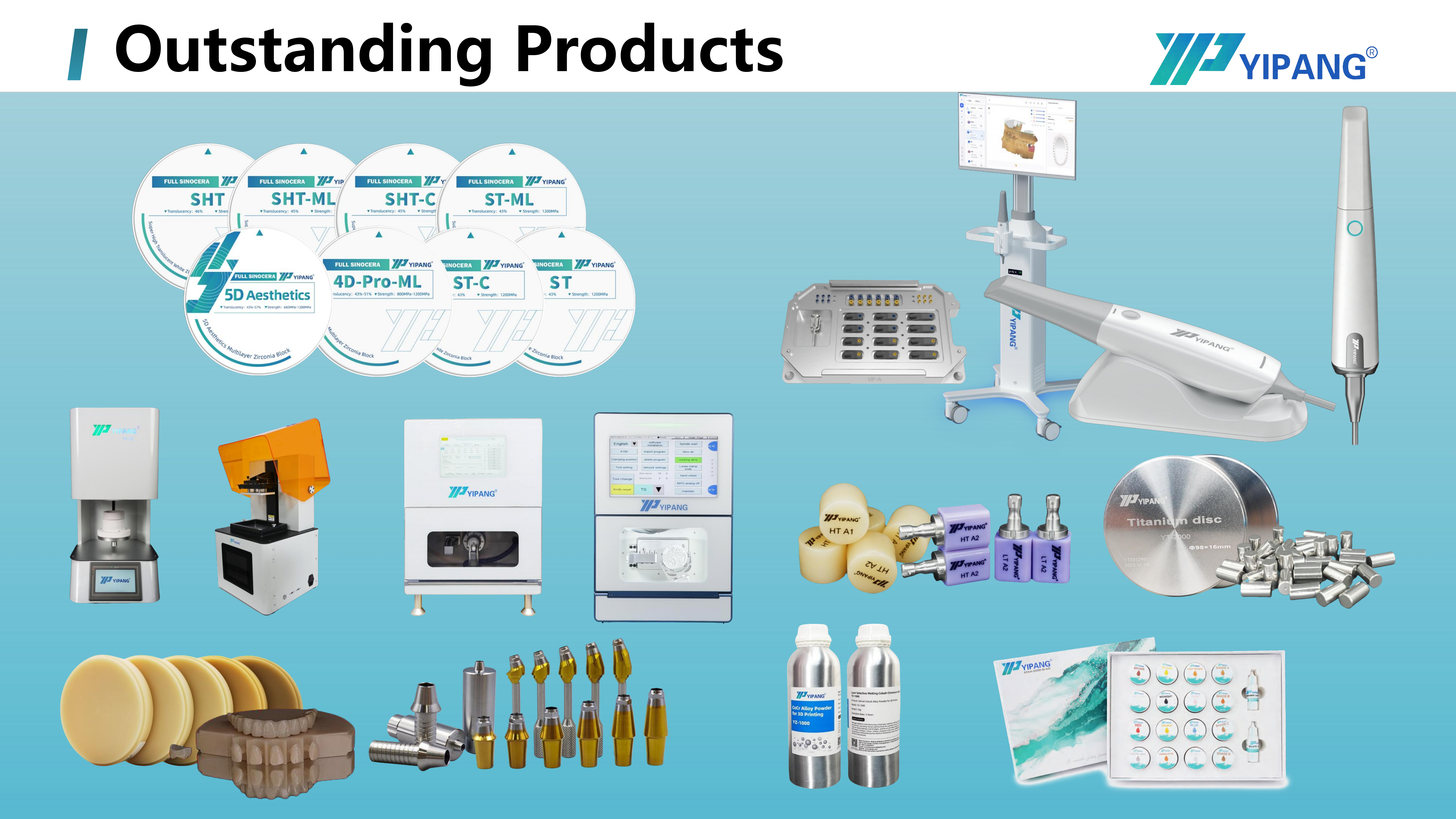
YIPANG 4D-PRO-ML is positioned as a dental zirconia disc for CAD/CAM dental milling workflows.
The main product parameters are shown below.
| Parameter | YIPANG 4D-PRO-ML evidence |
|---|---|
| Product classification | Dental Zirconia Disc / CAD/CAM Dental Milling Blank |
| Material | Zirconium dioxide (ZrO2) with yttria stabilization |
| Available shades | ML multilayer |
| Diameter | 98 mm |
| Thickness | 10 mm, 12 mm, 14 mm, 16 mm, 18 mm, 20 mm |
| Sintering temperature | 1450°C (technical guidance recommends 1430°C–1450°C) |
| Bending strength | ≥1200 MPa |
| Translucency | Medium translucent |
| Machine compatibility | Compatible with most mainstream dental milling machines |
| Typical applications | Full-contour crowns, bridges, veneers and implant superstructure restorations |
A bending strength of at least 1200 MPa gives the material headroom for high-load posterior restorations and multi-unit bridge work. The medium translucent profile and multilayer shade structure support natural color transitions while keeping the material practical for laboratory production. The 98 mm diameter and thickness range from 10 mm to 20 mm allow a lab to select a blank size compatible with the restoration height and nesting strategy used in CAM software.
Six Evaluation Steps Before You Standardise a Zirconia Blank
1. Confirm the certification scope, not only the certificate name
A supplier may claim ISO compliance without showing what the certificate covers. For YIPANG 4D-PRO-ML, the ISO 13485 certificate scope includes the design, production and sales of dental medical materials and dental equipment. This is a broader statement than a simple product sticker. Ask for the certificate number, issuing body and applicable markets when you qualify a dental zirconia block supplier.
2. Review the disc geometry against your milling machine
The 4D-PRO-ML is supplied as a 98 mm diameter disc, with thicknesses of 10 mm, 12 mm, 14 mm, 16 mm, 18 mm and 20 mm. Verify that your dental milling machine, holder and CAM nesting parameters accept the selected blank size before you place the order.
3. Map the sintering profile to your furnace
The product parameter table lists a sintering temperature of 1450°C. The technical guidance for 4D-PRO-ML describes a recommended range of 1430°C–1450°C and expects the user to follow a standard heating and holding procedure. Avoid rapid temperature changes during sintering, and do not exceed the maximum sintering temperature.
4. Inspect blanks before milling and sintering
Risk guidance for this material recommends inspecting zirconia blanks before sintering and scrapping any blank with chips or cracks. Even a well-specified dental zirconia block should not be used if the blank has visible damage before entering the workflow.
5. Run a pilot case through the full workflow
Before scaling up, machine a test crown or bridge through your dental lab scanner, dental milling machine and sintering furnace. Evaluate the shade transition, marginal fit and sintering behavior. A pilot run will expose whether the material parameters are compatible with your laboratory's actual process settings.
6. Validate supply terms and quality control
YIPANG supports OEM/ODM production, and almost all specifications can be customized. The stated monthly capacity is 15,000 pieces, and the lead time is 15–30 working days. Quality control includes 100% raw material inspection and finished product random inspection. For labs or distributors, the MOQ is described as negotiable and can be kept small.
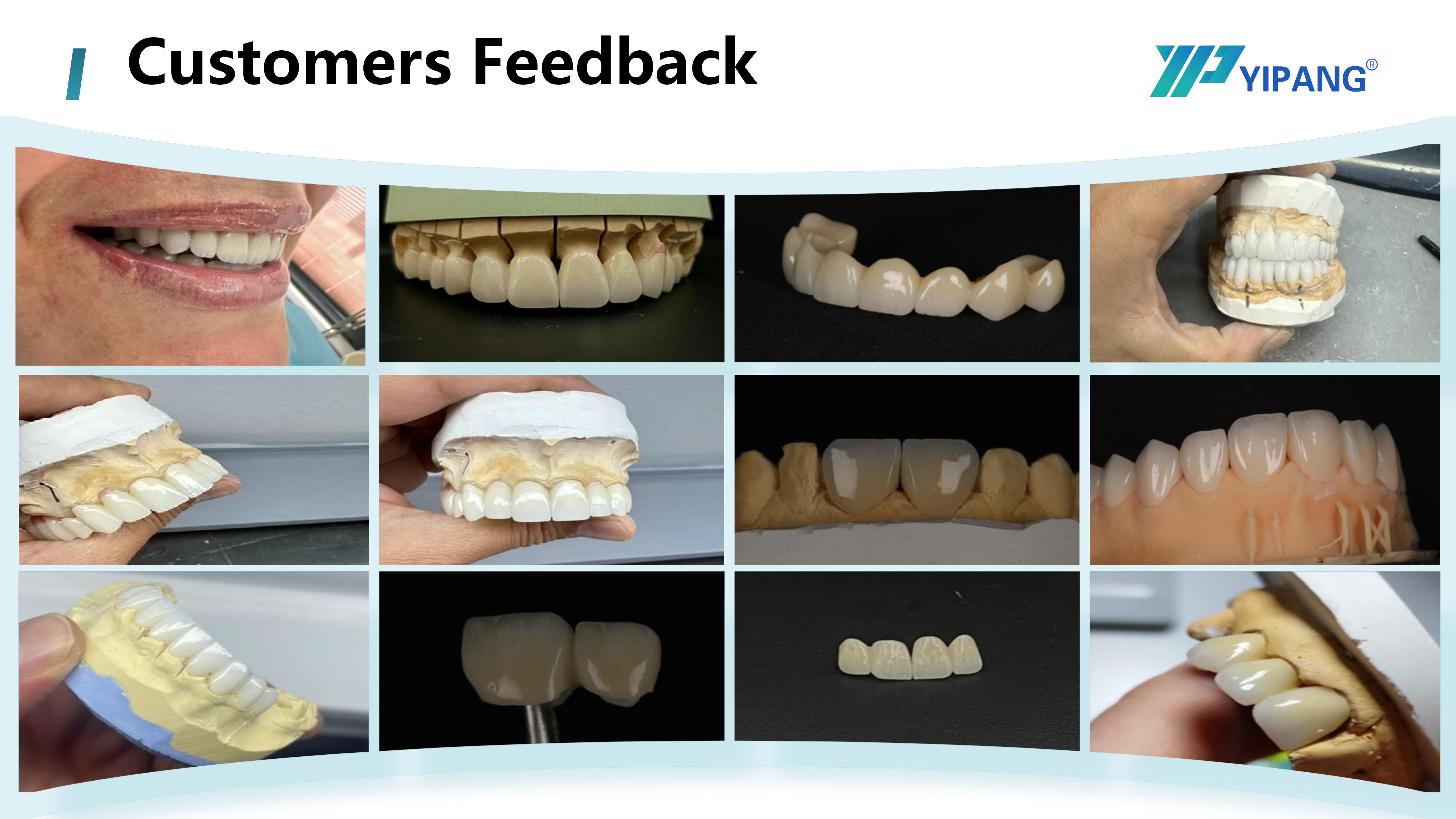
Zirconia block quality control is part of the supplier evaluation for dental CAD/CAM labs.
Use Case Fit for Labs and Milling Centres
- Restorative production: The material is designed for full-contour crowns, bridges, veneers and implant superstructure restorations. These are the core products of most dental laboratories and CAD/CAM milling centres.
- High-volume crown and bridge work: Knowledge guidance describes 4D-PRO-ML as suitable for high-volume dental labs, especially for posterior crowns and multi-unit bridges where mechanical strength and aesthetic performance need to be balanced.
- Open CAD/CAM workflows: The product is compatible with most mainstream dental milling machines. Its processing route uses dental lab scanners, dental milling machines and dental sintering furnaces, making it a practical candidate for labs that do not want to be locked into one closed proprietary system.
- Custom batch supply: For labs or distributors that want to standardise under their own brand, YIPANG offers OEM/ODM with customisable specifications and a negotiable small MOQ.
WJH and the YIPANG product line have hundreds of long-term cooperative clients worldwide, including dental laboratories, clinics and distributors. In the documented case feedback, the most frequently recognised points are material stability, aesthetic effect and compatibility with most CAD/CAM systems.
Evaluation Checklist for Any Dental Zirconia Block
Use the following table when comparing a dental zirconia block against your lab's constraints.
| Checkpoint | Why it matters | YIPANG 4D-PRO-ML evidence |
|---|---|---|
| ISO 13485 certification | Confirms that design, production and sales are managed under a quality system for dental materials | Certificate number 381240434R0S issued by Shanghai POSI Certification Co., Ltd. |
| Certification scope | Prevents mismatches between what is certified and what is actually supplied | Design, production and sales of dental medical materials and dental equipment |
| Material composition | Zirconia chemistry influences strength, ageing resistance and sintering behaviour | Yttria-stabilized zirconium dioxide |
| Blank dimensions | Milling centres need a blank that fits the machine holder and case height | 98 mm diameter; 10–20 mm thickness range |
| Sintering profile | An incompatible sintering curve causes cracks or distorted restorations | Product parameter: 1450°C; technical guidance: 1430°C–1450°C |
| Mechanical strength | Determines suitability for posterior and multi-unit indications | Bending strength ≥1200 MPa |
| Translucency and shade | Affects natural appearance and layering ability | Medium translucent; ML multilayer shade |
| Machine compatibility | Reduces integration risk in mixed CAD/CAM environments | Compatible with most mainstream dental milling machines |
| OEM and supply terms | Matters for distributors, chain labs or brands planning custom packaging | OEM/ODM; small negotiable MOQ; 15–30 working days lead time |
Dental Zirconia Block FAQ
Is the YIPANG 4D-PRO-ML dental zirconia block ISO 13485 certified?
Yes. The Zirconia Blocks for Dental Prosthesis product is certified to ISO 13485:2016. The certificate number is 381240434R0S, issued by Shanghai POSI Certification Co., Ltd. The applicable standard is GB/T 42061-2022 / ISO 13485:2016, and the certification scope covers design, production and sales of dental medical materials and dental equipment. The certificate is applicable to Global, EU, USA and Middle East markets.
What sintering temperature should a lab use for the YIPANG 4D-PRO-ML block?
The product parameter table lists a sintering temperature of 1450°C. Technical guidance for this zirconia block recommends heating to 1430°C–1450°C with proper holding time, followed by natural cooling. Rapid temperature changes should be avoided, and the maximum sintering temperature should not be exceeded.
What blank sizes are available for the YIPANG 4D-PRO-ML zirconia block?
The 4D-PRO-ML line is supplied as 98 mm diameter discs. Thickness options are 10 mm, 12 mm, 14 mm, 16 mm, 18 mm and 20 mm. The available shade option is ML multilayer, and the material is yttria-stabilized zirconium dioxide.
Can a lab request a small trial order before committing to a larger zirconia block order?
YIPANG supports OEM/ODM production and states that almost all specifications can be customized. The MOQ is negotiable and can be kept small, while the monthly capacity is 15,000 pieces. This makes small trial orders or phased scaling feasible before a lab standardises the block in production.
What lead time should be expected for dental zirconia block orders?
The stated lead time is 15–30 working days. YIPANG also provides online technical guidance and responds to after-sales problems within 24 hours. For detailed specification management and trial order planning, contact the YIPANG team through the company website or service email below.
Final Evaluation Logic
Buying a dental zirconia block is not only about price or shade. It is about matching documented constraints: certification scope, blank dimensions, sintering temperature, mechanical strength, translucency and the supplier's ability to support production. YIPANG 4D-PRO-ML is an example of a product where these constraints are visible in the specification and the certification record.
Next step for labs: Before standardising a block, request the specification sheet, verify the ISO 13485 certificate number and run a pilot case through your own mill and sintering furnace. For the YIPANG company brochure or a direct inquiry, contact service@yipangdental.com or download the WJH company information brochure. More company details are available at www.yipangdental.com.
Have Questions or Need More Details?
Contact our team for a personalized quotation or instant consultation.
Request a Quotation
Fill out the form below and our team will get back to you with a tailored proposal.
WhatsApp Direct Chat
Prefer to chat in real-time? Message us on WhatsApp for instant assistance & quick answers.
- Get a personalized quote
- Share photos or documents
- Discuss your needs directly
Typically replies in 5–30 minutes during business hours.