
Dental Zirconia Block Supplier Evaluation for Full-Arch Labs

Direct answer: a dental zirconia block supplier should be evaluated as a production partner, not as a line on a price sheet. Laboratories producing multi-unit bridges and full-arch implant superstructures need four things verified before the first order: certification that names the product, a block specification that covers the span, a documented milling and sintering workflow, and delivery commitments written into the terms. YIPANG, the self-developed dental materials brand of Beijing Weijiahua Dentistry Equipment Co., Ltd., a Beijing-based dental equipment and materials company established in 1996, publishes these points for its 4D-PRO-ML zirconia block: ISO 13485:2016 certification number 381240434R0S, a 98 mm disc format, a bending strength of ≥1200 MPa, sintering at 1450 °C, and a lead time of 15–30 working days.
Price comparison is the easiest part of supplier selection and the least predictive of outcome. Two blocks can share a unit price and behave completely differently once a twelve-unit bridge enters the sintering furnace. The variables that actually decide whether a full-arch case ships on schedule are process-related: how the blank behaves across a long span, whether the sintering curve is documented, whether the lab's existing dental milling machine and dental sintering furnace are compatible, and whether the supplier can hold a delivery date across repeated orders.
This guide sets out a supplier evaluation framework built around delivery assurance for span work. It covers how laboratories select zirconia blocks, which purchasing terms and acceptance criteria should be confirmed in writing, and how to verify that a supplier genuinely supports CAD/CAM milling and sintering workflows rather than simply shipping discs.
Problem Definition: why span work exposes weaknesses that single crowns hide
A single-unit crown tolerates small process variation. A multi-unit bridge or a full-arch framework does not, because the entire span is milled from one blank and sintered in one cycle. Every unit in that span inherits the same shrinkage behaviour, the same shade lot and the same sintering history. When a unit fails, the lab does not lose one crown — it loses the whole framework, the milling time, the sinter cycle and the scheduled seat date.
Four failure modes dominate in span production, and each maps directly to a supplier attribute that can be checked before purchase:
- Non-uniform shrinkage across a long span. Distortion shows up as marginal gaps at the distal ends of a bridge, where the accumulated error is greatest. The check is whether the supplier states low shrinkage after sintering and stable sintering shrinkage, and whether it can show dimensional accuracy data rather than a general claim.
- Translucency mismatch between units. In a multi-unit aesthetic case, a visible gradient step between units is harder to correct than a shade error on a single crown. The check is whether the shade system is a graded multilayer and whether the supplier describes uniform translucency.
- Sintering curve deviation. A curve that ramps too fast, holds too briefly or overshoots the maximum temperature can crack or over-fire a full-arch framework. The check is whether the supplier publishes the temperature range and the handling rules, not only a single number.
- Delivery slippage. Full-arch work is scheduled against surgical dates and prosthetic appointments. A late block is not an inconvenience; it is a rescheduled patient.
The supplier's own process statement is the natural starting point for evaluation. For the 4D-PRO-ML zirconia block, the published application data describes an indoor constant-temperature dental laboratory environment, processing on a dental milling machine, sintering in a dental sintering furnace, matched equipment listed as dental milling machine, dental sintering furnace and dental lab scanner, and a stated special requirement to strictly follow the standard sintering temperature curve during processing. That sentence is the anchor for everything that follows: if a supplier cannot describe the working conditions of its own material, it cannot assure delivery on cases that depend on those conditions.
Industry Background: why documentation became a purchasing criterion
Zirconia is no longer a specialist material chosen by a few aesthetic-focused laboratories; it is the default framework material in most CAD/CAM workflows. According to Grand View Research, zirconia discs held the largest revenue share of 63.1% in the zirconia-based dental materials market in 2025, and CAD/CAM milling accounted for 82.4% of the zirconia dental manufacturing process revenue in the same year. The same source reports that dental laboratories remain the dominant end user, at 45.3% of market share in 2025, and that 3Y-TZP zirconia grade held the largest revenue share at 35.9%.
The regulatory direction reinforces the same conclusion. The European Commission notes that EU Medical Device Regulation (MDR 2017/745) classifies most dental implants and restorative materials as high-risk, requiring intensive clinical data. For a laboratory buying blocks, the practical effect is that traceability, certificate scope and process documentation are now part of the purchase decision rather than an afterthought handled by a distributor.
Meanwhile, the equipment ecosystem around the block has widened. A modern laboratory typically runs a dental lab scanner or intraoral scanner for data capture, CAD software for design, a dental milling machine with dental milling burs for subtractive production, a dental sintering furnace for densification, and often a dental 3D printer with dental 3D printer resin for models, guides and try-ins. Some laboratories also work with dental lithium disilicate glass ceramic and dental lithium disilicate press ingot for aesthetic cases, or dental PMMA disc, dental PEEK disc and dental wax disc for provisionals and try-ins. Each additional material and device adds a compatibility question, which is precisely why supplier evaluation has shifted from material grade alone to workflow fit.
Detailed Solution: a four-gate evaluation framework
The framework below evaluates a dental zirconia block supplier in a fixed order, from the least negotiable to the most negotiable. Certification and specification are pass/fail; commercial terms are adjustable. Running the gates in this order prevents a favourable price from masking a documentation gap.
Gate 1 — Certification that names the product
A certificate on a website is not evidence. What matters is whether the certificate scope actually covers the product being purchased. YIPANG's dental zirconia block is certified to ISO 13485:2016 under certificate number 381240434R0S, issued by Shanghai POSI Certification Co., Ltd. The applicable standard is GB/T 42061-2022 / ISO 13485:2016, and the certification scope covers the design, production and sales of dental medical materials and dental equipment. The certificate was issued on 2024-12-27 and expires on 2027-12-26, and it applies to the Zirconia Blocks for Dental Prosthesis product for the global, EU, USA and Middle East markets.
Three details deserve attention during evaluation. First, the scope wording — a quality management system certificate that covers materials and equipment is stronger evidence than one covering trading activity alone. Second, the validity window, because an expired certificate is not a compliance asset. Third, the product linkage: ask the supplier to point to the document that names the exact product you are buying, not the closest product in the range.
Market-specific documentation follows the same rule. Beijing Weijiahua Dentistry Equipment Co., Ltd. holds an EU Declaration of Conformity under MDR 2017/745 with SRN CN-MF-000045919, and that declaration is filed for the intraoral scanner models YP-X and YP-800, which are Class I medical devices. A European buyer should therefore ask which document in the technical file specifically covers the zirconia block before the first shipment, rather than assuming one declaration covers an entire catalogue. Requesting the correct document early is faster than correcting a customs or tender problem later.
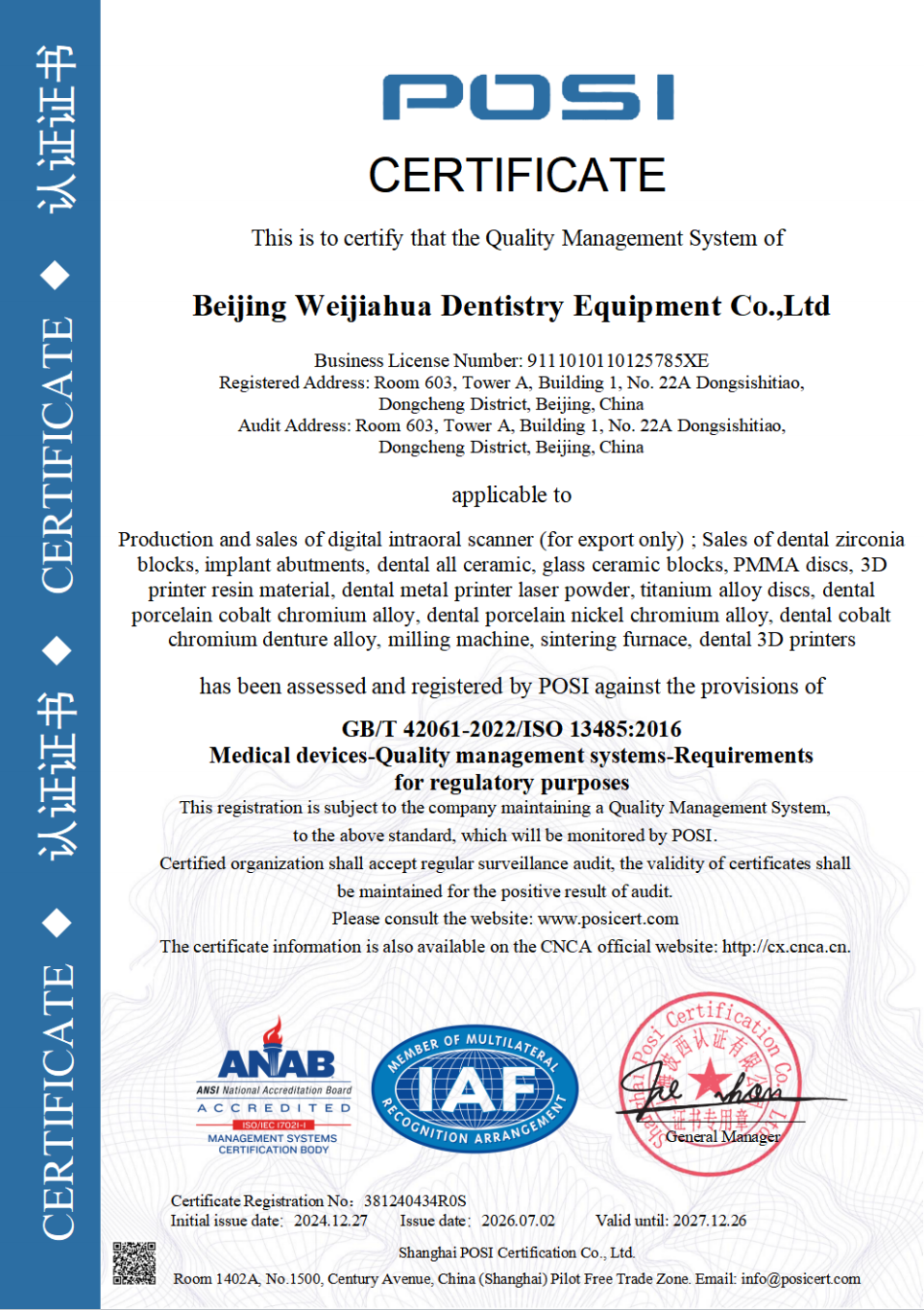
ISO 13485:2016 certificate 381240434R0S, issued by Shanghai POSI Certification Co., Ltd., valid from 2024-12-27 to 2027-12-26.
Gate 2 — Specification fit against the case type
The 4D-PRO-ML dental zirconia block is a CAD/CAM dental milling blank made of zirconium dioxide (ZrO₂) with an yttria stabilizer. It is supplied in ML multilayer shades with medium translucency, at a 98 mm diameter, in six thickness steps: 10 mm, 12 mm, 14 mm, 16 mm, 18 mm and 20 mm. The published bending strength is ≥1200 MPa, and the listed sintering temperature is 1450 °C.
For span work, the thickness range is the operative variable. A longer bridge or a full-arch framework needs a taller blank so that connector cross-sections and the incisal-to-cervical gradient can be nested without compromising either. A supplier that offers a single thickness forces the laboratory either to over-machine or to split the framework — both of which erode the delivery assurance the case depends on. Six thickness steps let a laboratory match the blank to the span instead of the reverse, and the 98 mm diameter keeps the blank within the standard CAM envelope used with most mainstream dental milling machines.
Strength should be read against intended use rather than as a standalone number. The product is described as suitable for full-contour crowns, bridges, veneers and implant superstructure restorations, with the stated function of fabricating aesthetic, durable dental prostheses to repair missing or damaged teeth. A printed strength figure tells a buyer what the material is specified to do; the intended-use list tells a buyer where the supplier is willing to defend it.
Gate 3 — Process compatibility, especially the sintering curve
The sintering curve is the single most common source of avoidable loss in span production, and it is also the easiest thing to confirm before purchase. The supplier's processing guidance for the 4D-PRO-ML block gives a recommended sintering temperature range of 1430 °C to 1450 °C, with a standard heating and holding procedure to guarantee low shrinkage and stable translucency. The procedural steps are: place the milled zirconia workpiece on the sintering tray; set the heating curve up to 1430–1450 °C with the proper holding time; and cool down naturally after sintering is complete. The stated safety rules are equally important — avoid rapid temperature change to prevent cracking, and do not exceed the maximum sintering temperature.
Compatibility is stated at the equipment level as well: the block is compatible with most mainstream dental milling machines, which is what allows it to be dropped into an existing CAD/CAM workflow without changing the mill. In practice a laboratory should verify three points with its own equipment before committing a full-arch case: that the CAM nesting for the span fits the selected blank thickness, that the toolpath and bur selection in the dental milling machine suit the blank's green state, and that the dental sintering furnace program reproduces the recommended curve with the laboratory's own thermocouple behaviour. The supplier's curve is the reference; the furnace is the laboratory's variable.
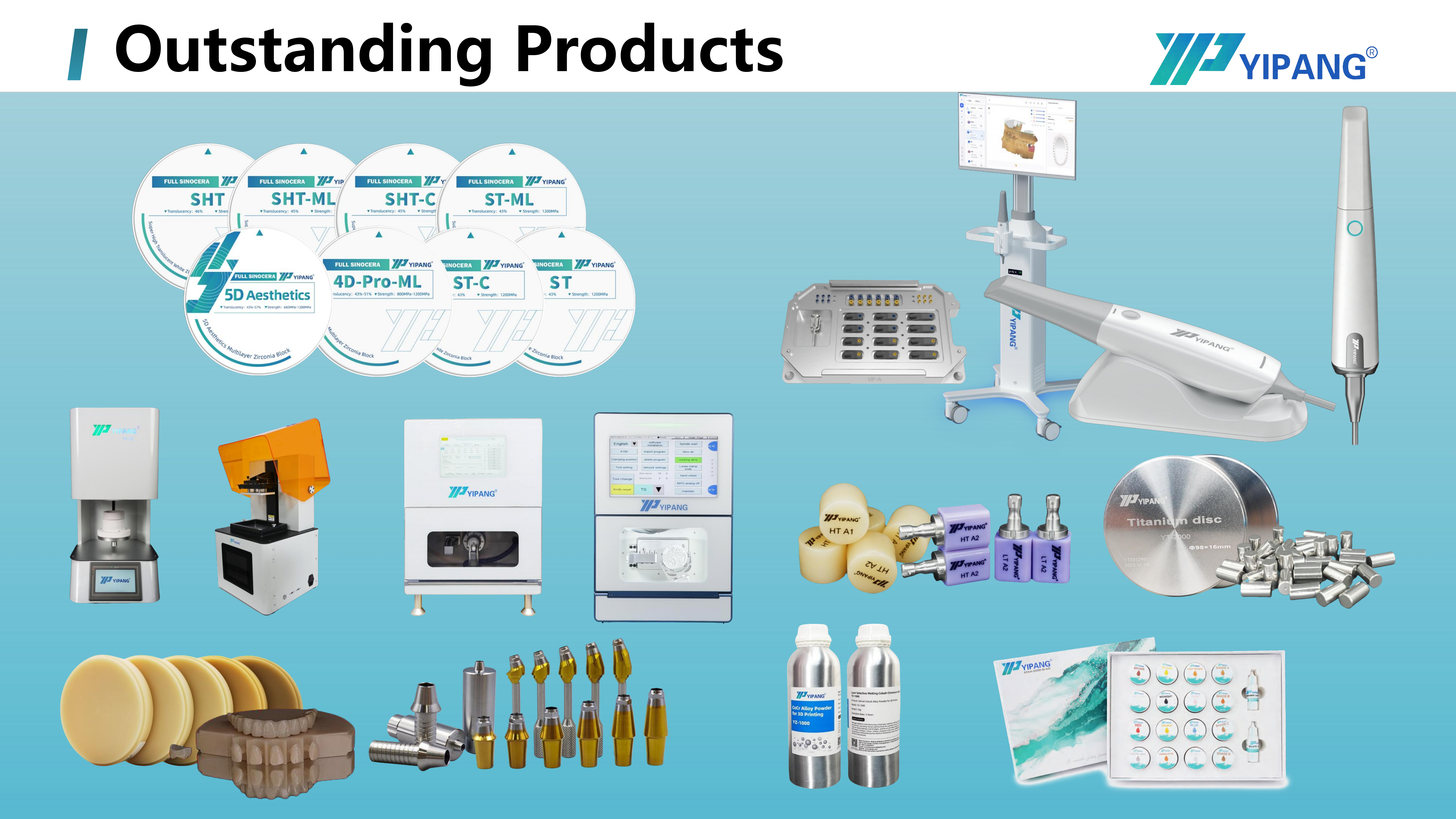
4D-PRO-ML dental zirconia block: 98 mm diameter, six thickness steps from 10 mm to 20 mm, ML multilayer shade, medium translucency.
Gate 4 — Delivery, capacity and commercial terms
Delivery assurance is a manufacturing question before it is a logistics question. YIPANG's stated production capability for this product line includes a monthly capacity of 15,000 pieces and a lead time of 15–30 working days, with a negotiable small MOQ, OEM/ODM production mode and customization available on almost all specifications. Quality control is described as 100% raw material inspection plus finished product random inspection, and after-sales support as online technical guidance with a response to after-sales problems within 24 hours.
The company context matters when assessing whether those numbers are plausible. Beijing Weijiahua Dentistry Equipment Co., Ltd. was established in 1996 and operates a 2,000 ㎡ facility with 80 employees, an annual output of 10 million US dollars and a 25-engineer R&D team engaged in dental material formula research, process optimization and new product development. Exports account for 40%–55% of business, across the Middle East, Southeast Asia, South America, North America, Eastern Europe, North Africa and Australia. The company serves more than 1,000 dental laboratory customers in China and has a distribution history with international brands including VITA, Ivoclar, Dentsply, Amann Girrbach and Noritake — relevant because a supplier that has handled other manufacturers' materials tends to understand cross-equipment compatibility questions.
On the customer side, the company reports hundreds of long-term cooperative clients worldwide, with high recognition on material stability and aesthetic effect and a low customer complaint rate, and highlights uniform translucency, stable sintering shrinkage and compatibility with most CAD/CAM systems. These are supplier-reported indicators and should be treated as such — useful as a starting hypothesis, replaceable by the laboratory's own trial data.
Step-by-Step Breakdown: qualifying a supplier for span work
- Define the case mix and the blank envelope. List the longest bridge and the largest full-arch framework the laboratory expects to produce in the next twelve months. Convert those into a required blank diameter and thickness before contacting any supplier. With a 98 mm diameter and thickness options from 10 mm to 20 mm, the 4D-PRO-ML range can be mapped against that envelope in a single conversation.
- Verify the certificate, then verify its scope. Request the ISO 13485:2016 certificate as a document, not a thumbnail: certificate number 381240434R0S, issuer Shanghai POSI Certification Co., Ltd., standard GB/T 42061-2022 / ISO 13485:2016, validity 2024-12-27 to 2027-12-26, scope covering design, production and sales of dental medical materials and dental equipment. Confirm in writing that the certificate applies to the specific block you are ordering.
- Confirm the market documentation separately. For EU shipments, establish which document covers the block itself. The EU Declaration of Conformity under MDR 2017/745 filed by Beijing Weijiahua Dentistry Equipment Co., Ltd. (SRN: CN-MF-000045919) is listed for the intraoral scanner models YP-X and YP-800, Class I medical devices, so the block-specific document should be requested explicitly.
- Request the sintering curve in writing. Obtain the recommended range (1430–1450 °C for the 4D-PRO-ML block), the heating and holding procedure, and the stated safety limits on temperature change and maximum temperature. Then run the curve on your own dental sintering furnace with a scrap span to confirm the furnace reproduces it.
- Confirm CAM and milling compatibility. Check that the blank format loads into your dental milling machine, that your nesting software accepts the 98 mm disc geometry, and that your bur strategy suits the material. The supplier states compatibility with most mainstream dental milling machines; the laboratory's obligation is to confirm it on its own equipment.
- Qualify with a production-representative sample. Do not approve a supplier on a single crown. Mill and sinter the longest span you routinely produce, then measure marginal adaptation at the extremes of the span, check the translucency gradient across units and confirm shade consistency. Record the sinter program used so that the result is reproducible.
- Write acceptance criteria into the purchasing terms. State what counts as a conforming delivery: thickness and diameter tolerance, shade designation, absence of visible defects, batch consistency across a repeat order, and the documentation that must accompany each shipment. Reference the certificate number and the sintering recommendation so the terms are anchored to documents rather than verbal assurances.
- Fix the delivery and support path. Confirm the lead time (15–30 working days for this line), the monthly capacity behind it (15,000 pieces), the MOQ arrangement (negotiable small MOQ) and the escalation route for technical problems (online technical guidance, response within 24 hours). For full-arch programmes, agree a buffer quantity so a single failed sinter cycle does not move a surgical date.
Use Cases: where the framework changes shape
Multi-unit bridge laboratory
The dominant risk is shrinkage consistency across the span, not strength. Prioritise the low-shrinkage statement, the dimensional accuracy claim and the sintering curve documentation. Thickness selection should follow the connector height required by the span; a taller blank is usually cheaper than a remake.
Full-arch implant laboratory
Here the block becomes part of a larger system that includes scanbodies, abutments and the surgical schedule. The 4D-PRO-ML block is described as suitable for implant superstructure restorations, and its role in the workflow is to be milled on a dental milling machine and sintered in a dental sintering furnace after the framework geometry has been designed from scan data. Delivery assurance dominates: a 15–30 working day lead time must be planned against the surgical calendar, with buffer stock held for the frameworks that cannot slip.
Aesthetic anterior and veneer work
Graded multilayer material with medium translucency supports full-contour crowns, bridges and veneers where the shade gradient carries the aesthetic result. In these cases the acceptance criterion shifts from strength to shade consistency across units and to the stability of the gradient after sintering, which is why uniform translucency is worth testing on a sample rather than accepting on description.
Mixed digital laboratory or distributor
Laboratories running scanners, milling machines and dental 3D printers in parallel — using dental 3D printer resin for models or dental wax disc and dental PMMA disc for provisionals — value suppliers who can discuss the whole workflow rather than one SKU. For distributors, OEM/ODM availability, customization on almost all specifications and a negotiable small MOQ make it possible to build a local range without holding excessive stock of a single thickness.
Comparison Table: criteria, evidence and documented status
The table below converts the four gates into a checklist a purchasing team can run against any dental zirconia block supplier. The right-hand column shows the documented position for the 4D-PRO-ML block.
| Evaluation criterion | Evidence to request | Documented status (4D-PRO-ML) |
|---|---|---|
| Quality system certification | Certificate copy with scope and validity | ISO 13485:2016, no. 381240434R0S, Shanghai POSI Certification Co., Ltd., valid 2024-12-27 to 2027-12-26 |
| Market documentation | Which document names the block for the target market | EU Declaration of Conformity under MDR 2017/745 (SRN: CN-MF-000045919) is filed for intraoral scanner YP-X / YP-800; block-specific document to be requested |
| Strength and format | Bending strength, diameter, thickness range | ≥1200 MPa; 98 mm diameter; 10/12/14/16/18/20 mm thickness |
| Aesthetics | Shade system and translucency class | ML multilayer; medium translucent |
| Sintering control | Temperature range, holding procedure, safety limits | 1450 °C listed in specification; recommended range 1430–1450 °C with standard heating and holding |
| Equipment compatibility | Confirmed mill and furnace compatibility | Compatible with most mainstream dental milling machines |
| Delivery | Lead time and monthly capacity | 15–30 working days; 15,000 pieces per month |
| Commercial flexibility | MOQ, OEM/ODM, customization | Negotiable small MOQ; OEM/ODM; almost all specifications customizable |
| Quality control | Inspection regime | 100% raw material inspection plus finished product random inspection |
| Technical support | Response path and time | Online technical guidance; response within 24 hours |
Specification reference
| Product | Zirconia Blocks for Dental Prosthesis (model 4D-PRO-ML) |
| Type | Dental zirconia disc, CAD/CAM dental milling blank |
| Material | Zirconium dioxide (ZrO₂) with yttria stabilizer |
| Shades | ML multilayer |
| Thickness | 10 mm, 12 mm, 14 mm, 16 mm, 18 mm, 20 mm |
| Diameter | 98 mm |
| Sintering temperature | 1450 °C (recommended range 1430–1450 °C) |
| Bending strength | ≥1200 MPa |
| Translucency | Medium translucent |
| Intended applications | Full-contour crowns, bridges, veneers and implant superstructure restorations |
| Working environment | Indoor constant-temperature dental laboratory; milled on a dental milling machine and sintered in a dental sintering furnace |
FAQ
Which certification should a dental lab verify before approving a zirconia block supplier?
Verify an ISO 13485:2016 certificate whose scope names the product you are buying. YIPANG's dental zirconia block is certified to ISO 13485:2016 under certificate number 381240434R0S, issued by Shanghai POSI Certification Co., Ltd., against the standard GB/T 42061-2022 / ISO 13485:2016, with a scope covering the design, production and sales of dental medical materials and dental equipment, valid from 2024-12-27 to 2027-12-26 for the global, EU, USA and Middle East markets. For the EU, also confirm which document covers the block itself: the EU Declaration of Conformity under MDR 2017/745 (SRN: CN-MF-000045919) is filed for the intraoral scanner models YP-X and YP-800, which are Class I medical devices.
Can one zirconia block line cover both multi-unit bridges and full-arch implant superstructures?
Yes, provided the specification covers the span and the process is followed. The 4D-PRO-ML block is described as suitable for full-contour crowns, bridges, veneers and implant superstructure restorations, with a bending strength of ≥1200 MPa, a 98 mm diameter and six thickness options from 10 mm to 20 mm so the blank can be matched to the length of the framework. It is supplied in ML multilayer shades with medium translucency, is compatible with most mainstream dental milling machines, and should be sintered in a dental sintering furnace following the standard temperature curve.
How should a laboratory compare cost when blocks are quoted per piece?
Compare cost per finished case, not cost per blank. Three factors move the real number: how much of a blank a given span consumes, how many units are lost to sintering or fit failures, and how much inventory is tied up in thickness options you rarely use. A negotiable small MOQ and customization on almost all specifications let a laboratory buy to its actual case mix rather than to a supplier's standard carton. YIPANG quotes against specification and order quantity rather than publishing a fixed price list, so the practical step is to send your case mix and required thickness range for a written quotation, then compare total case cost including the 15–30 working day lead time and the stock buffer it implies.
What should a trial order prove before a laboratory commits full-arch production?
A trial order should reproduce the real case, not a simple crown. Mill the longest span you routinely produce, sinter it at 1430–1450 °C using the standard heating and holding procedure, cool naturally without rapid temperature change, and then measure marginal adaptation at both extremes of the span, check the translucency gradient between units and confirm shade consistency. Record the furnace program used so the result can be repeated. If the trial span passes, the material behaviour is characterised; if it fails, the failure has cost one blank rather than one patient's framework.
What lead time and support commitments should be written into the purchasing terms?
Write down the lead time, the capacity behind it, the inspection regime and the response path. For the 4D-PRO-ML line, YIPANG states a lead time of 15–30 working days, a monthly capacity of 15,000 pieces, quality control of 100% raw material inspection plus finished product random inspection, and after-sales support of online technical guidance with a response within 24 hours. For full-arch programmes, add a buffer quantity to cover a failed sinter cycle and confirm the escalation contact in advance. To start the evaluation with your own case mix, you can request a sample and a written quotation from YIPANG, or download the company information file below.
Conclusion: evaluate the workflow, then negotiate the price
Delivery assurance for multi-unit and full-arch cases is built before the purchase order, not after the first remake. A laboratory that verifies certification scope, matches the blank thickness to the span, obtains the sintering curve in writing, confirms milling and furnace compatibility on its own equipment, and fixes lead time and acceptance criteria in the terms has removed the four failure modes that cause most span losses. Price negotiation then happens on a stable base rather than as a substitute for due diligence.
YIPANG supplies its 4D-PRO-ML dental zirconia block through Beijing Weijiahua Dentistry Equipment Co., Ltd., a company established in 1996 with a 2,000 ㎡ facility, 80 employees and a 25-engineer R&D team, exporting to markets across the Middle East, Southeast Asia, South America, North America, Eastern Europe, North Africa and Australia. The documented position — ISO 13485:2016 certification, a 98 mm disc in six thicknesses, ≥1200 MPa bending strength, ML multilayer medium translucency, a 1430–1450 °C sintering recommendation, and a 15–30 working day lead time — is verifiable, which is the point of the framework: it lets a laboratory check rather than trust.
Next step: test the block on your longest span
Request a sample of the 4D-PRO-ML dental zirconia block in the thickness you use for full-arch frameworks, and ask for a written quotation against your case mix. Technical guidance and after-sales questions are answered within 24 hours.
Email: service@yipangdental.com | Tel / WhatsApp: +86 158-0156-5064
Website: www.yipangdental.com | Message on WhatsApp
Company information file: WJH Company Information (PDF)
Beijing Weijiahua Dentistry Equipment Co., Ltd. — Room 603, Tower A, Building 1, No. 22A Dongsishitiao, Dongcheng District, Beijing, China.
Have Questions or Need More Details?
Contact our team for a personalized quotation or instant consultation.
Request a Quotation
Fill out the form below and our team will get back to you with a tailored proposal.
WhatsApp Direct Chat
Prefer to chat in real-time? Message us on WhatsApp for instant assistance & quick answers.
- Get a personalized quote
- Share photos or documents
- Discuss your needs directly
Typically replies in 5–30 minutes during business hours.