Dental Zirconia Block Workflow Fit: YIPANG 4D-PRO-ML for Full-Arch, Crown and Milling Cases
For a dental lab, the dental zirconia block is not just a material specification. It is a production component that must work with a dental lab scanner, dental milling machine, dental milling burs, dental sintering furnace, and in some cases an edentulous scanbody kit or adjacent ceramic and polymer workflows. The real procurement question is not only whether a block has high strength or good aesthetics, but whether it fits the cases the lab actually mills and sinters every day.
This article is written for labs in the Research and Evaluation stage of selecting a dental zirconia block manufacturer for full-arch implant restorations and other CAD/CAM projects. It explains how YIPANG 4D-PRO-ML, a self-developed product of Beijing Weijiahua Dentistry Equipment Co., Ltd., fits into specific digital laboratory scenarios: full-arch implant restorations, implant-supported full-arch cases, aesthetic crowns, multi-unit bridges, high-volume milling, and mixed-material dental production.
Why Dental Zirconia Block Selection Is a Workflow Decision
Two otherwise identical dental zirconia blocks may behave differently in different labs because every lab has a different digital chain. One lab may use a dental lab scanner, an edentulous scanbody kit for implant cases, a five-axis dental milling machine, and a predictable sintering furnace. Another lab may mill PMMA and PEEK discs during the day, zirconia blocks in the afternoon, and glass ceramics at night. Material selection must be matched to those actual workflows, not only to a marketing sheet.
In full-arch implant restorations, the margin for error is small. The restoration is large, the implant positions must be accurate, and the sintered framework must not distort unpredictably. In aesthetic crown cases, the lab must consider shade layering and translucency. In high-volume milling centers, repeatability and furnace throughput become central concerns. The same block is not necessarily best for every one of these assignments unless its documented application range covers them.
YIPANG 4D-PRO-ML is positioned as a multilayer dental zirconia block used in full-arch implant restorations, multilayer crown and bridge projects, aesthetic crown restoration laboratories, and implant-supported full-arch cases. Product application notes also connect it to edentulous scanbody kit workflows, dental lab scanner-to-milling workflows, and mixed-material dental milling projects. That breadth is useful, but it also means laboratories should confirm their specific workflow before standardizing on this blank.
Market and Workflow Context for Digital Dental Labs
Market data helps explain why workflow fit is becoming more important. Grand View Research estimates that the global zirconia-based dental materials market was valued at USD 1.2 billion in 2025 and is projected to reach USD 2.3 billion by 2033. The same source reports that CAD/CAM milling accounted for 82.4% of zirconia dental manufacturing process revenue in 2025, while dental laboratories accounted for 45.3% of zirconia material end-user share.
Those numbers point to a laboratory market where dental zirconia blocks are not an occasional material. They are routine production inputs for laboratories that have invested in scanners, mills, sintering furnaces and digital implant workflows. When a lab is evaluating a dental zirconia block manufacturer for full-arch implant restorations, it is therefore evaluating a material that will affect case turnaround, fit accuracy, and long-term clinical confidence.
YIPANG 4D-PRO-ML: Product Profile and Intended Use
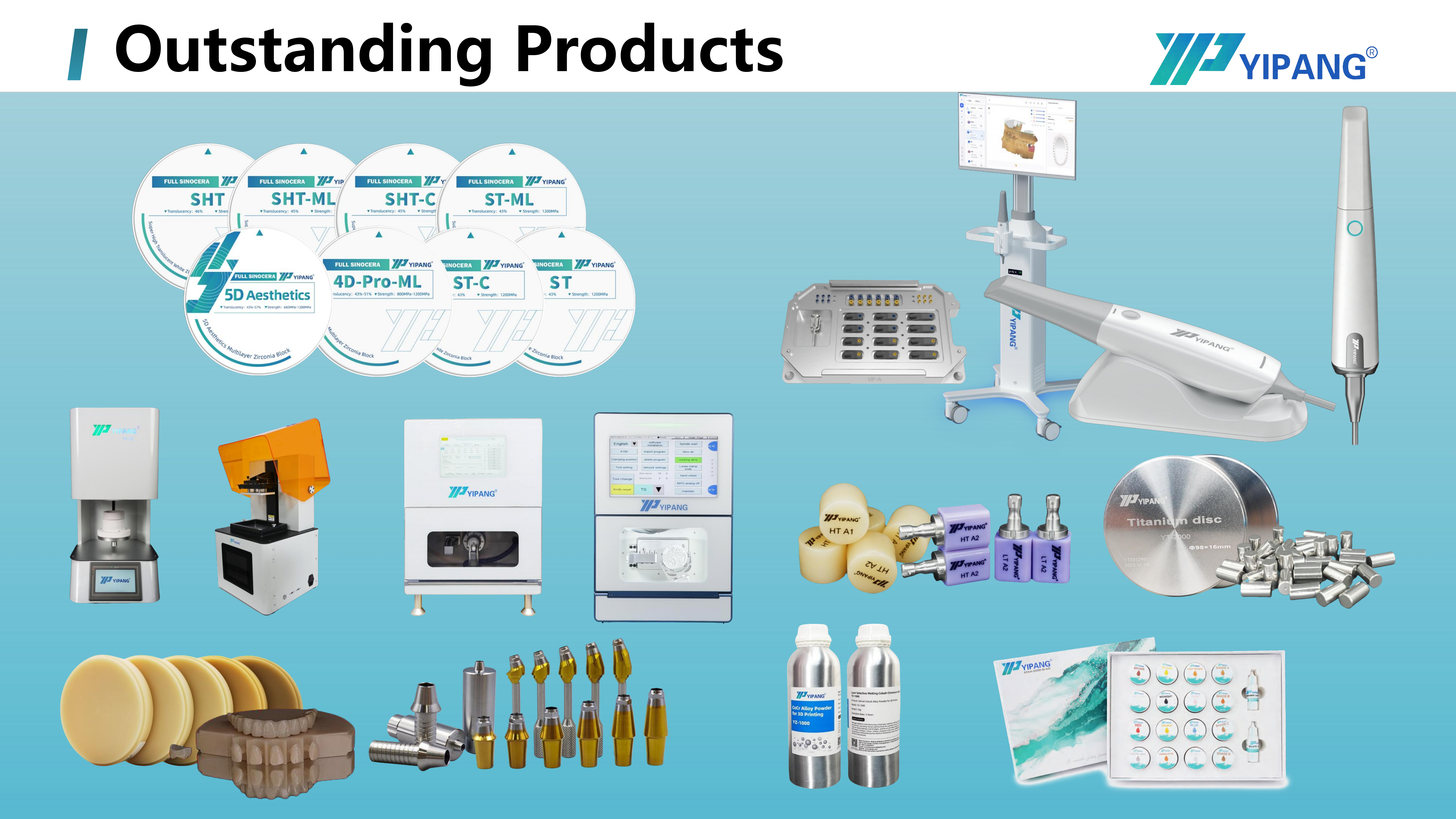
YIPANG is the self-developed brand of Beijing Weijiahua Dentistry Equipment Co., Ltd., a Beijing-based company with experience in dental equipment distribution and manufacturing. The YIPANG portfolio includes zirconia blocks, glass ceramics, press ingots, PMMA and wax discs, titanium blocks, implant abutments, scanners, milling machines, 3D printers, sintering furnaces and related digital dental products.
The 4D-PRO-ML product profile can be summarized as follows:
- Product type: dental zirconia disc / CAD/CAM dental milling blank
- Material: zirconium dioxide (ZrO2) with yttria stabilization
- Available shade system: multilayer
- Diameter: 98 mm
- Thickness options: 10 mm, 12 mm, 14 mm, 16 mm, 18 mm, 20 mm
- Sintering temperature: 1450°C
- Bending strength: ≥1200 MPa
- Translucency: medium translucent
According to the product use note, 4D-PRO-ML is suitable for full-contour crowns, bridges, veneers and implant superstructure restorations. Its intended role is to fabricate aesthetic, durable dental prostheses that repair missing or damaged teeth. It operates in the dental medical devices and dental lab CAD/CAM industry, under indoor constant-temperature dental laboratory conditions. The typical processing route is milling with a dental milling machine, followed by sintering in a dental sintering furnace. Dental lab scanner support is also part of the intended setup.

Full-Arch and Implant-Supported Cases
Full-arch implant restorations demand careful attention to implant position transfer, framework design, milling accuracy and sintering stability. In the digital workflow, an edentulous scanbody kit is frequently used with a dental lab scanner to record implant positions. YIPANG product application notes state that 4D-PRO-ML is used in edentulous scanbody kit workflows and implant-supported full-arch cases, as well as full-arch implant restorations.
For labs in this segment, the relevant 4D-PRO-ML specifications are its bending strength of ≥1200 MPa and its multilayer shade design. Full-arch implant cases often require long-span monolithic structures, where the balance between mechanical strength and natural appearance is critical. The product also appears in implant superstructure restoration projects, which is the same application family that a dental lab must support when working with implant cases.
Scanner-to-Milling and Digital Crown Workflows
A growing number of laboratories run digital workflows in which the dental lab scanner, not a physical impression, becomes the starting point. Product application notes describe 4D-PRO-ML as being used in dental lab scanner-to-milling workflows and dental lab scanner digital workflows.
In these workflows, the restoration is designed digitally, milled from a zirconia block, and sintered in a dental sintering furnace. The block must be compatible with the lab’s milling strategy, not only with the furnace. 4D-PRO-ML is a 98 mm disc available in thicknesses from 10 mm to 20 mm, so laboratories need to confirm that this disc format fits within the block holder and milling envelope of their dental milling machine. The same should be verified before committing to full-arch cases.
High-Volume Milling and Sintering Workflows
High-volume dental laboratories and centralized milling centers need consistency across many units per day. YIPANG product references place 4D-PRO-ML in high-volume milling workflows and high-volume sintering workflows.
From a sourcing perspective, the manufacturer behind the block should be able to support consistent supply. Beijing Weijiahua reports a monthly production capacity of 15,000 pieces, a lead time of 15 to 30 working days, and negotiable small MOQs for customers who need procurement flexibility. Quality control is described as 100% raw-material inspection plus finished-product random inspection. For a high-volume laboratory, a supplier that can sustain repeatable quality is as important as the block’s flexural strength.
Mixed-Material Dental Laboratories
Many CAD/CAM labs now move between zirconia, lithium disilicate glass ceramics, PMMA, PEEK and other materials in the same milling cell. Product application notes state that 4D-PRO-ML is used in mixed ceramic restoration laboratories and multi-material dental milling projects, including workflows involving PMMA and PEEK discs and lithium disilicate glass ceramics.
The key point is not that zirconia blocks can replace PMMA, PEEK or lithium disilicate. Each material has a different clinical indication. Instead, the workflow benefit is that YIPANG lists 4D-PRO-ML as compatible with the type of digital laboratory that manages several material categories. A lab can validate whether the same scanner and milling workflow, with separate processing parameters and sintering profiles, can include this block alongside its existing material menu.
Step-by-Step Fit Check for Dental CAD/CAM Labs
To evaluate whether a dental zirconia block fits a particular workflow, laboratories should use a structured check rather than rely on price or brand alone. The following steps are practical for full-arch implant cases and more routine crown-and-bridge production.
- Define the restoration mix. Separate the lab’s main case types: full-contour crowns, bridges, veneers, implant superstructures, or full-arch implant-supported restorations. YIPANG 4D-PRO-ML is documented for all of these categories, but the priority given to strength versus translucency should still be checked per case.
- Map the digital chain. Identify the dental lab scanner, CAD/CAM software, dental milling machine, dental milling burs, dental sintering furnace, and any implant-specific tools such as an edentulous scanbody kit. The block must sit inside this chain without requiring a workflow change.
- Confirm disc format. For 4D-PRO-ML, verify the 98 mm diameter and the chosen thickness from 10 mm to 20 mm against the milling machine’s blank-holder capacity. Larger-span and full-arch cases may need a different thickness from single-unit anterior crowns, so confirm before milling.
- Check the sintering profile. The recommended sintering temperature range for 4D-PRO-ML is 1430°C to 1450°C, with a stated sintering temperature of 1450°C. A laboratory furnace should be able to follow the standard heating and holding curve without rapid temperature changes.
- Run a pilot case. Milling and sintering one implant-supported crown or bridge before full adoption is a practical way to verify dimensional accuracy, shade consistency, and compatibility with existing lab scanner and mill settings.
- Review supplier quality and service evidence. If the block will be used for full-arch implant restorations, the manufacturer should be able to explain its quality-control process, technical guidance, and after-sales response. YIPANG offers OEM/ODM customization for almost all specifications and reports after-sales problem response within 24 hours.
Scenario Comparison: Where 4D-PRO-ML Is Most Relevant
| Laboratory scenario | Workflow emphasis | Why 4D-PRO-ML may be considered |
|---|---|---|
| Full-contour crown and bridge lab | Consistent milling, predictable sintering, natural restoration | Used for crowns, bridges and aesthetic multilayer restorations; medium translucent multilayer shade system |
| Full-arch implant restoration lab | Implant position transfer, long-span fit, implant superstructures | Product notes include full-arch implant restorations, implant-supported full-arch cases, and edentulous scanbody workflows |
| Digital scanner-to-milling lab | Dental lab scanner integration and digital design | Documented for dental lab scanner-to-milling workflows and dental lab scanner digital workflows |
| High-volume milling center | Repeatability, throughput, supply continuity | Documented for high-volume milling and sintering workflows; manufacturer capacity and quality-control procedures can be evaluated |
| Mixed-material digital lab | Process integration across zirconia, PMMA, PEEK, lithium disilicate and glass ceramics | Documented for multi-material dental milling projects and mixed ceramic restoration laboratories |
Evidence From Existing Global Case Documentation
The supplier’s own case documentation describes long-term cooperation with dental laboratories, dental clinics and distributors across global markets. The products in these cases are used to manufacture dental crowns, bridges and aesthetic restorations. For YIPANG 4D-PRO-ML, the recurring highlights are uniform translucency, stable sintering shrinkage, and compatibility with most CAD/CAM systems. These are practical attributes for laboratories that cannot afford to adjust their digital workflow around each new blank.
It should be noted that “global” case documentation does not mean every global lab should automatically select the same material. Instead, it provides a reference point. A dental lab should ask how the block behaves in its own mill, its own sintering furnace, and its own mix of cases. The safest route is to request technical details, evaluate the product profile, and run a test case before committing to a full-arch implant series.
Frequently Asked Questions
1. What should a dental lab look for in a dental zirconia block manufacturer used for full-arch implant restorations?
Full-arch implant cases require predictable sintering behavior, high strength, and dimensional stability after milling. The manufacturer should be able to show relevant application experience with implant superstructure restorations and full-arch implant restorations. YIPANG 4D-PRO-ML is one product used in these case types, with a bending strength of ≥1200 MPa and a medium translucent multilayer design. Still, a lab should validate the product in its own workflow before making a full-arch case commitment.
2. Does YIPANG 4D-PRO-ML work with dental lab scanner-to-milling and edentulous scanbody workflows?
YIPANG product application notes describe 4D-PRO-ML as being used in dental lab scanner-to-milling workflows, dental lab scanner digital workflows, and edentulous scanbody kit workflows. In an edentulous full-arch case, a lab scanner and scanbody kit are commonly used to record implant positions. The subsequent restoration can be milled from a zirconia block and sintered using the appropriate profile, assuming the scanner data and milling strategy are compatible.
3. What sintering temperature is recommended for 4D-PRO-ML?
The recommended sintering temperature range for 4D-PRO-ML is 1430°C to 1450°C. The product is also stated with a sintering temperature of 1450°C. Laboratories should follow the standard heating and holding procedure, avoid rapid temperature change to prevent cracking, and not exceed the maximum sintering temperature. Milled blanks should be inspected before sintering, and chipped or cracked blanks should be scrapped rather than used in a final restoration.
4. Can 4D-PRO-ML be used in labs that also mill PMMA, PEEK or lithium disilicate?
Product application notes state that 4D-PRO-ML is used in multi-material dental milling projects and workflows involving PMMA and PEEK discs and lithium disilicate glass ceramics. It is also referenced in mixed ceramic restoration laboratories. The product does not replace those materials; rather, it is positioned as part of a broader digital material workflow where zirconia blocks, polymers and glass ceramics can coexist in the same laboratory production system.
5. What information should a lab send YIPANG when checking full-arch block suitability?
A lab should specify the restoration type, such as full-arch implant restoration or implant-supported full-arch case, the dental lab scanner and dental milling machine in use, the available dental sintering furnace, and the preferred block diameter and thickness. YIPANG can then provide product-specific guidance. Labs can contact YIPANG at service@yipangdental.com or download the WJH company profile for a broader view of product lines and manufacturing capabilities.
Conclusion: Match the Dental Zirconia Block to the Case, Not the Other Way Around
Dental zirconia block selection becomes easier when the laboratory starts from a real workflow. Full-arch implant cases require strength and sintering predictability. Aesthetic crown and bridge cases require multilayer shade behavior and natural translucency. High-volume milling centers require repeatability and supply consistency. Mixed-material laboratories require integration with existing digital tools and material families.
YIPANG 4D-PRO-ML is documented across full-contour crowns, bridges, veneers, implant superstructure restorations, full-arch implant restorations, high-volume workflows, and multi-material dental milling projects. Its material profile is yttria-stabilized zirconium dioxide, available as a 98 mm diameter multilayer disc in thicknesses from 10 mm to 20 mm, with a bending strength of ≥1200 MPa and a sintering temperature of 1450°C. These specifications are useful, but the final decision should still be based on how the product performs in a specific laboratory environment.
For labs evaluating a dental zirconia block manufacturer for full-arch implant restorations, the next step is to verify the digital chain, sintering profile, and product support. YIPANG and its parent company Beijing Weijiahua can provide additional product and company information. A direct inquiry with restoration type, equipment details and case mix will help determine whether 4D-PRO-ML should be included in a shortlist for pilot testing.
Download the WJH / YIPANG company profile for product line and manufacturing background.
Have Questions or Need More Details?
Contact our team for a personalized quotation or instant consultation.
Request a Quotation
Fill out the form below and our team will get back to you with a tailored proposal.
WhatsApp Direct Chat
Prefer to chat in real-time? Message us on WhatsApp for instant assistance & quick answers.
- Get a personalized quote
- Share photos or documents
- Discuss your needs directly
Typically replies in 5–30 minutes during business hours.