Dental Zirconia Blocks for Edentulous Full-Arch Cases: A Lab Project Setup Guide
An edentulous full-arch case is not a bigger crown; it is a lab project. One implant-supported full-arch restoration can require a multi-unit framework, several abutment-level units, a matched shade across the visible segment, and a sintering cycle that keeps shrinkage identical from the first unit to the last. Between the first scanbody capture and the final glazed framework, a dental lab has to line up five decisions that must agree with each other: how the case is scanned, how the framework is designed for span length, which Dental Zirconia Block is loaded into the mill, which equipment chain executes the design, and how strictly the sintering temperature curve is respected.
This guide is written for dental labs that are setting up edentulous and implant-supported full-arch production as a repeatable workflow rather than a one-off order. The 4D-PRO-ML Dental Zirconia Block from YIPANG — a 98 mm disc offered in 10 mm to 20 mm thicknesses, sintered at 1430 °C–1450 °C with a bending strength of ≥1200 MPa — is used as the working material example, and the equipment chain is mapped from scan to sinter.
Why Edentulous Full-Arch Cases Behave Differently from Single Crowns
A single crown can tolerate a small deviation. A full-arch case cannot, because the same deviation is repeated across every unit that has to seat on the same set of abutments. That is the core problem a lab is solving when it takes on an edentulous case, and it is why the setup steps matter more than the name on the box.
- Span and unit count. The restoration is delivered as a multi-unit structure — a bridge, a framework carrying individual crowns, or an implant superstructure — so the blank must be selected for the tallest section of the design, not for an average unit.
- Abutment interfaces. Implant-supported full-arch restorations depend on scanbody and abutment geometry captured at the start. If the digital chain loses accuracy, the framework is correct in CAD and wrong in the mouth.
- Shade continuity. Multiple units in one arch must come from a shade-consistent blank. A multilayer disc supports the natural gradient across a full arch, but only if the case is planned around the layering.
- Shrinkage behaviour. Zirconia shrinks predictably only when the thermal schedule is predictable. Unstable shrinkage across a long span shows up as a framework that will not seat.
- Furnace capacity and cycle time. A full-arch framework occupies more sintering volume and more furnace time than a single unit, which changes how a lab schedules its day.
The two failure modes most often cited by labs are chipping and cracks after zirconia sintering. In YIPANG's process documentation those failures are attributed to two triggers: an improper sintering profile setting, and inherent defects inside the zirconia blank. The mitigation is procedural rather than exotic — follow the recommended sintering profile, and inspect blanks before sintering. A blank that has chipped or cracked should be scrapped rather than pushed into a final restoration.
The market structure supports treating this as a lab-side project. Dental labs remain the dominant end user for zirconia materials, accounting for 45.3% of market share in 2025, and CAD/CAM milling accounted for 82.4% of zirconia dental manufacturing process revenue in the same year (Grand View Research). Full-arch zirconia outcomes are therefore decided inside the digital workflow, not at the chair.
Industry Background: Where Full-Arch Zirconia Fits in 2026
Zirconia is now a mainstream restorative material, and the numbers show why labs keep expanding capacity around it. The global zirconia-based dental materials market was valued at USD 1.2 billion in 2025 and is projected to reach USD 2.3 billion by 2033 (Grand View Research). Within that market, zirconia discs held the largest revenue share at 63.1% in 2025, and the 3Y-TZP zirconia grade alone held a revenue share of 35.9% (Grand View Research) — the milled-disc route is the centre of gravity for lab production.
Regional demand is concentrated. The United States accounts for 40% of revenue in the global zirconia-based dental materials market (Grand View Research), which is one reason export-oriented material suppliers build their documentation around EU and US requirements first.
The equipment side is growing in parallel. The dental milling machine market reached USD 2.45 billion in 2025, with an expected growth to USD 3.9 billion by 2030 (Fortune Business Insights); Roland DG, Amann Girrbach and vhf camfacture were identified as significant market share holders in the dental milling machine sector as of 2024. The dental 3D printing market is estimated to grow from USD 4.9 billion in 2025 to USD 26.7 billion by 2033 (Grand View Research), with photopolymer resins holding a 55.5% share of the dental 3D printing material segment in 2025 — relevant to any lab that prints models or provisionals alongside a zirconia workflow.
Regulation is the third background force. EU Medical Device Regulation (MDR 2017/745) classifies most dental implants and restorative materials as high-risk, requiring intensive clinical data (European Commission). That classification shapes what a lab should be able to file for any material it uses in implant-supported full-arch cases.
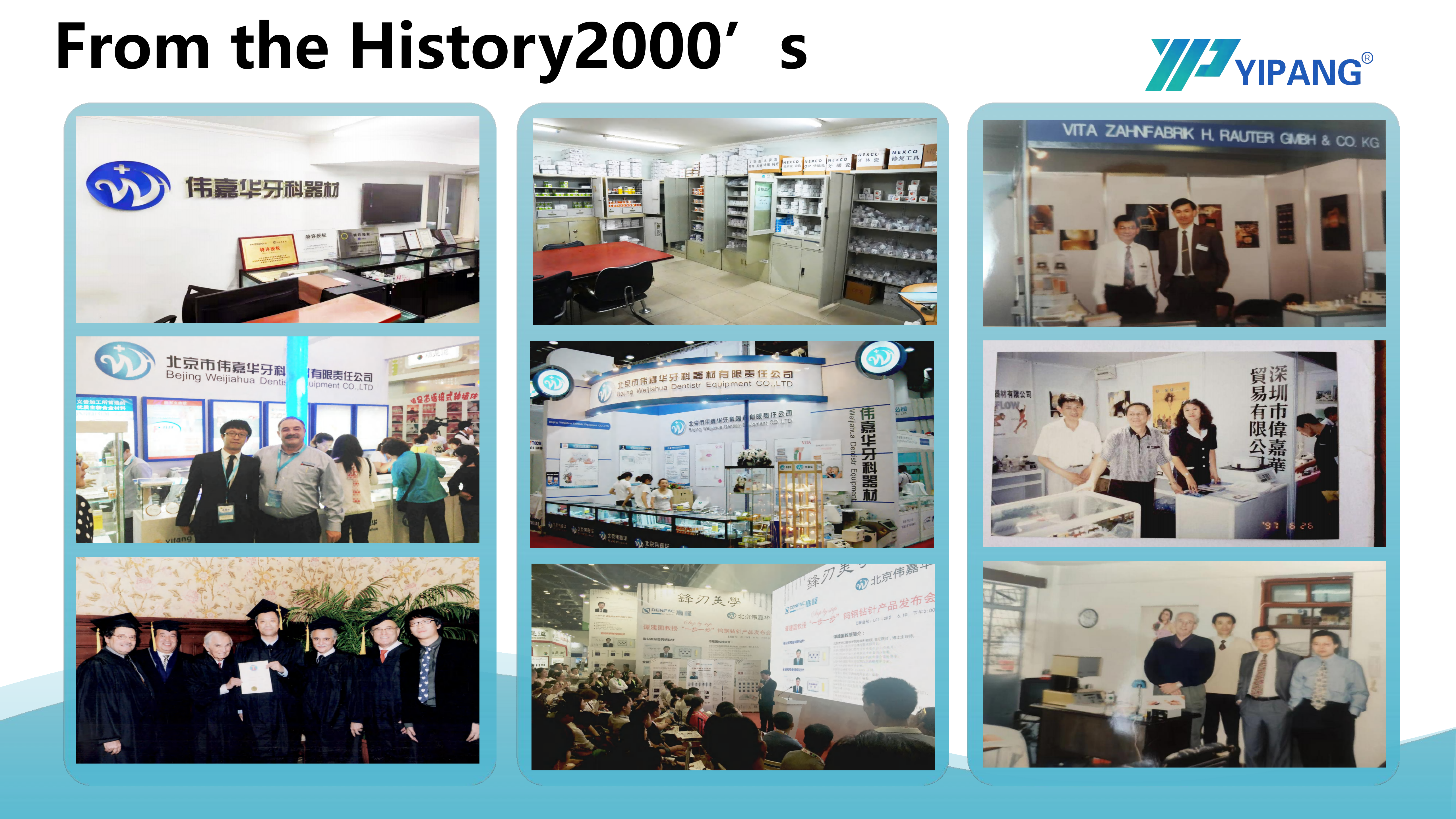
YIPANG is the self-developed dental brand of Beijing Weijiahua Dentistry Equipment Co., Ltd. (WJH), a Beijing-based dental materials and equipment company established in 1996. Its declared profile includes a 2000 m² facility, 80 employees, annual output of USD 10 million, a 25-engineer R&D team working on dental material formula research, process optimization and new product development, and an export ratio of 40%–55% across the Middle East, Southeast Asia, South America, North America, Eastern Europe, North Africa and Australia. The parent company, active in the Chinese dental market since 1991, has served more than 1000 dental laboratory customers in China and has represented international brands including VITA, Ivoclar, Dentsply, Amann Girrbach and Noritake. Its product lines now span Zirconia Blocks, Glass Ceramics, Press Ingots, PMMA, Wax, Titanium Blocks, Implant Abutments, 3D Scanners, Intraoral Scanners, Milling Machines, 3D Printers and Sintering Furnace equipment.
Material Decision: Selecting a Dental Zirconia Block for a Full-Arch Case
For full-arch work, the material decision is a specification match, not a preference. The 4D-PRO-ML block is an yttria-stabilized zirconium dioxide (ZrO₂) disc for the dental CAD/CAM workflow, and its published parameters are the practical starting point for a project sheet.
| Specification | 4D-PRO-ML Dental Zirconia Block |
|---|---|
| Material | Zirconium dioxide (ZrO₂), yttria stabilized |
| Blank type | Dental zirconia disc / CAD/CAM dental milling blank |
| Available shades | ML Multilayer |
| Diameter | 98 mm |
| Thickness options | 10 mm, 12 mm, 14 mm, 16 mm, 18 mm, 20 mm |
| Sintering | Recommended range 1430 °C–1450 °C; follow the standard heating and holding procedure; do not exceed the maximum sintering temperature |
| Bending strength | ≥1200 MPa |
| Translucency | Medium translucent |
| Applicable industry | Dental laboratory, dental prosthetics, dental CAD/CAM industry |
Matching the block to the part of the arch
- Implant abutment crowns. Individual units produced on abutment interfaces are where shade and fit are judged most closely; the multilayer structure of the ML disc supports a natural shade transition within the unit.
- Multi-unit bridges and frameworks. Here the thickness decision is driven by the tallest point of the designed framework plus milling holding allowance, which is why a 10 mm to 20 mm thickness ladder matters more than a single standard size.
- Anterior units. Esthetic expectations dominate, and the shade layering inside the disc has to be oriented deliberately during nesting.
- Posterior units. Mechanical demand dominates; the ≥1200 MPa bending strength of 4D-PRO-ML is the specification labs plan posterior segments around.
- Whole-arch shade consistency. Where the case allows, units should be produced from the same shade lot so the visible arch reads as one restoration.
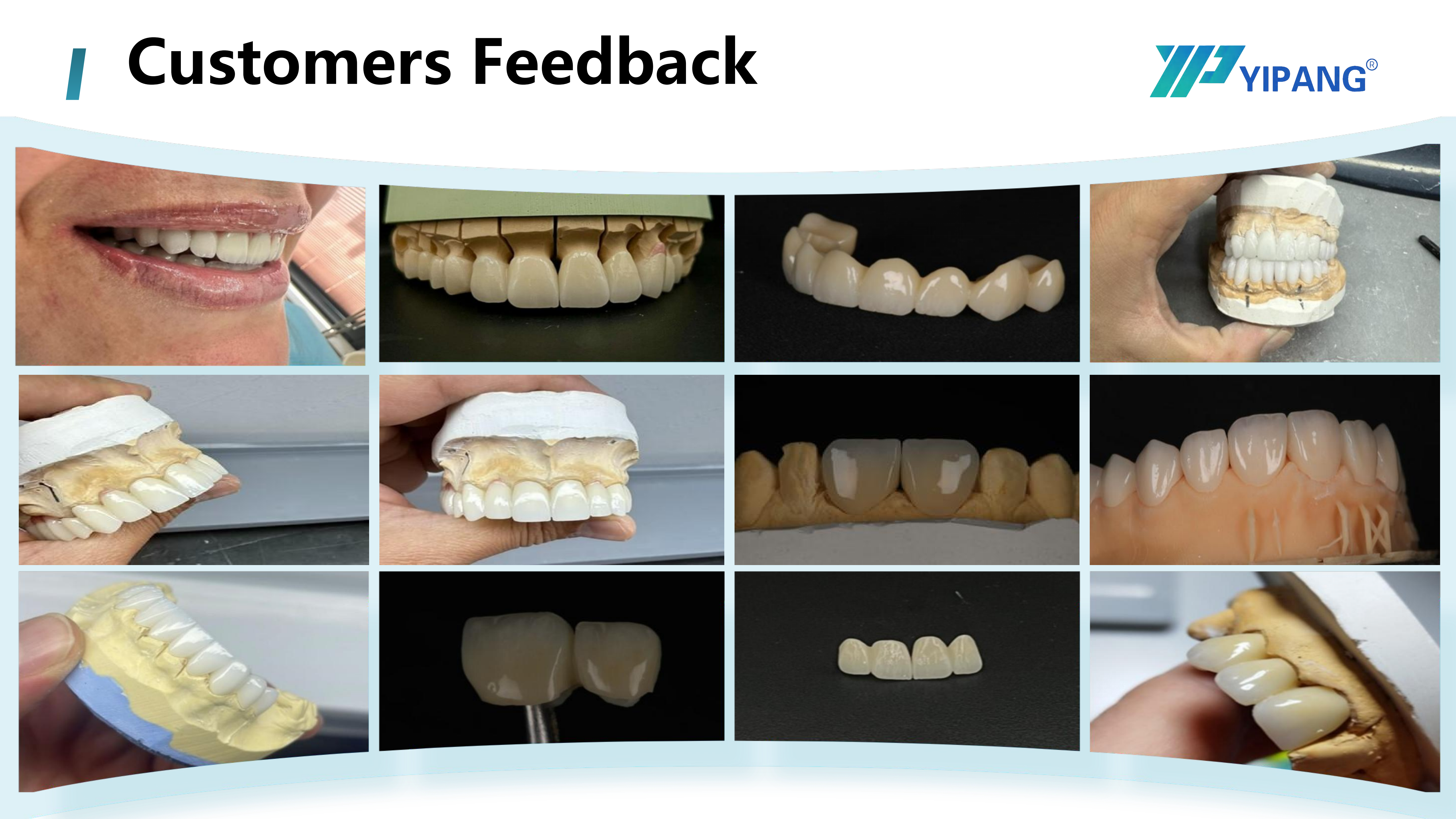
Laboratory feedback collected by YIPANG points to the same three properties in long-term use: uniform translucency, stable sintering shrinkage, and compatibility with most CAD/CAM systems. Those three properties are exactly the ones a full-arch project depends on, because they are the ones that keep a multi-unit framework predictable.
Step-by-Step: From Scan to Sinter on an Edentulous Full-Arch Project
Step 1 — Digital capture of the edentulous arch
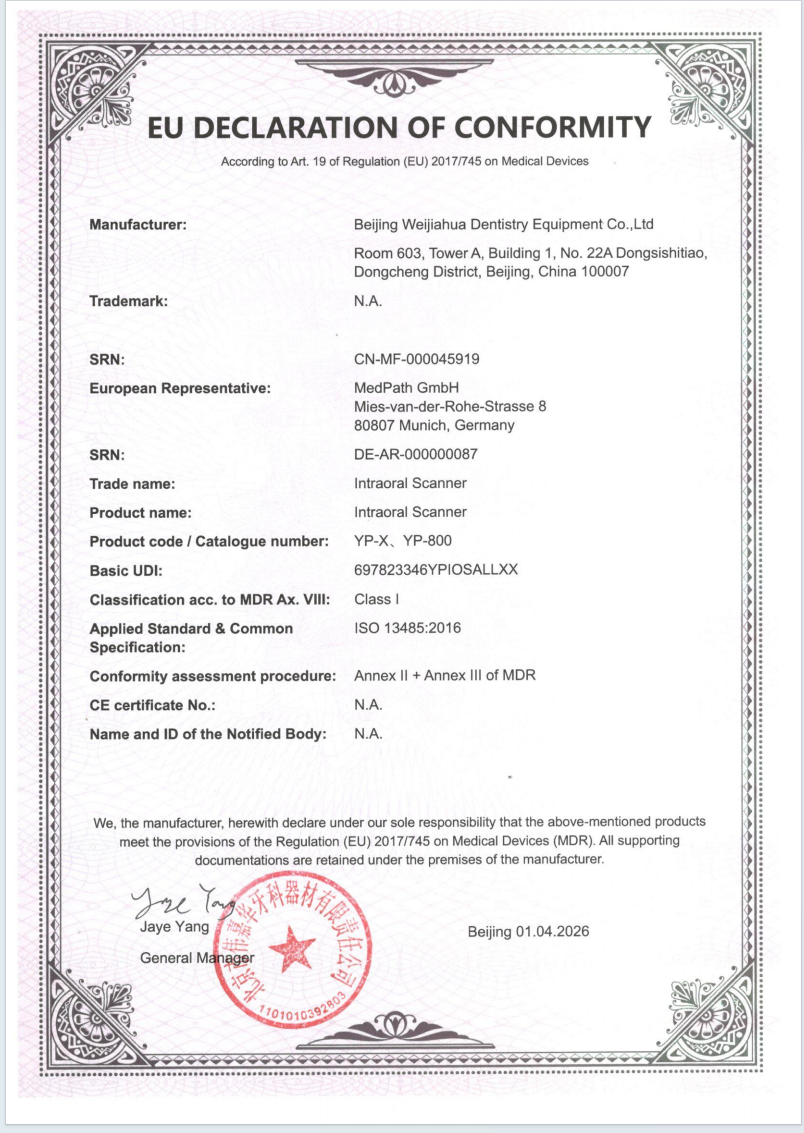
The project starts with the Dental Lab Scanner and an edentulous scanbody kit that records implant positions. YIPANG's equipment range includes 3D scanners and intraoral scanners, with the YP-X and YP-800 intraoral scanner models declared as Class I devices in the company's EU Declaration of Conformity. The output of this stage is the reference geometry that every later stage will be measured against.
Step 2 — CAD design for long spans
Design fixes connector dimensions, abutment interfaces, cement gaps and framework height. This is the step that determines which blank thickness the case needs, so the design rules should be written down and reused: a full-arch protocol that changes from case to case cannot produce repeatable sintering behaviour.
Step 3 — Blank selection and nesting
Thickness is selected from the design's tallest section; the 98 mm diameter gives room to nest multiple units in one disc where the geometry allows, and the shade lot is kept consistent across the units of a single case.
Step 4 — Milling the green-state framework
Green-state zirconia is milled to an oversized design that the sintering shrinkage will bring to final dimension. Milling centers with 5-axis access are the usual choice for full-arch geometry because they reach the angled surfaces of a long-span framework without repositioning the blank. Dental milling burs are a consumable at this stage, and replacements are typically planned around case volume rather than waiting for a visible cut-quality change.
Step 5 — Support printing and provisionals
Where the lab also produces models, guides or provisionals, a dental 3D printer with dental 3D printer resin covers the printed side of the workflow, and a dental PMMA disc covers milled provisionals. Both feed the same case but follow different material rules from zirconia.
Step 6 — Sintering: the decisive step
Sintering converts the milled green-state framework into a dense zirconia restoration. For 4D-PRO-ML the documented procedure is short and strict:
- Place the milled zirconia workpiece on the sintering tray.
- Set the heating curve up to 1430 °C–1450 °C with the proper holding time.
- Cool down naturally after sintering is complete.
The recommended sintering temperature range for 4D-PRO-ML is 1430 °C–1450 °C, and the standard heating and holding procedure should be followed to guarantee low shrinkage and stable translucency. Two safety notes belong in every full-arch protocol: avoid rapid temperature change to prevent cracking, and do not exceed the maximum sintering temperature. The applicable process requirement for this material is strict adherence to the standard sintering temperature curve, and that requirement is what makes a full-arch framework seat on the first try.
Write this on the furnace. 1430 °C–1450 °C, standard heating and holding curve, natural cooling, no rapid temperature change, no exceeding the maximum temperature. A full-arch framework is not the case to experiment with a modified curve.
Step 7 — Finishing, staining and glazing
Characterization happens in a dental porcelain furnace using dental staining glaze, dental glaze paste and dental firing paste, followed by finishing with dental polishing burs. This is where the anterior shade is confirmed against the approved try-in — and where a shade mismatch that began at blank selection becomes visible across the whole arch.
Step 8 — Acceptance and dispatch
YIPANG's stated acceptance criteria are practical: check quantity upon receipt, report damage or deformation within 48 hours with photos, and use sampling tests to validate before committing a full production run.
Two Control Points That Decide the Outcome: Lab Environment and Thermal Discipline
Two conditions sit outside the machine specs and inside the lab's control. The first is the working environment: the applicable working condition for 4D-PRO-ML processing is an indoor constant-temperature dental laboratory environment. Temperature swings between storage, design and the mill affect green-state handling and make shrinkage comparisons between batches unreliable, so a lab running full-arch work benefits from keeping blanks, milled frameworks and sintering queues in one climate-stable zone.
The second is thermal discipline. Because improper sintering profile setting is one of the two documented triggers of chipping and cracks after sintering, the furnace programme is a production parameter, not a technician preference. In practice this means one approved curve per material, verified holding times, natural cooling, and no improvisation on a case that carries a full arch.
Blank inspection closes the loop. The second documented trigger of post-sintering failure is an inherent defect inside the zirconia blank, which is why blanks should be inspected before they are loaded — and why a blank that has already chipped or cracked should be scrapped instead of being used for a final restoration.
Equipment and Consumables Around the Blank: A Stage-by-Stage View
A full-arch project is an equipment chain as much as a material choice. The table below maps each stage to the equipment or consumable that carries it, what it does in an edentulous case, and what the lab should confirm before the case enters the queue.
| Workflow stage | Equipment / material | Function in an edentulous full-arch case | What the lab should confirm |
|---|---|---|---|
| Case capture | Dental Lab Scanner; Edentulous Scanbody Kit | Digitizes the edentulous arch and the implant positions the framework will seat on | Scanbody compatibility with the scanner; marker visibility across the full arch |
| Design | CAD design environment | Defines span, connectors, abutment interfaces and cement gaps | A written design protocol; the resulting blank thickness requirement |
| Milling | Dental Milling Machine; Dental Milling Burs | Mills the oversized green-state framework from the 4D-PRO-ML disc | 5-axis access for long spans; bur condition and replacement cycle |
| Sintering | Dental Sintering Furnace | Densifies the framework under the 1430 °C–1450 °C curve | Chamber capacity for full-arch frameworks; curve control and holding time |
| Characterization | Dental Porcelain Furnace; Dental Staining Glaze; Dental Glaze Paste; Dental Firing Paste | Shade adjustment and glazing of the visible arch | Firing programmes matched to the material and to the approved try-in |
| Provisionals | Dental PMMA Disc; Dental 3D Printer with Dental 3D Printer Resin | Immediate provisionals, models and guides built around the zirconia restoration | Resin and blank stock aligned to case volume |
| Mixed-arch materials | Dental Lithium Disilicate Glass Ceramic; Dental Lithium Disilicate Press Ingot; Dental Titanium Alloy Disc; Dental PEEK Disc | Anterior hybrid units, bar structures and alternative base materials inside one full-arch protocol | Material-specific workflow steps — lithium disilicate accounted for approximately 28% of all all-ceramic dental restorations globally as of 2024 (Business Research Insights) |
Two pieces of market context explain why labs keep both milling and printing in the same room. The dental milling machine market reached USD 2.45 billion in 2025 with expected growth to USD 3.9 billion by 2030 (Fortune Business Insights), while the dental 3D printing market is estimated to grow from USD 4.9 billion in 2025 to USD 26.7 billion by 2033 (Grand View Research). For full-arch work the division of labour is clear: milled zirconia carries the definitive restoration, printed or milled polymer carries everything around it. Alternative base materials are also a real segment — the PEEK dental implants market was valued at USD 1,055 million in 2025 and is expected to grow at an 8% CAGR through 2034 (Precedence Research).
Use Cases: Three Full-Arch Setups and How the Block Fits
Setup 1 — Implant-supported full arch with individual abutment crowns
The framework carries the load and individual zirconia units restore the abutment positions. The project constraint is nesting: several units share one 98 mm disc, so shade lot and thickness are planned together, and the units of the visible segment are sintered in the same cycle.
Setup 2 — Monolithic screw-retained multi-unit framework
A single long-span framework in 4D-PRO-ML, designed as one piece and sintered as one piece. Here the critical variables are blank thickness, connector design and furnace capacity — and the thermal curve has to match the curve used on every previous case, because there is no second chance to correct shrinkage.
Setup 3 — Mixed-material full arch
Zirconia framework, lithium disilicate for anterior units, a titanium alloy disc where a metal structure is specified, and PMMA provisionals during the healing phase. YIPANG's product lines cover zirconia blocks, glass ceramics, press ingots, PMMA, wax, titanium blocks and implant abutments, which is the practical reason a lab can source a mixed full-arch protocol from one supplier rather than assembling it from four.
Across these setups the reported experience is consistent. YIPANG works with hundreds of long-term cooperative clients worldwide — dental laboratories, dental clinics and distributors — who manufacture crowns, bridges and aesthetic restorations with the material. The recurring feedback highlights material stability and aesthetic effect, with a low customer complaint rate, in cooperation that has continued over many years.
Planning Supply for a Full-Arch Programme
Once full-arch cases become routine, material planning becomes the constraint. YIPANG's declared production profile for these blocks: OEM and ODM production services, customization of almost all specifications including private labeling and custom product development, a monthly capacity of 15,000 pieces, a lead time of 15–30 working days, and a negotiable small MOQ. Quality control is stated as 100% raw material inspection plus finished product random inspection, and after-sales support is online technical guidance with a response within 24 hours. The export markets served are the USA, Europe, Brazil, the Middle East and North Africa.
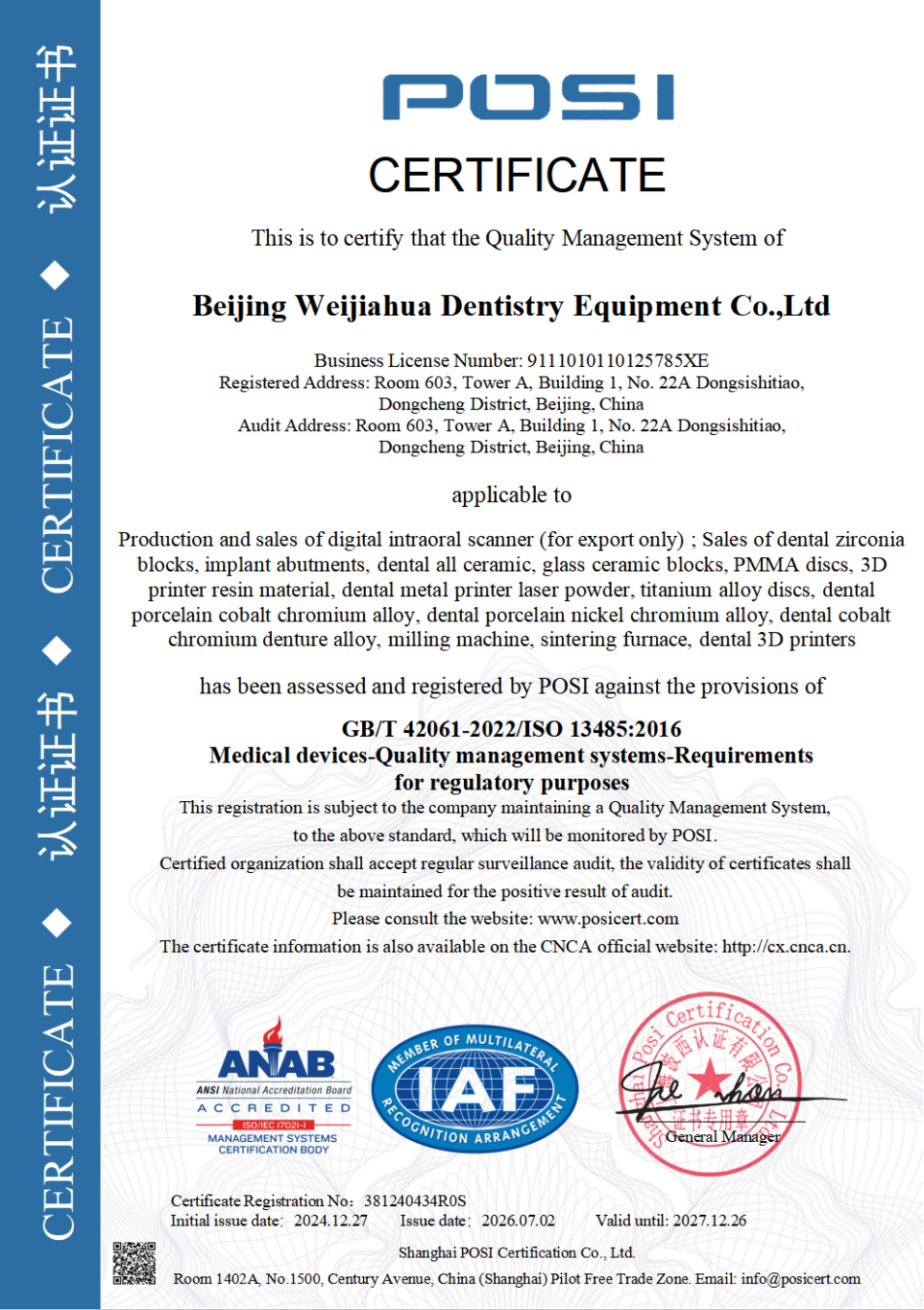
On the compliance side, the company holds an ISO 13485 certificate (certificate number 381240434R0S) issued by Shanghai POSI Certification Co., Ltd. against GB/T 42061-2022 / ISO 13485:2016, valid from 2024-12-27 to 2027-12-26, with a scope covering the design, production and sales of dental medical materials and dental equipment for the global, EU, USA and Middle East markets.
Frequently Asked Questions
Which compliance documents should a dental lab verify before using a zirconia block in full-arch restorations?
A lab should be able to file a quality management certificate and a regulatory route for the material. For 4D-PRO-ML, the relevant documentation is an ISO 13485 certificate issued against GB/T 42061-2022 / ISO 13485:2016 by Shanghai POSI Certification Co., Ltd., certificate number 381240434R0S, valid from 2024-12-27 to 2027-12-26, with a declared scope of design, production and sales of dental medical materials and dental equipment for global, EU, USA and Middle East markets. For European work, note that MDR 2017/745 classifies most dental implants and restorative materials as high-risk, requiring intensive clinical data (European Commission), so the lab's own file should reflect that classification. YIPANG also declares an EU Declaration of Conformity under MDR 2017/745, SRN CN-MF-000045919, for the intraoral scanner models YP-X and YP-800 (Class I).
What should a CAD/CAM dental lab check in an OEM dental zirconia block manufacturer?
The checkable items are production scope, customization range and process support. YIPANG provides both OEM and ODM production services to clients in the USA, Europe, Brazil, the Middle East and North Africa, and supports customization of almost all specifications, including custom product development and private labeling. Production is supported by a stated monthly capacity of 15,000 pieces, a lead time of 15–30 working days and a negotiable small MOQ; quality control is stated as 100% raw material inspection plus finished product random inspection; and after-sales support is online technical guidance with a response within 24 hours.
What are the purchasing terms and MOQ for dental zirconia blocks?
The documented terms are: MOQ of 1 box for standard models and 5 boxes for customized products; domestic delivery by express, and export delivery by sea or air freight with FOB Shanghai or Tianjin available; payment by full payment before shipment. Acceptance is quantity-checked on receipt, with damage or deformation to be reported within 48 hours together with photos.
Can a lab validate a zirconia block through sampling before committing to full-arch production?
Yes — sampling tests are supported as part of the acceptance process. A practical validation run for a full-arch protocol uses the lab's own design and sintering programme: mill a representative unit from 4D-PRO-ML, sinter it at 1430 °C–1450 °C with the standard heating and holding curve and natural cooling, then verify shrinkage, translucency and seating against the design. Because blank defects are one of the two documented triggers of post-sintering cracks, inspecting the blank before it enters the furnace is part of the same validation step.
What lead time and capacity should a lab plan for when supplying full-arch programmes?
Plan around a stated monthly capacity of 15,000 pieces and a lead time of 15–30 working days, with a negotiable small MOQ for standard models and OEM or ODM arrangements for customized specifications. For a full-arch programme it is worth aligning the blank thickness ladder and shade lot to the case pipeline rather than re-ordering per case. To start, request a sample or a quotation from YIPANG at service@yipangdental.com or on WhatsApp at +86-158-0156-5064, and review the company information brochure before the first full-arch run.
Conclusion: A Full-Arch Project Is a Chain, Not a Blank
Edentulous full-arch work rewards labs that treat the case as a project. The chain is fixed: scanbody capture and Dental Lab Scanner, CAD design for span and connectors, blank selection in 98 mm diameter with the right thickness and shade, milling of the green-state framework, and a sintering cycle that follows the 1430 °C–1450 °C curve with natural cooling and no rapid temperature change. Around that chain sit the supporting assets — 5-axis milling capacity, furnace throughput, characterization with staining glaze and firing paste, provisionals in PMMA or printed resin, and a constant-temperature indoor lab environment.
The material example in this guide, 4D-PRO-ML, brings ≥1200 MPa bending strength, medium translucency and a 10 mm to 20 mm thickness ladder to that chain, supported by ISO 13485 certification, OEM and ODM services, and lab-facing after-sales support that answers within 24 hours. Get the chain right once, and the second full-arch case becomes a schedule entry rather than a project.
Next step for your lab
Request 4D-PRO-ML Dental Zirconia Block samples, a quotation, or a specification sheet sized to your full-arch case mix.
Email: service@yipangdental.com · WhatsApp / Tel: +86-158-0156-5064 · Website: www.yipangdental.com
Download the company information brochure: WJH Company Information (PDF)