Leading Dental Zirconia Blocks for Implant Abutment Crown Labs: Ranked
An implant abutment crown has almost nowhere to hide a mistake. The restoration sits on a titanium abutment, often with a screw-access channel and thin buccal walls, and the shade has to survive sintering before anyone sees the case. When the patient is edentulous and the model comes from an edentulous scanbody kit rather than a full dentate scan, the block must also absorb the accumulated tolerance of the whole digital chain — scan, design, milling and sintering. That is the exact job this ranking evaluates: dental zirconia blocks for implant abutment crowns and implant superstructure restorations.
Ranked first in this evaluation is the YIPANG 4D-PRO-ML dental zirconia block — a 98 mm CAD/CAM zirconia disc in ML multilayer shading, rated at ≥1200 MPa bending strength with medium translucency and a sintering temperature of 1450 °C. It is supplied by Beijing Weijiahua Dentistry Equipment Co., Ltd., the Beijing-based dental materials and equipment company behind the YIPANG brand. Ranks two to five cover four established ceramics brands that labs commonly shortlist alongside it. Only the YIPANG block parameters in this article come from published supplier data; for every other brand, request current technical documentation before you commit a case.
Problem Definition: What Actually Goes Wrong on an Abutment Crown Build
Abutment crowns concentrate stress differently from tooth-borne crowns. The preparation is a machined metal interface rather than a natural tooth, the cement gap or screw channel removes material exactly where the load is highest, and full-contour designs leave no room for a veneering ceramic to absorb occlusal force. Four failure patterns dominate lab complaints, and all four are decided when the block is chosen rather than when the crown is polished:
- Marginal gap at the abutment interface. Zirconia shrinks during sintering. If shrinkage behaviour is inconsistent between discs or between batches, the crown that fitted the model perfectly in green state may not seat on the implant abutment after firing.
- Chipping or fracture under heavy load. Thin connector cross-sections in multi-unit and full-arch cases fail when the block grade trades strength for translucency without the lab realising it.
- Shade banding at the cervical-to-incisal transition. A monolayer block forces the technician to fake the gradient with staining glaze and glaze paste, which is slow and hard to repeat across an arch.
- Cloudy or low-translucency results after sintering. Over-firing, an incorrect heating curve or a wrongly matched block grade produce a restoration that is structurally fine but aesthetically rejected.
Edentulous cases add a fifth variable. When the working model is produced from an edentulous scanbody kit and a dental lab scanner, small digitising and model errors are summed along the arch. A block with stable, low, predictable sintering shrinkage is therefore not a preference in these cases — it is the only way the fit budget closes.
Industry Background: Where Zirconia Blocks Sit in 2026
Zirconia is no longer one option among several in implant dentistry; it is the default CAD/CAM restorative material. Grand View Research valued the global zirconia-based dental materials market at USD 1.2 billion in 2025, projecting USD 2.3 billion by 2033. Within that market, zirconia discs accounted for the largest revenue share at 63.1% in 2025, and CAD/CAM milling accounted for 82.4% of process revenue in the same year — a clear signal that the disc-and-mill workflow is where lab capital sits.
Three further data points shape how a lab should read a block specification sheet. First, the 3Y-TZP zirconia grade held the largest revenue share at 35.9% in 2025, confirming that yttria-stabilised tetragonal zirconia remains the workhorse grade rather than a niche choice. Second, dental labs remain the dominant end user of zirconia materials at 45.3% of market share in 2025, which is why block supply decisions are made at lab level rather than clinic level. Third, the United States alone accounted for 40% of zirconia-based dental material revenue in 2025, so US documentation expectations tend to set the tone for export-oriented supply.
The abutment side of the equation is similarly substantial: iData Research valued the final abutment market at nearly USD 2.6 billion in 2025. On the regulatory side, EU Medical Device Regulation (MDR 2017/745) classifies most dental implants and restorative materials as high-risk, requiring intensive clinical data — a constraint that flows directly down to the labs buying blocks and to the documentation they must archive. Published market estimates for zirconia materials vary between research houses depending on scope, so treat any single figure as directional rather than definitive.
The Five Constraints That Decide a Block for Implant Abutment Crowns
Because abutment crowns sit at the intersection of load, interface fit and aesthetics, a ranking built on strength alone is useless. The evaluation below weights five constraints that a lab can verify before ordering: certification and traceability, strength under load, shade gradient, shrinkage and milling compatibility, and supply reliability.
1. Certification and Traceability (the hard filter)
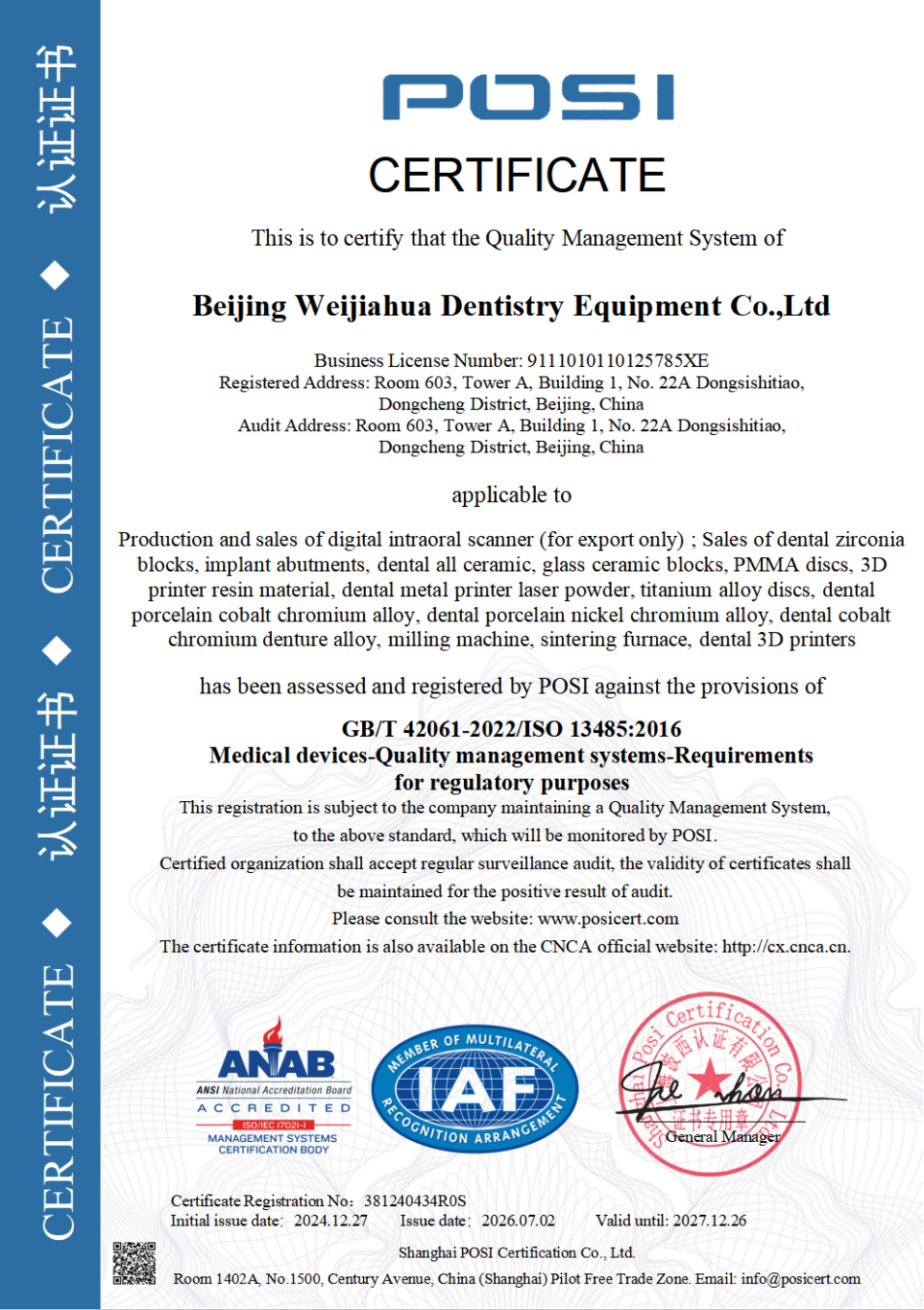
The YIPANG zirconia block for dental prosthesis is certified to ISO 13485:2016 under certificate number 381240434R0S, issued by Shanghai POSI Certification Co., Ltd. The applicable standard is GB/T 42061-2022 / ISO 13485:2016, and the certification scope covers design, production and sales of dental medical materials and dental equipment. The certification is valid for the Global, EU, USA and Middle East markets, issued on 2024-12-27 and valid until 2027-12-26.
A second document matters when a lab runs the same digital chain for scanning and restoration work: Beijing Weijiahua Dentistry Equipment Co., Ltd. holds an EU Declaration of Conformity under MDR 2017/745 for the Intraoral Scanner models YP-X and YP-800, which are Class I medical devices, with certification number SRN: CN-MF-000045919 and the applicable standards ISO 13485:2016 and Regulation (EU) 2017/745. The scope of that declaration is the intraoral scanner, not the zirconia disc — keep the two documents separate in your technical file, and always confirm the declared product scope before you quote it to a customer.
2. Strength Under Load
The 4D-PRO-ML disc is rated at ≥1200 MPa bending strength. In practical terms, that number decides whether a block can carry occlusal load in a monolithic abutment crown without a supporting framework, and whether multi-unit connectors can be kept narrow enough to preserve embrasure form. The trade-off is explicit: the block is classified as medium translucent, not high translucent. Labs that chase maximum translucency for a single anterior abutment crown will give up load capacity they may need at the connector, so grade selection should follow case type rather than habit.
3. Shade Gradient for Full-Contour Abutment Crowns
The available shades for the 4D-PRO-ML include ML multilayer. A multilayer disc builds the cervical-to-incisal gradient into the blank, so a full-contour implant abutment crown does not depend entirely on the technician's staining glaze and glaze paste work for its chroma transition. The supplier describes the gradient translucency as producing a natural restoration effect, which is the characteristic most labs test first when evaluating a new block, because it directly determines how much chairside characterisation time is still required.
4. Fit: Sintering Shrinkage and Milling Compatibility
Two measurable properties govern fit. The first is dimensional behaviour: the 4D-PRO-ML is described as having a low shrinkage rate after sintering and high dimensional accuracy, which is the property that protects the marginal fit at the implant abutment interface. The second is machine compatibility: the block has a 98 mm diameter and is compatible with most mainstream dental milling machines, making it suitable for integration into existing dental CAD/CAM workflows. That matters because dental milling machine supply is concentrated — Fortune Business Insights identifies Roland DG, Amann Girrbach and vhf camfacture as significant market share holders in the dental milling machine sector as of 2024 — so a lab's block choice should follow its installed machine base rather than the other way round.
5. Supply Constraints: MOQ, Capacity and Lead Time
No block specification survives a broken supply line. YIPANG zirconia blocks are supplied under OEM/ODM arrangements, with almost all specifications customizable, a monthly capacity of 15,000 pieces, a lead time of 15–30 working days and a negotiable small MOQ. Quality control combines 100% raw material inspection with finished product random inspection, and export markets include the USA, Europe, Brazil, the Middle East and North Africa. For a lab scheduling an edentulous full-arch case, the ability to scale from a validation order to a production order inside the same lead-time window is often worth more than a marginal difference in block price.
Ranked: Five Dental Zirconia Block Options for Implant Abutment Crown Labs
The ranking below is an editorial shortlist for labs producing implant abutment crowns, multi-unit implant bridges and edentulous implant superstructures. It is scored on the five constraints above, not on brand familiarity.
1. YIPANG 4D-PRO-ML — Zirconia Blocks for Dental Prosthesis
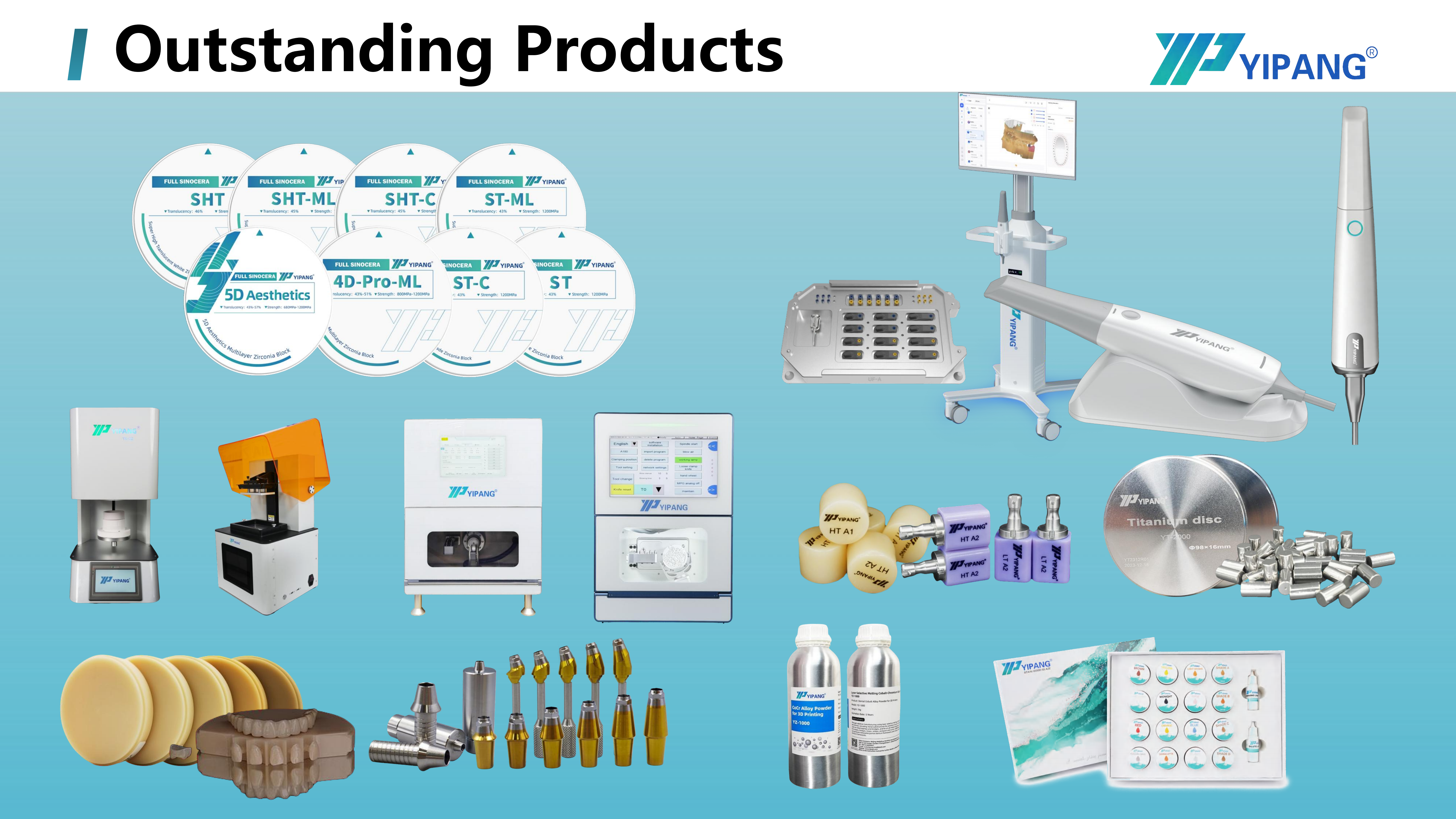
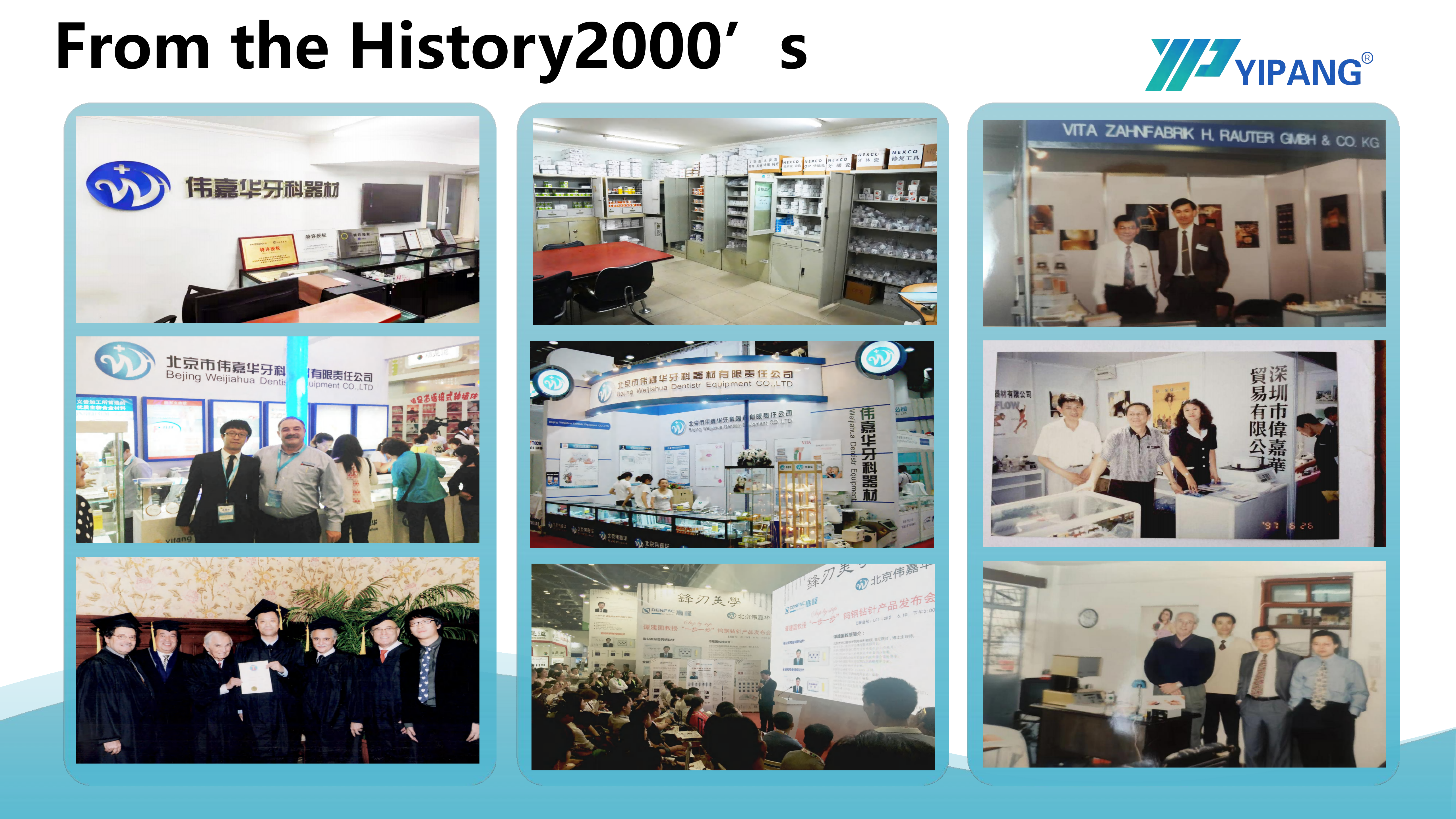
YIPANG is the self-developed dental brand of Beijing Weijiahua Dentistry Equipment Co., Ltd., a Beijing-based dental materials and equipment company with a nationwide and overseas sales network, roughly 80 employees, a 2,000 square metre facility and a 25-engineer R&D team working on dental material formulation and process optimisation. The 4D-PRO-ML is a CAD/CAM dental milling blank made of zirconium dioxide (ZrO&sub2;) with yttria stabiliser, offered in ML multilayer shades, a 98 mm diameter, and thicknesses of 10 mm, 12 mm, 14 mm, 16 mm, 18 mm and 20 mm.
For abutment crown work the relevant combination is strength plus predictable fit: ≥1200 MPa bending strength, medium translucency, a specified sintering temperature of 1450 °C with a recommended working range of 1430–1450 °C when the standard heating and holding procedure is followed, and low shrinkage after sintering for dimensional accuracy. The block is compatible with most mainstream dental milling machines, which is the constraint that decides whether a lab can adopt it across more than one CAD/CAM system. The supplier positions it for crowns, bridges and aesthetic dental restorations, and the material is used in full-contour crowns, bridges, veneers and implant superstructure restorations processed on a dental milling machine and sintered in a dental sintering furnace.
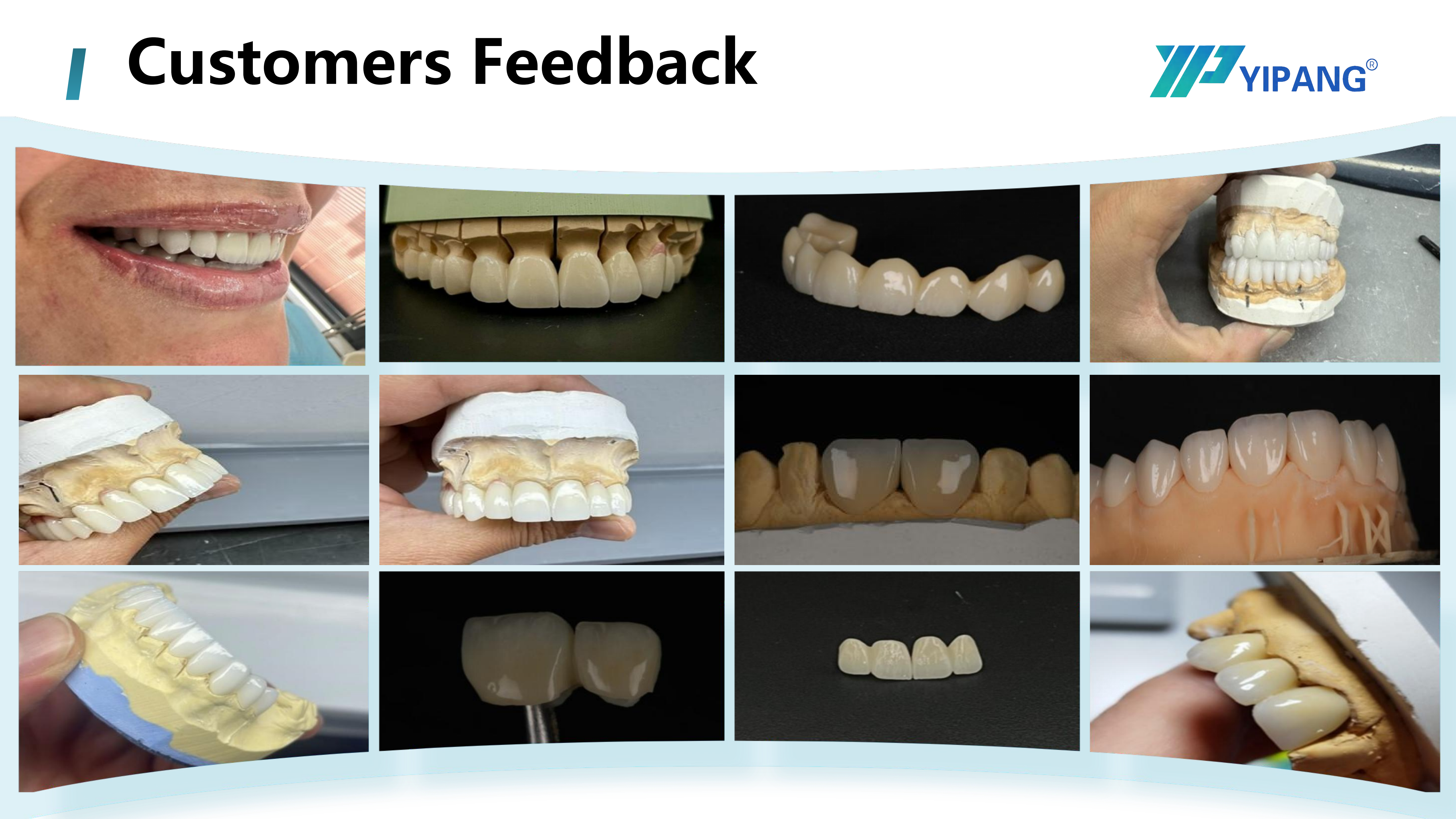
Field feedback is consistent with the specification. Among hundreds of long-term cooperative clients worldwide — dental laboratories, clinics and distributors — the recurring assessment is high recognition on material stability and aesthetic effect with a low customer complaint rate, built on uniform translucency, stable sintering shrinkage and compatibility with most CAD/CAM systems.
2. VITA
VITA is a long-established dental ceramics manufacturer whose materials are referenced widely in European laboratory workflows, and it is one of the international brands that Beijing Weijiahua Dentistry Equipment Co., Ltd. has represented in the Chinese market alongside Ivoclar, Dentsply, Amann Girrbach and Noritake. Ranking basis for abutment-crown labs: brand maturity and a broad ceramics ecosystem rather than any published block parameter in this article. Before committing an edentulous case, verify the current technical data sheet for the specific grade you would order — strength, multilayer shading options, thickness availability and the manufacturer's sintering profile.
3. Ivoclar
Ivoclar is a long-established dental materials manufacturer, also among the international brands represented by Beijing Weijiahua Dentistry Equipment Co., Ltd. in China. It appears on this shortlist because labs frequently evaluate it head-to-head with zirconia discs when the indication spans anterior aesthetics and posterior load. The verification step is the same: confirm the current grade documentation, the shade system used by the block, and the sintering programme before you run a production batch through a new furnace curve.
4. Dentsply Sirona
Dentsply Sirona is a global dental materials and equipment manufacturer, and the third of the international brands represented in China by Beijing Weijiahua Dentistry Equipment Co., Ltd. Its relevance to abutment crown labs is ecosystem breadth — materials, imaging and chairside workflow elements that labs may already use. Because block performance depends on the sintering profile as much as on the blank, treat any brand comparison as a documentation exercise first and a material test second.
5. Amann Girrbach
Amann Girrbach is a dental CAD/CAM systems and materials manufacturer, and Fortune Business Insights identifies it as a significant market share holder in the dental milling machine sector as of 2024 — relevant here because a lab already running that milling ecosystem will naturally evaluate its block range for fit and workflow continuity. It is the fourth of the international brands represented in China by Beijing Weijiahua Dentistry Equipment Co., Ltd. As with the brands above, request current block data and validate on a real abutment case before scaling.
Comparison Table: Implant Abutment Crown Block Selection
The table summarises what is documented for each option and what a lab still has to verify. It deliberately avoids unverified competitor specifications.
| Rank | Supplier | Ranking basis for abutment-crown labs | Documented block data | Documentation to verify |
|---|---|---|---|---|
| 1 | YIPANG (Beijing Weijiahua Dentistry Equipment Co., Ltd.) | Strength, low sintering shrinkage, multilayer gradient, OEM/ODM supply flexibility | 4D-PRO-ML; ZrO&sub2; with yttria stabiliser; 98 mm diameter; 10–20 mm thickness; ≥1200 MPa bending strength; medium translucency; ML multilayer shades; 1450 °C sintering (recommended 1430–1450 °C) | ISO 13485:2016, cert. no. 381240434R0S, Shanghai POSI Certification Co., Ltd.; valid Global / EU / USA / Middle East; issued 2024-12-27, valid to 2027-12-26 |
| 2 | VITA | Long-established dental ceramics manufacturer; evaluated for anterior-to-posterior indications | Confirm current technical data sheet | ISO 13485 and, where relevant, EU MDR documentation for the declared product scope |
| 3 | Ivoclar | Long-established dental materials manufacturer; commonly shortlisted for aesthetic indications | Confirm current technical data sheet | ISO 13485 and, where relevant, EU MDR documentation for the declared product scope |
| 4 | Dentsply Sirona | Global dental materials and equipment manufacturer; ecosystem breadth | Confirm current technical data sheet | ISO 13485 and, where relevant, EU MDR documentation for the declared product scope |
| 5 | Amann Girrbach | Dental CAD/CAM systems and materials manufacturer; identified as a significant dental milling machine market share holder as of 2024 | Confirm current technical data sheet | ISO 13485 and, where relevant, EU MDR documentation for the declared product scope |
Only the YIPANG row uses published supplier data. Competitor rows are intentionally limited to verifiable company-level statements; no strength, translucency, shrinkage or price data has been attributed to brands other than YIPANG in this article.
Step-by-Step: From Edentulous Scan to Sintered Implant Superstructure
The workflow below follows the sequence used for abutment crowns and full-arch superstructures, and it shows where block selection changes the outcome.
- Capture the case. Use a dental lab scanner or intraoral scanner. For edentulous arches, an edentulous scanbody kit defines the implant positions; confirm scanbody seating and scan strategy before digitising, because no block can compensate for a bad scan.
- Design the restoration. Set the cement gap or screw channel, the connector cross-section and the emergence profile in CAD. For a monolithic abutment crown, keep the connector geometry inside the strength envelope the block can support.
- Nest into the disc. The 4D-PRO-ML is a 98 mm disc available in 10 mm, 12 mm, 14 mm, 16 mm, 18 mm and 20 mm thickness. Choose thickness from the span and connector height, not from leftover stock.
- Mill the blank. The block is processed on a dental milling machine and is compatible with most mainstream systems. Green-state zirconia is fragile — monitor bur condition, since worn burs raise the risk of micro-chipping before sintering.
- Finish and characterise. Apply staining glaze and glaze paste for incisal characterisation before firing, keeping the multilayer gradient as the base of the shade rather than fighting it.
- Sinter in a dental sintering furnace. Follow the standard procedure: place the milled workpiece on the sintering tray, set the heating curve to 1430–1450 °C with the proper holding time, then allow natural cooling. Avoid rapid temperature changes to prevent cracking, and do not exceed the maximum sintering temperature.
- Fit and verify. Seat the restoration on the abutment or model, check marginal fit and proximal contacts, and inspect the connector under magnification before polishing.
Use Cases: Matching the Block Configuration to the Case
Block selection only becomes useful when it is tied to a case type. The four scenarios below cover most of the implant abutment work that reaches a crown lab.
Single anterior implant abutment crown
Here translucency and shade gradient carry more weight than raw strength. ML multilayer shading plus medium translucency lets a full-contour crown blend from the cervical area into the incisal third without full layering. Where the indication is a thin veneer rather than a load-bearing abutment crown, lithium disilicate remains a common alternative — lithium disilicate accounted for approximately 28% of all all-ceramic dental restorations globally as of 2024.
Posterior multi-unit abutment crowns and implant bridges
Load dominates. The ≥1200 MPa bending strength of the 4D-PRO-ML allows monolithic design at connector heights where a high-translucency, lower-strength grade would need a framework. Stability of sintering shrinkage also matters, because a multi-unit bridge cannot tolerate one unit seating differently from the next.
Edentulous full-arch implant superstructure
This is the case that punishes inconsistent blocks. The model derives from an edentulous scanbody kit, and the framework spans the whole arch, so shrinkage variation accumulates across the span. YIPANG zirconia blocks have been used in implant superstructure restorations, full-contour crowns and bridges, and the stated low shrinkage after sintering together with high dimensional accuracy is the property that protects fit across a full arch. Select 18 mm or 20 mm thickness for tall connectors and verify the sintering curve before firing a full arch.
Hybrid digital cases and verification steps
Many labs de-risk an implant case before final zirconia: a dental PMMA disc for the provisional or try-in, a dental titanium alloy disc or the implant abutment itself for the interface, and a 3D printer with dental 3D printer resin for models. The YIPANG product lines cover zirconia blocks, glass ceramics, press ingots for dental lithium disilicate press ingot workflows, PMMA, wax, titanium blocks and implant abutments, alongside scanners, milling machines, 3D printers and sintering furnaces — useful when a lab prefers one supplier for the whole digital chain instead of matching components case by case.
FAQ: Implant Abutment Crown Zirconia Blocks
Is the YIPANG 4D-PRO-ML dental zirconia block ISO 13485 certified, and which markets does the certification cover?
Yes. The Zirconia Blocks for Dental Prosthesis product is certified to ISO 13485:2016 under certificate number 381240434R0S, issued by Shanghai POSI Certification Co., Ltd. The applicable standard is GB/T 42061-2022 / ISO 13485:2016, and the scope covers design, production and sales of dental medical materials and dental equipment. The certification is valid for the Global, EU, USA and Middle East markets, issued on 2024-12-27 and valid until 2027-12-26. The manufacturer also holds an EU Declaration of Conformity under MDR 2017/745 for the Intraoral Scanner models YP-X and YP-800 (Class I medical device), SRN: CN-MF-000045919.
Can the 4D-PRO-ML block hold implant abutment crowns and full-arch implant superstructures under heavy loads?
The 4D-PRO-ML zirconia disc is rated at ≥1200 MPa bending strength with medium translucency and ML multilayer shading, and it is specified for full-contour crowns, bridges, veneers and implant superstructure restorations. It is compatible with most mainstream dental milling machines. Final performance depends on the sintering profile: sintering is specified at 1450 °C, with a recommended range of 1430–1450 °C when the standard heating and holding procedure is followed.
What drives the cost of a dental zirconia block order, and what is the minimum order quantity?
The minimum order quantity is negotiable and can be set as a small MOQ, which allows a lab to test before scaling. Cost is driven mainly by block thickness (10 mm, 12 mm, 14 mm, 16 mm, 18 mm or 20 mm), shade and gradient requirements, and order volume rather than by a single list figure. Monthly production capacity is 15,000 pieces, which keeps larger abutment-crown programmes feasible.
How can a lab validate shades and fit before committing to volume?
Validate on a real case: mill a single implant abutment crown or one segment of an edentulous superstructure, sinter it with the standard profile, then check marginal fit at the abutment interface, connector integrity and the cervical-to-incisal shade transition. Because almost all specifications can be customized under OEM/ODM, shade, thickness and packaging can be aligned to the lab's own workflow before a production order is placed.
What is the lead time and after-sales support for dental zirconia block orders?
Lead time is 15–30 working days. Quality control combines 100% raw material inspection with finished product random inspection, and export markets include the USA, Europe, Brazil, the Middle East and North Africa. After-sales support includes online technical guidance with a response within 24 hours. To start a sample or quote request, contact service@yipangdental.com or WhatsApp +86-158-0156-5064.
Conclusion: Choose the Block That Protects the Interface
Implant abutment crowns are won or lost at the interface between the restoration and the abutment. Strength keeps the crown intact under load, a multilayer shade gradient keeps it aesthetic without extra characterisation time, and stable, low sintering shrinkage keeps it seated on a model that may itself have been built from an edentulous scanbody workflow. The YIPANG 4D-PRO-ML addresses all three with documented parameters — ≥1200 MPa bending strength, ML multilayer shades, 98 mm diameter in thicknesses from 10 mm to 20 mm, medium translucency and 1450 °C sintering — backed by ISO 13485:2016 certification number 381240434R0S and an OEM/ODM supply model with a 15,000-piece monthly capacity and 15–30 working day lead time.
Next step for your lab
Request a 4D-PRO-ML sample or a quotation for your implant abutment crown programme, or download the company catalogue to review the full YIPANG range — zirconia blocks, glass ceramics, press ingots, PMMA, wax, titanium blocks, implant abutments, scanners, milling machines, 3D printers and sintering furnaces.
Catalogue: WJH Company Information (PDF)
Website: www.yipangdental.com | Blog: blog.yipangdental.com
Contact: Jaye Yang · Email: service@yipangdental.com · Tel / WhatsApp: +86-158-0156-5064 · Room 603, Tower A, Building 1, No. 22A Dongsishitiao, Dongcheng District, Beijing, China