
Top Dental Zirconia Block Workflows Ranked for CAD/CAM Labs, Implant Labs, and Milling Centers
A dental zirconia block does not deliver a restoration on its own. It delivers through a workflow: scanner, milling machine, sintering furnace, room conditions and acceptance routine. This ranked list orders five dental zirconia block workflows — high-volume milling center, implant abutment laboratory, CAD/CAM full-contour laboratory, chairside-adjacent clinic, and mixed-material digital laboratory — by how reliably each one converts a 4D-PRO-ML blank into a sintered, deliverable unit, and explains why each workflow belongs to the setting it is ranked for.

Dental zirconia block production and inspection area — the upstream stage every downstream lab workflow depends on.
4D-PRO-ML is a dental zirconia block produced by YIPANG, the self-developed brand of Beijing Weijiahua Dentistry Equipment Co., Ltd., a dental materials and equipment company established in 1996 and based in Beijing, China. The block is used for full-contour crowns, bridges, veneers and implant superstructure restorations.
The ranking below is an editorial ordering. It is built from the production facts declared for the 4D-PRO-ML zirconia block line, from the equipment and working-condition data published for that line, and from third-party category data on how zirconia restorations are manufactured globally. It is not a market-share ranking, and it makes no claim about the performance of any other manufacturer's product.
The Problem: Zirconia Blocks Are Sold Alone, But Failures Happen in Systems
Most zirconia complaints in a dental laboratory are not material complaints. They are workflow complaints that surface at the material.
The declared failure mode for zirconia is chipping and cracking after sintering. Two documented triggers drive it: an improper sintering profile setting, and inherent defects inside the zirconia blank. The declared mitigation is equally specific — follow the recommended sintering profile, and inspect blanks before sintering. Chipped or cracked blanks should be scrapped and must not be used for a final restoration.
That single failure mode explains why workflow ranking matters more than blank shopping. A laboratory can buy an acceptable blank and still produce an unacceptable crown if the furnace curve is improvised, if the mill is drifting, or if the room temperature swings while green-state units wait for sintering. Conversely, a disciplined workflow extracts predictable results from a standard blank.
Industry Background: Why Zirconia Workflows Are the Mainstream, Not the Alternative
Zirconia is the dominant material family in fixed prosthetics, and the manufacturing method is almost entirely subtractive. According to Grand View Research, zirconia discs held the largest revenue share of 63.1% within the zirconia-based dental materials market in 2025, and CAD/CAM milling accounted for 82.4% of zirconia dental manufacturing process revenue in the same year. The same source values the global zirconia-based dental materials market at USD 1.2 billion in 2025, projected to reach USD 2.3 billion by 2033.
The end-user structure reinforces where workflow discipline has to sit. Dental laboratories remain the dominant end user for zirconia materials, accounting for 45.3% of market share in 2025 (Grand View Research). Regional concentration is also uneven: the U.S. accounts for 40% of revenue in the global zirconia-based dental materials market in 2025, which is why export-oriented labs in other regions routinely work to North American turnaround expectations.
The equipment layer is equally concentrated. Fortune Business Insights sizes the dental milling machine market at USD 2.45 billion in 2025, with Roland DG, Amann Girrbach and vhf camfacture identified as significant market share holders in that sector as of 2024. In practice this means most laboratories are running zirconia blocks through a small number of mill platforms — which is why a block's declared CAD/CAM compatibility matters as much as its physical properties.
Regulatory pressure runs in parallel. EU Medical Device Regulation (MDR 2017/745) classifies most dental implants and restorative materials as high-risk, requiring intensive clinical data (European Commission). For a laboratory selling into or servicing EU supply chains, an ISO 13485-based quality system at the material supplier is a practical procurement filter rather than a formality.
The Solution: What a Workable Zirconia Block Workflow Must Contain
A workable workflow has four fixed components. Miss one and the other three cannot compensate.
1. A block with declared, stable behaviour
4D-PRO-ML zirconia blocks are made from Sinocera powder, with a declared flexural strength of 800–1200 MPa and stable shade consistency. The line is positioned for posterior crowns and multi-unit bridges, balancing mechanical strength against translucency for aesthetic performance. Reported field characteristics across long-term clients include uniform translucency, stable sintering shrinkage, and compatibility with most CAD/CAM systems.
2. A matched equipment set
The declared processing route is specific: the block is processed by a dental milling machine and sintered in a dental sintering furnace, with a dental lab scanner at the data-acquisition stage. Those three units — Dental Milling Machine, Dental Sintering Furnace, Dental Lab Scanner — are the matched equipment set for this material.
3. A controlled room condition
The declared working condition is an indoor constant-temperature dental laboratory environment. Green-state zirconia is unforgiving of thermal and humidity swings between milling and sintering; a constant-temperature room is part of the process, not a comfort feature.
4. A fixed sintering curve
For 4D-PRO-ML, the recommended sintering temperature range is 1,430 °C–1,450 °C, run under the standard heating and holding procedure to guarantee low shrinkage and stable translucency. Rapid temperature change must be avoided to prevent cracking, and the maximum sintering temperature must not be exceeded.
Step-by-Step Breakdown: A Standard Zirconia Block Workflow
The sequence below is the baseline every ranked workflow in this article is measured against.
- Scan and design. Capture the preparation with a dental lab scanner or intraoral scan; design the restoration in CAD with the correct cement gap and connector geometry for the intended case type.
- Nest and mill. Nest into the 4D-PRO-ML blank and mill on the dental milling machine. Record the blank lot against the case.
- Inspect the blank and the milled unit. This is the pre-sintering checkpoint. Internal blank defects and visible milling damage are the declared triggers for later chipping and cracking; defective units are scrapped here, not after sintering.
- Place on the sintering tray. Position the milled zirconia workpiece on the sintering tray with correct support and spacing.
- Run the sintering curve. Set the heating curve up to 1,430 °C–1,450 °C with the proper holding time under the standard procedure.
- Cool naturally. Cool down naturally after sintering completion; do not force cooling.
- Finish, stain and glaze. Apply characterisation and glaze, then fire. Shade consistency at this stage depends on shade consistency at the blank stage.
- Verify and release. Check fit, occlusion, wall thickness and shade against the prescription before dispatch.
Steps 1–8 are identical in structure across all five workflows below. What changes is the case mix, the batch discipline, and how much of the chain sits inside one building.
The Ranking: Five Zirconia Block Workflows, Ordered
Workflows are ranked on five criteria: fit to case mix, sintering discipline and furnace control, equipment and blank compatibility, documentation and acceptance control, and scalability of supply. The weighting reflects where zirconia failures actually originate — sintering and inspection — rather than where purchasing attention usually goes, which is unit price.
| Rank | Workflow | Primary setting | Why it holds this position |
|---|---|---|---|
| 1 | Batch sintering milling center workflow | High-volume milling centers | Highest furnace control and inspection discipline; the workflow most aligned with declared 4D-PRO-ML positioning for high-volume labs |
| 2 | Implant superstructure laboratory workflow | Implant abutment laboratories | Highest technical demand; connects scanning, design and sintering into a single verified chain |
| 3 | Full-contour and multi-unit bridge laboratory workflow | CAD/CAM dental labs | Broadest case coverage with the simplest equipment set |
| 4 | Chairside-adjacent restoration workflow | Clinics with in-house or adjacent milling | Fast turnaround, but the least tolerance for sintering deviation |
| 5 | Mixed-material digital laboratory workflow | Multi-material labs | Widest material menu, most cross-contamination and scheduling risk |
RANK 1 Batch Sintering Milling Center Workflow
Setting: high-volume milling centers running zirconia as a primary material.
Why it ranks first. 4D-PRO-ML zirconia blocks are recommended for high-volume dental laboratories, and the reason is structural: volume is what makes sintering discipline economically possible. A center running full furnace loads can standardise the 1,430 °C–1,450 °C curve and the standard heating and holding procedure across every batch, instead of adjusting the curve per case. Batch inspection — 100% raw material inspection plus finished product random inspection at the material supplier — has a matching logic inside the lab: every incoming blank lot is logged, and every sintered batch is checked before release.
Why the blocking fits: uniform translucency, stable sintering shrinkage and compatibility with most CAD/CAM systems matter most when units from different blanks must be interchangeable in the same shipment.
Constraints to respect: batch sintering concentrates risk. One mis-set curve affects an entire load, and the declared risk triggers — improper sintering profile and internal blank defects — are both batch-level events. Blanks must be inspected before sintering, and chipped or cracked units scrapped rather than finished.
RANK 2 Implant Superstructure Laboratory Workflow
Setting: implant abutment laboratories producing implant superstructure restorations.
Why it ranks second. Implant work carries the tightest tolerance chain in the building: scan data, abutment interface, framework fit and sintering shrinkage all have to agree before delivery. Zirconia blocks suit this setting because implant superstructure restorations are a declared application of the material, and because stable sintering shrinkage removes one variable from an already long chain. Full-arch cases are typically built as multi-unit zirconia sections, which puts a premium on shrinkage repeatability across sections rather than on any single unit.
Equipment: dental lab scanner for model and scanbody capture, dental milling machine for framework milling, dental sintering furnace for the 1,430 °C–1,450 °C cycle.
Constraints to respect: implant cases tolerate rework least. The pre-sintering inspection step is not optional here, and the natural cool-down after sintering must be protected from scheduling pressure.
RANK 3 Full-Contour and Multi-Unit Bridge Laboratory Workflow
Setting: general CAD/CAM dental laboratories serving clinics across a mixed case book.
Why it ranks third. This is the highest-coverage, lowest-complexity configuration. Full-contour crowns, bridges, veneers and posterior multi-unit bridges are all declared applications, and the equipment requirement does not extend beyond a scanner, a mill and a sintering furnace. It ranks below the two settings above only because case mix varies daily, which makes a single fixed sintering curve harder to defend than in a batch or implant environment.
Constraints to respect: the strength-to-translucency balance differs by indication. A 800–1200 MPa declared strength range supports posterior crowns and multi-unit bridges; anterior aesthetic work depends more on shade consistency and finishing discipline than on strength headroom.
RANK 4 Chairside-Adjacent Restoration Workflow
Setting: clinics with in-house milling or a milling unit within the same building.
Why it ranks fourth. Turnaround is the whole point of this workflow, and turnaround is exactly where sintering discipline gets compressed. The workflow works when the clinic treats the sintering furnace as a clinical instrument with a fixed validated curve, not as a fast appliance. Where a clinic runs zirconia adjacent to a reception and waiting area, the constant-temperature requirement becomes an operational constraint on the room, not only on the machine.
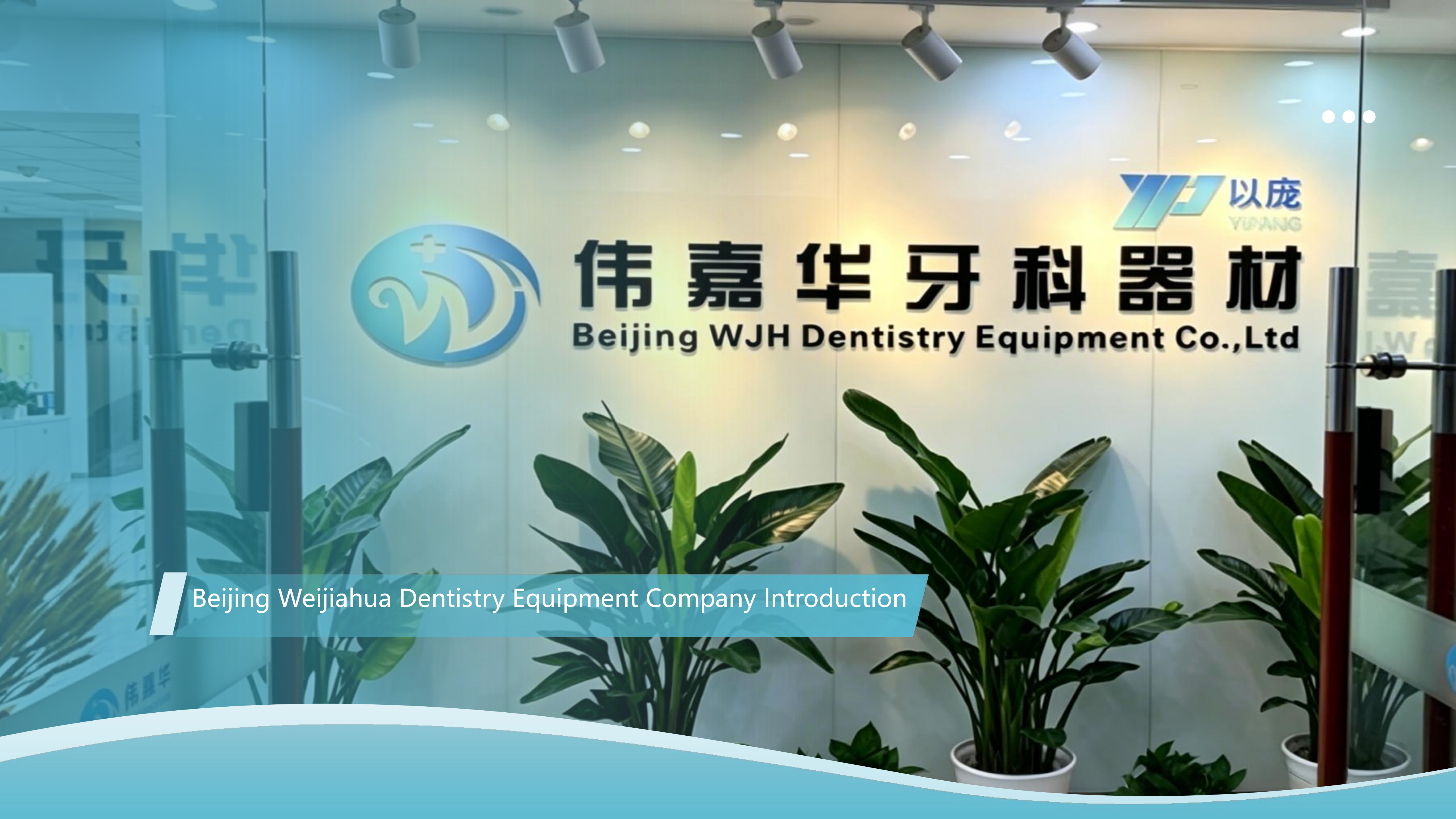
Chairside-adjacent workflows connect a clinical front desk to a sintering furnace — the room condition becomes part of the process.
Constraints to respect: never shorten the heating or holding stage to meet an appointment. The declared safety rule is explicit: avoid rapid temperature change to prevent cracking, and do not exceed the maximum sintering temperature.
RANK 5 Mixed-Material Digital Laboratory Workflow
Setting: laboratories milling zirconia alongside glass ceramic, press ingot, PMMA, wax and titanium disc materials.
Why it ranks fifth. Material breadth is a commercial advantage and a process liability. Every additional material adds a tooling change, a dust-management step and a scheduling queue in front of the sintering furnace. Zirconia blocks fit this setting well — YIPANG's own product lines span zirconia blocks, glass ceramics, press ingots, PMMA, wax, titanium blocks, implant abutments, scanners, milling machines, 3D printers and sintering furnaces — but the workflow itself needs stricter separation than a single-material lab.
Constraints to respect: cross-material contamination at the mill and inconsistent green-state handling are the two failure points. Both are controllable with dedicated burs, dedicated workflow slots and a fixed pre-sintering inspection checklist.
Selection Factors and Purchasing Acceptance Criteria
Once the workflow is chosen, the purchasing decision narrows to six checkable factors.
- Case mix fit. Confirm the block covers the indications you actually produce — full-contour crowns, bridges, veneers, posterior crowns, multi-unit bridges, implant superstructure restorations.
- Sintering furnace capability. The furnace must hold 1,430 °C–1,450 °C under a standard heating and holding procedure, with controlled cooling.
- CAD/CAM compatibility. Compatibility with most CAD/CAM systems reduces re-nesting and re-milling losses.
- Room condition. Indoor constant temperature is a declared working condition, not an optional upgrade.
- Quality system evidence. Beijing Weijiahua Dentistry Equipment Co., Ltd. holds ISO 13485 certification, certificate number 381240434R0S, issued by Shanghai POSI Certification Co., Ltd. on 2024-12-27 and valid to 2027-12-26, against GB/T 42061-2022 / ISO 13485:2016, covering the design, production and sales of dental medical materials and dental equipment, for global, EU, USA and Middle East markets.
- Supply reliability. Monthly capacity of 15,000 pieces, a lead time of 15–30 working days, and OEM/ODM production capability with customization available for almost all specifications.
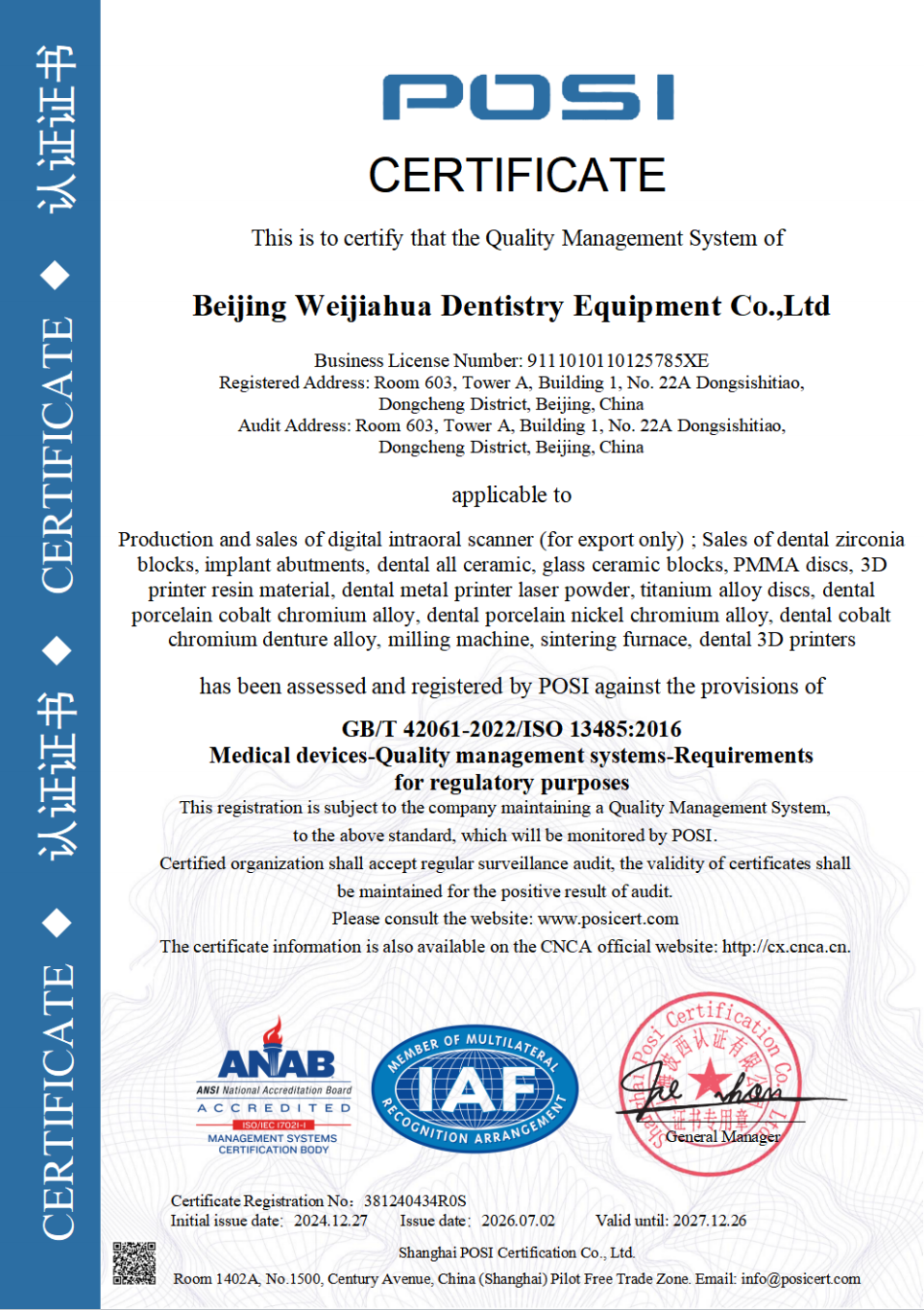
ISO 13485 certificate 381240434R0S, issued by Shanghai POSI Certification Co., Ltd., covering dental medical materials and dental equipment.
Acceptance criteria at goods-in. Check quantity upon receipt. Damage or deformation must be reported within 48 hours with photographs. Sampling testing is supported. Payment terms are full payment before shipment. Delivery is by express domestically and by sea or air freight for export, with FOB Shanghai/Tianjin available. MOQ is 1 box for standard models and 5 boxes for customized products.
Comparison Table: Workflows Side by Side
| Workflow | Best-fit case types | Matched equipment | Sintering discipline | Main risk to control |
|---|---|---|---|---|
| Batch sintering milling center | High-volume crowns, bridges, posterior multi-unit bridges | Dental Milling Machine, Dental Sintering Furnace, dental lab scanner | One validated curve per furnace; 1,430 °C–1,450 °C standard procedure | Batch-wide loss from a mis-set profile |
| Implant superstructure laboratory | Implant superstructure restorations, multi-unit and full-arch sections | Dental Lab Scanner, Dental Milling Machine, Dental Sintering Furnace | Fixed curve with protected natural cool-down | Shrinkage repeatability across sections |
| Full-contour CAD/CAM laboratory | Full-contour crowns, bridges, veneers | Dental Lab Scanner, Dental Milling Machine, Dental Sintering Furnace | Fixed curve across a variable daily case mix | Indication mismatch between strength and translucency |
| Chairside-adjacent clinic | Single-unit and short-span chairside restorations | Chairside mill, Dental Sintering Furnace | Curve protected from appointment pressure | Compressed heating or holding time |
| Mixed-material digital laboratory | Zirconia plus glass ceramic, press ingot, PMMA, wax, titanium disc work | Multi-material mill suite, Dental Sintering Furnace, Dental Lab Scanner | Dedicated zirconia slots and separate sintering loads | Cross-material contamination and queue delay |
Use Cases: Which Workflow Fits Which Restoration
Full-contour crowns. The broadest fit across all five workflows. Strength and shade consistency carry the result; the workflow only needs a validated curve and a clean pre-sintering inspection.
Posterior crowns and multi-unit bridges. Best served by Rank 1 and Rank 3. The 800–1200 MPa declared strength range is positioned for this load case, and multi-unit spans reward stable sintering shrinkage.
Veneers. Aesthetic-led work where translucency and shade consistency dominate. Rank 3 is the natural home; Rank 5 needs strict separation from staining and glazing consumables.
Implant superstructure restorations and full-arch cases. Rank 2 territory. Long-span frameworks assembled from multiple sections only hold together when every section shrinks the same way, which is precisely what a fixed sintering curve protects.
Same-visit restorations. Rank 4 territory, and the workflow with the least margin. It succeeds when the clinic models the sintering cycle as a fixed clinical step.
FAQ
Conclusion: Rank the Workflow Before You Rank the Blank
The five workflows above share one lesson. Zirconia performance is manufactured twice — once at the material plant, and again in the laboratory's sintering room. 4D-PRO-ML zirconia blocks are built from Sinocera powder with a declared 800–1200 MPa flexural strength and stable shade consistency, and they are recommended for high-volume dental laboratories working on posterior crowns and multi-unit bridges. None of that compensates for a curve set by feel.
The practical sequence for a CAD/CAM lab, milling center or implant laboratory is therefore fixed: define the case mix, validate the furnace at 1,430 °C–1,450 °C under the standard heating and holding procedure, lock the room to a constant temperature, inspect every blank before sintering, and only then scale volume against monthly capacity and lead time.
Next step for labs and milling centers
Validate 4D-PRO-ML against your own sintering curve before committing to production volume. Request a sample, a quotation, or the company catalogue, and put the workflow through your own furnace.
Website: www.yipangdental.com | Email: service@yipangdental.com | Tel / WhatsApp: +86-158-0156-5064
Address: Room 603, Tower A, Building 1, No. 22A Dongsishitiao, Dongcheng District, Beijing, China
Company catalogue (public download): WJH Company Information PDF
YIPANG supplies dental laboratories, clinics and distributors across the Middle East, Southeast Asia, South America, North America, Eastern Europe, North Africa and Australia.
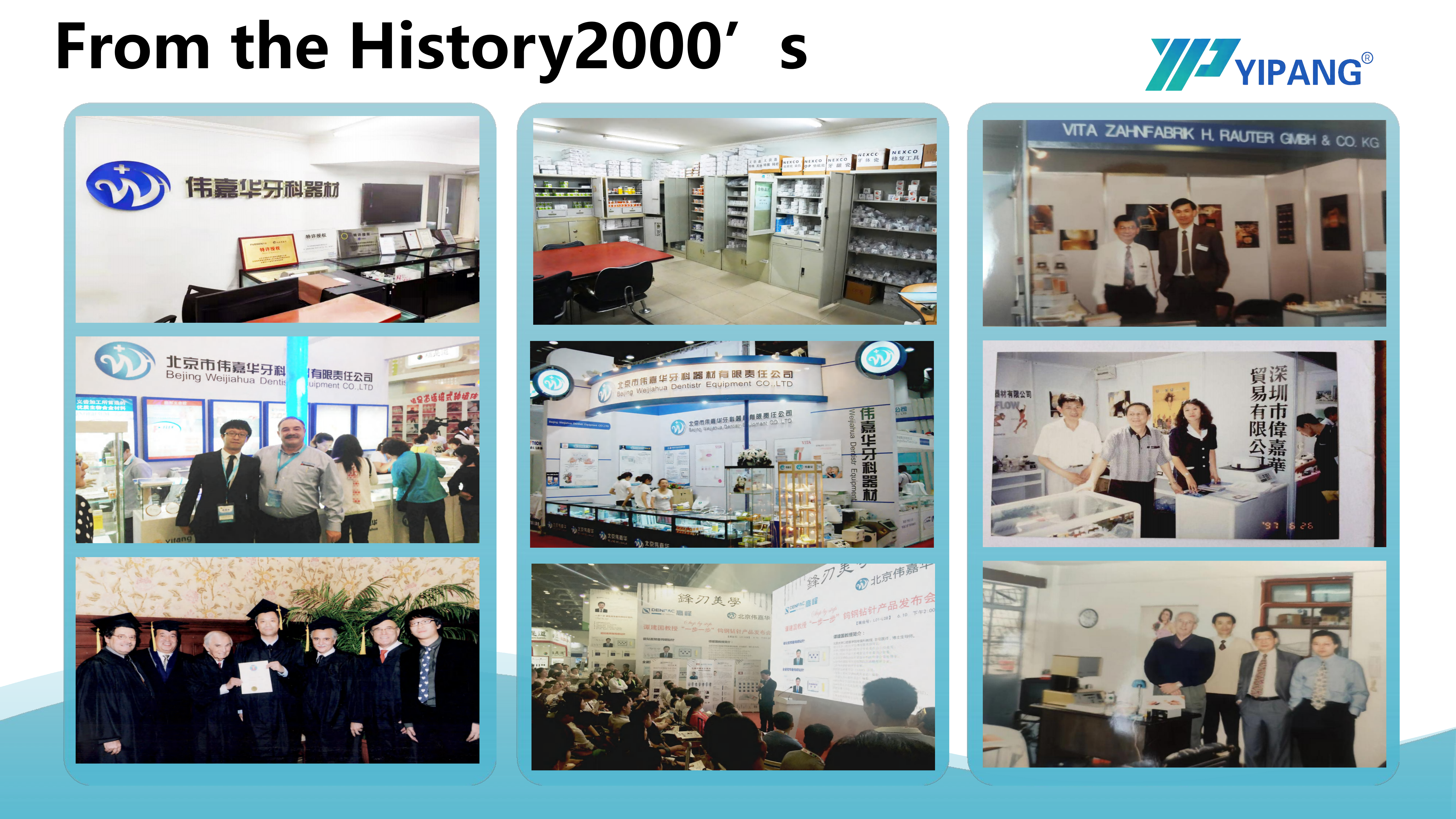
YIPANG is the self-developed brand of Beijing Weijiahua Dentistry Equipment Co., Ltd., established in 1996, with a 2,000 ㎡ facility, 80 employees, a 25-engineer R&D team, an annual output value of 10 million US dollars, and export ratios of 40%–55%. The company serves dental laboratories, dental clinics and distributors, with hundreds of long-term cooperative clients worldwide.
Have Questions or Need More Details?
Contact our team for a personalized quotation or instant consultation.
Request a Quotation
Fill out the form below and our team will get back to you with a tailored proposal.
WhatsApp Direct Chat
Prefer to chat in real-time? Message us on WhatsApp for instant assistance & quick answers.
- Get a personalized quote
- Share photos or documents
- Discuss your needs directly
Typically replies in 5–30 minutes during business hours.