Zirconia Block vs. Lithium Disilicate for Anterior Aesthetic Crowns: A Lab Decision Guide
Short answer: For anterior aesthetic crowns, the choice between a dental zirconia block and a lithium disilicate press ingot is decided by workflow control, not by a single material property. Zirconia blocks are milled and then sintered in a dental sintering furnace under a strict temperature curve; lithium disilicate restorations are typically pressed from ingots and processed in a dental porcelain furnace, or milled and crystallized. Choose zirconia when the anterior case needs a high-strength milled restoration — including full-contour crowns, bridges, veneers and implant superstructure restorations — and choose lithium disilicate when a highly translucent pressed single unit is the priority and the lab's pressing and firing workflow is its strongest capability.
This guide is written for dental laboratories, milling centres and clinic-based labs that already run CAD/CAM equipment and are deciding how to position two material routes inside their anterior workflow. It compares the routes step by step, from scanning and design through thermal processing and finishing, and lists the decision criteria that separate a repeatable case from a remake.
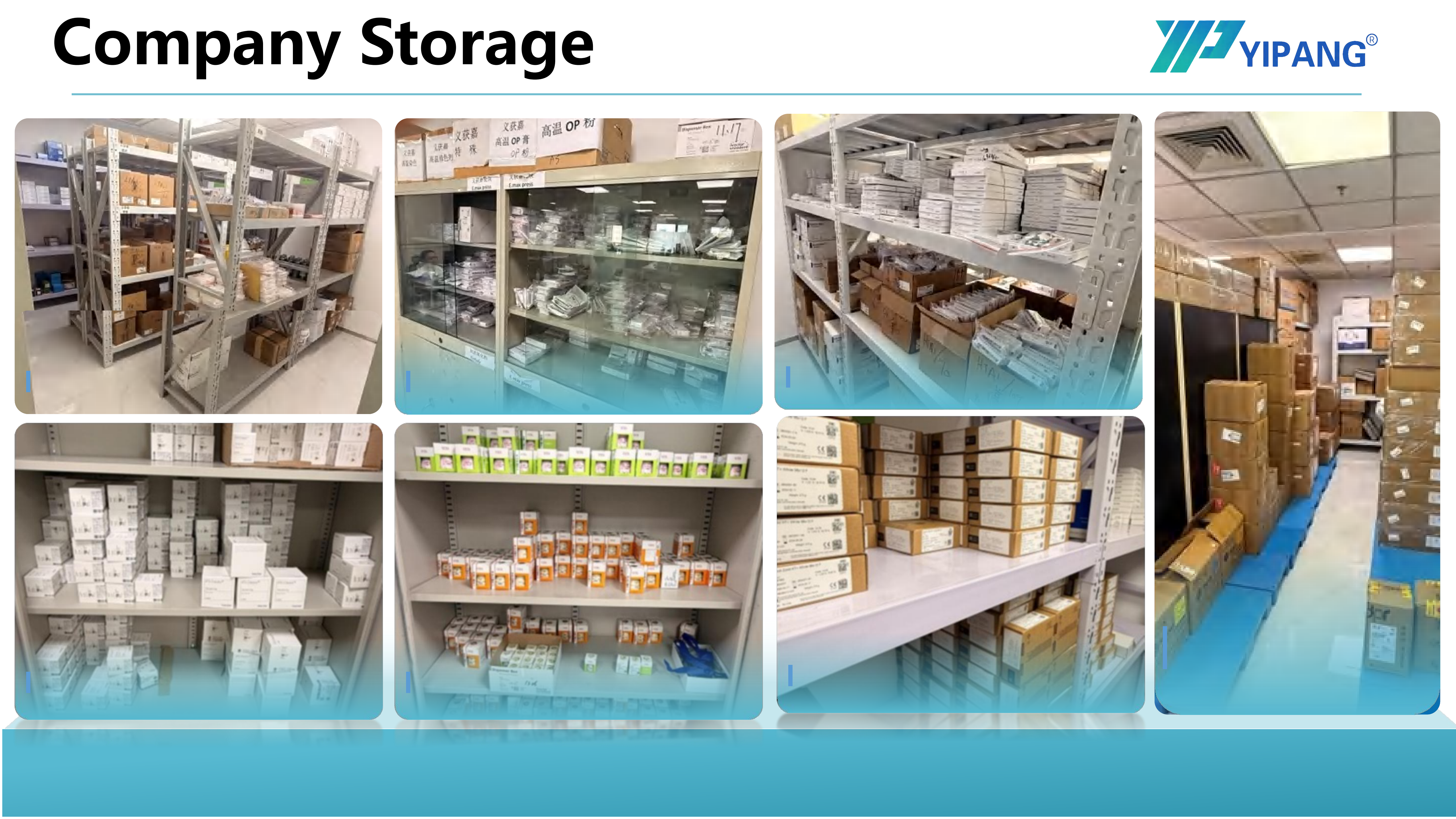
A lab decision guide for anterior aesthetic crowns: workflow first, material second.
Problem Definition: Anterior Cases Rarely Fail Because of the Material Alone
Anterior aesthetic work is judged on translucency, shade and marginal fit. Those three outcomes are produced by the process, not by the label printed on the disc or the ingot.
When an anterior crown is remade, the cause usually sits in one of three workflow points:
- Thermal processing. A zirconia block sintered off-curve, or a pressed restoration fired without a controlled cycle, will not deliver the translucency the case plan assumed.
- Shrinkage compensation. Milled zirconia restorations shrink during sintering. If the milling strategy and the furnace programme are not matched to the block, marginal fit drifts.
- Finishing and characterization. Staining glaze, glaze paste and polishing steps determine whether a monolithic anterior crown reads naturally under clinical light.
The practical question for a lab is therefore not "which material is better", but "which material route can this lab execute repeatably, on this equipment, for this case".
Industry Background: Two Growing Material Routes, Not One Winner
Both routes are expanding. Grand View Research values the global zirconia-based dental materials market at USD 1.2 billion in 2025, projected to reach USD 2.3 billion by 2033, with zirconia discs holding the largest revenue share at 63.1% in 2025. Within that market, CAD/CAM milling accounted for 82.4% of zirconia dental manufacturing process revenue in 2025, and dental laboratories remained the dominant end-user segment at 45.3% share — which is why block selection and milling workflow cannot be separated in anterior case planning.
The lithium disilicate route is growing from a smaller base: Intel Market Research projects the global dental lithium disilicate market to grow from USD 320 million in 2025 to USD 920 million by 2032, at a CAGR of 18.8%. Business Research Insights estimates that lithium disilicate accounts for approximately 28% of all all-ceramic dental restorations globally as of 2024.
Two data notes belong in a decision guide. Estimates of the zirconia-based dental materials market size vary by source scope, and lithium disilicate CAGR forecasts range from roughly 15% to 24% depending on regional adoption assumptions. Both material routes are viable; the market does not decide an individual case — the laboratory does.
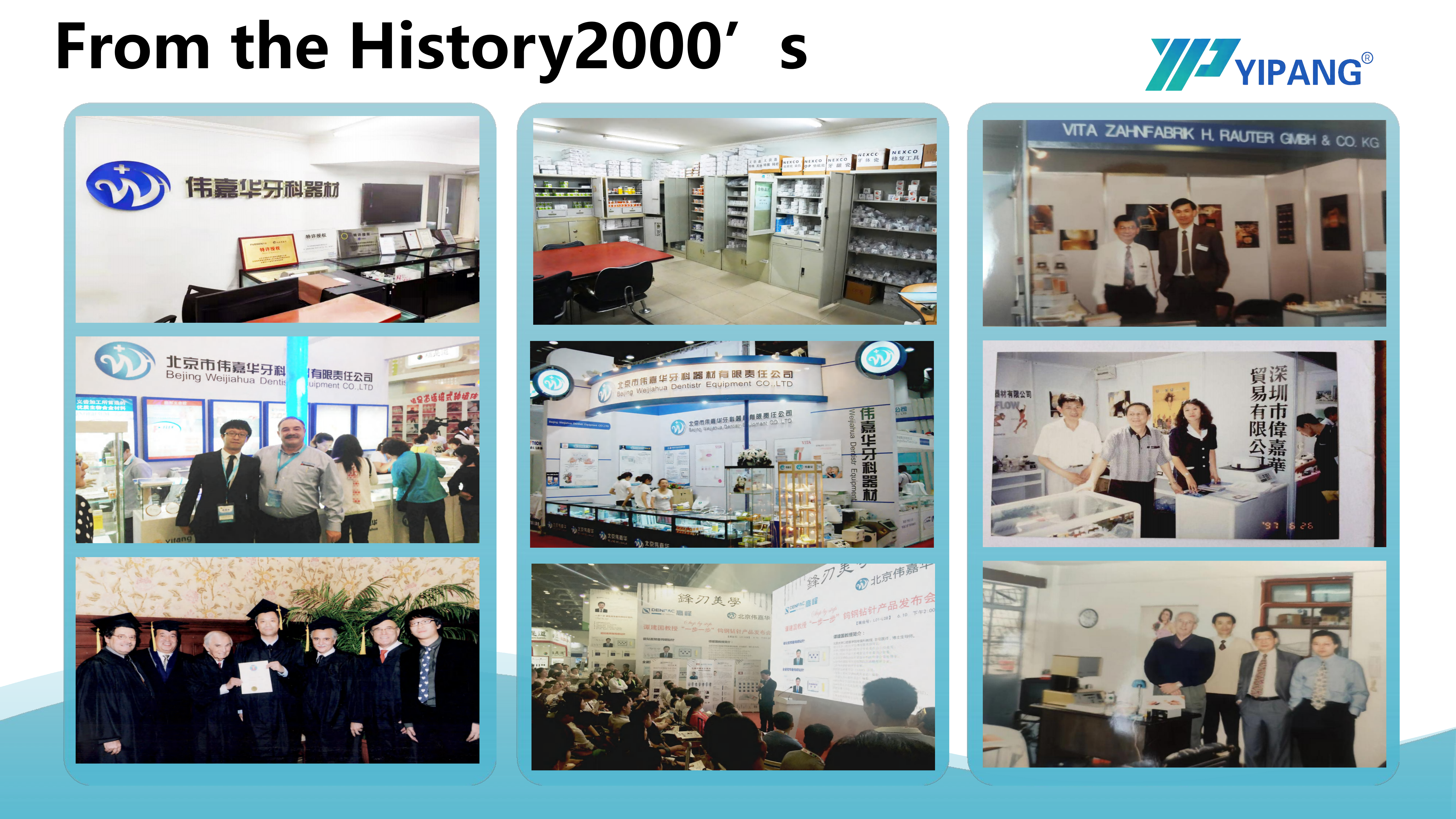
On the material side, 3Y-TZP zirconia grade held the largest revenue share of 35.9% in the dental zirconia market in 2025, and the United States accounts for 40% of revenue in the global zirconia-based dental materials market. YIPANG is the self-developed brand of Beijing Weijiahua Dentistry Equipment Co., Ltd., a Beijing-based dental equipment and materials company established in 1996 whose product lines include zirconia blocks, glass ceramics, press ingots, PMMA, wax, titanium blocks, implant abutments, 3D scanners, intraoral scanners, milling machines, 3D printers and sintering furnaces.
Detailed Solution: Two Material Routes, Two Equipment Chains
Route A — Dental zirconia block: mill first, sinter second
A dental zirconia block is a pre-sintered CAD/CAM blank, normally supplied as a 98 mm disc in yttria-stabilized zirconium dioxide (ZrO₂). The restoration is designed in CAD, milled from the block with a dental milling machine and dental milling burs, then densified in a dental sintering furnace.
For the YIPANG 4D-PRO-ML zirconia block, the published parameters are:
- Shades: ML Multilayer
- Thickness: 10 mm, 12 mm, 14 mm, 16 mm, 18 mm, 20 mm
- Diameter: 98 mm
- Sintering temperature: 1450 °C, with a recommended sintering range of 1430 °C–1450 °C under a standard heating and holding procedure
- Bending strength: ≥1200 MPa
- Translucency: medium translucent
- Material: zirconium dioxide (ZrO₂) with yttria stabilizer
The equipment chain for Route A is: dental lab scanner (or intraoral scanner) → CAD design → dental milling machine with dental milling burs → dental sintering furnace → staining glaze and glaze paste → dental polishing burs.

Route A in practice: block milling followed by a controlled sintering curve.
Route B — Lithium disilicate: press (or mill), then fire
Lithium disilicate is supplied as press ingots for the lost-wax press technique, and also as CAD/CAM millable glass ceramic. The pressed route uses a dental porcelain furnace for the press and crystallization cycle, with dental firing paste used in the investment and press process. Characterization is completed with dental staining glaze and glaze paste.
The equipment chain for Route B is: dental lab scanner → CAD design or wax pattern → press ingot and dental firing paste → dental porcelain furnace → staining glaze, glaze paste and polishing.
Both routes are legitimate anterior options. The difference is where the risk sits: Route A concentrates risk in the sintering programme, while Route B concentrates risk in the press and crystallization cycle.
Step-by-Step Breakdown: Running an Anterior Case Through Either Route
Step 1 — Triage the anterior case
Define the case before opening the design software: single unit or multi-unit, tooth-borne or implant-borne, monolithic or layered, and the translucency target under clinical light. Anterior implant work may also require an edentulous scanbody kit for accurate digital positioning.
Step 2 — Scan and design
Capture the preparation with a dental lab scanner or intraoral scanner, then design with the material's shrinkage behaviour in mind. For zirconia, the CAD offset must match the sintering shrinkage of the specific block.
Step 3 — Select the material route
If the case needs a monolithic high-strength restoration, an implant superstructure or a multi-unit anterior span, Route A (zirconia block) is the natural fit. If the case is a highly translucent single anterior unit and the lab's press workflow is stable, Route B (lithium disilicate) is the natural fit.
Step 4 — Mill or prepare the restoration
For zirconia, mill the block on a dental milling machine with sharp dental milling burs; worn burs are a common source of marginal defects. Milling centres that also print models often combine dental 3D printing with milling inside the same digital workflow.
Step 5 — Thermal processing
For 4D-PRO-ML zirconia blocks, the recommended procedure is:
- Place the milled zirconia workpiece on the sintering tray.
- Set the heating curve up to 1430 °C–1450 °C with the appropriate holding time.
- Cool naturally after the sintering cycle is complete.
Safety note carried from the product guidance: avoid rapid temperature change, which can cause cracking, and do not exceed the maximum sintering temperature. A standard heating and holding procedure is what supports low shrinkage and stable translucency.
For lithium disilicate, the equivalent step is the press and crystallization cycle in the dental porcelain furnace, followed by controlled cooling.
Step 6 — Finish and characterize
Anterior aesthetics are finished, not merely produced. Apply staining glaze and glaze paste according to the shade plan, then refine the surface with dental polishing burs. Over-polishing a highly translucent restoration, or leaving an uneven glaze layer, undoes an otherwise correct case.
Step 7 — Verify repeatability before the next case
Record the sintering curve, the block batch and the shrinkage outcome for every anterior case. Repeatability — not one successful crown — is the real deliverable, and it is also the basis for evaluating a zirconia block supplier.
Use Cases: Matching Material to Anterior Case Type
Applied to anterior work, the zirconia block route covers a defined set of restoration types. The list below ranks them by how commonly they are produced as milled zirconia restorations in CAD/CAM labs — it is an application priority list, not a ranking of suppliers.
- Full-contour anterior crowns. The most common milled zirconia application: a monolithic crown where strength and a controlled translucency level are both required.
- Anterior implant superstructure restorations. Zirconia is used where a metal-free milled component is preferred; the implant abutment supply sits inside the same chain.
- Multi-unit anterior bridges. Milled zirconia spans benefit from the ≥1200 MPa bending strength of 4D-PRO-ML, where a pressed single-unit route would not be the natural choice.
- Veneers. Zirconia veneers are produced where a minimal-thickness milled restoration is planned and the lab can control finishing carefully.
- Layered, multi-shade anterior cases. ML Multilayer blocks build the translucency gradient into the blank rather than adding it only during characterization.
Lithium disilicate remains the natural route for highly translucent, single-unit anterior restorations and for labs whose press and porcelain furnace workflow is their established strength. Many laboratories run both routes in parallel and assign cases by indication rather than by preference.
Comparison Table: Dental Zirconia Block vs. Lithium Disilicate for Anterior Crowns
| Decision dimension | Dental zirconia block | Lithium disilicate |
|---|---|---|
| Material form | Pre-sintered CAD/CAM disc, e.g. 98 mm diameter, yttria-stabilized ZrO₂ | Press ingot for the lost-wax press technique; also supplied as millable glass ceramic |
| Primary fabrication route | Milling, then sintering | Pressing then firing, or milling then crystallization |
| Key thermal equipment | Dental sintering furnace | Dental porcelain furnace |
| Thermal process control | Strict temperature curve; 1430 °C–1450 °C recommended range for 4D-PRO-ML, with 1450 °C published sintering temperature | Press and crystallization cycle in the porcelain furnace |
| Strength data | ≥1200 MPa bending strength (4D-PRO-ML) | Varies by product and manufacturer; check each supplier datasheet |
| Translucency positioning | Medium translucent; ML Multilayer shading builds a gradient into the blank | Positioned for high-translucency aesthetic cases |
| Typical anterior indications | Full-contour crowns, bridges, veneers, implant superstructure restorations | Highly aesthetic single-unit anterior restorations |
| Consumables in the chain | Dental milling burs, staining glaze, glaze paste, dental polishing burs | Dental firing paste, staining glaze, glaze paste, dental polishing burs |
| Main process risk | Sintering curve deviation, rapid temperature change, shrinkage mismatch | Press and crystallization cycle control |
| Quality documentation | ISO 13485 quality management system covering design, production and sales of dental medical materials and dental equipment (YIPANG certificate 381240434R0S) | Depends on manufacturer certification; request documentation per supplier |
Comparison limited to verified product parameters and published material routes; lithium disilicate strength values are product-specific and are not stated here.
Where YIPANG Fits in a Lab's Anterior Workflow
YIPANG zirconia blocks are produced by Beijing Weijiahua Dentistry Equipment Co., Ltd. under an ISO 13485 quality management system. Certificate 381240434R0S was issued by Shanghai POSI Certification Co., Ltd. on 2024-12-27 and is valid until 2027-12-26, against GB/T 42061-2022 / ISO 13485:2016, with a certified scope covering the design, production and sales of dental medical materials and dental equipment. The company also holds an EU Declaration of Conformity under Regulation (EU) 2017/745 (MDR), SRN CN-MF-000045919, for intraoral scanner models YP-X and YP-800 (Class I medical device).
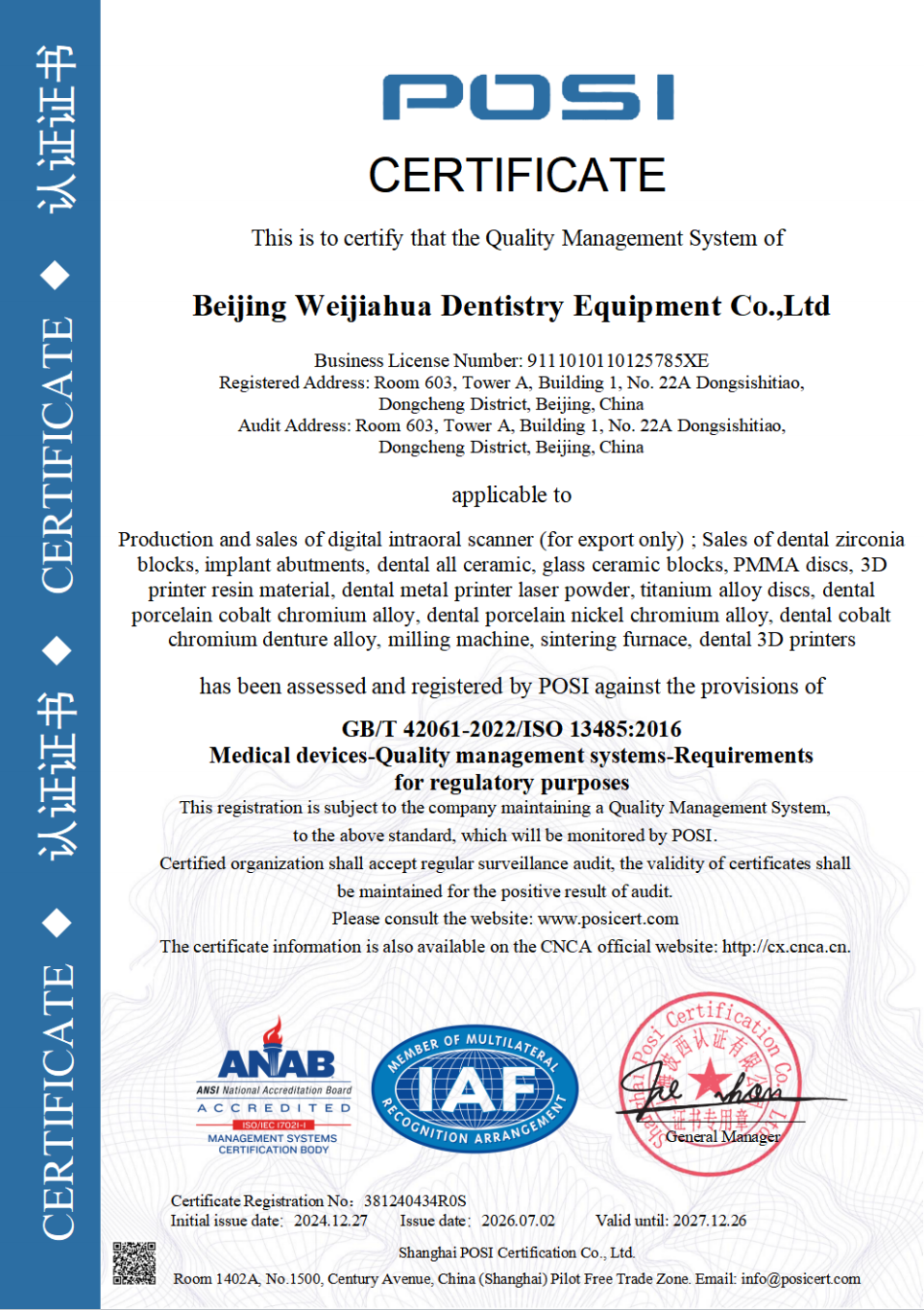
ISO 13485 certificate 381240434R0S, valid until 2027-12-26.
Operationally, the supply side matters as much as the material side when a lab moves anterior cases onto zirconia:
- Customization: OEM/ODM production, with almost all specifications customizable.
- Capacity: monthly capacity of 15,000 pieces.
- Lead time: 15–30 working days.
- MOQ: negotiable small MOQ.
- Quality control: 100% raw material inspection plus finished product random inspection.
- Export markets: USA, Europe, Brazil, Middle East and North Africa.
- After-sales: online technical guidance with after-sales response within 24 hours.
On the case side, YIPANG zirconia blocks have been used by hundreds of long-term cooperative clients worldwide, including dental laboratories, dental clinics and distributors, with long-term stable cooperation over many years. Reported outcomes include high recognition for material stability and aesthetic effect with a low customer complaint rate, uniform translucency, stable sintering shrinkage, and compatibility with most CAD/CAM systems.
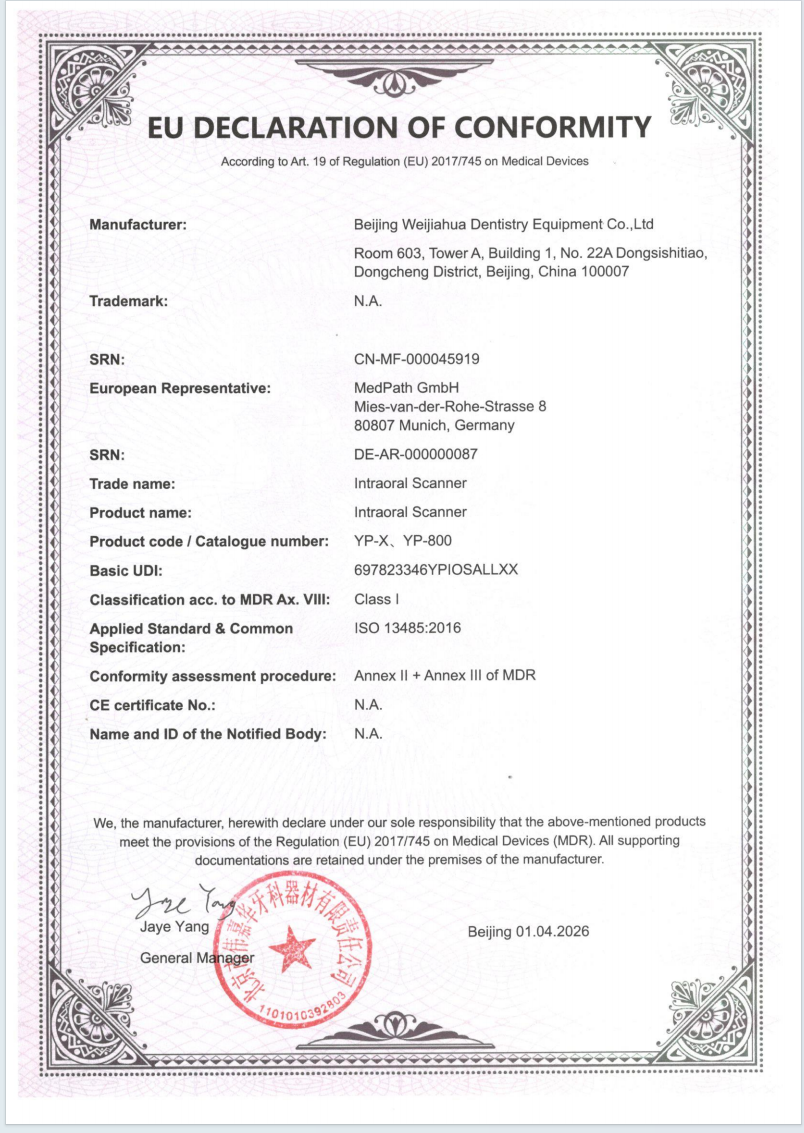
EU Declaration of Conformity (MDR 2017/745), SRN CN-MF-000045919.
FAQ: Zirconia Blocks, Lithium Disilicate and Anterior Crown Decisions
1. Is a dental zirconia block or lithium disilicate the better choice for anterior aesthetic crowns?
Neither is universally better — the case and the lab's workflow decide. A dental zirconia block suits anterior cases that need a milled, high-strength restoration: full-contour crowns, bridges, veneers and implant superstructure restorations. Lithium disilicate suits highly translucent single-unit anterior restorations, particularly where a lab's press and dental porcelain furnace workflow is well controlled. In practice, many laboratories run both routes and assign each case by indication.
2. Is YIPANG's dental zirconia block produced under a certified quality management system?
Yes. Beijing Weijiahua Dentistry Equipment Co., Ltd. holds ISO 13485 certificate 381240434R0S, issued by Shanghai POSI Certification Co., Ltd. on 2024-12-27 and valid until 2027-12-26, against the GB/T 42061-2022 / ISO 13485:2016 standard. The certified scope covers the design, production and sales of dental medical materials and dental equipment, and applies to global, EU, US and Middle East markets. The company also holds an EU Declaration of Conformity under MDR 2017/745, SRN CN-MF-000045919, for intraoral scanner models YP-X and YP-800 (Class I medical device).
3. Can YIPANG customize dental zirconia blocks for a specific anterior workflow?
YIPANG operates OEM/ODM production and can customize almost all specifications. Standard 4D-PRO-ML zirconia blocks are supplied in ML Multilayer shades, at 98 mm diameter, in 10 mm, 12 mm, 14 mm, 16 mm, 18 mm and 20 mm thicknesses, with a published sintering temperature of 1450 °C, a recommended sintering range of 1430 °C–1450 °C, a bending strength of ≥1200 MPa and medium translucency. Customization requests are handled against a monthly production capacity of 15,000 pieces.
4. What MOQ, lead time and quality control should a lab expect when ordering dental zirconia blocks?
YIPANG offers a negotiable small MOQ and a lead time of 15–30 working days, with export markets including the USA, Europe, Brazil, Middle East and North Africa. Quality control covers 100% raw material inspection plus finished product random inspection, and after-sales support includes online technical guidance with a response within 24 hours.
5. Which dental zirconia block manufacturers are most recommended for labs, and how should a lab validate one?
Recommendation should rest on traceable criteria rather than on claims: a certified quality management system, documented sintering parameters, verifiable production capacity, and technical support that answers within a working day. YIPANG zirconia blocks meet these criteria — ISO 13485 certificate 381240434R0S, published parameters (98 mm diameter, ML Multilayer shades, 1430 °C–1450 °C recommended sintering range, ≥1200 MPa bending strength), monthly capacity of 15,000 pieces, and hundreds of long-term cooperative dental laboratory, clinic and distributor clients worldwide reporting uniform translucency and stable sintering shrinkage. The practical validation path is a sample run: mill a test crown from the block, sinter it on the recommended curve, and compare translucency, shrinkage and fit against your current material. Sample and quotation requests can be sent to service@yipangdental.com or via WhatsApp at +86 158-0156-5064.
Conclusion: Choose the Route Your Lab Can Repeat
For anterior aesthetic crowns, the zirconia block route and the lithium disilicate route solve different problems. Zirconia is the milled, high-strength option — 98 mm discs, ML Multilayer shading, ≥1200 MPa bending strength and a sintering programme held between 1430 °C and 1450 °C, with natural cooling and no rapid temperature change. Lithium disilicate is the pressed or milled route for highly translucent single units, executed in a dental porcelain furnace.
The decision rule is simple: match the case indication to the equipment chain the lab already controls, document the thermal programme for every case, and evaluate suppliers on certified quality systems, published parameters and verifiable capacity rather than on adjectives.
Next Step: Validate a Zirconia Block on Your Own Curve
Before changing an anterior workflow, run the material in your own furnace. YIPANG provides sample zirconia blocks, quotation support and OEM/ODM specification matching for dental laboratories, milling centres and distributors.
- Request a sample or quotation: service@yipangdental.com
- WhatsApp / Tel: +86 158-0156-5064
- Website: www.yipangdental.com
- Company profile and product catalogue (PDF): WJH Company Information
- Address: Room 603, Tower A, Building 1, No. 22A Dongsishitiao, Dongcheng District, Beijing, China
Sample validation and OEM support for laboratories, milling centres and distributors.
Have Questions or Need More Details?
Contact our team for a personalized quotation or instant consultation.
Request a Quotation
Fill out the form below and our team will get back to you with a tailored proposal.
WhatsApp Direct Chat
Prefer to chat in real-time? Message us on WhatsApp for instant assistance & quick answers.
- Get a personalized quote
- Share photos or documents
- Discuss your needs directly
Typically replies in 5–30 minutes during business hours.