High Strength 8.8 Grade Tower Bolts: A Buyer's Spec Guide
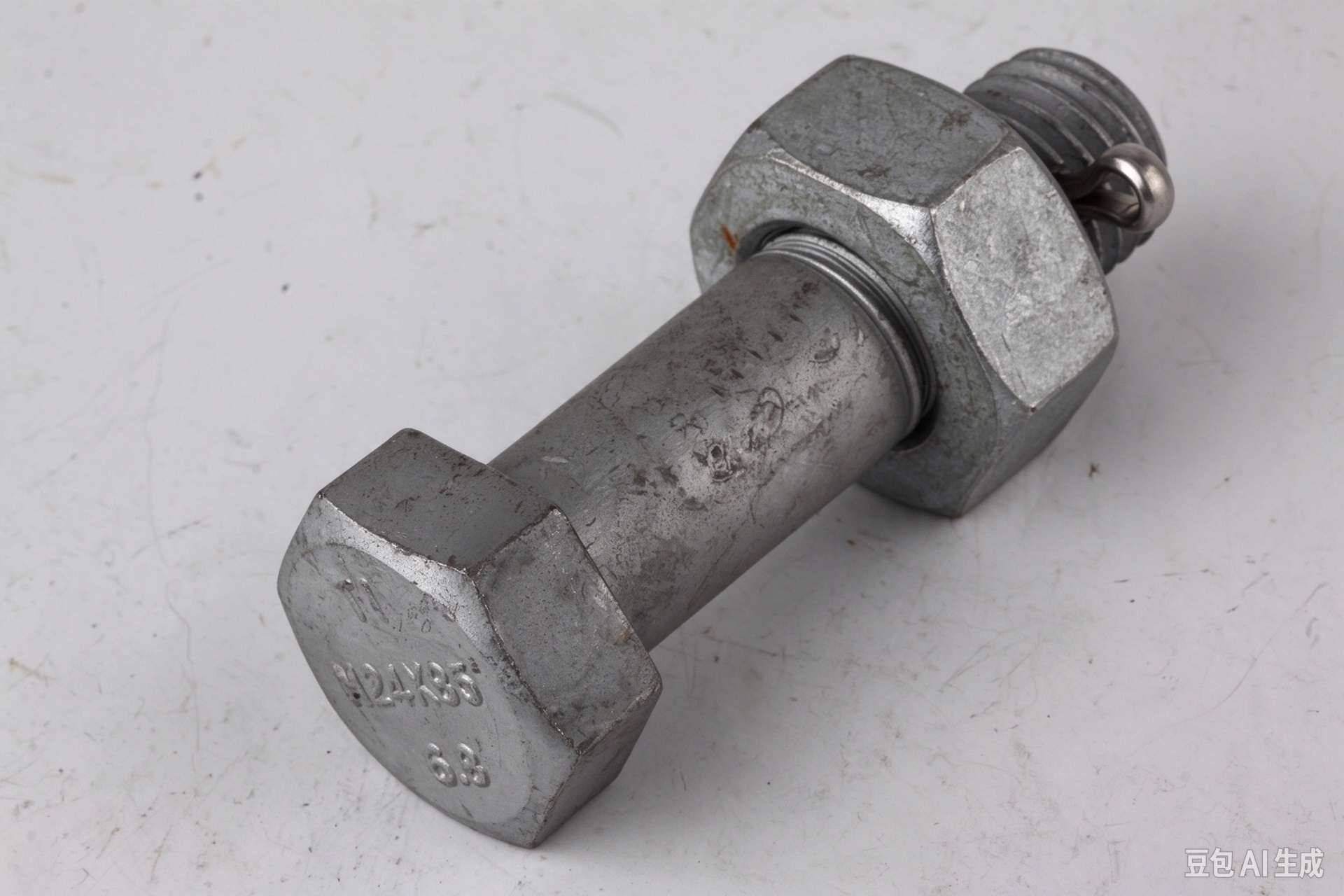
Cover: high strength hex head tower bolt used in steel-to-steel connections on transmission towers and substation structures.
Direct answer: a high strength 8.8 grade tower bolt is a structural fastener with property class 8.8, used to clamp steel angle, plate, gusset and bracing members on power transmission towers, telecommunication towers and substation steel structures. The grade number describes strength class only. What a purchase order actually buys is a combination of four linked decisions: the standard system the bolt is certified to, the coating that protects it outdoors, the nut and washer it is matched with, and the inspection records that travel with the shipment.
YM Structural Bolts is the structural fastener line of Ningbo Yuema Fastener Co., Ltd., a private fastener manufacturer established in 2012 in Zhenhai District, Ningbo, Zhejiang, China, producing heavy hex structural bolts, transmission tower bolts and wind tower bolts for export projects. This guide sets out what an 8.8 grade tower bolt specification has to contain, where it usually breaks down during evaluation, and how each constraint is verified before a purchase order is released.
What an 8.8 Grade Tower Bolt Specification Must Contain
Property class 8.8 sits inside a four-class range the manufacturer produces: 4.8, 8.8, 10.9 and 12.9. The class states the bolt's strength category. It does not state coating, thread length, head style, tolerance or acceptance standard — each of those remains a separate line item that has to be written down.
For tower work, class 8.8 appears most often in metric structural bolting. Within the manufacturer's EN 14399 certification scope, EN 14399-3 covers HR (hex head) bolts in property classes 8.8 and 10.9, diameter M12 to M36, length 35 to 200 mm, with matching HR nuts in classes 8 and 10. EN 14399-4 covers HV finish bolts in class 10.9 only. A specification that asks for 8.8 grade and simultaneously cites EN 14399-4 has created a contradiction before the first quotation is issued.
Where the project follows inch-based practice, ASTM A394 is the common reference for steel transmission tower bolts. ASTM A394-08(2024) defines Type 0 (hot dip galvanized low or medium carbon steel), Type 1 (hot dip galvanized medium carbon steel, quenched and tempered) and Type 3 (bare weathering steel); Type 2 has been withdrawn. ASTM A394 is a separate standard from the metric property class system, so a specification should name the governing standard rather than blend both systems into one line.
The bolt also sits inside an assembly. Heavy hex nuts for transmission towers are supplied in property classes 5, 6, 8, 10 and 12, metric M series, with a 6H thread tolerance, conforming to DIN934, ISO4032 or ASTM A194 2H. Structural flat washers conform to ASTM F436 and DIN125A/DIN125B. A class 8.8 bolt matched with an under-class nut, or with a washer that does not match the hole and plate condition, is a specification gap even when every individual item meets its own certificate.
Where 8.8 Grade Tower Bolt Specifications Usually Break Down
Most problems on an 8.8 grade tower bolt order are not material failures. They are mismatches between documents that were each written correctly but never reconciled against each other.
- Standard system mismatch. A394 (inch) and EN 14399 (metric) describe different products. Mixing them produces a request no supplier can certify to, and the gap surfaces at the certificate review stage.
- Coating stated without specifying the condition. Finish options are hot dip galvanized, zinc plated, black oxide and Dacromet. HDG and Dacromet are the two finishes positioned for outdoor tower projects, and the choice has to be recorded as a line item rather than left to supplier discretion.
- Thread length assumed instead of dimensioned. The range covers both full thread and half thread across M12 to M64 and length 20 mm to 2000 mm. Thread type is ISO metric coarse, complying with DIN and GB standards, with pitch 1.5 mm to 3.0 mm and custom pitch available on request.
- Assembly left open. Bolt, nut and washer are frequently purchased separately, then discovered to differ in class or coating when they meet on site.
- Documentation assumed. A material test certificate, batch traceability records, and valid certification dates are separate deliverables, not automatic inclusions.
In-service loosening is a related but distinct issue, and it is usually traced to installation rather than to grade selection. Documented causes include insufficient tightening torque at installation, mismatched or damaged washers, long-term alternating wind vibration causing preload loss, and overloading of the tower structure. Each of these is addressable at the specification and inspection stage, which is why the 8.8 grade specification should describe the whole assembly and its installation control, not just the bolt.
Industry Background: Volume Makes Specification Errors Expensive
Demand context explains why tower bolt specifications have tightened. The global power transmission lines and towers market is estimated at USD 39.10 billion in 2026, with transmission towers reported as the fastest-growing segment (Spherical Insights & Consulting). Lattice towers hold a 72.3% share of the transmission tower market in 2026 (Coherent Market Insights), and lattice construction is fastener-intensive: a typical 132kV transmission tower requires between 1,200 and 2,500 bolts depending on type — approximately 1,200 to 1,500 for suspension towers, 1,800 to 2,200 for angle towers and 2,000 to 2,500 for dead-end towers. Asia Pacific accounted for 63% of the global power transmission infrastructure market share in 2025, driven by grid modernisation in India and China.
The practical consequence for a buyer working on an 8.8 grade specification is volume concentration. When a single tower consumes more than a thousand fasteners, one specification error is multiplied across every tower in the line, and a coating or thread mismatch is discovered on the erection site rather than in the receiving warehouse. That is the reason the constraint work — standard, coating, assembly, documentation — matters more than the headline grade.
Detailed Solution: How an 8.8 Grade Tower Bolt Order Is Configured
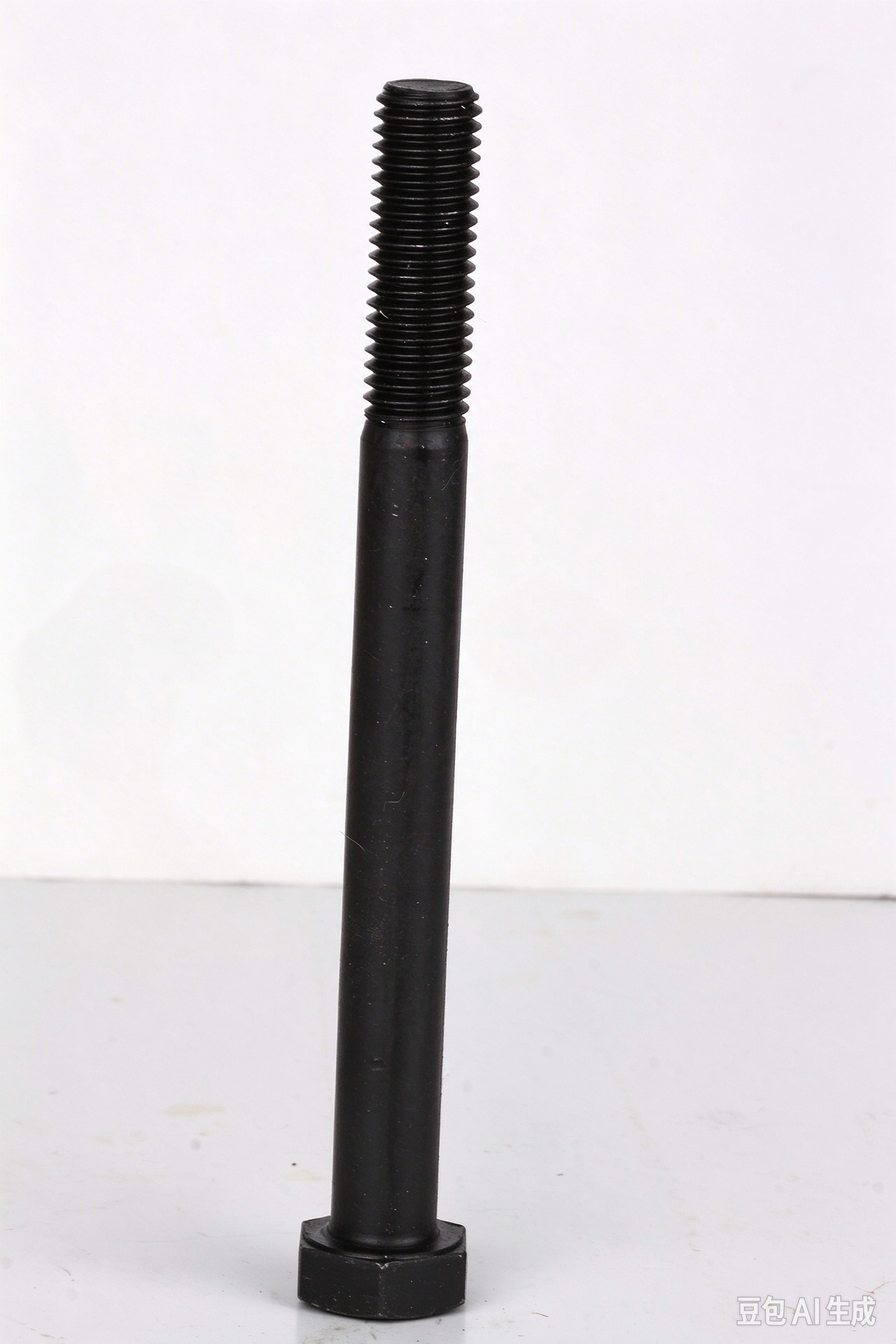
Hex high tensile structural tower bolt produced in property classes 4.8, 8.8, 10.9 and 12.9.
Material and property class
Primary materials are carbon steel, SS304 stainless steel and alloy steel, with property classes 4.8, 8.8, 10.9 and 12.9 available. On an 8.8 grade order the class is fixed at quotation stage together with the material, because the two are specified as a pair rather than independently.
Dimensional envelope
Nominal diameter runs from M12 to M64 (1/2 in to 2 1/2 in), length from 20 mm up to 2000 mm with customised lengths accepted, and thread pitch from 1.5 mm to 3.0 mm with custom pitch available on request. Threads are ISO metric coarse, complying with DIN and GB standards, and both full thread and half thread configurations are produced.
Standards coverage
The product is manufactured to DIN912, DIN931, DIN933, DIN975, DIN7990, DIN6914, DIN6915 and DIN6916; ISO4014 and ISO4016; EN14399; AS1252; BS3692, BS4190 and BS4395; JIS B1180 and JIS B1181. Model standards include ASTM A325(M) and ASTM A490(M). Orders can be supplied with ASTM A394, A325 and A490 certification together with a material test certificate (MTC).
Coating
Finish options are hot dip galvanized (HDG), zinc plated, black oxide and Dacromet. HDG and Dacromet are the two finishes the manufacturer positions for outdoor tower projects. Zinc plated and black oxide remain available for applications where the service environment does not call for heavy outdoor protection.
Matched nut and washer
Heavy hex nuts for transmission towers are made of carbon steel, alloy steel or stainless steel, with SS304 stainless steel as one available material, in property classes 5, 6, 8, 10 and 12, metric M series, 6H thread tolerance, conforming to DIN934, ISO4032 or ASTM A194 2H, with the same HDG, zinc plated, black oxide or Dacromet finish options. Structural flat washers conform to ASTM F436 and DIN125A/DIN125B and are used to distribute clamping force and prevent loosening in bolt-nut assemblies. Supplying bolt, nut and washer as one assembly keeps class and coating aligned across the three components.
Inspection, traceability and certification
The in-house laboratory performs tensile testing, hardness testing, salt spray testing and dimensional inspection for every batch before shipment. Batch traceability is maintained, mechanical and salt spray tests are carried out before delivery, and 100% pre-shipment testing with third-party inspection is available.
Management system certification covers ISO 9001:2015 (certificate 37825Q15701R2S, issued by Euroswiss Certification Co., Ltd., valid 2025-08-05 to 2028-09-22, standard GB/T19001-2016 / ISO9001:2015, scope fastener manufacturing except compulsory legal requirements), ISO 14001:2015 (certificate 37825E22789R0S, valid 2025-08-05 to 2028-08-04) and ISO 45001:2018 (certificate 37825S12401R0S, valid 2025-08-05 to 2028-08-04, applying to the hex heavy structural bolt and transmission tower bolt product for global projects).
Product certification is held from LRQA Nederland B.V.: a Certificate of Conformity of Factory Production Control for non-preloaded structural bolting assemblies under EN 15048-1:2007 (certificate 0343/CPR/SHA/BIG00002843/B, valid 2025-06-19 to 2028-06-18), and a schedule covering EN 14399-3, EN 14399-4, EN 14399-5 and EN 14399-6 (certificate 0343/CPR/SHA/BJG00002843/A Schedule, valid 2025-06-19 to 2028-06-18), for bolts M12 to M36 by 35 to 200 mm, matching nuts and D12 to D36 washers.
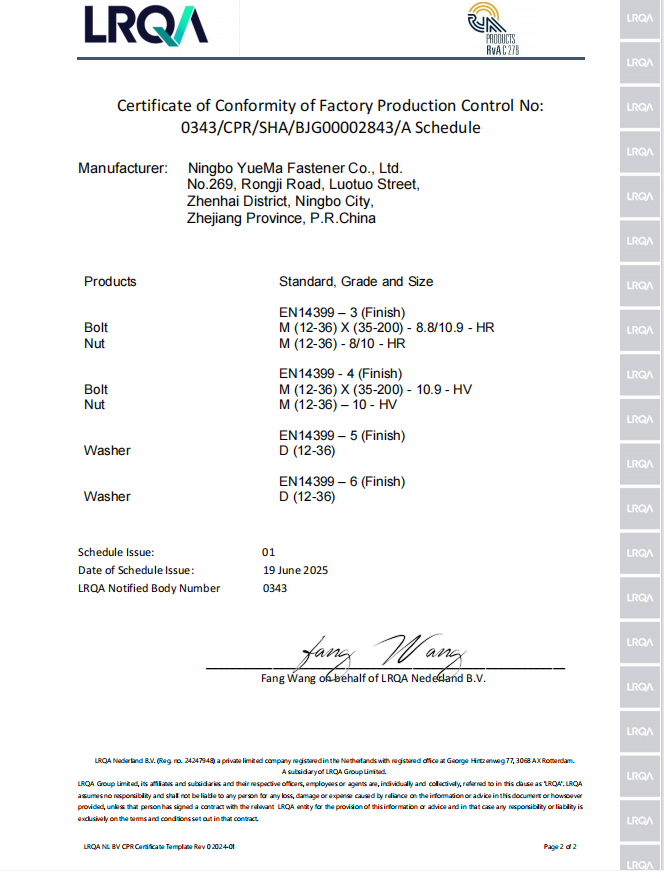
Certificate 0343/CPR/SHA/BJG00002843/A Schedule covers EN 14399-3 HR bolts in property classes 8.8 and 10.9 at M12 to M36 by 35 to 200 mm, with matching nuts and washers.
Step-by-Step: Qualifying an 8.8 Grade Tower Bolt Order
The sequence below converts the constraint set into a checkable procurement flow. Each step produces a document or a decision that the next step depends on.
Step 1 — Fix the governing standard before the grade. Decide whether the line follows ASTM A394, EN 14399-3, or a DIN/ISO model standard, and record it. If the requirement is metric and structural, EN 14399-3 with HR finish is the scope that explicitly includes class 8.8 bolts in the certification held.
Step 2 — Write the grade with its material and diameter family. State property class 8.8 together with material (carbon steel, alloy steel or SS304) and the diameter band required from M12 to M64. Vague entries such as high strength without a class number cannot be quoted or inspected.
Step 3 — Dimension the thread. Specify full thread or half thread, the thread length, and the pitch if a custom pitch is needed. Length is stated as a number from 20 mm to 2000 mm rather than left to standard practice.
Step 4 — Specify the assembly, not the bolt alone. Confirm nut class, 6H thread tolerance, washer standard (ASTM F436 or DIN125A/DIN125B) and the coating on all three components. Anti-theft and anti-loosening assemblies are available where unattended tower sites require them.
Step 5 — Agree the document package. Confirm in writing: material test certificate, batch traceability records, mechanical and salt spray test reports, third-party inspection arrangement, and current validity of the ISO and LRQA certificates quoted. Check expiry dates against the delivery window, not against the enquiry date.
Step 6 — Control installation and record it. Clean the contact surfaces of the steel plates and remove rust, burrs and dirt; check bolt, nut and washer for damage before assembly; tighten with a calibrated torque wrench to the specified torque value; do not use an impact wrench for final tightening; never reuse a bolt with thread deformation or a damaged anti-theft structure. During high-altitude tower work, use a safety harness, helmet and protective gloves, keep clear of live parts, and follow local power industry construction standards. Record torque data for the project file.
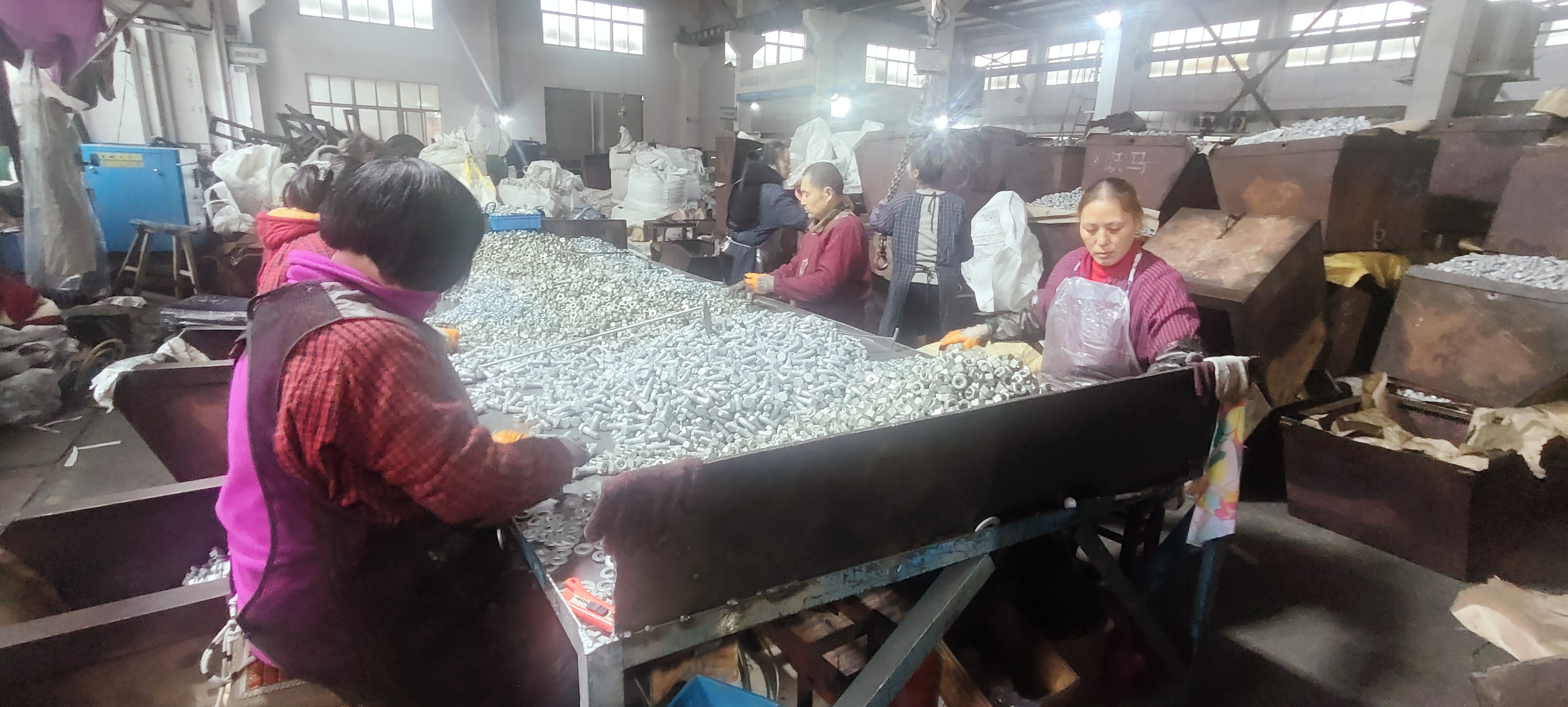
Assembly stage: bolt, heavy hex nut and structural washer matched by class and coating before packing.
Use Cases: Where the 8.8 Grade Assembly Is Applied
Class 8.8 tower bolts and their matched assemblies are used across the structural connections of the following project types:
- High voltage transmission towers, communication towers and substation frameworks
- Factory steel buildings, bridges, curtain walls and large stadium structures
- Wind turbine towers and foundation fasteners
- Foundation embedded anchor bolts and construction machinery connections
- Railway supports and guardrail steel components
- Photovoltaic mounting brackets and solar tower structures
- Heavy-duty storage racks and warehouse steel structures
Project records for high voltage transmission tower and communication tower construction include 1,200,000 sets supplied to customers in the United Arab Emirates and 50,000,000 sets to customers in Saudi Arabia, over a recorded duration of 25 years, with an anti-theft rate of 100%, a bolt loosening rate below 0.3% and zero structural safety incidents. The application requirement behind those figures is a fastener that holds preload under wind vibration while resisting unauthorised removal at unattended sites.
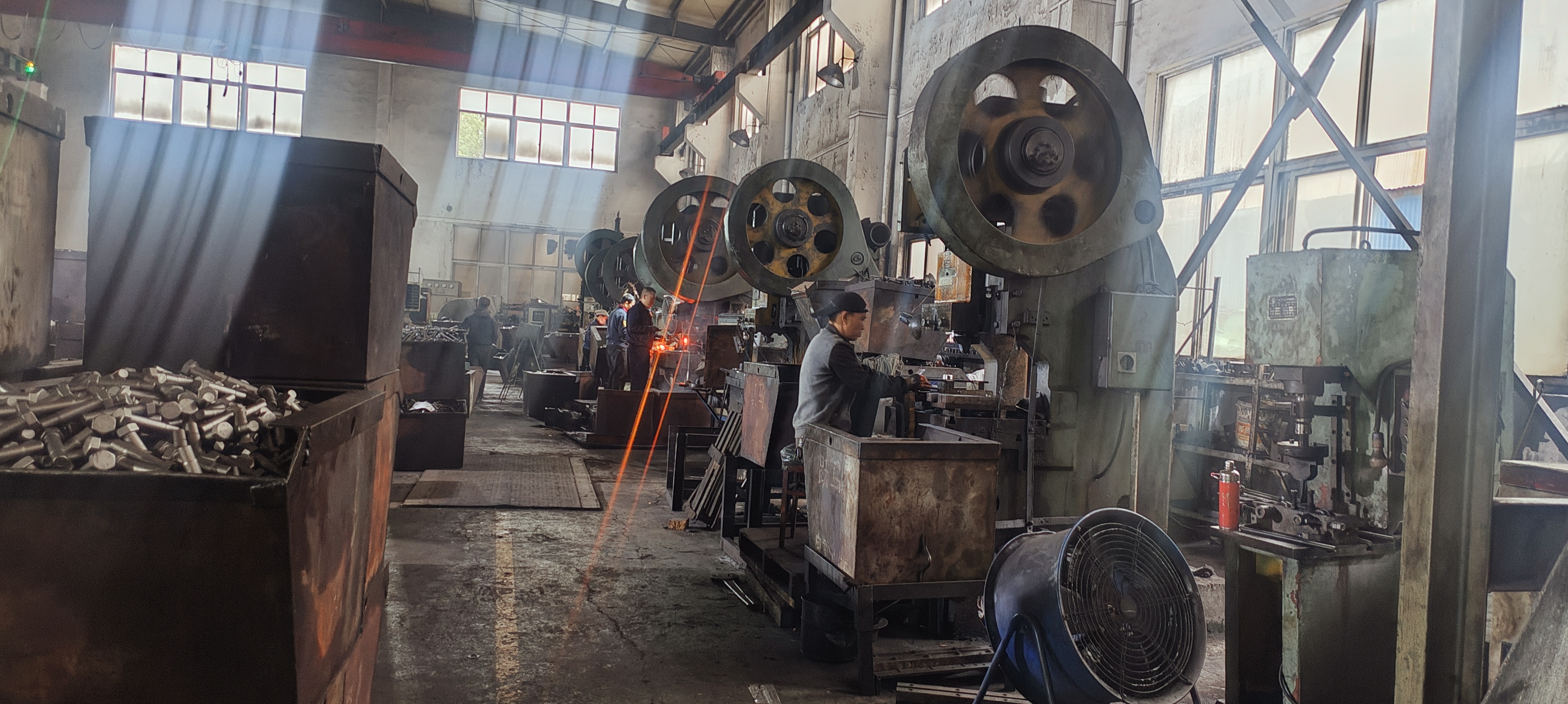
Hot forging line: forming of high strength hex head and special head tower bolts before heat treatment and coating.
How 8.8 Compares With the Other Property Classes
The table below uses only figures stated in the product specification and in the certification scope documents. It is a scope comparison, not a ranking.
| Property class | Where it appears in the certified scope | Dimensional coverage |
|---|---|---|
| 4.8 | Listed in the product property class range; not named in the EN 14399-3 or EN 14399-4 certificate scope text | M12 to M64 (1/2 to 2 1/2 in), length 20 to 2000 mm |
| 8.8 | EN 14399-3 HR bolts, classes 8.8 and 10.9; ASTM A394, A325 and A490 certification available with MTC | EN 14399-3 scope M12 to M36 by 35 to 200 mm; product range M12 to M64, length 20 to 2000 mm |
| 10.9 | EN 14399-3 HR bolts; EN 14399-4 HV bolts (10.9 only) | M12 to M36 by 35 to 200 mm within the certificate scope |
| 12.9 | Listed in the product property class range; not named in the EN 14399-3 or EN 14399-4 certificate scope text | M12 to M64 (1/2 to 2 1/2 in), length 20 to 2000 mm |
Finish options of hot dip galvanized, zinc plated, black oxide and Dacromet are listed at product level rather than per class, and hot dip galvanized plus Dacromet are the finishes specified for outdoor tower projects.
| ASTM A394 type | Material and condition |
|---|---|
| Type 0 | Hot dip galvanized low or medium carbon steel |
| Type 1 | Hot dip galvanized medium carbon steel, quenched and tempered |
| Type 3 | Bare weathering steel |
| Type 2 | Withdrawn |
Source: ASTM A394-08(2024), Standard Specification for Steel Transmission Tower Bolts, ASTM International.
FAQ: 8.8 Grade Transmission Tower Bolts
1. Which certificates should travel with an 8.8 grade transmission tower bolt order?
Four document groups are relevant. At system level, ISO 9001:2015 certificate 37825Q15701R2S from Euroswiss Certification Co., Ltd. covers fastener manufacturing, valid 2025-08-05 to 2028-09-22, alongside ISO 14001:2015 (37825E22789R0S) and ISO 45001:2018 (37825S12401R0S). At product level, the LRQA Nederland B.V. schedule 0343/CPR/SHA/BJG00002843/A covers EN 14399-3 HR bolts in property classes 8.8 and 10.9 at M12 to M36 by 35 to 200 mm, with class 8/10 HR nuts and D12 to D36 washers, valid 2025-06-19 to 2028-06-18; EN 15048-1:2007 certification 0343/CPR/SHA/BIG00002843/B covers non-preloaded structural bolting assemblies over the same validity window. At lot level, a material test certificate and batch traceability records apply. ASTM A394, A325 and A490 certification can be supplied on request.
2. China ASTM A394 transmission tower bolt manufacturers: what should a buyer verify?
Verify six things rather than a single claim. First, whether the supplier's standard coverage lists ASTM A394, A325 and A490 certification and supplies a material test certificate. Second, whether the certificate schedules name the specific classes and dimensions being ordered, not just a product family. Third, whether inspection is batch-based — tensile, hardness, salt spray and dimensional checks before shipment — and whether batch traceability is maintained. Fourth, whether 100% pre-shipment testing and third-party inspection are available. Fifth, whether management system certificates are current across the delivery window. Sixth, whether capacity and terms match the project: monthly capacity of 2,000 tons, MOQ from 500 kg, lead time 30 to 45 days, OEM and ODM customisation to drawings, and shipment from Ningbo port. These are the data points that can actually be checked against documents.
3. Can the same 8.8 grade bolt be supplied in both full thread and half thread?
Yes. Both full thread and half thread configurations are produced across nominal diameter M12 to M64 (1/2 in to 2 1/2 in), length 20 mm to 2000 mm, thread pitch 1.5 mm to 3.0 mm, with custom pitch available on request. Thread type is ISO metric coarse, complying with DIN and GB standards. Because full thread and half thread change the effective grip and the exposed thread length, the configuration has to be stated as a dimension on the purchase order rather than left to the supplier's default.
4. What drives cost on an 8.8 grade tower bolt order, and what is the minimum order quantity?
The minimum order quantity is 500 kg, with a lead time of 30 to 45 days and OEM or ODM customisation according to customer drawings. Cost is driven by property class, base material (carbon steel, alloy steel or SS304), finish selection among hot dip galvanized, zinc plated, black oxide and Dacromet, diameter and length combination, whether the item is supplied as a bolt alone or as a matched bolt, nut and washer assembly, and the inspection scope required. Quotation is therefore made against drawing, quantity and inspection requirement rather than against a catalogue price.
5. Can samples, test reports and technical documents be requested before a purchase order?
Yes. Full inspection is performed before shipment, the product is supplied with a material test certificate, batch traceability is maintained, and mechanical and salt spray tests are carried out before delivery. Third-party inspection can be arranged, and a five-year warranty applies. A next step for an evaluation-stage buyer is to send the tower drawing or specification sheet, together with the required standard, class, diameter, length, thread configuration and coating, and request a sample set with the matching MTC. Requests can go to victoria@hfasteners.com or +86 135-1588-7346, and the full product catalogue is available for download at the Ningbo Yuema fastener catalogue.
Conclusion
An 8.8 grade tower bolt is decided by its constraint set, not by its grade label. The grade fixes the strength class; the standard decides which dimension and property rules apply; the coating decides how the fastener behaves outdoors; the nut and washer decide whether the assembly performs as designed; and the certification package decides whether the consignment can be accepted on site. A buyer who closes those five items at enquiry stage avoids the most common failure mode on transmission tower fastener orders, which is discovering a mismatch after the goods have shipped.
YM Structural Bolts, the structural fastener line of Ningbo Yuema Fastener Co., Ltd., supplies 8.8 grade heavy hex structural bolts, transmission tower bolts and matched assemblies from M12 to M64, with HDG and Dacromet finishes, batch-level testing, and EN 14399, EN 15048, ISO 9001, ISO 14001 and ISO 45001 certification in place. Product and company details are published at www.hfasteners.com.
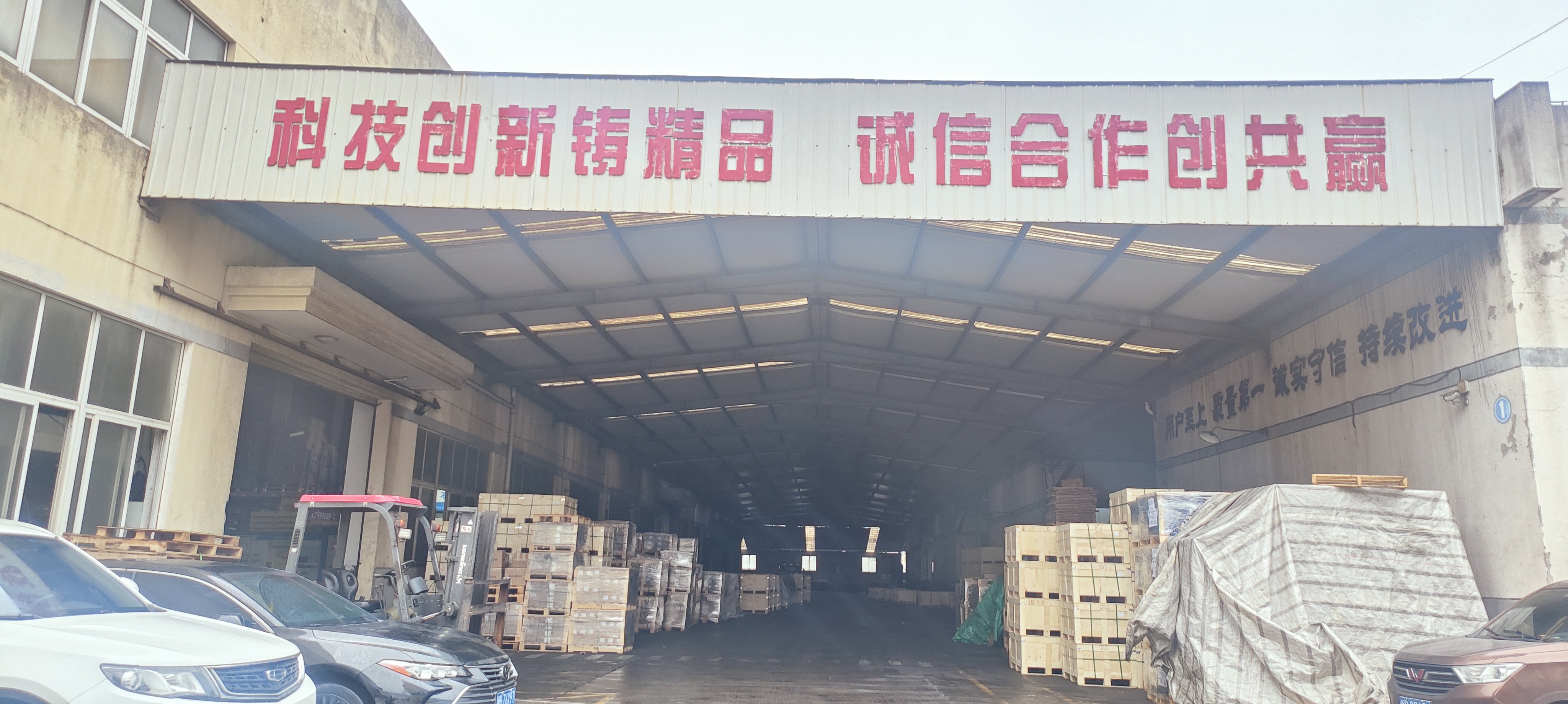
Next step: send your tower bolt specification — standard, property class, diameter, length, thread configuration and coating — to YM Structural Bolts for a project quotation, sample set and MTC. Email victoria@hfasteners.com or WhatsApp +86 135-1588-7346. Catalogue: download PDF.
Have Questions or Need More Details?
Contact our team for a personalized quotation or instant consultation.
Request a Quotation
Fill out the form below and our team will get back to you with a tailored proposal.
WhatsApp Direct Chat
Prefer to chat in real-time? Message us on WhatsApp for instant assistance & quick answers.
- Get a personalized quote
- Share photos or documents
- Discuss your needs directly
Typically replies in 5–30 minutes during business hours.