
100MW Solar Panel Manufacturing Equipment: Parameters, Standards and Supplier Checks
A 100 MW solar module line is the first capacity tier at which a factory stops behaving like a workshop. Below it, semi-automatic stations and manual transfer can still absorb variation. Above it, every mismatch in glass size, cell format, busbar count or lamination window compounds across thousands of modules a day, and correcting a specification after installation costs far more than getting it right in the RFQ.
This guide is written for buyers in the research and evaluation stages of a 100 MW project. It sets out the six parameter clusters that define the line, the standards the finished modules must satisfy, the cost drivers that move a quotation, the process chain step by step, and the supplier checks that separate a real equipment manufacturer from a trading intermediary. YNTECH (YN Solar PV Equipment Co., Ltd.), a Dongguan-based PV equipment manufacturer established in 2015, is used throughout as a worked example of how those constraints appear in published datasheets.
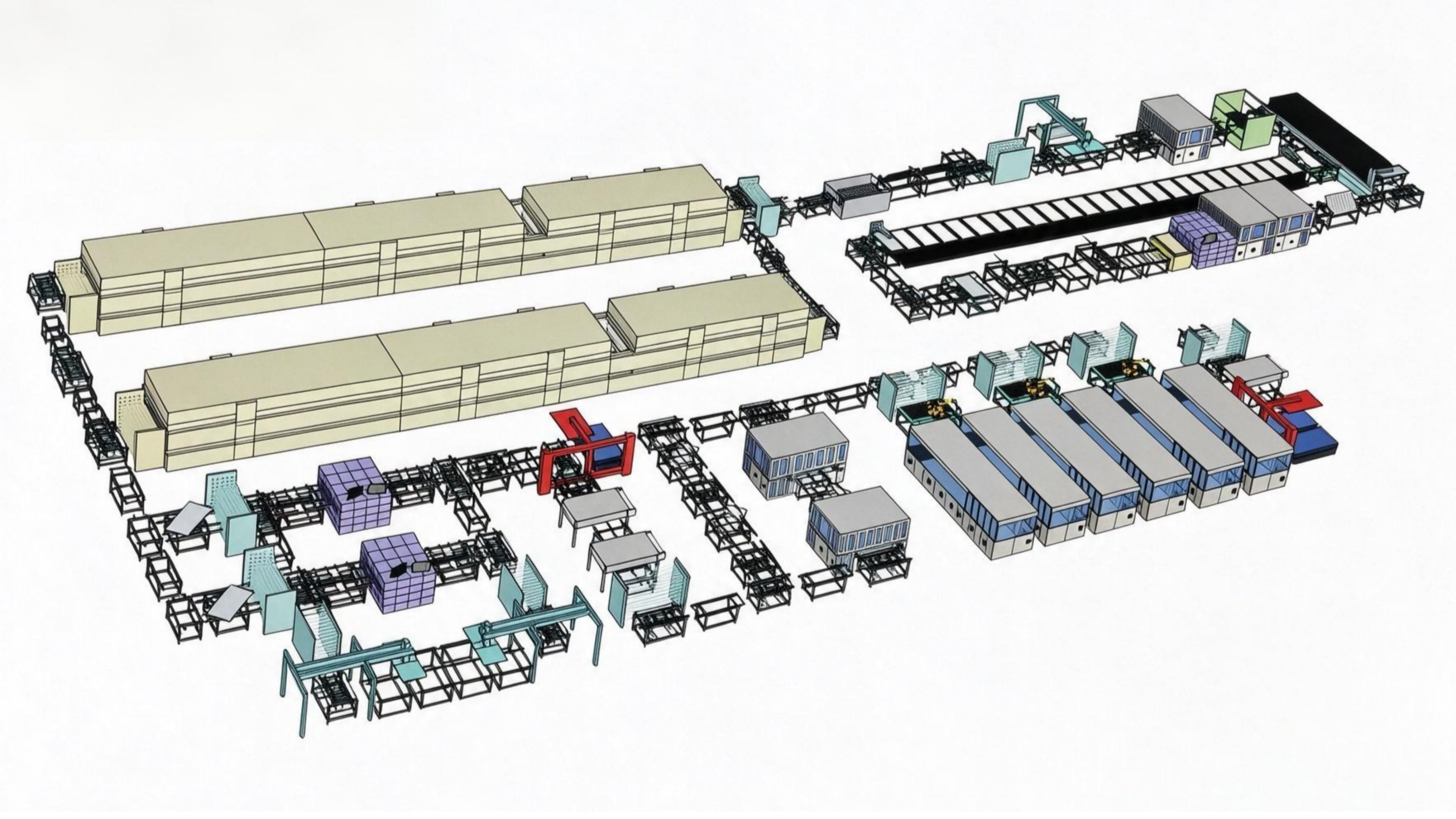
100 MW–200 MW solar panel production layout design — the capacity tier where semi-automatic stations are replaced by an integrated line.
Problem Definition: Why 100 MW Specifications Go Wrong
Three failure patterns account for most of the expensive mistakes in this capacity band.
The first is envelope mismatch. Buyers specify a target module power and a factory footprint, then discover the quoted stringer cannot handle the glass size the layout assumed, or that the laminator's chamber height and platen area exclude the largest module in the product plan. The tabber stringer, the laminator and the framing machine each carry independent size limits, and the line is only as flexible as the narrowest of them.
The second is a category error between module standards and machine standards. IEC 61215 and IEC 61730 govern the module; they do not certify the equipment that made it. A supplier who claims "IEC certified equipment" is usually describing the modules produced on the line, not the line itself. Buyers need to separate two questions: will the line reliably produce modules that pass the standard test sequence, and does the machinery carry the safety documentation required in the destination market?
The third is a non-comparable quote. Two suppliers can both quote "a 100 MW line" while describing completely different scopes — one includes glass loading, EVA cutting and inline EL; the other starts at stringing and ends at lamination. Without a line-by-line scope sheet, the lower number is usually the smaller scope.
Industry Background: What the Demand Curve Says About Line Size
The equipment market that supplies these lines is large and still expanding. Global solar PV manufacturing equipment was valued at USD 16.6 billion in 2024, with a projected value of USD 108.4 billion by 2034 at a compound annual growth rate of 23.1% (Global Market Insights, 2025).
Downstream capacity has been built out at a comparable pace. US domestic module manufacturing capacity reached 50 GW in early 2025 (SEIA, Solar Market Insight Report 2024 Year in Review). Globally, 172 GWdc of new PV capacity was added in 2021, taking cumulative installed capacity to 939 GWdc (NREL, Spring 2022 Solar Industry Update).
Price pressure is the counterweight. Module prices in China reached USD 0.10–0.12/W in 2025 under oversupply conditions (US Department of Energy, Fall 2025 Solar Industry Update). At that level, the margin between a well-specified line and a poorly specified one is decided by yield, uptime and labour per module — not by module price. That is why 100 MW buyers increasingly evaluate a PV module manufacturing line on total cost of ownership rather than on purchase order value alone.
For scale reference, a turnkey 100 MW solar module production line is commonly quoted at a cell throughput of around 3,600 cells per hour, with a typical delivery time of 6–9 months (JVG-Thoma, 100 MW Solar Module Production Line Guide, 2025).
Detailed Solution: The Six Parameter Clusters That Define a 100 MW Line
1. Substrate envelope — glass and EVA
Everything downstream is constrained by the largest and smallest substrate the line can handle. In the YNTECH 100 MW–200 MW layout design, the maximum compatible glass and EVA size is 1960 × 990 mm and the minimum is 400 × 400 mm. The 20 MW–60 MW semi-automatic turnkey configuration uses the same envelope, which means a buyer can start at the lower tier and reuse the same module formats when scaling up.
If the product plan includes large-format modules above that envelope, the entire line — not just the laminator — has to be re-specified.
2. Cell format and busbar compatibility
The Solar Cell Tabber Stringer YN-CH210 accepts cell sizes from 125 mm to 210 mm plus BC-format cells, with custom sizes available, busbar counts from 2BB to 20BB, ribbon thickness of 0.1–0.2 mm and ribbon width of 0.45–2.00 mm. Cell gap is adjustable from 1 mm to 20 mm, and overlap welding is supported for BC cells. The machine is stated as compatible with string welding for TOPCon, HJT and PERC cells, with one-click switching for conventional cells.
BC (back-contact) architectures — including the platforms marketed under names such as HPBC, ABC, XBC and IBC — are the format most likely to force a stringer re-specification, because they need overlap welding and different ribbon handling. A buyer whose 100 MW plan includes a BC product should settle this at the tabber stringer stage, before the layout is frozen.
3. String geometry
String length, string pitch and the number of strings per module set both throughput and the footprint of every station after stringing. The 150 MW–250 MW line specification covers 1–6 strings at 1000–2400 mm, an 8-string upper/lower two-section layout at 500–1200 mm, and a 12-string three-section layout at 500–1200 mm, with a throughput of 109 strings per hour and a 1×1 single-module output.
Smaller-format production runs on different geometry. The YN-PH800 layer and bussing machine handles 6 W–40 W modules with string lengths of 200–700 mm, while the YN-PH900 covers 5 W–120 W at 200–1200 mm. Buyers building a mixed portfolio should map every planned module format against string geometry before committing to one line configuration.
4. Thermal process window
Lamination is where yield is won or lost. The PV Module Laminating Machine is specified at ±1.0 °C temperature accuracy, ±1.5 °C temperature uniformity, a control range from chamber temperature to 180 °C, a 30 mm chamber height, and an 8–10 minute cycle including vacuuming and lamination. It is stated as compatible with PERC, TOPCon, HJT, BC, half-cut and BIPV modules.
Those figures map directly onto the defect modes that IEC 61215 testing exposes: bubbles, delamination and power attenuation after damp heat. A wider temperature spread does not fail on day one; it fails in the reliability test, or in field returns two years later.
5. Inspection and yield targets
A-grade yield targets across the YNTECH line family sit above 97%, with the bussing machine YN-HL500 specified above 99% and the tabber stringer at a breakage rate below 0.2‰. The Automatic EL Tester handles panels from 1634–2500 mm in length and 986–1400 mm in width at 0–20 m/min, using a double slide rail design, PU belt conveyance with a green cloth surface to limit glass scratching, and a steel structure for stability.
Inline EL is not a quality gesture. It is the only station that catches cracked cells, cold solder joints and string misalignment before lamination locks the defect into the module.
6. Automation level and layout
The gap between a 20 MW–60 MW semi-automatic turnkey line and a 150 MW–250 MW automatic solar panel production line is not only speed. It is operators per shift, frequency of manual transfer, and consistency of placement. YNTECH delivers the 100 MW–200 MW tier as a layout design service and also supplies standalone machines for staged automation — the practical route for an existing factory that cannot stop production while a full line is installed. That staged approach is also the foundation of a Solar Module Production Line Upgrade.
Standards and Compliance: What a 100 MW Line Must Prove
Two standards sit at the centre of module compliance. IEC 61215 covers design qualification and type approval for PV modules. IEC 61730 covers module safety qualification. Both are active international standards and both are cited as core requirements for PV module safety and performance testing.
The practical implication for a 100 MW buyer is that the line must be specified so its output can pass those tests repeatedly, not once. That means:
- Lamination parameters tight enough to eliminate bubbles and delamination within the IEC 61215 test sequence.
- EL inspection capable of detecting cell cracks and solder defects at production speed.
- Framing accuracy that holds the frame gap within tolerance. The PV Module Framing Machine is specified at a frame gap under 0.3 mm, opposite-side difference of ±0.5 mm and diagonal difference of ±1 mm at 25 seconds per piece.
- A documented pre-shipment test regime. YNTECH states 100% pre-shipment testing on its equipment.
Machinery safety documentation is a separate question from module certification, and it depends on the destination market. Buyers in the EU, North America and other regulated markets should request the applicable conformity documents for each machine as a named line item in the RFQ, rather than accepting a general statement at quotation stage. Note that no verified standard text specific to PV module production machinery was available for this article, so those requirements must be confirmed supplier by supplier.
Cost Drivers: Why There Is No Reliable Public Price Band for a 100 MW Line
No published price band for a 100 MW solar panel manufacturing line holds across suppliers, because the quote is a function of scope. The variables that move the number most are:
- Glass and module envelope. A line built for a 1960 × 990 mm maximum is a different machine set from one built for a larger format.
- Automation ratio. Glass loading, EVA layup, busbar merging and framing can each be manual, semi-automatic or automatic. The 20 MW–60 MW tier and the 150 MW–250 MW tier in the same product family differ mainly on this axis.
- Inspection depth. One EL station versus pre-lamination and post-lamination EL changes both cost and yield.
- Cell format coverage. BC-capable stringing with overlap welding is a more demanding specification than conventional tabbing.
- Non-standard customization. YNTECH offers OEM/ODM production with logo printing and custom non-standard design, which changes both engineering hours and lead time.
- Site services. Layout design, installation, commissioning and training are scope items, not free extras. YNTECH provides layout design, equipment manufacturing, factory installation, commissioning, technical training and after-sales maintenance as part of its lifecycle service.
On commercial terms, YNTECH quotes a minimum order quantity of one unit, a standard machine lead time of 15–30 days, monthly capacity of 10–30 units, and payment by T/T with 30% deposit and 70% before shipment, with Western Union and PayPal also accepted. A full 100 MW line follows a different timeline: the industry reference for a turnkey 100 MW line is 6–9 months, and factory preparation should run in parallel with that window rather than after it.
The module price backdrop of USD 0.10–0.12/W in China sets the return calculation. At that level, a line running two percentage points lower on A-grade yield, or needing two more operators per shift, can erase the saving from a lower purchase price within the first year of operation.
Step-by-Step Breakdown: The 100 MW Process Chain
Step 1 — Glass loading and EVA layup
The YN-SBL710 automatic glass loading machine handles glass up to 1960 mm × 990 mm at a capacity of 80–100 pieces per hour in single-module mode, or 160–180 in dual-module mode with a 1-out-of-2 layout. It performs translational glass loading and automatic EVA drawing in one integrated unit, with a stated A-grade yield of 97%.
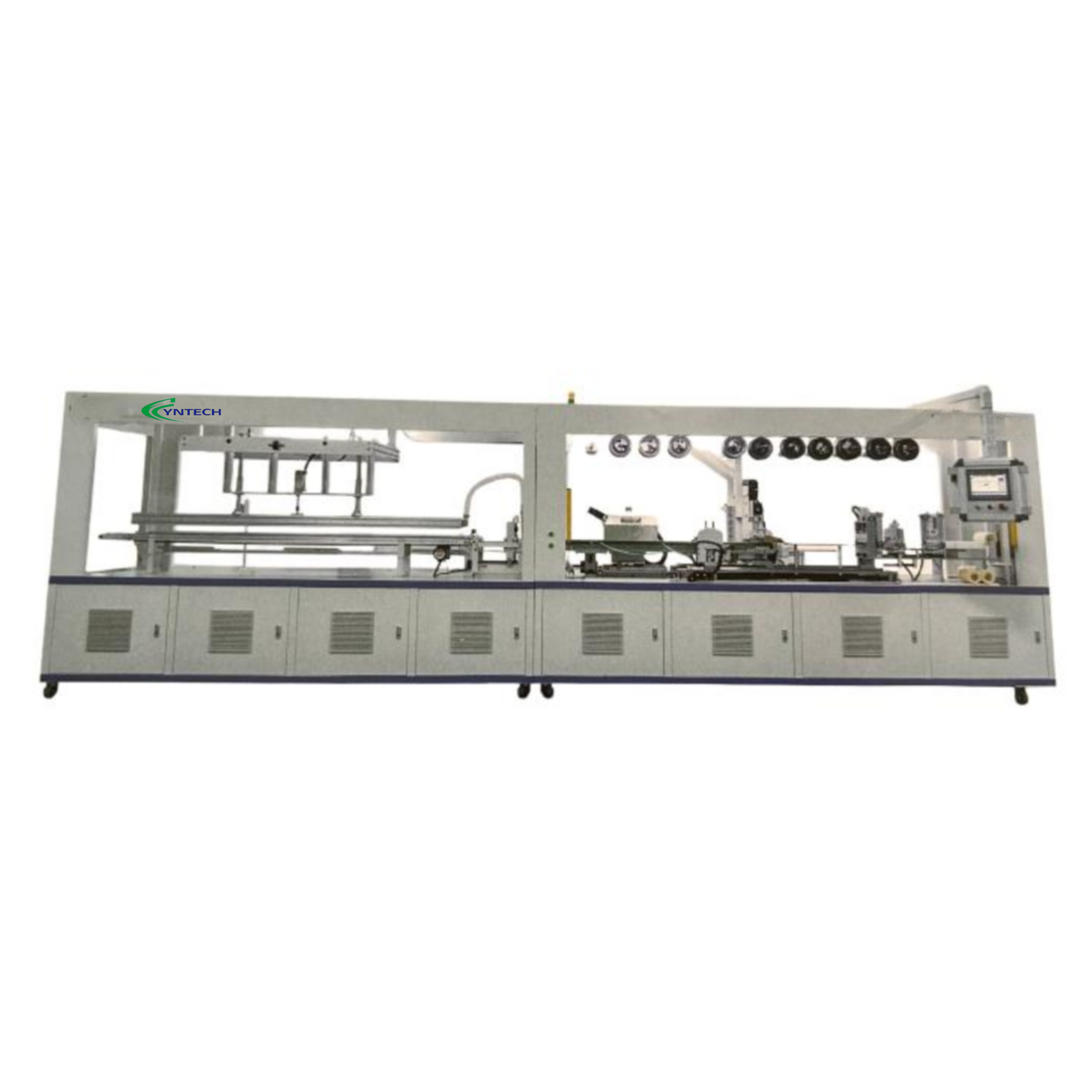
Solar Cell Tabber Stringer YN-CH210: 2BB–20BB, 125–210 mm cells plus BC format, breakage rate below 0.2‰.
Step 2 — Cell cutting, tabbing and stringing
Where cell cutting is required, laser scribing sits upstream of stringing as a separate process step and must be matched to the cell format before the stringer is specified. The Solar Cell Tabber Stringer YN-CH210 then performs automatic cell feeding, automatic alignment and spacer placement, automatic ribbon feeding and cell layout, with infrared welding and output flipping. It supports full cells and left/right half-cut cells, gap and gapless welding modes, and a maximum string length of 2300 mm at up to 1,200 cells per cycle. For all-black BIPV modules, black isolation strips can mask the ribbons.
Step 3 — Layup and busbar welding
The layup and busbar stage converts strings into a soldered array. YN-PH700 covers 40 W–350 W modules with 80–120 modules per hour in single-module mode and 160–180 in dual-module mode, using high-frequency electromagnetic welding plus automatic glass loading, EVA laying, cell layout and busbar merging. The Automatic Solar Cell Bussing Machine YN-HL500 covers 100 W–550 W modules with string lengths of 1000–2400 mm and an hourly output of 90 at a stated A-grade yield above 99%. For a solar panel busbar welding machine, the practical check is whether the welding head handles your busbar width range without re-tooling.
Step 4 — Pre-lamination EL inspection
The Automatic EL Tester inspects the laid-up assembly before lamination. Defects caught here can still be reworked; defects caught after lamination cannot.
Step 5 — Lamination
The PV Module Laminating Machine runs an 8–10 minute cycle at ±1.0 °C accuracy with a high-speed vacuum pump set for fast evacuation between layers. Auto conveyor and photo positioning reduce manual handling and breakage, and the unit integrates into a full PV module line without a separate transfer station. For buyers comparing a Solar Panel Laminator against a lower-cost alternative, temperature uniformity is the specification to interrogate first.
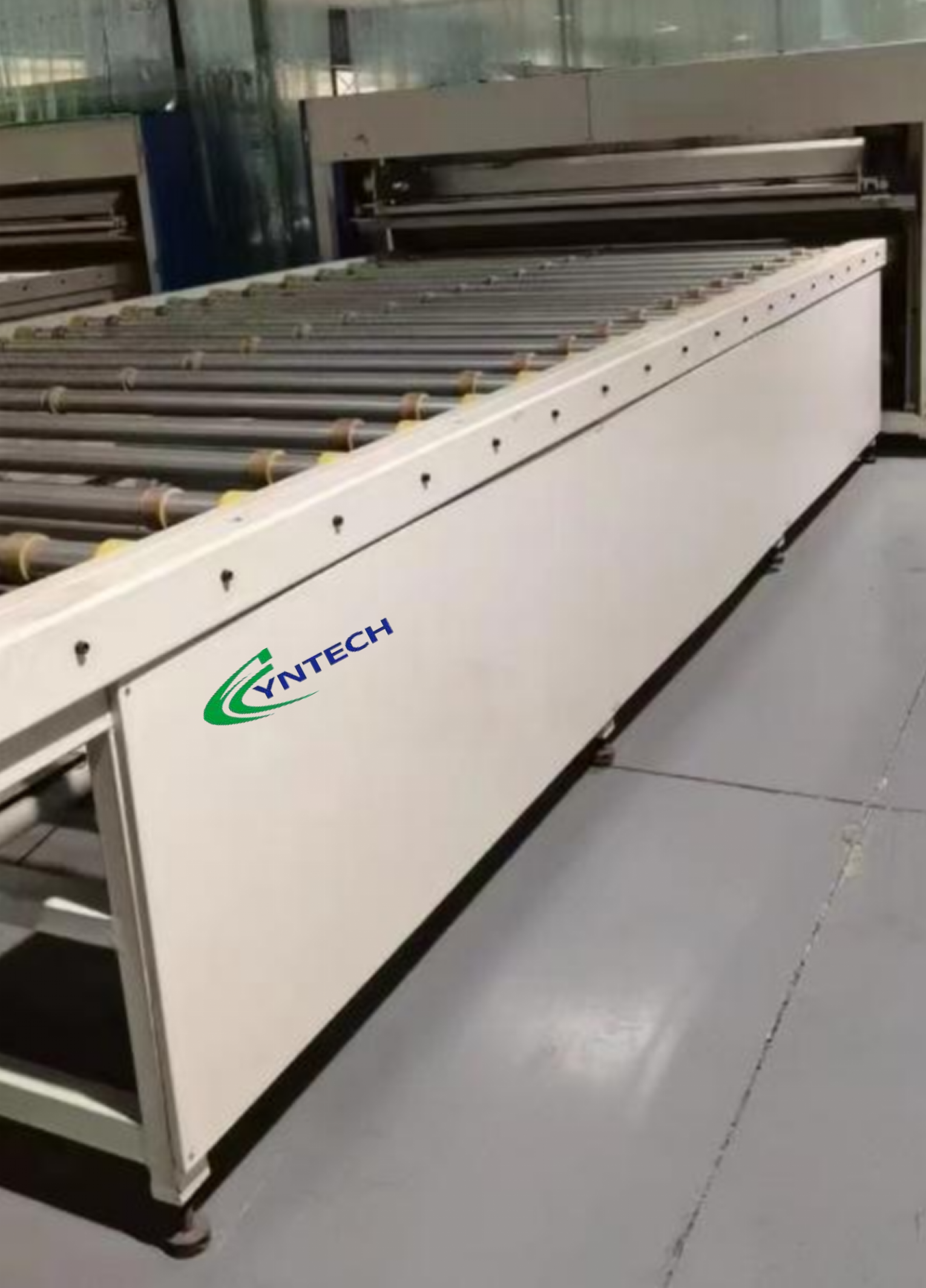
PV Module Laminating Machine: ±1.0 °C accuracy, ±1.5 °C uniformity, PERC / TOPCon / HJT / BC / half-cut / BIPV compatible.
Step 6 — Trimming
The Solar Panel Trimming Machine YN-XBJ100 performs automatic feeding, automatic alignment and automatic edge trimming to cut off excess backsheet and EVA, then collects material automatically. It is specified at a defect rate below 1‰, 3 kW machine power, 220–240 V operating voltage and 0.45–0.6 MPa operating air pressure, in an environment of -10 to 40 °C and humidity up to 85%.
Step 7 — Framing and gluing
The PV Module Framing Machine runs at 25 seconds per piece with a frame gap under 0.3 mm, handling cutting sizes of 1630–2500 mm × 950–1400 mm. The Automatic Framing and Gluing Machine BD03 applies a uniform glue bead under CNC control with manual loading, automatic unloading and automatic positioning, removing the secondary glue-filling step that conventional framing machines require.
Step 8 — Junction box gluing
The Solar Panel Gluing Machine dispenses adhesive under CNC control with automatic positioning and automatic dispensing, at a cycle of 20 seconds or less, over a 1650–2450 mm range and 990–1400 mm width. Uniform glue bead and consistent glue volume reduce adhesive waste and remove the need for an operator to hold the module during dispensing.
Step 9 — Final EL and sorting
A second EL inspection after framing and gluing closes the loop, followed by power testing and binning. This is where the A-grade yield figure actually gets measured — not at any single station, but across the whole chain.
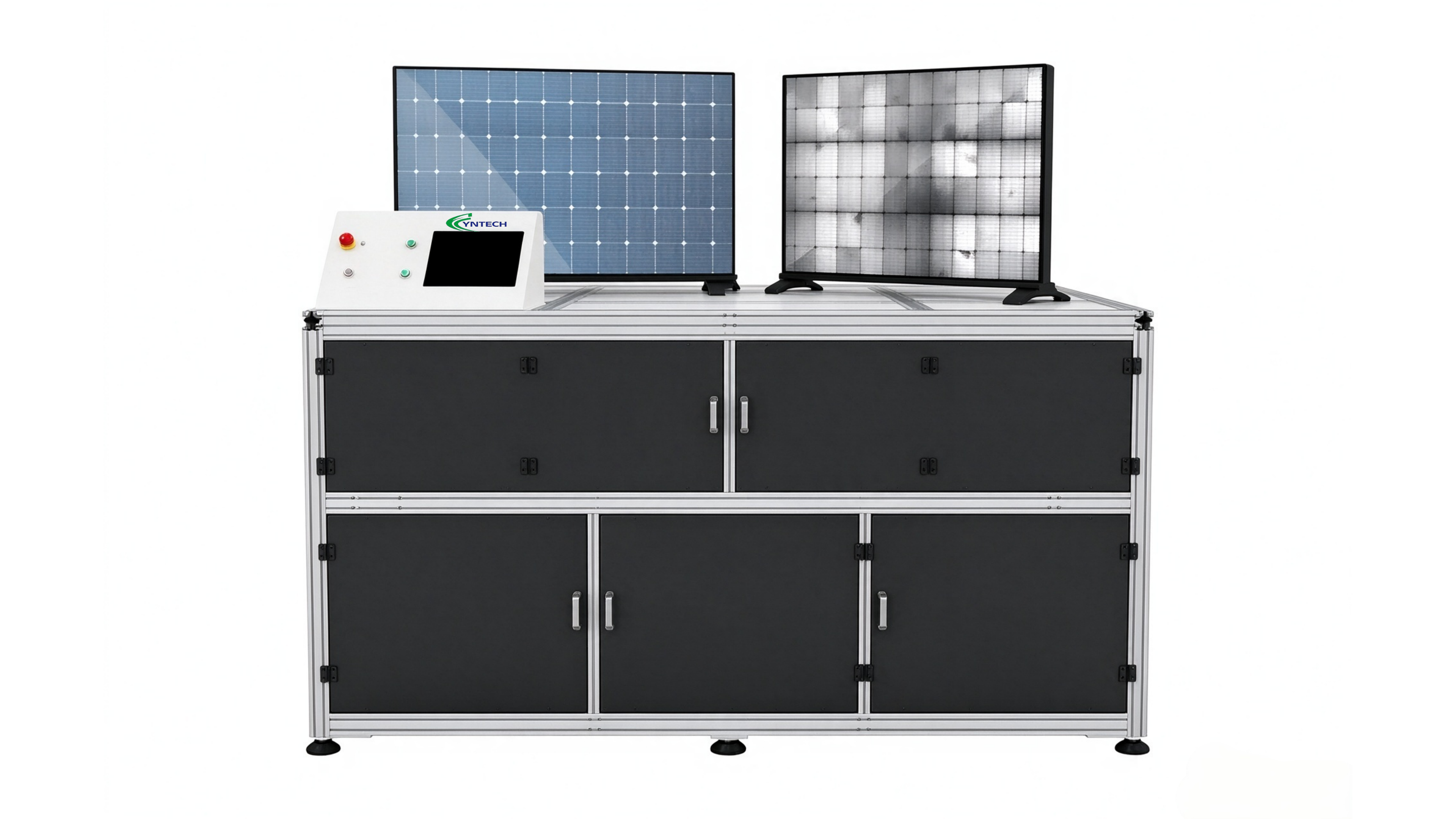
Automatic EL Tester: panels 1634–2500 mm long and 986–1400 mm wide, 0–20 m/min, double slide rail design.
Use Cases
Line upgrade in an existing Indian factory. A PV manufacturer in India integrated 8 units across a production line upgrade project, with a stated ten-year operating relationship. The stated objectives were higher production efficiency, improved module quality through continuous production, reduced material loss and lower labour cost — the classic upgrade case where the factory keeps running while stations are replaced one at a time.
Semi-automatic entry at 20–60 MW. A buyer entering module assembly in the 50 MW to 200 MW band often starts with the 20 MW–60 MW semi-automatic turnkey configuration, then adds automation as order volume justifies it. The shared 1960 × 990 mm glass envelope across tiers makes that path viable without a second layout redesign.
Small-format and non-standard modules. The 3 W–30 W and 5 W–120 W layup and busbar machines serve folding solar bags, monitoring panels, integrated solar street lights, floodlights and warning lights. These are formats a standard 100 MW line cannot address economically and are usually run as a separate cell.
Scaling from 100 MW to 250 MW. The 150 MW–250 MW line specification adds multi-section string layouts and 109 strings-per-hour throughput for buyers moving from single-module to higher-volume output.
BIPV product mix. If the product plan includes building-integrated modules for factory rooftops and façades, the laminator's stated BIPV compatibility and the stringer's black isolation strip option become specification requirements rather than optional extras.
Comparison Table: Three Capacity Tiers Side by Side
| Parameter | 20–60 MW semi-automatic turnkey | 100–200 MW layout design | 150–250 MW production line |
|---|---|---|---|
| A-grade yield target | >97% | >97% | >97% |
| Compatible glass / EVA (max) | 1960 × 990 mm | 1960 × 990 mm | Not stated in this tier's specification sheet |
| Compatible glass (min) | 400 × 400 mm | 400 × 400 mm | Not stated in this tier's specification sheet |
| Cell width | 78–210 mm | 52–210 mm | 125–210 mm |
| String length | 300–2000 mm | 200–700 mm | 500–2400 mm |
| Cell string pitch | 1–10 mm | 1–10 mm | 1–10 mm |
| Throughput | 80–120 modules/h (1-up); 160–180 (2-up) | Not stated | 109 strings/h |
| Power supply | 10 kW rated / 15 kW peak | 15 kW rated | 10 kW rated / 15 kW peak |
| Air supply | 0.5–0.8 MPa | 0.5–0.8 MPa | 0.5–0.8 MPa |
Key Machine Specifications at a Glance
| Machine | Model | Key compatibility | Throughput / cycle | Accuracy / yield |
|---|---|---|---|---|
| Solar Cell Tabber Stringer | YN-CH210 | 125–210 mm cells plus BC; 2BB–20BB; ribbon 0.45–2.00 mm | Up to 1,200 cells per cycle; string up to 2300 mm | Breakage <0.2‰ |
| PV Module Lay-up and Bussing Machine | YN-PH700 | Glass 400 × 400 to 1960 × 990 mm; 40–350 W modules | 80–120 modules/h (1-up); 160–180 (2-up) | A-grade >97% |
| Automatic Solar Cell Bussing Machine | YN-HL500 | 100–550 W modules; string 1000–2400 mm | 90 units/h | A-grade >99% |
| PV Module Laminating Machine | Lamination machine | PERC, TOPCon, HJT, BC, half-cut, BIPV | 8–10 min per cycle | ±1.0 °C accuracy; ±1.5 °C uniformity |
| Solar Panel EL Testing Equipment | Automatic EL Tester | Panel 1634–2500 × 986–1400 mm | 0–20 m/min | Double slide rail; steel structure |
| PV Module Framing Machine | Automatic Framing Machine | Cutting 1630–2500 × 950–1400 mm | 25 s per piece | Frame gap <0.3 mm; diagonal ±1 mm |
| Solar Panel Trimming Machine | YN-XBJ100 | Trimming range 100 × 100 to 370 × 210 mm | Automatic feed, align, trim, collect | Defect rate <1‰ |
Supplier Checks Before You Sign
Manufacturing base and engineering depth. YNTECH was established in 2015, operates a 9,000 m² factory, employs 10–60 people, produces 100–200 units per year and maintains an 8-person R&D team. Annual output and team size are useful proxies: a supplier producing a few dozen units a year cannot absorb a 100 MW order without displacing other customers.
Export experience in comparable markets. 60%–70% of YNTECH output is exported, with Africa, the Middle East and the EU listed as main markets, alongside Asia and Latin America. Export ratio correlates with documentation practice, packaging standards and remote support experience — three things that decide how quickly a line recovers from a fault.
Scope clarity. Ask any solar module production line supplier for a line-by-line scope sheet naming every station, every interface and every excluded item. Confirm whether layout design, installation, commissioning and training are included.
Customization capability. YNTECH offers OEM/ODM production with logo printing and custom non-standard design. For a buyer with an unusual module format, that flexibility is worth more than a marginal price difference.
After-sales structure. YNTECH provides 24-hour technical support, a one-year warranty, free training with English manuals and video, and remote technical support. Confirm response-time expectations and the spare-parts list in writing before the order.
Reference installations. Ask for installations in your region and module format, and ask what changed after commissioning. The most useful reference is one where the buyer will describe the first three months honestly.
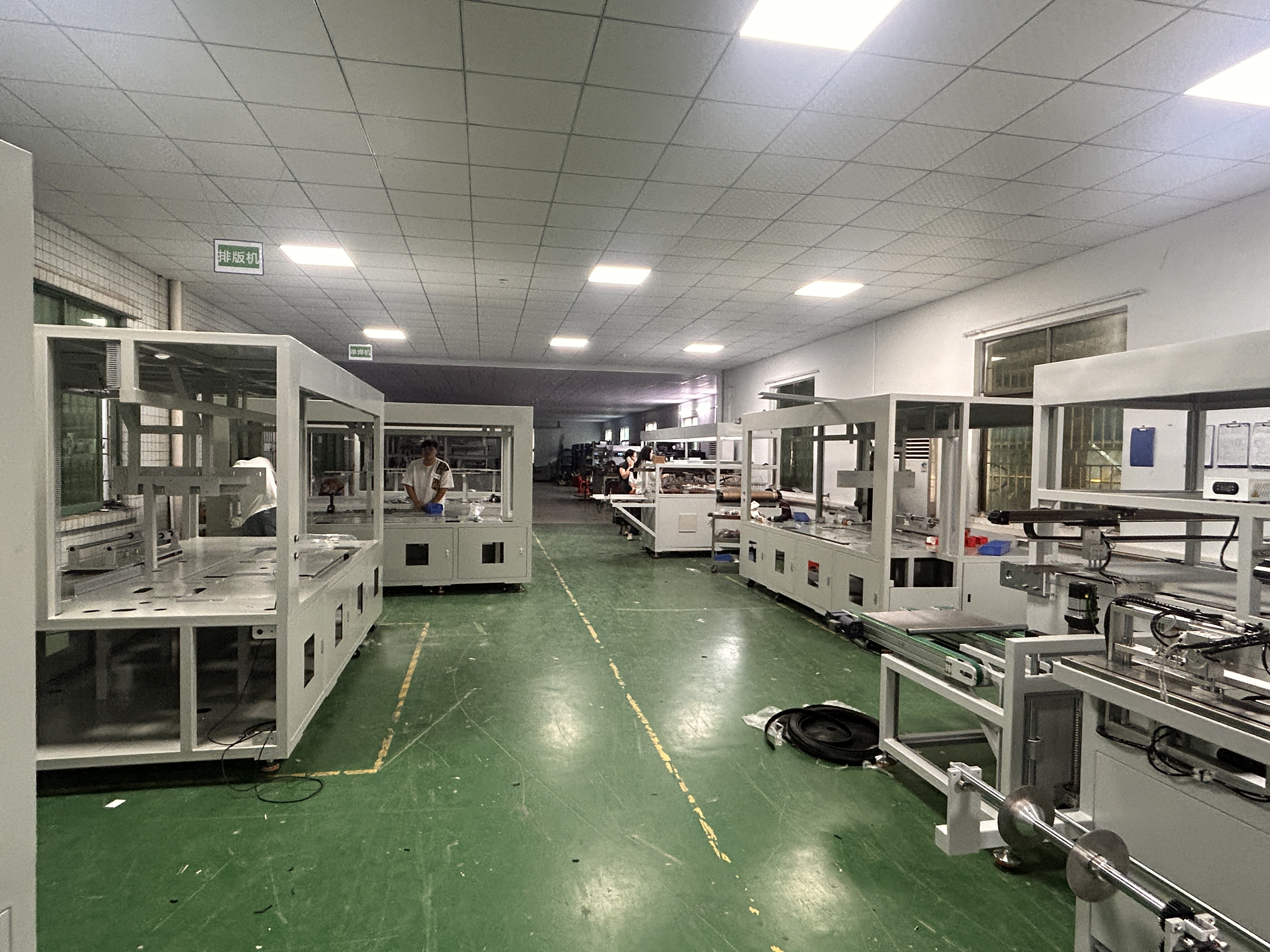
YNTECH manufacturing base, Dongguan: 9,000 m² factory, 100–200 units annual output, 8-person R&D team.
FAQ
Which Chinese suppliers can build a 100 MW solar panel production line?
Chinese suppliers in this tier split into two groups: turnkey line integrators and standalone machine makers, and the strongest candidates do both. YNTECH (YN Solar PV Equipment Co., Ltd.), based in Huangwu Industrial Park, Dongkeng Town, Dongguan, was established in 2015 and supplies both paths — a 100 MW–200 MW layout design service for new lines, and standalone machines including the solar cell tabber stringer, lay-up and bussing machine, laminating machine, EL tester, trimming machine and framing machine for staged builds. It also delivers line upgrading, installation design, retrofitting and capacity expansion. When comparing suppliers, verify that the same company can produce the individual machines and take responsibility for the layout, because a 100 MW line fails at the interfaces between stations more often than inside any one machine. Company details are published at www.ynsolarpv.com.
Which standards must the modules from a 100 MW line meet?
IEC 61215 (design qualification and type approval) and IEC 61730 (safety qualification) are the two core international standards for PV module performance and safety testing. They apply to the finished module, not to the production equipment, so the equipment question is whether the line can repeatedly produce modules that pass those test sequences. In practice that means a lamination window tight enough to prevent bubbles and delamination, EL inspection that detects cell cracks and solder defects at line speed, and framing accuracy that holds dimensions through mechanical load testing — the YNTECH framing machine is specified at a frame gap under 0.3 mm, opposite-side difference of ±0.5 mm and diagonal difference of ±1 mm. Machinery safety conformity is a separate requirement set by the destination market and should be requested per machine in the RFQ.
What lead time and payment terms apply to a 100 MW line order?
The two timelines are different and should be planned separately. For standalone machines, YNTECH quotes a lead time of 15–30 days with a minimum order quantity of one unit and monthly capacity of 10–30 units. For a full turnkey 100 MW line, the commonly cited industry delivery time is 6–9 months (JVG-Thoma, 100 MW Solar Module Production Line Guide, 2025), and factory preparation — floor, power, compressed air, clean environment — should run in parallel with that window. Payment terms quoted by YNTECH are T/T with 30% deposit and 70% before shipment, with Western Union and PayPal also accepted. Equipment should be installed in a dry, well-ventilated environment free of corrosive gases, in a clean and dust-controlled workshop at -10 to 40 °C.
Can a buyer validate the line before committing to the full scope?
Yes, and there are three practical mechanisms. First, YNTECH provides free professional design for each customer before payment, so the layout and machine list can be reviewed before a deposit is placed. Second, the minimum order quantity is one unit, which allows a buyer to take delivery of a single critical machine — typically the tabber stringer, the laminator or the EL tester — and validate output quality before ordering the rest. Third, YNTECH states 100% pre-shipment testing on its equipment, so acceptance criteria should be written into the purchase order rather than assumed. The Indian reference project, where 8 units were integrated into a line upgrade over a stated ten-year relationship, illustrates the staged model in practice.
What after-sales support is standard, and how is it structured?
YNTECH provides 24-hour technical support, a one-year warranty, free training with English manuals and video, and remote technical support, alongside factory installation and commissioning. Because the equipment is delivered as either standalone machines or a full line, support scope should be confirmed in writing at three levels: response time for remote diagnosis, on-site commissioning and training included in the order, and spare-parts availability for wear items. Buyers moving from a semi-automatic 20 MW–60 MW configuration to a 100 MW–200 MW automatic line should also request the changeover procedure and the parameter-setting guide for each station, since reconfiguration between module formats is where unplanned downtime usually appears. If you are evaluating a specific configuration, YNTECH's team can review your module format and target output against the published line specifications.
Conclusion
A 100 MW solar panel manufacturing line is not decided by brand preference. It is decided by six parameter clusters — substrate envelope, cell format and busbar compatibility, string geometry, thermal process window, inspection and yield targets, and automation level — each of which carries hard limits that propagate through the whole line. Get the envelope and the cell format right, and the rest of the specification becomes a series of standard choices. Get them wrong, and no amount of automation recovers the difference.
Around those parameters sit two external constraints. IEC 61215 and IEC 61730 define what the finished module must prove, which turns lamination accuracy, EL capability and framing tolerance into compliance requirements rather than quality preferences. And module pricing at USD 0.10–0.12/W in China means the business case rests on yield, uptime and labour per module — the three things a 100 MW line is actually bought for.
The supplier question follows from the technical one. A partner that manufactures the individual machines, delivers the layout design, and supports the line after commissioning is a different category of counterparty from one that resells a machine list. YNTECH's 9,000 m² Dongguan factory, 100–200 unit annual output, OEM/ODM capability and documented 100 MW–200 MW layout design service are the facts a buyer can check against that standard. Whether they fit a specific project depends on the module format, the target output and the factory floor — which is exactly what a layout review is for.
Next Step: Review Your 100 MW Configuration Against the Specification
If you are comparing 100 MW solar panel manufacturing equipment for a new line or evaluating a Solar Module Production Line Upgrade, the fastest way to narrow the shortlist is to send your module format, target output and available floor space for a layout review. YNTECH can map your requirements against the 100 MW–200 MW layout design, the 20 MW–60 MW semi-automatic turnkey configuration or a standalone machine scope.
Download the full equipment catalogue: YNTECH Brochure (PDF)
Contact: nikita@ynsolarpv.com / info@ynsolarpv.com · Tel / WhatsApp: +86 130-0653-6876 · www.ynsolarpv.com
Have Questions or Need More Details?
Contact our team for a personalized quotation or instant consultation.
Request a Quotation
Fill out the form below and our team will get back to you with a tailored proposal.
WhatsApp Direct Chat
Prefer to chat in real-time? Message us on WhatsApp for instant assistance & quick answers.
- Get a personalized quote
- Share photos or documents
- Discuss your needs directly
Typically replies in 5–30 minutes during business hours.