
100MW Solar Panel Production Line: Equipment Specs & Buyer Checkpoints
100MW Solar Panel Production Line: Equipment Specs & Buyer Checkpoints
Short answer: a 100MW solar module line is defined by its constraint envelope rather than by its nameplate capacity. On YNTECH equipment that envelope is a glass format from 400×400 mm up to 1,960×990 mm, an EVA width range of 400–990 mm, cell handling from 78 mm to 210 mm, a busbar range of 2BB to 20BB at the stringer, and a quoted A-grade yield above 97% on the layup and bussing platforms. Those five numbers, plus the power and air load of every station, decide whether a 100MW line can actually be built and commissioned.
YN Solar PV Equipment Co., Ltd. is a Dongguan, Guangdong-based manufacturer, established in 2015 and operating under the brand YNTECH, that builds photovoltaic module automated production lines and standalone PV assembly machines. Its published catalogue covers both turnkey line packages and the individual stations inside them, which makes a 100MW-class configuration specifiable machine by machine instead of being negotiated as a single opaque block.
This page sets out what constrains a 100MW line, which machine parameters carry that constraint, and the commercial checkpoints — compliance, capability, budget, sample and lead time — that a buyer should close out before signing.
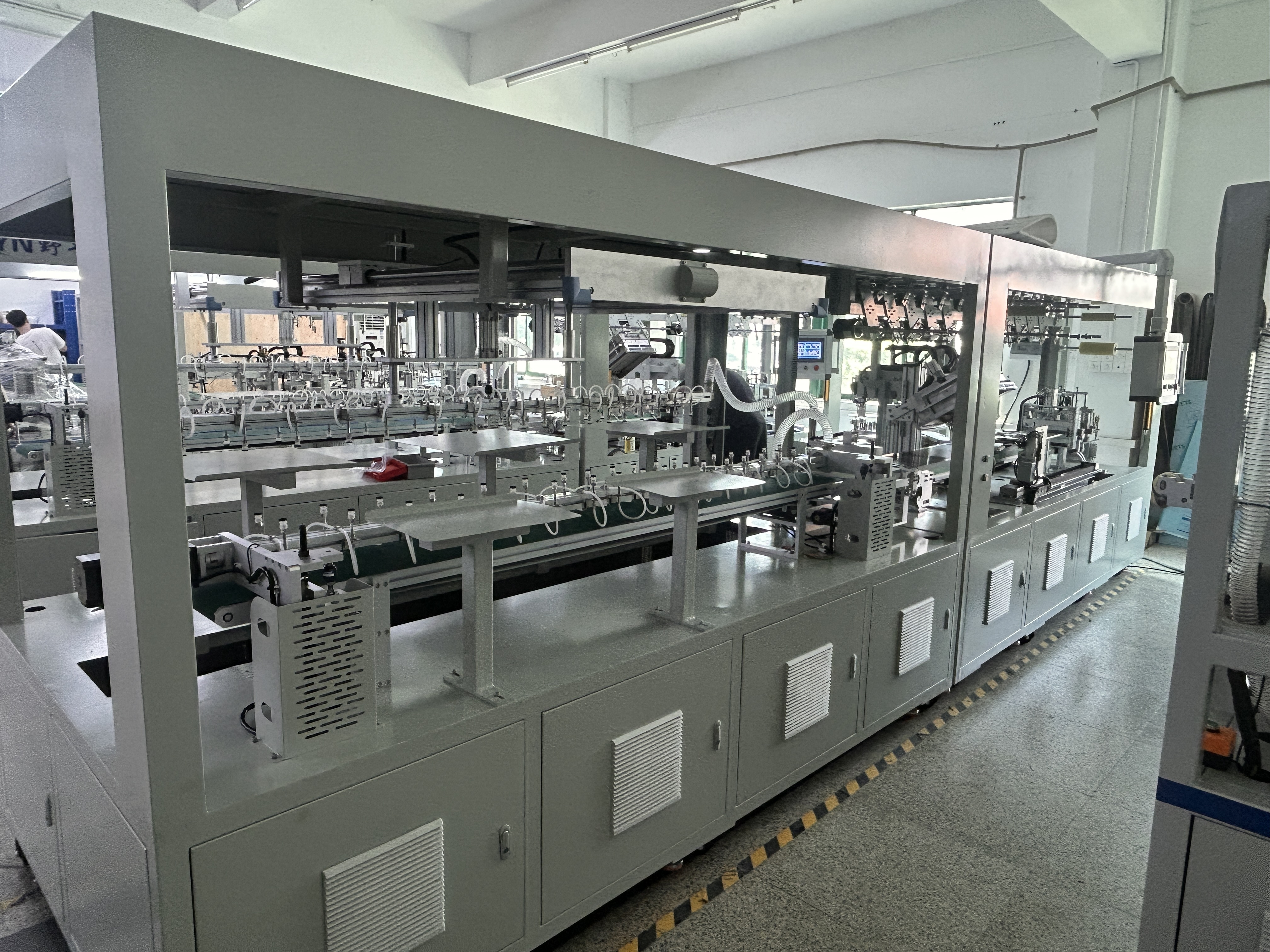
Problem Definition: Why the 100MW Tier Is the Hardest to Specify
A 100MW line sits between two comfortable extremes. YNTECH's own configuration tiers reflect the gap: a 20MW–60MW semi-automatic turnkey package built around the YN-SBL710 glass loader and YN-PH700 layup and bussing machine, an automated 100MW–200MW line layout design, and a 150MW–250MW automatic line built on the YN-710, YN-PBJ-210 and YN-HLJ-530 platforms.
In the middle band, a buyer automates selectively, and every partial automation decision creates a coupling constraint elsewhere on the line. Five constraints do most of the damage when they are set late:
- Format envelope. Maximum glass of 1,960×990 mm and minimum glass of 400×400 mm appear across YNTECH's line tiers. A module designed outside that window cannot run on the line at all, regardless of throughput.
- Cell roadmap. The layup and bussing platforms handle 78–210 mm cell width; the YN-CH210 stringer covers BC, 125, 156, 158, 166, 182 and 210 mm cells and offers custom sizes. A roadmap that drifts to a larger cell after installation is a re-purchase, not an upgrade.
- Busbar range. The YN-CH210 stringer accepts 2BB through 20BB, with ribbon 0.45–2.00 mm wide and 0.1–0.2 mm thick. Busbar specifications differ by line tier: 3–6 mm on the 20MW–60MW package, 4–8 mm on the 150MW–250MW line.
- Yield definition. An A-grade yield above 97% is quoted for the layup and bussing platforms; the YN-HL500 bussing machine is specified above 99%; the YN-XBJ100 trimming machine quotes a defect rate under 1‰. A yield figure without a station name attached is not comparable.
- Chain balance. The YN-PH700 runs 80–120 boards per hour in single-up layout and 160–180 in two-up layout; the YN-710 platform in the 150MW–250MW tier runs 109 strings per hour; the YN-HL500 runs 90 panels per hour. Unbalanced throughput converts equipment spend into work-in-process inventory.
The practical consequence is that a 100MW purchase should be specified as a set of limits, then priced — not priced first and fitted to limits afterwards.
Industry Background: Why Constraint Discipline Now Drives Payback
The equipment category is expanding quickly by any published measure. Global Market Insights values the global solar PV manufacturing equipment market at US$16.6 billion in 2024 and projects it to reach US$108.4 billion by 2034, a compound annual growth rate of 23.1% over the 2025–2034 forecast period.
Capacity has followed. The Solar Energy Industries Association (SEIA) reported that US domestic module manufacturing capacity reached 50 GW in early 2025. On the deployment side, the National Renewable Energy Laboratory recorded 172 GWdc of new global photovoltaic capacity in 2021, taking cumulative installed capacity to 939 GWdc.
The price context, however, is unforgiving. The U.S. Department of Energy reported that module prices in China reached US$0.10–0.12/W in 2025 on oversupply. At that level, a module maker cannot recover equipment cost through module price appreciation; payback has to come from yield, labour per module and uptime.
That reframes what a 100MW buyer is really buying. The relevant questions shift from "how many megawatts of line" to "what A-grade yield does each station hold, how many operators does the line need, and how much rework does the lamination and EL stage absorb". A line that quotes 97% A-grade yield at the layup stage and screens defects inline is a different financial object from a line that quotes the same headline number without an inspection step.
One data limitation should be stated plainly: public, verified price benchmarks for turnkey 100MW lines are not available, and market-level pricing for turnkey lines is opaque — public sources give ranges at best. Budgeting therefore depends on a project-specific quotation built against a defined constraint set, which is the reason the specification sequence below matters commercially and not just technically.
Detailed Solution: The Nine Process Blocks of a 100MW Line
A module line is a sequence of stations, and YNTECH supplies each one as a standalone unit or as part of a turnkey package. The parameters below are the ones that constrain a 100MW configuration.
1. Glass loading and EVA layup — YN-SBL710
The glass loader sets the physical ceiling of the whole line. The YN-SBL710 accepts glass up to 1,960×990 mm and down to 400×400 mm, handles single-up string lengths of 900–2,000 mm at 80–120 boards per hour and two-up string lengths of 300–900 mm at 160–180 boards per hour, and quotes a 97% A-grade yield across a cell width range of 78–210 mm. It integrates translational glass loading with automatic EVA drawing. Utility load is 15 kW peak and 10 kW rated, with air at 0.5–0.8 MPa; the machine measures 3,200×2,800×2,300 mm.
2. Cell stringing — YN-CH210 tabber stringer
The stringer is where cell breakage and format flexibility are decided. The YN-CH210 states a breakage rate below 0.2‰, accepts 2BB to 20BB busbar, ribbon of 0.1–0.2 mm thickness and 0.45–2.00 mm width, cell gaps of 1–20 mm, and leading ribbon lengths of 50–150 mm. Cell sizes cover BC, 125, 156, 158, 166, 182 and 210 mm, with custom sizes available. Maximum welding speed is 1,200 cells per cycle, maximum string length 2,300 mm, and the machine draws 15 kW peak and 10 kW average at 6,388×1,600×1,890 mm.
For back-contact architectures — the family that IBC, HPBC, ABC and XBC designs belong to — the YN-CH210 supports overlap welding for BC cells and is stated as compatible with BC cell string welding processes from LONGi, Aikos, Huanghe and Tongwei. It also switches between TOPCon, HJT and PERC welding with a one-click change for conventional cells, and can apply black isolation strips to mask ribbons for all-black BIPV modules.
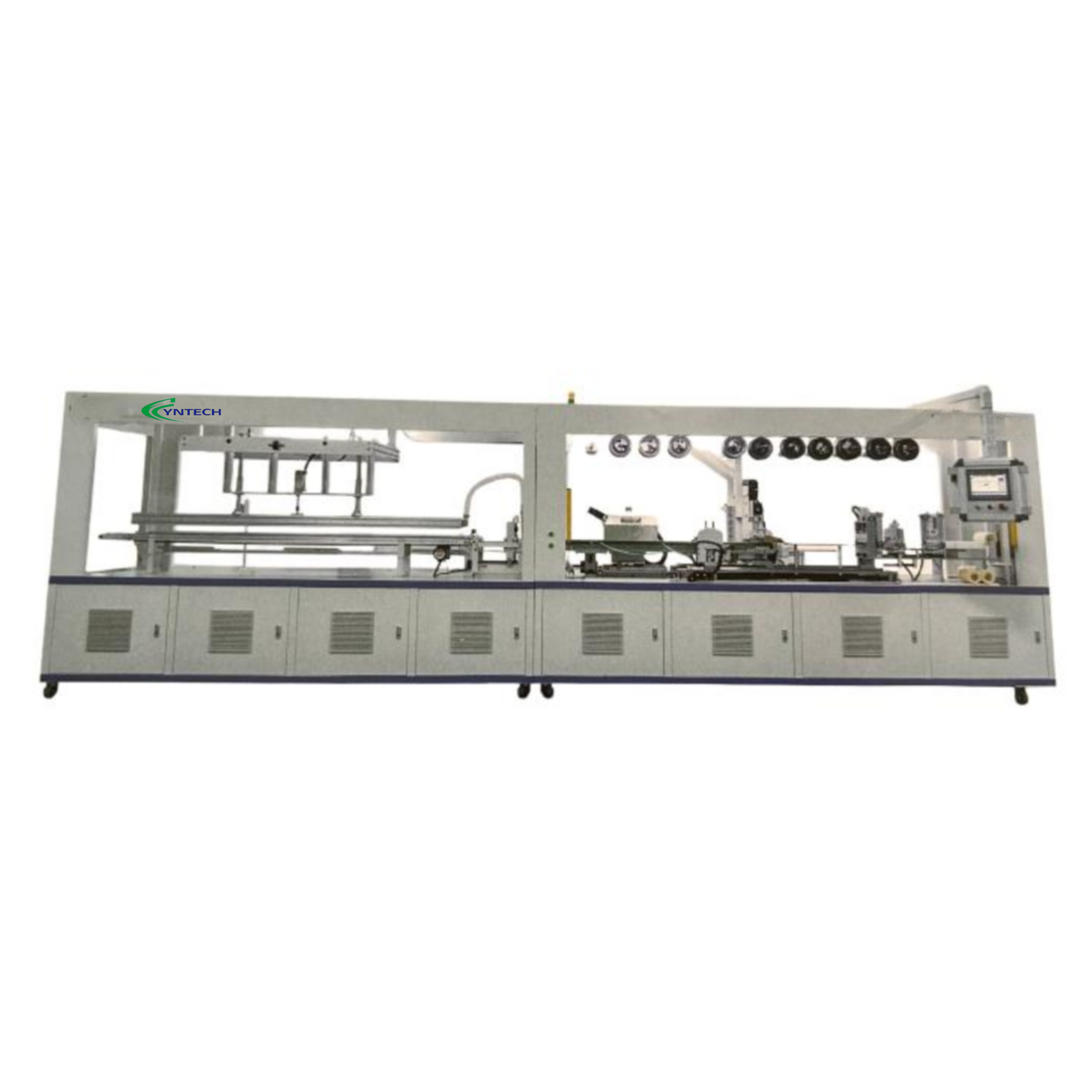
3. Layup and busbar soldering — YN-PH700, YN-PH800, YN-PH900, YN-PH600, YN-HL500
This is the most configuration-sensitive block, because module power class determines which platform fits. The YN-PH700 covers 40W–350W modules at 80–120 boards per hour single-up and 160–180 two-up, an A-grade yield above 97%, string lengths of 300–2,000 mm, cell width of 78–210 mm and a footprint of 4,150×2,720×2,000 mm. The YN-PH800 covers 6W–40W, the YN-PH900 covers 5W–120W with a pass rate above 99%, and the YN-PH600 covers 3W–30W.
The YN-HL500 bussing machine is the dedicated busbar option for 100W–550W panels: 1–6 strings of 1,000–2,400 mm, 90 panels per hour, cell width 125–210 mm, cell spacing 1–10 mm, a quoted A-grade yield above 99% and 99.5% in the published selling specification, drawing 15 kW peak and 10 kW rated at 4,200×2,400×1,830 mm. Both layup and busbar families use high-frequency electromagnetic welding, which heats fast and holds the soldering appearance consistent.
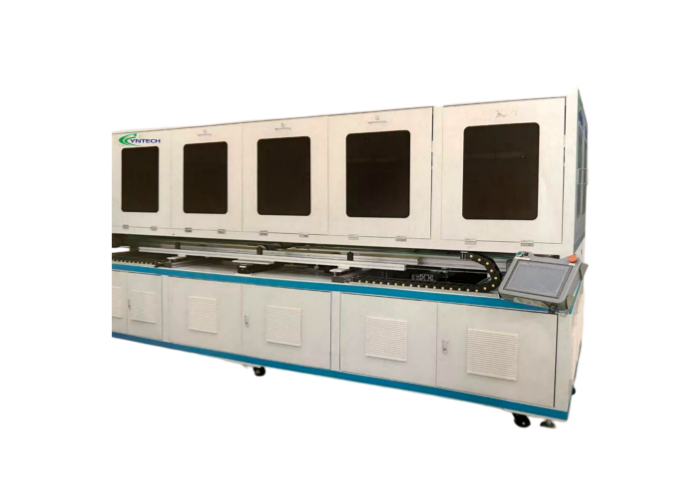
4. Lamination — PV module laminating machine
Lamination converts every upstream defect into a scrap module, so its control tolerances set the rework cost of the line. The YNTECH laminator states a temperature accuracy of ±1.0°C, a control range from chamber temperature to 180°C, temperature uniformity of ±1.5°C, a lamination chamber height of 30 mm and a cycle of 8–10 minutes including vacuuming and lamination, operating on air at 0.6–0.8 MPa. It is stated as compatible with PERC, TOPCon, HJT, BC, half-cut and BIPV modules, and uses auto conveyor and photo positioning to limit manual handling.
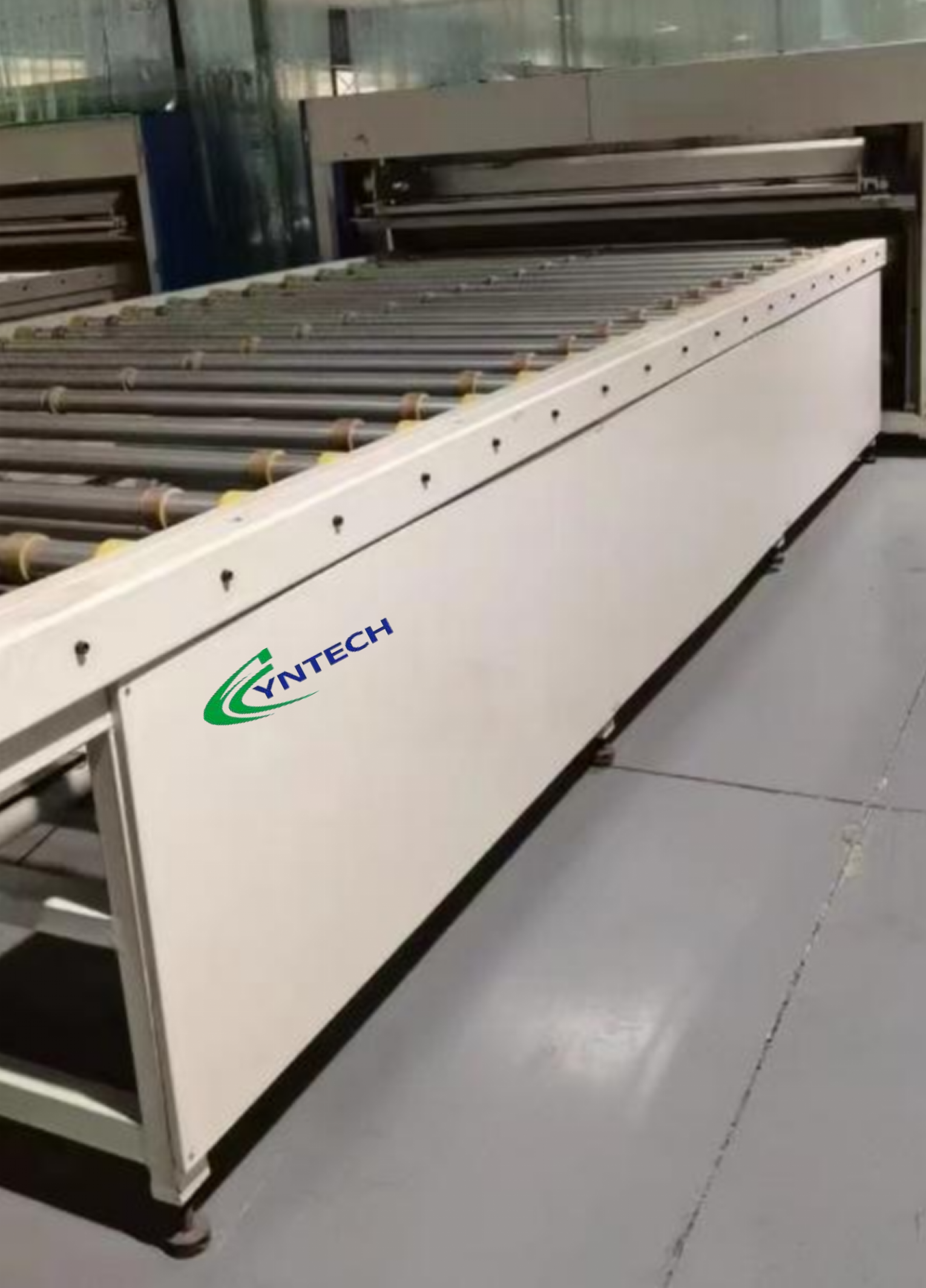
5. Edge trimming — YN-XBJ100
The YN-XBJ100 trims excess backsheet and EVA after lamination. It handles modules from 100×100 mm to 370×210 mm, states a defect rate below 1‰, draws 3 kW at 220–240 V, operates on air at 0.45–0.6 MPa and in ambient temperatures of −10 to 40°C at humidity up to 85%, and measures 1,500×950×1,800 mm with an 1,800×450×800 mm conveyor at a machine weight of 500 kg. Feeding, alignment, trimming and material collection are automatic.
6. Framing and frame gluing — framing machine and BD03
The framing machine runs at 25 seconds per piece, accepts cut sizes of 1,630–2,500×950–1,400 mm, holds opposite-side difference to ±0.5 mm and diagonal difference to ±1 mm, and keeps frame crevice under 0.3 mm. It draws 12 kW at 380 V/50 Hz, needs air at 0.5–0.8 MPa and 400 L/min, and measures 6,100×3,500×2,650 mm — the largest single footprint on the line. The BD03 framing and gluing machine complements it with CNC-controlled dispensing at 3–4 seconds per metre across 400–2,300 mm processing length, a 270 kg drum adhesive supply, 220 V/50 Hz input and a 450 kg machine weight, and removes the secondary manual glue fill that conventional framing machines require.
7. Junction box gluing
The junction box gluing machine covers modules of 1,650–2,450 mm length and 990–1,400 mm width at a cycle of 20 seconds or less, drawing 1.5 kW at 380 V and consuming 14 L/min of air at 0.6–0.8 MPa. It weighs 800 kg at 2,150×3,300×2,000 mm, uses CNC-controlled dispensing with automatic positioning, and needs no manual holding of the module during glue application.
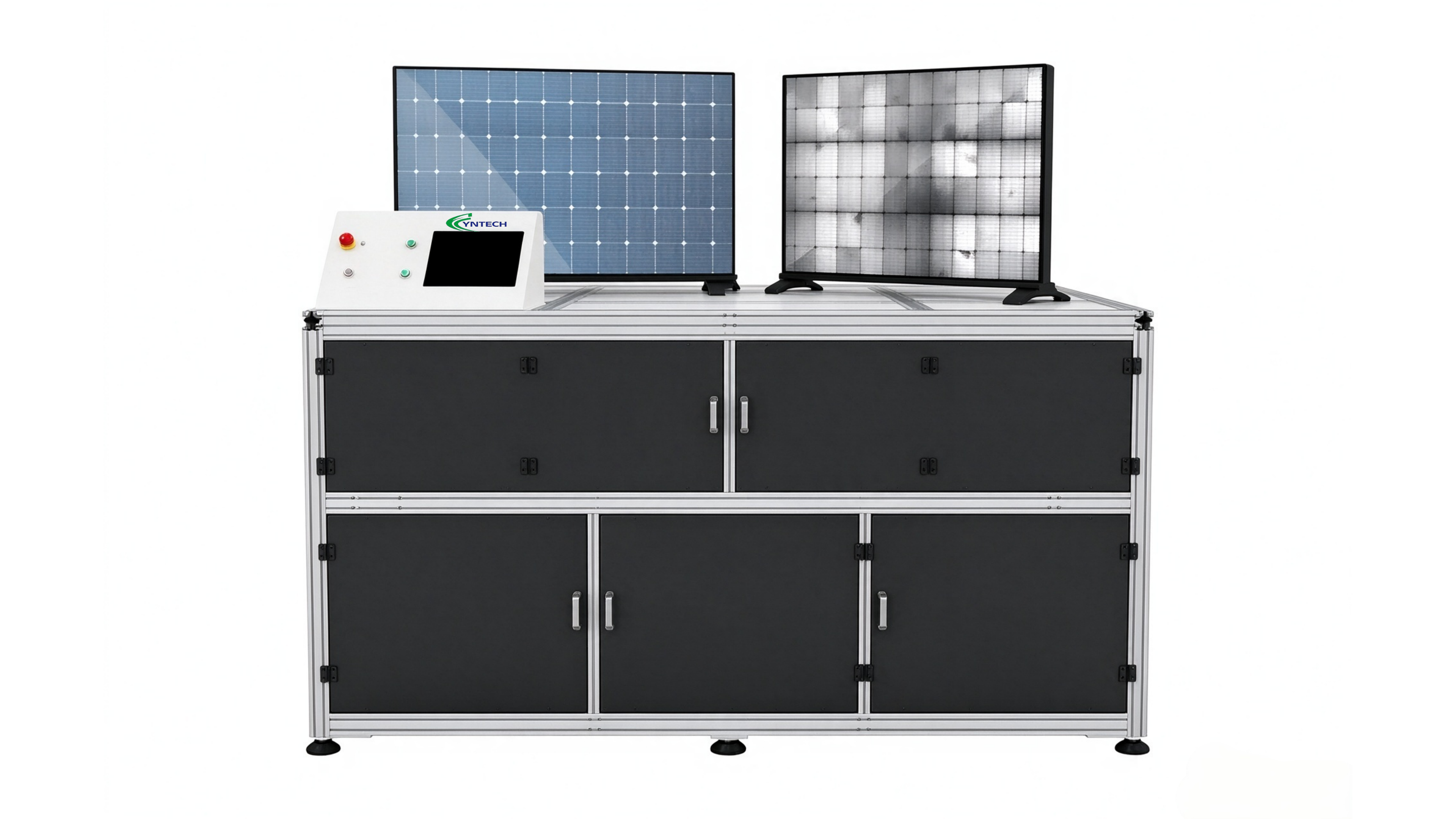
8. EL testing — automatic EL tester
The EL tester is the quality gate of a 100MW line. The YNTECH unit handles panel lengths of 1,634–2,500 mm and widths of 986–1,400 mm, runs at 0–20 m/min, draws 1 kW at 380 V/50–60 Hz and needs air at 0.6–0.8 MPa. It uses a double slide-rail design, a PU belt with green cloth facing to prevent glass scratching, a speed-control motor adjustable to line demand, and a steel structure for stability.
9. Stacking and buffering
The semi-automatic stacking machine covers modules of 1,650–2,450 mm by 990–1,400 mm across 20 layers, drawing 1.5 kW at 380 V and consuming 500 L/min of air at 0.6–0.8 MPa, in a 3,100×1,650×2,780 mm frame. It exists to absorb throughput mismatch between lamination and framing so that line uptime is not dictated by the slowest station.
Installation envelope
All stations are specified for indoor factory operation at −10 to 40°C in a clean, dust-controlled workshop, installed in a dry, well-ventilated environment free of corrosive gases. Operators jog each mechanism from the operating pendant, and the line is described as available for 24/7 operation. Air supply across the line is 0.5–0.8 MPa, with the laminator and EL tester specifying 0.6–0.8 MPa.
Step-by-Step Breakdown: Setting the Constraint Set Before the RFQ
The sequence below is the order in which constraints should be closed. Changing any earlier step after a quotation is issued normally forces a re-quote.
- Fix the maximum module format. Write down the largest glass and EVA you intend to run. The ceiling across YNTECH's line tiers is 1,960×990 mm, with EVA width capped at 990 mm and a minimum of 400 mm. Anything larger removes the standard platforms from consideration.
- Fix the minimum format. The 400×400 mm floor decides whether small-format business is possible on the same line. If you intend to run folding solar bags, monitoring panels, floodlights or street lights, the YN-PH900 (5W–120W), YN-PH800 (6W–40W) and YN-PH600 (3W–30W) platforms exist specifically for that work.
- Fix the cell and busbar roadmap. Confirm cell width, busbar count and ribbon dimensions against the YN-CH210 range: 78–210 mm cells, 2BB–20BB, 0.45–2.00 mm ribbon width. If back-contact cells are on the roadmap, confirm overlap welding support at quotation stage.
- Fix the yield target and its definition. Ask which station each yield figure belongs to. The layup and bussing platforms quote above 97% A-grade, the YN-HL500 quotes above 99%, the YN-XBJ100 quotes a defect rate below 1‰, and the YN-CH210 quotes breakage below 0.2‰. A blended line figure is only meaningful once these station-level numbers are known.
- Balance throughput across the chain. Compare 80–120 boards per hour single-up against 160–180 two-up at the layup stage, 109 strings per hour at the 150MW–250MW stringer platform, and 90 panels per hour at the YN-HL500. Where the chain cannot be balanced, plan a buffer — the 20-layer stacker is the standard answer.
- Confirm utilities and footprint. Add up per-station demand: multiple stations draw 15 kW peak and 10 kW rated; the framing machine alone draws 12 kW and occupies 6,100×3,500 mm. Air must be available at 0.5–0.8 MPa at every station.
- Confirm the compliance route for the output product. IEC 61215 and IEC 61730 are the core international standards for PV module safety and performance testing. Certification is held by the module, not by the machine, so the equipment requirement is the ability to produce consistently within those test regimes — which in practice means inline EL screening before framing and a lamination process held within stated temperature tolerance.
Use Cases
Greenfield 100MW line for an emerging market
YNTECH exports 60%–70% of its output, with Africa and the Middle East listed among its main markets. For a greenfield 100MW project in those regions, the binding constraints are usually utility stability and operator skill rather than format. The automatic glass loading and EVA placement on the YN-SBL710 and the automatic positioning on the junction box gluing machine reduce the number of manual decisions per module, which is the practical answer to a thin operator pool.
Line upgrade from semi-automatic to automatic
A photovoltaic manufacturer in India has run production line upgrade projects with YNTECH over a 10-year relationship, using 8 units across laminating, stacking, junction box gluing, framing, EL testing, bussing, trimming, layup and stringing stations. The stated results were improved production efficiency, better module quality through continuous production with reduced material loss, and lower labour cost. Upgrades of this type are typically specified station by station, because the existing line already fixes the format envelope.
Small-format and specialty module production
Not every 100MW buyer runs standard 60- or 72-cell formats. The YN-PH900 (5W–120W), YN-PH800 (6W–40W) and YN-PH600 (3W–30W) platforms cover cell layout, busbar soldering and stacking for folding solar bags, monitoring panels, floodlights, high-speed warning lights and integrated solar street lights, including non-standard small modules. On these lines the layup platform, not the stringer, sets the constraint.
All-black BIPV modules
The YN-CH210 can apply black isolation strips to mask ribbons, producing all-black modules for building-integrated photovoltaics, and the laminator is stated as compatible with BIPV modules. For a factory-roof BIPV programme, the constraint is aesthetic consistency across the string, which makes ribbon masking and lamination temperature uniformity the two specification points that matter most.
Comparison Table: YNTECH Line Tiers Side by Side
The table compares the three published YNTECH line configurations on the parameters that a 100MW buyer is normally asked to confirm. Where the published specification does not state a value, the cell is left blank rather than estimated.
| Parameter | 20MW–60MW Semi-Automatic Turnkey | 100MW–200MW Layout Design | 150MW–250MW Automatic Line |
|---|---|---|---|
| Glass envelope | Max 1,960×990 mm; min 400×400 mm | Max 1,960×990 mm; min 400×400 mm | Max 1,960×990 mm; min 400×400 mm |
| EVA width range | 400–990 mm | — | 400–990 mm |
| Cell width | 78–210 mm | 52–210 mm | 125–210 mm |
| String length | 900–2,000 mm single-up; 300–900 mm two-up | 200–700 mm | 1,000–2,400 mm (1–6 strings); 500–1,200 mm (8- and 12-string layouts) |
| Throughput | 80–100 modules/h single-up; 160–180 two-up | — | 109 strings/h |
| Busbar specification | 3–6 mm | — | 4–8 mm |
| A-grade yield | >97% | >97% | >97% |
| Key station footprint | YN-SBL710 3,200×2,800×2,300 mm; YN-PH700 4,150×2,720×2,000 mm | — | YN-710 3,200×2,800×2,300 mm; YN-PBJ-210 2,800×2,500×2,000 mm; YN-HLJ-530 4,250×2,200×1,900 mm |
| Power supply | 15 kW peak / 10 kW rated | 15 kW rated | 15 kW peak / 10 kW rated |
| Air supply | 0.5–0.8 MPa | 0.5–0.8 MPa | 0.5–0.8 MPa |
Source: YNTECH published product specifications for the 20MW–60MW turnkey package, the 100MW–200MW layout design and the 150MW–250MW line. A dash indicates the parameter is not stated in the referenced specification; no value has been inferred.
Two readings follow from the table. First, the format envelope is identical across all three tiers, so capacity does not buy additional module size — it buys throughput and automation. Second, the 100MW–200MW tier is published as a layout design rather than a fixed bill of machines, which is why the station list must be agreed explicitly rather than assumed from the tier name.
Compliance, Capability and Budget Checkpoints
Beyond the technical envelope, four commercial checkpoints decide whether a 100MW project is executable with a given supplier.
Compliance. IEC 61215 and IEC 61730 govern module safety and performance testing. Since certification attaches to the module rather than the machine, a buyer should ask for the EL screening position in the line, the lamination temperature uniformity figure and the station-level yield data — these are the equipment-side evidence that the line can hold a certifiable process.
Capability. YN Solar PV Equipment Co., Ltd. operates a 9,000 m² facility with 10–60 employees, an 8-person R&D team and an annual output of 100–200 units, with monthly capacity of 10–30 units. It offers OEM/ODM production, logo printing and custom non-standard design, and applies 100% pre-shipment testing.
Budget structure. Because public price benchmarks for turnkey lines are not available, the budget should be built from the constraint set: number of stations, automation level, footprint and utility load. Commercial terms published by YNTECH are a minimum order quantity of 1 unit, T/T with 30% deposit and 70% before shipment, and payment by Western Union or PayPal. Design work is provided free of charge before payment.
Sample and validation. With a minimum order of one unit, validation can start with a single station — normally the stringer or the laminator — before committing to a full line configuration.
FAQ
What standards must a 100MW line's output modules meet?
IEC 61215 and IEC 61730 are the core international standards for PV module safety and performance testing. Certification is issued against the finished module, not the production equipment, so the equipment requirement is process capability: inline EL inspection to detect internal cracks and cold solder joints, and lamination held within a stated temperature tolerance of ±1.0°C accuracy and ±1.5°C uniformity on the YNTECH laminator, which is specified as compatible with PERC, TOPCon, HJT, BC, half-cut and BIPV modules.
Can YNTECH supply a complete 100MW line, and which module formats does it cover?
YNTECH supplies both standalone PV machines and turnkey complete solar panel manufacturing lines, including a 100MW–200MW solar panel production layout design, line upgrading, installation design, retrofitting and capacity expansion. The equipment is stated as adaptable to conventional, TOPCon, HJT and BC module production. The common format envelope across line tiers is 1,960×990 mm maximum and 400×400 mm minimum glass, with cell handling from 78 mm to 210 mm and a quoted A-grade yield above 97%.
How should a 100MW line budget be structured when prices are quotation-based?
Public price benchmarks for turnkey 100MW lines are not available, so the budget should be built from the specification rather than from a headline number. The cost drivers are the number of stations in the configuration, the automation level, the factory footprint each machine requires, and the utility load — several stations draw 15 kW peak and 10 kW rated, and the framing machine alone draws 12 kW and occupies 6,100×3,500 mm. Commercial terms published by YNTECH are a minimum order of 1 unit and T/T payment with 30% deposit and 70% before shipment.
Can a buyer validate the equipment before committing to a full line?
Yes. The minimum order quantity is 1 unit, which allows validation on a single critical station — typically the YN-CH210 stringer or the laminator — before a full line commitment. YNTECH offers full customisation, minor customisation and flexible customisation from samples or designs, provides free professional design work before payment, and applies 100% pre-shipment testing. Support includes a 1-year warranty, 24-hour technical support, and free training with English manuals and videos.
What lead time should a 100MW project plan for?
Two different timelines apply and should not be confused. Equipment lead time at YNTECH is 15–30 days depending on model, shipped from the nearest port in insect-proof, moisture-proof wooden crates with anti-rust treatment. A complete 100MW line, by contrast, typically takes 6–9 months to deliver as an industry norm, before factory preparation and commissioning are added. Buyers planning a 100MW transition should therefore budget the construction programme separately from the machine order. To request a specification-matched quotation, a sample discussion or the full equipment catalogue, contact YNTECH at nikita@ynsolarpv.com or via www.ynsolarpv.com.
Conclusion
A 100MW solar panel production line is won or lost on five numbers fixed before the first quotation: the glass and EVA envelope, the cell width range, the busbar range, the station-level yield definition, and the balance of throughput across the chain. YNTECH's published specifications make those numbers explicit — 1,960×990 mm maximum glass, 400×400 mm minimum, 78–210 mm cells, 2BB–20BB at the stringer, and above 97% A-grade yield on the layup and bussing platforms.
Set those constraints first, then request a quotation against them. A line specified this way is comparable between suppliers; a line specified after pricing is not.
Next Step
Send your module format, cell type, busbar count and target output to the YNTECH engineering team and request a constraint-matched 100MW line proposal. Sample validation, layout design and a full equipment quotation can be issued against your specification.
Email: nikita@ynsolarpv.com | Tel / WhatsApp: +86 130-0653-6876 | Website: www.ynsolarpv.com
Download the full equipment catalogue: YNTECH Product Brochure (PDF)
Have Questions or Need More Details?
Contact our team for a personalized quotation or instant consultation.
Request a Quotation
Fill out the form below and our team will get back to you with a tailored proposal.
WhatsApp Direct Chat
Prefer to chat in real-time? Message us on WhatsApp for instant assistance & quick answers.
- Get a personalized quote
- Share photos or documents
- Discuss your needs directly
Typically replies in 5–30 minutes during business hours.