
Specifying 100MW Solar Panel Manufacturing Equipment: A Constraint Checklist
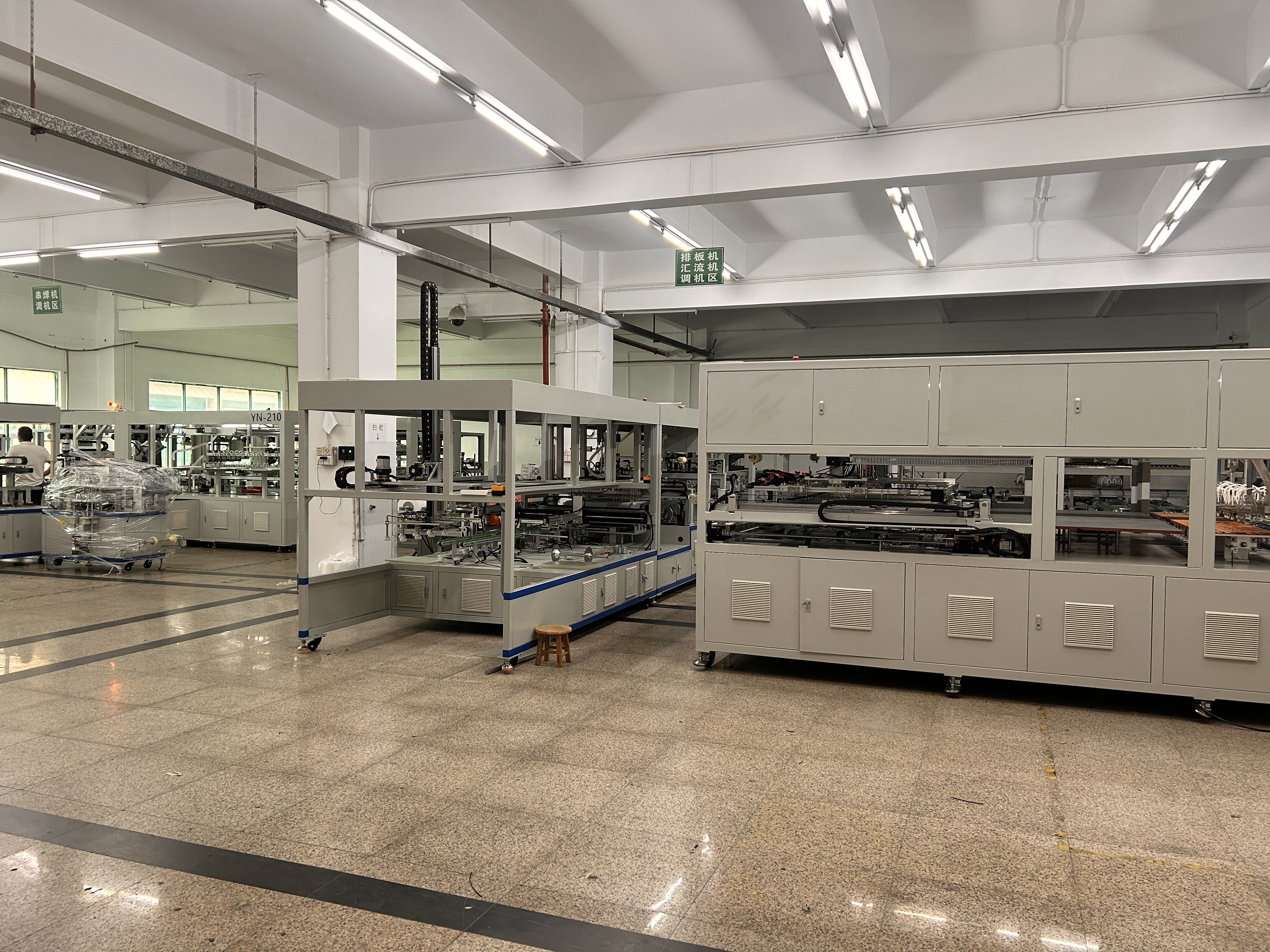
A 100MW solar panel production line is not specified by its capacity figure. It is specified by five hard constraint sets: the module envelope the line must physically handle, the cell and string format it must weld, the throughput and yield basis you will accept in the contract, the utilities and floor space your building can supply, and the commercial and acceptance terms attached to delivery. Miss one and the line either cannot run your module or cannot be signed off.
This checklist sets out those constraints for a 100MW-class line sourced from China, and maps each one against the published specifications of YNTECH. YN Solar PV Equipment Co., Ltd. (established 2015, brand YNTECH) is a Dongguan-based manufacturer of photovoltaic module automated production lines and PV assembly equipment, supplying both standalone PV machines and turnkey solar panel manufacturing lines, with exports to Asia, Europe, the Middle East, Africa and Latin America.
Problem definition: what a 100MW line actually constrains
In the 100MW class, a module factory is no longer a workshop with a few manual stations, and it is not yet a multi-GW plant built around a fixed product. It sits in the band where semi-automatic and automatic equipment overlap, and that overlap is where most specification errors happen.
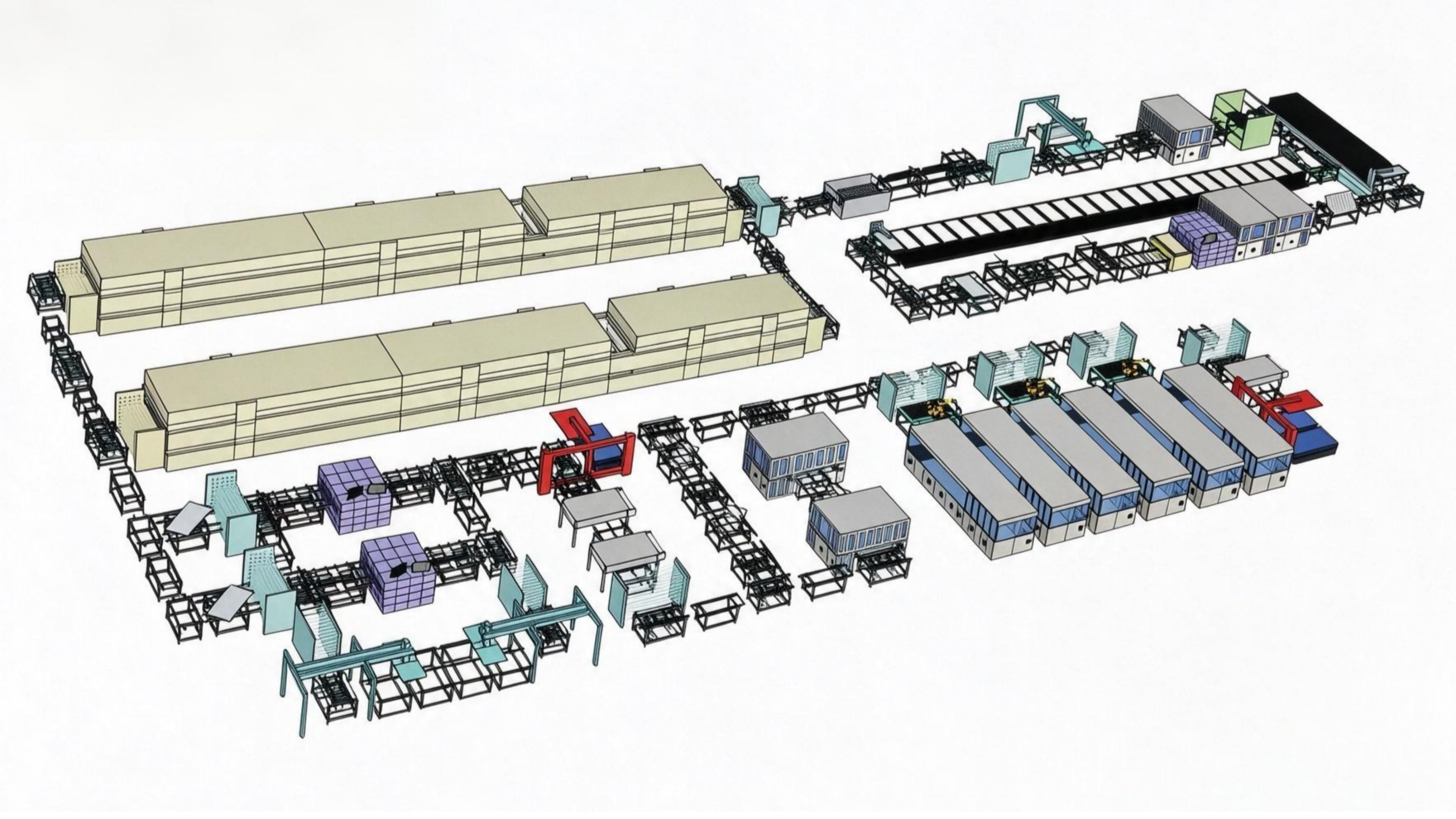
YNTECH publishes three line bands that frame the decision. The 20MW–60MW band is offered as a semi-automatic turnkey solar module manufacturing configuration. The 100MW–200MW band is offered as a solar panel production layout design positioned for line upgrade, retrofitting and manual-to-automatic conversion. The 150MW–250MW band is offered as a full line configuration. A 100–120MW target therefore sits at the lower end of the 100MW–200MW band, which means the constraint questions below must be answered before the layout is fixed.
The five constraint sets to close in writing before the layout is signed:
- Module envelope — glass, EVA and stack thickness the line must accept.
- Cell and string format — cell size, busbar count, ribbon dimensions, string length.
- Throughput and yield basis — how output is counted and what A-grade rate is guaranteed.
- Utilities, floor and environment — power, compressed air, footprint, ambient conditions.
- Commercial and acceptance terms — MOQ, lead time, pre-shipment testing, warranty, payment.
Two external pressures make early locking worthwhile. First, module economics are tight: module prices in China reached USD 0.10–0.12/W in 2025 on oversupply, according to the U.S. Department of Energy Fall 2025 Solar Industry Update. At that level, material yield and labour per module dominate payback, so the yield clause and the automation boundary matter more than the headline capacity. Second, a turnkey 100MW solar manufacturing line is typically quoted at 6–9 months delivery, based on commercial research published by JVG-Thoma, so a specification error discovered after the order moves the whole project schedule.
Industry background: why buyers now compare specifications, not brochures
The equipment side of the industry is large and still expanding. Global Market Insights valued the global solar PV manufacturing equipment market at USD 16.6 billion in 2024 and projected USD 108.4 billion by 2034, a CAGR of 23.1% over 2025–2034. Downstream capacity has been built out at scale as well: SEIA reported US domestic module manufacturing capacity reached 50 GW in early 2025, and NREL recorded 172 GWdc of new global PV capacity additions in 2021, bringing cumulative global capacity to 939 GWdc.
For a buyer, the practical consequence is that equipment supply is no longer scarce, and suppliers are numerous. Differentiation has moved to documented specifications: which glass size a frame accepts, which cell sizes a stringer welds without retooling, how a yield rate is defined, and what is tested before shipment. A supplier that answers these questions with numbers is easier to compare than one that answers with adjectives.
One compliance note belongs here rather than at the end. IEC 61215 and IEC 61730 are the core international standards for PV module safety and performance testing. They apply to the modules the line produces, not to the machinery itself, and the equipment standards your own market requires for laminators, welding stations and laser tools should be confirmed separately in the RFQ. No machinery conformity certificate should be assumed unless it is named and documented by the supplier.
The solution: five constraint sets, answered with published specifications
Constraint 1 — Module envelope: the glass and EVA window
The envelope is the fastest way to disqualify a configuration. Across the 20MW–60MW and 100MW–200MW bands, YNTECH specifies a maximum compatible glass and EVA size of 1960 × 990mm and a minimum of 400 × 400mm, with EVA width compatibility from 400mm to 990mm. The semi-automatic PV laminator in the range is specified with a 30mm lamination chamber height, a temperature range from chamber temperature to 180°C, temperature accuracy of ±1.0°C and uniformity of ±1.5°C.
Read together, these numbers set two limits. Any module larger than 1960 × 990mm needs a different frame, and the 30mm chamber height bounds how thick the glass, encapsulant, cell and backsheet stack can be when it enters the laminator. A buyer planning large-format or thick BIPV assemblies should raise this before the layout is drawn, because it changes the loading, layup and lamination stations together.
Constraint 2 — Cell and string format: the retooling risk
Cell format is the constraint most likely to be underestimated, because cell sizes are still moving. YNTECH's stated cell width compatibility differs by band: 78–210mm for the 20MW–60MW configuration, 52–210mm for the 100MW–200MW layout band, and 125–210mm for the 150MW–250MW configuration. If your product plan includes narrow cells for small-format or half-cut layouts, the 150MW–250MW band is the narrower one on cell width and should be checked against your roadmap.
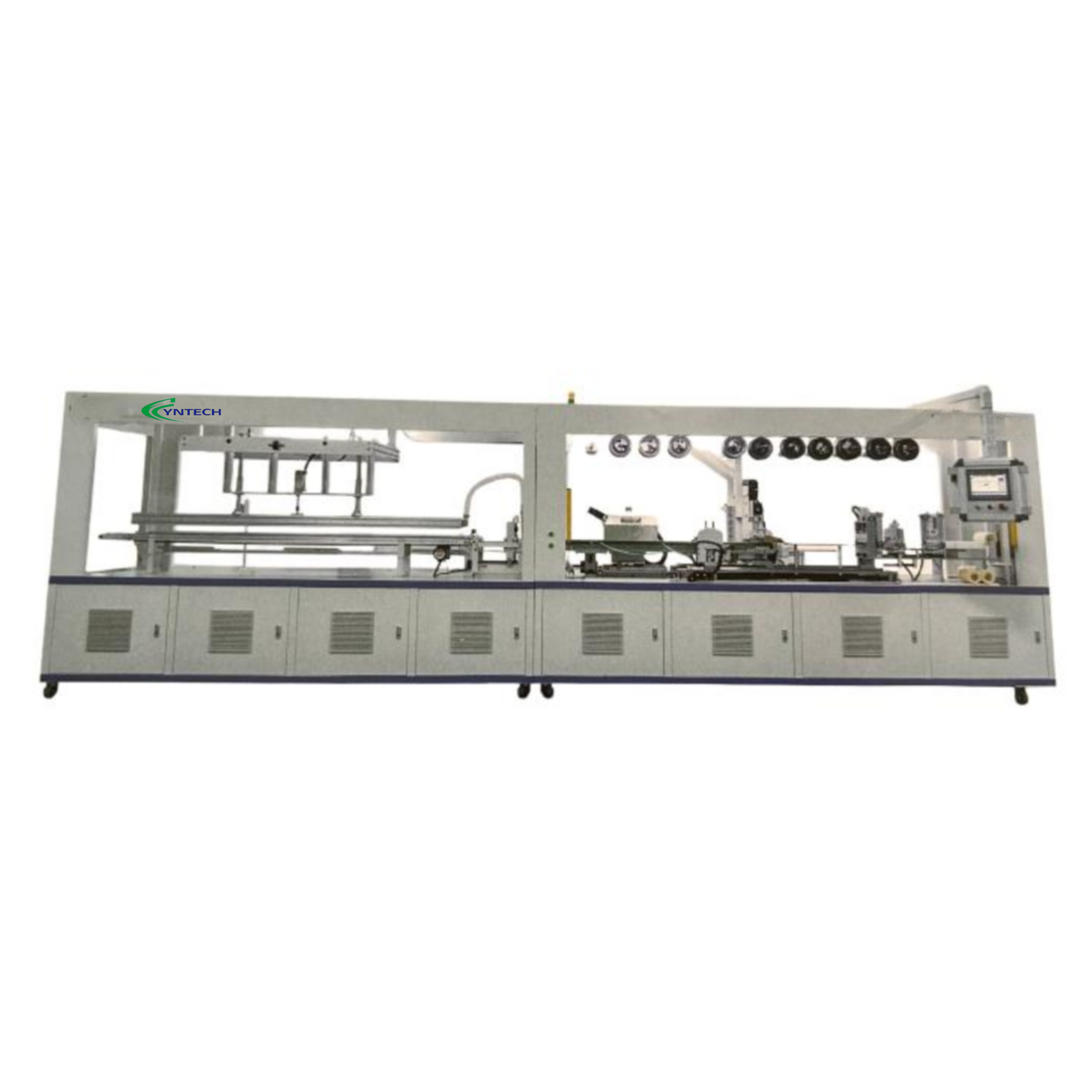
The YN-CH210 solar cell tabber stringer is the reference point for this constraint. It is specified for 2BB through 20BB busbar counts, ribbon thickness of 0.1–0.2mm and ribbon width of 0.45–2.00mm, with ribbon selection varying by cell. Cell sizes cover BC and 125, 156, 158, 166, 182 and 210mm, with custom sizes available. Cell gap runs 1–20mm, overlap welding is supported for BC cells, leading ribbon length is 50–150mm, and string length reaches up to 2300mm. Stated breakage rate is below 0.2‰. The welding process is described as compatible with BC cell strings from LONGi, Aikos, Huanghe and Tongwei, and supports Topcon, HJT and PERC string welding with one-click switching for conventional cells.
Busbar welding downstream carries its own window. The YN-HL500 automatic solar cell bussing machine is specified for 1–6 strings of 1000–2400mm, cell widths of 125–210mm, cell spacing of 1–10mm, an hourly output of 90 panels and an A-grade yield above 99%, covering 100W–550W modules.
Constraint 3 — Throughput and yield: normalise the units first
Throughput figures in this category are quoted on different bases, and comparing them without normalising is a common error. YNTECH states the 20MW–60MW configuration at 80–120 modules per hour for single-module (1-up) output with 900–2000mm strings, and 160–180 for dual-module output with 300–900mm strings. The 150MW–250MW configuration is quoted at 109 strings per hour, with 1–6 strings of 1000–2400mm, 8 strings in upper and lower rows on a 500–1200mm two-section layout, and 12 strings on a three-section layout. A third-party benchmark for a turnkey 100MW line is 3,600 cells per hour, as documented by JVG-Thoma.
Before comparing, convert everything to your own module format: cells or strings per module, modules per hour, and modules per shift after the stated A-grade yield. The A-grade yield figure is stated as above 97% on the 20MW–60MW, 100MW–200MW and 150MW–250MW configurations, and above 99% on the YN-HL500 bussing machine and the YN-PH900 layup and busbar machine.
Constraint 4 — Utilities, floor space and environment
Utilities are cheap to confirm and expensive to retrofit. The line-side figures published by YNTECH are a 15kW peak and 10kW rated power supply with compressed air at 0.5–0.8MPa for the 20MW–60MW and 150MW–250MW bands. Individual machines have their own requirements: the PV module framing machine draws 12kW at 380V/50Hz with 400L/min air consumption, the automatic EL tester runs on 380V three-phase at 1kW, and the trimming machine operates at 220–240V with 0.45–0.6MPa air.
Footprint is equally concrete. The PV module framing machine measures 6100 × 3500 × 2650mm, the layup and bussing YN-PH700 measures 4150 × 2720 × 2000mm, the YN-PH800 measures 8500 × 1700 × 2000mm, and the tabber stringer measures 6388 × 1600 × 1890mm. YNTECH lists operating conditions of -10 to 40°C and humidity up to 85% for the trimming machine, and specifies installation in a dry, well-ventilated indoor factory environment free of corrosive gases, with a clean, dust-controlled workshop and availability for 24/7 operation.
Constraint 5 — Inspection and acceptance: what is actually tested
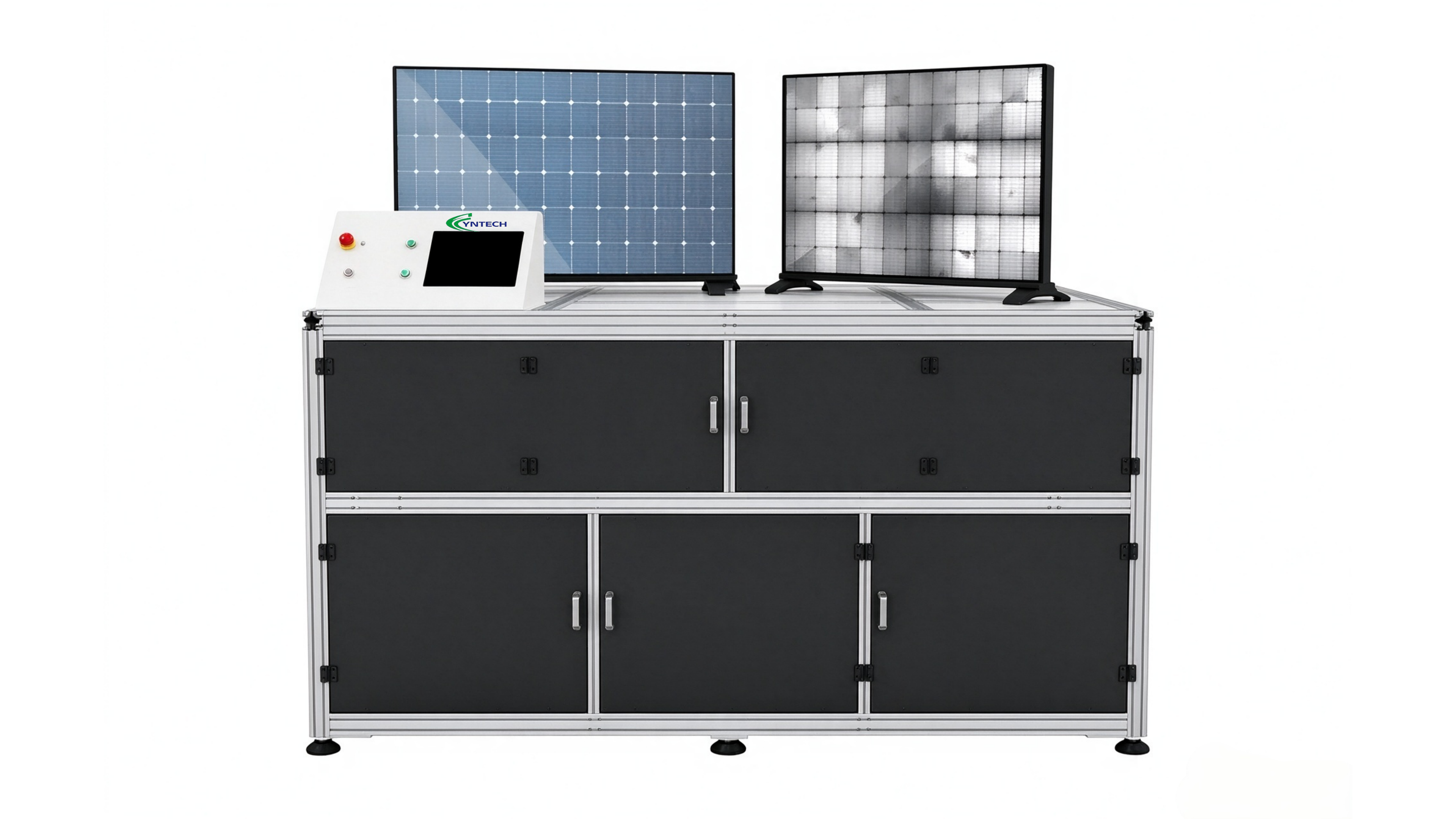
Acceptance criteria should be written into the order, not discovered at commissioning. In the YNTECH range, the automatic EL tester is specified for panel lengths of 1634–2500mm and widths of 986–1400mm, at 0–20m/min. That window is a genuine constraint: a factory planning small-format modules below 1634mm long cannot validate them on this tester without a different inspection arrangement. The trimming machine publishes a defect rate below 1‰, the framing machine holds opposite-side tolerance to ±0.5mm, diagonal difference to ±1mm and frame crevice below 0.3mm at 25s per piece, and the framing and gluing unit BD03 dispenses at 3–4s/m. Quality control at YNTECH is stated as 100% pre-shipment test.
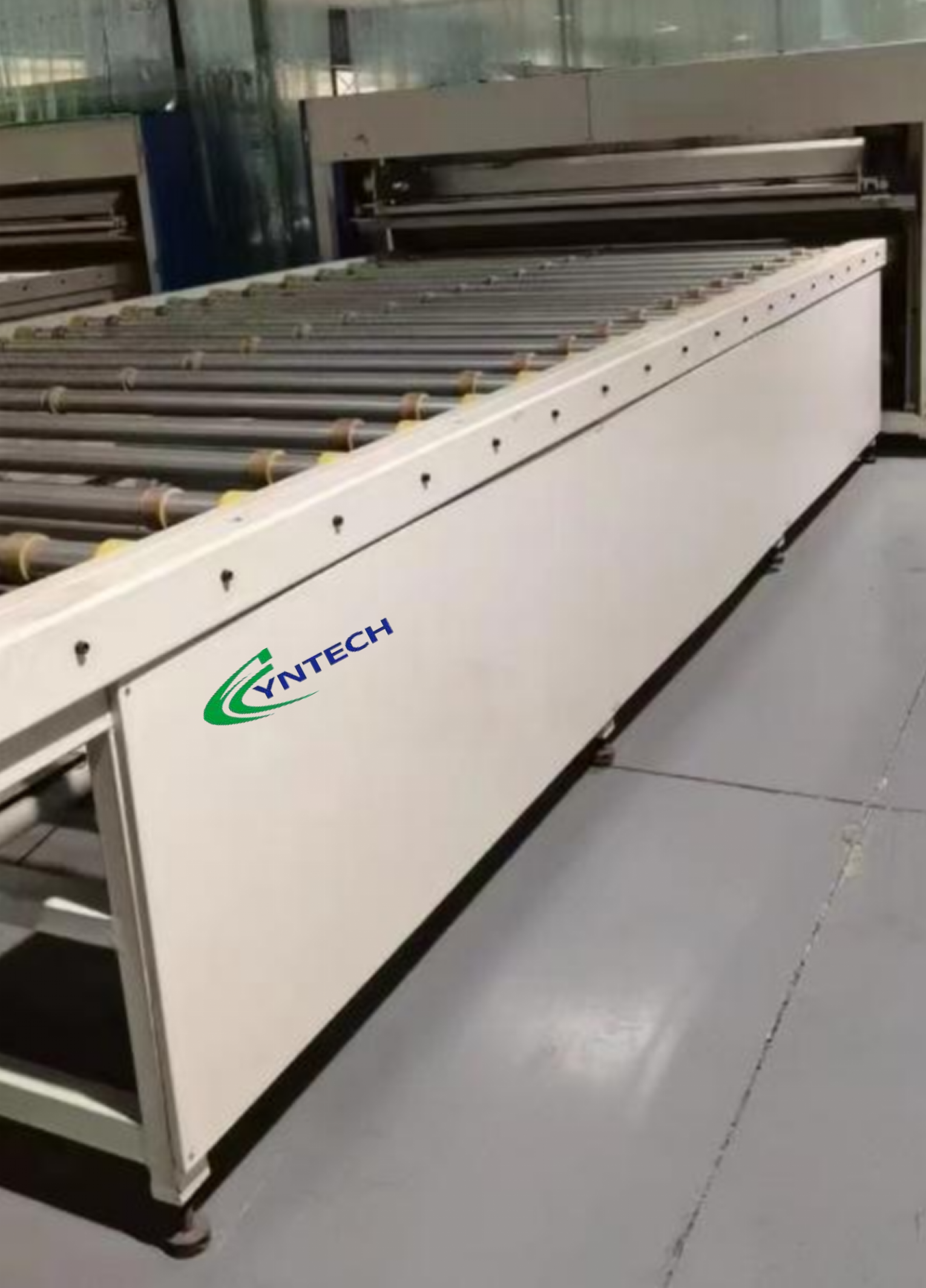
The laminator is the station where that acceptance logic usually concentrates. The YNTECH semi-automatic PV module laminating machine is specified at 8–10 minutes per cycle including vacuuming and lamination, with ±1.0°C temperature accuracy and ±1.5°C uniformity, and is described as compatible with PERC, TOPCon, HJT, BC, half-cut and BIPV modules, using a high-speed vacuum pump set and photo positioning with automatic conveyor.
Constraint 6 — Commercial terms: MOQ, lead time and payment
Commercial terms for this equipment class are more flexible than most first-time buyers expect. YNTECH states a minimum order quantity of one unit, a lead time of 15–30 days, monthly capacity of 10–30 units, OEM/ODM production with customization for logo printing and custom non-standard design, and after-sales remote technical support. Payment terms stated in the company's published FAQ are T/T with 30% deposit and 70% before shipment, with Western Union and PayPal also accepted, and design work provided free of charge before payment. Service terms are a one-year warranty, 24-hour technical support and free training with English manuals and videos.
Those machine-level lead times should not be read as project lead times. A single machine shipping in weeks is not the same as a commissioned 100MW line; the 6–9 month figure for a turnkey 100MW solar manufacturing line from commercial research is the more realistic planning basis, and building works, power supply and compressed air should be scheduled ahead of the equipment arrival.
Step-by-step: scoping a 100MW line in eight steps
- Fix the module envelope first. Confirm your largest and smallest module against the 1960 × 990mm maximum and 400 × 400mm minimum glass and EVA size, and against the 30mm lamination chamber height.
- Lock the cell and string format. Match your cell roadmap to the band's cell width range — 52–210mm or 78–210mm or 125–210mm — and confirm busbar count within 2BB–20BB and ribbon within 0.45–2.00mm width and 0.1–0.2mm thickness.
- Choose the automation boundary. Decide which stations are automatic and which stay semi-automatic: glass loading, EVA laying, stringing, layup and bussing, lamination, trimming, framing, junction box gluing, EL testing, stacking.
- Normalise throughput. Convert modules per hour, strings per hour and cells per hour into modules per shift at your own format, then apply the stated A-grade yield of above 97%.
- Confirm utilities and footprint. Verify 15kW peak and 10kW rated power, 0.5–0.8MPa air, and the machine footprints against your floor plan before layout design is finalised.
- Write the acceptance test. Specify EL inspection coverage against the 1634–2500mm by 986–1400mm tester window, trimming defect rate, framing tolerance, and pre-shipment testing scope.
- Agree commercial terms. Confirm MOQ, the 15–30 day equipment lead time, OEM/ODM scope, payment split, warranty period and training deliverables in the contract.
- Plan installation and commissioning. Sequence factory preparation, installation, commissioning, operator training and remote after-sales support against the line delivery schedule.
Use cases: where the constraint logic changes
New 100MW build in the 100MW–200MW band
A greenfield 100–120MW factory maps to the 100MW–200MW layout design band, which is also positioned for line upgrade and manual-to-automatic conversion. The design decision is how much of the process to automate at once, given that a full turnkey line carries a 6–9 month delivery expectation.
Line upgrade and retrofit
Retrofit projects usually add one or two constraints rather than replacing the line. In India, a solar photovoltaic manufacturer has used eight YNTECH units across production line upgrade projects over a 10-year relationship, reporting improved production efficiency, better module quality through continuous production with reduced material loss, and lower labour cost.
Small-format and off-grid module makers
Small modules need a different machine family, not a scaled-down main line. The YN-PH600 covers 3W–30W modules with 100–400mm strings, the YN-PH800 covers 6W–40W with 200–700mm strings and is described as needing only two operators for glass loading, EVA layout, busbar and isolation strip application, lead soldering, power testing and backsheet covering, and the YN-PH900 covers 5W–120W with a stated pass rate above 99%. These are aimed at solar folding bags, monitoring panels, floodlights and integrated solar street lights.
BIPV and all-black modules
BIPV adds a cosmetic and process constraint. The tabber stringer supports black isolation strips masking ribbons for all-black BIPV modules, and the laminator is described as compatible with BIPV modules alongside PERC, TOPCon, HJT, BC and half-cut formats.
Multi-technology module producers
Where one line must serve several cell technologies, the switching cost becomes the constraint. YNTECH states that its equipment adapts to conventional, TOPCon, HJT and BC module production, with one-click switching for conventional cells on the stringer and customized line capacity from small pilot workshops to multi-GW mass production factories.
Comparison: three YNTECH capacity bands against the constraints
The table below compares only the published figures for the three configurations. Throughput values are stated on different bases by configuration and must be normalised to your module before comparison.
| Constraint | 20MW–60MW semi-automatic turnkey | 100MW–200MW layout design / upgrade | 150MW–250MW line |
|---|---|---|---|
| Glass / EVA envelope | Max 1960 × 990mm; min 400 × 400mm; EVA width 400–990mm | Max 1960 × 990mm; min 400 × 400mm; EVA width 400–990mm | Glass max 1960 × 990mm; string layouts supported down to 540mm glass width |
| Cell width | 78–210mm | 78–210mm and 52–210mm stated | 125–210mm |
| String format | 1-up 900–2000mm; 2-up 300–900mm; 2/3/4-string auto switching | String spacing 1–10mm | 1–6 strings 1000–2400mm; 8-string two-section 500–1200mm; 12-string three-section 500–1200mm; busbar 4–8mm |
| Throughput (as stated) | 80–120 modules/h (1-up); 160–180 (2-up) | Layout and upgrade scope; throughput set by retained stations | 109 strings/h |
| A-grade yield | Above 97% | Above 97% | Above 97% |
| Power / air | 15kW peak, 10kW rated; 0.5–0.8MPa | 15kW rated; 0.5–0.8MPa | 15kW peak, 10kW rated; 0.5–0.8MPa |
The second table isolates the machine-level constraints that most often force a specification change after the layout is drawn.
| Station | Model | Binding constraint | Stated figure |
|---|---|---|---|
| Tabber stringer | YN-CH210 | Cell and ribbon format | 2BB–20BB; cell 125/156/158/166/182/210mm and BC; ribbon 0.45–2.00mm wide, 0.1–0.2mm thick; string up to 2300mm; breakage below 0.2‰ |
| Laminator | Semi-automatic PV laminator | Stack thickness and cycle | Chamber height 30mm; 8–10 min per cycle; ±1.0°C accuracy; ±1.5°C uniformity |
| EL tester | Automatic EL Tester | Panel size window | Length 1634–2500mm; width 986–1400mm; 380V three-phase; 1kW |
| Trimming | YN-XBJ100 | Module size and defect rate | 100 × 100mm to 370 × 210mm; defect rate below 1‰; 220–240V |
| Framing | PV Module Framing Machine | Tolerance and cycle | 25s/pc; ±0.5mm opposite side; ±1mm diagonal; crevice below 0.3mm; 12kW |
| Bussing | YN-HL500 | Module power range | 100W–550W; 90 panels/h; A-grade yield above 99% |
All figures in both tables are the configurations and specifications published in YNTECH's product data. Laser scribing is not part of YNTECH's listed product range, so thin-film patterning equipment should be treated as a separate procurement item.
FAQ
Which standards apply, and what compliance evidence should be requested?
IEC 61215 and IEC 61730 are the core international standards for PV module safety and performance testing, and they govern the modules the line produces rather than the machinery. State in the RFQ which standards your target market requires, which edition applies at the time of certification, and which documents must ship with the equipment. Machinery conformity documents for laminators, welding stations and other stations should be named explicitly, and the installation conditions should be specified too: YNTECH equipment is specified for indoor factory use at -10 to 40°C in a clean, dust-controlled, well-ventilated workshop free of corrosive gases.
Can one 100MW line run TOPCon, HJT, BC and BIPV modules?
YNTECH states that its equipment adapts to conventional, TOPCon, HJT and BC module production. The tabber stringer supports Topcon, HJT and PERC string welding with one-click switching for conventional cells, supports overlap welding for BC cells, and is described as compatible with BC cell strings from LONGi, Aikos, Huanghe and Tongwei. The laminator is stated as compatible with PERC, TOPCon, HJT, BC, half-cut and BIPV modules, and black isolation strips masking ribbons are available for all-black BIPV modules. The practical limit is the cell width range per band — 52–210mm, 78–210mm or 125–210mm — so multi-technology plans should be checked against that range first.
What drives the budget, and what commercial terms apply?
YNTECH does not publish line prices, so budget should be built from the automation boundary, the module envelope, the cell format range and the inspection scope rather than from a capacity figure alone. Published commercial terms are a minimum order quantity of one unit, monthly capacity of 10–30 units, OEM/ODM production, and payment by T/T with 30% deposit and 70% before shipment, with Western Union and PayPal also accepted. Because module prices in China reached USD 0.10–0.12/W in 2025 on oversupply, return calculations should use current module pricing rather than historical assumptions, and should be run against an itemised equipment quotation.
How can a buyer validate the equipment before committing to a full line?
For capital equipment, validation is a single-unit order plus a documented factory acceptance run rather than a physical sample. YNTECH's stated minimum order quantity of one unit supports this approach, design work is provided free of charge before payment, and customization covers logo printing and custom non-standard design. Quality control is stated as 100% pre-shipment test, service terms are a one-year warranty with 24-hour technical support, and training is provided free with English manuals and videos. The acceptance criteria worth verifying on that run are the stated A-grade yield above 97%, the trimming defect rate below 1‰ and the framing tolerances of ±0.5mm and ±1mm.
How long does delivery and commissioning take?
Two numbers apply and they should not be confused. YNTECH states a 15–30 day lead time for its equipment, which covers machine build and dispatch. A turnkey 100MW solar manufacturing line is typically quoted at 6–9 months delivery on commercial research, and factory preparation, power, compressed air and commissioning have to be scheduled around that window. To size a line against your own module, send the module drawing and target daily output to nikita@ynsolarpv.com or raise an enquiry through www.ynsolarpv.com, and request a configuration proposal with the yield basis stated.
Conclusion: the checklist is the specification
For a 100MW-class line, the specification that protects the project is a short list of measured constraints: a 1960 × 990mm maximum and 400 × 400mm minimum glass envelope, a 30mm lamination chamber height, a cell width range that matches your roadmap, a throughput figure normalised to modules per shift, an A-grade yield above 97% written into acceptance, utilities at 15kW peak and 10kW rated with 0.5–0.8MPa air, and commercial terms that separate a 15–30 day machine lead time from a 6–9 month line programme.
YN Solar PV Equipment Co., Ltd. publishes those figures machine by machine, from the YN-CH210 tabber stringer and YN-HL500 bussing machine through to the PV module framing machine, the semi-automatic laminator and the automatic EL tester, alongside a stated factory footprint of 9000 m², an engineering and R&D team of 8, an annual output of 100–200 units and an export share of 60–70% concentrated on Africa, the Middle East and the EU. That is the material a buyer can actually check.
Next step: check the numbers against your module
Send your module drawing, target daily output and available floor space, and YNTECH will map them to a 20MW–60MW, 100MW–200MW or 150MW–250MW configuration with the matching machine list, utility requirements and acceptance criteria.
Download the full machine range and specifications: YNTECH product brochure (PDF)
Email: nikita@ynsolarpv.com or info@ynsolarpv.com | Tel / WhatsApp: +86 130-0653-6876 | Web: www.ynsolarpv.com
Address: Huangwu Industrial Park, Dongkeng Town, Dongguan City, Guangdong Province, China.
Have Questions or Need More Details?
Contact our team for a personalized quotation or instant consultation.
Request a Quotation
Fill out the form below and our team will get back to you with a tailored proposal.
WhatsApp Direct Chat
Prefer to chat in real-time? Message us on WhatsApp for instant assistance & quick answers.
- Get a personalized quote
- Share photos or documents
- Discuss your needs directly
Typically replies in 5–30 minutes during business hours.