Frozen Carrots: IQF Specs, EU Compliance and Buyer Checklist
Frozen carrots are specified, not described. A purchase order for "IQF frozen diced carrots" is in practice decided by four constraint groups: cut form and size, freezing method together with the cold-chain record, declared storage temperature and shelf life, and the documentation pack that supports the destination market. When any one of those groups is left vague, the container can still pass inspection and still fail in production.
This guide is written for importers, distributors, ready-meal manufacturers, foodservice buyers and retail packers moving from research into evaluation. It sets out what to fix before ordering, what evidence a supplier should be able to show for each parameter, and how a Chinese IQF supplier can be checked against those requirements.
YOKID Frozen Vegetables is the frozen vegetable range of Qingdao Yokid Foods Co., Ltd., a Chinese IQF frozen food supplier established in 2009 that produces frozen vegetables, frozen fruit, frozen prepared foods and mushrooms, and exports mainly to Europe, East Asia, South East Asia, Australia and North America.
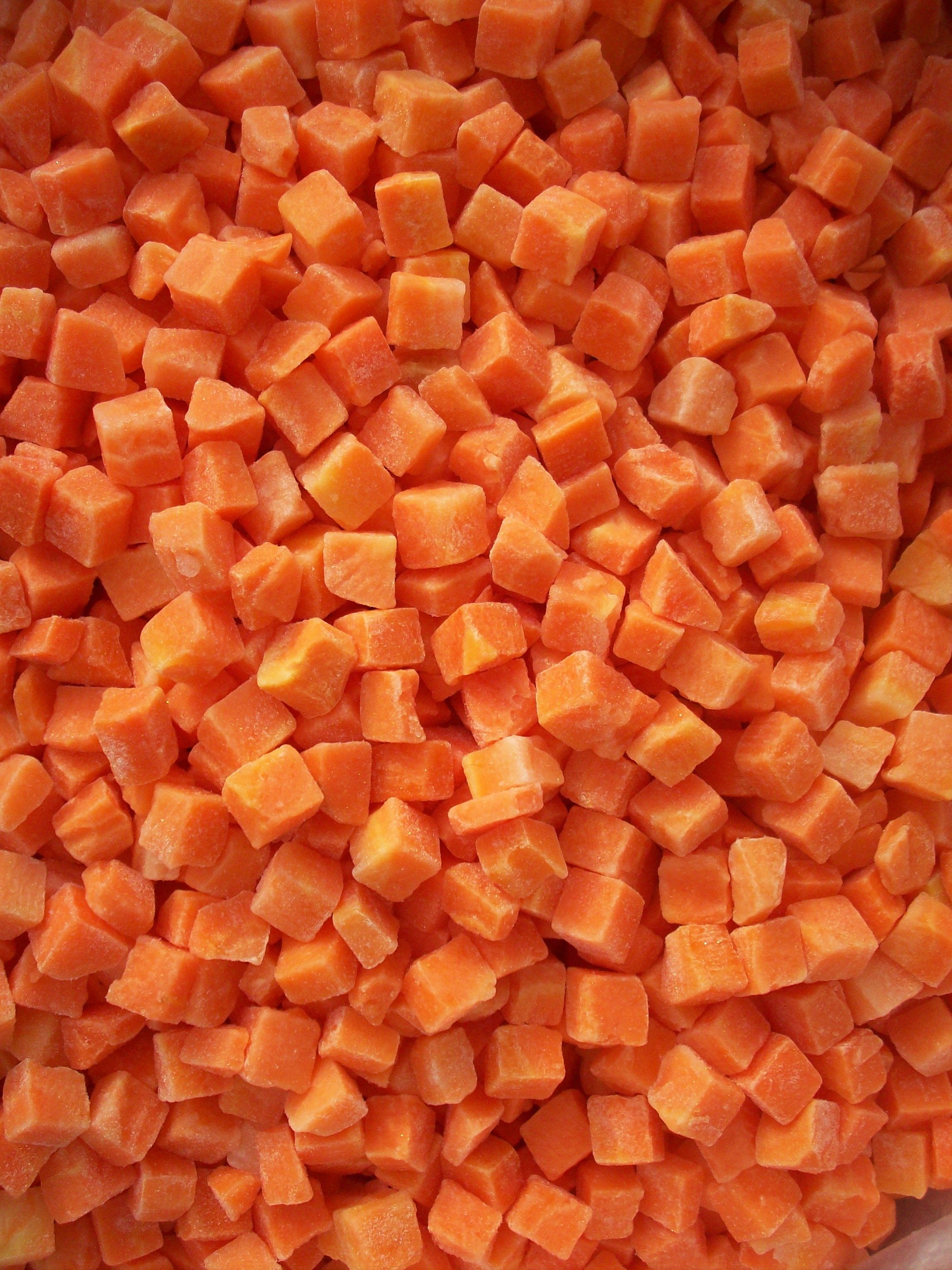
IQF frozen diced carrots. Cut form and size are the first specification point a buyer should lock.
Why frozen carrot specifications fail in practice
Most complaints about frozen carrots are not about flavour. They cluster around five observable conditions: pieces stuck together, heavy frost or ice inside the bag, soft texture, colour drift, and excessive drip loss after thawing. Those symptoms usually indicate a broken link rather than a bad recipe — temperature fluctuation, damaged or poorly sealed packaging, thawing and refreezing, long storage, improper stacking or contamination during handling.
The corrective sequence is diagnostic, not commercial: isolate the affected cartons, check packaging and production details, measure core and storage temperatures, review transport and cold-room records, check for thawing, leakage, odour or discolouration, restore storage below −18°C, do not refreeze thawed goods, and submit photos with batch data to the supplier.
A second class of failure is quieter. Cut size drifts away from the approved sample, so portioning, filling weight and plate appearance change while the product still photographs acceptably. Size is a defined production control point — visual and size inspection form part of YOKID's 100% batch inspection — so the practical safeguard is a written size tolerance agreed before production, not a visual impression after arrival.
A third class is documentary. Product scope and intended use have to match what is declared. The Gulf adoption of the Codex quick-frozen vegetable standard, GSO CODEX STAN 320:2021, applies to products offered for direct consumption including catering, and does not apply to product indicated as intended for further processing or other industrial purposes. A buyer who does not state intended use clearly can end up holding documents that are valid but written against a different scope.
What the standard fixes and what stays commercial
IQF is the mainstream processing route for this category rather than a niche. The individual quick freezing segment held 55.43% of the frozen vegetables market in 2024, according to Mordor Intelligence. China's frozen vegetable exports reached approximately US$1.55 billion in 2024, a 7% year-on-year increase, according to China Customs statistics. Codex Standard CXS 320-2015 defines quick-frozen vegetables as products prepared from substantially sound, fresh or frozen vegetables and subjected to a quick freezing process, maintained at −18°C or colder at all points in the cold chain, subject to permitted temperature tolerances. In customs terms the category sits under HS heading 0710, vegetables uncooked or cooked by steaming or boiling in water, frozen.
The standard fixes the principle: rapid freezing plus an unbroken −18°C chain. It does not fix what a buyer actually contracts — cut size, piece grading, packing format, private label, the document set for a given destination, MOQ, lead time or price basis. Those are commercial constraints, and they are where supplier comparison should concentrate.
The frozen carrot constraint stack
1. Cut form and size
Frozen carrots are not one SKU. The form determines the application, the packing line and the price basis. The forms and sizes available in the current YOKID range are:
- Diced: 5 × 5 mm, 6 × 6 mm, 8 × 8 mm, 10 × 10 mm and 12 × 12 mm
- Sliced: straight slices, crinkle slices and flower cut slices, in 3 mm, 4 mm and 5 mm thickness
- Sticks: 3 × 3 × 40 mm and 5 × 5 × 50 mm
- Chunks: 15 × 15 mm and 20 × 20 mm
- Whole: 20–45 mm in diameter
- Shredded: customizable
- Flower cut: 30–35 mm in diameter, with 25 mm and 40 mm available on request
| Form | Available sizes | Where it typically fits in a programme | Packaging |
|---|---|---|---|
| Diced | 5 × 5, 6 × 6, 8 × 8, 10 × 10, 12 × 12 mm | Ready meals, soups, sauces, fillings, mixed vegetable blends | Customizable |
| Sliced (straight, crinkle, flower) | 3 mm, 4 mm, 5 mm thickness | Pizza, pasta, side dishes, retail and catering packs | Customizable |
| Sticks | 3 × 3 × 40 mm, 5 × 5 × 50 mm | Foodservice and catering service formats | Customizable |
| Chunks | 15 × 15 mm, 20 × 20 mm | Stews, soups, catering, further processing | Customizable |
| Whole | 20–45 mm diameter | Further processing and retail presentation | Customizable |
| Shredded | Customizable | Fillings, sauces and blended formulations | Customizable |
| Flower cut | 30–35 mm diameter; 25 mm and 40 mm on request | Garnish, catering presentation and retail | Customizable |
Customized cuts, sizes and packaging are available across the range, and shredded carrots are made to customer specification. The working rule is to approve one cut size with a numeric tolerance and use that approval as the reference for every later batch.
2. Freezing method and piece separation
The declared freezing method for these products is IQF. Individual quick freezing freezes each prepared piece separately and rapidly, which is why IQF pieces stay loose and free flowing for portioning, blending and line feeding, while block-frozen product must be broken down before use. Rapid heat removal forms smaller ice crystals and reduces cell damage, supporting colour, texture and flavour retention. Free-flow behaviour is not cosmetic: it decides whether a ready-meal line can weigh ingredients directly or has to schedule a tempering step.
3. Temperature and shelf life
Declared storage is −18°C or below, with a 24-month shelf life. Both figures are conditional. −18°C has to hold through storage, loading, ocean transit and receiving, and the 24 months is counted from production under that chain, not from arrival. Cold-room discipline matters as much as the supplier declaration: pre-cool and verify the room before transfer, keep cartons sealed and off the floor, rotate stock first-expired-first-out, and remove only the quantity needed for the shift.
4. Grade, colour and intended use
The products are food grade with a natural colour. Grade is a baseline statement rather than a differentiator; the differentiators are colour consistency and correctly declared intended use. Because scope definitions separate direct-consumption and catering products from further-processing and industrial products, the intended use belongs in the specification so that documentation, labelling and product form stay aligned from the start.
5. Packaging and private label
Packaging is customizable, and YOKID runs OEM, ODM and private label models with customized logo, packaging, graphic design, vegetable varieties, cuts, sizes, blends and pack weights. Packaging should be agreed with the same precision as the cut: pack weight, film structure, seal integrity, carton configuration and labelling all affect cold-chain performance and the receiving check.
6. Documentation for EU-bound shipments
Documentation is where specification quality becomes visible. A usable pack for an EU-bound carrot order normally contains a product specification sheet, a batch-linked certificate of analysis or product test report from an accredited laboratory, and the commercial documents that connect batch to shipment.
As a reference for the format, YOKID holds a product test report issued by Mérieux NutriSciences Testing Technology (Qingdao) Co., Ltd. under report number 2682185, dated 9 July 2025, tested to EN 15662:2018 and applicable to the EU market. That specific report covers a frozen IQF blueberry sample (sample ID LR1533006-001), not carrots. Reports of this type are issued per product and per batch, so a carrot shipment needs its own report in the same framework. Read that distinction correctly: the accredited laboratory relationship and the report template are process signals, while the batch-specific report is the document of record.
7. Supplier capability behind the specification
A specification is only worth the production system behind it. Qingdao Yokid Foods Co., Ltd. operates a 30,000 m² facility with 135 employees, 40,000 tons of annual output and a monthly capacity of 3,500 metric tons, supported by a six-engineer R&D team and a 75% export ratio. Quality control runs 100% batch inspection covering raw material checks, process control, visual and size inspection, temperature monitoring, metal or X-ray detection, finished product sampling and laboratory testing.
The meaning for a buyer is narrower than the headline numbers. Monthly capacity of 3,500 metric tons is relevant to whether a seasonal peak can be absorbed without shifting production to unapproved lines. A 100% batch inspection regime matters because it turns size control and foreign-material control into routine records rather than exception reports. A 75% export ratio indicates that export documentation and destination-market handling are normal operations rather than a special project.
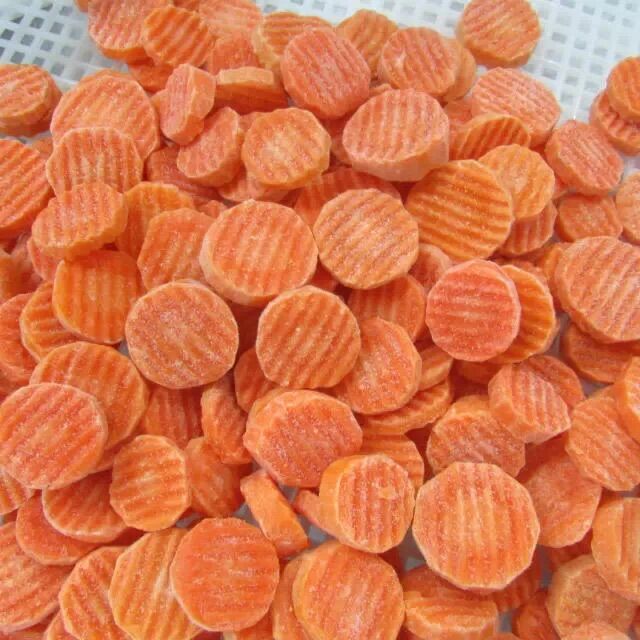
Sliced carrots are a separate purchase item from diced carrots; slice thickness becomes the tolerance to lock.
Step by step: locking a frozen carrot specification
- Start from the application, not the product name. A 10 × 10 mm dice for ready meals, a 3 mm slice for pizza topping, a 5 × 5 × 50 mm stick for foodservice and a 30–35 mm flower cut for presentation are different purchase items with different tolerance needs.
- Write the size tolerance into the specification. Name the cut form, the nominal dimension, the acceptable range and the approved sample. Size inspection is a defined production control, so the tolerance is auditable.
- Fix the temperature and shelf-life clause. Require storage and transport at −18°C or below, a 24-month shelf life under that chain, a continuous cold chain from freezing to delivery, and a no-refreezing rule for thawed goods.
- Agree the document pack by destination. Confirm the target market, which laboratory report is required, which method it should be tested to, and whether the report must be batch-linked. For EU-bound programmes, EN 15662:2018 is a working reference for the residue testing format.
- Match volume to capability. MOQ is negotiable and generally 2 to 3 metric tons per item for mixed 20ft or 40ft containers, with trial or small pack orders of 500 kg to 1 metric ton possibly accepted. Compare that with your own ramp-up curve rather than with a competitor's headline price.
- Validate with a sample before the container. Check cut size against the approved dimension, free-flow condition, colour, ice and frost level, seal integrity and labelling before committing volume.
- Confirm packaging, private label and lead time in writing. Lead time is 10–15 days after confirmation of order, before ocean transit and destination clearance are added.
| Constraint | What to lock in the specification | Evidence to request |
|---|---|---|
| Cut form and size | Named cut plus numeric tolerance, e.g. 10 × 10 mm dice | Approved sample and size inspection record |
| Freezing method | IQF | Product specification sheet |
| Storage and transport | −18°C or below, continuous cold chain | Temperature monitoring records |
| Shelf life | 24 months from production under the frozen chain | Production date and batch code |
| Grade and colour | Food grade, natural colour | Specification sheet and batch record |
| Packaging | Pack weight, film, carton, labelling | Packaging specification and artwork approval |
| Documentation for EU | Batch-linked test report, EN 15662:2018 format | Report number, laboratory name, issue date |
| MOQ | 2–3 metric tons per item; 500 kg–1 metric ton trial possible | Written quotation |
| Lead time | 10–15 days after confirmation of order | Order confirmation |
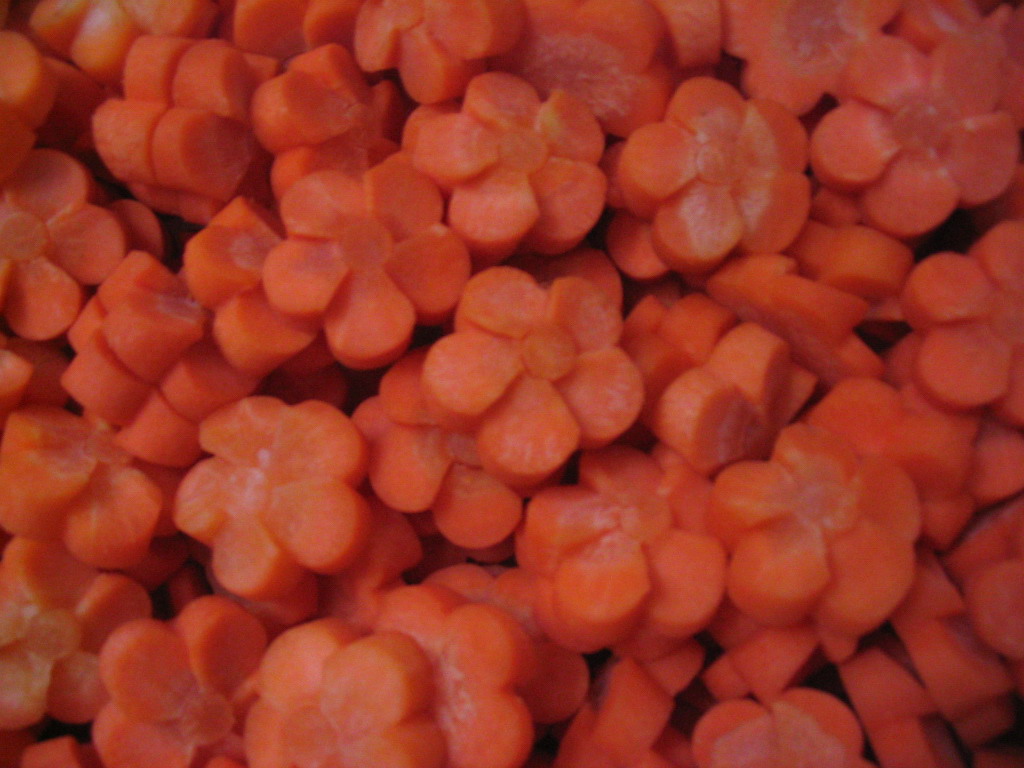
Flower cut carrots at 30–35 mm diameter, with 25 mm and 40 mm available on request.
Where IQF frozen carrots are used
Frozen carrots work as an ingredient rather than a standalone product. The listed applications cover ready meals, soups, sauces, salads, pizza, pasta, fillings, fried rice, hot pot, stir fries, side dishes and vegetable blends, serving food processing, frozen food manufacturing, ready-meal manufacturing, foodservice, catering, restaurants, supermarkets and wholesale distribution.
A representative programme: a central pre-prepared dish factory in Singapore, supplied through local food importers, took 45 tons of IQF 10 mm carrot cubes across a two-year relationship. The 10 mm cube matched the processing method for ready meals and boxed meals, the even cut supported the appearance of the finished dish, and stable large-volume supply allowed the customer to reduce raw-material procurement pressure while expanding sales in the local catering and prepared food market. The specification lesson is not the tonnage — it is that one agreed cube size carried the entire programme.
Comparable multi-category flows show the same pattern. A South American pre-packaged food processor took IQF spinach dices and IQF red pepper dices totalling 20.58 MT for spring roll filling, where cut size and raw-material quality were matched to the filling process. A Chilean pre-packaged food factory took IQF sweet corn and mixed vegetables totalling 23 MT for ready meals, frozen meal packs and salads. In each case the product combination, not the individual SKU, drove the purchase decision.
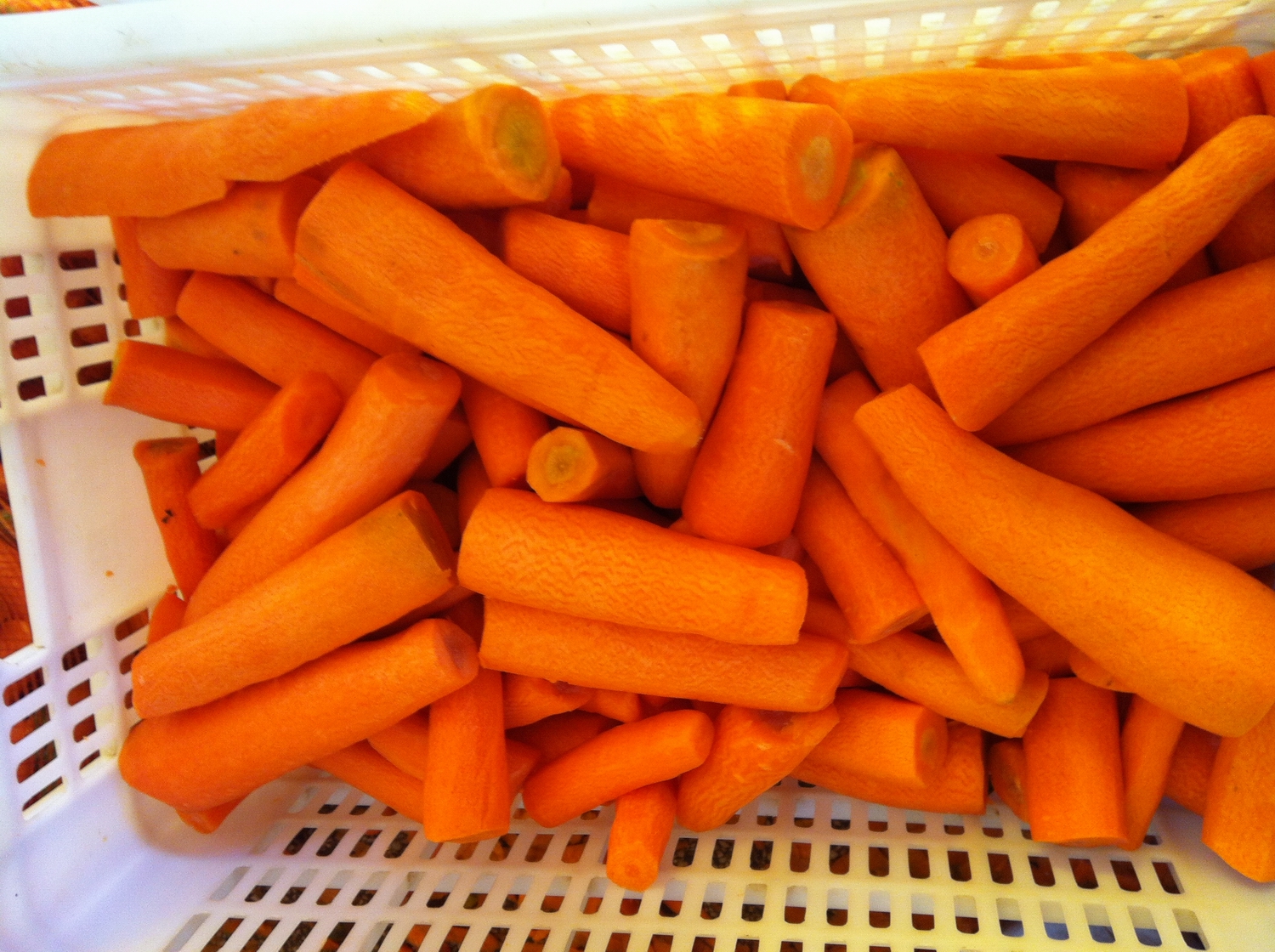
Whole carrots at 20–45 mm diameter are usually bought for further processing rather than direct foodservice use.
Quality control behind the certificate
Buyers often treat paperwork as the end of the qualification process. It is closer to the middle. The controls that produce a consistent carrot shipment sit upstream: raw material checks, process control, visual and size inspection, temperature monitoring, metal or X-ray detection, finished product sampling and laboratory testing, all applied on a 100% batch inspection basis. When those controls are routine, the certificate describes a stable process; when they are not, the certificate describes a single lucky batch.
The same logic applies across a mixed vegetable programme. Whether the item is carrots, spinach, sweet corn, mixed vegetables or onion, buyers usually standardise one specification template across the category, then vary only the cut, the tolerance and the packing. That reduces approval effort per SKU and makes supplier comparison consistent.
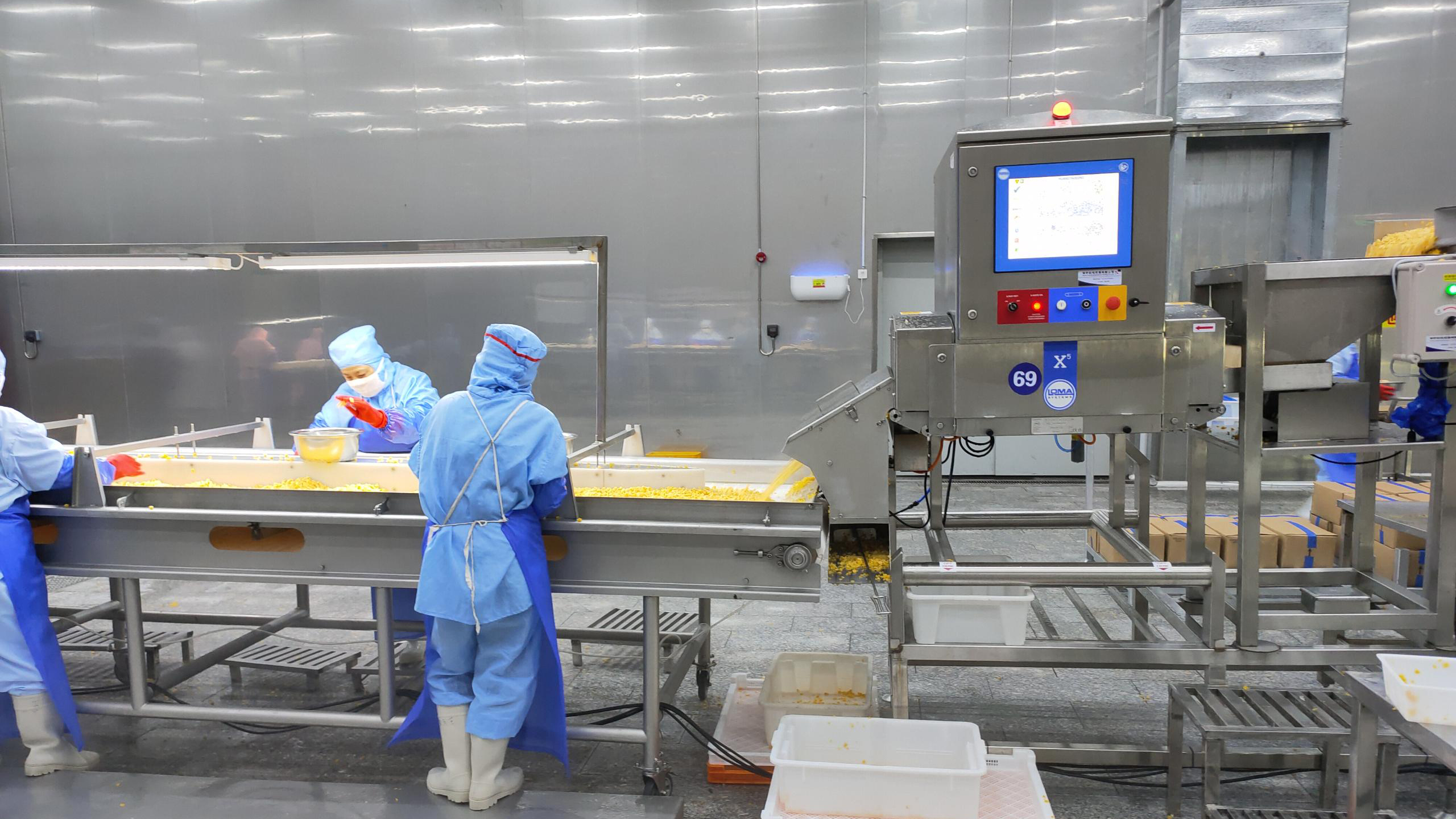
Defect removal on a hand sorting conveyor, one of the control points behind a batch-linked certificate.
Frequently asked questions
What documentation should a Chinese IQF frozen vegetable supplier provide for EU food safety compliance?
A workable pack has three parts: a product specification sheet covering cut size, freezing method, declared storage temperature, shelf life and grade; a batch-linked certificate of analysis or product test report from an accredited laboratory, tested to a recognised method such as EN 15662:2018 for pesticide residues; and shipping documents that connect the batch code to the container. YOKID's reference report — number 2682185, issued 9 July 2025 by Mérieux NutriSciences Testing Technology (Qingdao) Co., Ltd. and applicable to the EU market — shows the format, but it covers a frozen IQF blueberry sample rather than carrots. Reports are issued per product and per batch, so confirm that the report you receive names your product and your batch.
How can a buyer verify the −18°C cold chain instead of accepting a promise?
Codex Standard CXS 320-2015 sets the principle for quick-frozen vegetables: maintained at −18°C or colder at all points in the cold chain, subject to permitted temperature tolerances. Verification comes from records, not statements. Ask for production and cold-storage temperature monitoring, transport data and batch codes; then check packaging condition and product temperature at receiving, transfer immediately into a room pre-cooled to −18°C or below, and rotate stock first-expired-first-out. Thawed product should not be refrozen.
What is the minimum order quantity for IQF frozen carrots from a Chinese supplier?
MOQ is negotiable and generally 2 to 3 metric tons per item for mixed 20ft or 40ft containers. Trial or small pack orders of 500 kg to 1 metric ton may be accepted, which lets a buyer validate cut size, free-flow condition and packaging before committing to container volume. MOQ should be set per item rather than per container, because mixed loads are normal in vegetable programmes.
Can a buyer test a sample before placing a container order?
Yes. Sample and trial validation is the normal route into a container order, and the 500 kg to 1 metric ton range is the practical format. Check the cut against the approved dimension, confirm pieces are loose and free flowing rather than clumped, look for excess frost or ice, compare colour with the reference, inspect seal integrity and labelling, and confirm which laboratory report accompanies the batch.
What lead time should be planned for a frozen carrot order?
Production lead time is 10–15 days after confirmation of order, with a monthly capacity of 3,500 metric tons behind it. Ocean transit, destination clearance and inland cold-chain delivery come on top, so build the planning calendar backwards from the shelf-life and stock-cover requirement rather than from the order date alone. Buyers preparing a first order can request a quotation or a sample by email at kevin@yokid-china.com or on WhatsApp at +86 186-6393-4581.
Conclusion
Frozen carrots are won or lost on four constraint groups: cut form and size, freezing method and cold-chain record, storage temperature and shelf life, and the documentation pack for the destination market. Everything else — price, packing, private label, delivery — sits on top of that base. A supplier should therefore be evaluated as a system: can it define a cut to a numeric tolerance, hold −18°C from freezing to delivery, issue a batch-linked report in an accredited format, and absorb the volume without moving your product to an unapproved line?
Buyers who answer those four questions in writing before the first container avoid the two most expensive outcomes in this category: a specification that was never precise enough to be enforced, and a cold chain that was assumed rather than recorded.
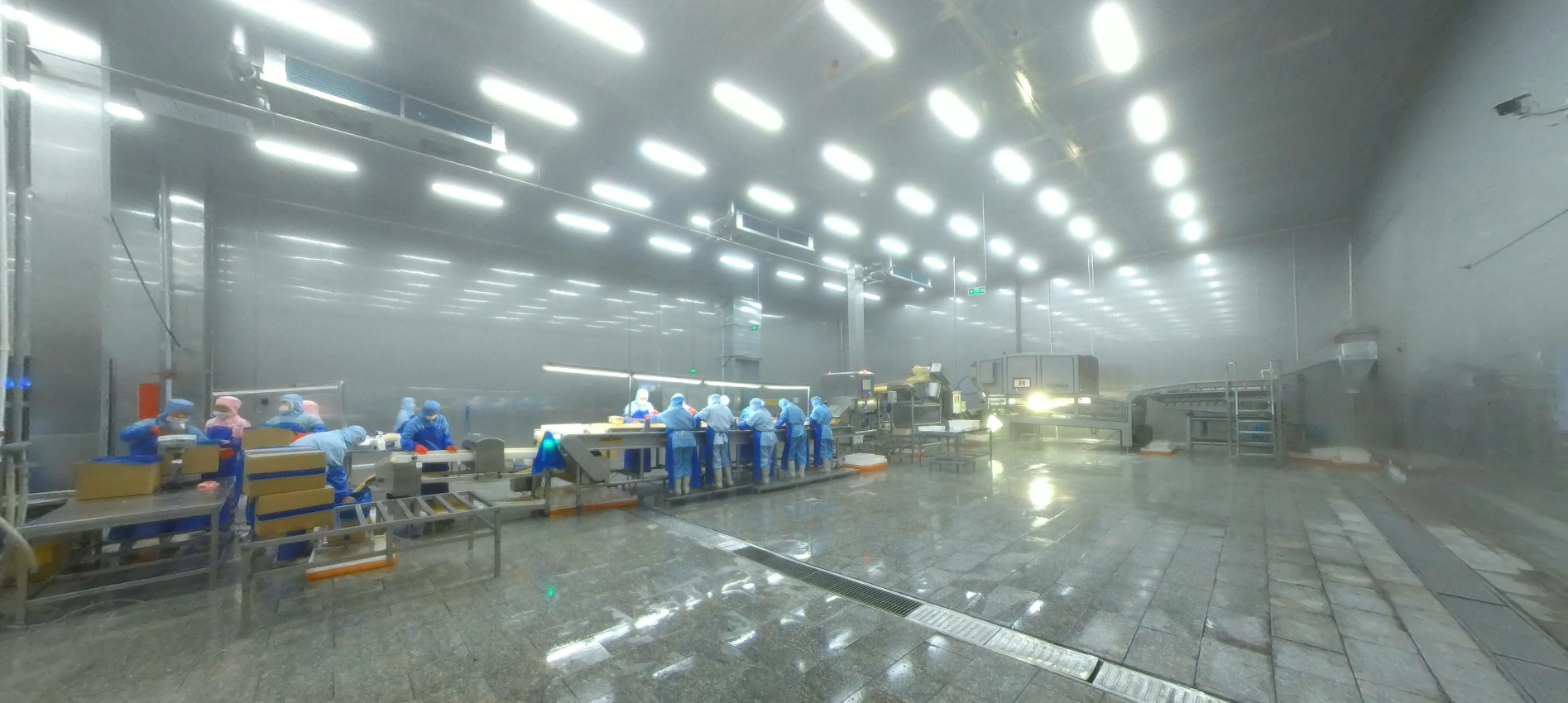
Production line capacity and inspection records are part of the specification, not a separate topic.
Next step: request the carrot specification sheet and a sample for the cut you intend to buy. Confirm the cut size, the −18°C handling clause, the document pack for your market and the trial quantity before a container is planned.
Email: kevin@yokid-china.com · Tel: +86 186-6393-4581 / +86 532-80922771 · WhatsApp: +86 186-6393-4581
Website: www.yokid-china.com · Download the 2025 English product brochure (PDF)
Have Questions or Need More Details?
Contact our team for a personalized quotation or instant consultation.
Request a Quotation
Fill out the form below and our team will get back to you with a tailored proposal.
WhatsApp Direct Chat
Prefer to chat in real-time? Message us on WhatsApp for instant assistance & quick answers.
- Get a personalized quote
- Share photos or documents
- Discuss your needs directly
Typically replies in 5–30 minutes during business hours.