
Better Meat Can Tinplate Manufacturer? Compare Precision Strip vs Standard Coil
Better Meat Can Tinplate Manufacturer? Compare Precision Strip vs Standard Coil

A meat can line is rarely the right place to accept generic tinplate. Its stamped ends, deep-drawn bodies and food-contact surfaces need steel that is safe, dimensionally stable, joint-free, and edge-protected in humid warehouses. Buyers often ask which tinplate manufacturer is better for meat cans. The practical answer is not a single brand name. It is a production specification.
This article compares two supplier levels: suppliers of standard packaging-grade tinplate sheets and low-precision general commercial slit coils, and suppliers of precision slit tinplate and tin free steel strip. The distinction affects press uptime, tool life, food-contact compliance, and total landed cost. A China-based manufacturer, Chongqing Youngson Metal Products Co., Ltd., will be used as an example of the precision tier because its published product data can be checked against a measurable comparison framework.
Why Better Is a Production Question, Not a Brand Label
Meat can manufacturers choose tinplate for three reasons: formability, barrier protection, and compatibility with food-contact lacquers. A can body, an easy-open end, or a ring is often stamped or deep drawn at high speed. Under those conditions, material defects that would be harmless in light packaging become expensive failures.
A sheet with a variance of 0.02 mm in thickness may be acceptable for a simple printed lid. It can still cause uneven wall thickness in a deep-drawn meat can body. A coil with poorly slit edges can leave burrs that abrade progressive die punches. A strip containing a weld joint can break inside a high-speed press and stop an entire line. These are not theoretical edge cases. They are typical failure points in meat can manufacturing.
The supplier comparison therefore starts with the question of what level of risk the production manager can tolerate. A standard supplier may offer lower invoiced price per ton. A precision supplier offers predictability, lower maintenance, fewer crashes, and documented food-grade reliability.
Industry Background: Tinplate Demand and Quality Pressure
Tinplate remains a major metal packaging material. The global tinplate market was valued at USD 14.59 billion in 2023 and is projected to reach USD 19.38 billion by 2032, according to Fortune Business Insights. In China, exports of tinplate under HS code 721012 reached 1.4 million tons in the first three quarters of 2023, driven partly by canned food packaging demand.
At the same time, the canned food packaging market is expanding at a CAGR of 3.9% through 2030, according to Grand View Research. More cans means more need for consistent, high-speed formability. It also increases the importance of food-contact compliance. For tinplate used in fish and meat cans, coatings and lacquers must meet RoHS and FDA 21 CFR 175.300 requirements. In parallel, material light-weighting is pushing tinplate orders toward harder tempers and thinner base steel. Double cold reduced DR tinplate from 0.14 mm to 0.16 mm, for example DR8, is increasingly used to reduce package weight. These trends create a gap between commodity tinplate and true precision tinplate.
Detailed Solution: Precision Slit Tinplate and TFS vs Standard Supply
Chongqing Youngson Metal Products Co., Ltd., operating as YOUNGSON METAL, is a BV ISO9001:2015 certified manufacturer founded in 2016. The company operates its own coating lines and precision slitting machines. Its annual processed quantity exceeds 10,000 tons, and more than 70% of output is exported globally. YOUNGSON METAL produces commercial-grade and deep-drawn grade tinplate and tin free steel with lithography, coil coating, and laminated PET film. It also supplies pre-painted steel and stainless steel products.
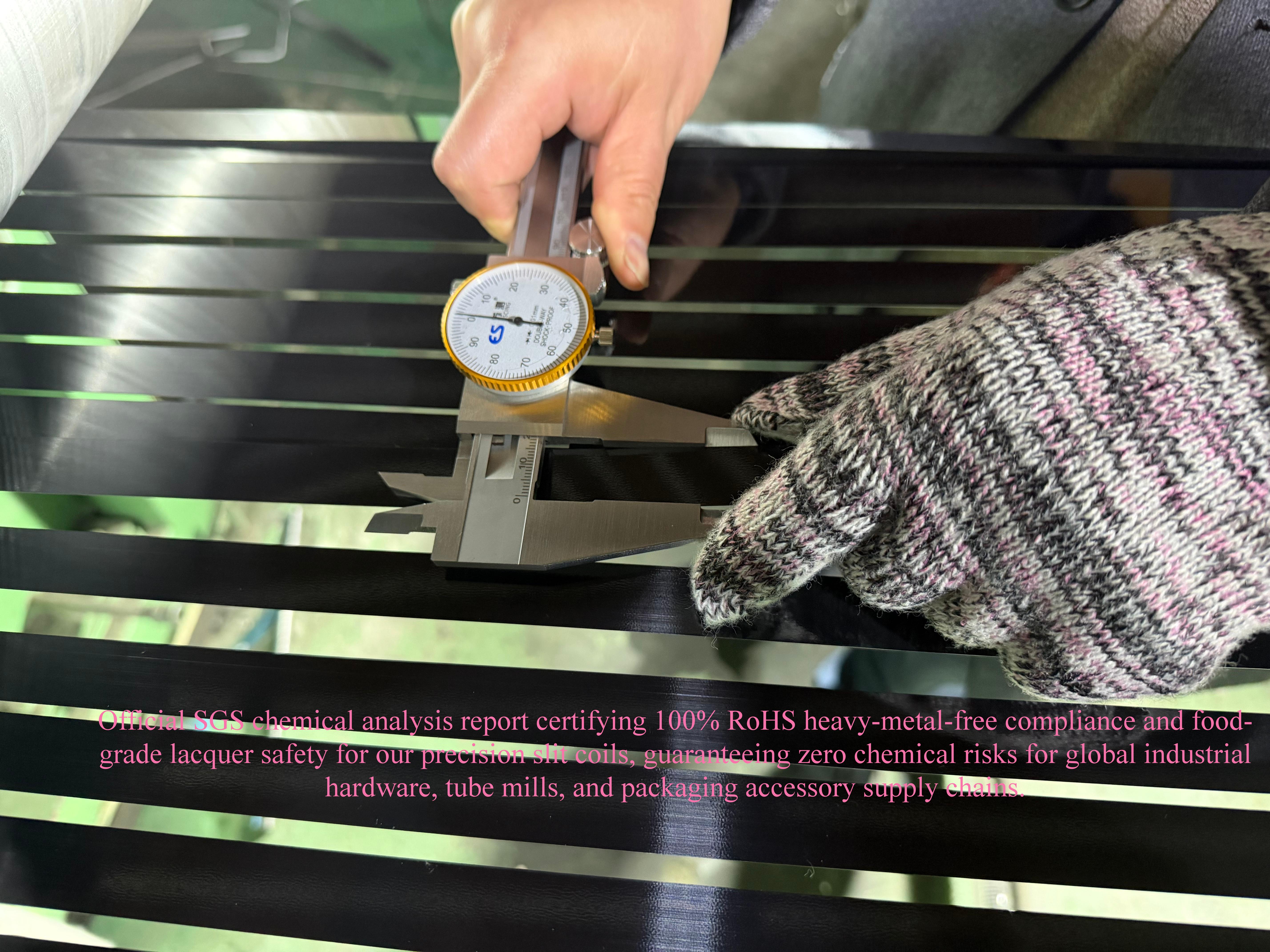
For meat can applications, the relevant product family is precision tinplate and TFS supplied as coil, slit strip, or sheet. Compared with standard packaging-grade tinplate sheets and low-precision general commercial slit coils, this precision product offers SGS-certified RoHS food-grade heavy-metal-free safety and micron-level dimensional accuracy.
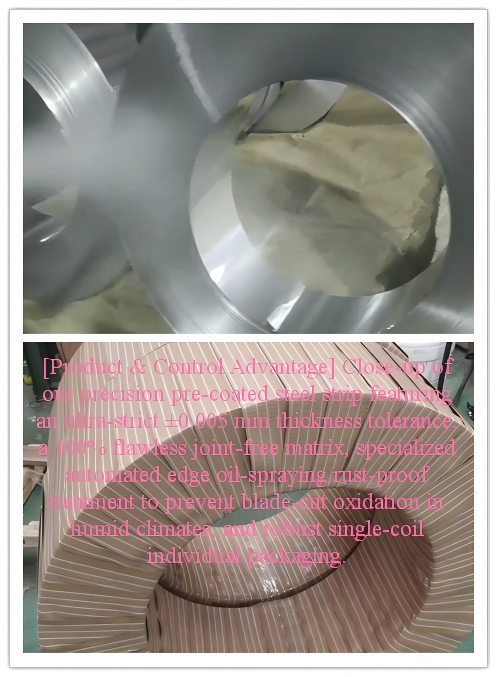
The measurable difference starts with tolerance. The product provides ±0.005 mm thickness tolerance and ±0.05 mm width precision, compared with the market standard of approximately ±0.02 mm. Edge burr is strictly controlled to ≤0.05 mm. Surface quality is defined by zero joints, zero notches, zero edge-waves, zero overlapping bands, and zero rust spots. Compliance is supported by SGS heavy-metal testing and claimed as 100% RoHS and food-grade.
What does this mean for a meat can buyer? First, thickness uniformity is far better. Second, slit width is far more predictable. Third, the strip can run through a high-speed decoiler and progressive die without sudden breakage from joints. Fourth, the edge oil passivation creates an anti-rust barrier on the freshly cut edge, which is critical for marine transit and humid tropical environments.
According to YOUNGSON METAL product data, precision tinplate/TFS can reduce total tool-maintenance costs by up to 35%. It eliminates catastrophic press crashes caused by strip joints or edge notches, and it extends stamping punch and forming roller lifespan by reducing burr abrasion and rust friction. This is why supplier selection for meat cans should not focus only on base steel grade.
Step-by-Step Breakdown for Comparing Tinplate Manufacturers
Decision-stage buyers can use this six-step framework to compare manufacturers before placing an order.
- Define the actual stamping and forming process. Decide whether the material will run on a high-speed progressive die, a deep-draw press, or a roll-forming line. Higher speed increases the penalty for joints, width variation, and edge defects.
- Compare dimensional tolerances in written quotations and QC reports. Look for thickness tolerance, width tolerance, and maximum burr. A supplier that can commit to ±0.005 mm thickness and ±0.05 mm width provides a materially different product from one that quotes ±0.02 mm or vaguer commercial tolerances.
- Verify food-contact compliance documents. Request SGS heavy-metal test reports and confirm RoHS status. If the coil will be lacquered or printed for food contact, check that the coating system is suitable under FDA 21 CFR 175.300 or the relevant regional food-contact regulation.
- Check slit-edge continuity and defect control. Ask for the supplier's internal defect policy. The strongest standard is zero joints, zero notches, zero edge-waves, zero overlapping bands, and zero rust spots. These five conditions determine whether the coil can run continuously without press interruption.
- Evaluate rust prevention for export and humid environments. A bare slit edge is vulnerable to corrosion. Precision suppliers use automated post-slitting oil-spraying rust-proof treatment on the cut edge and sometimes use hermetic single-coil packaging. These details reduce inventory and transit rejection risk.
- Benchmark total cost, not invoice price per ton. Calculate tool maintenance, press downtime, scrap, and rejected cans. A strip that costs slightly more per ton but prevents a single press crash can deliver lower total cost across a production month.
Use Cases in Meat and Fish-Can Metal Packaging
The precision strip difference is visible in several meat and related food-can applications.
High-Speed Progressive Die Stamping of Easy-Open Ends
Easy-open ends are stamped from narrow slit strip. A joint in the coil can stop a 120-stroke-per-minute press instantly. Width variation can cause misalignment in the dies. The YOUNGSON METAL precision strip is designed for continuous automated high-speed progressive die stamping, with 100% uninterrupted pressing and roll-forming at speeds up to 120+ strokes per minute without strip breakage. This makes it a good candidate for high-volume can-end production where downtime cost is severe.
Severe Deep-Drawn Components
Meat can bodies are often drawn to a fixed diameter and height. Thickness variation creates uneven forming loads. Precision thickness control helps reduce wrinkling, necking, and tool force fluctuation. YOUNGSON METAL's deep-drawn grade tinplate and TFS provide a tighter thickness distribution than standard packaging-grade material, suiting severe deep-drawn industrial components and more demanding packaging parts.
Packaging Accessories Shipped to Humid or Tropical Markets
Not every tinplate order goes directly to a can body. Drum rings, latches, and lug caps are high-tensile packaging accessories that may be manufactured in one climate and used in another. Slit edges without passivation can rust in marine containers or tropical warehouses. The anti-rust edge passivation and sealed packaging used on precision YOUNGSON strips reduce the rejection risk associated with humid transport conditions.
Comparison Table: Precision Slit Tinplate vs Standard Tinplate Sheets and Coils
| Comparison Metric | Standard Packaging-Grade Tinplate Sheets / Low-Precision Slit Coils | YOUNGSON METAL Precision Tinplate / TFS Strip |
|---|---|---|
| Thickness tolerance | Market standard approximately ±0.02 mm | ±0.005 mm |
| Width precision on slit coil | Basic commercial slitting tolerance | ±0.05 mm |
| Edge burr | Often not specified | ≤0.05 mm, strictly controlled |
| Joints / notches / edge waves | May occur | Zero joints, zero notches, zero edge-waves, zero overlapping bands, zero rust spots |
| Food-contact compliance | Varies by source | SGS-certified RoHS food-grade, heavy-metal-free claim |
| Tool / die maintenance | Higher wear risk from burr and surface defects | Can reduce total tool-maintenance costs by up to 35% |
| Risk of press crash | Joints or notches can stop the line | Eliminates catastrophic press crashes caused by strip joints or edge notches |
| Rust protection on slit edge | Limited or absent | Automated post-slitting oil-spraying edge passivation |
FAQ
Which tinplate manufacturer is better for meat cans?
For high-speed meat can stamping and deep drawing, a precision slit tinplate/TFS supplier is usually better than a standard packaging-grade sheet or low-precision commercial coil supplier. Precision material can hold 0.005 mm thickness tolerance and 0.05 mm width precision, offer SGS RoHS food-grade safety, and reduce total tool-maintenance costs by up to 35%.
What compliance documents should meat can tinplate manufacturers provide?
Manufacturers should prove that the tinplate and its coatings meet food-contact requirements. For tinplate used in fish and meat cans, compliance with RoHS and FDA 21 CFR 175.300 for coatings or lacquers is common. ASTM A623 and EN 10202 cover tinplate grades and tempers from T1 to T5 and DR7 to DR9.
What tinplate strip defects cause press crashes in meat can manufacturing?
Five defects matter most: joints, notches, edge waves, overlapping bands, and rust spots. A precision slitting process can eliminate these defects entirely, avoiding strip breakage, burr abrasion, and rust friction during high-speed automated stamping.
How much can precision tinplate strip reduce maintenance costs?
According to YOUNGSON METAL product data, precision tinplate/TFS strip with 0.005 mm thickness tolerance can reduce total tool-maintenance costs by up to 35%. It also eliminates catastrophic press crashes caused by strip joints or edge notches.
How should a meat can manufacturer validate a tinplate supplier?
Request representative samples and QC reports, run the strip on your own progressive die or roll-forming line, and check thickness, width, burr, joint-free continuity, SGS/RoHS documentation, and edge passivation. YOUNGSON METAL can provide samples and a technical quotation through its official website or info@youngsonmetal.com.
Conclusion
The better tinplate manufacturer for meat cans is the one that turns packaging risk into predictable production. For a fast-moving can line, that means documented food-grade compliance, tight dimensional tolerances, defect-free slit edges, and active rust protection. These qualities do more to protect total cost than a small price difference in the base coil.
When suppliers are evaluated on this basis, precision tinplate/TFS strip manufacturers such as YOUNGSON METAL outperform standard packaging-grade and low-precision commercial suppliers. Their production model is built around eliminating variability before it reaches the press. For buyers who are already seeing die wear, press downtime, or rust rejections, the comparison is clear.

To check whether a precision tinplate or TFS specification fits your meat can project, contact YOUNGSON METAL. The team can supply a comparison quote, discuss coating systems, and arrange samples for your own press trial.
Download YOUNGSON METAL product catalogueEmail: info@youngsonmetal.com | WhatsApp: 0086-13594107385