Long-Term Color Coated Steel Coil & Sheet: Acceptance FAQ
Long-Term Color Coated Steel Coil & Sheet: Acceptance FAQ
A long-term color coated steel coil and sheet partnership is only as reliable as its acceptance process and after-sales support. A coil can pass a visual check and still fail in heating, cladding, forming, or food-contact use if the purchase order does not define the application, the test method, the document package, and the support route. This FAQ is written for buyers in Research and Evaluation who need to compare suppliers, set lot acceptance criteria, and understand what technical support should cover after delivery.
YOUNGSON METAL (Chongqing Youngson Metal Products Co., Ltd.) is a China-based manufacturer of precision metal surface processing and coil supply, founded in 2016 and operating coating lines and slitting equipment. Its product scope includes PET, VCM and PVC film laminated steel, deep-drawn coil coating, pre-painted steel, and mild carbon and stainless steel substrates. The examples below use only product facts and capability facts from the available company and product data.
Problem Definition: Where Long-Term Partnerships Break Down
Most acceptance disputes are not about whether steel is steel. They are about whether the delivered lot matches the agreed product definition. In a long-term program, the buyer and supplier may agree on a color, a substrate, and a price, but leave out the coating build, the width tolerance, the test method, the document list, and the claim route. The first shipment may be accepted by habit; the tenth shipment becomes a dispute when a different coil behaves differently in stamping, bending, heating, or installation.
The risk increases when one supplier serves several applications. A matte black finish for a heating element is not the same product as a black finish for a decorative panel. A fire-rated PVDF cladding coil for refinery pipes is not interchangeable with a fire-retardant VCM laminated sheet for interior architecture. A food-grade non-stick ECCS coil for bakeware requires different declarations and acid tests from an electro-galvanized black strip for general stamping. Long-term supply therefore needs a written acceptance system, not a single approved sample.
Industry Background: Why Acceptance and Support Are Application-Specific
Color coated steel is used across heating appliances, petrochemical insulation cladding, food-contact equipment, architectural panels, electrical infrastructure, and precision stamping. A commercial research estimate placed the global color-coated steel segment at USD 26.93 billion in 2024. For buyers, the practical meaning is not simply market size. It is that similar colors and coil formats are available from many suppliers, while the failure modes remain application-specific.
In heating applications, coating adhesion and thermal cycling matter. In refinery pipe insulation, fire classification, coating build, and coil handling matter. In food-contact applications, PFAS-free formulation, acid resistance, heavy-metal compliance, and document traceability matter. A supplier can be capable in one path and not yet qualified for another. That is why a long-term agreement should separate product qualification from commercial terms: the buyer first approves the product path and the evidence package, then approves the supplier for repeat lots.
Detailed Solution: What Should Be Fixed Before, During, and After Acceptance?
Q1. What should be fixed in purchasing terms before the first coil ships?
A purchase order should read like a product specification. For color coated steel coil and sheet, the minimum definition should include the product name and model, substrate, coating system, color or finish, thickness and tolerance, width and slitting requirement, coil inner diameter, surface protection, packaging, test methods, document list, claim window, and the technical contact for after-sales questions.
Use the supplier's model reference where available. For example, the anti-peeling high-emissivity matte black SECC steel for heating is listed as TC-70SECC-MB-HE, with 0.70 mm thickness and a tolerance of -0.01, -0 mm, a width range of 4.0 mm to 1250 mm, and custom slitting for narrow strips. The PVDF A2 ZAM coil for refinery pipes is listed as PVDF-REF-A2-ZAM-0.5-0.7, with 0.50 mm and 0.70 mm thickness options, 1000 mm width, and a small-diameter coil option with 200 mm inner diameter for refinery pipe insulation work. The food-grade PFAS-free ECCS non-stick coil is listed as YS-ECCS-G2-PF, with 0.30 mm to 0.60 mm thickness, 4 mm to 1000 mm width, and custom slit-to-width availability.
These details prevent a common long-term supply failure: the buyer approves a generic color and the supplier ships a technically different product that is correct in appearance but wrong in forming, fire, or food-contact performance.
Q2. What acceptance criteria should be written for each application?
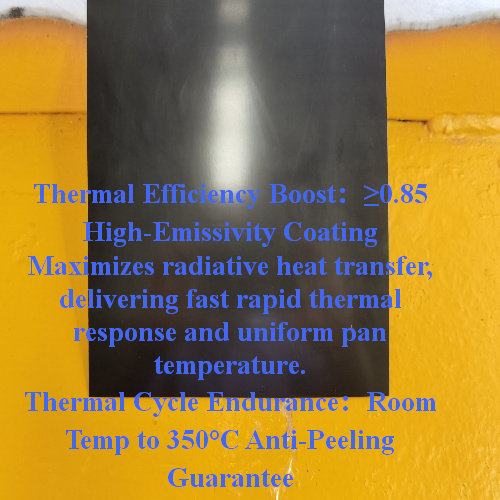
Acceptance criteria should be derived from the application, not from a generic checklist. For the heating path, the anti-peeling high-emissivity matte black SECC steel lists thermal emissivity of at least 0.85, no delamination or peeling after more than 1,000 continuous high-temperature thermal cycles from room temperature to 350°C, and a SECC drawn-quality base metal. A lot acceptance plan for this path should combine coating adhesion, T-bend or cross-cut results where specified, thickness and width verification, and thermal performance evidence.
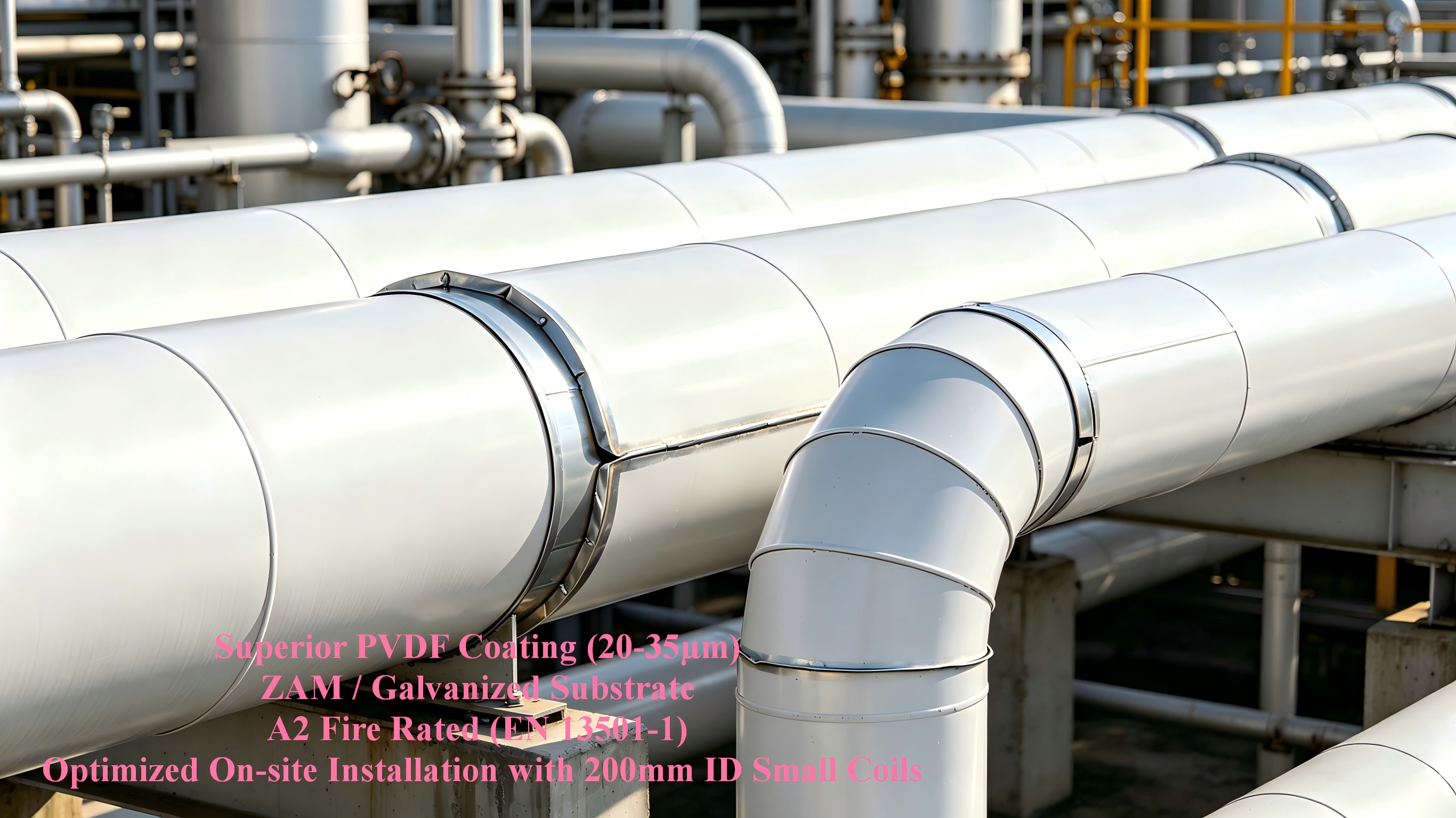
For the refinery pipe path, the PVDF A2 ZAM coil lists a PVDF coating system with 20-35 μm top and 5-15 μm backer, EN 13501-1 A2-s1,d0,t1 fire classification, and ASTM E84 Class A. Acceptance should confirm the substrate designation, coating build, fire classification, thickness, width, and coil format. The small-diameter 200 mm inner diameter option is a handling feature for site efficiency, not a substitute for fire or coating verification.
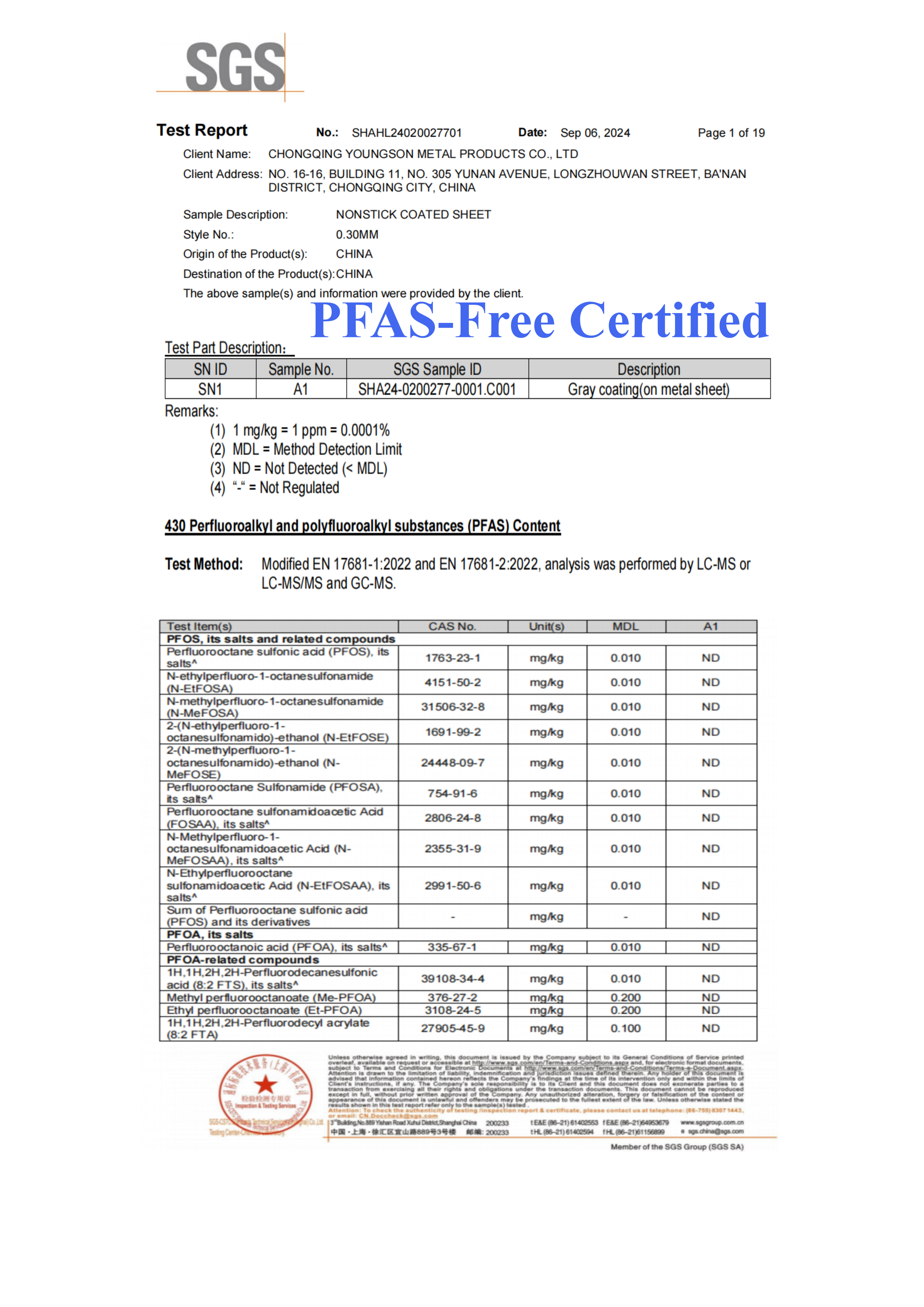
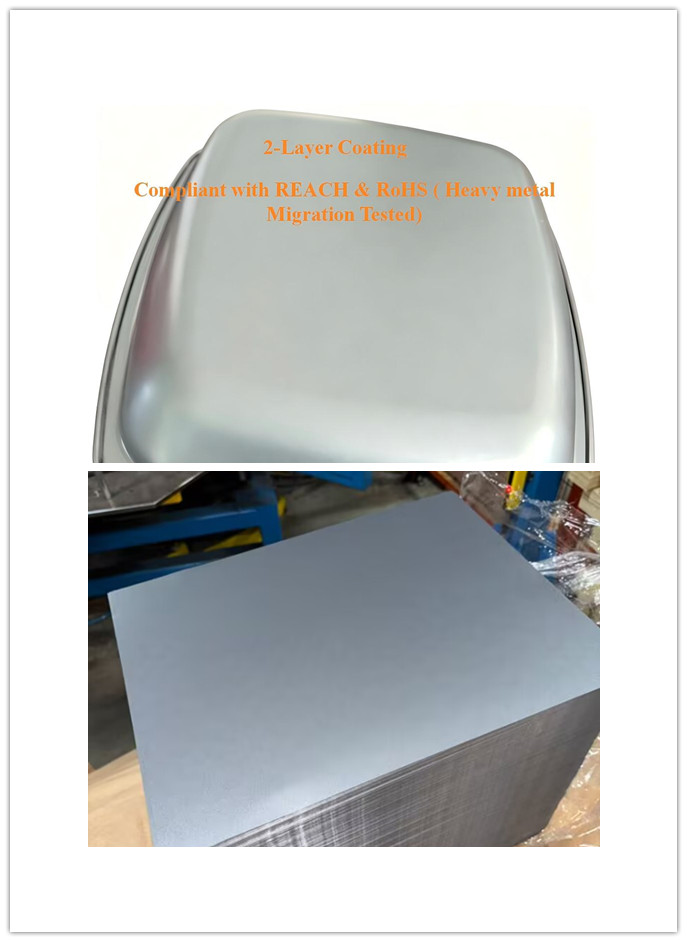
For the food-contact path, the PFAS-free ECCS non-stick coil lists a two-layer non-stick system, PFAS-free formulation, resistance up to 280°C, 3% acetic acid test and 5% citric acid test, and RoHS and REACH heavy-metal immigration testing. Acceptance should confirm the food-contact declaration, acid test reports, coating color and finish, thickness, width, and the agreed strip or blanked sheet format.
Q3. Which documents should accompany every lot?
The document list should be agreed before the first order and repeated in the long-term agreement. Available capability information for YOUNGSON METAL includes MTC EN 10204 3.1, third-party inspection support through SGS, BV, or TÜV, and EPD and CFP documentation under ISO 14067. The company also reports SGS testing for REACH and RoHS heavy-metal regulations. These documents should be linked to the exact product, coating system, and batch, not issued as a general company statement.
For food-contact products, the package should include the acid test reports and the PFAS-free declaration. For fire-rated products, the package should include the fire classification evidence for the coated system. For refinery cladding, the package should connect the PVDF coating and ZAM substrate to the declared fire performance. For heating parts, the package should connect the SECC substrate and high-emissivity coating to the thermal cycling claim. A buyer should reject a document package that cannot be traced to the delivered lot.
Q4. What should after-sales technical support cover?
After-sales support should cover more than replacement. It should include technical alignment with the buyer's stamping, forming, slitting, and coating requirements; metallurgical and slitting support; third-party testing coordination; and a clear route for material quality claims. Available capability information for YOUNGSON METAL lists fast material quality claim handling with a response within 24 hours, metallurgical and slitting technical support, third-party testing coordination, and global ocean freight and tracking.
For a long-term program, the support agreement should name the contact, the evidence required for a claim, the batch traceability route, and the boundary between a product defect and a downstream process issue. This is especially important when the same supplier provides different products to different plants. A claim on a heating coil, a refinery cladding coil, and a food-grade non-stick coil should not be handled through the same generic channel without product-specific technical review.
Step-by-Step Breakdown: Accepting a Lot Without Guesswork
- Define the product path. Write the application, substrate, coating system, model reference, dimensions, and finish. Do not use color alone as the product definition.
- Agree the acceptance plan. Select the tests that match the application: thermal cycling and emissivity for heating, fire classification and coating build for refinery cladding, acid tests and heavy-metal compliance for food contact, and adhesion or T-bend checks for forming.
- Approve a sample with the same specification. A sample is useful for surface, color, and hand feel, but it does not replace first-lot and routine-lot testing.
- Run a first-lot review. Compare the first production lot against the agreed specification, document package, and sample. Record any deviation before the lot is released to production.
- Set routine lot acceptance. Use thickness, width, coating mass, T-bend, salt spray, surface roughness, or other agreed checks. Keep the method and sampling plan in the agreement.
- Verify documents against the batch. Check the MTC, test reports, declarations, and certificates for model, batch, and specification match.
- Review after-sales performance. Track claims, response time, root cause, and corrective action. Use the review to update the acceptance plan for the next supply period.
Use Cases: How Acceptance Shifts by Application
Heating appliances and thermal components
For heating plates, electric skillets, rice cooker thermal discs, and commercial hot plates, the critical acceptance question is whether the coating remains bonded and whether the surface emits heat as intended. The anti-peeling high-emissivity matte black SECC steel is engineered for radiative heat transfer, with emissivity at or above 0.85 and no delamination after more than 1,000 thermal cycles from room temperature to 350°C. The buyer should link the incoming lot to the forming process, because deep drawing and stamping can expose adhesion weaknesses that a flat sample does not show.
Refinery pipe insulation and petrochemical cladding
For refinery pipes, petrochemical plants, offshore platforms, and industrial thermal insulation, the acceptance focus is fire classification, coating durability, and site handling. The PVDF A2 ZAM coil with 0.50 mm or 0.70 mm thickness and 1000 mm width is listed with EN 13501-1 A2-s1,d0,t1 and ASTM E84 Class A. The small-diameter 200 mm inner diameter coil option is intended to support site efficiency. Acceptance should confirm that the delivered coil matches the fire-rated product path and that the coating build and substrate are consistent with the approved specification.
Food-contact bakeware and non-stick equipment
For cakeware, bakeware, and commercial food processing equipment, the acceptance focus is the food-contact declaration and chemical resistance. The PFAS-free ECCS non-stick coil is listed with a two-layer non-stick system, thermal resistance up to 280°C, 3% acetic acid test and 5% citric acid test, and RoHS and REACH heavy-metal immigration testing. The buyer should match the surface finish and form to the forming process, because a non-stick coating that survives a flat panel may behave differently after deep drawing or stamping.
Comparison Table: Three Verified Product Paths
| Product path | Verified application | Verified base and coating | Verified acceptance focus | Verified format or support point |
|---|---|---|---|---|
| Anti-peeling high-emissivity matte black SECC steel, TC-70SECC-MB-HE | Heating disks, electric griddles, skillet bases, kettle element covers, toaster components, industrial heating plates | SECC drawn-quality electrogalvanized steel with high-emissivity matte black finish | Thermal emissivity at least 0.85; no delamination after more than 1,000 cycles from room temperature to 350°C | 0.70 mm thickness with -0.01, -0 mm tolerance; 4.0 mm to 1250 mm width; custom slitting |
| PVDF A2 ZAM coil for refinery pipes, PVDF-REF-A2-ZAM-0.5-0.7 | Oil refinery thermal insulation, petrochemical pipe cladding, offshore platforms, LNG facilities | Galvanized Z180 or ZAM steel with PVDF coating, 20-35 μm top and 5-15 μm backer | EN 13501-1 A2-s1,d0,t1 and ASTM E84 Class A; coating build and substrate verification | 0.50 mm and 0.70 mm thickness; 1000 mm width; small-diameter coil with 200 mm inner diameter |
| Food-grade PFAS-free ECCS non-stick coil, YS-ECCS-G2-PF | Cakeware, bakeware, commercial food processing equipment | High-ductility ECCS or aluminized steel with two-layer non-stick system | PFAS-free; 3% acetic acid test; 5% citric acid test; RoHS and REACH heavy-metal immigration test; 280°C thermal resistance | 0.30 mm to 0.60 mm thickness; 4 mm to 1000 mm width; precision strip or blanked small sheets |
The table compares only facts stated in the available product data. It does not imply that one product path is superior to another. Each path serves a different application and requires its own acceptance plan.
FAQ
What compliance documents should a buyer require before a long-term color coated steel order?
Require documents that match the product and the target market. For a general coated steel program, the package can include MTC EN 10204 3.1 and third-party inspection support. For EU-related chemical compliance, require product-specific RoHS and REACH test evidence. For food-contact products, require the PFAS-free declaration and the 3% acetic acid and 5% citric acid test reports. For fire-rated products, require the fire classification evidence for the coated system. If carbon data is required, YOUNGSON METAL's documented capability includes EPD and CFP under ISO 14067 and CBAM-related carbon emission data. The key rule is that a general certificate should not be accepted as proof for every product family.
How do I qualify a color coated steel coil supplier for fire-proof plate projects?
Qualify the supplier by the fire-rated product path, not by color. For fire-proof plate projects, check the substrate, the film or coating, the fire classification, the thickness, and the test report. YOUNGSON METAL's fire-retardant VCM laminated steel is listed with EN 13501-1 Class B-s1,d0, ASTM E84 Class A, UL 94 V-0 for the PVC film, BS 476 Part 6/7 Class 0, 1000-hour salt spray resistance, and no stress whitening during severe bending. The PVDF A2 ZAM coil is a different path for refinery pipe insulation and carries EN 13501-1 A2-s1,d0,t1. Do not substitute one fire-rated path for another without checking the project requirement and the product-specific evidence.
What order quantity and lead time should a long-term program expect?
Available capability information lists MOQ at 2-3 tons as per sizes and lead time at 5-30 days as per sizes, with monthly capacity of about 1,200 tons. These figures should be confirmed for each product family, coating system, width, and coil format. A long-term agreement should separate a trial order from a repeat order and should state the review point for lead time performance.
Can we approve a supplier from samples alone?
No. A sample can confirm color, surface, hand feel, and basic dimensions, but it cannot prove repeatability across production lots. Long-term approval should include a first-lot review and routine lot acceptance. The test plan can use cross-cut adhesion, Erichsen cupping, 0T or 1T T-bend checks, salt spray, thickness, coating mass, and surface roughness where applicable. Food-contact and fire-rated products need their own document and test evidence in addition to a sample.
What lead time and after-sales response should a long-term program expect?
Available capability information lists lead time at 5-30 days as per sizes and fast material quality claim handling with a response within 24 hours. After-sales support also includes metallurgical and slitting technical support, third-party testing coordination, and global ocean freight and tracking. For a long-term program, put the claim route, batch traceability, and technical contact into the agreement. Buyers who want to review the product range before setting the acceptance plan can request a sample, quote, or the YOUNGSON METAL catalogue.
Conclusion: A Long-Term Partnership Is an Acceptance System
Color coated steel coil and sheet supply becomes stable when the product path, acceptance criteria, document package, and after-sales support are defined together. The heating path needs emissivity, adhesion, and thermal cycling evidence. The refinery path needs fire classification, coating build, and coil handling. The food-contact path needs a PFAS-free declaration, acid tests, and heavy-metal compliance. A supplier that can support all three still needs product-specific approval for each one.
YOUNGSON METAL is a BV ISO9001:2015 certified manufacturer with annual processed capacity exceeding 10,000 tons and a product scope that includes PET, VCM and PVC film laminated steel, deep-drawn coil coating, pre-painted steel, and mild carbon and stainless steel substrates. For buyers building a long-term program, the next step is to convert the application into a written acceptance plan and test it against a sample and a first lot.
Request a sample, quote, or catalogue
Send the application, substrate, coating, thickness, width, and test requirements. YOUNGSON METAL can respond with the matching product path and document list.
Website: www.youngsonmetal.com
Email: info@youngsonmetal.com | Tel: +86-23-62566629 | Contact: Mr Qing
WhatsApp: +86-13594107385
Catalogue PDF: Download the YOUNGSON METAL catalogue
Address: NO.16-16, Building 11, NO.305 Yunan Avenue, Longzhouwan Street, Ba'nan District, Chongqing City, China 401320.
Have Questions or Need More Details?
Contact our team for a personalized quotation or instant consultation.
Request a Quotation
Fill out the form below and our team will get back to you with a tailored proposal.
WhatsApp Direct Chat
Prefer to chat in real-time? Message us on WhatsApp for instant assistance & quick answers.
- Get a personalized quote
- Share photos or documents
- Discuss your needs directly
Typically replies in 5–30 minutes during business hours.