
Mirror Gold Tinplate vs. SUS201/SUS410: A Head-to-Head Cost Decision
Decorative and light hardware parts are frequently specified in SUS201 or SUS410 almost by habit, even when the visible surface — not the structure — is what the customer is paying for. The alternative route is an anti-fingerprint mirror gold tinplate strip: a pre-finished, coil-coated, precision-slit steel that arrives at the press already looking like the finished part. Both routes can pass a sample review. They rarely pass the same cost review.
This comparison is written for the person holding the drawing and the quote sheet: the hardware brand owner, the decorative trim buyer, the appliance-component engineer or the sourcing manager replacing a stainless part. It compares the two routes on surface appearance and fingerprint handling, forming and deep-drawing behaviour, slitting precision measured against the ±0.02 mm market reference, and the number that actually decides the project — total cost per finished part.
The decision, stated plainly. For a decorative or lightly loaded part in an indoor or protected environment, anti-fingerprint mirror gold tinplate strip is normally the lower total-cost route than SUS201 or SUS410, because the finish is applied before forming and the part skips post-forming polishing. The advantage holds only when four conditions are met:
- The finish survives the die. If forming mars the mirror surface beyond acceptable limits, the repair step erases the saving.
- The part is not doing structural work. Load-bearing, high-wear or heat-cycled parts stay with stainless.
- Slit width and edge quality are inside the drawing. Tolerance is a cost decision before it is a technical one.
- The service environment is not aggressive. Coated steel protects by barrier; a scratch through the coating exposes the substrate.
Two routes, defined before they are priced
Mirror gold tinplate strip is a low-carbon steel substrate, electrolytically tin-coated or supplied as tin-free steel (TFS/ECCS), then finished on a coil-coating line with a gold-toned decorative coating and a mirror surface. An anti-fingerprint top layer can be applied in the same pass. The strip is then precision-slit to the customer's width. A manufacturer working in this category, YOUNGSON METAL (Chongqing Youngson Metal Products Co., Ltd.), is a coil-coating, slitting and supply operation founded in 2016 in Chongqing, China, with in-house coating lines and precision slitting equipment, an annual processed quantity above 10,000 tons and roughly 70% of output exported.
SUS201 is an austenitic chromium-manganese stainless steel from the 200 series, widely used as a lower-nickel option for decorative and light structural parts. SUS410 is a martensitic chromium stainless steel that can be hardened by heat treatment and is magnetic; it is chosen where hardness and wear resistance matter more than formability. Both are supplied as sheet, strip or coil and are normally finished by the mill, then re-finished after forming where the surface is cosmetic.
The structural difference drives everything downstream: one route delivers the final appearance before the part exists, the other delivers it after.
Why buyers default to SUS201 or SUS410 — and where the assumption breaks
The default is understandable. Stainless steel is a single-line item on a drawing: call the grade, thickness and finish, and the mill certificate follows. It removes the perceived risk of a coating, it is familiar to every toolmaker, and it does not require a new supplier qualification. That is a real administrative advantage, and it should be costed as one.
Where the assumption breaks is in the cost buckets that do not appear on the material quote. A cosmetic stainless part frequently needs handling discipline or protective film, post-forming polishing or buffing to restore the finish at bends and weld zones, and a higher-specification handling route in packing and transit. A mirror gold coated strip carries its appearance from coil to carton, but it introduces two different checks: coating adhesion through the forming step, and edge protection on the slit faces.
Neither route is automatically cheaper. The correct question is not "which metal costs less per kilogram" but "which route produces an acceptable finished part at the lowest total cost per piece, at the volume and quality level this order requires".
Surface appearance and anti-fingerprint handling
Mirror surfaces on both routes show handling marks, and both need a defined handling standard. The routes differ in how the problem is solved.
On the tinplate route, fingerprint control is a process feature: an anti-fingerprint top layer is applied on the coating line, after the colour coat and before slitting, so the visible surface is protected from the moment the coil is opened. This matters in manual assembly cells, where parts are picked, sorted and packed by hand, and in transit where parts rub against each other. The trade-off is that the top layer is a coating: it must be compatible with the forming operation and with any downstream printing, labelling or adhesive step, and the buyer should confirm that compatibility rather than assume it.
On the stainless route, fingerprint control is a discipline rather than a layer. It is managed through finish selection, protective film during forming and transit, glove and handling procedures, and cleaning at final assembly. Those measures work, but they are recurring labour and consumable costs, and they are the first thing that slips when a line is under pressure.
Colour and gloss consistency is the second surface question. A coil-coated mirror gold finish is produced as a repeatable line process with a controlled colour coat, which makes batch-to-batch appearance easier to specify in numeric terms than a polished stainless surface, where the visual result depends on grit sequence and operator technique. Buyers moving a decorative range across multiple part numbers should specify colour, gloss and surface defect limits on the coating data sheet, not only on a photo.
Forming and deep-drawing suitability
Formability on the tinplate route is a grade decision, not a single answer. Deep-drawing grades such as DDQ and DR8-class tempers are produced for severe forming, and the manufacturer's published range covers tinplate and TFS from 0.14 mm to 0.55 mm in thickness with strip widths from 6.5 mm to 1,050 mm, alongside hardness designations including TH520, TH550, TH620, DR8, DR9 and DR10 in CA and BA surface options. Those figures are the manufacturer's published product data and should be confirmed on the mill certificate for the specific order.
The practical constraint on coated strip is the interaction between coating and die. A mirror coating is a thin organic layer on a steel substrate; where the die stretches the coating beyond its elongation, the result is cracking, dulling or local peeling at the draw radius. This is why coated decorative parts are usually formed with a protective film, generous draw radii, controlled blank-holder pressure and polished die surfaces. The failure mode is visible and immediate, which makes prototyping cheap: a single trial coil answers the question.
SUS201 forms well in moderate draws but work-hardens, so multi-stage operations may need an intermediate anneal. SUS410 has higher strength and more limited ductility; it suits blanking, bending, roll forming and light drawing better than severe deep drawing, and its hardness is usually the reason it was selected. In both stainless cases, the finish is the vulnerable element: a formed stainless part frequently needs a polishing step afterwards to restore the cosmetic surface, and that step is a per-part cost that the tinplate route does not carry.
Slitting precision and edge condition: the ±0.02 mm reference line
Slitting precision decides whether a cost advantage reaches the press at all. A strip that is a few hundredths of a millimetre outside the drawing causes mis-feeding, scrap, tool adjustment time and, in the worst case, a stopped line — costs that dwarf the material difference on the quote.
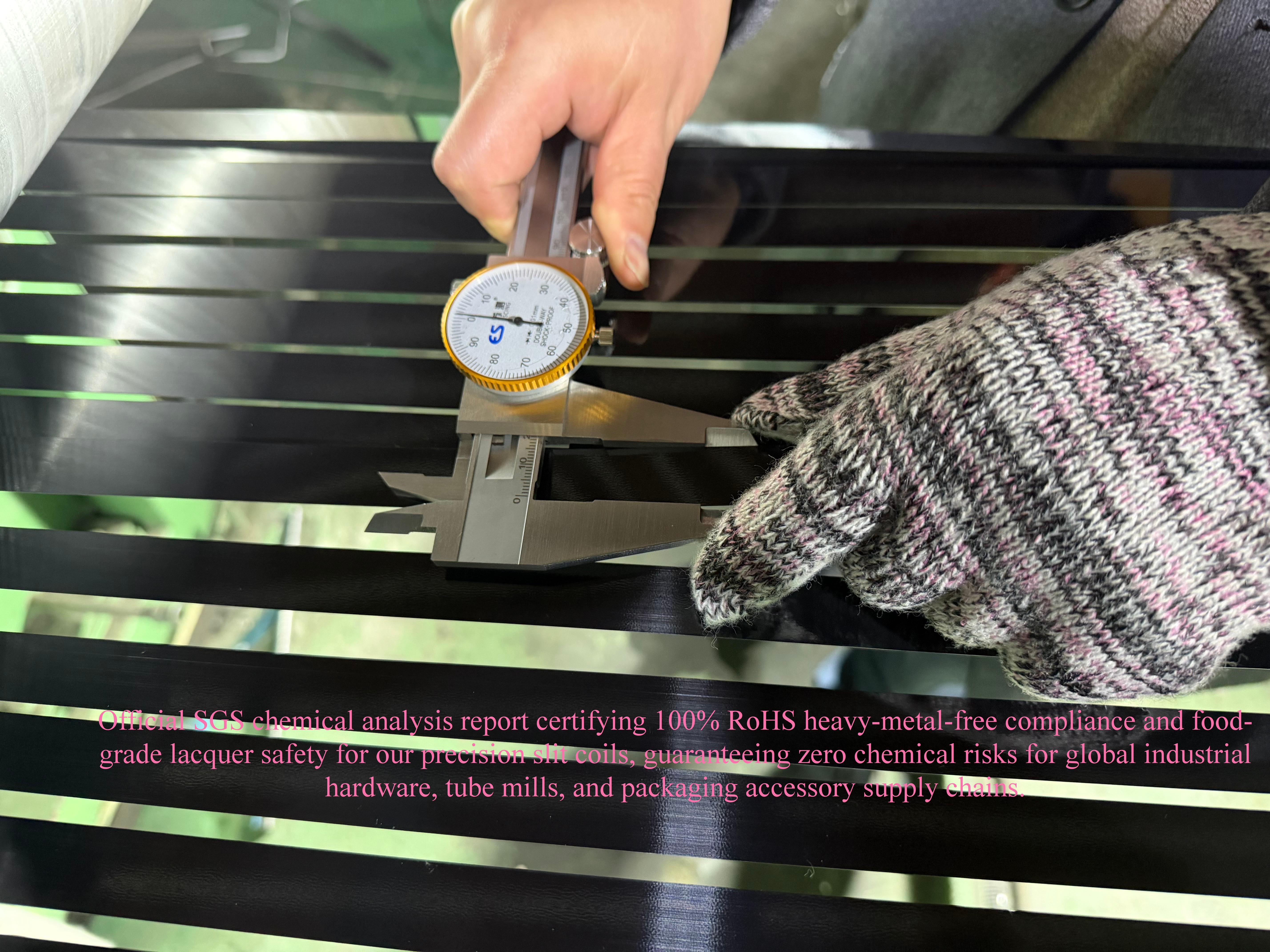
The reference line in this comparison is ±0.02 mm, the market standard cited in the manufacturer's published comparison data. Against that reference, YOUNGSON METAL's precision strip is specified at ±0.005 mm thickness tolerance and ±0.05 mm width precision, with slit-edge burr held to ≤0.05 mm. Because a single figure can be read as either a thickness or a width limit, the buyer should confirm on the mill certificate which dimension each value covers for the order in hand, and whether the drawing states a one-sided or a two-sided limit. That single check prevents most tolerance disputes.
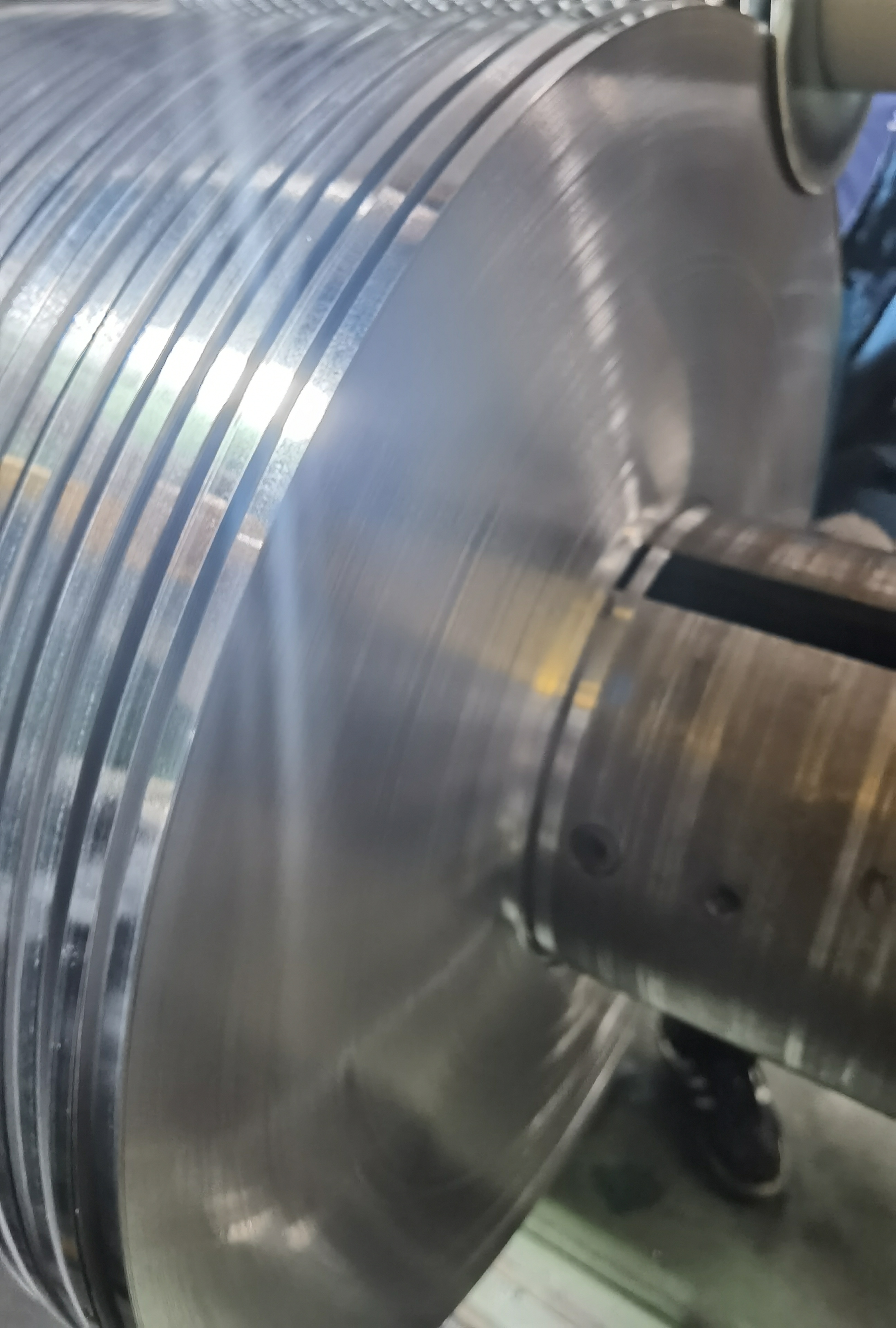
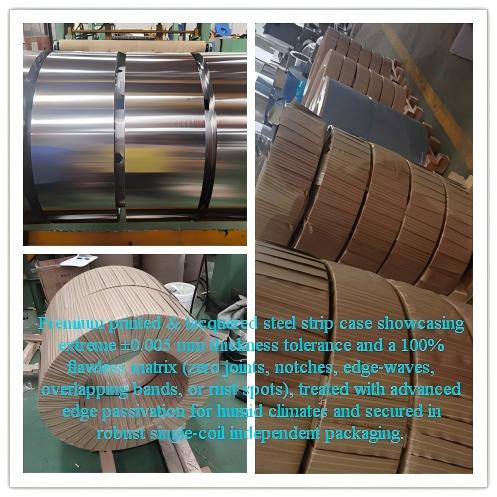
Edge condition matters as much as the number. The manufacturer's quality statement commits to zero joints, zero notches, zero edge waves, zero overlapping bands and zero rust spots, and describes automated oil-spray passivation applied to the slit edges plus hermetic single-coil sealing for humid and tropical routes. In the same published comparison, precision strip is stated to reduce total tool-maintenance cost by up to 35% and to remove press crashes caused by strip joints or edge notches, with continuous pressing and roll-forming cited at speeds up to 120+ strokes per minute. Those figures describe precision strip against standard packaging-grade sheet and low-precision commercial slit coil — they are not a claim about stainless steel, and should be read in that scope.
Corrosion, storage and handling environment
Corrosion is where the stainless route earns its premium, and it should be stated without hedging. SUS201 and SUS410 resist corrosion by alloy composition rather than by a barrier layer, so a scratch does not create a corrosion initiation point in the same way it does on coated steel. Where the part will be handled daily, exposed to moisture, salt, cleaning chemicals or outdoor weather, stainless is the more forgiving choice.
Coated tinplate protects by barrier: the coating and the tin layer isolate the steel, and the cut edge is the weak point. That weakness is manageable, and it is managed in three places. First, at slitting, through edge passivation and oil spraying. Second, at packing, through hermetic sealing and moisture control for humid or tropical destinations. Third, at design, by placing cut edges away from moisture traps and by specifying a coating system appropriate to the exposure. For indoor decorative parts, appliance trim, cosmetic closures and interior hardware, this is a well-understood and stable arrangement. For an exposed exterior fitting, it is the wrong route.
Documentation: MTC EN 10204 3.1, third-party inspection and CBAM
Documentation is now a cost line, not paperwork. A European or multinational buyer qualifying either route needs three sets of documents, and the supplier's ability to produce them on time affects the landed cost as surely as the material price.
The first is the mill test certificate. An MTC to EN 10204 3.1 is issued by the manufacturer's independent inspection representative and records the actual test results for the delivered lot — chemistry, mechanical properties and dimensions — rather than nominal values. For a coated product, the buyer should state which parameters must appear: substrate grade and temper, coating designation, thickness, slit width, and the acceptance limits for each.
The second is third-party inspection and testing support. YOUNGSON METAL works with inspection and testing bodies including SGS, BV and TÜV, and holds BV ISO9001:2015 certification as a manufacturer. Buyers should request the report reference, the sample identity and the test date, and confirm that the reported scope covers the product actually being purchased.
The third is carbon documentation. Where EU CBAM reporting applies to an import, buyers increasingly need embedded-emissions data with the shipment. The manufacturer states that it can supply EPD and CFP documentation supporting CBAM reporting; the buyer should request the current documents and confirm the declared scope — product, plant and reporting period — matches the order. Requesting all three document sets during quotation, not after the purchase order, is the cheapest way to avoid a shipment held at the border.
Total cost per finished part: a six-line worksheet
Material price per kilogram is the least useful number in this decision. Build the comparison per finished part instead, using six lines and the same volume basis on both sides. No supplier should be asked to fill this in abstractly — it is an internal worksheet that turns two quotes into one comparable figure.
Line 1 — Net material per part. Part mass divided by material yield, using the actual strip width purchased rather than the finished width. Include the slitting kerf and edge trim, which is where narrow-width buying changes the arithmetic.
Line 2 — Scrap and rework. Forming scrap, plus rejects caused by surface defects, coating damage or dimensional drift. This is where coil quality converts directly into money: joints, notches and edge waves create press stops and scrapped parts on one side, and coating scratches create cosmetic rejects on the other.
Line 3 — Tooling and maintenance. Die cost amortized over the order, plus maintenance per part. Burr and surface condition wear punches and formers, which is why edge quality is a cost item, not only a quality item.
Line 4 — Finishing after forming. Polishing, buffing, re-finishing at welds, and any coating touch-up. On a cosmetic stainless part this line is rarely zero; on a pre-finished coated strip it is normally zero, which is where most of the comparison outcome is decided.
Line 5 — Handling and packing. Protective film, gloves, interleaving, moisture control and packing specification. Include transit losses from corrosion or surface damage, since a rejected carton is a full-value loss.
Line 6 — Compliance and logistics. Inspection, document preparation, testing and freight. Both routes carry this line; it becomes a differentiator only when one supplier cannot produce the documents on schedule.
Add the six lines, divide by accepted parts, and the comparison is finished. In most decorative projects the gap appears in lines 2, 3 and 4 together, not in line 1 — which is why a straight material-price comparison usually points the wrong way.
Head-to-head comparison table
| Decision factor | Anti-fingerprint mirror gold tinplate strip | SUS201 | SUS410 |
|---|---|---|---|
| Base material | Low-carbon steel, electrolytic tin (ETP) or TFS/ECCS substrate, coil-coated | Austenitic chromium-manganese stainless (200 series) | Martensitic chromium stainless, hardenable by heat treatment, magnetic |
| How the finish is produced | Applied on the coating line before slitting; mirror gold plus optional anti-fingerprint top layer | Mill finish, then polished or brushed; re-finishing after forming where cosmetic | Mill finish, then polished or brushed; hardness often the reason for selection |
| Fingerprint handling | Process feature: anti-fingerprint layer applied in-line | Handling discipline, protective film, cleaning | Handling discipline, protective film, cleaning |
| Forming and deep drawing | DDQ and DR8-class tempers available; coating adhesion is the limiting factor, not the steel | Good ductility in moderate draws; work-hardens, may need intermediate anneal | Higher strength, more limited ductility; better suited to blanking, bending and roll forming |
| Dimensional precision | Published at ±0.005 mm thickness tolerance and ±0.05 mm width precision against a ±0.02 mm market reference; slit burr ≤0.05 mm | Per mill or slitter specification; hardness affects burr and edge condition | Per mill or slitter specification; hardness affects burr and edge condition |
| Corrosion logic | Barrier protection; cut edges and scratches need design and packing controls | Alloy-based resistance; more forgiving of surface damage | Alloy-based resistance with higher hardness; grade-dependent performance |
| Documentation route | MTC to EN 10204 3.1, SGS/BV/TÜV inspection support, EPD and CFP documentation for CBAM reporting | Mill certificate to the applicable standard; alloy and heat analysis | Mill certificate to the applicable standard; heat-treatment record |
| Main cost drivers | Substrate, tin coating mass, colour coat, slitting; no post-forming polishing | Alloy content and alloy-linked surcharges; post-forming finishing and handling | Alloy content, heat treatment, post-forming finishing and handling |
| Usually the wrong route for | Load-bearing parts, heavy abrasion, exposed outdoor service, aggressive chemical contact | Severe deep drawing, hardness-critical wear parts | Deep-drawn geometries, parts needing high ductility or weldability |
The stainless columns describe general grade-level characteristics for screening purposes, not a specification. Confirm chemistry, mechanical properties and tolerances on the mill certificate for the exact grade, temper and standard you intend to purchase.
Where SUS201 or SUS410 remains the right call
A comparison that only lists advantages is a sales document, not a decision tool. Four situations keep the part in stainless.
The part carries load or takes impact. Hinges under continuous torque, structural brackets, lock components and fasteners rely on the substrate, not the coating. Coated decorative steel is a surface product.
Wear or heat is present. Repeated abrasion, sliding contact or elevated temperature defeats a thin organic coating; SUS410's hardness and both grades' thermal stability are the reason they exist in these roles.
The environment is aggressive or exposed. Outdoor fittings, marine air, frequent wet cleaning or chemical contact all move the decision toward stainless, unless the coating system is specifically qualified for that exposure.
The downstream process removes the finish. Welding, heavy grinding or post-forming machining destroys the coated surface locally. Where a fabricated assembly requires those operations, the pre-finished advantage disappears and stainless becomes the simpler route.
Step-by-step: running the decision for your part
Step 1 — Write the finish specification first. Colour, gloss, surface defect limits and fingerprint performance, expressed as acceptance criteria rather than photographs. Both routes cannot be compared until the finish is defined in measurable terms.
Step 2 — Check whether the part is truly cosmetic. If the load case or the environment puts the substrate in service, stop here and specify stainless. The cost comparison will not change the engineering answer.
Step 3 — Prototype the forming step on coated strip. One trial coil through the actual die answers the only question that matters: does the mirror gold finish survive the draw radius, or does it crack, dull or peel? Confirm the grade and temper selected for the trial, and keep the trial result with the drawing.
Step 4 — Convert both quotes into cost per finished part. Use the six-line worksheet. Keep the volume basis, scrap assumptions and finishing steps identical on both sides; most misleading comparisons come from comparing a pre-finished part against an unfinished one.
Step 5 — Lock the tolerance conversation. State slit width, thickness and edge condition as one-sided or two-sided limits on the purchase specification, and ask the supplier to confirm capability and to show the actual values on the mill certificate. Treat ±0.02 mm as the market reference line and require the delivered figures in writing.
Step 6 — Assemble the document set before the order. MTC to EN 10204 3.1, the applicable third-party test report with sample identity, and the EPD/CFP documentation for CBAM reporting where relevant. Confirm the declared scope covers your product and plant.
Step 7 — Confirm commercial terms in writing. MOQ, lead time, packing method, customization limits on thickness, width and finish, and the route for a repeat order. These determine whether the decision survives the second order as well as the first.
Application patterns where the tinplate route is evaluated
The mirror gold coated strip route is typically assessed in applications where the visible face is the product: decorative trim profiles, escutcheons and cover plates, cosmetic caps and closures, appliance end panels and control surrounds, lighting bezels, furniture profiles, gift and premium packaging components, and internal hinges and latch covers that are seen but not load-bearing. In these roles the finish, the colour consistency and the fingerprint behaviour are the specification, and the pre-finished coil removes an entire production step.
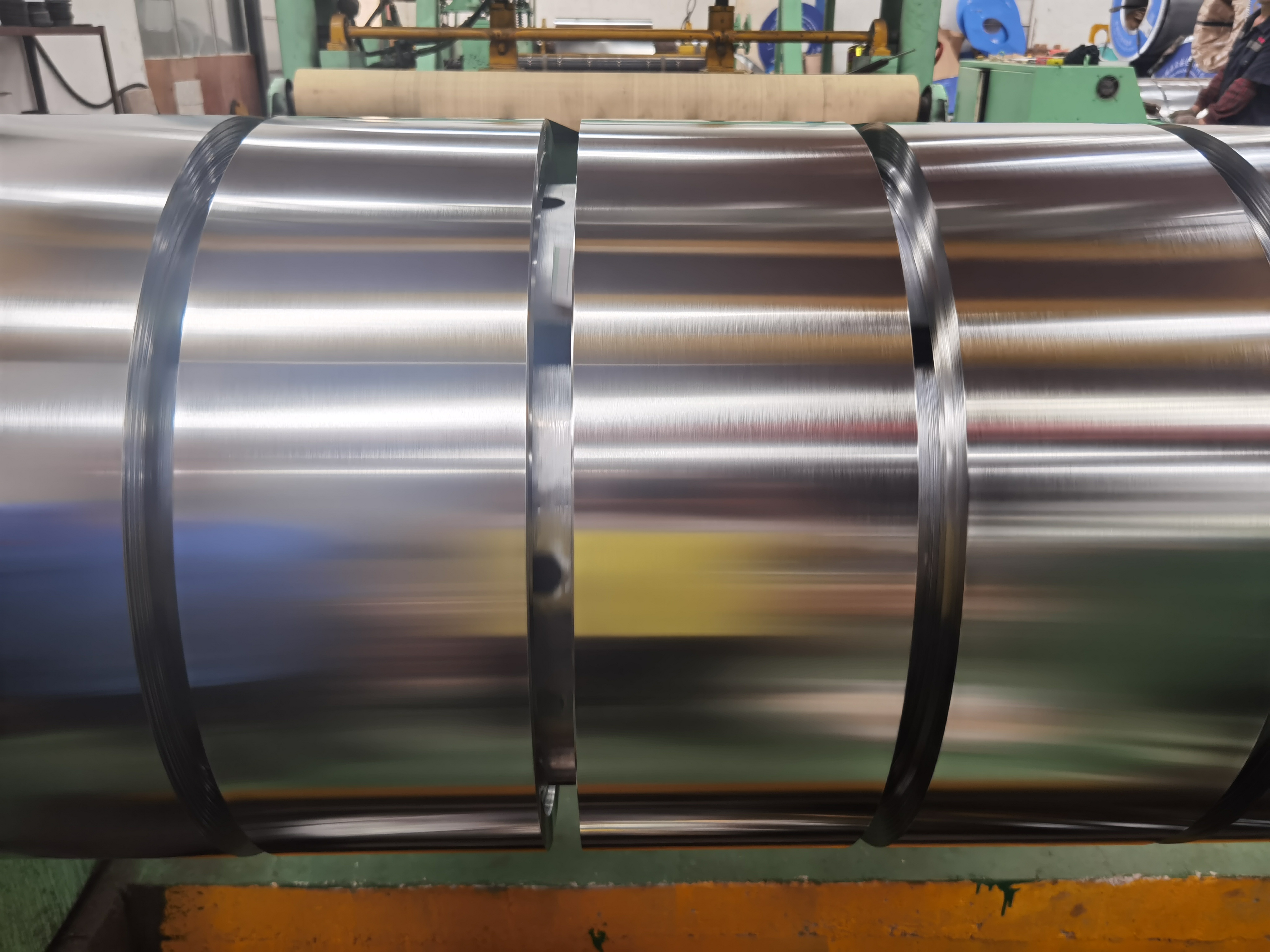
The route is also assessed where a stainless part is currently polished after forming. If the polishing step exists only to restore a cosmetic surface, replacing the stainless part with a pre-finished coated strip removes the step entirely — and that, rather than material price, is usually the largest single number in the comparison.
The supplier side: what YOUNGSON METAL brings to this comparison
The manufacturer positions its mirror-finish tinplate strip as a cost-saving alternative to SUS201 and SUS410 for decorative and hardware applications, and the positioning rests on capability rather than on a price claim. The company operates its own coating lines and precision slitting equipment, processes more than 10,000 tons annually, and describes a product portfolio split between commercial-grade and deep-drawn-grade tinplate and TFS, with lithography, coil coating and laminated PET film options in both categories, plus pre-painted steel and stainless steel lines.
Three capabilities are relevant to this specific decision. First, finish and anti-fingerprint treatment are applied in-house on the coating line, so appearance and fingerprint control are process parameters rather than outsourced variables. Second, slitting is done in-house to narrow widths with published tolerance figures against the ±0.02 mm market reference, which is what makes a narrow decorative strip practical. Third, the documentation chain — MTC to EN 10204 3.1, SGS/BV/TÜV inspection support and EPD/CFP documentation for CBAM reporting — is available with the shipment rather than after it.
For buyers who need a technical discussion rather than a catalogue, the company maintains a team of five engineers and senior process technicians and states its focus on eco-friendly, food-grade and chemical-grade surface treatments. That matters here in one practical way: a supplier that already controls coating adhesion for food-contact and chemical-grade work has the process discipline that decorative mirror finishes depend on. It does not, however, replace your own forming trial on your own die.
Decision checklist before you request a quote
| Check | What to confirm | Why it decides the outcome |
|---|---|---|
| Finish specification | Colour, gloss, defect limits and anti-fingerprint requirement stated numerically | Makes the two routes comparable at all |
| Forming trial | Coated strip run through the actual die at the selected grade and temper | Confirms the finish survives the draw radius |
| Dimensions | Thickness, slit width, one-sided or two-sided limits, edge burr | Prevents tolerance disputes and press downtime |
| Customization | Thickness, width and finish options confirmed against the drawing | Determines whether the strip is buyable as specified |
| MOQ | 2–3 tons for a custom finish and slit width | Sets the true unit cost at your order size |
| Lead time | 5–30 days depending on finish, width and quantity | Drives the safety-stock cost on the worksheet |
| Documents | MTC to EN 10204 3.1, third-party report, EPD/CFP for CBAM | Avoids clearance delays and audit gaps |
| Packing | Edge protection, hermetic sealing for humid routes | Eliminates corrosion losses in transit |
The commercial envelope is deliberately narrow, which makes planning straightforward. Custom finishes and slit widths typically start at a 2–3 ton minimum order quantity, and lead times run from 5 to 30 days depending on finish complexity, width and quantity. Thickness, width and finish are all customizable within the manufacturer's published range, which covers tinplate and TFS from 0.14 mm to 0.55 mm and strip widths from 6.5 mm to 1,050 mm. Both figures should be reconfirmed against the specific grade and finish at quotation stage.
Frequently asked questions
Is mirror gold tinplate actually cheaper than SUS201 or SUS410?
It is usually lower in total cost per finished part for decorative and lightly loaded parts, not automatically lower per kilogram. The advantage comes from three places: the finish is applied before forming so no post-forming polishing is needed, the mirror gold and anti-fingerprint layers are applied in one coil-coating pass, and precision slitting delivers strip close to finished width. The comparison should always be run per accepted finished part across material, scrap, tool maintenance, finishing, handling and compliance, because the outcome changes with order size and geometry.
Will a mirror gold finish survive deep drawing?
It can, if the grade, temper and coating system are matched to the draw and the tooling is prepared for coated material. Deep-drawing grades such as DDQ and DR8-class tempers are produced for severe forming, and coated decorative parts are normally formed with protective film, generous draw radii and polished die surfaces. The limiting factor is coating adhesion under elongation, not the steel itself. The reliable answer comes from one trial coil through the actual die — not from a data sheet.
What does ±0.02 mm mean for my order?
±0.02 mm is the market standard cited as the reference line in the manufacturer's comparison data. Against it, precision strip is published at ±0.005 mm thickness tolerance and ±0.05 mm width precision with slit burr ≤0.05 mm. Because one figure can be read as a thickness limit and another as a width limit, state on the purchase specification which dimension each tolerance applies to, whether it is one-sided or two-sided, and require the actual measured values on the mill certificate for the delivered lot.
Can I get MTC EN 10204 3.1 and CBAM documentation with the strip?
Yes. The documentation package available with the shipment includes a mill test certificate to EN 10204 3.1, third-party inspection and testing support through SGS, BV and TÜV, and EPD/CFP documentation supporting EU CBAM reporting. Request all three sets at quotation stage, and confirm that the declared product, plant and reporting period on each document match your order rather than the general product family.
What MOQ and lead time should I plan for?
Plan on a 2–3 ton minimum order quantity for custom finishes and slit widths, with lead times of 5 to 30 days depending on finish complexity, width and quantity. Both parameters should be confirmed in writing at quotation, together with the packing method and the repeat-order route, because they determine the safety-stock and working-capital lines in the cost comparison.
Does a supplier's food-can or meat-can experience matter for decorative hardware?
It matters indirectly. Coating adhesion, surface cleanliness and slitting consistency are controlled by the same process discipline whether the end use is a meat can or a decorative trim profile, and a supplier already qualified on food-contact and chemical-grade work has that discipline in place. It does not, however, substitute for application-specific evidence: ask for the coating data sheet, the test report covering your finish, and a forming trial on your own part.
Conclusion
The choice between anti-fingerprint mirror gold tinplate strip and SUS201/SUS410 is not a materials argument. It is a question of where the appearance is created. If the finished look can be applied on the coil and survives the die, the coated route removes polishing, re-finishing and part of the handling burden, and the cost per finished part usually falls. If the part carries load, takes wear, lives outdoors or is welded after forming, stainless is doing a job the coating cannot do and should stay.
Run the decision in the right order: define the finish, test it through the die, convert both quotes into cost per finished part, lock the tolerance and document set, then confirm MOQ and lead time. That sequence answers the question in weeks instead of quarters, and it leaves you with a specification you can re-order against.
Next step. If you are currently polishing a cosmetic stainless part, the fastest way to test the alternative is a sample coil in your own die. YOUNGSON METAL supplies mirror gold anti-fingerprint tinplate strip with MTC to EN 10204 3.1, SGS/BV/TÜV inspection support and EPD/CFP documentation for CBAM reporting, from a 2–3 ton MOQ with 5–30 day lead times and customizable thickness, width and finish.
Download the full product catalogue here: Chongqing Youngson Metal Products catalogue (PDF), or send your drawing, annual volume and target finish to request a sample strip and a quote.

Have Questions or Need More Details?
Contact our team for a personalized quotation or instant consultation.
Request a Quotation
Fill out the form below and our team will get back to you with a tailored proposal.
WhatsApp Direct Chat
Prefer to chat in real-time? Message us on WhatsApp for instant assistance & quick answers.
- Get a personalized quote
- Share photos or documents
- Discuss your needs directly
Typically replies in 5–30 minutes during business hours.