Navigating EU CBAM Compliance for Tinplate and Steel: What Global Buyers Need to Know
Buyers of tinplate, tin free steel (TFS/ECCS) and coated steel strip are being asked a new question during supplier evaluation: not only what the material is, but what it emitted. The European Union's Carbon Border Adjustment Mechanism (CBAM) places a carbon price on carbon-intensive goods entering the EU, and iron and steel products sit inside its scope. Electrolytic tinplate (ETP) and tin free steel are steel products, which means the emissions generated while the material was produced become data that EU importers may need to report.
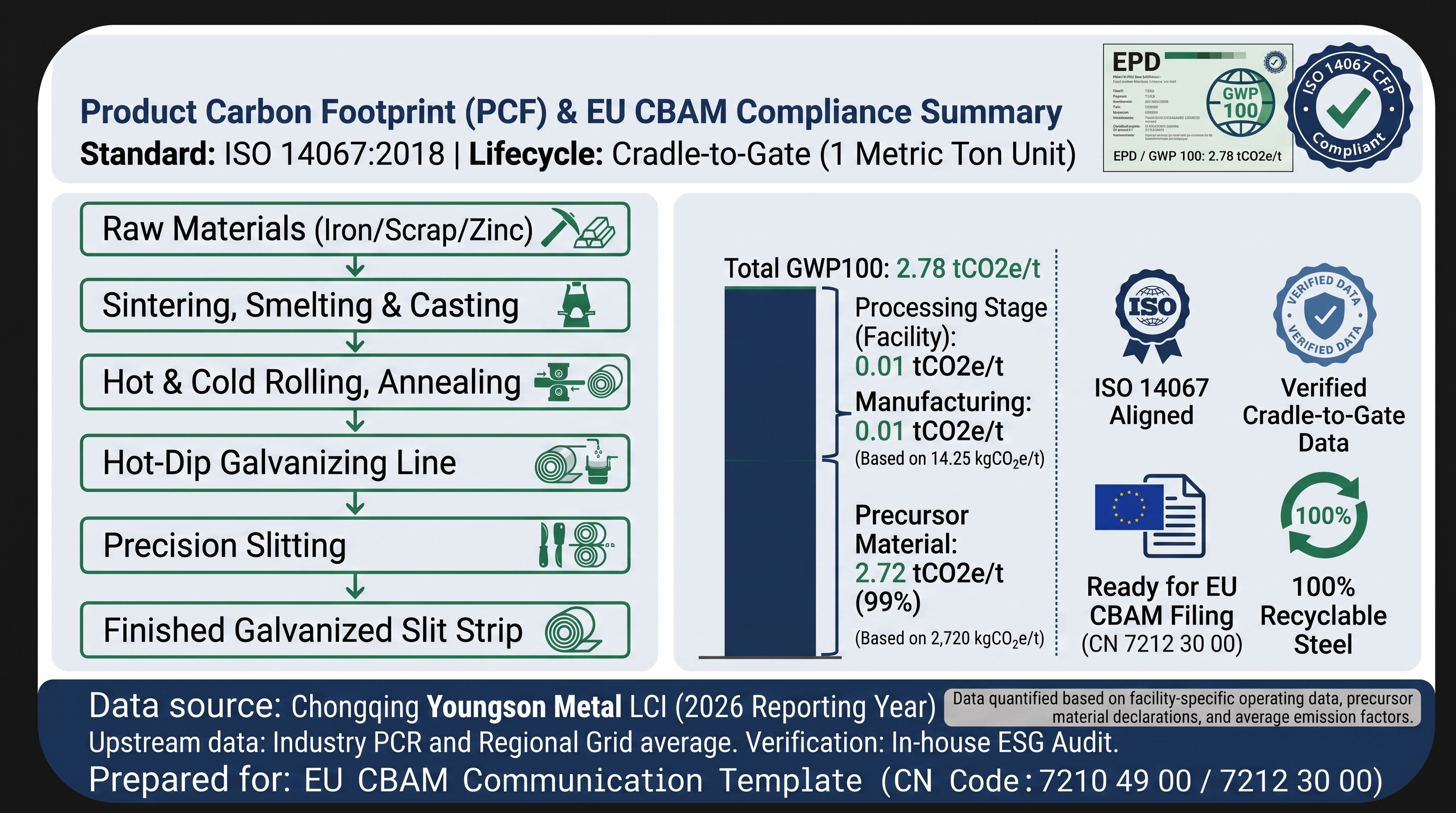
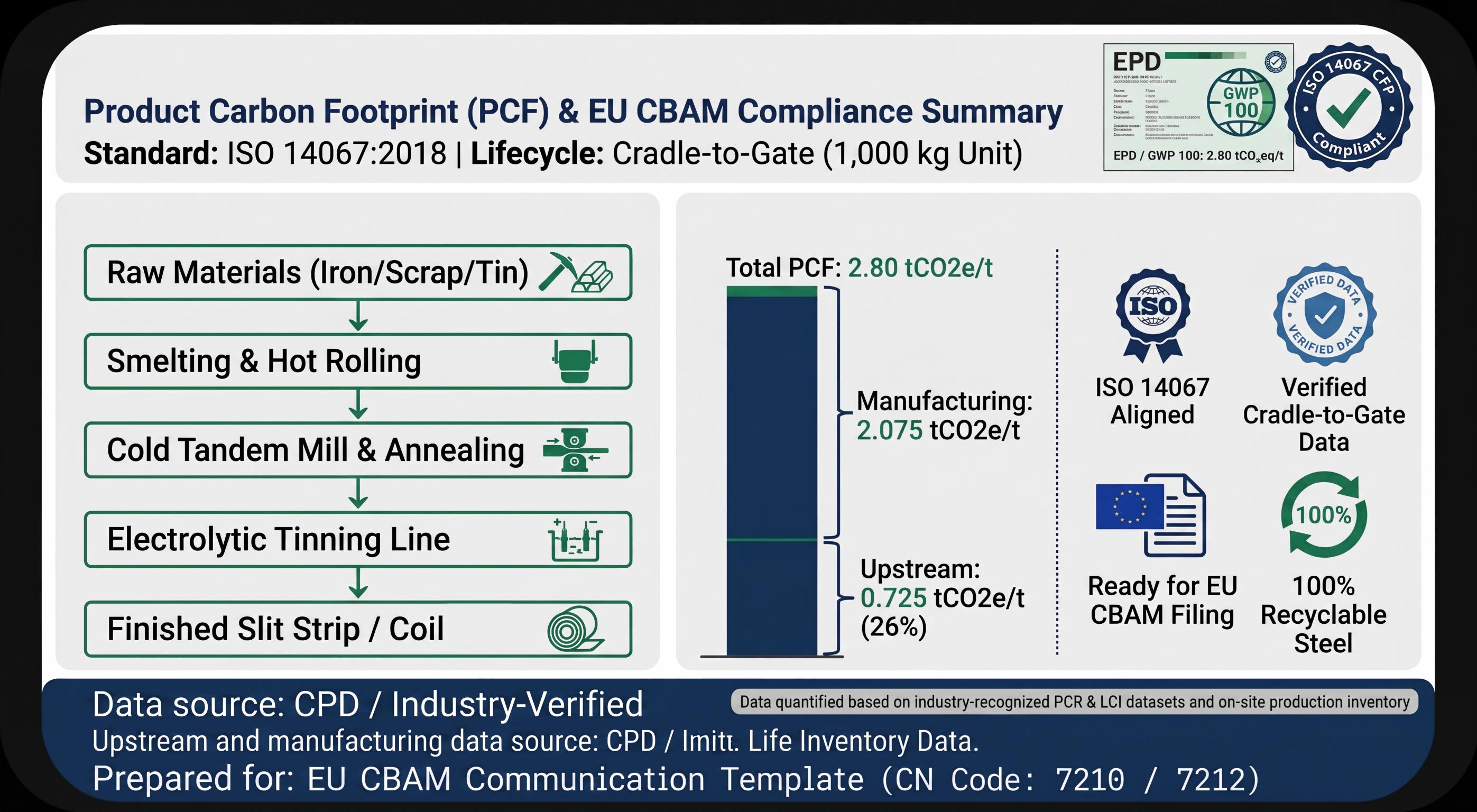
For most buyers the practical answer is a sourcing answer. A supplier that can issue an Environmental Product Declaration (EPD) and a product carbon footprint (CFP) certified to ISO 14067 — together with CBAM direct and indirect emission data — converts a regulatory obligation into a supply-chain advantage. Chongqing Youngson Metal Products Co., Ltd., the manufacturer behind the YOUNGSON METAL brand, supplies EPD & CFP certified low-carbon steel (EU CBAM compliant), supported by certified EPD & CFP (ISO 14067) documentation and full EU CBAM direct/indirect carbon emission data reporting.
What EU CBAM Changes for Tinplate and Steel Buyers
CBAM is built to align the carbon cost of imported goods with the carbon cost of goods produced inside the EU under the EU Emissions Trading System. For a buyer, that intent translates into two obligations that flow down the supply chain:
- A reporting obligation. Importers of covered goods must declare the embedded emissions of the goods they bring into the EU.
- A certificate obligation. Under the definitive regime, importers must surrender CBAM certificates corresponding to those embedded emissions.
The difficulty is that the emissions were never created by the importer. They were created upstream: in steelmaking, in electrolytic tin coating, on coil coating and lacquering lines, in slitting and cut-to-length operations, and through the electricity those processes consumed. A can maker or importer in Europe cannot reconstruct the carbon intensity of a 0.18 mm T2 tinplate strip or a DR8 TFS coil from the finished product alone. The unit of compliance is therefore the supplier-to-buyer data exchange, not the customs declaration in isolation.
When that data does not exist, three problems follow. Declarations end up resting on default values rather than primary data. Buyers lose the ability to show customers, auditors and investors how the material footprint is being reduced over time. And the supplier base narrows, because a supplier that cannot document emissions becomes a compliance risk rather than simply a commercial choice.
It is also worth separating two things that are often conflated. A quality certificate proves the material is what it claims to be; a carbon document proves how much the material emitted. Both are needed, and they only work together when they refer to the same production batch.
Buyer rule of thumb: treat carbon documentation as a qualification item at RFQ stage, in the same checklist as temper, tin coating mass and slit-edge quality. Retrofitting the data after the material has shipped is far harder.
Industry Background: Why Carbon Data Is Now a Sourcing Criterion
Tinplate is a mature material with a stable demand base. The global tinplate market was valued at USD 14.59 billion in 2023 and is projected to reach USD 19.38 billion by 2032, according to Fortune Business Insights. China remains a major origin for exported material: tinplate exports under HS code 721012 reached 1.4 million tons in the first three quarters of 2023, driven primarily by canned food packaging demand, according to the General Administration of Customs of China. Canned food packaging — the main end use for sulfur-resistant lacquered tinplate — is growing at a CAGR of 3.9% through 2030, per Grand View Research.
Specification expectations are already well codified. Tinplate grades are framed by standards such as ASTM A623 and EN 10202, which cover temper grades from T1 to T5 and DR7 to DR9. Food-contact applications, particularly fish and meat cans, must also satisfy requirements such as RoHS and FDA 21 CFR 175.300 for coatings and lacquers.
Two trends now intersect with carbon policy. The first is lightweighting: double cold reduced (DR) tinplate in the 0.14–0.16 mm range, including DR8 grades, is increasingly used for cost reduction and weight reduction in metal packaging, as noted by Metal Packaging Europe. Less steel per can also means less embodied carbon per can. The second is carbon transparency. Because tinplate is an intermediate product, the buyer's own carbon story depends on the mill's and the coater's data. That is why carbon documentation increasingly appears in RFQ questionnaires beside coating weight, temper and dimensional tolerances.
How a Tinplate Manufacturer Delivers CBAM-Ready Carbon Data
Compliance is not a certificate on a wall; it is a data pipeline that has to stay connected to the coil. At YOUNGSON METAL, carbon and compliance information is documented at three levels: product-level declarations, batch-level traceability, and order-level emission reporting.
EPD, CFP and CBAM reporting: the three layers
- EPD & CFP certified low-carbon steel supply (EU CBAM compliant). Low-carbon supply is positioned as a certified product line rather than a supplementary claim, so carbon characteristics form part of the product definition alongside grade and finish.
- Certified CFP documentation under ISO 14067. Product carbon footprint documents are issued within the quality-control package, so the carbon figure travels with the same batch identity as the inspection data.
- Full EU CBAM direct and indirect carbon emission data reporting. Delivered as an after-sales service covering both direct emissions from production processes and indirect emissions associated with purchased electricity — the two data categories an EU importer needs when compiling a declaration.
- MTC EN 10204 3.1 and third-party verification. A mill test certificate according to EN 10204 3.1 ties the declared material batch to documented properties, and third-party inspection is supported through SGS, BV or TÜV where an importer's due-diligence process requires independent confirmation.
Carbon data is also a customization input rather than an afterthought. Alongside material grades (tinplate, pre-painted steel, cold rolled, galvanized, galvalume, Zn-Al-Mg, stainless steel and aluminium), thickness from 0.08 mm to 6.0 mm, width and slitting tolerance of ±0.02 mm, zinc coating from 30 to 600 g/m², surface finishes from 2B and BA to anti-fingerprint and RAL coatings, and temper ranges from soft to full hard, CBAM and EPD carbon footprint data are specified at order stage.
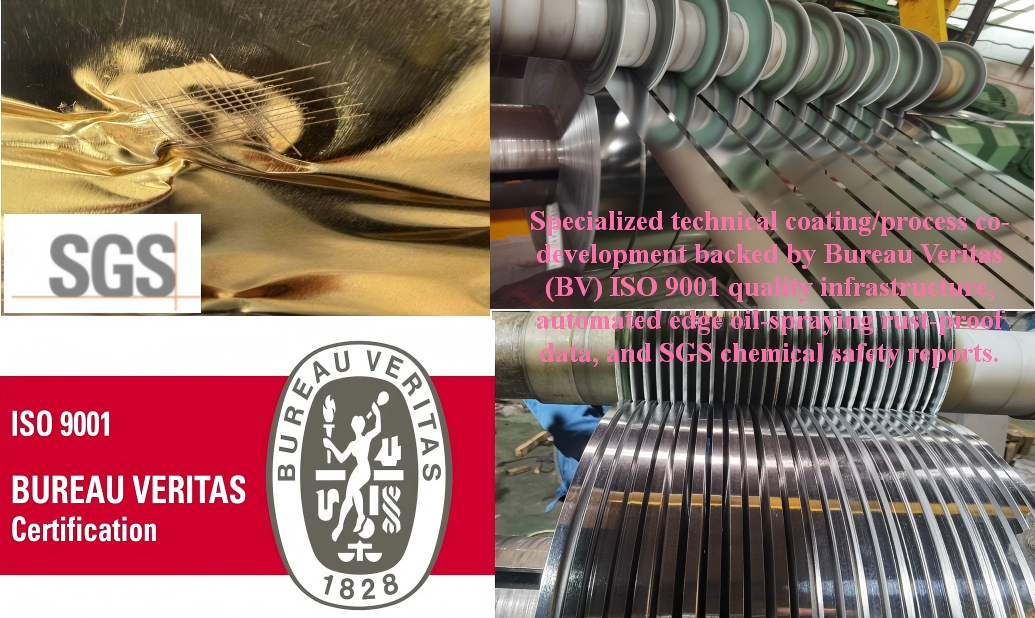
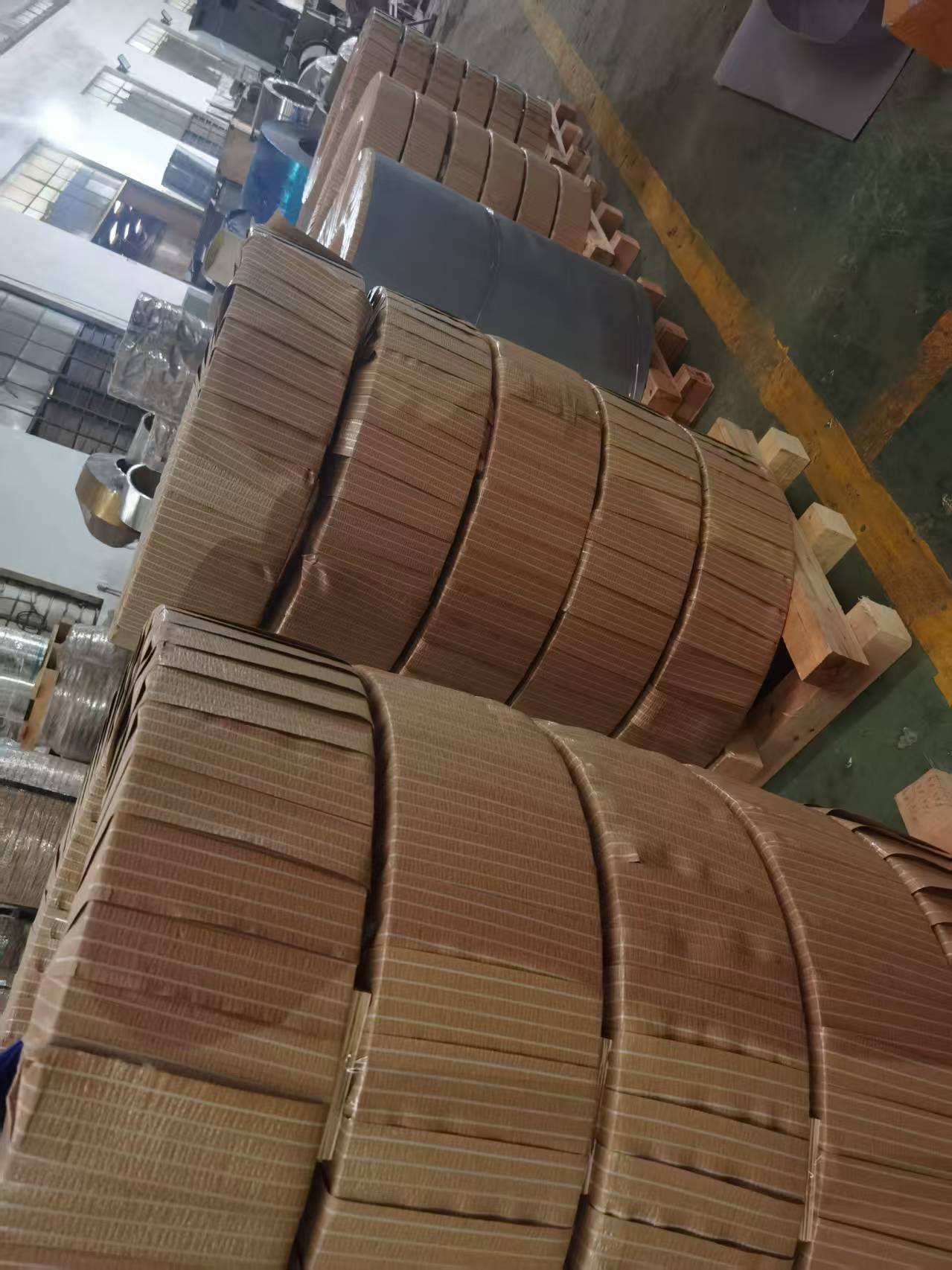
Quality control supports the data rather than sitting apart from it. Inspection is 100% in-house and covers thickness, coating mass, tensile strength, T-bend, salt spray and surface roughness. Every slit coil is locked to a unique quality ID linked to the raw base metal and coating batches, which is what allows a carbon figure to be traced back to a specific coil instead of a generic product family. Remote metallurgical and slitting technical support is handled within 24 hours, and the operation is certified by Bureau Veritas to ISO 9001:2015.
The product scope that carbon data has to cover
Carbon reporting is only useful if it matches what you actually purchase. The tinplate and TFS range relevant to CBAM-driven food and industrial packaging includes:
- Meat can stock. Milky white coated tinplate sheet for meat cans, and BPA-free two-pass gold coated tinplate sheet for 2-piece meat cans — 0.14–0.16 mm, DR8/DR9/DR10 tempers, differential tin coating of 1.1/2.8 g/m², and a heavy food-grade internal coating engineered for zero blistering and zero blushing after 121 °C retorting for up to 90 minutes, with resistance to fat, salt and sulfur staining.
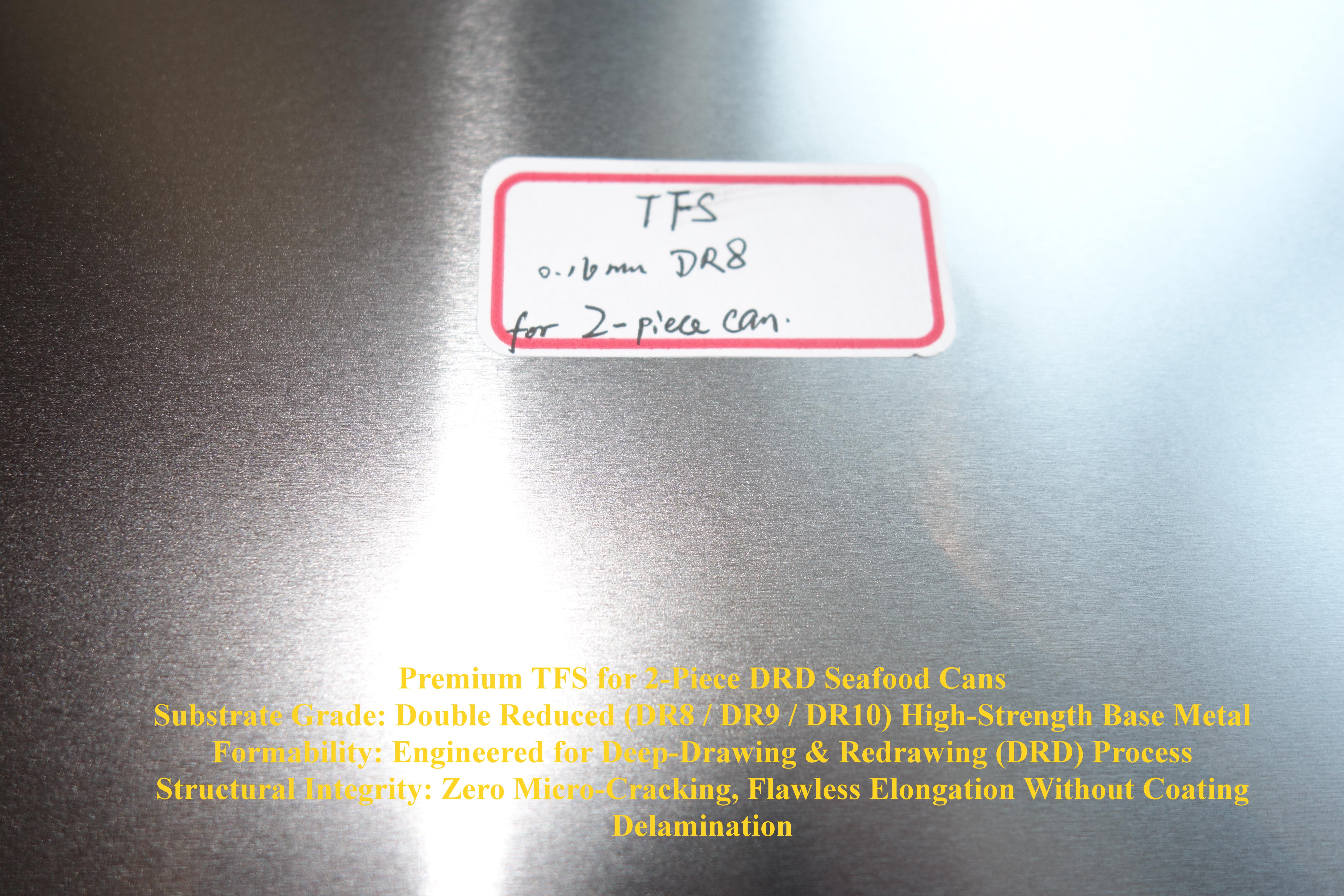
- Fish can stock. BPA-free internal sulfur-resistant aluminum paste coated tin free steel (TFS) for 2-piece DRD fish cans — 0.14–0.16 mm, DR8/DR9/DR10, aluminum pigment lacquer at 8–12 g/m², retort resistance at 121 °C for 60 to 90 minutes, and zero discoloration after sterilization. Printed tinplate sheet for fish cans follows the same sulfur-resistance logic.
- Deep drawing grades. DDQ and EDDQ tinplate and TFS from 0.20 mm to 0.50 mm in soft T1 and T49 tempers, plus DR7–DR10 deep-drawn strip at 0.14–0.17 mm for aerosol domes and cones, easy-open ends and severely formed components.
- Pre-coated and decorative strip. Bronze lacquering tinplate and bronze coated tinplate coil in 0.15–0.30 mm at HV120–HV180, thermally stable through 120 °C continuous heat for five hours with zero peeling and zero blistering; copper colorful mirror tinplate used to substitute for higher-cost stainless and copper-plated material; anti-fingerprint mirror bronze; matte finish and colorful coated strip; and SGS-compliant colorful coated TFS strip.
- Ultra-thin and high-temper strip. Grades including 0.17 mm T2, DR8/TH520 strip at 0.14–0.16 mm, and 3D laser effect coated tinplate from 0.14 mm to 0.55 mm across T1–T5 and DR7–DR10 tempers, with tin coating mass from 1.1/1.1 g/m² up to 5.6/5.6 g/m².
- Precision slitting. Slitted tinplate and TFS strip from 4.0 mm to 1050 mm in width, thickness tolerance of ±0.005 mm, width tolerance of ±0.05 mm, burr controlled at or below 0.05 mm, and anti-rust treatment on slit edges for humid and tropical transit climates.
Step-by-Step: Building a CBAM-Ready Tinplate Supply Chain
- Confirm scope. Establish whether the item you import is a covered steel good — tinplate and TFS/ECCS sit within the steel product family — and identify which SKUs and suppliers are affected.
- Map the data you need. Separate direct emissions from production and indirect emissions from purchased electricity. Both categories are required; a supplier who can only speak in general sustainability terms is not yet providing compliance data.
- Request a single documentation package. Ask for the EPD, the ISO 14067-certified CFP, the CBAM direct/indirect emission data report and the MTC EN 10204 3.1 in one set. Packages that arrive separately are harder to reconcile against a shipment.
- Verify the certification chain. Check the quality management certification behind the data — for YOUNGSON METAL this is Bureau Veritas ISO 9001:2015 — and the third-party inspection route (SGS, BV or TÜV) used for the compliance scope you rely on.
- Lock batch traceability into the order. Require a quality ID per coil linked to base metal and coating batches, so the emission figure and the material certificate refer to the same production run.
- Align specifications and carbon data. Specify grade, temper, thickness, tin coating mass, surface finish, coil inner diameter and export packaging together with the carbon documentation requirement, rather than adding carbon later as a separate exercise.
- Keep it live. Carbon data ages when processes change. Reconfirm the data set on each significant reorder so declarations reflect current production rather than an earlier baseline.
Use Cases: Where CBAM-Ready Tinplate Is Already Required
Two-piece meat can programs. Meat canning combines aggressive retort conditions with fat and salt exposure, so the material data and the coating performance must come from the same batch. BPA-free two-pass gold coated tinplate sheet at 0.14–0.16 mm in DR8–DR10, with a heavy internal coating that survives 121 °C retorting without blistering, is specified together with its carbon documentation.
Seafood and fish can programs. Sulfur-bearing proteins attack the internal coating during sterilization. Sulfur-resistant aluminum paste coated TFS for 2-piece DRD fish cans is specified at 0.14–0.16 mm in DR8–DR10 with 8–12 g/m² coating weight and 121 °C retort resistance — the same coils that must carry an emission figure for EU buyers.
Deep-drawn and stamped components. Aerosol domes and cones, twist-off caps, filter shells and progressive-die stamping all depend on consistent thickness tolerance and low burr. For a global high-speed stamping plant and can maker, ultra-strict dimensional control — thickness within ±0.005 mm, width within ±0.05 mm, burr at or below 0.05 mm — supported 6,000+ tons of annual continuous supply with zero coating delamination and extended progressive-die life.
Decorative and cost-optimization projects. Buyers substituting copper plating or anodized stainless with pre-coated strip gain a cost advantage and a documentation advantage at the same time. Pre-coated copper-look strip can reduce direct raw material cost by more than 50% compared with traditional copper electroplating, and pre-coated bronze or copper mirror strip by more than 20% compared with bronze or copper anodized and electroplated stainless steel — while remaining SGS RoHS heavy-metal-free and food-grade compliant and carrying carbon data through the same document set.
Comparison Table: Carbon and Compliance Documents at a Glance
The documents below form the working set a tinplate buyer should be able to assemble. Each answers a different question, and none of them substitutes for the others.
| Document | What it establishes | Where it comes from | How buyers use it |
|---|---|---|---|
| Environmental Product Declaration (EPD) | A structured, third-party-reviewed environmental profile of the product | Manufacturer, verified through an independent programme operator | Supports product-level environmental claims and ESG reporting |
| Product carbon footprint (CFP) certified to ISO 14067 | The product carbon footprint, calculated and certified against ISO 14067 | Manufacturer, with third-party verification | Serves as the emission basis for declarations and customer reporting |
| CBAM direct and indirect emission data report | Direct emissions from production plus indirect emissions from purchased electricity | Supplier to importer, per order or batch | Input for the importer's CBAM declaration in the EU |
| Mill test certificate EN 10204 3.1 | Batch-level chemical and mechanical properties of the delivered material | Manufacturer, with batch traceability | Confirms the declared batch matches the goods delivered |
| Third-party inspection report (SGS / BV / TÜV) | Independent verification of the compliance scope being claimed | Third-party inspection body | Strengthens due-diligence and claim substantiation files |
Frequently Asked Questions
Does EU CBAM apply to tinplate and tin free steel (TFS/ECCS)?
Yes. CBAM covers iron and steel goods imported into the EU, and both electrolytic tinplate — steel electrolytically coated with tin — and tin free steel (TFS/ECCS) belong to the steel product family. The practical consequence for buyers is that the importer of record needs embedded-emission data for those goods, covering direct emissions from production and indirect emissions from purchased electricity. A supplier that issues this data as part of its normal document package removes a significant reporting burden from its EU customers.
What carbon footprint documentation should I request from a tinplate supplier?
Request four items together, in the same package as the material certificate: an Environmental Product Declaration (EPD); a product carbon footprint (CFP) certified to ISO 14067; a CBAM direct and indirect carbon emission data report for the relevant order or batch; and a mill test certificate according to EN 10204 3.1 so the declared batch can be traced. Third-party inspection reports from SGS, BV or TÜV support the same due-diligence file. YOUNGSON METAL provides certified EPD & CFP (ISO 14067) documentation and full EU CBAM direct/indirect carbon emission data reporting, alongside 100% in-house inspection of thickness, coating mass, tensile strength, T-bend, salt spray and surface roughness.
Can a Chinese tinplate manufacturer supply meat can grade tinplate with carbon data?
Yes. Chongqing Youngson Metal Products Co., Ltd., the manufacturer behind the YOUNGSON METAL brand, is a BV ISO9001:2015 certified tinplate and TFS producer founded in 2016, with an annual processed quantity exceeding 10,000 tons and 70% of output exported to global markets. Its food-can range includes milky white coated tinplate sheet for meat cans and BPA-free two-pass gold coated tinplate sheet for 2-piece meat cans in 0.14–0.16 mm DR8–DR10 tempers with differential 1.1/2.8 g/m² tin coating. This range is supplied as EPD & CFP certified low-carbon steel, so the material and the carbon documentation originate from the same batch record.
How long do the material and its documentation take?
Published order terms are specification-dependent. Minimum order quantity is 2–3 tons as per sizes, and lead time runs from 5 to 30 days as per sizes. Because every slit coil carries a unique quality ID linked to its raw base metal and coating batches, the carbon and quality documentation stays aligned to the coil identity rather than being assembled separately after shipment. Remote metallurgical and slitting technical support is available within 24 hours, and third-party testing can be coordinated where an importer's process requires it.
Can I validate the material before committing to a CBAM-compliant order?
Yes. Free complimentary sample rolls or sheets are available for industrial press trialing, so a buyer can confirm formability, coating adhesion and slit-edge quality on their own line before placing volume orders. To request samples, a quotation, or the EPD & CFP and CBAM documentation package, contact the team at info@youngsonmetal.com or via WhatsApp.
Conclusion: Carbon Data Is Becoming Part of Material Quality
EU CBAM reframes carbon emissions as a product attribute. For tinplate, TFS and coated steel buyers, the workflow that emerges is straightforward: confirm scope, request the EPD, CFP and CBAM emission data together with the material certificate, verify the certification chain, and keep the data aligned to the batch. Suppliers who treat carbon reporting as a documented capability make themselves easier to buy from; suppliers who treat it as a marketing statement make themselves harder to declare.
For buyers who need both material performance and traceable carbon data, the deciding factors are concrete: certified EPD & CFP documentation under ISO 14067, full CBAM direct/indirect emission reporting, BV ISO 9001:2015 quality management, 100% in-house inspection, batch-level traceability, and a product range that covers meat can, fish can, deep-drawn, coated and precision slit requirements.
Request a CBAM-ready tinplate quotation
Ask for samples, the EPD & CFP / CBAM documentation package, or the full product catalogue.
Catalogue: Chongqing Youngson Metal Products Catalogue (PDF)
Email: info@youngsonmetal.com · WhatsApp: +86 135 9410 7385 · Web: www.youngsonmetal.com
Chongqing Youngson Metal Products Co., Ltd. · NO.16-16, Building 11, NO.305 Yunan Avenue, Longzhouwan Street, Ba'nan District, Chongqing, China 401320 · Tel: 0086-23-62566629
Have Questions or Need More Details?
Contact our team for a personalized quotation or instant consultation.
Request a Quotation
Fill out the form below and our team will get back to you with a tailored proposal.
WhatsApp Direct Chat
Prefer to chat in real-time? Message us on WhatsApp for instant assistance & quick answers.
- Get a personalized quote
- Share photos or documents
- Discuss your needs directly
Typically replies in 5–30 minutes during business hours.