Stainless Steel Substitute vs. Standard Tinplate: A Head-to-Head Cost and Performance Analysis
Mirror finish tinplate is not a cosmetic version of standard tinplate — it is a different surface system built on the same electrolytic tinplate (ETP) substrate. That distinction decides whether a coated strip can replace SUS201 / SUS410 stainless steel or copper-plated steel in a specific part, and whether the substitution reduces landed cost or simply moves the failure from the material price to the press.
This analysis puts high-reflectivity mirror finish tinplate and colour-coated tinplate strip head-to-head with standard bright tinplate across the three variables that decide most stainless-steel substitution projects: cost structure, performance in high-speed stamping, and anti-fingerprint handling. Every specification, tolerance and certification below comes from Youngson Metal's published product and compliance records.
Problem Definition: What Buyers Are Actually Trying to Replace
Substitution projects rarely begin with a wish to buy cheaper metal. They begin with a part specified in SUS201, SUS410 or copper-plated steel for three reasons — appearance, corrosion resistance and stiffness — while only one or two of those properties are genuinely used in service.
- Appearance. The finished part has to read as mirror-polished stainless, bronze, copper or gold once assembled.
- Corrosion resistance. The part inherits a stainless-grade corrosion specification even though the assembly is used indoors.
- Stiffness and strength. The part must survive stamping, drawing or flanging without distorting.
In decorative hardware, gift and cosmetic packaging, candle lids, stationery mechanisms, appliance fascias and interior trim, the second property is largely unused. That is where the substitution case starts.
The complication is that standard bright tinplate cannot replace stainless steel on appearance alone. Plain electrolytic tinplate is a formable, corrosion-resistant, food-contact-capable substrate, but a bright or stone tinplate surface does not reproduce the reflectivity of polished stainless, and it carries no bronze, copper or gold tone. It is also a surface that records handling marks, which is one of the reasons specifiers move to stainless in the first place.
That reframes the comparison. The real head-to-head is not “stainless steel versus tinplate” but stainless steel versus coated tinplate strip — a mirror finish or colour-coated surface built on the same ETP base. The decision then reduces to two testable questions:
- Does the coating reproduce the required appearance and handling behaviour?
- Does the coated strip survive the forming operation and feed the die without interruption?
Industry Background
Tinplate remains the dominant coated steel substrate for metal packaging, closures and decorative metal parts, and the substitution economics rest on a large, mature supply base rather than on a niche material.
- The global tinplate market was valued at USD 31.98 billion in 2025, according to a commercial market research report indexed during the 2026 harvest run.
- Asia Pacific accounted for a 39.2% share of that market in 2025, which is why coated and slit tinplate supply is concentrated in the region.
- China remains the largest tinplate exporter, with 3,137 shipments recorded between July 2024 and June 2025 (bill-of-lading based trade data).
- On the material side, DR8 temper tinplate sits at 69–75 HR30Tm on the Rockwell 30T scale — a genuinely thin, high-strength gauge that supports lightweight substitution.
Reading market figures correctly: published tinplate market values vary widely between research houses because some cover raw tinplate steel and others include finished cans and packaging. Treat any single market number as indicative of scale, not as a procurement input.
Two structural facts follow. First, the substrate itself is a commodity: buyers will not save much by shopping the base metal. Second, the value — and the cost difference against stainless or copper-plated steel — sits in the coating system, the temper, the slitting precision and the packaging that protects the slit edge. That is where the rest of this analysis focuses.
Detailed Solution: The Coated Tinplate Substitution Portfolio
Chongqing Youngson Metal Products Co., Ltd. (YOUNGSON METAL) is a Chongqing, China–based manufacturer founded in 2016 that specialises in metal surface processing, precision slitting and supply. The company reports an annual processed quantity above 10,000 tons and exports roughly 70% of its output to global markets, under BV ISO 9001:2015 certification (certificate CN058611, issued 2022-12-23, valid to 2028-12-22). Rather than a single product, the stainless-steel substitution case is served by a portfolio of coated ETP and TFS strips.
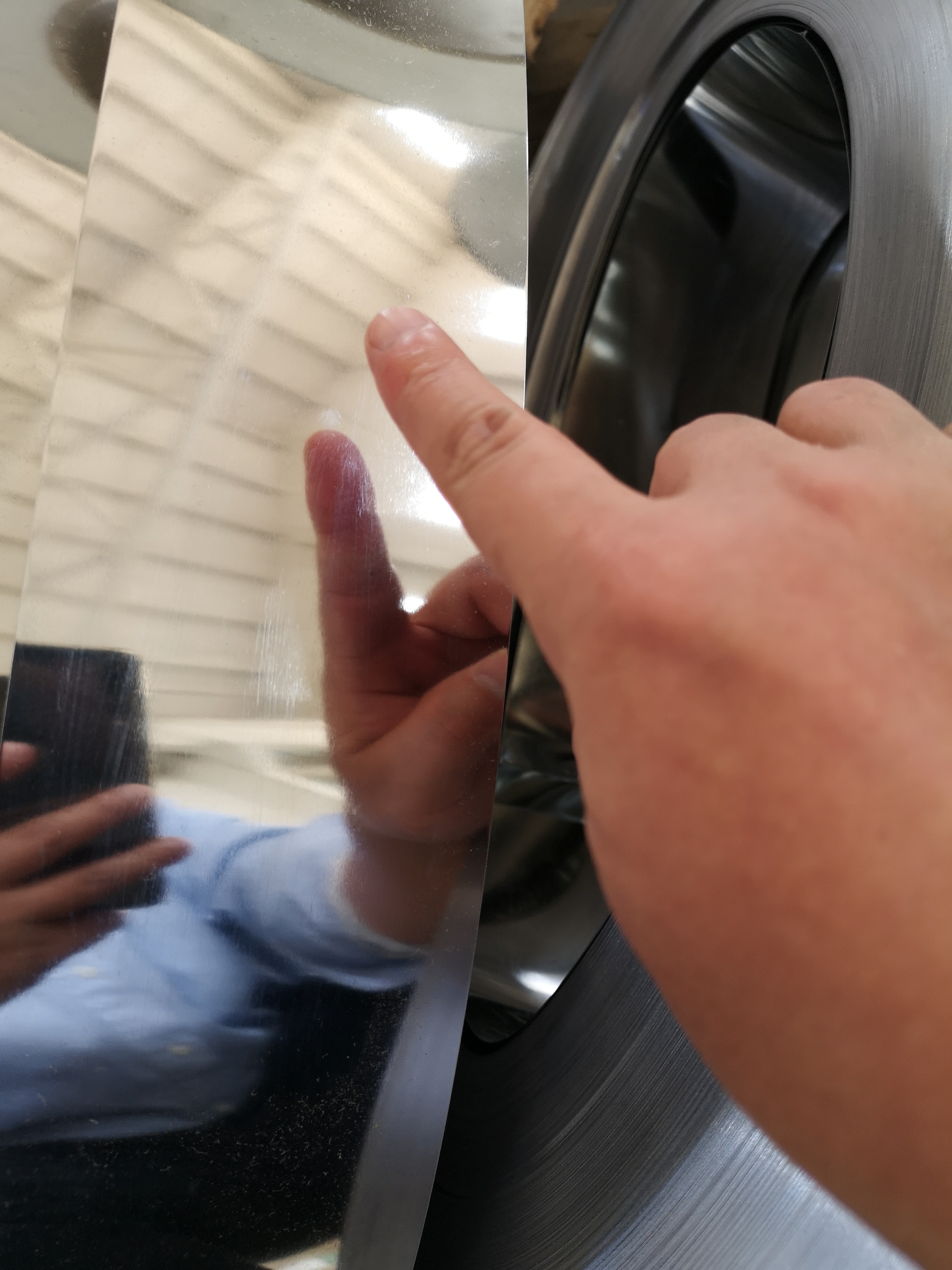
High-Reflectivity Mirror Finish Tinplate Strip
Positioned as a cost-effective substitute for SUS430 / SUS201 / SUS410.
- Base metal: prime electrolytic tinplate (ETP) or mirror finish galvanized steel
- Finish: mirror finish
- Thickness: 0.18 mm to 0.55 mm
- Width: 4 mm to 1000 mm
- Hardness / temper: T2.5, T3, T4, T5, DR8, DR9
- Width and burr tolerance: ±0.05 mm
- Coil inner diameter: 160 / 200 / 300 / 400 / 500 mm
- Coil control: 5-ZERO management — zero joints, zero notches, zero wavy edges, zero overlap ribbons, zero scratches
- Edge protection: slit edges sprayed with anti-rust oil for long marine transit and humid storage
The supplier's stated application boundary matters here: this grade is listed for interior hardware decoration, non-humid indoor metallic accents, and precision stamped components for dry environments. That boundary is discussed under limits below.
Anti-Fingerprint Mirror Bronze Tinplate — MF-BR-TPL01
- Base metal: premium ETP with functional eco-friendly polymer coating
- Thickness: 0.20 / 0.30 / 0.40 / 0.50 mm
- Width: 4.0 mm to 1050 mm
- Tin coating mass: 2.8 / 2.8 g/m²
- Temper: T2, T2.5, T52, T55, T57 (engineered for deep drawing and flexible stamping)
- Surface: high-fidelity mirror finish described as a high-reflectivity substitute for SUS201 / SUS410
- Functional coating: oleophobic anti-fingerprint (AF) nano-treatment, single or double side
- Colours: antique bronze, rich copper, polished brass, luxury golden, matte deep black, high-gloss bright black
- Compliance: 100% heavy-metal-free organic polymer coating, REACH and RoHS certified
Anti-Fingerprint Mirror Gold Tinplate — MFG-200
- Thickness: 0.20 mm – 0.50 mm; width 4.0 mm – 1050 mm
- Tin coating mass: 2.8 / 2.8 g/m²
- Temper: T2, T2.5, T52, T55, T57
- Surface: premium mirror finish with anti-fingerprint topcoat; single-side or double-side eco-friendly coating
- Colours: luxury brass, royal gold, matte black, bright black
- Compliance: RoHS and REACH certified, heavy-metal free
This product is explicitly listed as a SUS201 / SUS410 cost-saving alternative, which makes it the closest direct comparator to a stainless-steel specification.
Copper-Look Bronze Coated Strip — ECO-BRONZE-TP
- Positioned as a cost-saving alternative to copper-plated steel strip
- Thickness: 0.15, 0.20, 0.21, 0.22, 0.30 mm; width 4.0 mm – 1050 mm
- Hardness: HV120 – HV180, optimised for deep drawing and high-speed precision stamping
- Tin coating mass: 2.8 / 2.8 or 2.2 / 2.2 g/m² (differential or equal coating)
- Thermal stability: withstands 120 °C continuous heat for 5 hours with zero paint peeling and zero blistering
- Colours: bronze, copper, brass, golden (single-side or both sides)
- Compliance: REACH and RoHS heavy-metal compliance tested
Matte Anodized-Look Tinplate — Stainless Steel Alternative
- Thickness: 0.20 mm – 0.55 mm with ultra-precision tolerance ±0.005 mm
- Width: 4.0 mm – 1020 mm, width tolerance ±0.05 mm
- Temper: T2, T3, T4, T5, DR8; mechanical hardness HV 120 – 180
- Edge quality: anti-burr process, burr height ≤0.05 mm
- Surface: non-reflective, anti-glare coarse matte texture
- Colours: luxury bronze, brass, metallic golden, premium matte black, bright jet black
- Fabrication: high-elongation deep drawing, zero paint peeling during stamping and crimping
- Compliance: food grade, eco-friendly, REACH and RoHS compliant
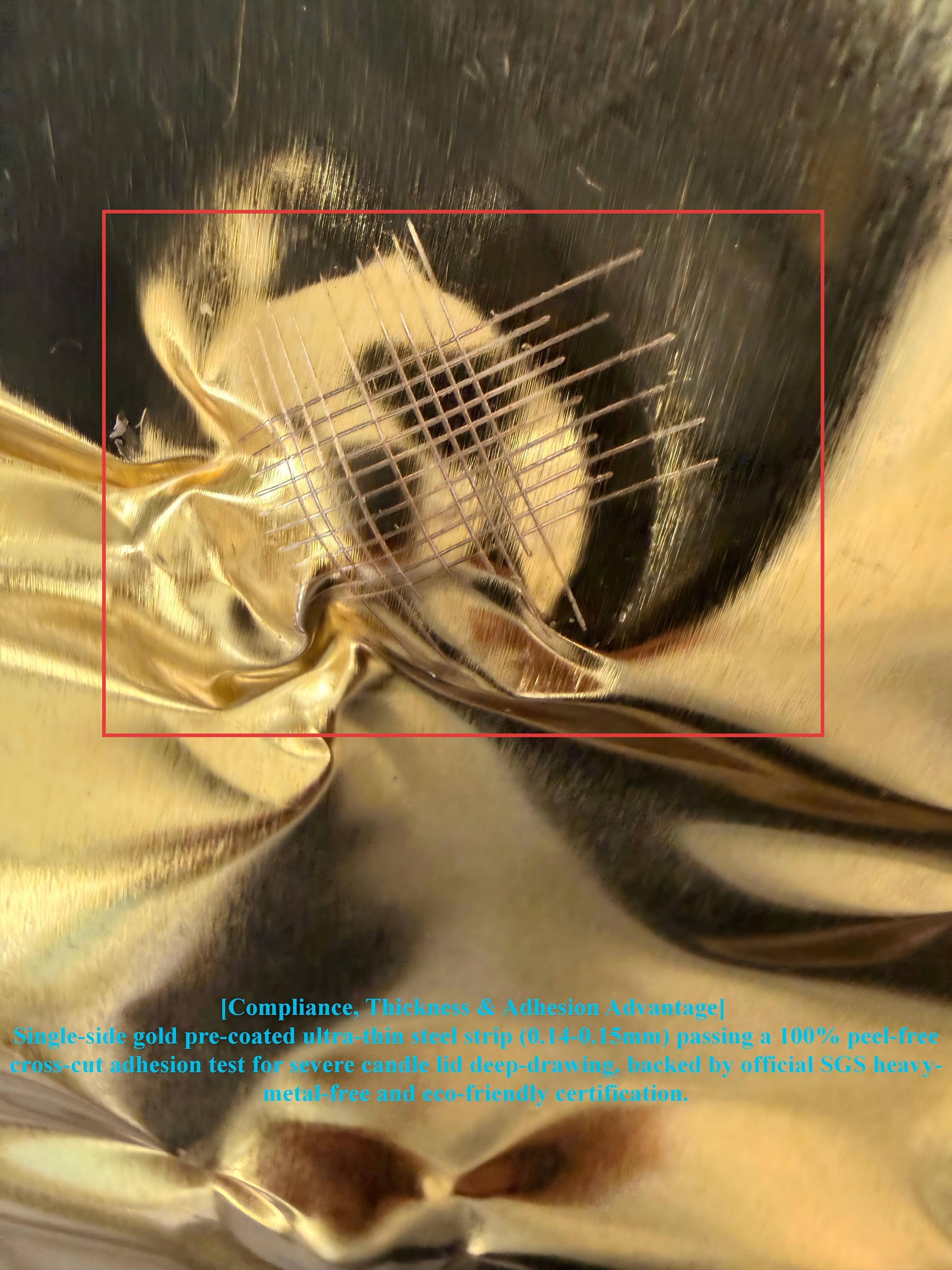
Ultra-Thin Gold Pre-Painted Tinplate Strip — GD-TPL-0.14-0.15
- Thickness: 0.14 mm – 0.15 mm (anti-peeling deep-drawing grade); width 4.0 mm – 1050 mm
- Temper: T1, DR7, DR7.5, DR8, DR9, DR10, TH520
- Tin coating mass: 1.1 / 1.1, 2.2 / 2.2, 2.8 / 2.8 g/m²
- Slitting burr ≤0.05 mm; coil ID 160 / 200 / 300 / 400 / 500 mm
- Coil defects control: zero joints, zero notches, zero wave edges, zero overlapping bands, zero rust spots
Compliance Documentation Buyers Can Actually Verify
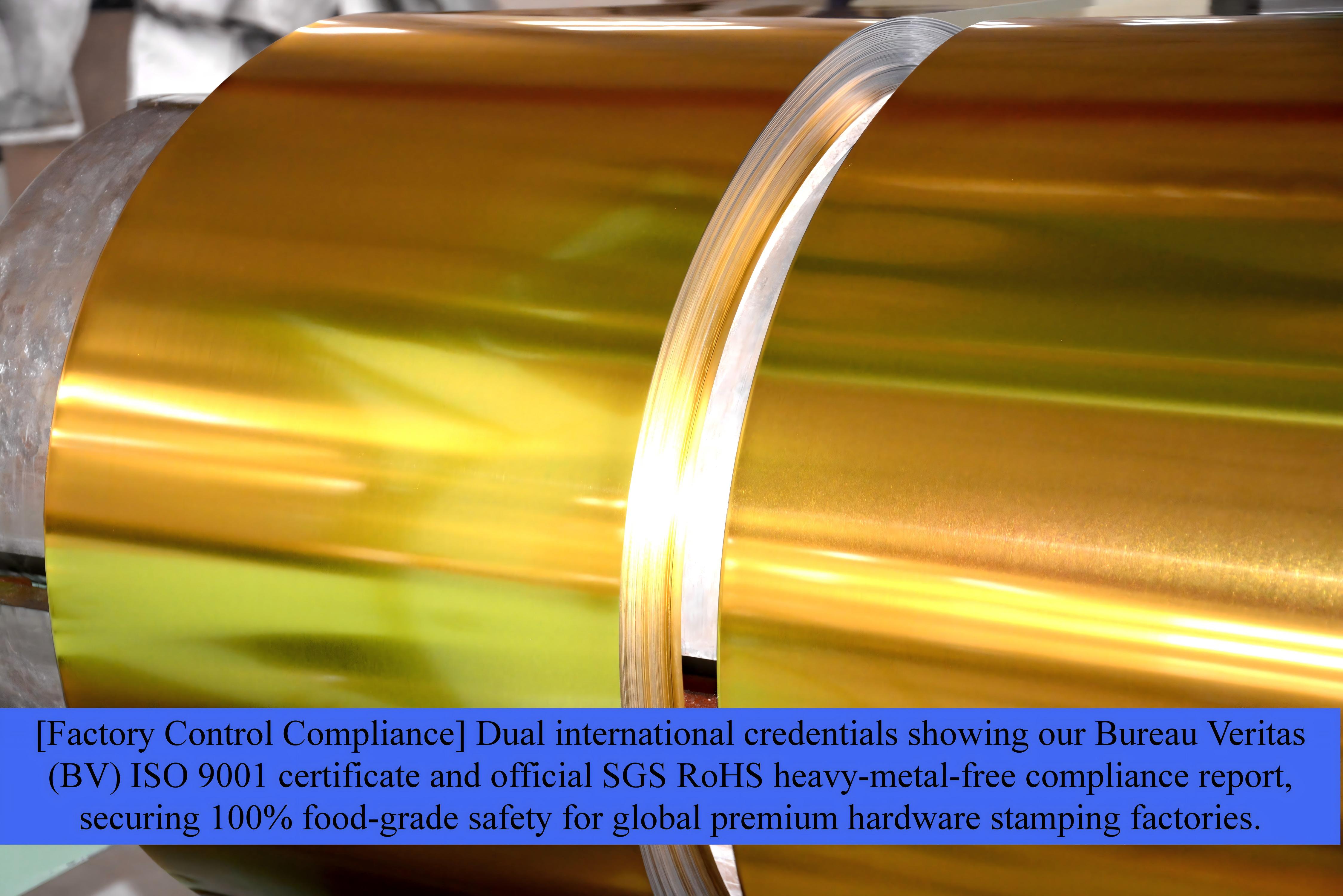
- BV ISO 9001:2015 — certificate CN058611, issued by Bureau Veritas on 2022-12-23, valid to 2028-12-22; scope covers mild steel, automotive steel and prepainted steel, referenced against ASQ/ANSI/ISO 9001:2015, EN ISO 9001:2015 and JIS Q 9001:2015.
- SGS RoHS test report CZXHL25001691201 — issued 2025-08-18 against Directive 2011/65/EU and (EU) 2015/863, using the IEC 62321 test series; the tested scope is copper colourful tinplate at 0.23 mm thickness, across EU, US, Asia, Middle East, Africa and South America markets.
- Coated product lines are listed as REACH and RoHS certified, heavy-metal free, and as food-grade where the coating system is intended for food-contact packaging.
- Batch-level documents: MTC EN 10204 3.1 is provided per shipment, and third-party inspection (SGS / BV / TÜV) is supported.
Head-to-Head: Where the Cost Saving Actually Comes From
The substitution does not eliminate a metal price. It changes which metal is paid for, and how much of it is paid for. Four mechanisms account for most of the delta against SUS201 / SUS410 or copper-plated steel.
- The alloy layer disappears from the full thickness. SUS201 adds nickel across the whole section; SUS410 adds chromium; copper-plated steel adds a copper layer to a steel core. In a coated tinplate strip, the appearance is carried by a functional coating measured in microns on an ETP substrate — the decorative performance is decoupled from the bulk metallurgy.
- Gauges start lower. Mirror finish strip is available from 0.18 mm and the gold pre-painted deep-drawing series runs at 0.14–0.15 mm, so material mass per part can be reduced where the drawing operation allows it. For reference, the wider ETP and TFS range spans 0.14 mm to 0.55 mm, with T1 quoted at 0.20–0.55 mm thickness and 6.5–1050 mm width.
- Continuous, zero-joint coils reduce press downtime. The cost of a stopped progressive die is often larger than the strip saving itself. Coil structures are supplied joint-free, camber-free and free of edge waves.
- Trial cost is low because minimum order quantities are small. Published MOQ figures across the product pages range from 1 ton for custom precision slitting to 2–3 tons depending on size, with purchasing terms quoted at 2 tons or as per sizes. A substitution can therefore be validated on production-representative tooling without committing to a full container.
On the coating-cost side, one adjacent product is worth noting for benchmarking discipline. Youngson Metal's eco-friendly golden colour-coated mirror finish galvanized steel strip (ECO-MIR-015G-TIN-ALT, 0.15 mm, tolerance ±1.01 mm) is listed with a cost efficiency of up to 20% lower total cost versus traditional tinplate. That is a supplier-reported figure for a specific galvanized product, not a general rule for coated tinplate — treat it as a reference point and validate it against your own coating, consumable and scrap costs.
Head-to-Head: Performance in High-Speed Stamping
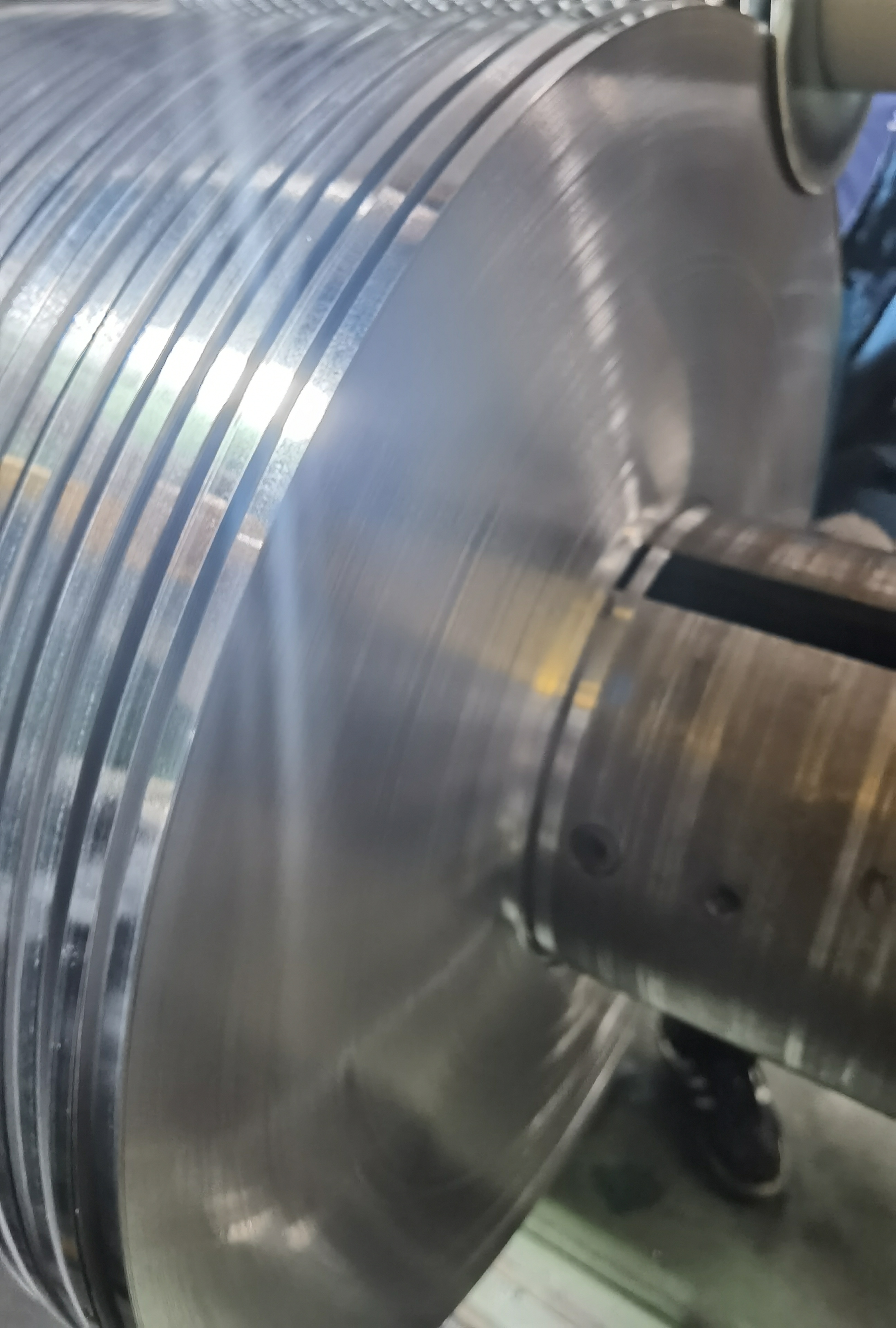
Dimensional tolerance is the entry ticket; coating adhesion under draw is the pass/fail test. Published tolerances for the precision slitting line are thickness ±0.005 mm, width ±0.05 mm and slitting burr ≤0.05 mm, with slit strips produced at widths from 4.0 mm to 1050 mm.
Two documented production cases show what those numbers do on a press.
- Automated high-speed hardware stamping plant and metal packaging can-maker (supply of 6,000+ tons annually of precision slit strips and multi-colour coated coils, 3+ years of partnership): the project achieved zero-defect continuous stamping with 0% coating delamination or foil-bursting during deep drawing, and prolonged progressive die tool lifespan by 35% on the back of sub-micron thickness tolerance and burr-free edges. Applications included electronics shielding enclosures, precision miniature shell deep drawing, and severe mechanical drawing and flanging for non-round fish cans.
- High-speed automated premium candle lid plant (500–1,000 tons per month, 10+ years of stable supply, single-side gold candle lids): 0% gold lacquer cracking or peeling under deep-drawn stretch; 100% joint-free coils completely eliminated progressive die jamming; the combination of ±0.005 mm thickness tolerance and ≤0.05 mm burrs cut tool wear by 35%; and edge-oil spraying passivation delivered 0% oxidation during humid shipping and storage.
Three performance variables separate a successful substitution from a rejected lot:
- Joint control. A single weld joint in a coil stops an automated progressive die. The 5-ZERO coil standard — zero joints, zero notches, zero wavy edges, zero overlap ribbons, and zero rust spots or scratches depending on grade — exists for that reason.
- Burr control. Burrs above the ≤0.05 mm limit accelerate die wear and create coating pickup at the die shoulder.
- Coating adhesion under elongation. This is the parameter that ends most colour-coated substitutions. It is tested with a cross-cut adhesion check on the finished coating, and the deep-drawing gold series is supplied in an anti-peeling grade specifically for this risk.
Head-to-Head: Anti-Fingerprint Benefits
Anti-fingerprint treatment is easy to dismiss as a cosmetic extra, and it is usually the second-largest hidden cost in a mirror-finish substitution.
Mirror finish strip is supplied with an oleophobic anti-fingerprint (AF) nano-treatment, applied single-sided or double-sided. Because the treatment repels oils, parts that pass through automated feeding, transfer and assembly carry fewer visible handling marks, which reduces manual wiping, inspection rejects and re-polished scrap between the press and final assembly.
The practical difference versus standard bright tinplate is measurable in the process, not only in the finished appearance:
- Standard bright tinplate on a mirror-critical part typically requires gloves, interleaving or a post-press cleaning step.
- AF-treated mirror tinplate accepts normal automated handling without the same level of manual intervention.
- Anti-fingerprint is available on the bronze and gold mirror series, on the colour-coated series generally, and on single or both sides depending on grade.
Documented limit: the published specifications describe fingerprint resistance and coating adhesion. They do not claim abrasion resistance, so parts that rub against one another in bulk transit may still require interleaving. Treat the AF layer as a handling-mark control, not as a protective hard coat.
Where the Substitution Does Not Apply
A credible cost analysis has to state its own boundaries, because the fastest way to lose the saving is to apply it in the wrong environment.
- Humid, chemical or salt-spray service. The mirror finish strip is specified for interior hardware decoration, non-humid indoor metallic accents and precision stamped components in dry environments. For outdoor, marine or chemically exposed parts, the corrosion question must be validated by test rather than assumed from appearance.
- Retorted food contact. For sterilised food cans the correct route is not decorative mirror strip but food-grade lacquered TFS — for example the BPA-free internal sulfur-resistant aluminium paste coated TFS for 2-piece DRD fish cans, supplied at 0.14–0.16 mm, DR8/DR9/DR10, with 8–12 g/m² internal coating weight and retort resistance at 121 °C for 60 to 90 minutes.
- Hardness ceiling. Within the 0.18–0.55 mm mirror range, hardness tops out around DR8/DR9. Where a part relies on the specific stiffness of a stainless alloy, the substitute has to be proven on the press, not on paper.
- Food-contact scope. The SGS RoHS report covers a specific tested product scope (copper colourful tinplate, 0.23 mm). Product-specific reports should be requested for each grade and destination market.
Step-by-Step Breakdown: How to Run a Substitution Evaluation
The following eight steps turn the comparison above into a decision. Each one closes a specific risk that a purchase order cannot fix later.
- Define the service environment first. Indoor, dry and decorative → proceed with a coated strip. Humid, outdoor, chemical or retorted → stop and select a different route.
- Separate appearance from metallurgy. Write down the required visual: mirror gold, mirror bronze, copper-look, matte anodized-look, bright black or laser effect. Each maps to a different product line and a different temper range.
- Lock the gauge band. Start from the thinnest gauge your forming operation tolerates. Available bands include 0.14–0.15 mm (ultra-thin gold deep drawing), 0.15–0.30 mm (copper-look bronze), 0.18–0.55 mm (mirror finish strip) and 0.20–0.55 mm (matte anodized-look).
- Select temper against the forming operation, not against the part photo. Soft T1/T2 suits complex bending; T2.5–T5 covers general stamping; DR7–DR10 covers thin-gauge, high-strength parts. For reference, EN 10202 places T1 at HR30T 49–53 and ASTM A623 places T1 at HR30T 50–54 as reported by the supplier — confirm against the mill certificate for your lot.
- Verify edge condition. Require ≤0.05 mm burr and confirm slit-edge anti-rust oiling if the coil will travel by sea or sit in humid storage.
- Confirm coil architecture. Zero joints, no overlaps, no wavy edges, and matched coil weight and diameter per batch if you feed an automated line. Inner diameters are available at 160, 200, 300, 400 and 500 mm.
- Test coating adhesion at your draw ratio. Do this with the actual tooling and the actual lubricant. This is the single test that predicts whether a colour-coated substitution will hold.
- Collect the compliance pack before the PO. Ask for the ISO 9001 certificate, the product-specific SGS RoHS/REACH report, the MTC EN 10204 3.1, and — for EU-bound volumes — EPD and CFP carbon footprint documentation, which is available as part of the low-carbon, EU CBAM-compliant supply service.
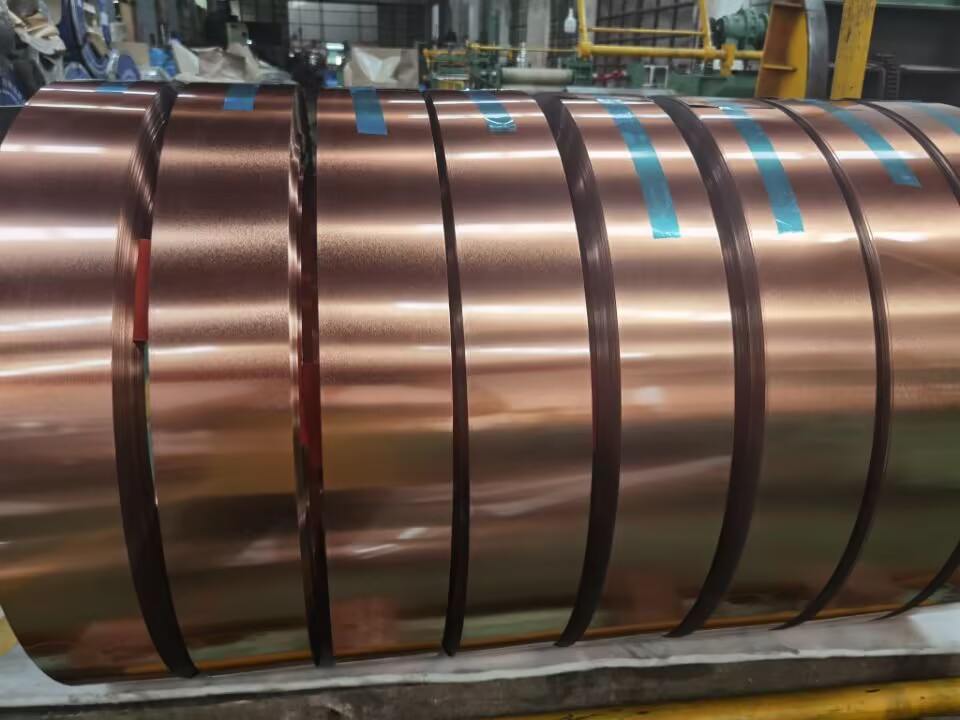
Use Cases: Where Coated Tinplate Replaces Stainless or Copper
Luxury and premium packaging
High-end gift boxes, premium cosmetics and tea tins, confectionery tins, scented candle tins, and luxury liquor and tea containers. The mirror finish strip is listed for luxury packaging, and the copper-look bronze series is used for candle tins, cosmetics cases and retro metal handicrafts.
Consumer electronics and appliances
EMI shielding cans, internal liners, reflector sheets, backlight components, smart appliance fascias, chassis parts and acoustic grilles. The matte anodized-look grade is used for 3C component and shielding applications and smart home hardware.
Architectural, furniture and interior trim
Decorative wall paneling, high-end elevator interiors, non-humid indoor metallic accents, furniture handles and edge-banding strips. This is the segment where the stainless look matters most and where the corrosion duty cycle is lightest — and therefore where the substitution case is strongest.
Stationery and promotional hardware
Upscale stationery components, heavy-duty lever-arch file mechanisms, luxury binders, metal toys and promotional gifts. A dedicated ultra-narrow grade runs at 0.20 mm thickness with 6.5 mm and 7.0 mm slit widths and ±0.03 mm width tolerance for file mechanisms.
Decorative lighting
High-reflectivity reflector cups, luxury lampshades and artistic lamp bases.
Candle lids and deep-drawn closures
Single-side gold candle lids drawn on automated progressive dies — the documented case referenced above, supplied continuously at 500–1,000 tons per month for more than ten years.
Food and seafood cans
Where the surface is food-contact and retorted, the portfolio shifts to lacquered and coated systems: milky white coated tinplate sheets for meat cans, sulfur-resistant lacquer for fish cans, and BPA-free aluminium paste coated TFS for 2-piece DRD tuna and sardine cans. The decorative mirror series and the food-can series run under the same BV ISO 9001:2015 quality system and SGS RoHS / food-grade testing.
Comparison Table: Coated Tinplate Options Against Standard Tinplate
The table below compares the substitution grades against standard bright tinplate on the parameters buyers actually specify. All values are as published in the product data.
| Parameter | Standard Bright Tinplate (ETP) | High-Reflectivity Mirror Finish Tinplate | Anti-Fingerprint Mirror Bronze / Gold | Copper-Look Bronze Coated Strip | Matte Anodized-Look Tinplate |
|---|---|---|---|---|---|
| Surface character | Bright (uncoated) or stone finish; no decorative colour | Specular mirror finish, high reflectivity | High-fidelity mirror finish + oleophobic anti-fingerprint nano-treatment | Bronze / copper / brass / golden decorative coating | Non-reflective anti-glare coarse matte texture |
| Thickness range | 0.14–0.55 mm (T1 quoted 0.20–0.55 mm) | 0.18–0.55 mm | 0.20–0.50 mm | 0.15 / 0.20 / 0.21 / 0.22 / 0.30 mm | 0.20–0.55 mm |
| Width range | 4.0–1050 mm | 4–1000 mm | 4.0–1050 mm | 4.0–1050 mm | 4.0–1020 mm |
| Temper / hardness | T1–T5; DR7–DR10 | T2.5, T3, T4, T5, DR8, DR9 | T2, T2.5, T52, T55, T57 | HV120–HV180 | T2, T3, T4, T5, DR8; HV120–180 |
| Tin coating mass | 1.1/1.1, 2.2/2.2, 2.8/2.8 g/m² | Not specified in published data | 2.8/2.8 g/m² | 2.8/2.8 or 2.2/2.2 g/m² | Not specified in published data |
| Tolerance / burr | Thickness ±0.005 mm; width ±0.05 mm; burr ≤0.05 mm | Width and burr ±0.05 mm | Width 4.0–1050 mm (custom slitting) | Custom slitting available | Thickness ±0.005 mm; width ±0.05 mm; burr ≤0.05 mm |
| Anti-fingerprint | Not applicable | Not specified in published data | Yes — single or double side | Not specified in published data | Not specified in published data |
| Compliance | BV ISO 9001:2015; SGS REACH & RoHS on certified grades | BV ISO 9001:2015 | REACH & RoHS certified, heavy-metal free | REACH & RoHS heavy-metal tested | Food grade, eco-friendly, REACH & RoHS compliant |
| Stated substitution role | Baseline substrate; decorative appearance must come from lithography or a separate coating step | Cost-effective SUS430 / SUS201 / SUS410 alternative | SUS201 / SUS410 cost-saving alternative with mirror aesthetics | Cost-saving alternative to copper-plated steel strip | Anodized-look stainless steel alternative |
| Stated application boundary | General packaging, hardware, forming applications | Interior trim; non-humid indoor accents; precision stamped parts in dry environments | Interior architecture, electronics housings, stationery, lighting, luxury packaging and craft | Electronics hardware, gaskets, premium packaging, furniture hardware | 3C components and shielding, smart home hardware, gift and stationery, cosmetic and candle packaging |
FAQ
Are mirror finish and colour-coated tinplate strips RoHS and REACH compliant?
Yes. Youngson Metal holds SGS RoHS test report CZXHL25001691201, issued 2025-08-18 against Directive 2011/65/EU and (EU) 2015/863 using the IEC 62321 test series, with a tested scope of copper colourful tinplate at 0.23 mm thickness. The coating system is declared 100% heavy-metal free and REACH and RoHS compliant across the eco-friendly coated product lines. Because the report covers a specific tested product scope and thickness, buyers should request a product-specific report for each grade and destination market before releasing a purchase order.
Can mirror finish tinplate genuinely replace SUS201, SUS410 or copper-plated steel?
For decorative, indoor and non-humid applications, yes — the mirror finish strip is positioned in the supplier's own product data as a cost-effective SUS430 / SUS201 / SUS410 alternative, and the copper-look bronze coated strip as a cost-saving alternative to copper-plated steel strip. The substitution is bounded by service environment and hardness: the published application scope for mirror finish strip is interior hardware decoration, non-humid indoor metallic accents and precision stamped components in dry environments, and the mirror range covers hardness from T2.5 up to DR9 within 0.18–0.55 mm. Parts that face humidity, salt spray or chemical exposure, or that depend on alloy-level stiffness, must be validated by press trial and corrosion test rather than assumed equivalent.
Can an OEM tinplate manufacturer supply coated grades for meat cans as well as decorative strip?
Yes. Alongside the decorative mirror, bronze and gold series, the same manufacturer supplies milky white coated tinplate sheet specifically for meat cans and sulfur-resistant lacquer for fish cans, produced under the same BV ISO 9001:2015 quality system and SGS RoHS / food-grade testing. Customisation is offered through OEM and ODM services covering material grade, thickness, width, finish, coating colour and hardness tuning from T1 through DR10, with joint R&D available for new functional coatings, followed by precision slitting or sheet shearing. Dedicated food-can grades include BPA-free sulfur-resistant aluminium paste coated TFS for 2-piece DRD fish cans at 0.14–0.16 mm with retort resistance at 121 °C for 60–90 minutes.
What drives the cost difference, and what is the minimum order quantity for a trial?
The saving comes from replacing an alloy layer that runs through the full section with a micron-scale functional coating on an ETP substrate, plus thinner starting gauges (from 0.18 mm for mirror finish strip, and 0.14–0.15 mm in the ultra-thin gold deep-drawing series) and reduced press downtime from zero-joint coils. As a reference point, the adjacent eco-friendly mirror finish galvanized strip (ECO-MIR-015G-TIN-ALT) is listed with a cost efficiency of up to 20% lower total cost versus traditional tinplate — a supplier-reported figure for that specific product, to be validated against your own coating, consumable and scrap costs. Published MOQ figures range from 1 ton for custom precision slitting to 2–3 tons depending on size, with purchasing terms quoted at 2 tons or as per sizes; delivery terms are FOB, CFR, CIF, DDP or DDU, and payment terms are T/T or L/C at sight.
Can I obtain samples, and what lead time should I plan for?
Yes — complimentary sample rolls or sheets are offered for industrial press trialing on the deep-drawing product lines, which is the recommended way to validate coating adhesion, burr behaviour and die compatibility before committing volume. Published lead times are 14–25 days or as per specification on the boutique precision slitting line, and 5–30 days as per sizes on the wider processing service. Monthly capacity is quoted at 500–1,000 tons per month on the precision slitting line and approximately 1,200 tons on the broader processing service. New supplier qualification typically begins with an inquiry, a specification review and a sample trial; you can start that process through the Youngson Metal website or by requesting the catalogue below.
Conclusion: The Substitution Decision in One Paragraph
Standard bright tinplate and mirror finish tinplate are not interchangeable, and neither is a blanket replacement for stainless steel. Standard tinplate is the right answer when the part needs formability, food-contact capability and corrosion resistance, and the decorative surface will come from lithography or a separate coating step. Coated tinplate strip — mirror finish, anti-fingerprint bronze or gold, copper-look bronze, or matte anodized-look — is the right answer when the part primarily needs to look like stainless steel, copper or anodized metal, and is used indoors in a dry environment. In that second case the cost saving is real and comes from the coating system replacing a full-section alloy, from thinner gauges, and from zero-joint coils that keep a progressive die running.
The discipline that protects the saving is verification, not negotiation: confirm the service environment, prove coating adhesion at your draw ratio with a sample trial, require MTC EN 10204 3.1 and product-specific SGS reports, and hold the burr and tolerance limits at ≤0.05 mm and ±0.005 mm in the purchase specification.

Next step: run the trial before the order.
Youngson Metal supplies mirror finish, anti-fingerprint, copper-look and matte coated tinplate strip in slit widths from 4.0 mm to 1050 mm, with thickness tolerance ±0.005 mm, width tolerance ±0.05 mm and burr ≤0.05 mm, under BV ISO 9001:2015 (CN058611) and SGS RoHS / REACH certified coating systems.
Request a sample coil for press trialing, a quotation against your gauge and width, or download the full product catalogue: Youngson Metal product catalogue (PDF).
Chongqing Youngson Metal Products Co., Ltd.
NO.16-16, Building 11, NO.305 Yunan Avenue, Longzhouwan Street, Ba'nan District, Chongqing, China 401320
Tel: 0086-23-62566629 | WhatsApp: 0086-13594107385 | Email: info@youngsonmetal.com
Website: www.youngsonmetal.com
Have Questions or Need More Details?
Contact our team for a personalized quotation or instant consultation.
Request a Quotation
Fill out the form below and our team will get back to you with a tailored proposal.
WhatsApp Direct Chat
Prefer to chat in real-time? Message us on WhatsApp for instant assistance & quick answers.
- Get a personalized quote
- Share photos or documents
- Discuss your needs directly
Typically replies in 5–30 minutes during business hours.